

Your agency delivers good work. It just does not deliver it the same way twice. One project runs cleanly, the next slips three weeks, and the difference is usually whether you were involved.
Across every agency engagement I have run, the same pattern repeats. It is not a talent problem. It is structural: the operating system lives in the founder's head, and heads do not scale.
This article is for agency founders running teams of 5 to 30 people. By the end you will know whether to build this yourself this quarter or bring in help, and what the full 12-week sequence involves.
Key takeaways
- An agency operating system is the documented set of processes, roles, capacity numbers and meeting rhythms that lets delivery run without the founder in every job.
- A workable version one has 5 components, not 50 documents.
- Most agencies under 10 people should build this themselves. Paying for help at that size is usually premature.
- Built internally, expect 40–60 founder hours over 8–12 weeks.
- Operational inefficiency erodes roughly 15–30% of potential agency profit, on my own estimate from client work. That is the number to weigh the build against.
What is an agency operating system?
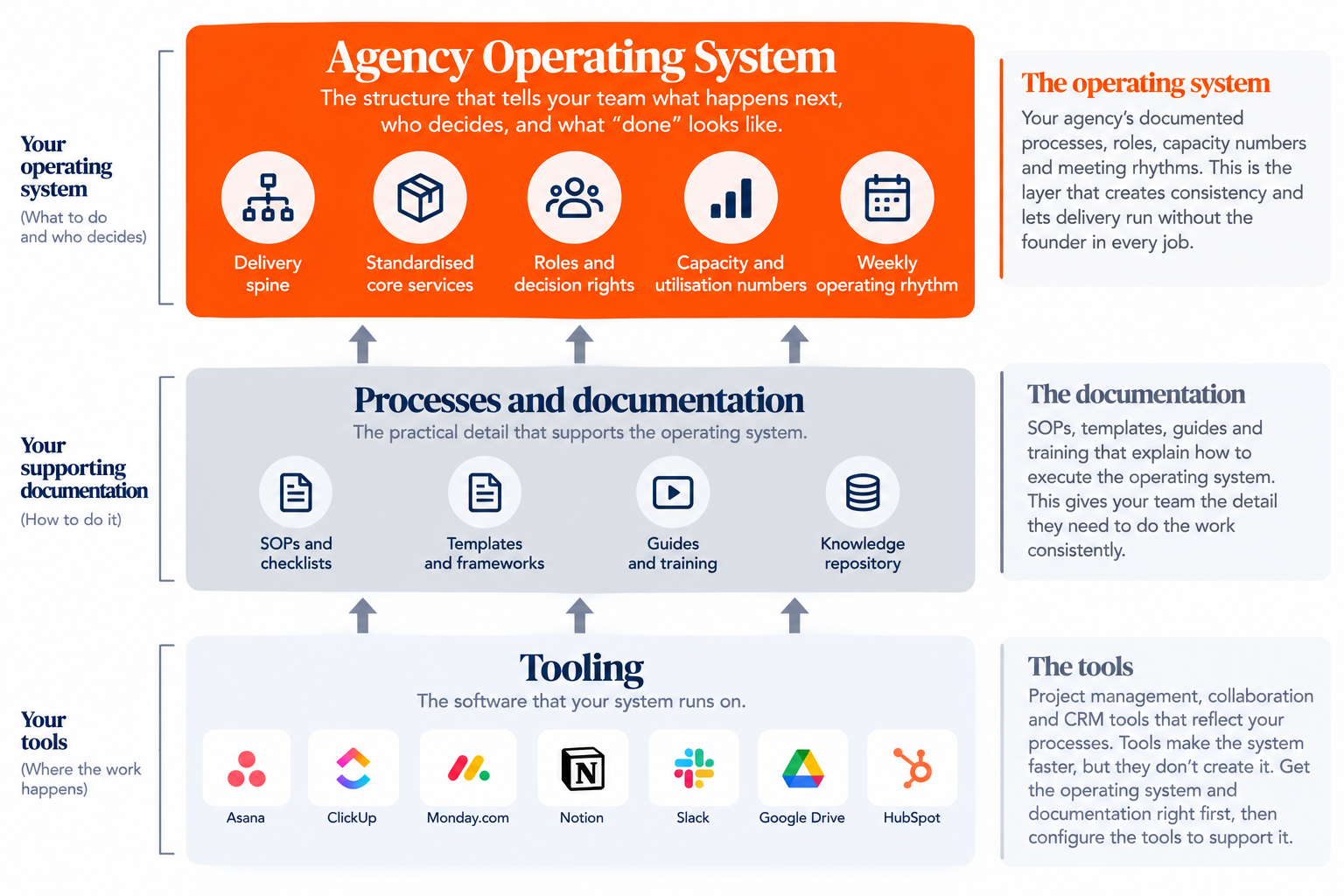
An agency operating system is the documented set of core processes, role definitions, capacity numbers and meeting rhythms that lets your agency deliver the same quality of work regardless of who is doing it.
It is not project management software, nor a folder of SOPs nobody opens. It is the layer that tells your team what happens next, who decides, and what "done" looks like.
| What people assume it is | What it actually is |
|---|---|
| A tool like Asana or ClickUp | A set of agreements the tool then reflects |
| A library of written procedures | A short spine of decisions, roles and numbers |
| A one-off documentation project | A living structure reviewed on a fixed schedule |
| Something you build at 50 people | Something you build at 8 and refine after |
Why do most agencies never build one?
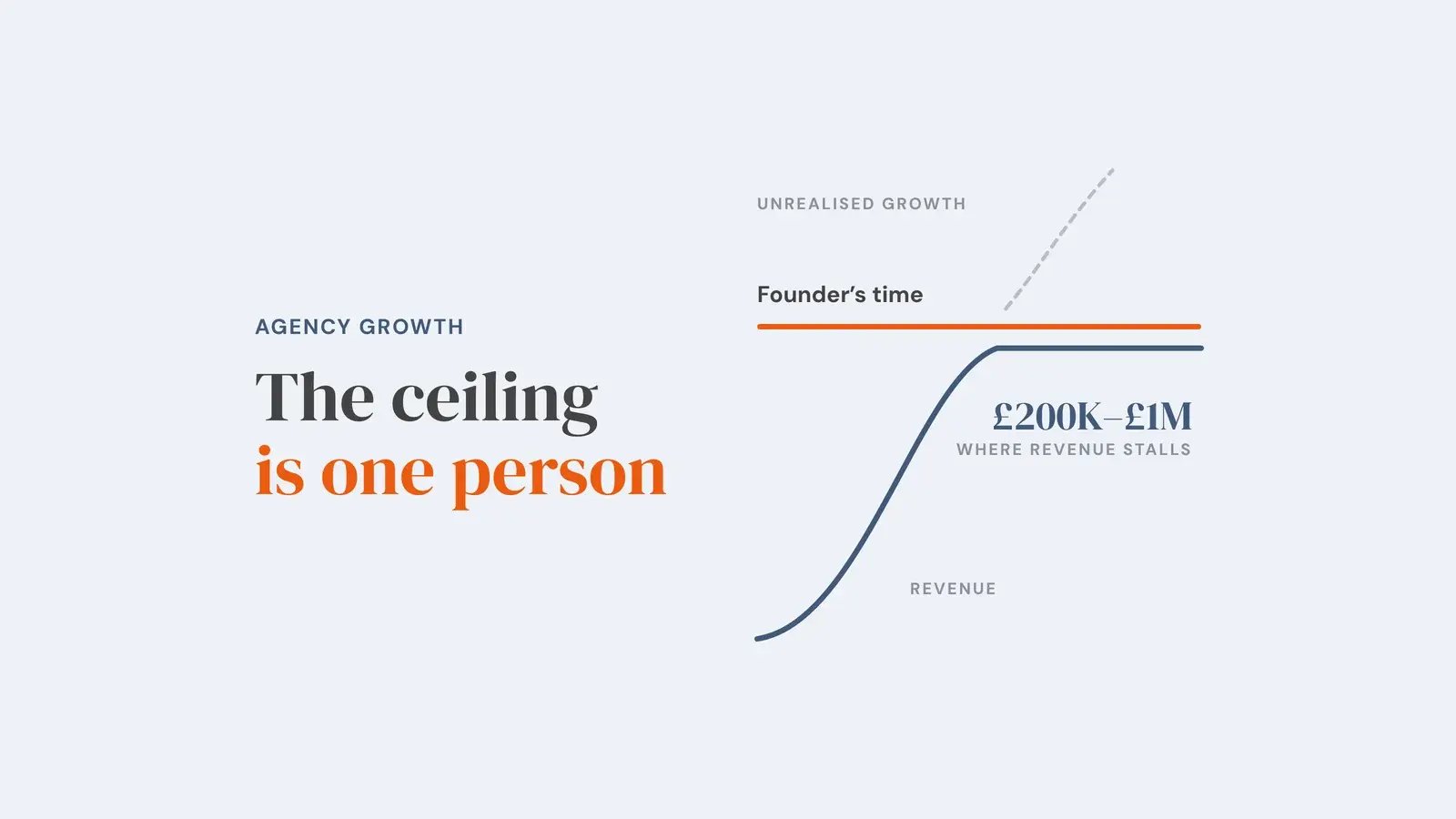
Most agencies never build an operating system because the founder is the operating system, and in my experience that holds until roughly £40,000–£80,000 ($5,000–$10,000) of monthly revenue.
That range is my observation, not a published benchmark. Below it you absorb every gap personally. Above it, the gaps surface as missed deadlines, inconsistent output, and clients who quietly stop renewing.
The trigger is rarely a crisis. It is usually the quarter where revenue climbs and your take-home does not.
Related Reading: Why Agency Growth Stalls at Founder Capacity (Even With a Team)
What does a simple agency operating system include?
A simple agency operating system has 5 components: a delivery spine, standardised core services, defined roles and decision rights, capacity and utilisation numbers, and a weekly operating rhythm.
- Delivery spine: The 6–10 stages every client project passes through, won to closed, on one page.
- Standardised core services: Your top 3 services defined by scope, inclusions, exclusions and price logic.
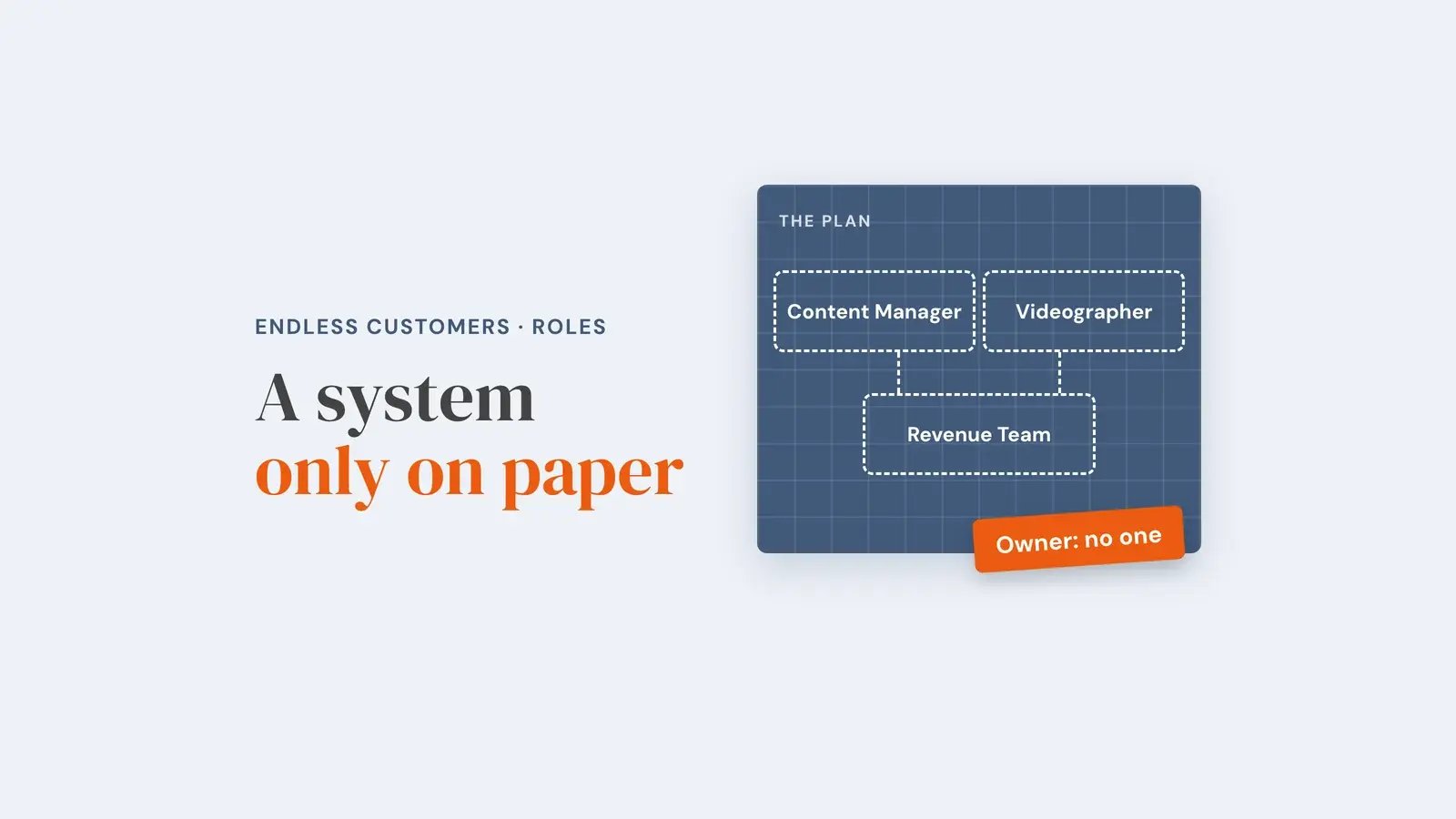
- Roles and decision rights: Who owns each stage, and which decisions never reach you.
- Capacity and utilisation numbers: Billable hours available per person per week, how much is sold, and the utilisation target you are holding people to.
- Weekly operating rhythm: One delivery meeting, one commercial meeting, both with a fixed agenda.
Anything beyond those 5 is refinement, and refining a system you have not yet built is how founders lose six months. Version one leaves out career frameworks, task-level SOPs and new software.
Software is the last decision, not the first. A tool configured around undefined processes only makes the confusion faster.
How much does it cost to build an agency operating system from scratch?
Building an agency operating system internally costs time rather than cash: 40–60 founder hours over 8–12 weeks. Paid routes run from around £500 ($640) for an off-the-shelf framework to £5,000–£9,000 ($6,500–$11,500) for full external installation.
| Approach | Cash cost | Founder time | Typical timeline | Honest risk |
|---|---|---|---|---|
| Build it internally | £0 | 40–60 hours | 8–12 weeks | Stalls the first time client work spikes |
| Off-the-shelf framework (EOS, Traction and similar) | £0–£500 (approx. $0–$640) for books and templates | 40–60 hours | 8–16 weeks | Generic to business, not built for agency delivery or utilisation |
| Hire an internal operations manager | £45,000–£65,000 (approx. $58,000–$83,000) per year | 60–100 hours to hire, onboard and direct | 3–6 months to effect | You are buying a person, not yet a system |
| My systems audit, then self-implement | From £2,500 (approx. $3,200) | 20–30 hours | 3 weeks to roadmap | The roadmap never gets actioned |
| My full systems implementation | £5,000–£9,000 (approx. $6,400–$11,500) | 10–15 hours | 8–12 weeks | Systems get installed but the founder never changes their own behaviour, so decisions keep routing back to them |
The last two rows are my own engagements at my published prices, listed so you can weigh them against the options I do not sell. Time estimates come from client work, not published benchmarks. Full figures sit on the Agency Services Pricing page.
Operational inefficiency erodes roughly 15–30% of potential agency profit. That is my own estimate, from measuring rework, unbilled scope and idle capacity before and after installation. For a £1m agency, typically 10 to 15 people, that is £150,000–£300,000 ($195,000–$385,000) a year.
How do you build one, step by step?
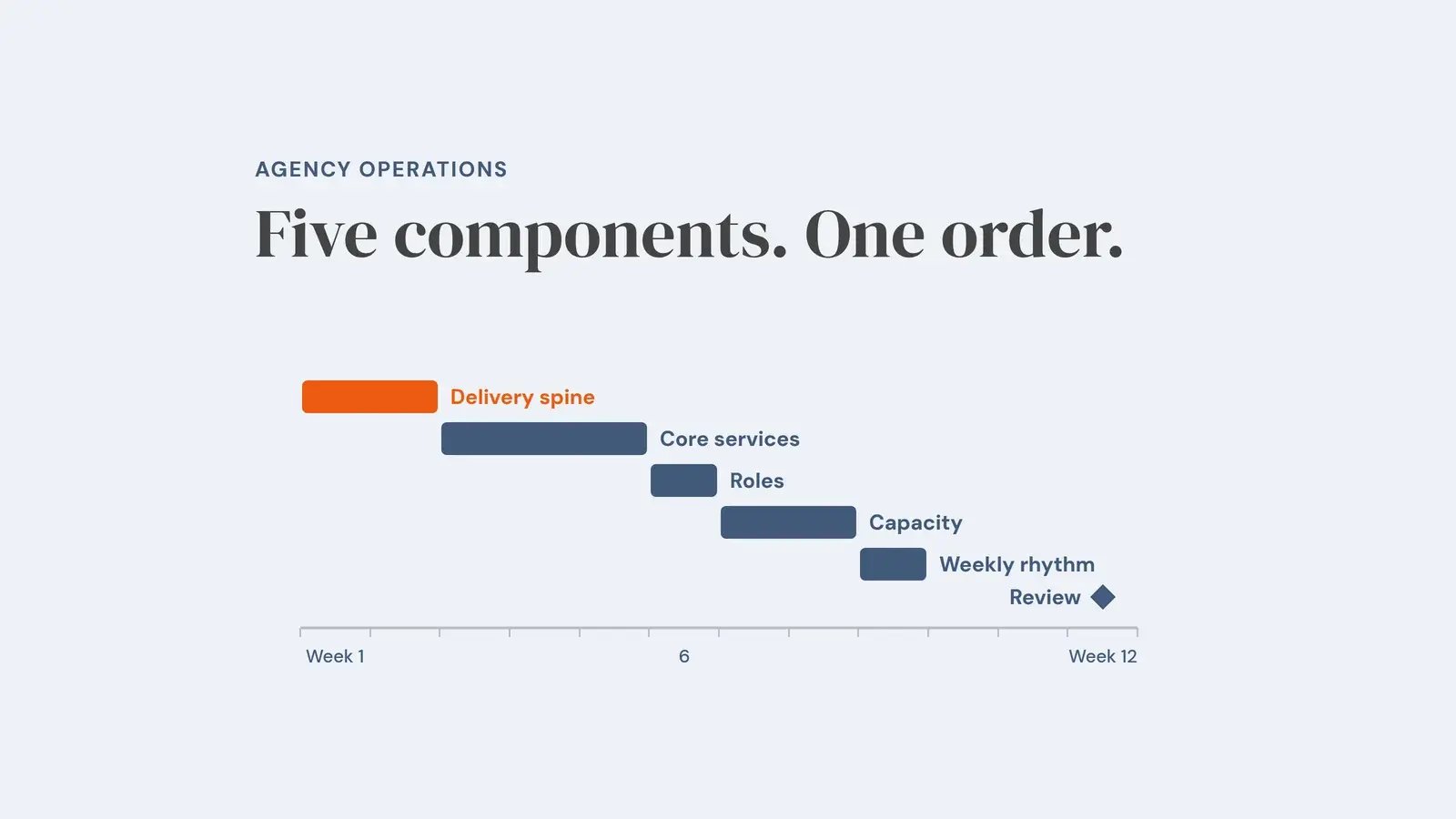
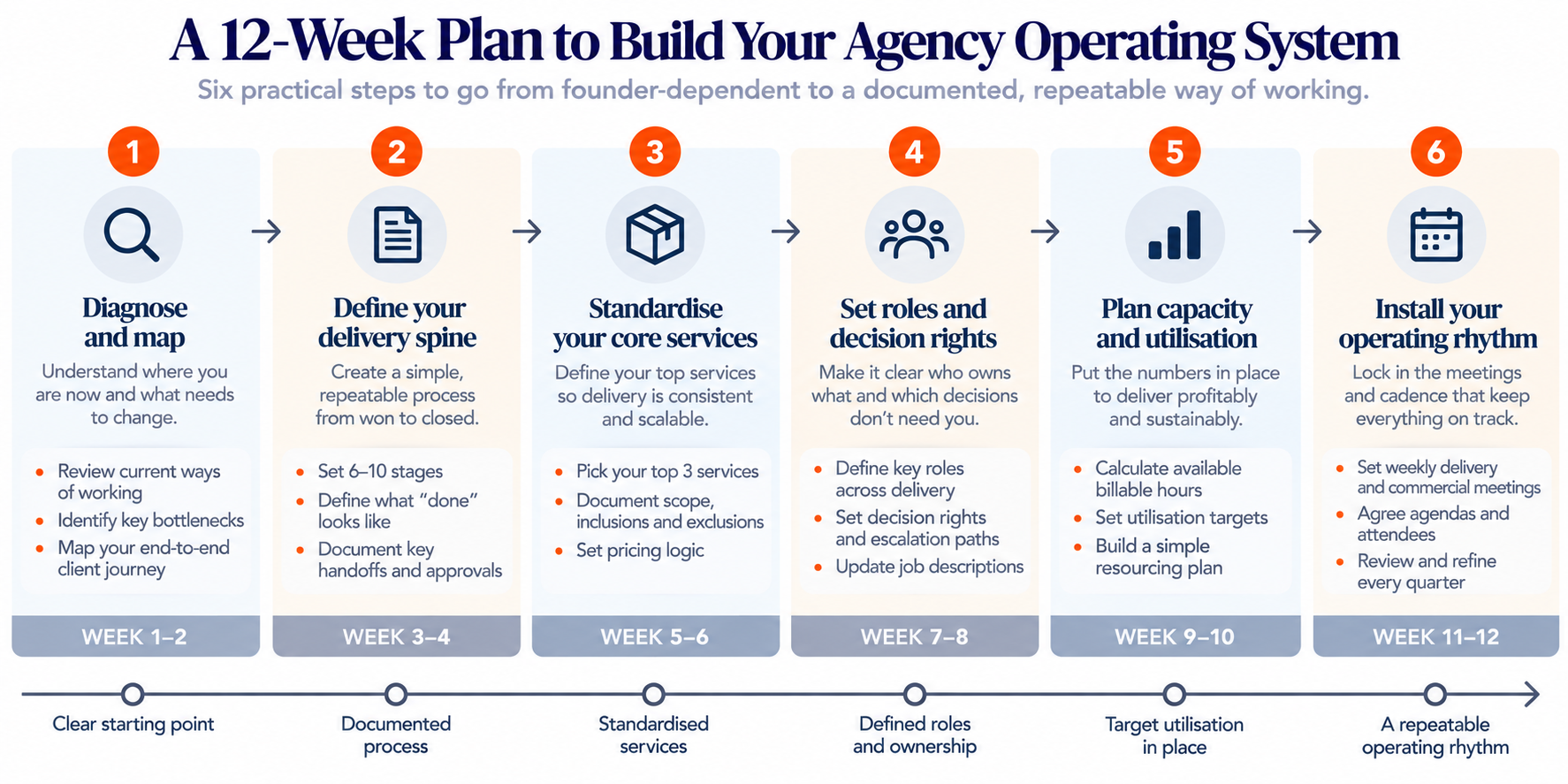
Build your agency operating system in 6 steps, in this order: map the delivery spine, standardise your top 3 services, define roles and decision rights, set capacity numbers, install a weekly rhythm, then review.
- Map the delivery spine (week 1–2): Whiteboard how work moves today, not how it should. One page.
- Standardise your top 3 services (week 3–5): Scope, inclusions, exclusions, price logic. Anything outside it is a variation, not goodwill.
- Define roles and decision rights (week 6): Name an owner per stage. List the decisions that must stop reaching you.
- Set capacity numbers (week 7–8): Hours available, hours sold, utilisation target.
- Install the weekly rhythm (week 9): Two fixed meetings, fixed agendas, same time weekly.
- Review (week 12): What broke, what got ignored, what needs a decision.
The order matters more than the polish. Agencies that document SOPs before mapping the spine end up with 50 documents describing a process nobody agreed on.
What does a well-built agency operating system look like?
The best agency operating systems share 4 traits: short enough to read in an hour, owned by someone other than the founder, tied to numbers rather than opinions, and reviewed on a fixed schedule.
In my engagements, agencies hitting all four have got the founder out of day-to-day delivery within two quarters. Treat that as a tendency I have observed, not a guarantee. It is the standard the Agency Operating System™ is built to, across its three stages: systemise, standardise, scale.
What goes wrong when agencies build this alone?
The 4 failure modes are over-documenting, building around your current team instead of the role, skipping capacity numbers, and having no owner once you step back.
| Failure mode | What it looks like | The fix |
|---|---|---|
| Over-documenting | 50 pages, zero adoption | One page per stage, maximum |
| Built around people | System breaks when someone leaves | Define the role, then assign the person |
| No capacity numbers | Profit is a surprise every month | Set utilisation targets in week 7 |
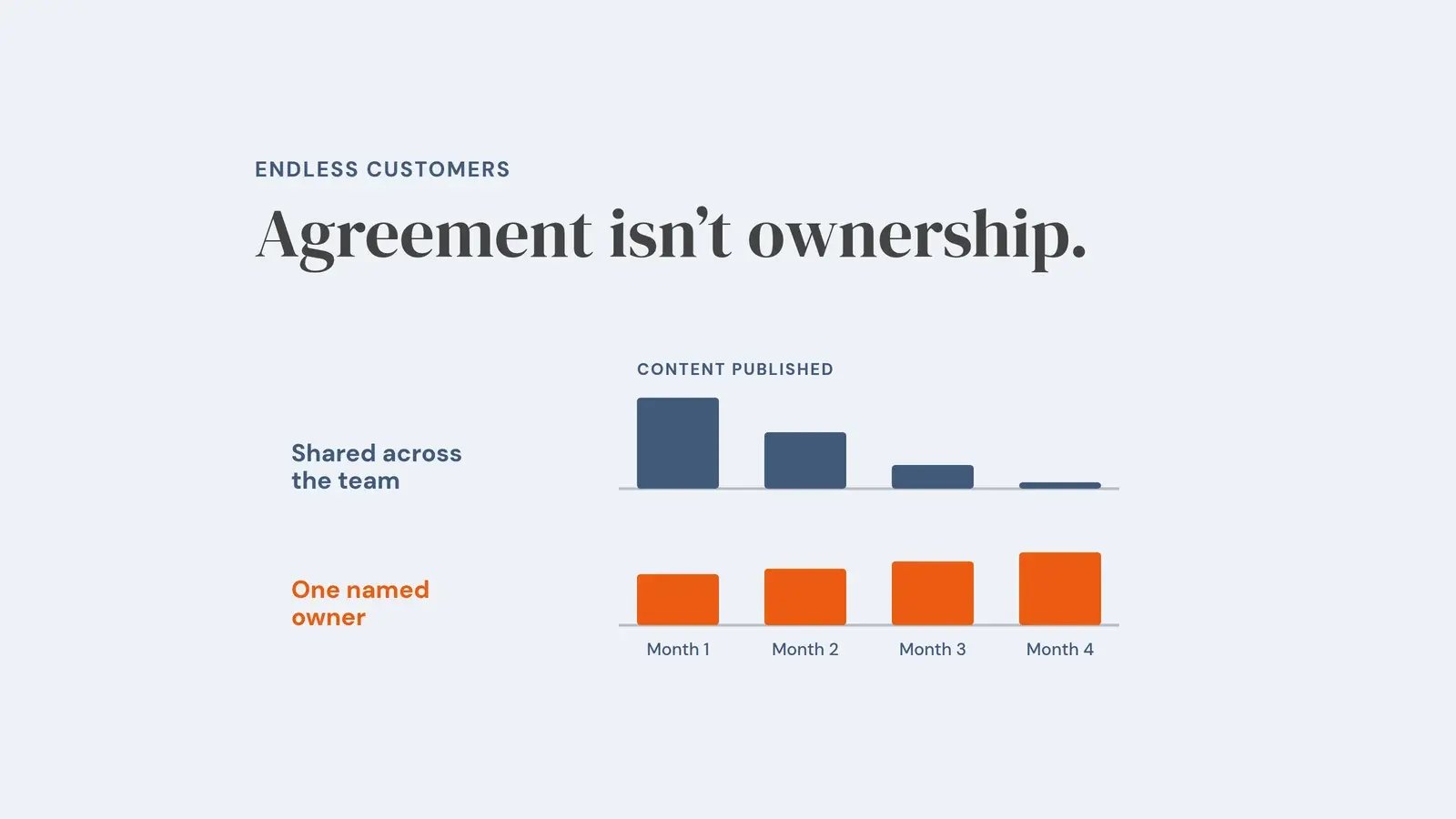
| No owner | Quietly abandoned by month four | Name an operations owner on day one |
Should you build it yourself or bring in help?
Most agencies under 10 people should build this themselves. Paying someone at that size is usually premature: the decisions the system encodes are still yours to make, and outsourcing them produces a document your team never agreed to.
Bring in help when you are past 10 people, have started once and not finished, or another stalled quarter costs more than the fee. Use this test:
- Attempted this before and not finished? The constraint is time, not knowledge.
- Is delivery costing you clients or margin now? Speed beats cost.
- Someone internal to own it? If not, fix that first, whichever route you take.
Where the gap is commercial rather than operational, Systems & Pricing Consultancy addresses pricing architecture alongside delivery. Where you need someone embedded week to week, Fractional COO for Agencies runs from £4,200–£6,900 (approx. $5,400–$8,800) per month.
How do you know it is working?
Three things change when the system is working: delivery timelines stop slipping, your calendar clears of client work, and you can forecast capacity a quarter ahead. Track those from week one. Margin improvement lags by a quarter or more, so it is a poor early signal.
Frequently asked questions
How long does it take to build an agency operating system from scratch?
8 to 12 weeks internally, at 4 protected hours a week. With outside help, 3 weeks for a roadmap or 8–12 weeks for installation.
Do I need dedicated software to run one?
No. Your existing project management tool is enough for version one, because software is the last decision, not the first. Choose new tooling only once the processes are agreed.
What if my services are bespoke for every client?
The delivery spine still standardises. Stages, roles, decision points and the capacity model hold even when creative output varies.
Who should own it if not the founder?
An operations lead, delivery director or senior account lead, with authority to change the process rather than maintain documents.
Can I build this while still delivering client work?
Yes, at 4 hours a week. Below that it stalls, the most common reason internal builds fail.
Where to start
An agency that runs on the founder's involvement is not a talent problem waiting for a better hire. It is a structural problem with a known fix: 5 components, in a fixed order, over 12 weeks.
If you are under 10 people, start on your own this week. If you are past that, or have stalled here before, the Agency Operating System™ is the framework I use to install this with agency teams directly.
How to take action now
- Block 4 hours a week for the next 12 weeks.
- Whiteboard your delivery spine on one page this week.
- Name the system's owner before you write anything.
- Write down your current utilisation number, or admit you do not have one.
- If you have stalled before, book a scoping call: 30 minutes, we map your gaps against the 5 components, and you leave with a written view of which to fix first.

Pricing disclaimer: All GBP–USD price conversions are rounded estimates and correct at the time of publishing. Exchange rates fluctuate and figures should be treated as indicative only.
Topics: