Undercharging, over-delivering, and operating without documented systems is not a capacity issue. It is a commercial architecture problem. I install the structure that fixes it.
Document and standardise how work gets done, so delivery is consistent, repeatable, and no longer dependent on you.
Redesign your pricing and scope structures around margin, value, and sustainability, not gut feel and hope.
Define your services clearly, scope them tightly, and stop scope creep from silently eroding profit on every engagement.
Without commercial architecture and documented systems, the pattern is always the same:

Scope creep is not a client problem. It is a pricing and process problem. Without clear boundaries, every engagement costs more than it should.
Processes that live in your head cannot scale. Delivery becomes inconsistent and your time is permanently consumed by execution.
More clients means more chaos. Every new engagement adds pressure to a system that was never built to hold it.

The first stage of the Agency Operating System™ addresses the structural components every agency needs before sustainable growth is possible:
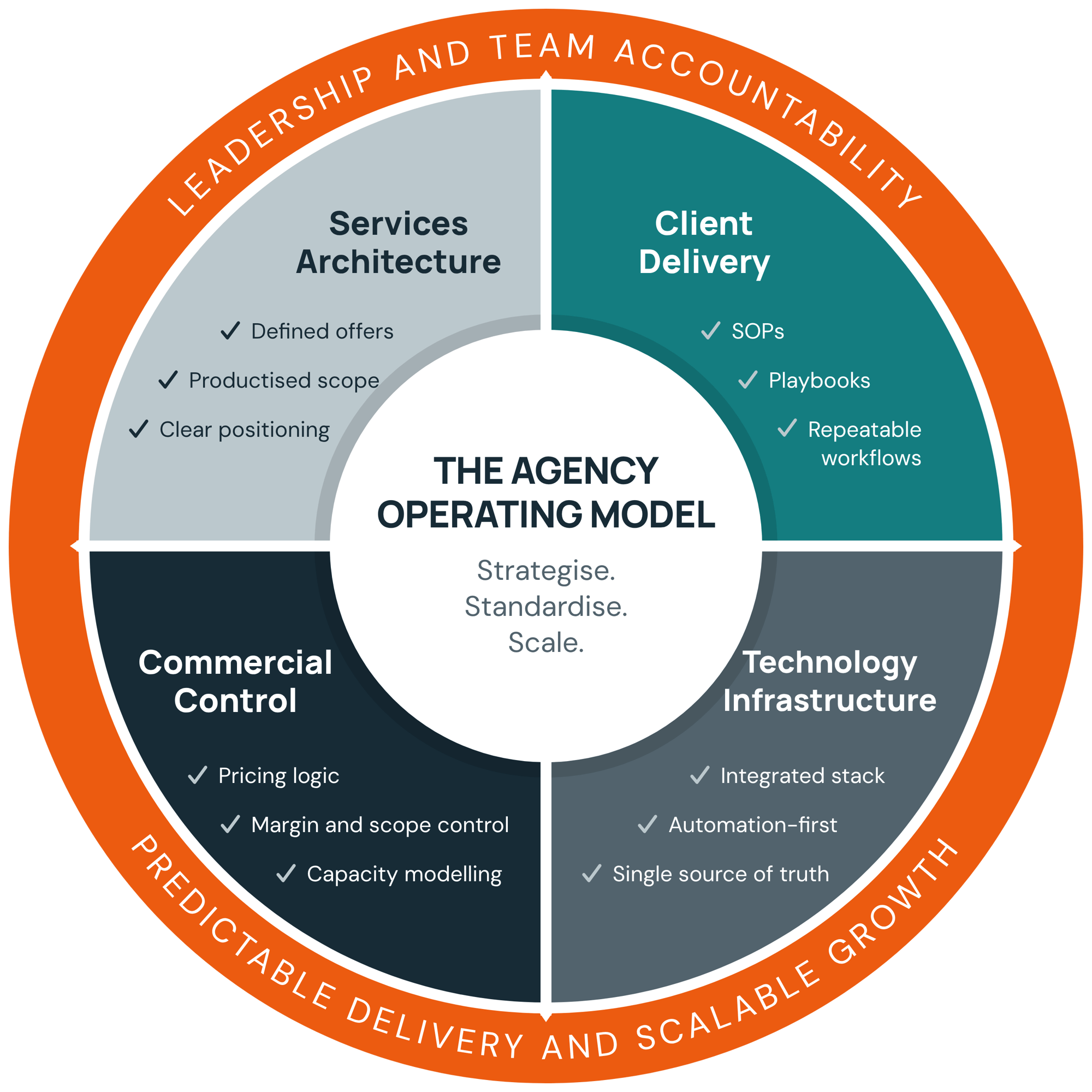
Book a callDefined offers, productised scope, and clear positioning that removes ambiguity and protects margin.
SOPs, playbooks, and repeatable workflows your team can follow without constant oversight.
Pricing logic, margin analysis, and capacity modelling built around profitability, not revenue.
An integrated, automation-first stack that gives you a single source of truth across the business.
Clear ownership of outcomes at every level, so delivery does not depend on founder intervention.
Most agencies experiencing chaos, margin pressure, or founder-dependency are not facing a motivation problem. They are facing a structural one.
Pricing is guesswork. Processes live in people's heads. Scope is negotiated on goodwill. The result is an agency that grows in volume but not in health.
I work with your leadership team to map the current state, identify the structural gaps, and install the commercial and operational architecture that makes consistent, profitable delivery possible.

Agencies that undercharge do not do so because they undervalue their work. They do it because their pricing was never built on a documented commercial model.
When pricing lacks structure, scope creep becomes inevitable. Margin erodes silently. And the agency works harder for less return with every passing quarter.
I redesign pricing architecture from the ground up, aligned to your service model, your delivery costs, and the value you actually deliver.

Charleh Knighton - Managing Director, KUB
A clear process to transform your agency from chaos to control:

A structured audit of your services, pricing, delivery, and operations. I identify the structural weaknesses and what needs to be built first.
A clear commercial and operational framework: defined service tiers, documented delivery processes, and pricing built on margin and scope control.
Systems installed, team trained, documentation handed over. The architecture belongs to you. No ongoing dependency required.
Systems and pricing consultancy can be done as a long-term project, or short-term audits to identify where areas can be improved.
Having worked inside and alongside agencies for years, I have seen the same structural problems repeat. Pricing built on hope. Delivery built on tribal knowledge. Growth that creates chaos rather than capacity.
The Agency Operating System™ is the framework I designed to fix it. Systemise is Stage 1, the foundation everything else is built on. Without it, standardisation and scale are impossible.
Systems & Pricing Consultancy is a structured engagement that helps agencies fix the operational and commercial architecture underneath delivery chaos, margin erosion, and founder dependency.
It solves undefined offers, weak scope control, undocumented delivery, pricing built on guesswork, and the founder being the only person who knows how the agency really runs.
This is built specifically for agencies. The focus is not generic growth advice — it is the structure that protects margins, improves delivery consistency, and reduces founder dependence.
Because delivery problems and pricing problems are usually the same problem viewed from different angles. If scope is vague and delivery is inconsistent, margins will always suffer.
It is about rebuilding the structure underneath them. I do not treat chaos, undercharging, or scope creep as isolated issues — I fix the architecture causing them.
Founder-led agencies that are growing in revenue but not in health, profitability, or operational control.
No. It is also for agencies that are growing but know their current structure will break under more scale.
An operations manager runs the existing system. I design and install the commercial and operational architecture the team can then run properly.
No. I work with leadership and the delivery team to build systems they can own. The goal is stronger internal capability, not replacing the team.
A more structured agency with clearer offers, stronger margins, documented delivery, and less reliance on the founder to hold everything together.
Commercial architecture is the structure behind how your agency makes money: pricing logic, service packaging, scope boundaries, margin protection, and capacity assumptions.
Typically SOPs, playbooks, delivery workflows, onboarding processes, handoff points, ownership structures, and documentation that makes delivery repeatable.
Yes. Defined offers are often the starting point because unclear services create unclear delivery, weak positioning, and poor pricing.
Yes. Productising scope and structuring service tiers is a common part of the work when it supports margin, consistency, and sales clarity.
Yes. Scope creep is usually a pricing and process problem, not just a client management issue. Clear boundaries and structured delivery reduce it significantly.
If needed, yes. I rebuild pricing around value, delivery cost, and sustainability rather than inherited assumptions or founder instinct.
Yes. Capacity modelling is essential if your agency keeps overselling, overloading the team, or confusing revenue growth with healthy growth.
Absolutely. Pricing without delivery structure breaks. Delivery without commercial control becomes unprofitable. Both need to work together.
Yes. Technology infrastructure is part of Stage 1 when your systems are fragmented, overly manual, or giving you no reliable source of truth.
Usually yes. I refine, simplify, or restructure existing tools first before recommending major changes.
The work typically follows three stages: map the current state, design the architecture, then install and transfer the system to your team.
I audit your services, pricing, delivery model, and operations to identify where the real structural weaknesses are.
You get a clear view of what is causing fragility, margin loss, or founder dependence, and what needs to be built first.
It means creating the service structure, delivery model, pricing logic, and accountability framework your agency needs to run more predictably.
Systems are installed, documentation is created, workflows are structured, and your team is trained to use what has been built.
Yes. The systems need to reflect how your agency actually operates, so leadership and key delivery people will be involved at the right points.
Yes. Documentation and handover are built into the process so the architecture belongs to you, not me.
By building them around real workflows, involving the people who use them, and training the team properly rather than dropping documentation into a folder and hoping it sticks.
Yes. Some agencies only need a structured audit and roadmap before implementing independently.
No. The default outcome is ownership transfer. Ongoing support is optional, not required.
Most agencies see better delivery clarity, stronger scope control, improved pricing confidence, and a measurable reduction in operational chaos.
Yes. Clearer pricing and tighter delivery control usually improve margins faster than most agencies expect.
Often within weeks. Relief usually comes early because leadership gains visibility and the team stops improvising quite so much.
Yes. That is one of the core goals. If the founder is the system, the agency cannot scale safely.
Yes. Documented systems and clear roles reduce variation across projects and people.
Yes. When responsibilities, workflows, and success metrics are clearer, accountability becomes much easier to maintain.
Yes, but safely. The purpose is not to create faster chaos. It is to build an operation worth scaling first.
In most cases, yes. Ambiguity creates stress. Structure reduces it.
Absolutely. Better onboarding, clearer scope, and more consistent delivery create a more predictable client journey.
An agency that is more profitable, less fragile, and far less dependent on founder memory, effort, or intervention.
Investment depends on whether you need a focused audit, a pricing audit, or a broader systems implementation engagement.
Yes. A structured audit is often the best place to begin if you want clarity before committing to broader implementation.
Usually project-based for the initial structural work. Ongoing support can be added later if useful.
That depends on the scope, but focused audits are faster while full structural redesign and installation naturally take longer.
Yes. This work can be delivered remotely with structured workshops, reviews, and implementation support.
Typically founder-led agencies with enough revenue and delivery complexity that structural issues are already affecting margin, time, or team performance.
That is common. The work may involve refinement and simplification rather than rebuilding everything from scratch.
No. The structure matters more than the tool. Tools can be reviewed and improved as part of the process.
Yes. In fact, documented systems become even more important when delivery includes external contributors.
Book a scoping call. We will look at where the structural pressure sits: pricing, scope, delivery, or founder dependence, and identify the right place to start.
If your agency is losing margin, relying on you to hold delivery together, or pricing work without a documented commercial model, that is a structural problem. And it has a structural fix. Book a scoping call to explore where to start.