

AI has made marketing cheaper to produce. It hasn't made it any easier to know what's worth doing. The Marketing Diagnostic looks at your marketing as it actually runs, hears from your team, and tells you what to fix first, what to stop paying for and where the money should go.
Your marketing, suppliers and spend, looked at as they actually run.
The people closest to your customers say what's working and what isn't.
Clear priorities your team can act on, with or without me.
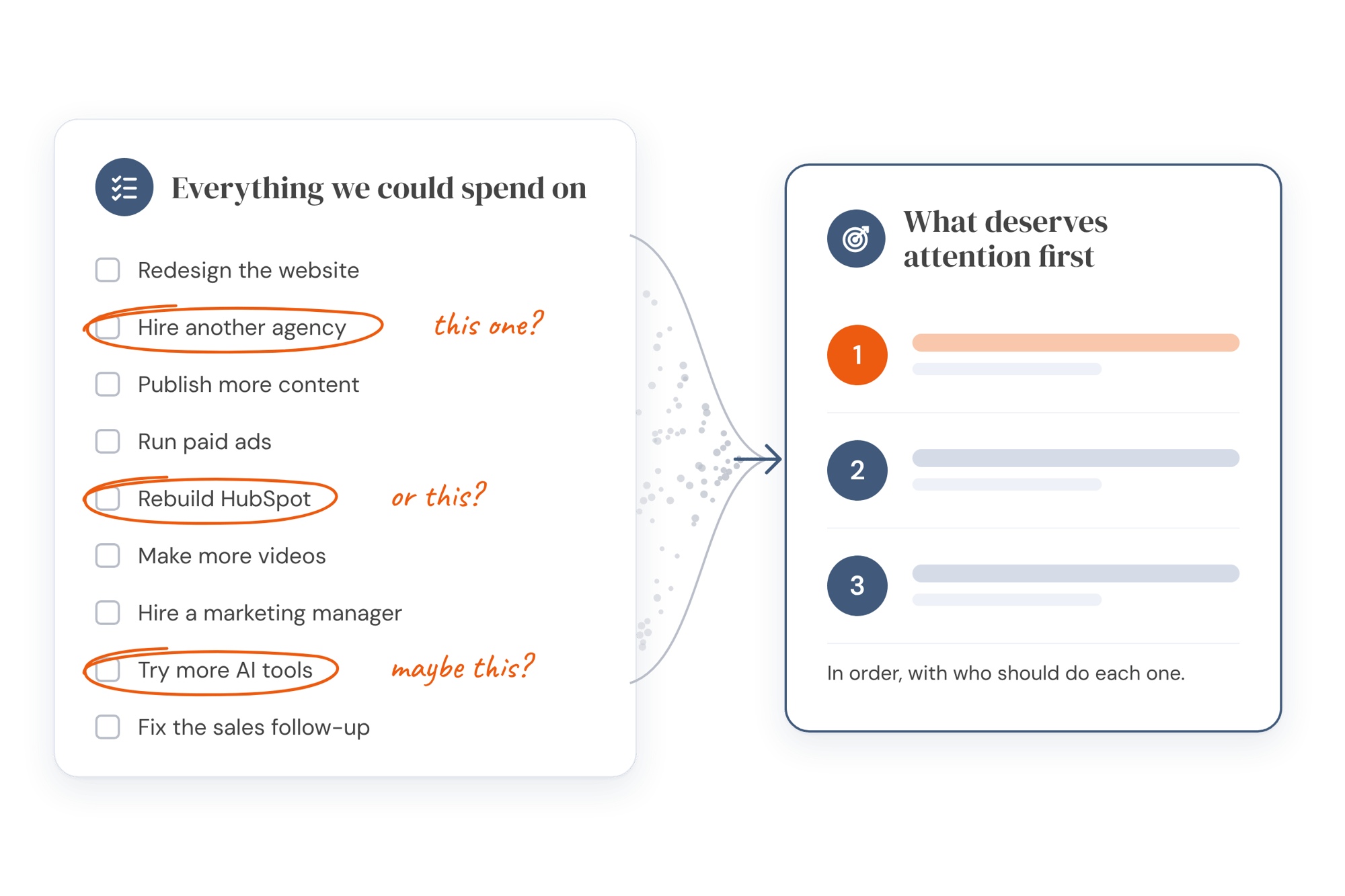
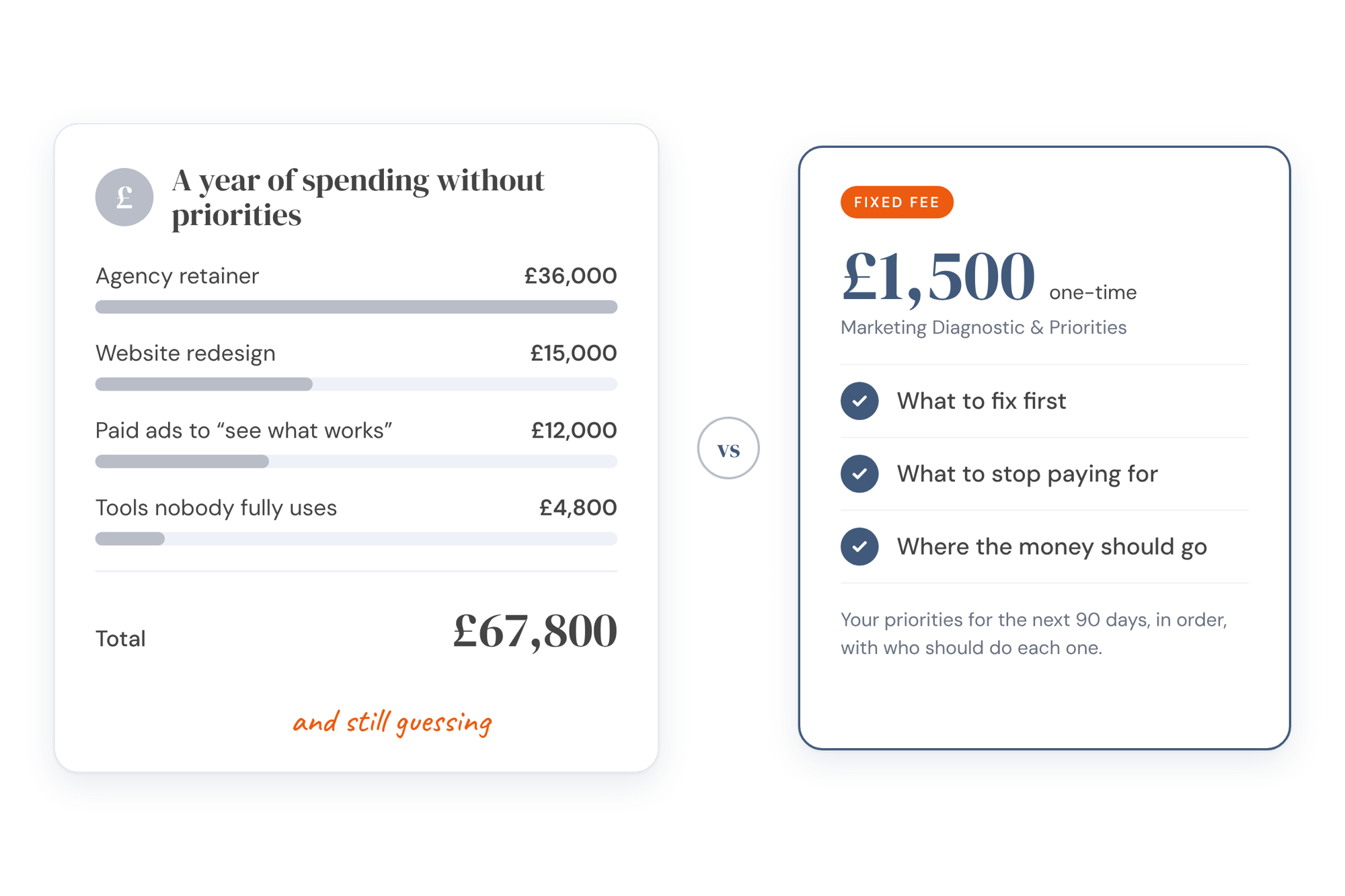
When nobody knows what to fix first, the money goes to whatever feels most urgent. Here's what that usually costs.
More content, a new website or another agency, when the real issue was somewhere else.
Retainers keep renewing for work your own team could now do with AI.
Sales, marketing and leadership each fix their own theory, and nothing improves.
Each area is checked against evidence: your systems, your numbers, your team and your buyers.
Book a callWhat you say you do, whether buyers can tell, and whether your website and your sales conversations agree.
Whether you have one, whether your team could use it, and whether your content sounds like you.
What your buyers actually ask, set against what your content answers, including whether your case studies prove anything.
Whether you have any, and which one would help buyers qualify themselves fastest.
What runs, what converts, and what gets sent to nobody.
Whether people trust the data, what you pay for versus what you use, and whether to configure or rebuild.
How AI assistants describe you today, and the signals they rely on, such as reviews, directories and consistent details.
Every retainer and contractor, what each costs and delivers, and which work your team could now do.
What you have, what it buys at today's rates, and three ways to spend it.
Who could own marketing internally, what they'd need, and whether to hire before or after the system is in place.
Where it helps, I interview members of your team one at a time, for 25–40 minutes each. Everyone gets the same four questions, plus anything their role brings up.
You see the themes, not who said what, so people speak freely. Patterns across the conversations become evidence that an outside review on its own can't give you.
You receive it before we meet, in your own workspace. Then we go through it together in a two-hour walkthrough with your leadership team.
What to fix first, what to stop paying for and where the money goes, on one page you can forward to anyone.
The themes from the interviews, anonymised, so you hear what's really happening without knowing who said what.
What to keep doing, what's likely to break, and what it will cost you if it's left alone.
The questions your content already answers, the ones it misses, and the topics to write next, in priority order.
What each retainer and contractor actually delivers for the money, and whether to keep, renegotiate or end it.
Three ways to spend what you have, from changing nothing to building the function properly, each with a cost.
Whether your CRM needs configuring or rebuilding, what each option involves, and roughly what it would cost.
The priorities in order, with who should do each one: your team, a supplier or me.
It works best when there's enough marketing happening to look at, and a decision that needs making.
You run a founder-led B2B business. You're at roughly £1m–£20m, with sales coming in but marketing that lacks focus.
Your results are up and down. You can't tell what's working, or why.
Budget matters. You want to know where limited money should go before you spend more of it.
You're not ready for a retainer. You want clear priorities before you commit to anything longer.
There's nothing to diagnose yet. You're pre-launch or still finding out whether people will buy.
You want a full marketing strategy. The diagnostic sets priorities. The detailed plan comes after.
You're looking for reassurance. If your agency is the problem, the document will say so.
You can't give access. Without your systems and your team, there isn't enough to go on.
No long onboarding and no lengthy proposal. You give me access, I do the digging, and we go through what I find together.

Tell me about your business and what isn't working. We'll check the diagnostic is the right fit.
You give me access and a few names to interview. I review everything and research what your buyers ask.
We go through the findings together, and you leave knowing what to fix first and who should do it.
The Marketing Diagnostic & Priorities is a one-time, fixed fee of £1,500 ($2,000).
That includes access to your systems, a leadership session, interviews with your team, research into what your buyers ask, the Diagnostic & Priorities document and a two-hour walkthrough with your leadership team.
There are two ways to start. Book a free 30-minute call and I'll confirm whether it's the right fit, or skip the queue and reserve your place now with a £500 deposit. The deposit counts towards the fee, and you get it back if our first call shows it isn't a fit.
£1,500 ($2,000) one-time
2-4 weeks
About 4 hours
Priorities for your next 90 days
After the walkthrough, if you feel the diagnostic hasn't told you what to fix first, say so. Your deposit is refunded and the balance is never invoiced.
And if you go ahead with a Fractional Marketing Director engagement or a HubSpot project within 90 days, the full fee is credited against your first invoice.

Charleh Knighton - Managing Director, KUB
Richard Suswain - Partner, Tyrrell & Company
Most audits are built to sell you the next thing, whether that's a retainer, a tool or a bigger project. The Marketing Diagnostic is paid for up front and stands on its own, so it can tell you what to fix, what to stop and when you don't need outside help at all.
Free audits exist to sell a retainer, so they tend to find the problems a retainer fixes. They rarely question the agency's own work.
This one is paid and independent, so it can tell you to stop paying for something, including me.
Tools score what they can see from the outside.
They can't hear your team, read your supplier contracts or see your budget, and they end in a score, not a decision.
A strategy takes longer and produces a plan. The diagnostic takes 2–4 weeks and produces priorities.
If you need a plan after that, it's built on the diagnostic instead of starting again.
A hire takes months to find and settle in, and inherits the problems without the authority to end a supplier contract.
With the diagnostic done first, they start with clear priorities.
Run the 90 days yourselves, hand parts to a supplier, or work with me. If you choose me within 90 days, the fee is credited.
Either way, I'll check in after 60 days to ask how it's going. One message, not a sales sequence.
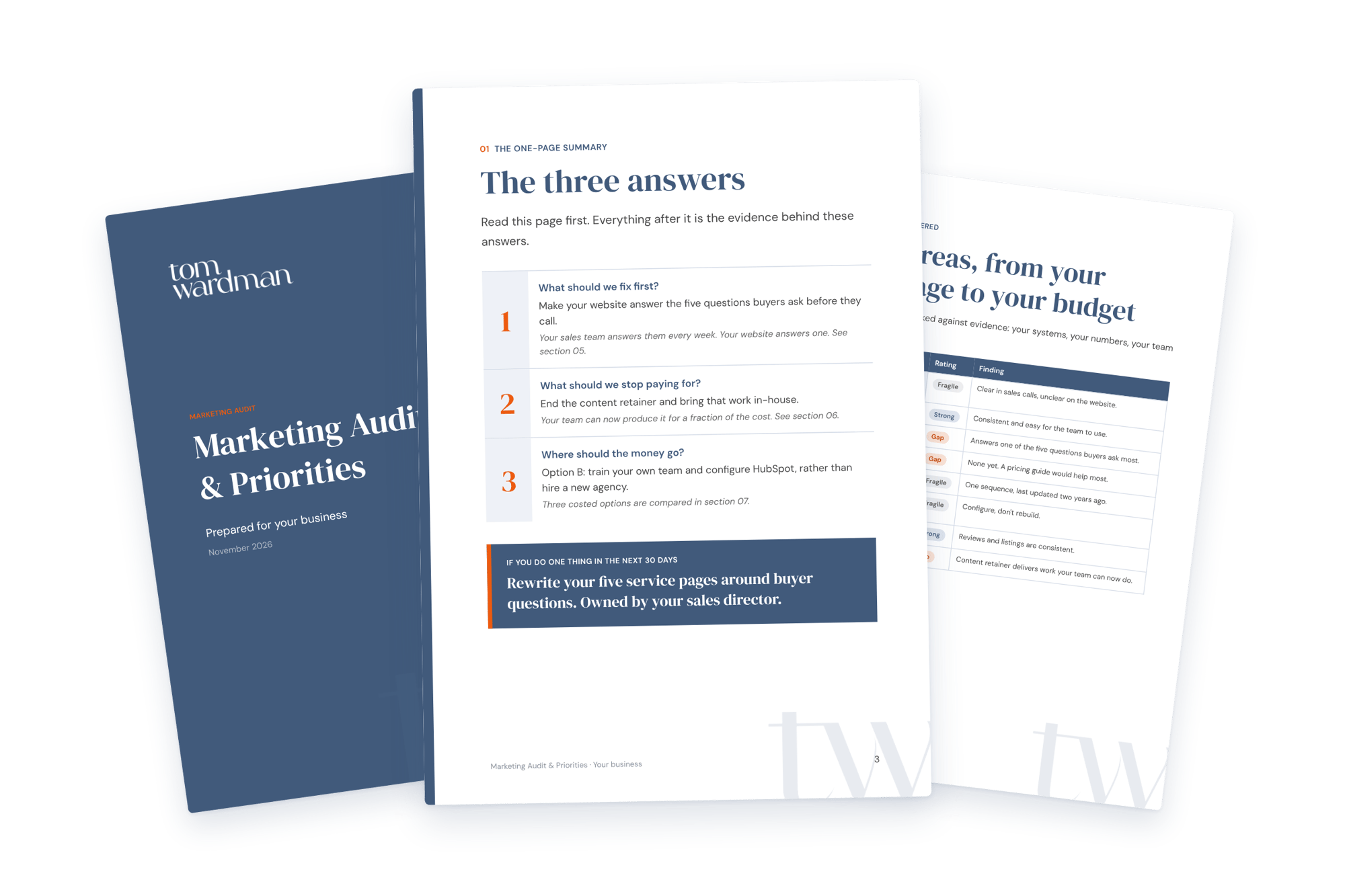
It's a fixed-fee review of your marketing as it actually runs, which ends with a short written document and a live walkthrough. It tells you what to fix first, what to stop paying for and where your money should go.
Ten areas: position and message, brand voice, website and content, buyer-facing tools, email and nurture, your CRM, AI trust signals, suppliers and spend, budget, and team and ownership. Each one is checked against evidence from your systems, your numbers, your team and your buyers.
I do, personally. I'm a fractional marketing director, HubSpot Gold Partner and certified Endless Customers coach, and no part of the diagnostic is handed to a junior or an assistant.
An audit usually scores what it finds and leaves you to decide what to do. The diagnostic ends in a decision: no more than three priorities, in order, with who should own each one.
Yes. I check whether your website and your sales conversations say the same thing, how leads move through your CRM, and what your salespeople hear from customers. Sales and marketing problems usually turn out to be the same problem.
Yes. Every retainer and contractor is reviewed: what it costs, what it delivers, and which of that work your own team could now do with AI. This is the part that answers "should we still be paying for this?"
Yes. I check how tools like ChatGPT currently describe you, and the signals they rely on, such as reviews, directory listings and consistent business details. The diagnostic tells you where the gaps are. Fixing them is separate work.
Yes, and sometimes it does. If the honest answer is that your team can handle the next 90 days without me, the document says so on the first page.
AI helps with research and with organising notes, so my time goes on judgement rather than admin. Every finding and every recommendation is mine, and the interviews are always done by me, in person or on a call.
No. I review whichever CRM you use, or the spreadsheet you use instead. If HubSpot would suit you better, the document says so and explains why.
£1,500 ($2,000), fixed. That covers everything from the first access checklist to the two-hour walkthrough and a check-in 60 days later.
A free audit is a sales tool, so it tends to find what the seller fixes. Charging a fixed fee means I can tell you to stop paying for something, or that you don't need me yet, without it costing me the sale. It also means you get a finished piece of work, not a pitch.
An access review and one-page questionnaire, a 50-minute leadership session, team interviews where they help, research into what your buyers ask, the ten-area review, the Diagnostic & Priorities document, a two-hour walkthrough and a check-in 60 days later.
No. The fee is the same whatever your revenue, however many systems you use and however many people I interview.
It reserves one of a limited number of diagnostic slots each month. It counts towards the £1,500, and you get it back if our first call shows the diagnostic isn't a fit.
If you reserve a place, you pay the deposit when you book. The rest is invoiced after the walkthrough, on 30-day terms, so you've seen the findings before the balance is due.
Yes. If you start a Fractional Marketing Director engagement or a HubSpot Strategy & Implementation project within 90 days, the full £1,500 comes off your first invoice.
You don't pay for it. Tell me after the walkthrough, your deposit is refunded and the balance is never invoiced.
Fixing what we find. That's for your team, a supplier, or me under a separate agreement, and the document says which is the best fit for each priority.
The diagnostic costs $2,000 for clients who prefer to pay in US dollars, on the same terms as the sterling price.
Usually two weeks from the day I have access. It can take up to four weeks when there are more team members to interview.
Either book a free 30-minute call so I can confirm the diagnostic is the right fit, or reserve your place straight away with a deposit. If you reserve first, the call still happens, and the deposit is refunded if it isn't a fit.
Your website, analytics, Search Console, HubSpot or other CRM, email platform, and any ad accounts, review sites or Google Business Profile. I'll also ask for your supplier contracts or scopes if you have them. I send a one-page checklist, and most clients finish it in under an hour.
About four hours from the founder or MD in total: setup, a 50-minute leadership session and a two-hour walkthrough. Anyone I interview gives 25–40 minutes. Everything else is me working with the access you've given.
Usually the people closest to sales, delivery and marketing. You choose who. Everyone gets the same four questions: what's working, what isn't, what customers ask that you don't answer, and what they'd fix first. You see the themes, never who said what.
No. Interviews are included where they help, and most businesses find they're the most useful part. If your team is very small, or the founder is the only person close to customers, the diagnostic can run without them.
Yes. Interview notes are never shared word for word. The document reports the themes only, so nobody can tell who said what. I'm also happy to sign an NDA before we start.
Yes, by default. The leadership session, interviews and walkthrough all run on video calls. The leadership session and walkthrough can be held in person if you'd prefer.
Only if required. The full, editable file will be yours to keep at the end of the process.
I research reviews, online communities and forums where your buyers talk, along with your sales team's inbox and the team interviews. I then compare what buyers ask with what your website and content already answer.
The Diagnostic & Priorities document, sent before we meet, and an 80-minute walkthrough with your leadership team. Both are yours to keep, whatever you decide next.
A one-page summary of the three answers, then what your team said, what's working and what's fragile, what your buyers ask, a supplier and spend review, three costed budget options, a HubSpot recommendation and your next 90 days. A full appendix holds the evidence behind each finding.
You can read the main findings in about 20 minutes. The first page fits on one page and is written so you can forward it, and the detailed evidence sits in an appendix for anyone who wants it.
We spend 80 minutes going through the findings with your leadership team: the summary, what your team said, the content gaps, the supplier review, the budget options and the next 90 days. At the end, we record what you've decided in the document.
Say so in the walkthrough. That's what it's for. If you still feel it hasn't told you what to fix first, you don't pay for it.
Yes. The document is written so your team can act on it without me, and each priority says who should own it. If "run it yourselves" is the right answer, that's what I'll recommend.
No. In the walkthrough I'll say once whether I think you need me, and in what form. If the answer is "not yet", that's the recommendation.
You decide what to do with the priorities. Around 60 days later, I'll send one short message to ask how it's going. There's no follow-up sales sequence.
They become the starting point. The priorities, the buyer research and the team themes feed straight into the first phase of a Fractional Marketing Director engagement or the design stage of a HubSpot project, so nothing is repeated.
The diagnostic gives you clarity straight away: what to fix first and what to stop paying for. Stopping or renegotiating a supplier can save money within weeks. Results from new marketing work depend on how quickly you act on the priorities.
Founder-led B2B businesses at roughly £1m–£20m in revenue, with sales coming in but marketing that lacks focus or produces patchy results. It suits businesses that want clear priorities before committing to anything longer.
Businesses that are still finding out whether people will buy, anyone who wants a full marketing strategy rather than priorities, and businesses that can't give access to their systems or team. Without that access, there isn't enough evidence to go on.
That's common, and the diagnostic looks at what they deliver and what it costs. Sometimes the answer is to keep them and change the brief. Sometimes it's to bring part of the work in-house. Either way, you'll have the evidence to have that conversation with them.
Then you may not need the diagnostic. If you know HubSpot needs rebuilding, for example, we can scope that project directly. The diagnostic is for when the problem isn't clear, or when people inside the business disagree about it.
Usually, yes. The smaller the budget, the more it matters where each pound goes. The diagnostic includes three costed options for the money you have, including changing nothing.
A free audit only reviews what the agency can see and sell. The diagnostic also covers your suppliers, your budget and your team's view, and it's paid for up front, so it has no reason to recommend more work than you need.
Tools score what they can see from the outside, such as your website and search rankings. They can't hear your team, read your supplier contracts or see your budget, and they end in a score rather than a decision.
It's a good idea. A new hire takes months to settle in and usually inherits the problems without the authority to end a supplier contract. With the diagnostic done first, they start with clear priorities and a reason for each one.
A strategy takes longer and produces a detailed plan. The diagnostic takes two to four weeks and produces priorities. If you need a plan afterwards, it's built on the diagnostic instead of starting again.
Yes. It runs remotely by default, and I work with founder-led B2B businesses across the UK, Europe and the US. Clients outside the UK can pay $2,000 in US dollars.
Book a short call, or reserve your place now. Within a month, you'll know where your marketing money should go, and you keep the findings either way.