
HubSpot strategy & implementation

HubSpot built around your growth engine, not default templates

Most HubSpot portals are set up in a hurry and never properly structured. I design and implement yours around your actual sales process, lifecycle model, and growth strategy, so the platform works as infrastructure, not an obstacle.

A misconfigured HubSpot portal is more damaging than no portal at all

Poor setup doesn't just limit performance; it actively works against you:

x_brush_1

Inherited mess compounding over time

Duplicates, broken workflows, and unmapped lifecycle stages accumulate. The longer they sit, the more they distort your data and slow your team down.

x_brush_1

A tool misaligned with how you sell

Default HubSpot setup reflects HubSpot's assumptions, not your sales process. Without strategic configuration, the platform creates friction rather than removing it.

x_brush_1

Reporting that can't be trusted

When the structure is wrong, the data is wrong. Decisions get made on metrics that don't reflect what's actually happening in your pipeline.

Build the foundation

A HubSpot portal architected for your growth engine

This is not implementation support. It is strategic architecture, designed around how your business acquires, converts, and retains customers.

Book a call
check_brush_2

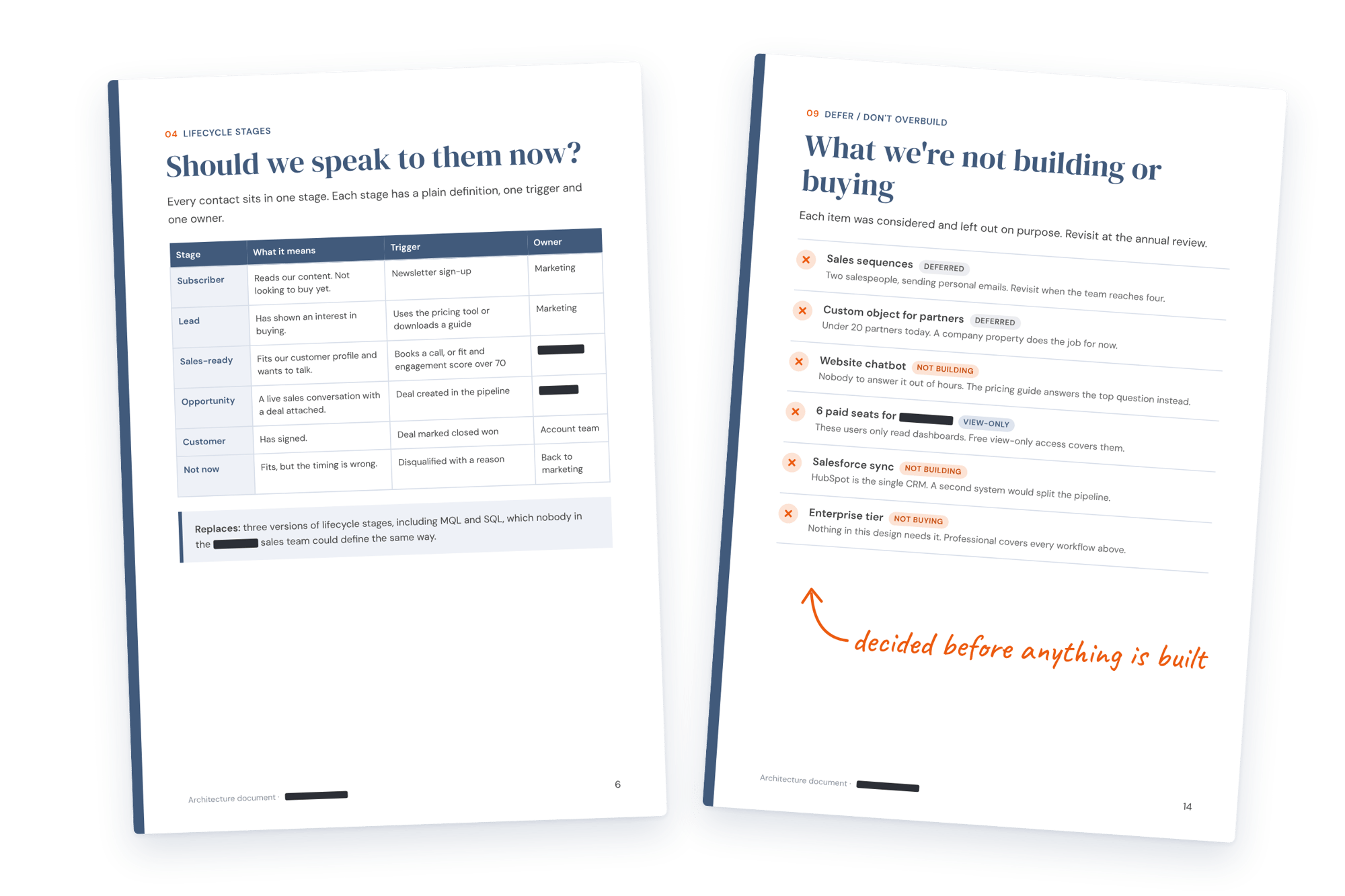
Lifecycle stage design

Your contact and deal stages mapped to reflect how buyers actually move through your pipeline, not HubSpot's defaults.

check_brush_2

Pipeline architecture

Deal pipelines built to match your sales process, with clear stage definitions, owner logic, and automation where it adds value.

check_brush_2

Governance and structure

Property conventions, naming logic, and data standards established so your portal stays clean and usable as it scales.

check_brush_2

Inherited mess resolved

Existing portals audited and restructured; duplicates removed, broken workflows corrected, contact data cleaned and mapped.

check_brush_2

Growth strategy alignment

Every configuration decision tied back to your revenue goals and the In-House Growth Engine™ framework.

Who this is for

Four situations where this is the right starting point

This is a fixed-scope project, not a retainer. It is designed for businesses that need HubSpot properly structured, whether that means building from scratch, rescuing what exists, or overhauling what no longer works.

New setup

You have HubSpot but haven't properly configured it. You need a structured foundation before you build anything on top of it.

Rebuild

Your portal has been set up and added to by multiple people over time. It needs architectural clarity, not more patches.

Re-onboarding

You moved to HubSpot, it didn't deliver, and you need to understand why, and fix it properly.

Optimisation overhaul

Your portal works, but not well enough. You need a strategic review and a structured improvement plan with clear implementation.

Testimonials

How we'll work together

A defined project. A clear outcome.

Fixed scope. No retainer. A structured process from discovery to a fully implemented portal.

Pricing

How much does HubSpot Strategy and Implementation cost?

Each project is scoped to the situation, whether you need a clean foundation built from scratch, an existing portal rescued and restructured, or a strategic overhaul of what you already have.

Why choose me?

A growth strategist, not a HubSpot generalist

The HubSpot partner market has fragmented. Large agencies over-engineer and upsell licences. Niche specialists know the platform deeply but not your business. Implementation shops build without thinking.

I sit in a different position entirely.

I am a growth strategist who knows HubSpot deeply across marketing, sales, and content, and uses it as the infrastructure layer of the In-House Growth Engine™. That means the strategic decisions come first, and the platform configuration follows.

No licence pressure. No junior account managers. No over-engineering. Right-sized HubSpot, built around how you actually grow.

SolutionPartnerTierBadges_FINAL_GOLD_TEAL

Need ongoing management after implementation?

A well-built portal still needs maintenance. If you want your HubSpot infrastructure monitored, maintained, and proactively optimised after this project closes, HubSpot portal management is the natural next step.

Frequently asked questions

What is HubSpot Strategy & Implementation?

It’s a structured project that designs and builds your HubSpot portal around how your business actually sells, markets, and grows. Instead of relying on default templates, the platform is configured as infrastructure for your growth engine.

How is this different from standard HubSpot onboarding?

Standard onboarding typically follows HubSpot’s default assumptions. This approach begins with your sales process, lifecycle stages, and growth strategy, then builds the portal architecture to support them.

Why is strategy important before configuring HubSpot?

Without strategy, HubSpot reflects generic defaults rather than your real pipeline. That creates reporting errors, automation gaps, and friction for your team.

Is this service about HubSpot setup or marketing strategy?

Both. Strategic architecture defines how HubSpot should work, and the implementation ensures it is configured correctly.

What problems does this project usually solve?

Misaligned pipelines, unreliable reporting, broken workflows, unclear lifecycle stages, and CRM systems that don’t reflect how your team actually sells.

What happens if HubSpot is set up incorrectly?

Data becomes unreliable, automation breaks over time, and your team loses trust in the system.

Is this a one-off project or ongoing support?

This is a defined project with a clear scope and completion point.

Who typically needs HubSpot Strategy & Implementation?

Businesses that want HubSpot built properly from the start or repaired after a messy implementation.

Is this suitable for both new and existing HubSpot portals?

Yes. Projects can involve building from scratch, restructuring existing portals, or overhauling poorly configured systems.

What’s the end goal of the project?

A HubSpot portal that accurately reflects your pipeline, supports your sales process, and provides reporting your leadership team can trust.

What does the implementation process involve?

The process includes discovery and architecture, full configuration of the system, and final documentation and handover.

What is covered during the discovery phase?

Your sales process, lifecycle stages, pipeline structure, reporting needs, and growth objectives are mapped before any configuration begins.

What parts of HubSpot are configured during implementation?

Lifecycle stages, pipelines, properties, workflows, governance standards, and reporting structure.

Do you design the lifecycle stage framework?

Yes. Lifecycle stages are mapped to reflect how buyers actually move through your funnel rather than relying on HubSpot defaults.

Do you design sales pipelines as part of the project?

Yes. Pipelines are structured around your real sales stages, with automation and reporting configured accordingly.

Is data governance included?

Yes. Naming conventions, property standards, and structural rules are defined so your portal remains clean and scalable.

Can you fix issues in an existing HubSpot portal?

Yes. Many projects involve restructuring or rebuilding portals that were previously implemented incorrectly.

Do you handle workflow and automation setup?

Yes. Workflows are configured to support lifecycle movement, lead management, and operational efficiency.

Do you clean up existing data during the project?

Where necessary, duplicates and structural issues are resolved as part of rebuilding the portal foundation.

Is documentation included at the end?

Yes. Your team receives documentation explaining how the system is structured and how to maintain it.

How does the project process work?

The project follows three stages: discovery and architecture, implementation, and final handover with documentation.

How long does a typical project take?

Most projects take between two and six weeks depending on scope and complexity.

Is this delivered as a retainer?

No. This is a fixed-scope project with a clear start and finish.

What’s the advantage of a fixed project scope?

You know exactly what will be delivered, how long it will take, and what the investment will be.

Do you work with our internal marketing or sales team during the project?

Yes. Collaboration ensures the system reflects how your team actually operates.

Will our team be trained to use the system?

Yes. The handover phase includes walkthroughs and documentation so your team understands how the portal works.

What happens if we discover additional work during the project?

Additional requirements can be scoped separately if needed.

Do you manage HubSpot integrations as part of the implementation?

Yes, if integrations are part of the required architecture.

Can you build the system around our existing tech stack?

Yes. HubSpot is configured to work alongside your current tools where appropriate.

What happens after the project ends?

Your portal is fully implemented and ready to operate internally, with optional maintenance services available if required.

What improvements should we expect after implementation?

Clearer reporting, reliable automation, structured pipelines, and a CRM system your team trusts.

Will this improve reporting accuracy?

Yes. When lifecycle stages and pipelines are structured correctly, reporting reflects real performance.

Can this improve sales team efficiency?

Yes. A properly structured CRM removes friction from lead management and pipeline tracking.

Will automation work more reliably?

Yes. Workflows are designed around your process rather than generic assumptions.

Does this help with marketing and sales alignment?

Yes. Shared lifecycle definitions and reporting frameworks align both teams.

Can this shorten sales cycles?

Indirectly. Better data, clearer processes, and improved lead management remove friction from the buying journey.

What’s the biggest mistake companies make with HubSpot?

Building on top of a poorly structured foundation rather than fixing the architecture first.

Will this future-proof our HubSpot portal?

Yes. Governance standards and structured design make the system scalable as your business grows.

Can this reduce CRM complexity for our team?

Yes. Proper structure often simplifies workflows and reporting significantly.

What’s the biggest transformation clients see?

Confidence in their CRM data and reporting.

How much does HubSpot Strategy & Implementation cost?

Projects typically range from £3,000–£10,000 depending on scope and complexity.

What determines the final project price?

Whether the project involves a new setup, a rebuild of an existing portal, or a full optimisation overhaul.

Is this suitable for companies new to HubSpot?

Yes. New implementations benefit most from building the system correctly from day one.

Is this suitable if we already use HubSpot?

Yes. Many clients engage this service to repair or restructure existing portals.

Do we need internal HubSpot expertise?

No. The system is built and documented so your team can operate it confidently afterward.

What types of businesses benefit most from this service?

B2B companies using HubSpot to manage marketing, sales, and customer relationships.

Do you work internationally?

Yes. Most HubSpot projects can be delivered remotely.

What if our HubSpot portal already works reasonably well?

An optimisation overhaul can identify structural improvements and performance opportunities.

What happens if we need ongoing support after the project?

HubSpot Portal Maintenance is available to monitor and maintain the system long-term.

What’s the first step to begin?

Book a call to review your current HubSpot setup and determine whether a new implementation, rebuild, or optimisation project is the right approach.

Ready to build HubSpot properly?

If your portal is underperforming, overcomplicated, or simply never set up correctly, let's define the scope and build the foundation your growth engine needs.