

Your agency is billing more than ever. So why does your bank account tell a different story?
And what if growth itself, including the headcount, the new clients, the expanded overhead, is the reason your personal income is not keeping pace?
Revenue climbs, headcount grows, and yet personal take-home pay shrinks or becomes unpredictable, and most agency founders do not see it coming.
This article is for agency founders at the £250k–£1.5m ($315k–$1.875m) revenue mark who are starting to notice the gap. You will understand exactly why this happens, which metrics actually matter, and the specific steps to correct it.
Key takeaways
- The agency revenue-take-home paradox is when top-line revenue grows but founder personal net income stays flat or falls.
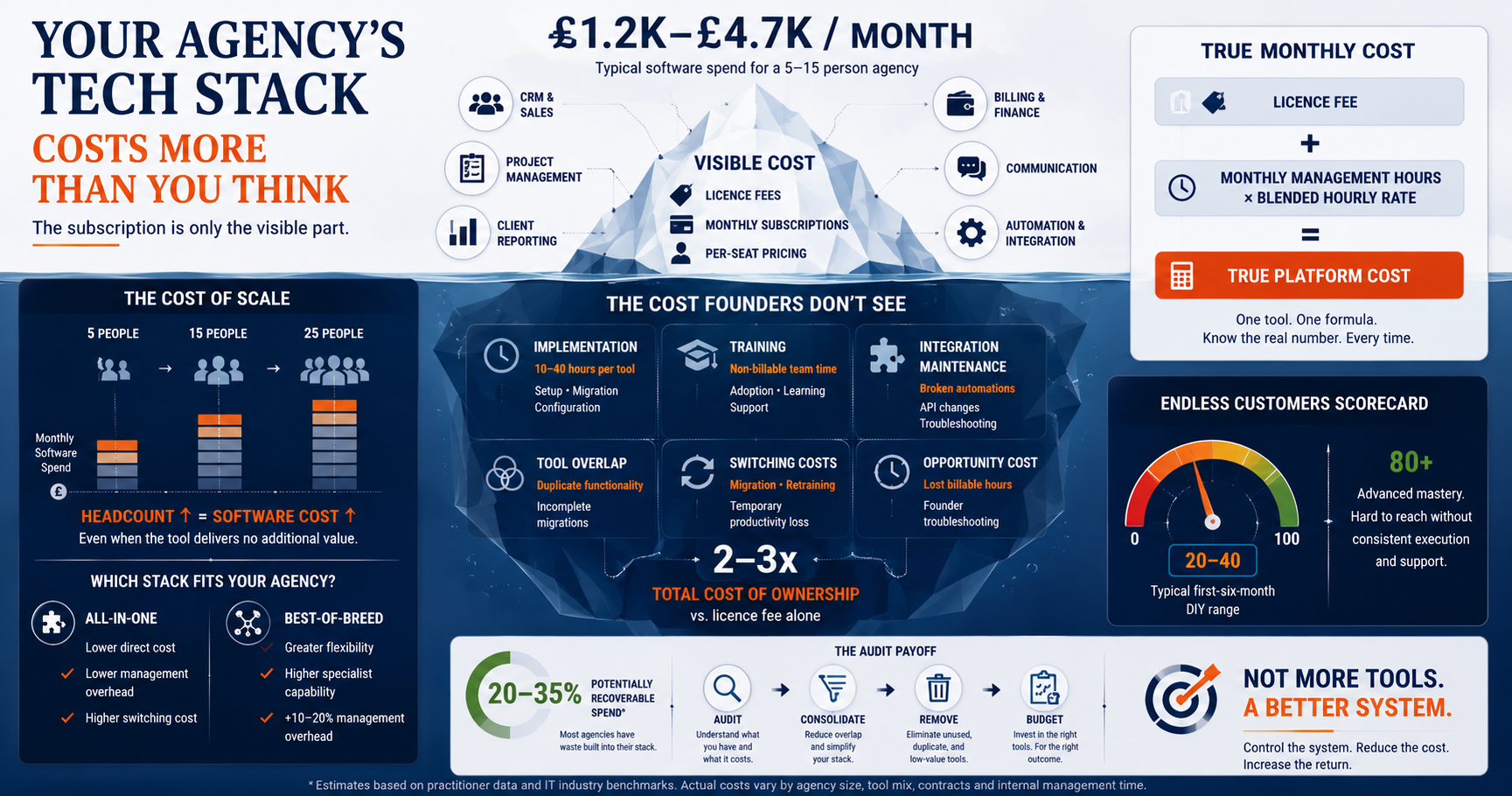
- This happens because scaling introduces layered costs, headcount, tools, and overhead, that consume margin faster than revenue is generated.
- Revenue and founder take-home pay are different metrics. Only gross profit and owner's discretionary earnings determine what lands in your account.
- The fix is a margin and pricing correction first, not more revenue.
- Founder pay should be set as a fixed structural cost, not treated as whatever is left over after everything else is paid.
What is the agency revenue-take-home paradox?
The agency revenue-take-home paradox is the pattern where a service agency's top-line revenue grows while the founder's personal net income stays flat or falls.
It happens because scaling introduces layered cost structures, including headcount, software, management overhead, that consume margin faster than new revenue can replace it.
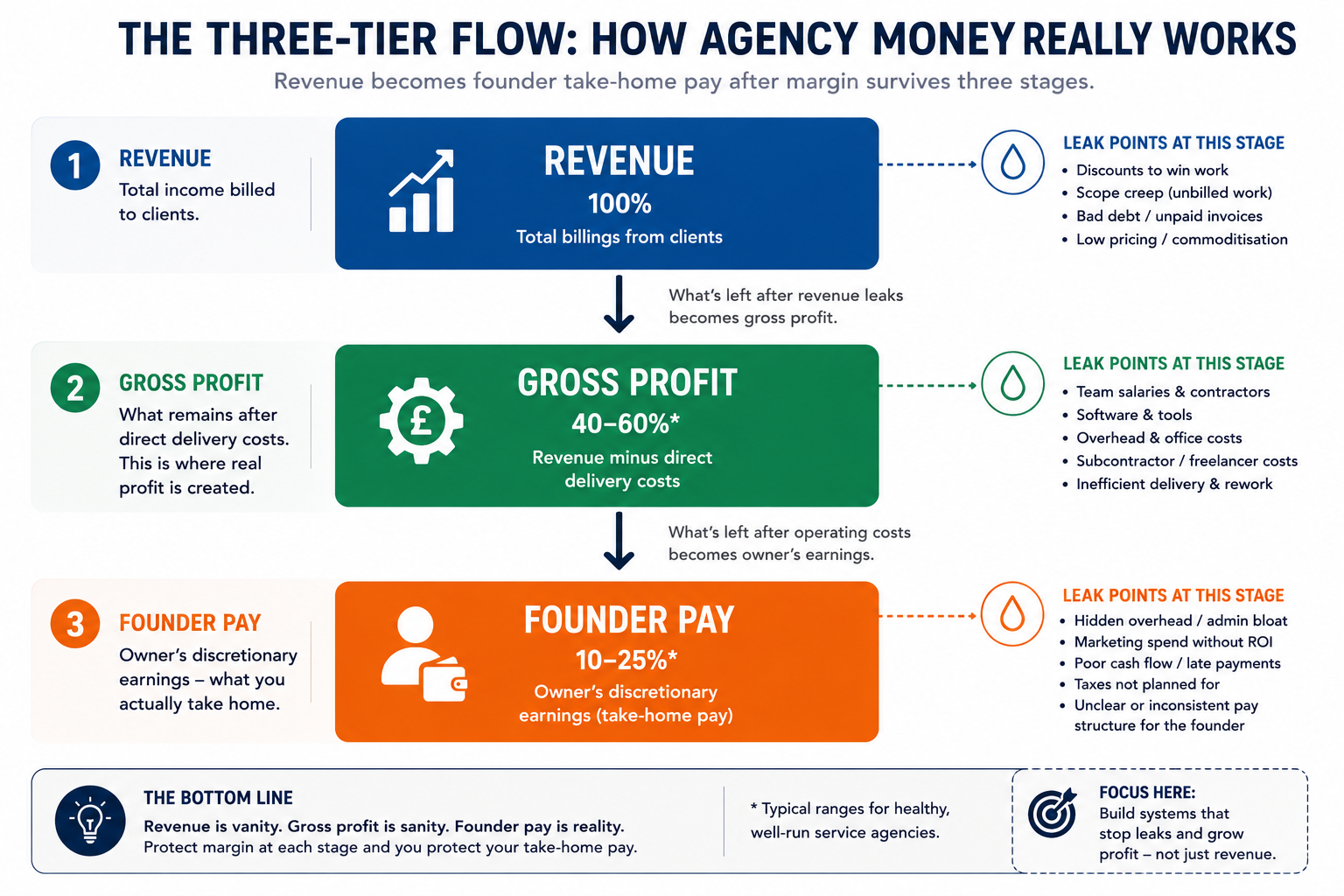
Three terms worth separating clearly:
- Revenue: Total income billed to clients. The number most founders default to tracking.
- Gross profit: Revenue minus direct delivery costs: staff, freelancers, tools. The number that determines whether the work is actually profitable.
- Owner's discretionary earnings: What remains after all business costs, including your own salary. The number that determines what lands in your account.
Revenue growth and founder take-home pay are not the same metric, and treating them as if they are is what creates the problem.
Why do founders expect more revenue to mean more personal pay?
The most damaging financial misconception for agency founders is believing that revenue growth automatically means higher personal earnings; it rarely works that way beyond the solo or micro-agency stage.
Early on, the belief holds. When you are the only person billing, each new client puts more money directly in your pocket. The problem is carrying that expectation forward into a fundamentally different cost structure.
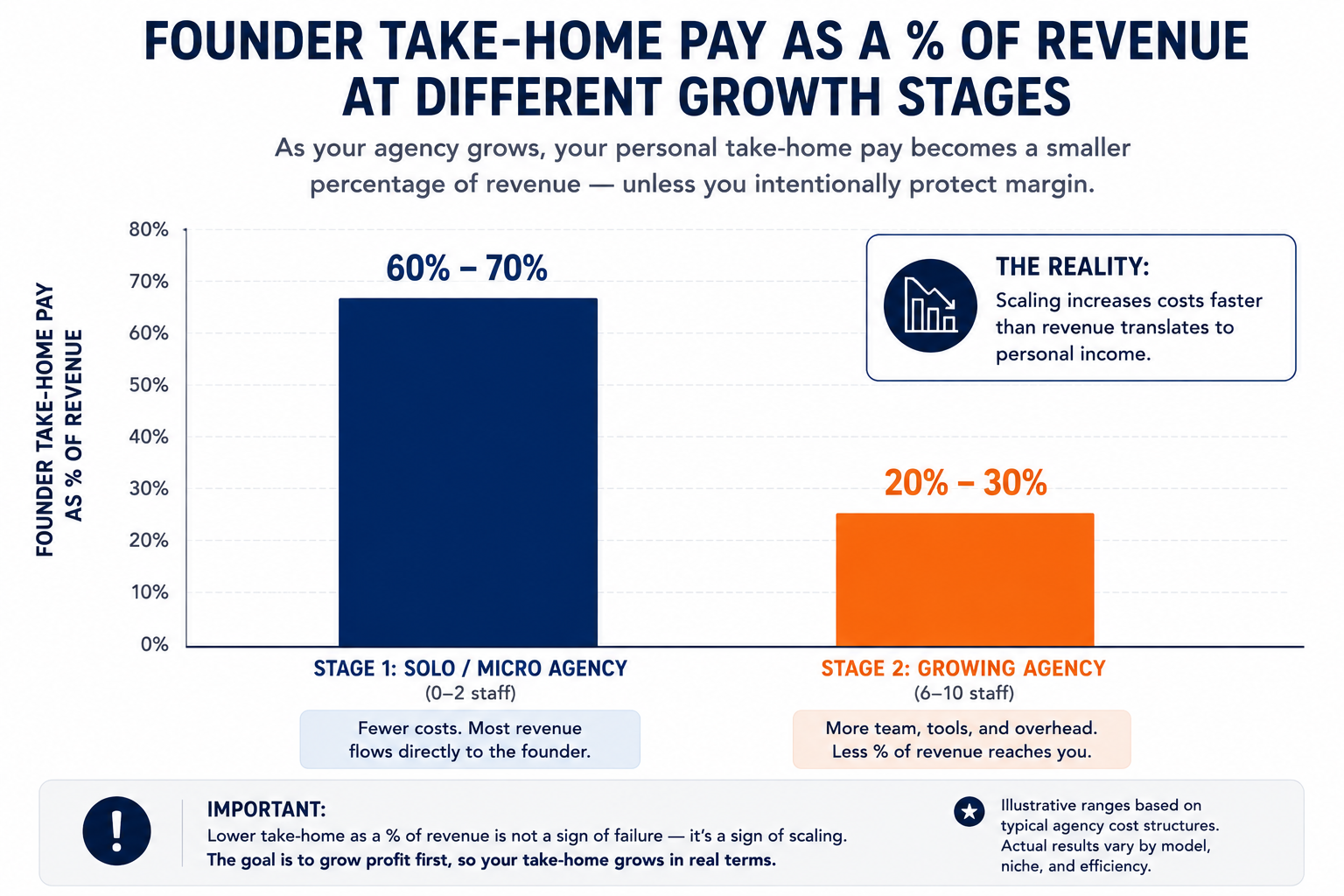
At the solo or micro-agency stage, a founder might reasonably take home 60–70% of revenue. By the time a team of 6–10 is in place, that figure can fall to 20–30%, not because the business is failing, but because the cost structure has changed entirely.
Note: Figures are illustrative estimates based on typical agency cost structures. Actual results vary significantly by model, niche, and team size.
The overhead growth is not a sign something has gone wrong, but it does mean the rules have changed and your pay structure needs to change with them.
What hidden problems shrink agency founder pay during growth?
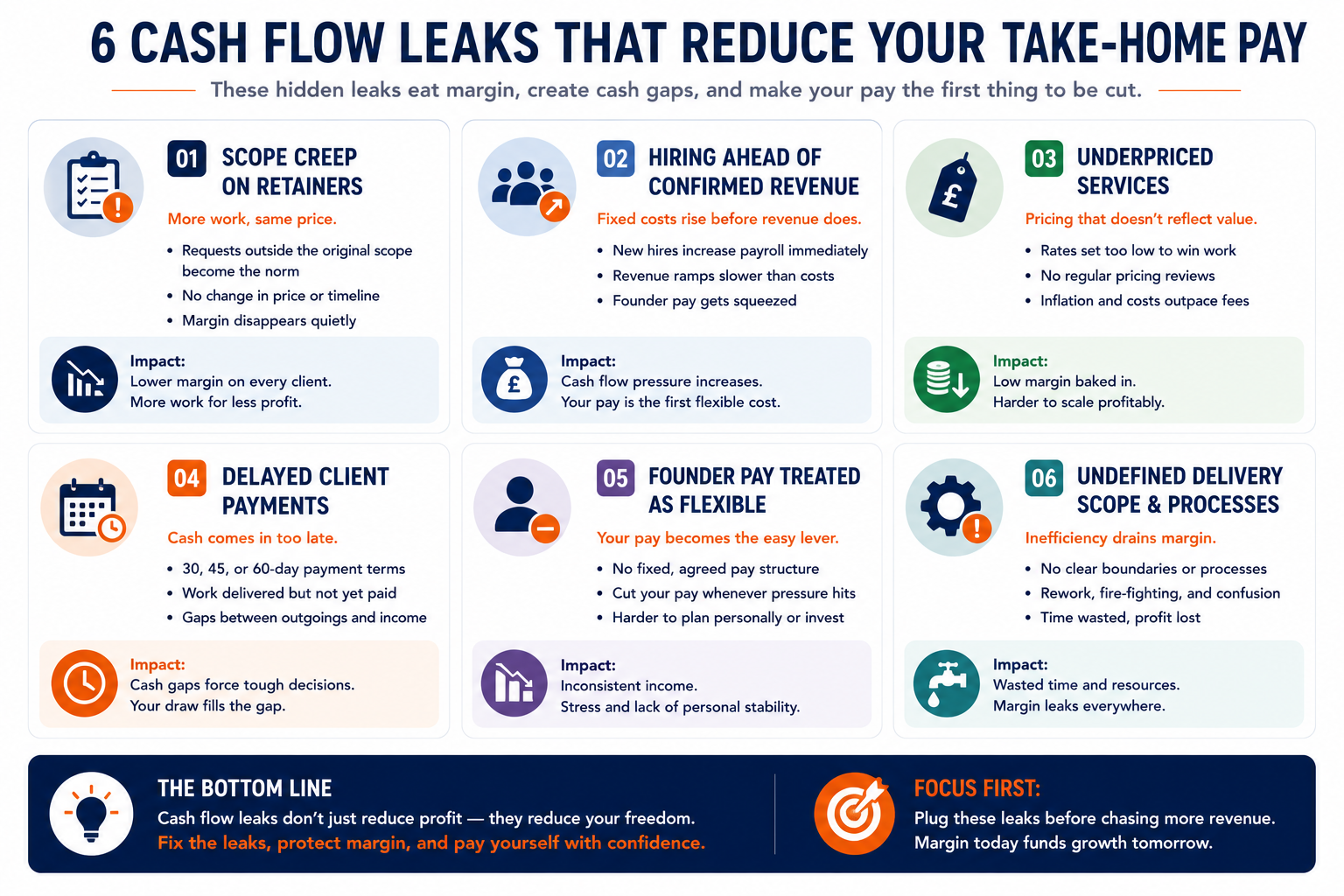
The primary problems that erode founder take-home pay during growth are uncontrolled headcount expansion, scope creep on retainer clients, underpriced services, and cash flow timing gaps.
Each amplifies the next. A team hired to service underpriced clients generates payroll obligations that arrive before client payments do, leaving the founder's draw as the only flexible line item.
The most common causes:
- Hiring ahead of margin: Bringing on staff before new revenue is confirmed or correctly priced
- Retainer scope creep: Clients consuming more than contracted with no rate adjustment
- Flat retainer rates: Pricing agreed two or more years ago that has never been revisited
- Delayed client payments: 30–60 day payment terms creating recurring cash gaps
- Founder pay treated as flexible: Owner draw cut first whenever margins tighten
- Undefined delivery scope: No clear boundaries on what is and is not included
Revenue vs. profit: what agency founders should actually track
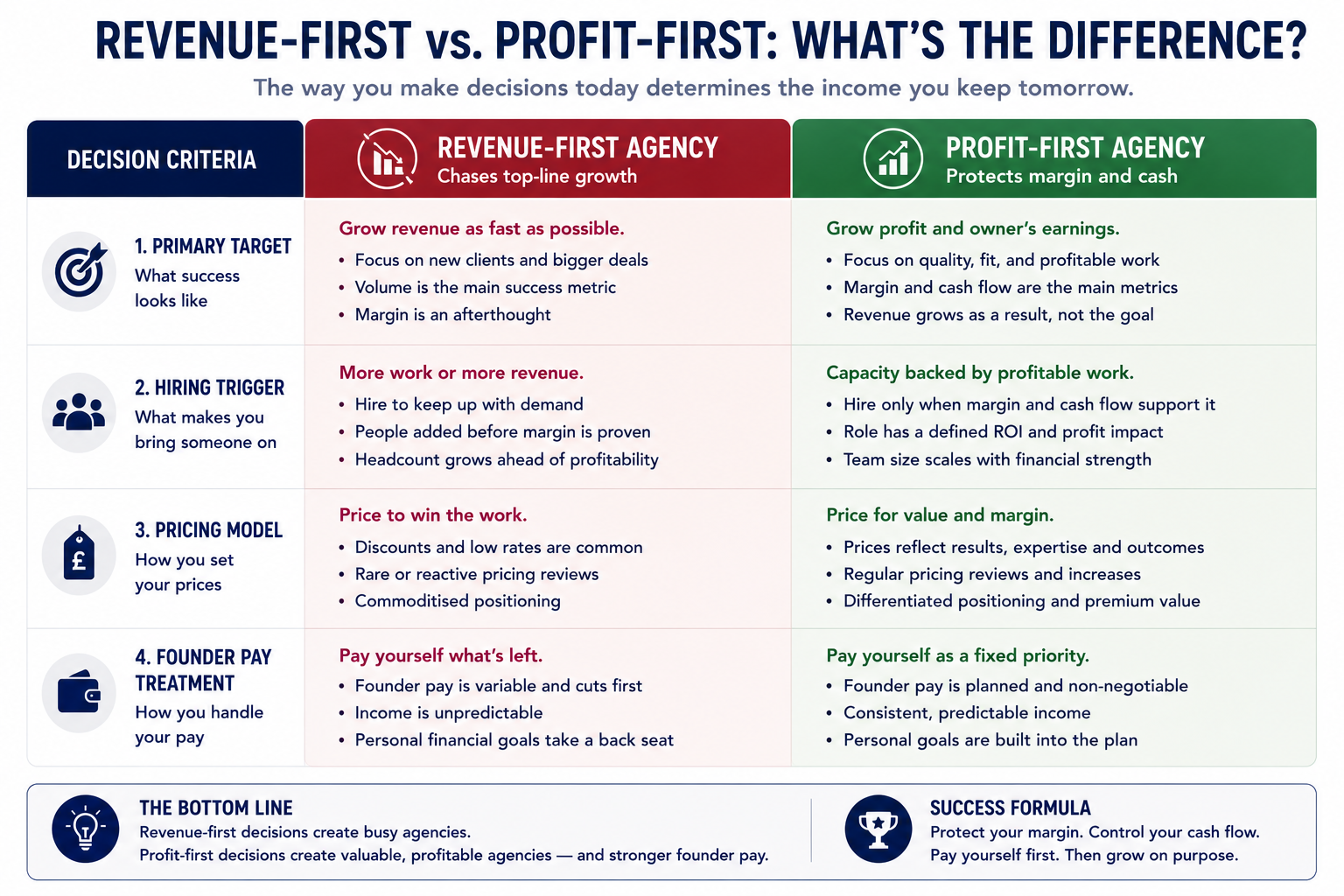
For agency founders, only profit growth, specifically gross profit margin and owner's discretionary earnings, determines what actually lands in their personal account.
Many agencies scale revenue while gross margin contracts. They are doing more work, managing more people, and taking home less per pound of effort than they were at half the size. See also: Why Agency Growth Stalls at Founder Capacity (Even With a Team)
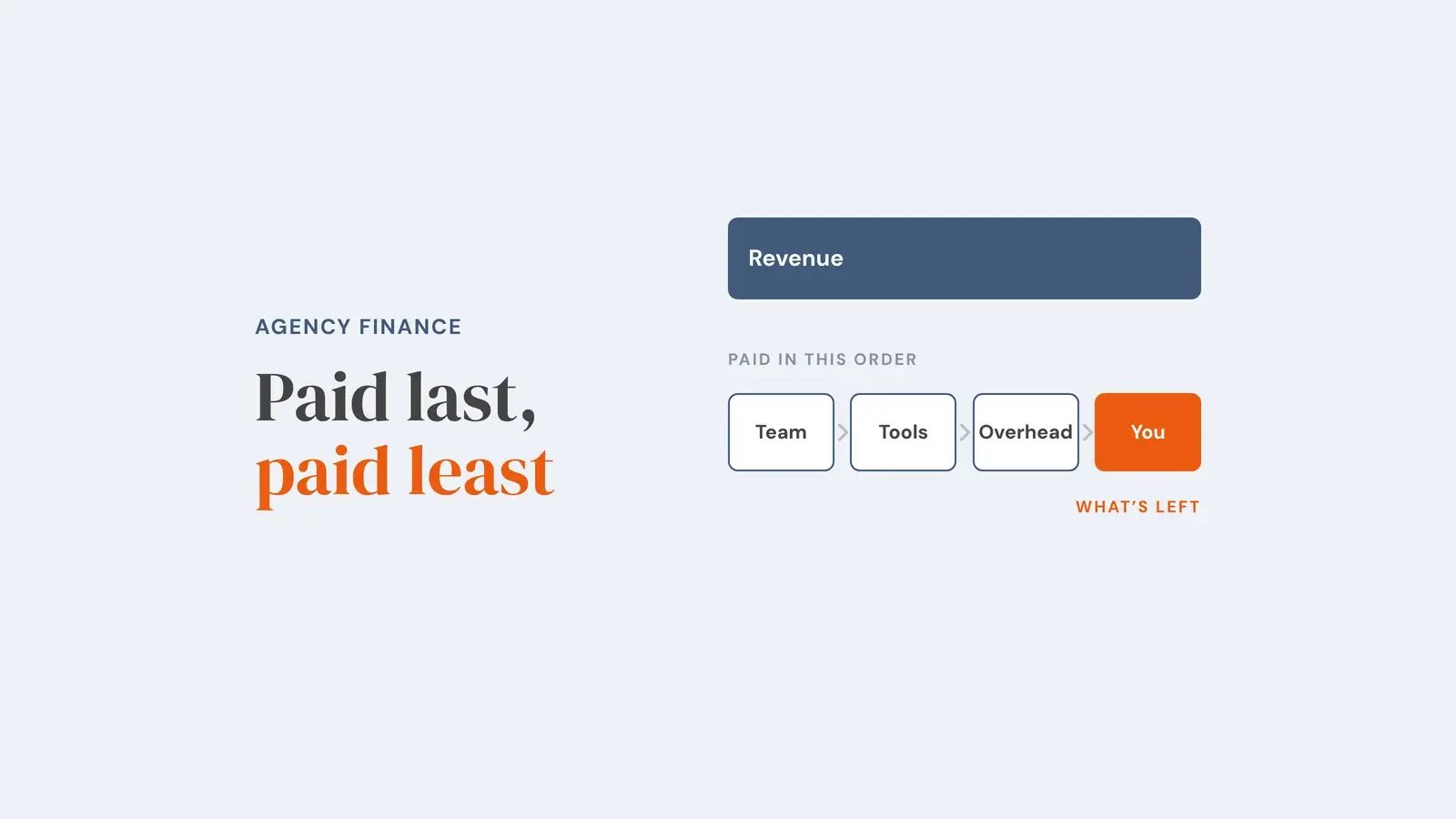
A revenue-first agency funds everyone else first and pays the founder last. A profit-first agency does the opposite.
What are the best frameworks for protecting agency founder pay?
The most effective frameworks for protecting agency founder income during growth are Profit First, outcome-based pricing, and rolling 13-week cash flow forecasting.
These work because they make founder pay structurally non-negotiable, rather than whatever is left after every other obligation is met.
Top 5 frameworks for agency founders:
- Profit First (Mike Michalowicz): Allocates owner pay before operational costs. Applicable at any agency size.
- Outcome-based pricing: Prices services on value delivered, not hours worked. Best for retainer-heavy agencies with scope creep problems.
- 13-week cash flow forecasting: Tracks money in and out 13 weeks ahead to catch gaps before they hit. Best for agencies on 30–60 day payment terms.
- Capacity utilisation tracking: Measures billable vs. available hours per team member. Best for agencies above £500k ($625k) revenue.
- Fixed founder salary model: Sets a defined founder pay as a line item first, then models all other costs around remaining margin.
Related reading: How To Diagnose What's Actually Broken In Your Agency Ops
How to fix the take-home pay squeeze: 6 steps for agency founders
Agency founders can begin reversing the take-home pay squeeze in 6 steps, starting with a margin audit and ending with a pricing structure that protects founder income at every stage of growth.
Most agencies try to grow their way out of the problem by taking on more revenue. The real fix is always a margin and pricing correction first.
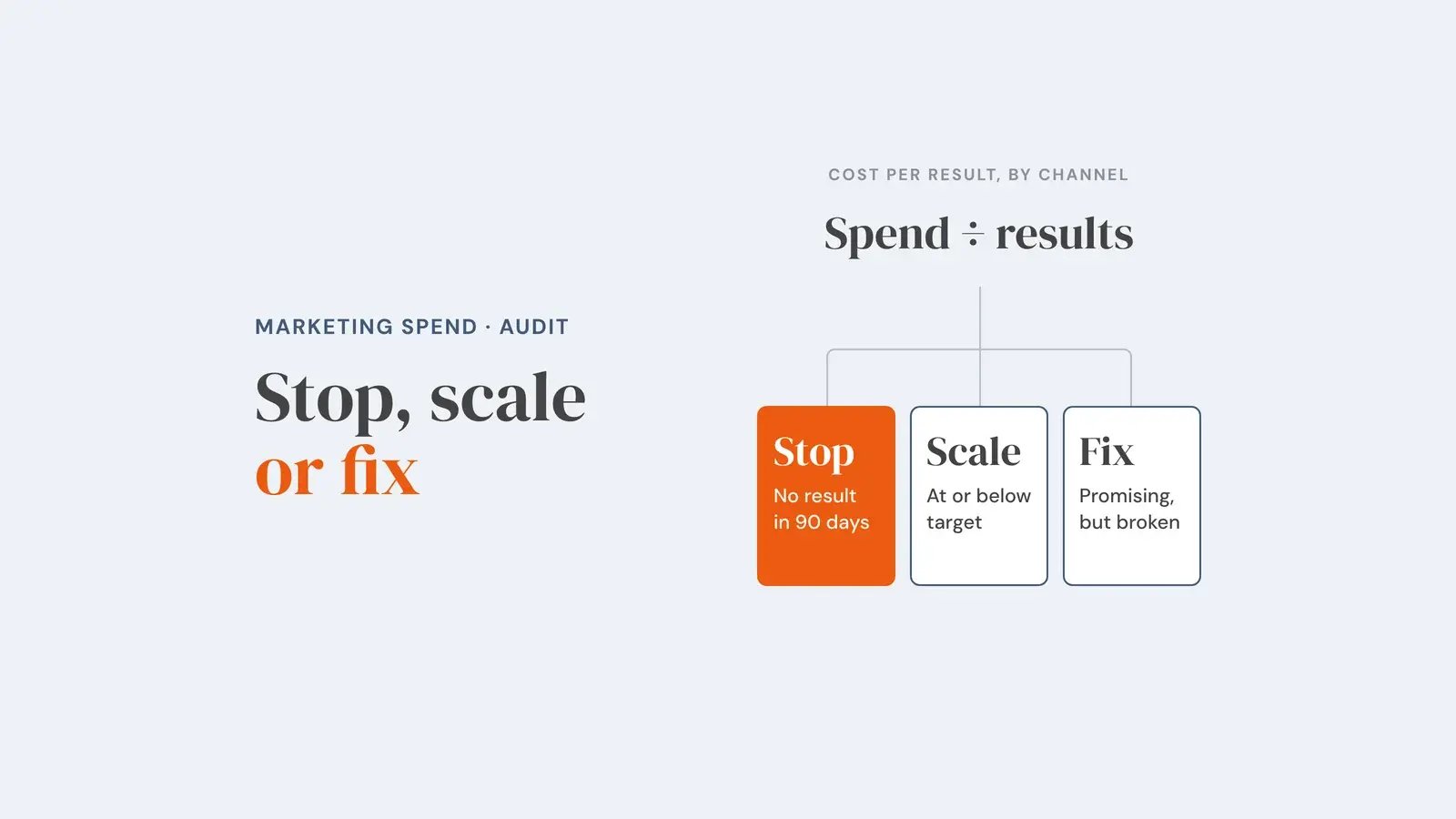
- Audit margin by client: Identify which clients are profitable and which are not. KPI: gross margin % per client account.
- Renegotiate or exit underpriced retainers: Present updated pricing with clear scope boundaries. KPI: average retainer value vs. 12 months ago.
- Set a fixed founder salary: Model all other costs around it, not the other way around. KPI: founder salary as a % of gross profit.
- Build a 3-month cash reserve: Removes the pressure to cut founder pay when cash is short. KPI: months of operating costs held in reserve.
- Price all new work on outcomes: Removes the direct link between hours worked and income earned. KPI: average project margin %.
- Review headcount against utilisation quarterly: Only hire when billable capacity is genuinely full. KPI: team utilisation rate above 70–75%.
Related reading: Why Hiring Won't Fix Your Agency's Delivery Problems, and What Will
Frequently asked questions
At what revenue level does the take-home pay squeeze typically hit?
Most agency founders first notice it between £300k–£500k ($375k–$625k) in annual revenue. This is typically when the first 2–3 hires are in place, retainer pricing has not been updated, and overhead has caught up with billing.
How much should an agency founder take home as a % of revenue?
A broadly accepted target for owner's discretionary earnings in a service agency is 15–25% of gross revenue. At £1m ($1.25m) in revenue, that equates to £150k–£250k ($190k–$315k) in founder earnings. Figures below 10% typically indicate a structural margin problem. (Estimate based on typical agency P&L structures; figures vary by business model and geography.)
Is it normal for founder pay to drop when hiring?
Yes, temporarily. A short-term dip when bringing on senior staff is expected and normal. The problem is when it becomes permanent, which happens when the hire was not priced into the cost structure before the decision was made.
The structural fix for the agency take-home pay problem
The gap between agency revenue and founder take-home pay is structural, not incidental.
The agency revenue-take-home paradox is not a revenue problem. It is a cost architecture problem. The fix is not found by billing more; it is found by correcting the structure beneath what you bill.
Revenue is a vanity metric until the cost architecture beneath it is corrected. Gross profit and owner's discretionary earnings are what determine what actually lands in your account, and both are shaped by decisions made long before the invoice goes out.
How to take action now
- Run a margin audit by client this week and identify your three least profitable accounts
- Set a fixed founder salary in your next financial model and treat it as non-negotiable
- Review your retainer pricing against current delivery costs
- Build a 13-week cash flow forecast if you do not already have one
If you want structured help identifying where your agency's margin is leaking, and building the operational framework to protect it, my Agency Systems Consultancy offers a focused audit. Audits start from £2,500 ($3,125). View agency services and pricing.

About the author
Tom Wardman is an agency operations and growth specialist who works with founder-led digital marketing agencies to install the systems, pricing structures, and operational frameworks that protect margin and reduce founder dependency. He provides Fractional COO, Fractional CGO, and Agency Systems Consultancy services to agencies across the UK.
Pricing disclaimer: All GBP–USD price conversions are rounded estimates based on a rate of £1 = $1.25 and correct at the time of publishing. Exchange rates fluctuate and figures should be treated as indicative only.
Topics: