

Is your agency reliably missing deadlines despite everyone being fully booked?
Have you already hired to resolve the chaos, only to find the chaos arrived first?
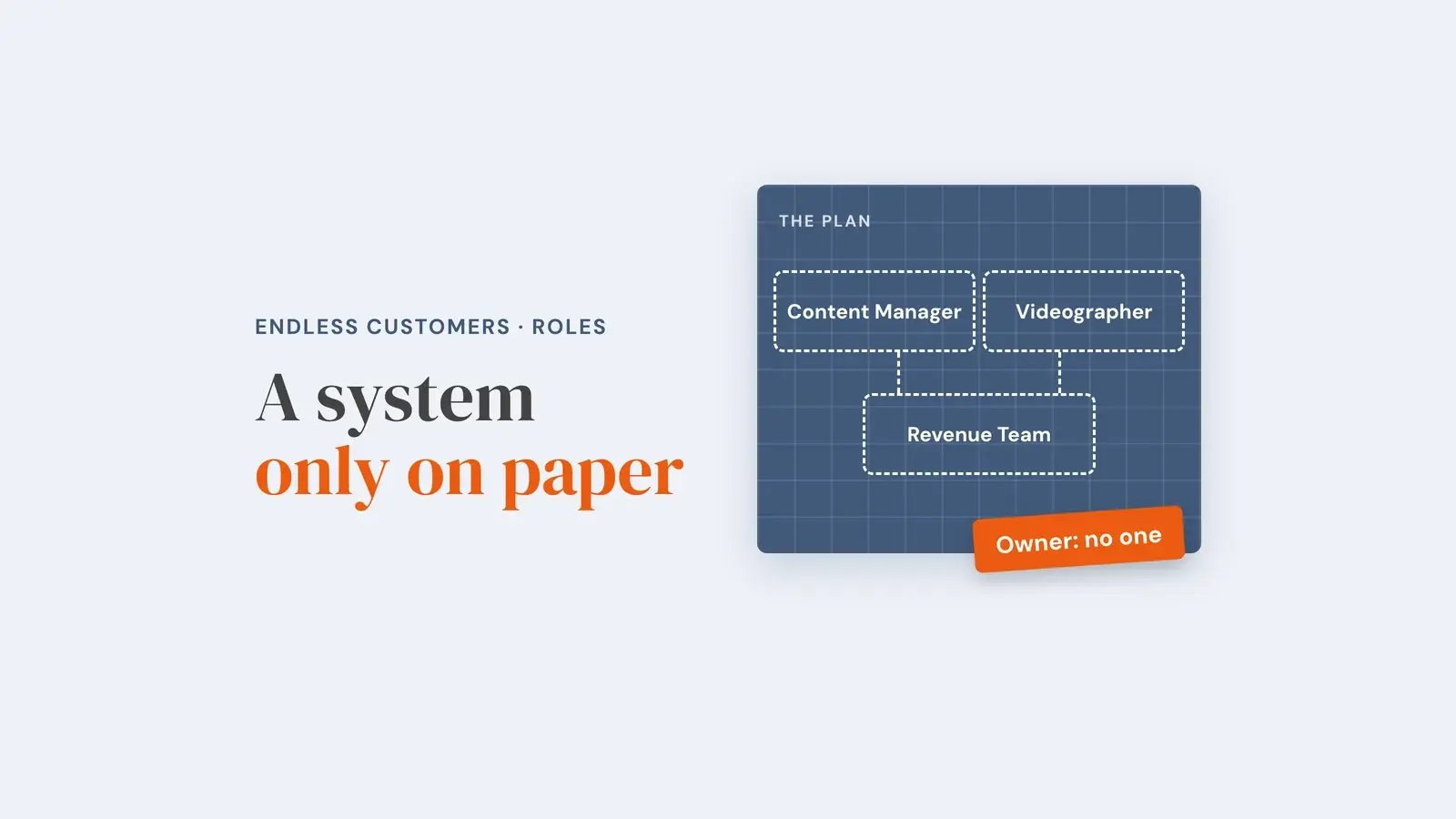
You are not failing because of your people. You are failing because of your structure.
This article is for agency owners and operations leads who suspect the delivery problems run deeper than headcount. You will learn how to distinguish a capacity problem from a systems failure, why hiring into a broken system makes things worse, and what to fix before you consider your next hire.
Key takeaways
- An agency delivery problem is a systemic failure in workflows, briefing quality, and accountability structures, not a lack of headcount.
- Hiring into a broken delivery system scales the dysfunction: more people means more management overhead, more miscommunication, and more rework.
- The true year-one cost of a mid-level UK agency hire, including salary, employer NI, recruitment fees, and ramp-up productivity loss, often exceeds £60,000–£90,000 ($75,000–$112,500).
- Agencies that fix their delivery systems before hiring report faster turnaround, fewer revision cycles, and higher margins.
- If your team is reliably busy but deadlines are still missed, you have a systems problem, not a staffing shortfall.
What is an agency delivery problem?
An agency delivery problem is a systemic failure to produce client work on time, on scope, and at a quality standard that doesn't require constant rework or heroic effort from your team.
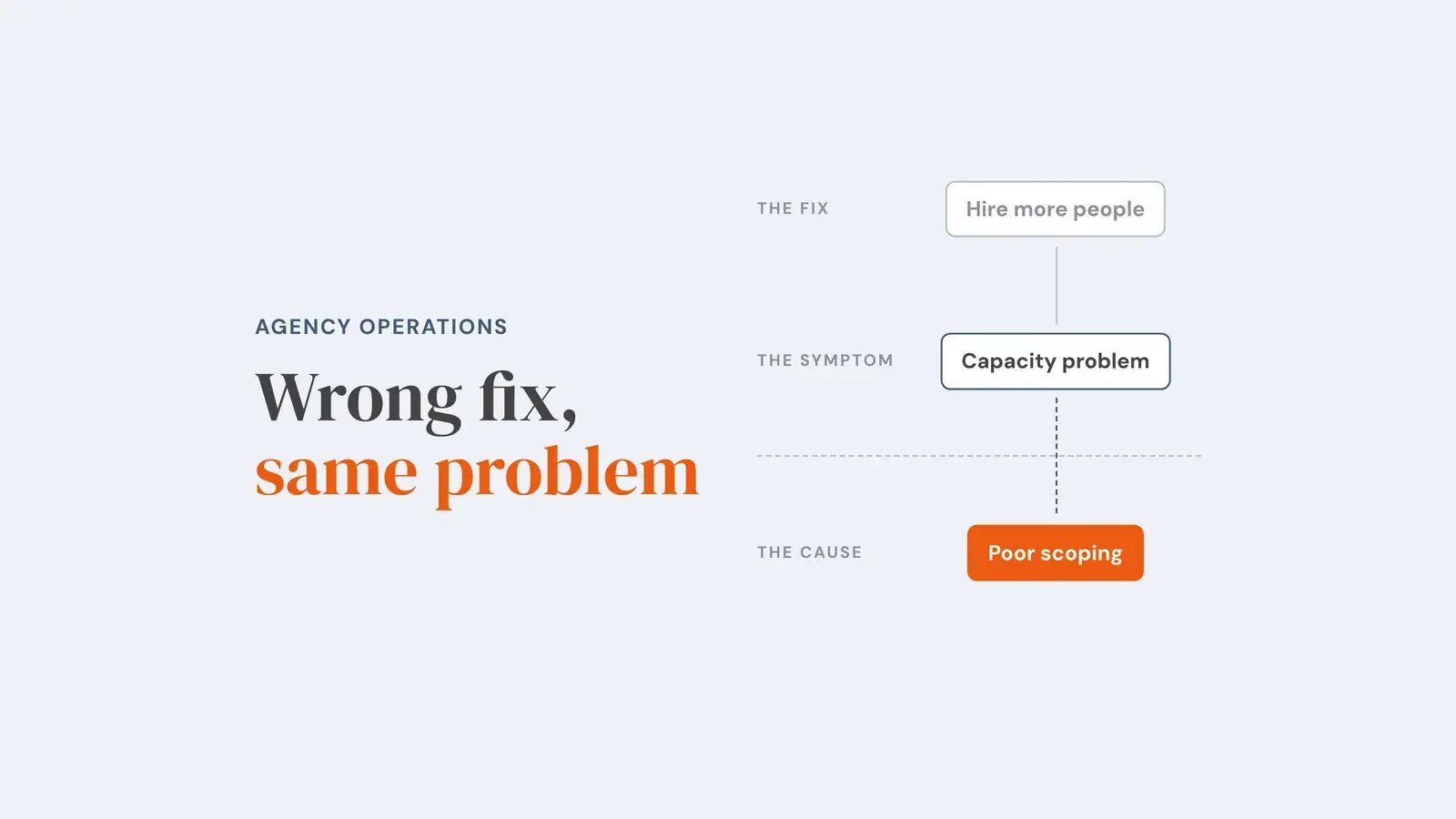
Unlike a capacity problem, which is genuinely about not having enough hours in the day, a delivery problem lives in your processes, handoffs, briefing quality, and accountability structures. The distinction matters because the solutions are completely different.
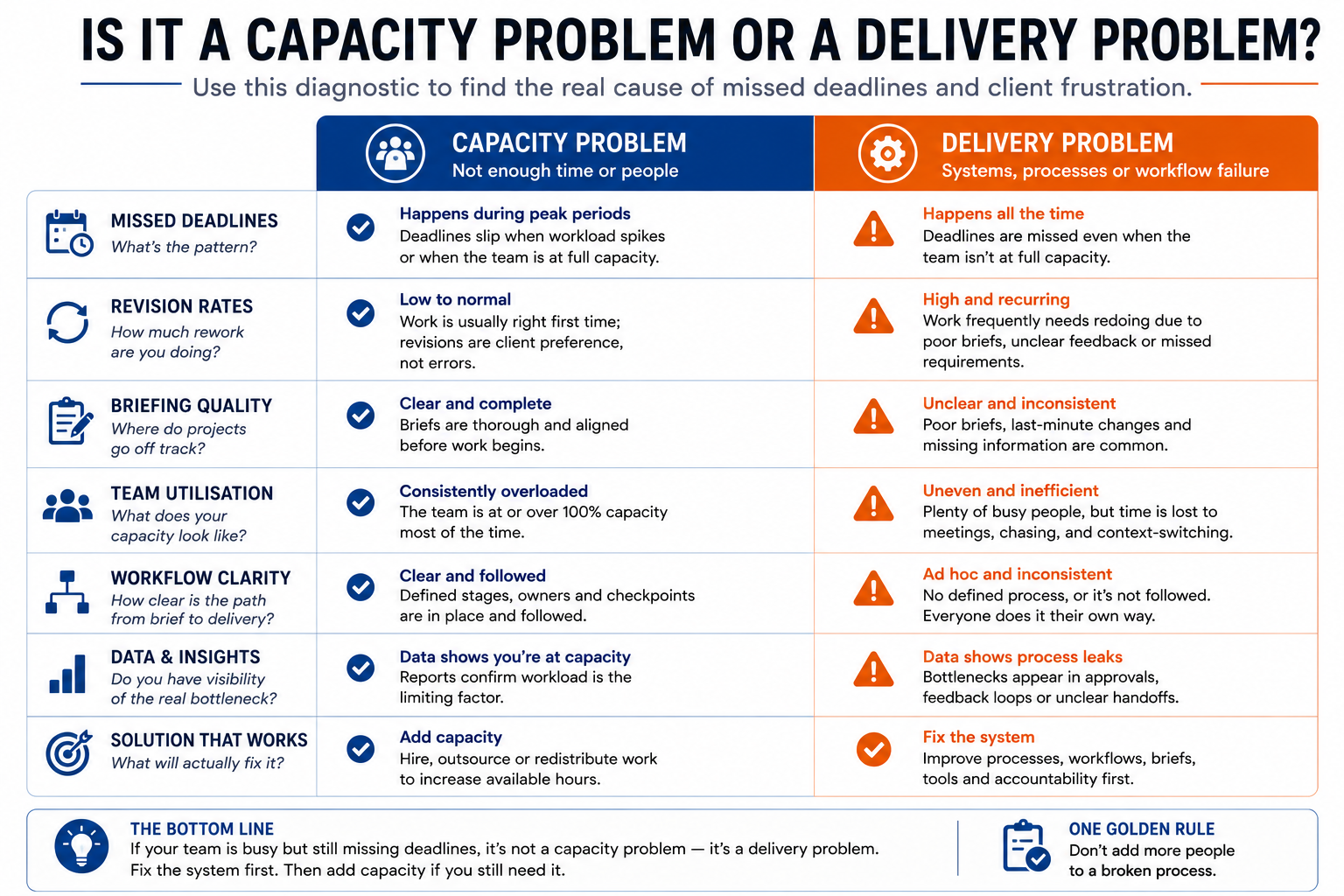
The most common misdiagnosis: agency owners see missed deadlines and assume they need more people. Most of the time, the root cause is a process gap, not a person gap.
The hiring myth: why agency owners reach for headcount first
Most agency owners hire when they feel overwhelmed, because adding people feels like the fastest and most logical response to being stretched thin.
This is an expensive misconception; the belief that more people automatically produces more output is one that costs agencies significantly more than they anticipate.
The triggers that most often push agency owners toward a premature hire:
- A key team member leaves and panic sets in
- A new client win creates a short-term delivery spike
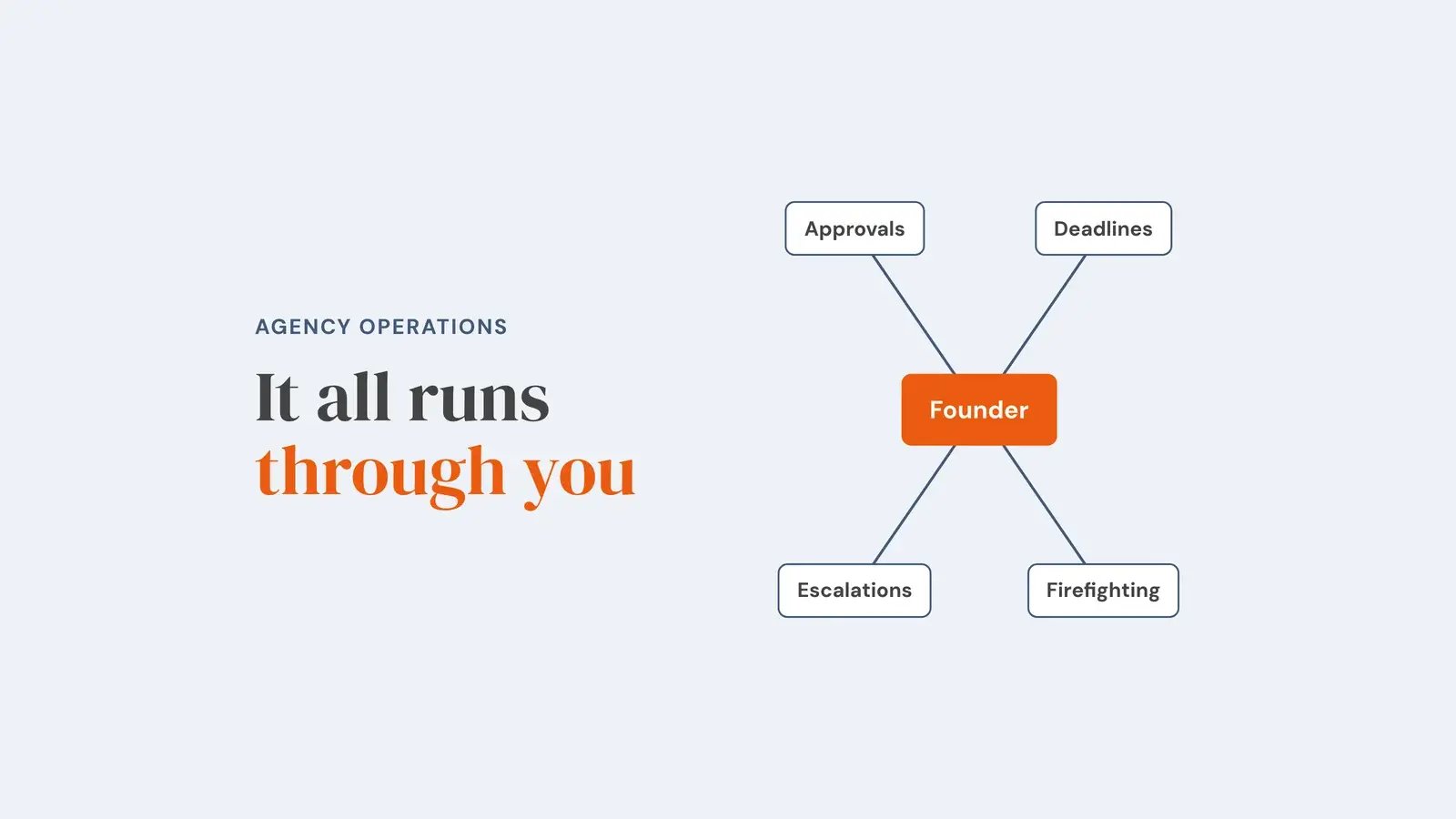
- The founder is in everything and assumes a hire will free them up
- Client complaints increase and something visible has to change
- Competitors appear to be growing their headcount
Each of these triggers feels like a staffing problem. Most of them are a systems problem wearing a staffing costume.

How hiring amplifies agency delivery problems instead of fixing them
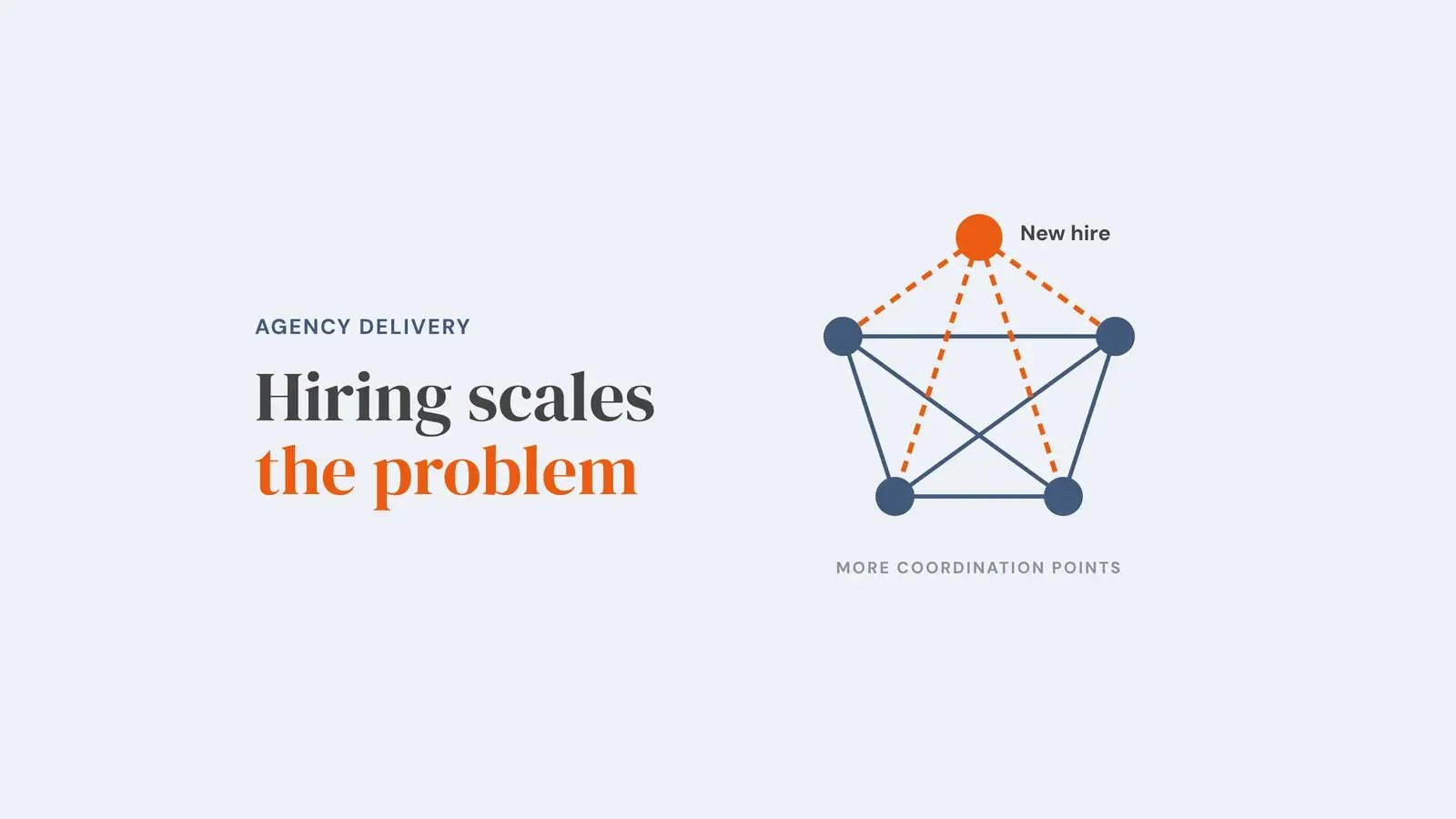
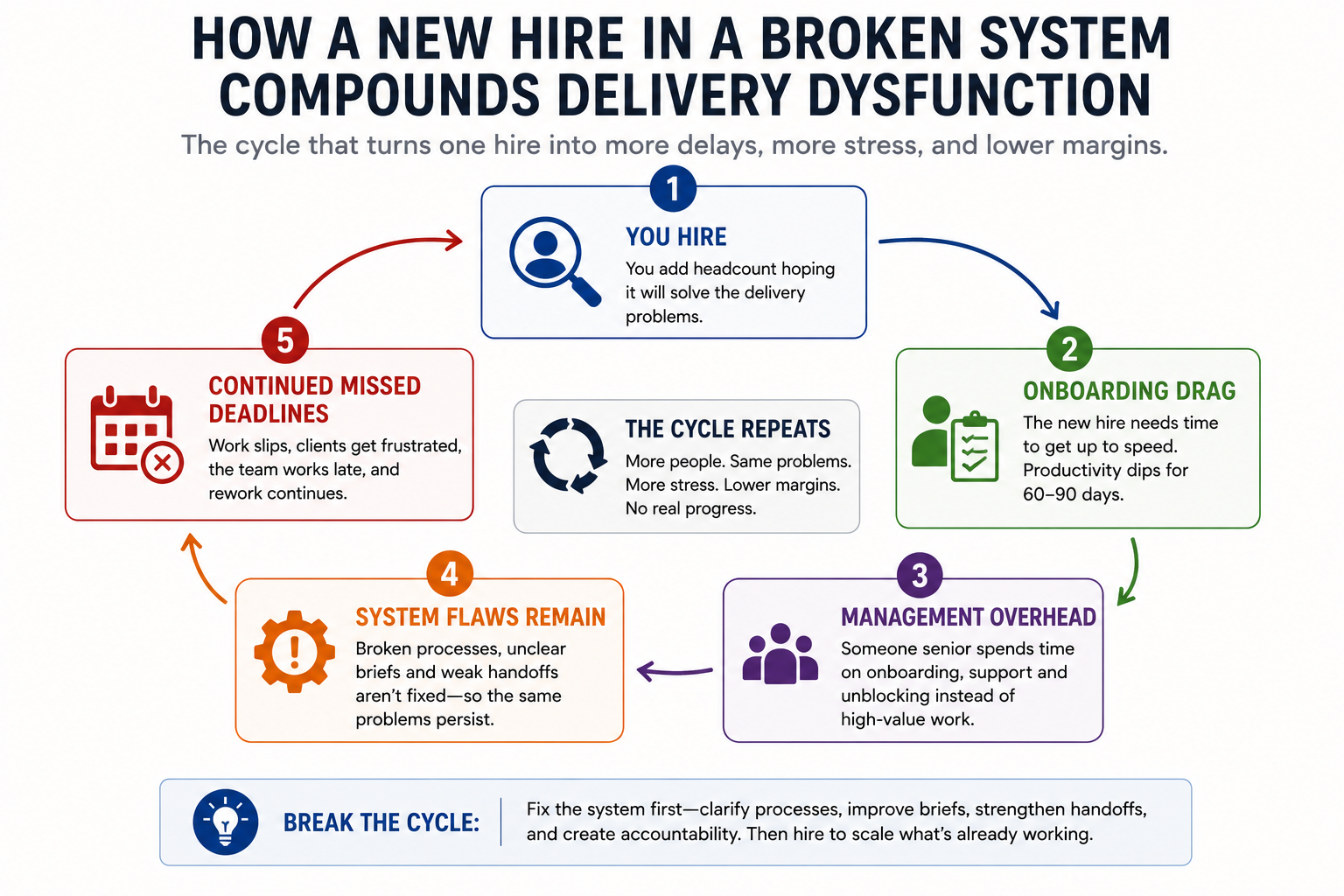
When you hire into a broken delivery system, you don't solve the problem; you scale it, adding more people who are subject to the same dysfunctional processes, unclear briefs, and inconsistent workflows.
Each new hire contributes the following:
- Onboarding drag: output dips for 60–90 days while the new person settles in
- Management overhead: someone senior absorbs that onboarding cost, reducing their own output
- Communication complexity: more people means more coordination points, and more room for things to fall through
- Process fragmentation: new hires inherit undocumented ways of working and create their own variations
- Diluted accountability: unclear ownership spreads further across a larger team
The net result: the bottleneck shifts rather than disappears, and the agency's margins take a hit before any benefit is realised.
The real cost of hiring to fix delivery at your agency
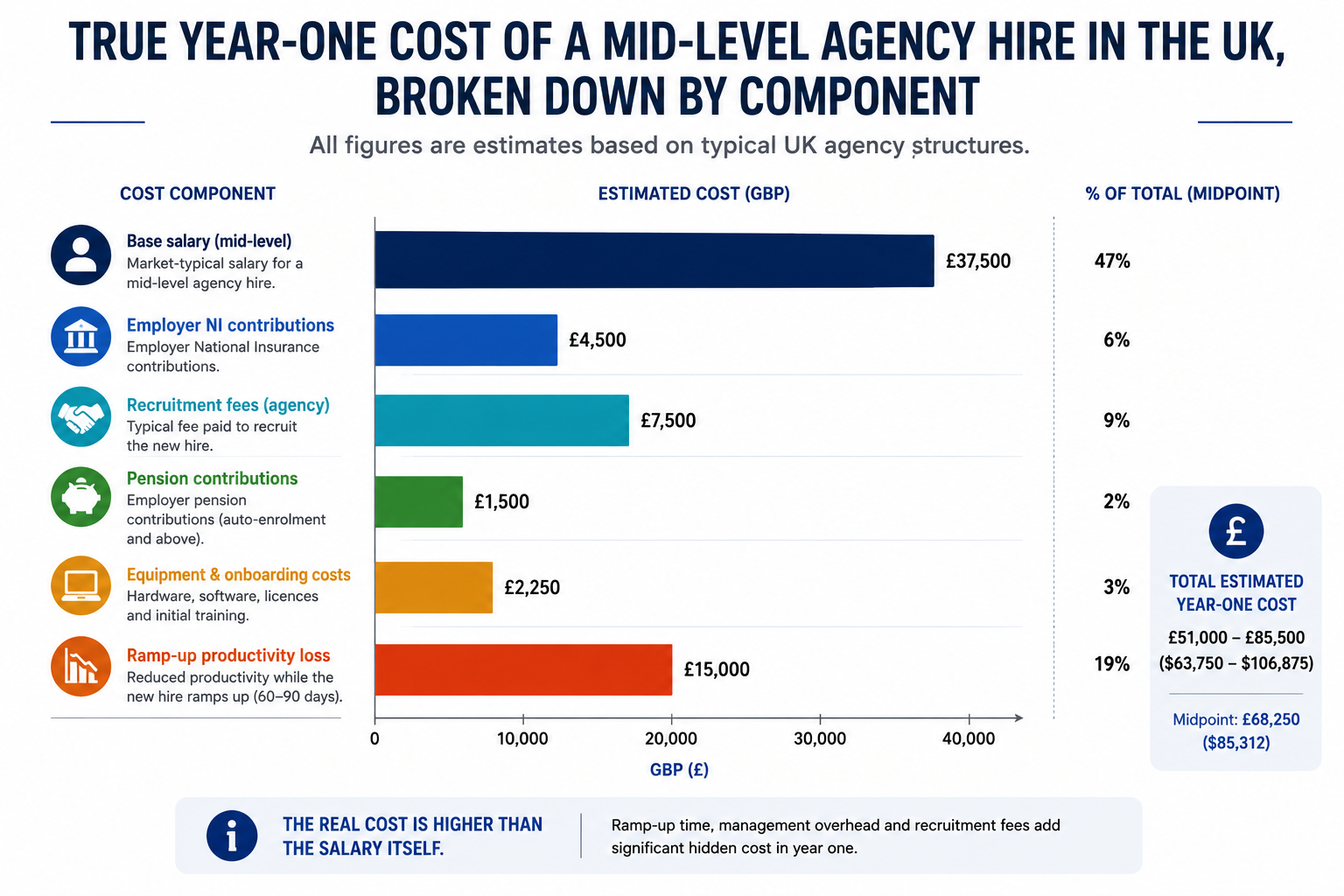
Hiring to fix a delivery problem is one of the most expensive mistakes an agency can make; the true year-one cost of a single mid-level hire often exceeds £60,000–£90,000 ($75,000–$112,500) when all factors are included.
These are estimates based on typical UK agency cost structures. Actual figures will vary by role, seniority, and recruitment method. Figures are derived from REC UK Recruitment Industry data and standard HMRC employer contribution rates.
| Cost component | Estimated range |
|---|---|
| Base salary (mid-level) | £30,000–£45,000 ($37,500–$56,250) |
| Employer NI contributions | £3,500–£5,500 ($4,375–$6,875) |
| Recruitment fees (agency) | £5,000–£10,000 ($6,250–$12,500) |
| Pension contributions | £1,000–£2,000 ($1,250–$2,500) |
| Equipment and onboarding costs | £1,500–£3,000 ($1,875–$3,750) |
| Ramp-up productivity loss (60–90 days) | £10,000–£20,000 ($12,500–$25,000) |
| Total estimated year-one cost | £51,000–£85,500 ($63,750–$106,875) |
These are indicative figures based on typical UK agency structures. Treat as a planning guide, not precise projections.
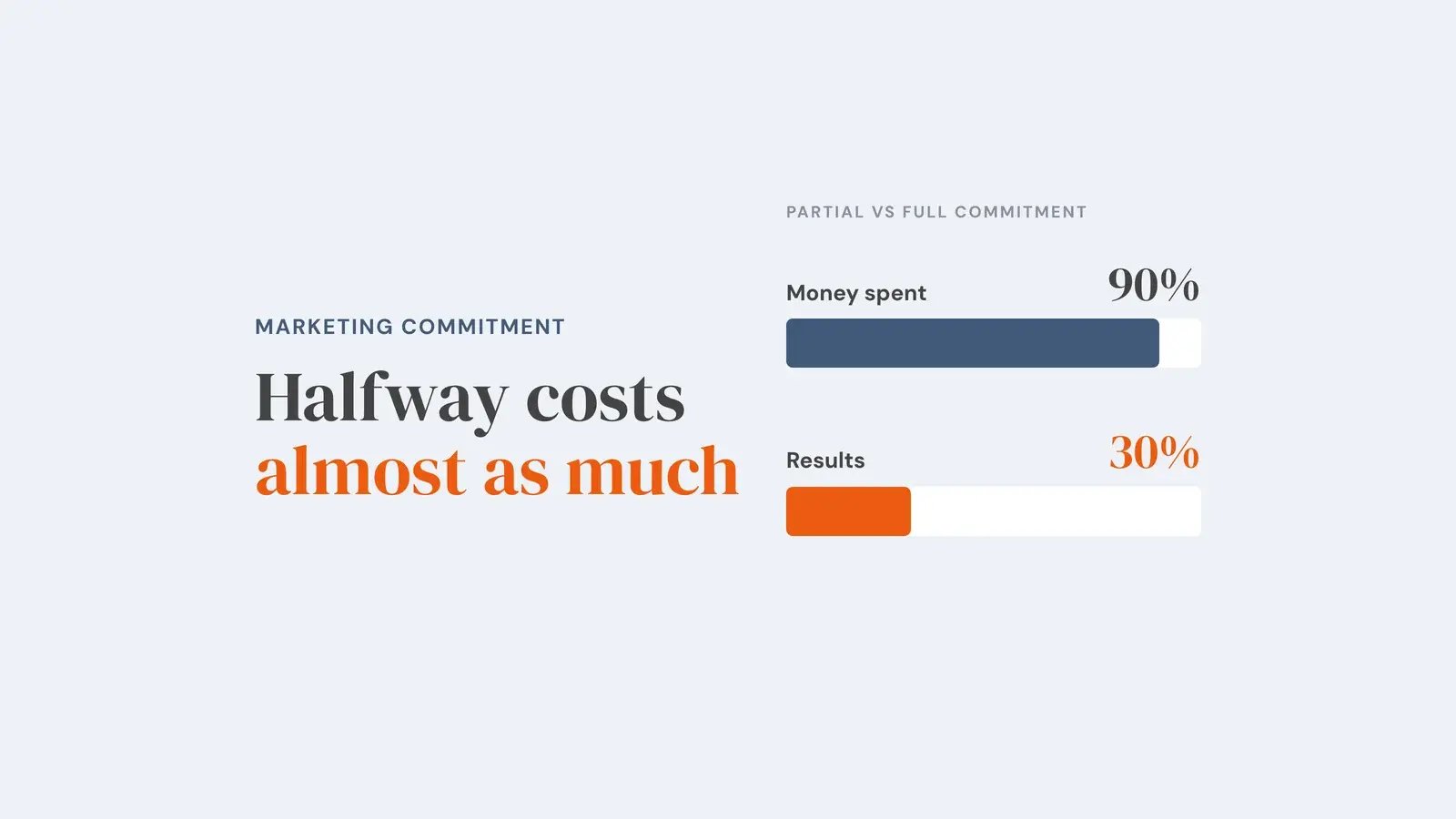
Beyond direct financial cost, most agencies see a measurable drop in team output for the first 60–90 days after a new hire joins, worsening the bottleneck the hire was brought in to solve.
Should you hire first, or fix your systems first?
Both approaches cost money and time. The question is which one addresses the actual problem.
Hiring adds resource to an existing process. Fixing your systems removes the root cause of the failure. Those are not the same intervention, and they produce different outcomes.
Agencies that invest in standardised workflows, clear SOPs, and accountable project management structures before hiring routinely report faster turnaround, fewer revision cycles, and higher margins.
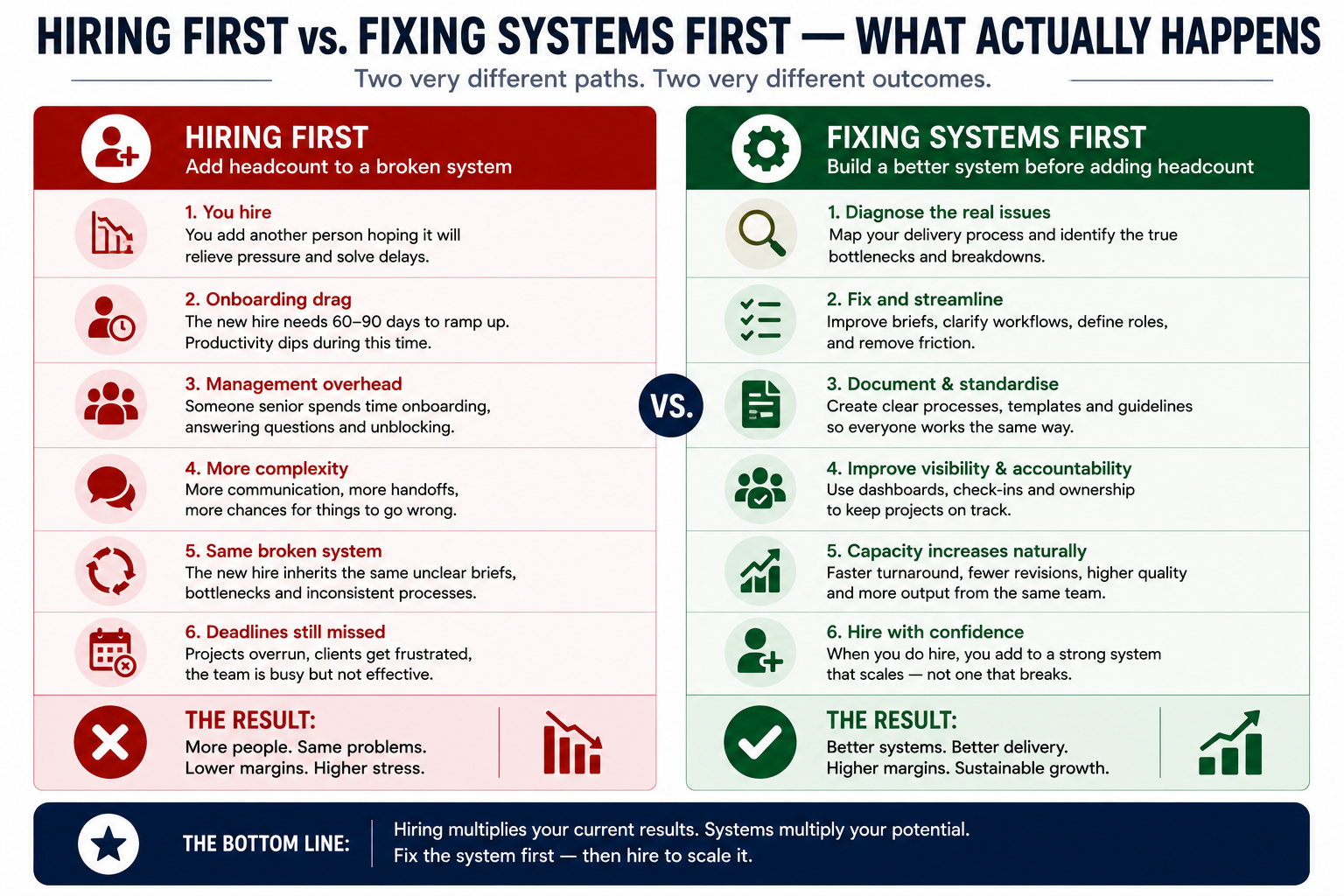
Structure before scale is not the cautious approach. It is the faster one.
How to tell if your agency has a delivery problem, not a capacity problem
The clearest sign of a delivery problem, rather than a capacity problem, is that adding hours or people doesn't measurably improve output speed or quality.
Run through this diagnostic:
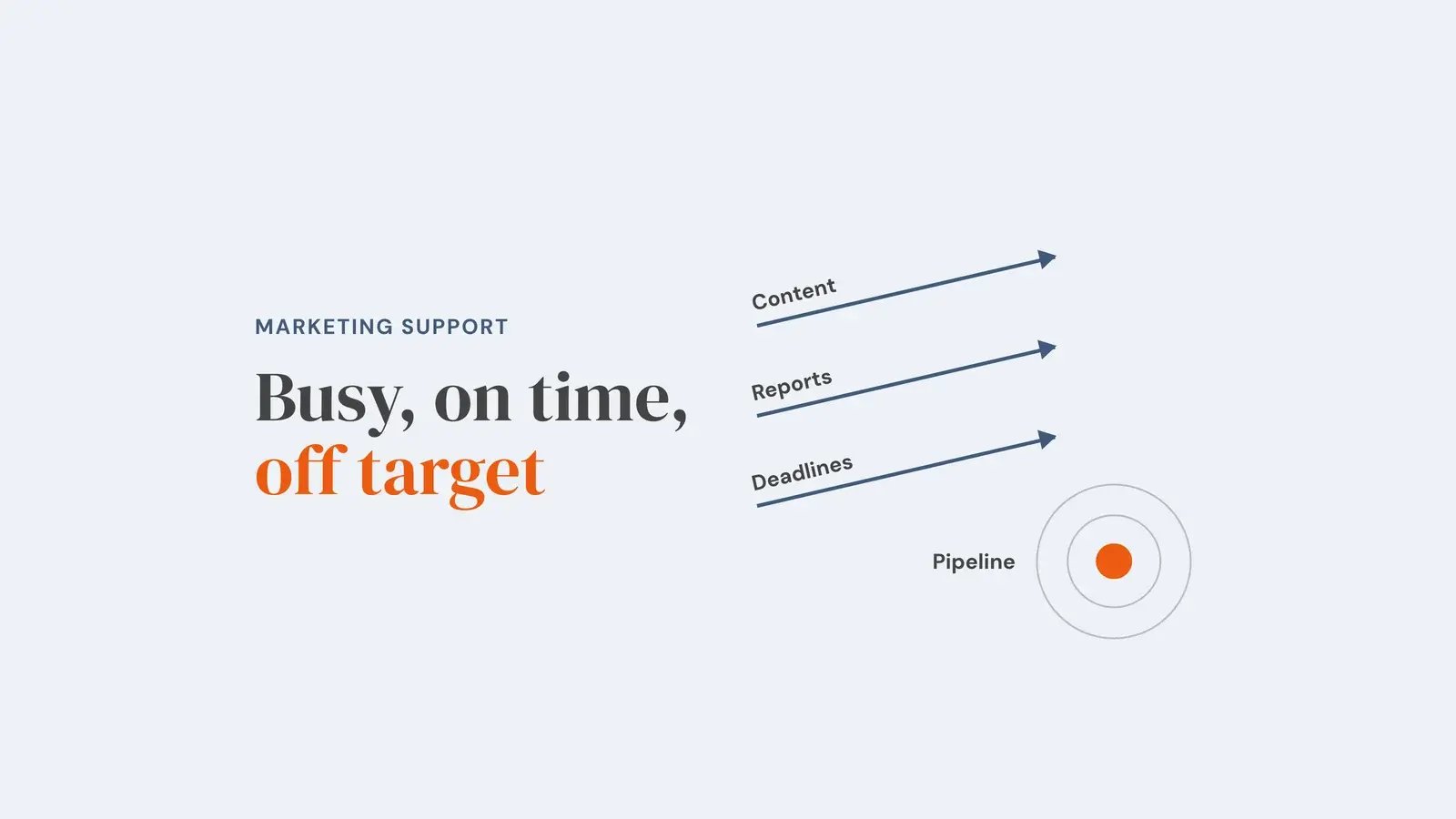
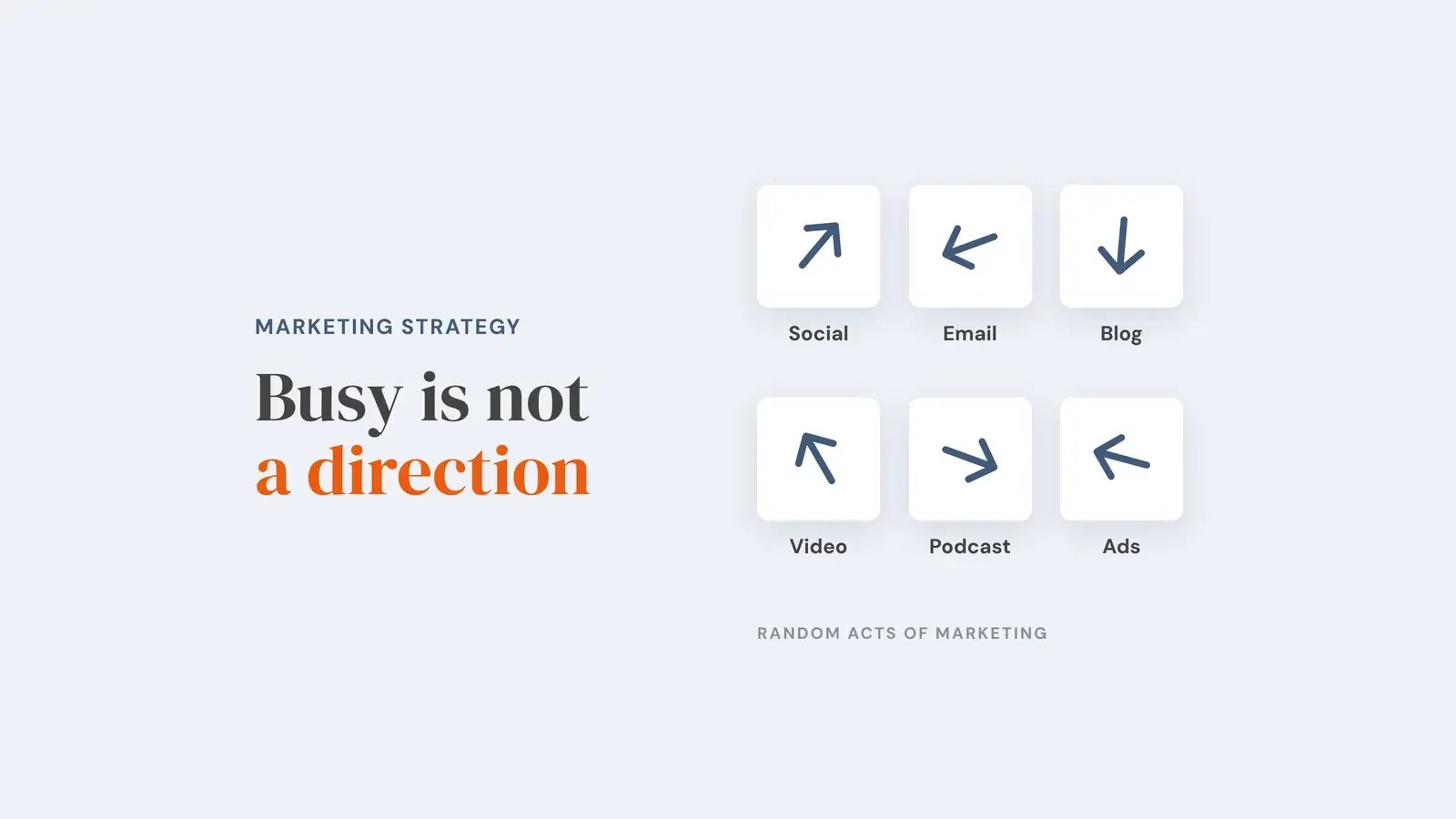
- Your team is reliably busy, but deadlines are still missed
- Revision rates are high even on straightforward briefs
- Work quality varies depending on who handles the project, not what the brief says
- You cannot clearly explain your delivery process to a new client
- Project ownership is unclear; tasks fall through the gap between roles
- Profitability per project is declining despite similar workloads
- You have hired before, and the problems came with the hire
If three or more of these apply, the problem is structural, and hiring will not fix it. The steps below are where to start.
How to fix agency delivery problems before you hire
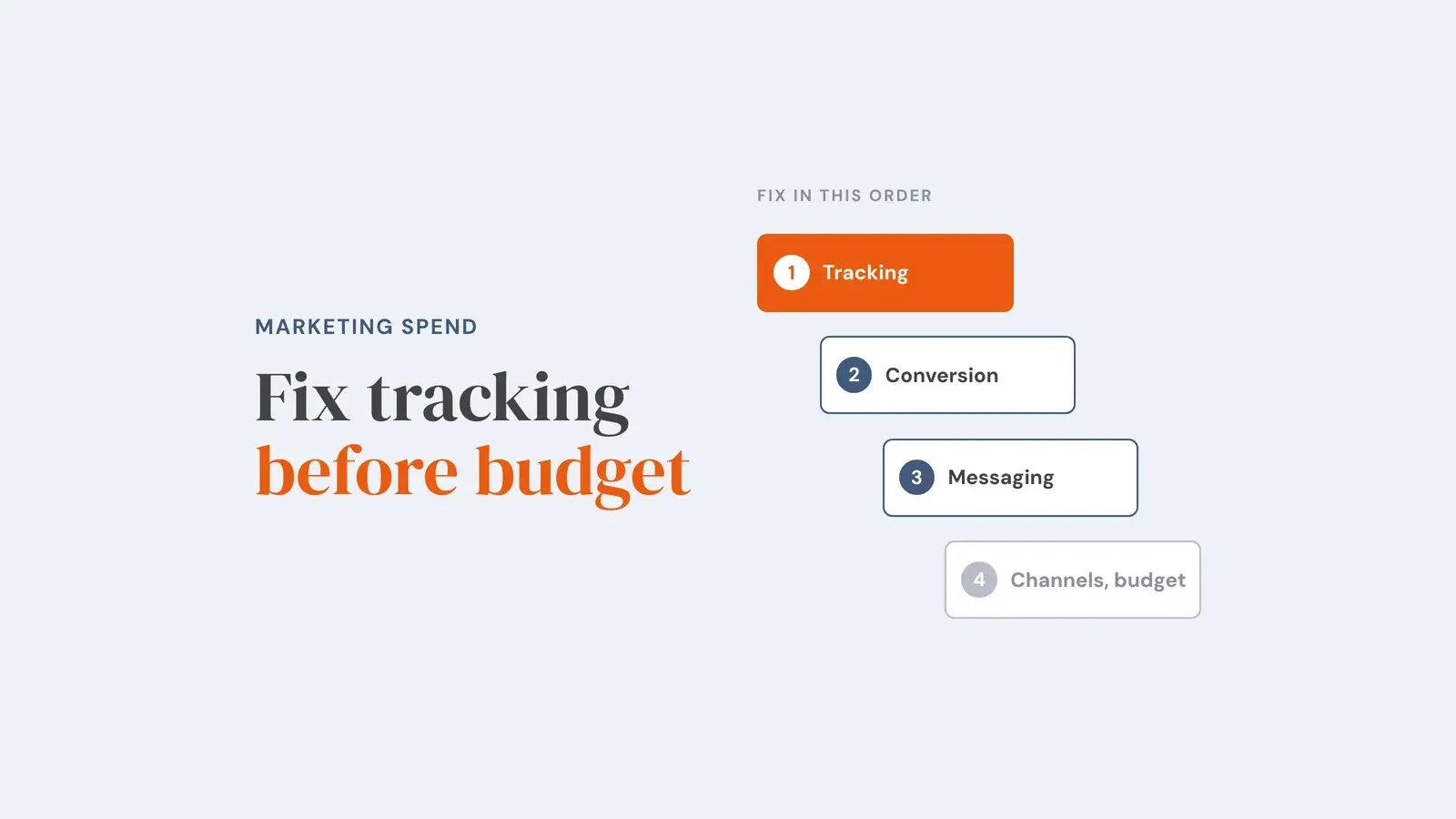
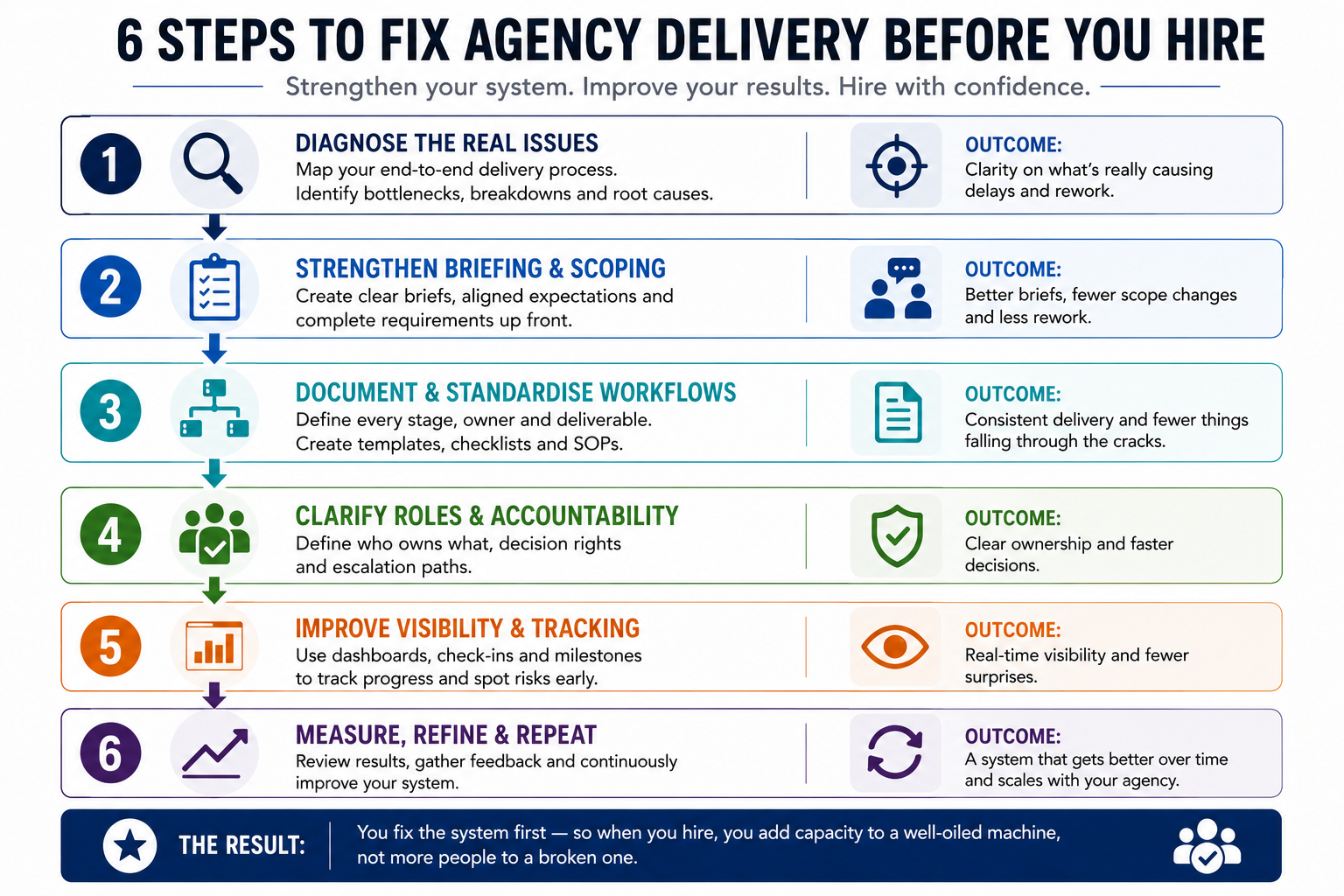
Fixing agency delivery problems before hiring follows a clear sequence: audit your workflows, identify the true bottleneck, standardise the process, measure output, and only then assess whether additional headcount is genuinely needed.
- Audit: Map your current delivery process end-to-end. Where do delays routinely occur?
- Diagnose: Identify whether the bottleneck is a process gap, a briefing gap, or an accountability gap.
- Standardise: Build SOPs and templates that remove reliance on individual knowledge.
- Assign ownership: Make accountability explicit at every stage of the workflow.
- Measure: Run the standardised process for 4–6 weeks and track delivery speed, output quality, and revision rates.
- Decide: Only once the system is working cleanly should you assess whether headcount is the right next step.
This sequence ensures any future hire steps into a functional, documented system, rather than inheriting the chaos that was already there.
My Systems & Pricing Consultancy and Fractional COO for Agencies services are built specifically for agencies at this stage of work.
Frequently asked questions
At what point is it actually right to hire?
The right time to hire is when your delivery system is working cleanly and output is genuinely constrained by available hours, not when delivery is chaotic and you hope a new person will absorb the damage.
How long does it take to fix a delivery problem without hiring?
Most agencies see measurable improvement within 4–8 weeks of implementing standardised workflows and clear accountability. Full stabilisation typically takes 2–3 months.
Can better project management software fix delivery issues?
Better project management software rarely fixes delivery issues on its own. Software surfaces problems; it doesn't fix the underlying process. Implementing a new tool into a broken workflow adds friction more often than it removes it.
What's the difference between a delivery problem and a people problem?
The difference between a delivery problem and a people problem is scope. A delivery problem affects output regardless of who is involved. A people problem is specific to one individual. If multiple people are producing inconsistent results, it is a delivery problem.
Should you pause new business until delivery is fixed?
You do not necessarily need to pause new business until delivery is fixed, but be honest about your current capacity to deliver to the standard your clients expect. Taking on new clients into a broken system accelerates the damage.
Moving forward
You have been firefighting delivery issues and reaching for headcount as the answer. You can now see that the balance will not tip without fixing the structure underneath it.
The pattern is predictable: structure first, then scale. The agencies that grow profitably get this sequence right, and delivery systems can be fixed faster than most agency owners expect. Once fixed, they make every future hire more effective, not just the next one.
How to take action now:
- Run the 7-point diagnostic above against your current delivery operation
- Map one core delivery workflow end-to-end this week to identify where delays occur
- Audit your briefing quality, most delivery failures start at the brief, not in execution
- Review whether your team has documented SOPs or relies on individual knowledge
- Book a scoping call to explore whether Systems Consultancy or Fractional COO support is the right starting point
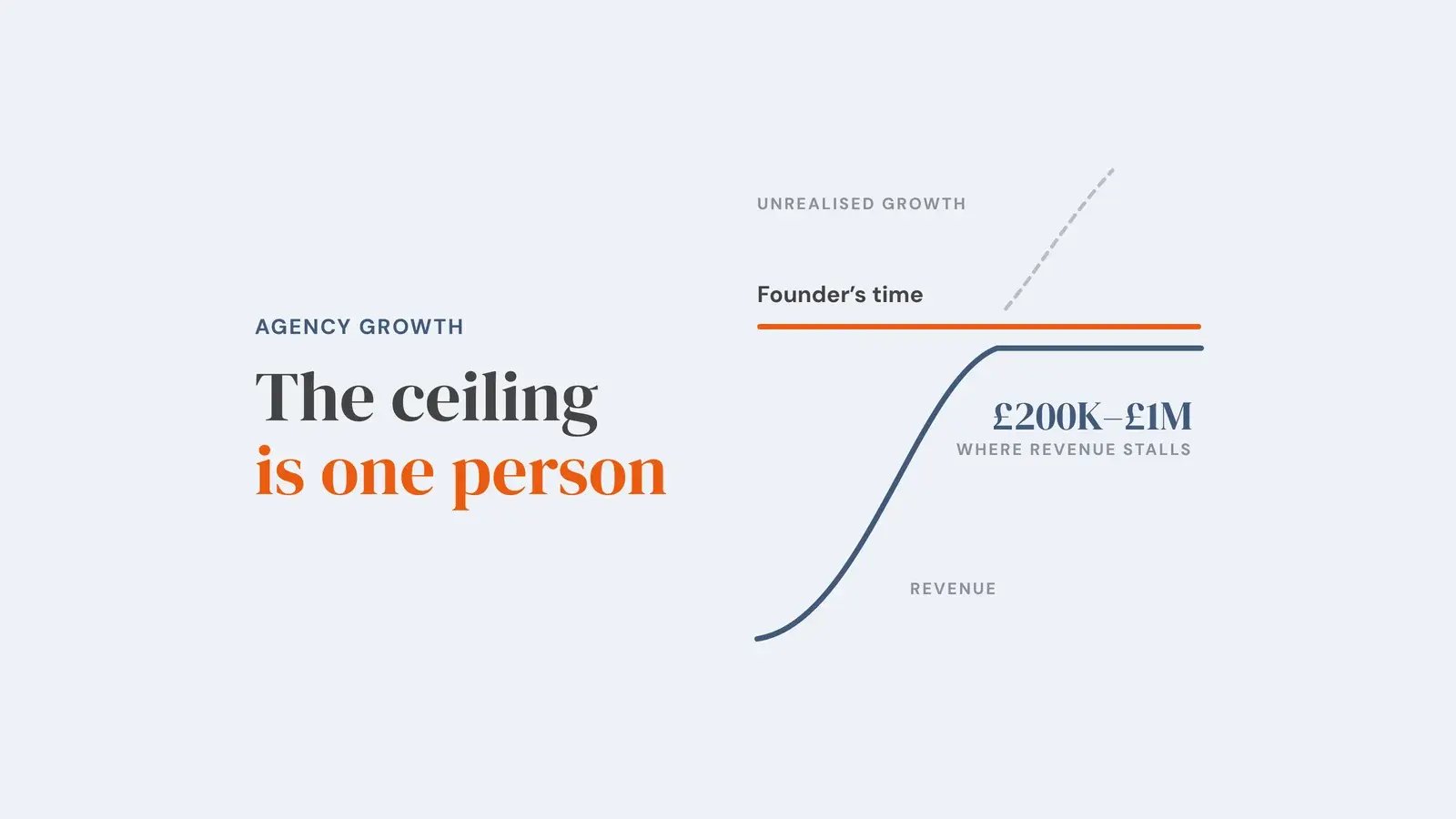
For a broader view of what structural agency operations looks like at the leadership level, read Why Agency Growth Stalls at Founder Capacity (Even With a Team).
Weighing up fractional support against a full-time hire? Fractional COO Vs Full-Time Hire: The True 12-Month Cost Breakdown covers the numbers directly.

About the author
Tom Wardman is an agency operations strategist and the architect of the Agency Operating System™. Having worked inside and alongside digital marketing and creative agencies, Tom specialises in fixing the structural problems, including delivery fragility, margin erosion, and founder dependency, that prevent agencies from growing profitably. His services range from one-off systems audits to embedded Fractional COO and CGO leadership, all designed to transfer operational capability to your team rather than create ongoing reliance on an external consultant.
Pricing disclaimer: All GBP–USD price conversions are rounded estimates and correct at the time of publishing. Exchange rates fluctuate and figures should be treated as indicative only.
Topics: