

Does your agency keep growing, yet you still review every deliverable, handle every difficult client call, and quietly hold the whole operation together?
Does adding people somehow add to your workload rather than reduce it?
There is a structural fix, and it does not require you to hire your way out of it.
If so, you have likely hit the agency founder capacity ceiling. This article explains what that ceiling is, why it persists even with a capable team, and what a structured path out of it looks like, so you can build an agency that scales without you at the centre of it.
Key takeaways
- The agency founder capacity ceiling is the structural limit that occurs when an agency's delivery, decisions, and client relationships all route back to the founder, regardless of how many people are on the team.
- Hiring alone does not fix founder dependency. Without documented processes, defined decision rights, and transferred client ownership, new hires typically add to the founder's management load rather than reduce it.
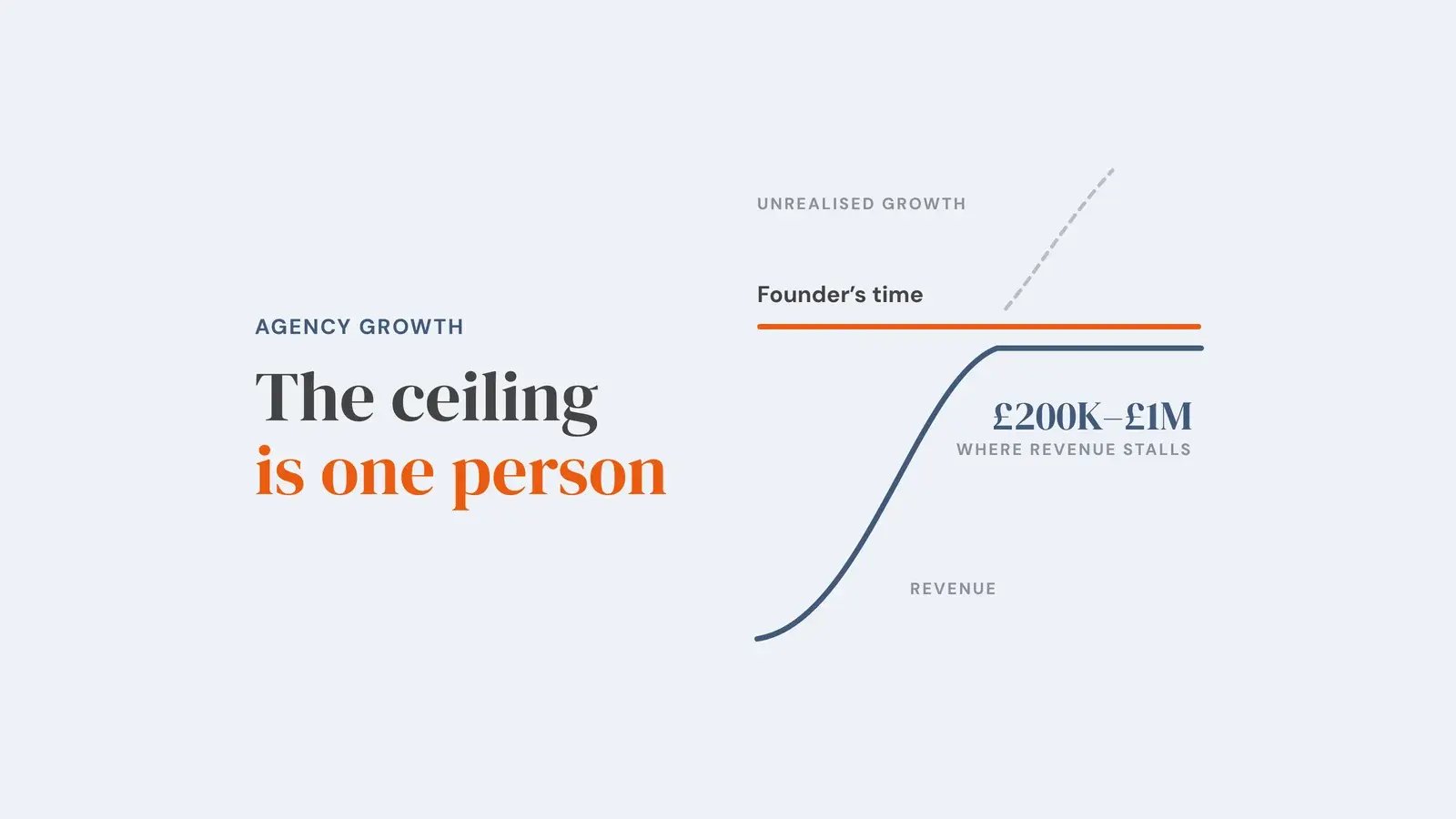
- Agencies at this ceiling commonly plateau between £200K–£1M ($250K–$1.25M) in annual revenue, an estimate based on industry observation.
- The hidden costs include founder burnout, elevated staff turnover, and a business that is structurally unsaleable (meaning its value is tied to one person, making it unattractive to buyers) due to key-person risk.
- Breaking the ceiling requires structure before headcount. Audit your dependencies, document your processes, and formally redefine what the founder's role actually is.
What is the agency founder capacity ceiling?
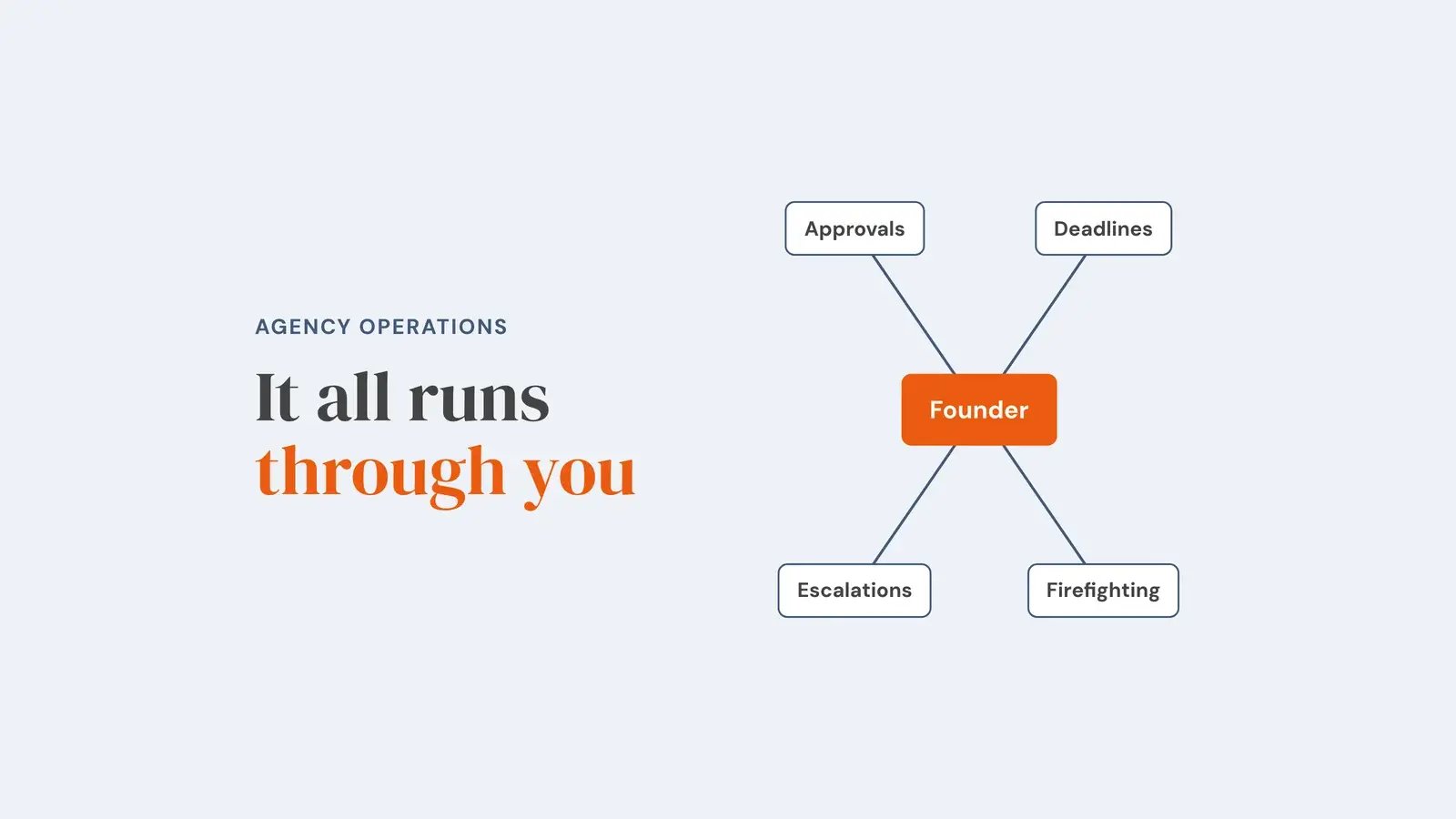
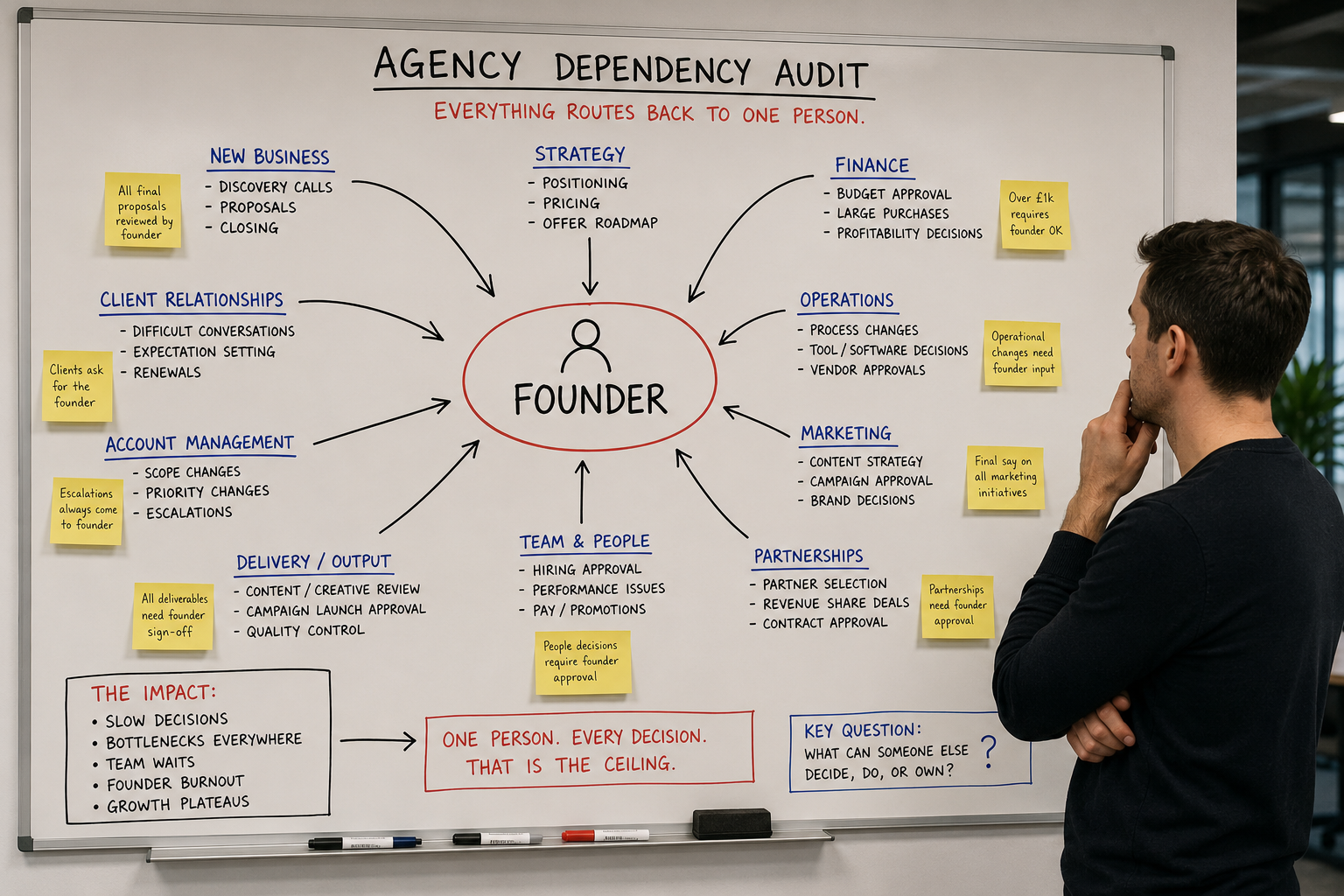
The agency founder capacity ceiling is the invisible growth limit that occurs when an agency's delivery, decisions, and client relationships are all constrained by the personal bandwidth of its founder.
Even agencies with capable teams hit this ceiling when the founder remains the primary point of approval, quality control, or client contact. The ceiling is structural. You can work harder, hire more, and win more clients, and still not break through it, because the architecture of how work gets done has not changed.
You are likely at your ceiling if:
- Clients ask for you by name, and disengage when you are unavailable
- Deals stall when you are on holiday or offline
- Work does not leave the door without your personal review
- Your team escalates decisions to you rather than resolving them independently
- Revenue has been flat for 12+ months despite growing headcount

Why hiring more staff doesn't automatically fix the problem
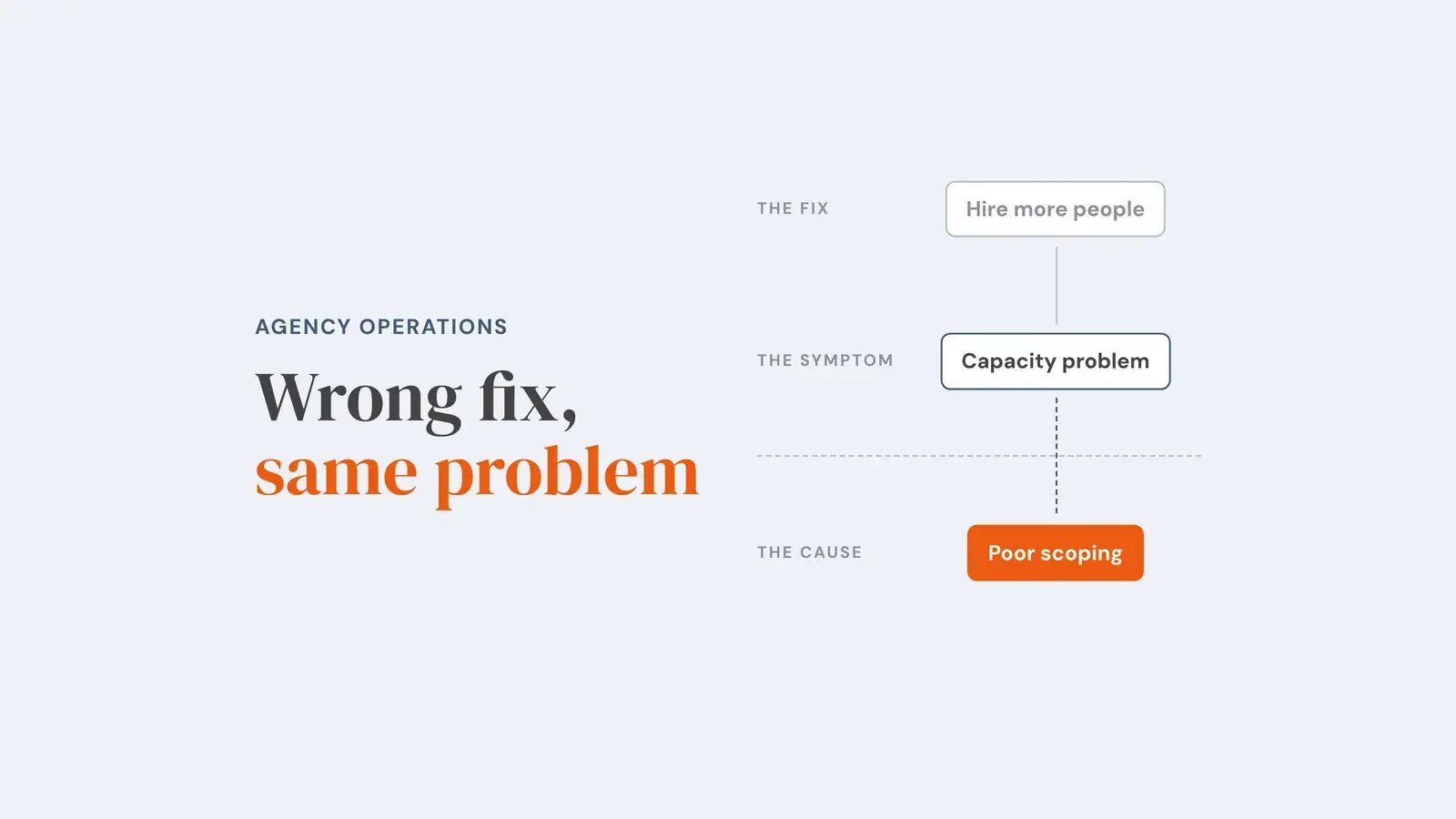
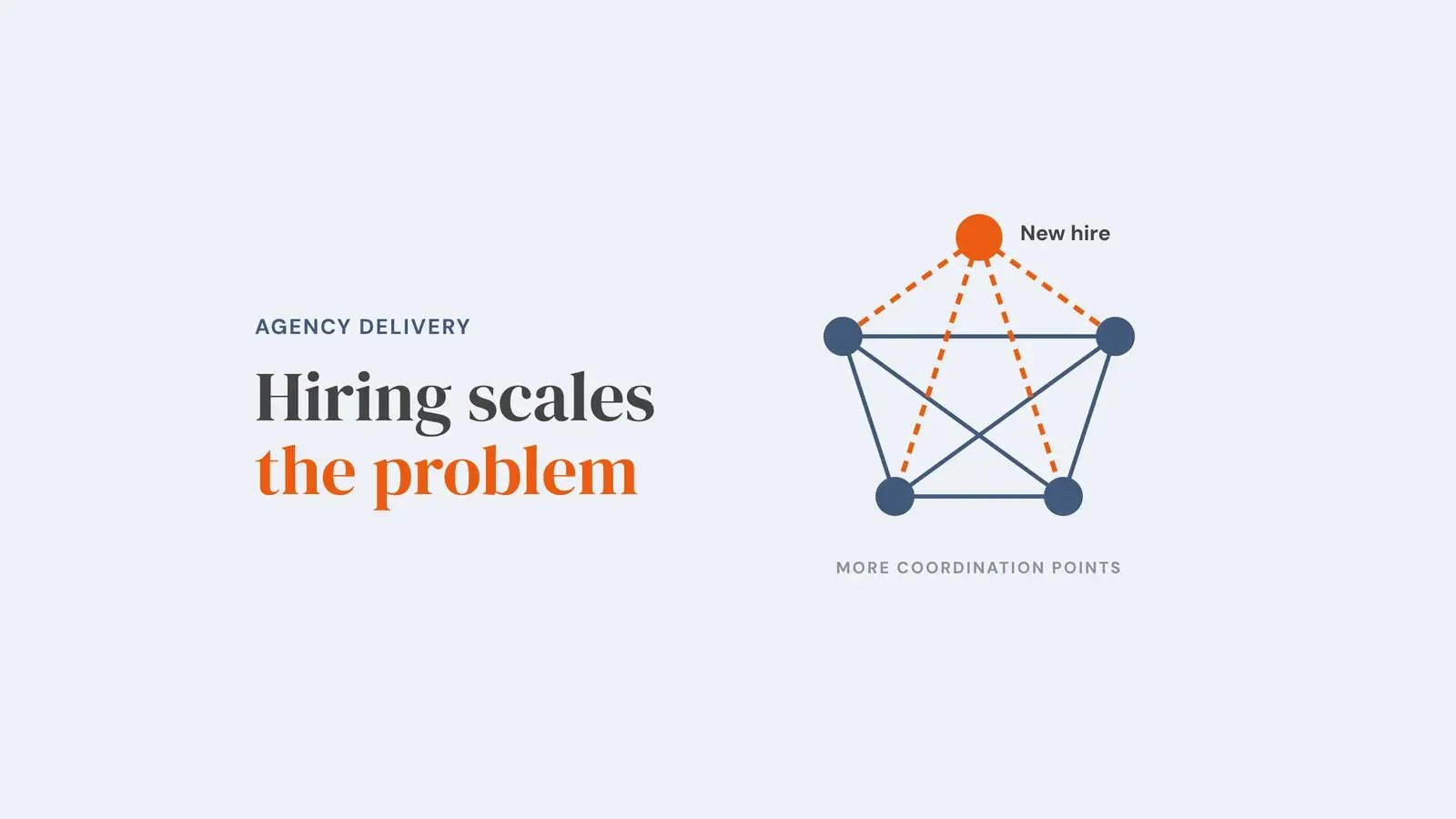
Hiring more staff does not break the agency founder capacity ceiling unless decision rights, documented processes, and client relationships are deliberately transferred away from the founder.
A new account manager without documented processes will ask the founder what to do. A new strategist without defined decision rights will escalate every non-standard situation. The bottleneck rebuilds itself with every hire because the underlying architecture — not the headcount — is the problem.
Common hiring mistakes that reinforce founder dependency:
- Hiring for execution without defining ownership or accountability
- Onboarding staff without documented processes for them to follow
- Adding headcount before fixing the decision-making structure
- Growing client volume faster than the operational infrastructure can support
That said, there are situations where close founder involvement is entirely appropriate. In the earliest stages, when processes do not yet exist and the founder's judgment is genuinely the product, a high degree of personal involvement is rational.
The problem is not involvement itself. It is when that involvement becomes structural dependency: a permanent, unintentional architecture that makes the agency unable to function without you, even after the team and revenue base have grown.

What does staying stuck at founder capacity actually cost your agency?
Agencies stuck at the founder capacity ceiling typically plateau between £200K–£1M ($250K–$1.25M) in annual revenue, leaving substantial growth unrealised because one person's time cannot stretch further. (Estimated range based on industry observation, no single published source.)
Beyond the revenue cap, the costs compound in ways that rarely appear on a P&L.
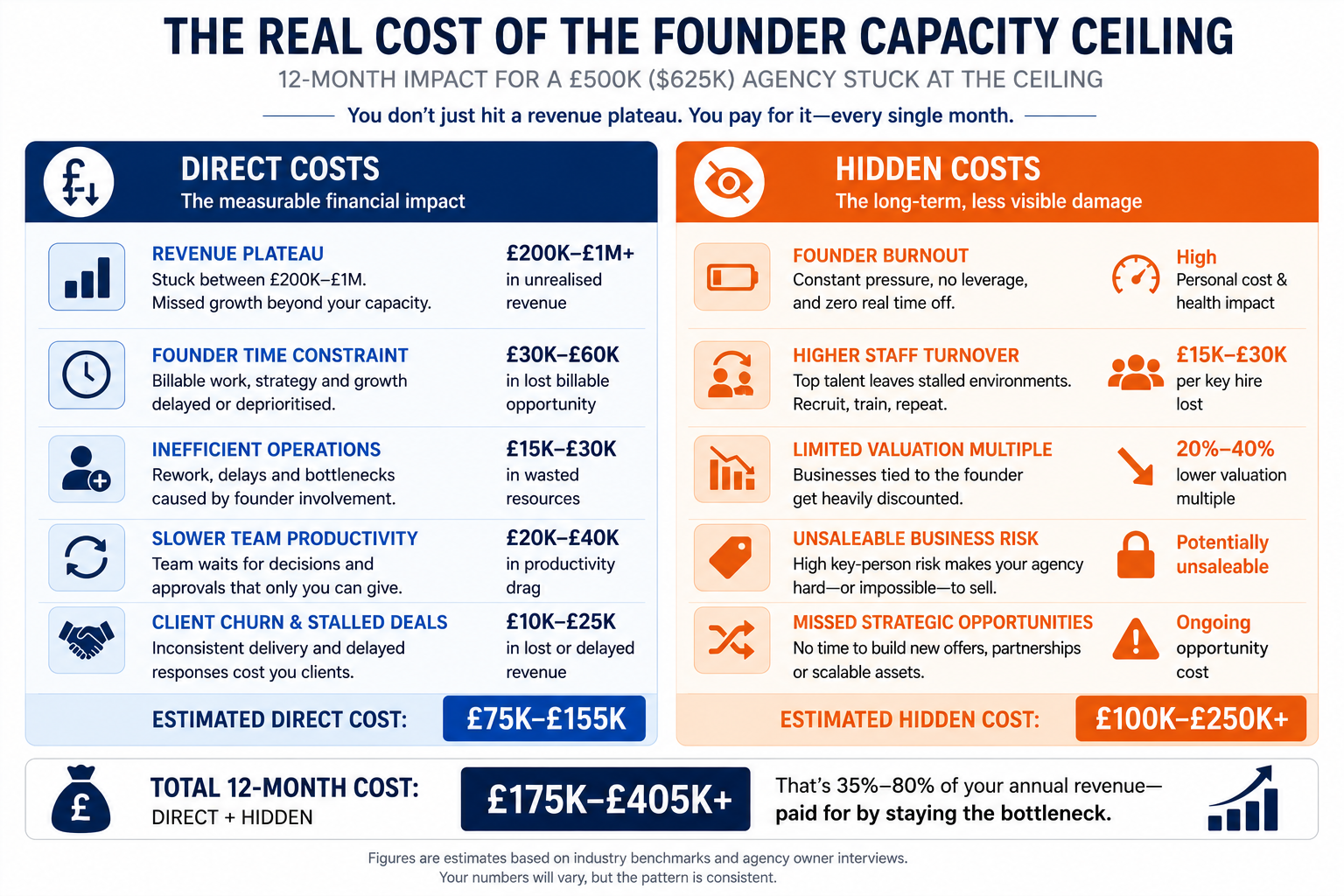
A business where value lives in one person is both unscalable and structurally unsaleable. Structurally unsaleable means the business's value is tied so closely to one individual that acquirers can't price it without factoring in the risk of that person leaving.
Research from Equiteq's Agency Growth and M&A Intelligence Report, a leading source on agency valuation multiples and acquisition criteria, suggests acquirers typically apply a significant valuation discount, or walk away entirely, when this kind of key-person risk is high.
The real problems that keep agencies founder-dependent
The most common structural problems that keep digital marketing agencies founder-dependent are undocumented processes, founder-held client relationships, absent leadership layers, and a culture where nothing ships without founder approval.
These problems compound over time. Each month without a fix makes the agency more reliant on the founder, not less, regardless of how many people are on the payroll.
The 6 root causes; use these to self-diagnose:
- Undocumented processes: Work is completed from memory rather than a defined system
- Founder-owned client relationships: Key clients bond with you personally, not the business
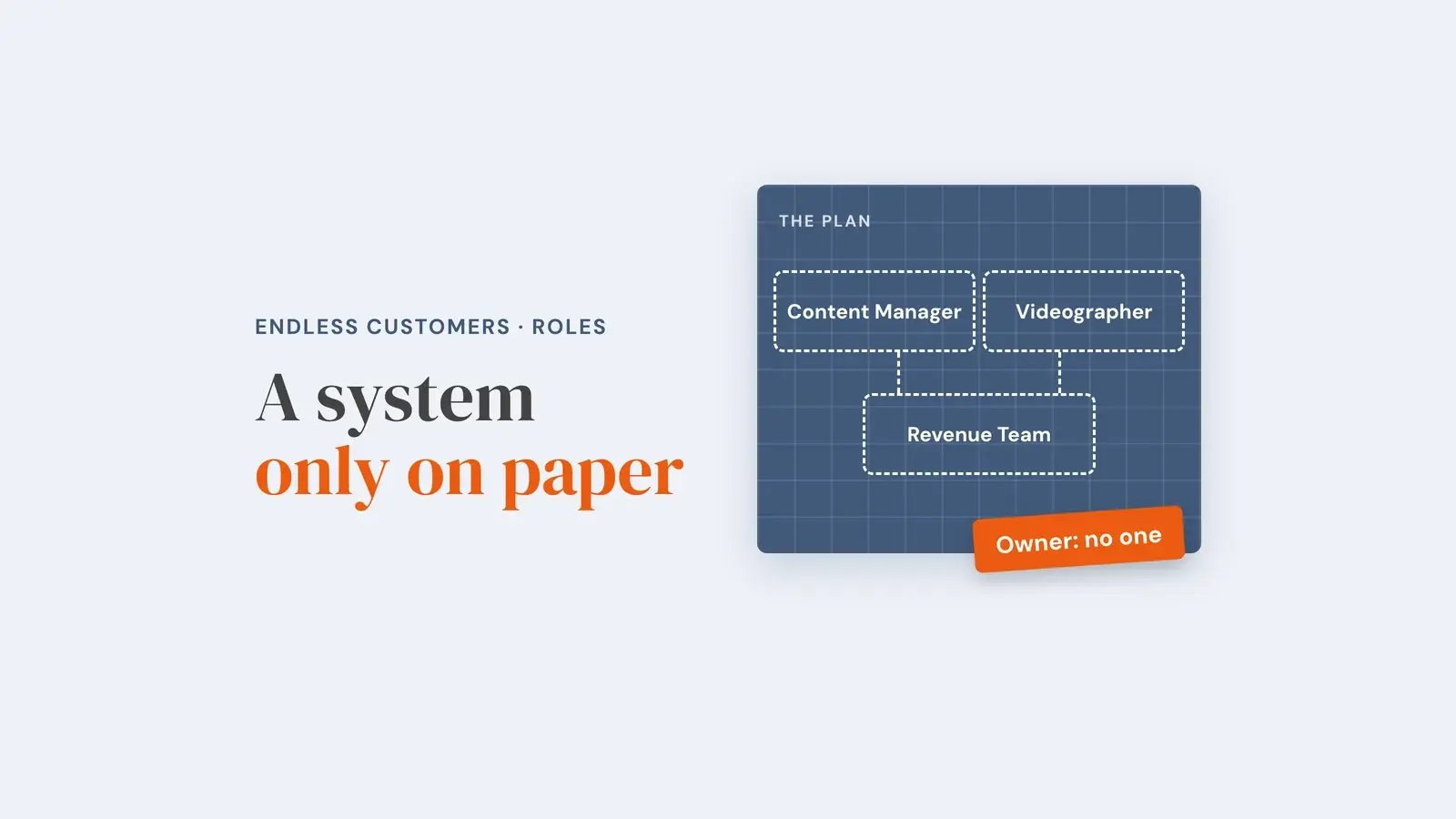
- No defined decision rights: The team has no authority to act without founder sign-off
- Absent middle leadership: No accountability layer sits between the founder and delivery
- Founder-controlled quality gate: Nothing leaves the door without a personal review
- Tribal knowledge: Critical know-how exists only in the founder's head
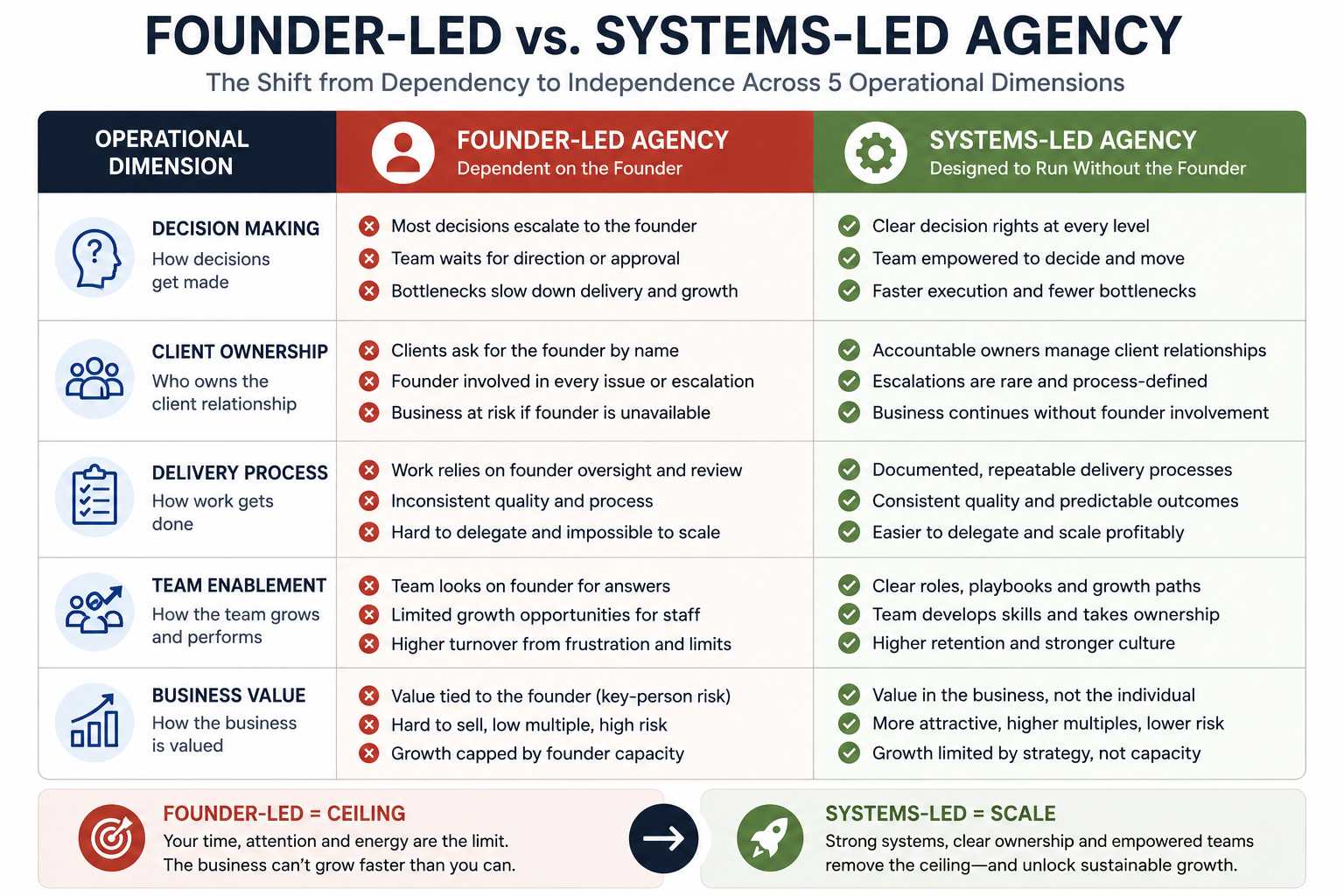
Founder-led vs. systems-led agency: what's the difference?
A founder-led agency depends on the owner's personal knowledge, relationships, and judgment to function day-to-day. A systems-led agency operates through documented processes, empowered team ownership, and defined decision rights that exist independently of any one person.
The distinction is not about team size or years in business. It is entirely about whether the agency can deliver results and retain clients when the founder steps back.
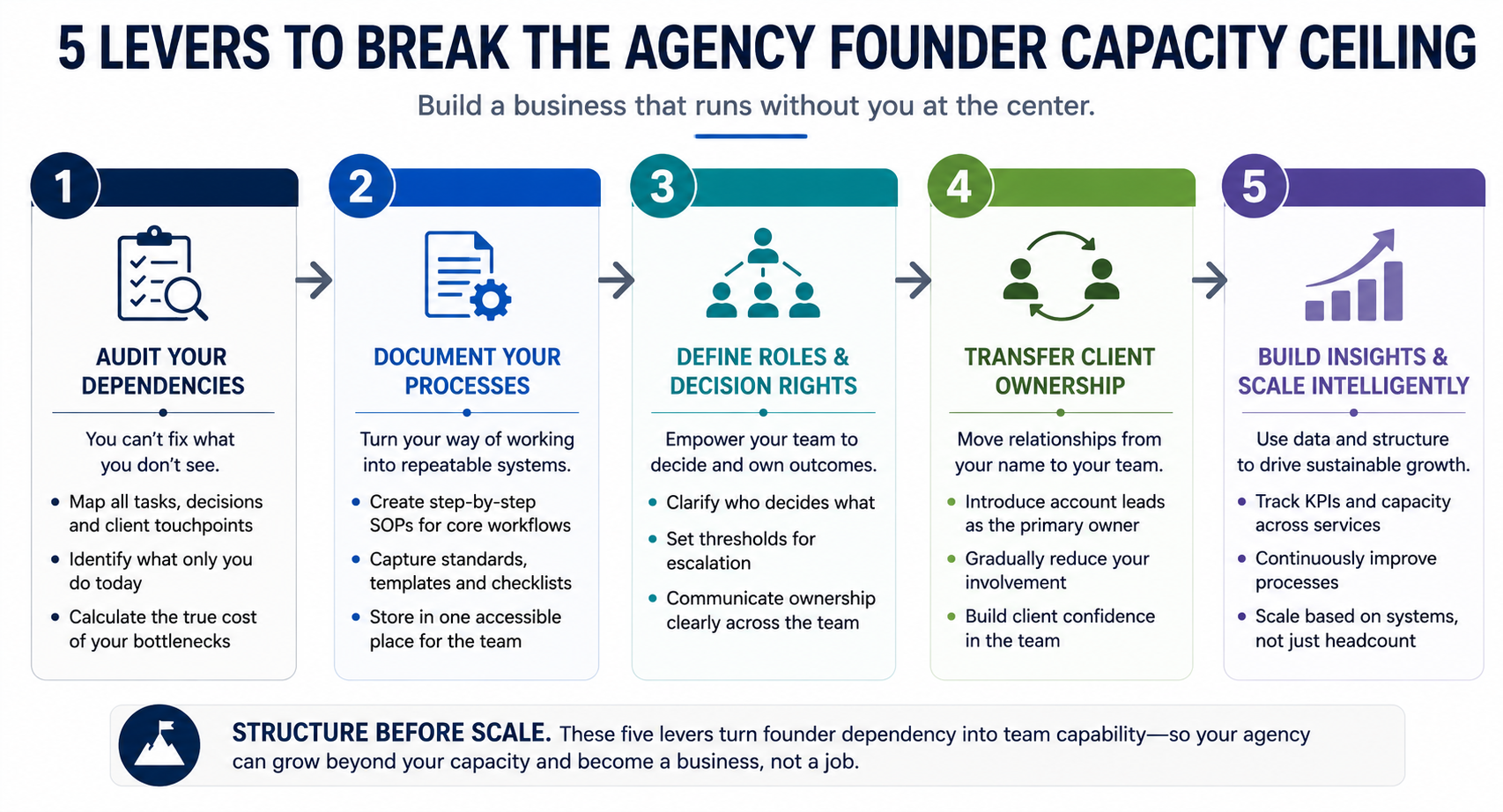
The 5 most effective levers for breaking past founder capacity
The five most effective levers for breaking the agency founder capacity ceiling are: process documentation, delegated client ownership, a defined internal leadership layer, autonomous delivery team structures, and a deliberate redefinition of the founder's role.
Agencies that successfully scale past their founder's bandwidth apply these levers in sequence, not simultaneously.
- Process documentation: Captures tribal knowledge and makes delivery repeatable without founder involvement
- Delegated client ownership: Moves key client relationships from the founder to named account leads
- Internal leadership layer: Resolves delivery issues before they escalate to the founder
- Autonomous delivery teams: Gives teams the authority, tools, and SOPs to complete work without sign-off
- Founder role redefinition: Formally repositions the founder as a strategic leader, not an operational one
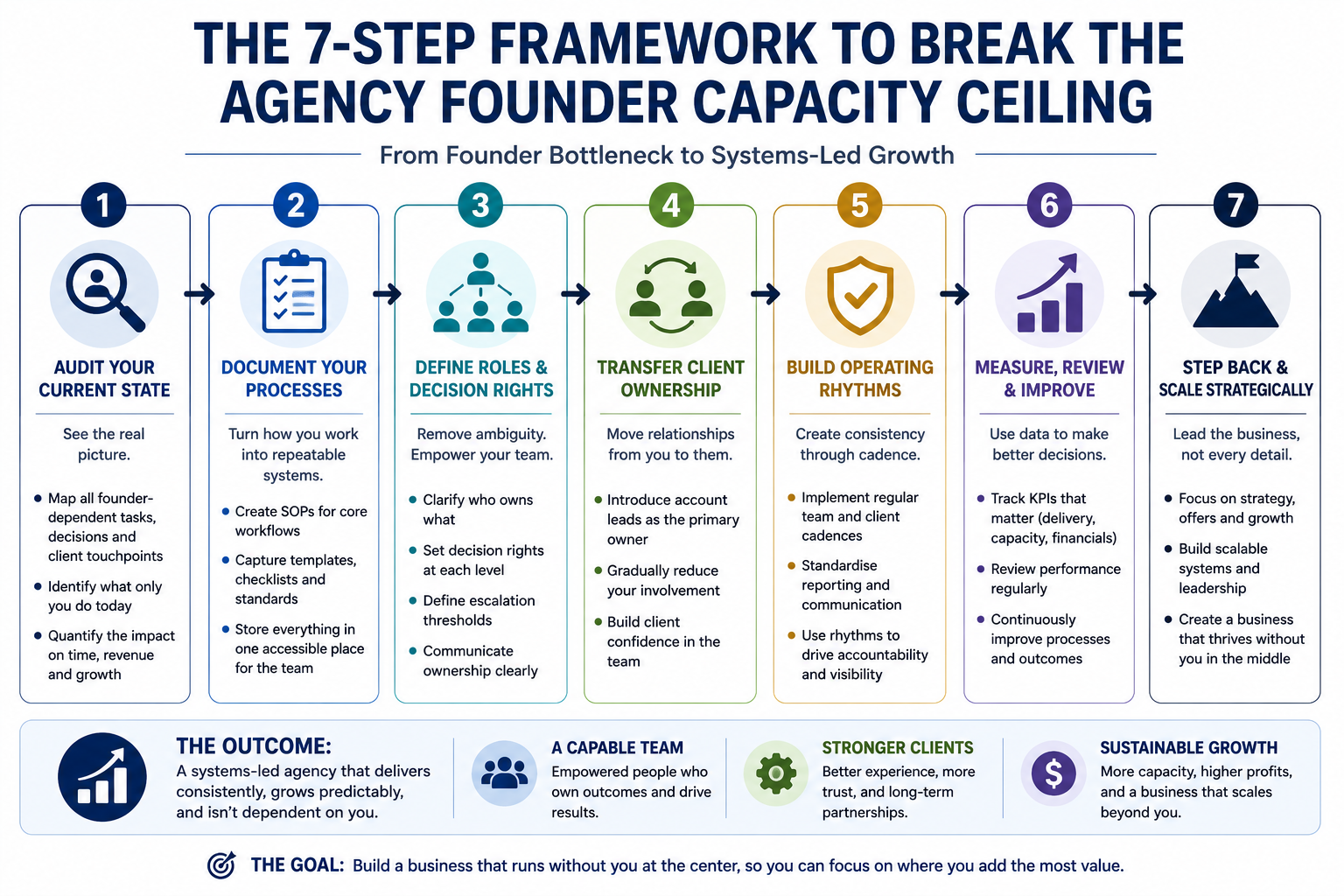
How to break the founder capacity ceiling: a step-by-step framework for agencies
Breaking the agency founder capacity ceiling requires four structured phases: audit every founder dependency, document and systematise core delivery processes, delegate decision-making with clear accountability frameworks, and reposition the founder as a strategic leader rather than an operational one.
This framework works because it targets the structural root cause: founder dependency, rather than adding headcount to a model that will absorb new hires into the same pattern.
The 7-step framework:
- Audit: Map every decision, task, and client relationship that currently routes through you
- Prioritise: Identify the top 3 dependencies causing the most significant bottleneck
- Document: Convert tribal knowledge into written SOPs and delivery playbooks
- Define decision rights: Specify what the team can resolve without escalation
- Transfer client relationships: Introduce named account leads and reduce your direct involvement deliberately
- Build a leadership layer: Appoint or develop a senior owner for delivery accountability
- Redefine the founder role: Write down what you are now responsible for, and what you are not
The Agency Operating System™ is designed to install exactly this structure. The Fractional COO service for agencies provides embedded operational leadership for founders ready to make the transition, without the cost of a full-time hire. See agency services pricing for full investment details.
Frequently asked questions about agency founder capacity
How long does it take to break past founder capacity?
Most agencies see meaningful reduction in founder bottleneck within 3–6 months of structured effort. A full transition to a systems-led model typically takes 9–18 months, depending on team size and operational complexity at the starting point.
What should an agency founder delegate first?
Start with repeatable delivery tasks — work that follows the same pattern on every project. These are easiest to document and safest to hand off. Leave client strategy and business development until the delivery foundation is stable.
Do I need to hire a COO or operations manager to scale?
Not necessarily at first. Many agencies break the ceiling through documentation and defined decision rights alone. A Fractional COO is a cost-effective alternative for agencies that are not yet ready for a full-time operations hire.
Can a small agency under 10 people break this ceiling?
Yes, and it is considerably easier to fix the structure at this stage than at 25 people. The root causes are identical, but simpler to address with a smaller team and fewer entrenched habits.
What is the difference between being a busy founder and being a bottleneck?
A busy founder has a high workload but the agency still functions during their absence. A bottleneck founder is one whose absence stops work from moving, because decisions, quality reviews, or client trust sit with them personally, not with the business.
Conclusion
You have likely spent years building an agency that, structurally speaking, cannot yet exist without you.
That is not a reflection of your leadership quality. It is a reflection of the architecture, or the absence of one. The founder capacity ceiling is not a permanent condition. It is a solvable structural problem with a clear, sequential fix.
You now have the diagnostic framework to identify where the bottleneck sits, the 5 levers that break it, and a 7-step framework to install structure before scale.
How to take action now
- Run a dependency audit: list every decision and task that only you can approve this week
- Review the 6 root causes and identify the two most relevant to your agency right now
- Pick one process to document this month and formally assign its ownership to a team member
- Review the founder-led vs. systems-led comparison table honestly, and share it with a senior colleague
- Book a scoping call if you want structured support to install the right operational layer
The goal is not to remove yourself from your agency. It is to build one that is capable of growing beyond your personal capacity, so you can lead it rather than carry it. That is what the Agency Operating System™ helps agency founders do: replace founder dependency with repeatable, trusted systems that work without you at the centre.

About the author
Tom Wardman is a Growth Independence Architect™ and fractional consultancy founder specialising in agency operations and growth systems. He works with agency owners across the UK to replace founder dependency with scalable architecture through the Agency Operating System™. Tom is also the author of Build a Trusted Brand and one of the UK's first five certified coaches in the Endless Customers methodology, trained directly under Marcus Sheridan.
Pricing disclaimer: All GBP–USD price conversions are rounded estimates and correct at the time of publishing. Exchange rates fluctuate and figures should be treated as indicative only.
Topics: