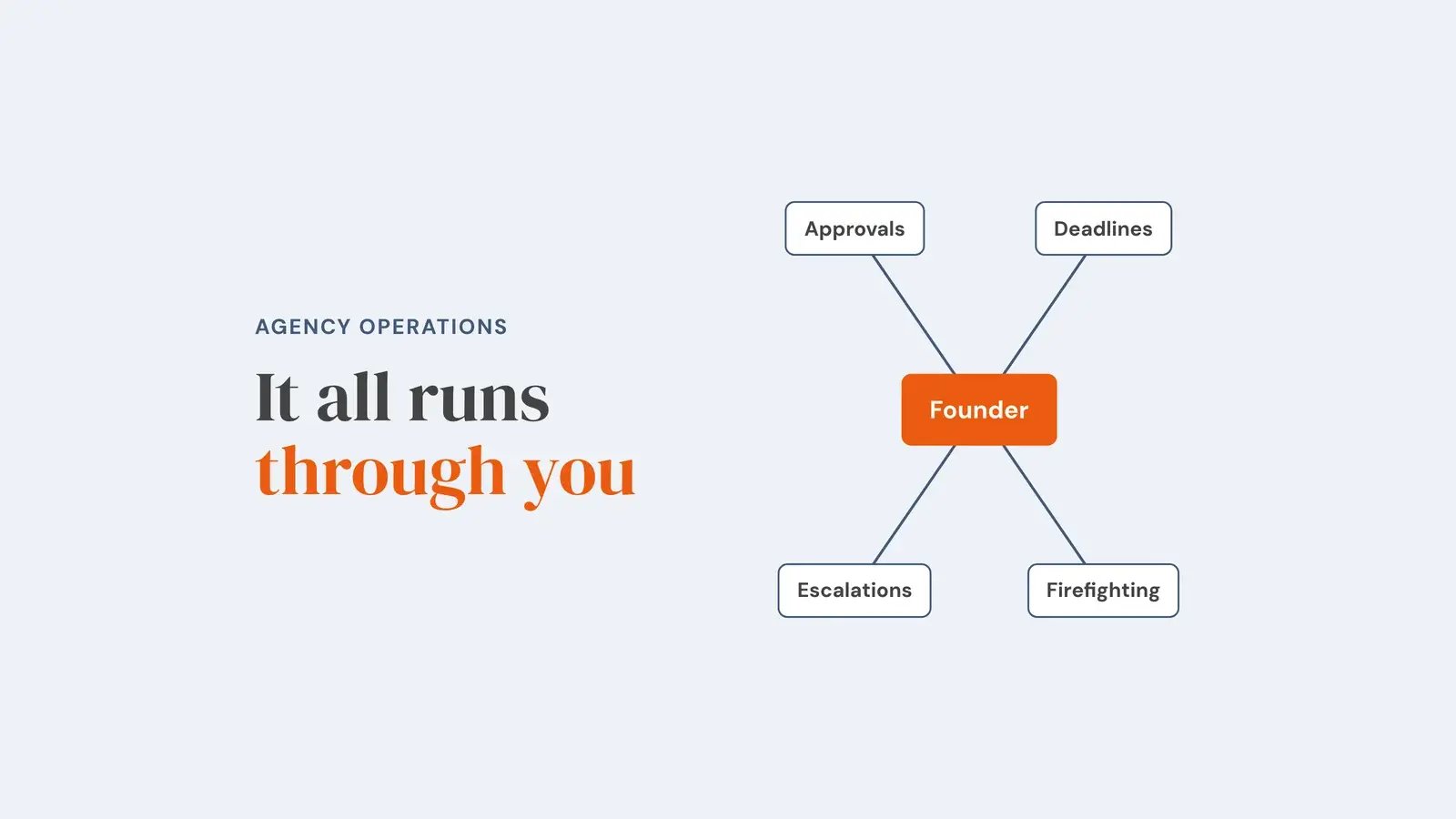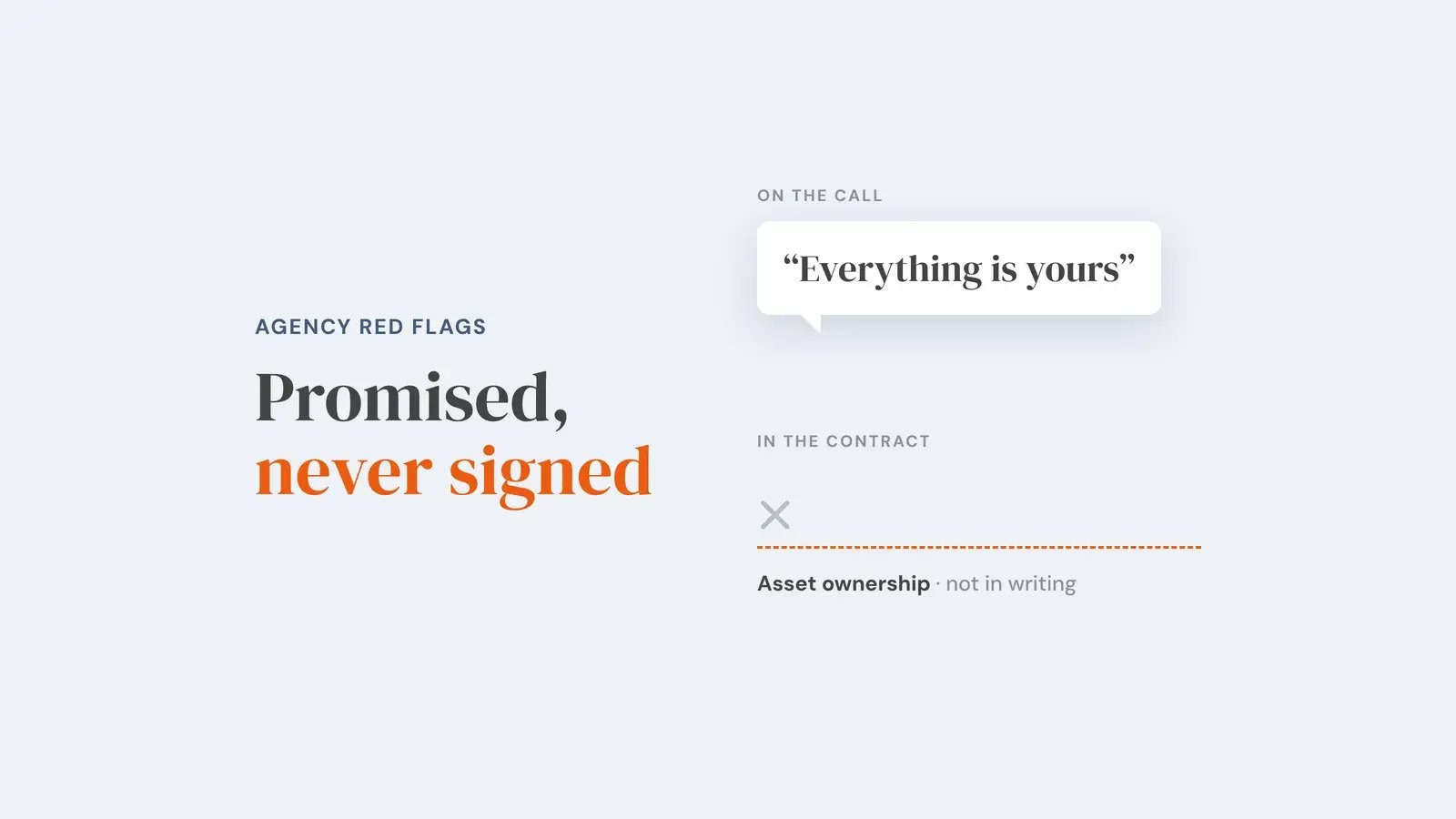


Are you still the first person clients call when something goes wrong? Does delivery slow down every time you step back?
If you built your agency from scratch, you almost certainly did so by doing the work yourself. That made sense at the start. Now it is the thing stopping you from growing.
This isn't theoretical. It's the same document, delegate, detach sequence used to move founder-dependent agencies onto systems their teams can run without them.
This article gives you a staged, practical playbook for removing yourself from client delivery, without losing quality, clients, or your team's confidence. You will learn what the transition involves, what it costs, and which approach fits your agency's size and stage.
Key takeaways
- Transitioning out of delivery means systematically removing yourself from the execution of client work, so projects are managed and delivered by your team, not you.
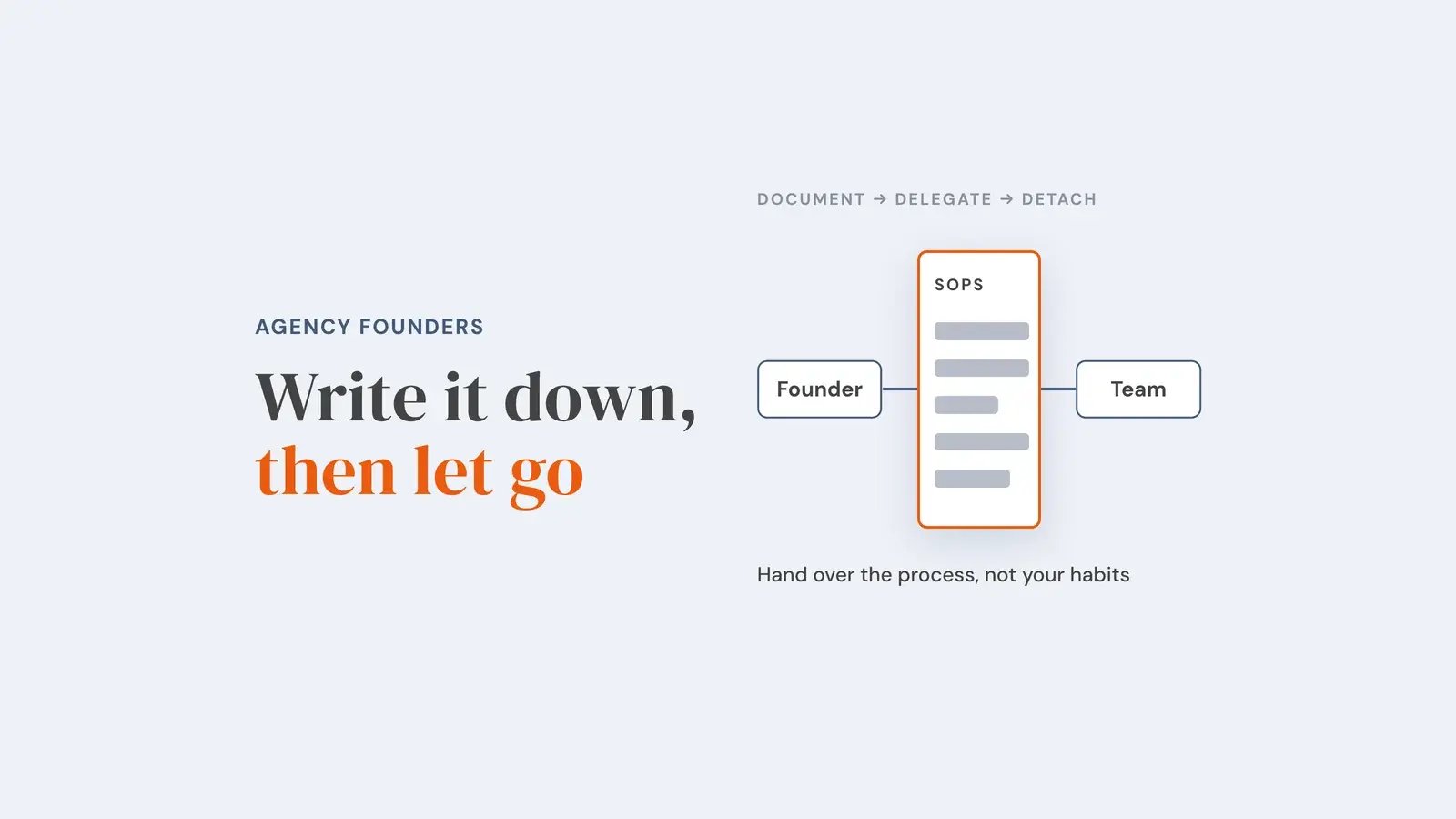
- The correct sequence is: document first, delegate second, detach third. Skipping documentation transfers chaos, not capability.
- For agencies under £2M ($2.5M) revenue, promoting an internal team member into a Delivery Lead role typically outperforms external hiring on cost, speed, and retention.
- The direct annual cost of transition ranges from £40,000–£120,000 ($50,000–$150,000), depending on whether you promote internally or hire a senior delivery person externally.
- Founder-dependent agencies typically sell at 1–2x revenue; founder-independent agencies with documented delivery systems attract 3–5x or higher.
What does transitioning out of delivery actually mean?
Transitioning out of delivery means removing yourself from the day-to-day execution of client work, so projects are scoped, managed, and delivered without you being the central resource.
Most agency founders occupy two roles simultaneously: business owner and chief delivery resource. Those two roles share the same hours, which means one always suffers.
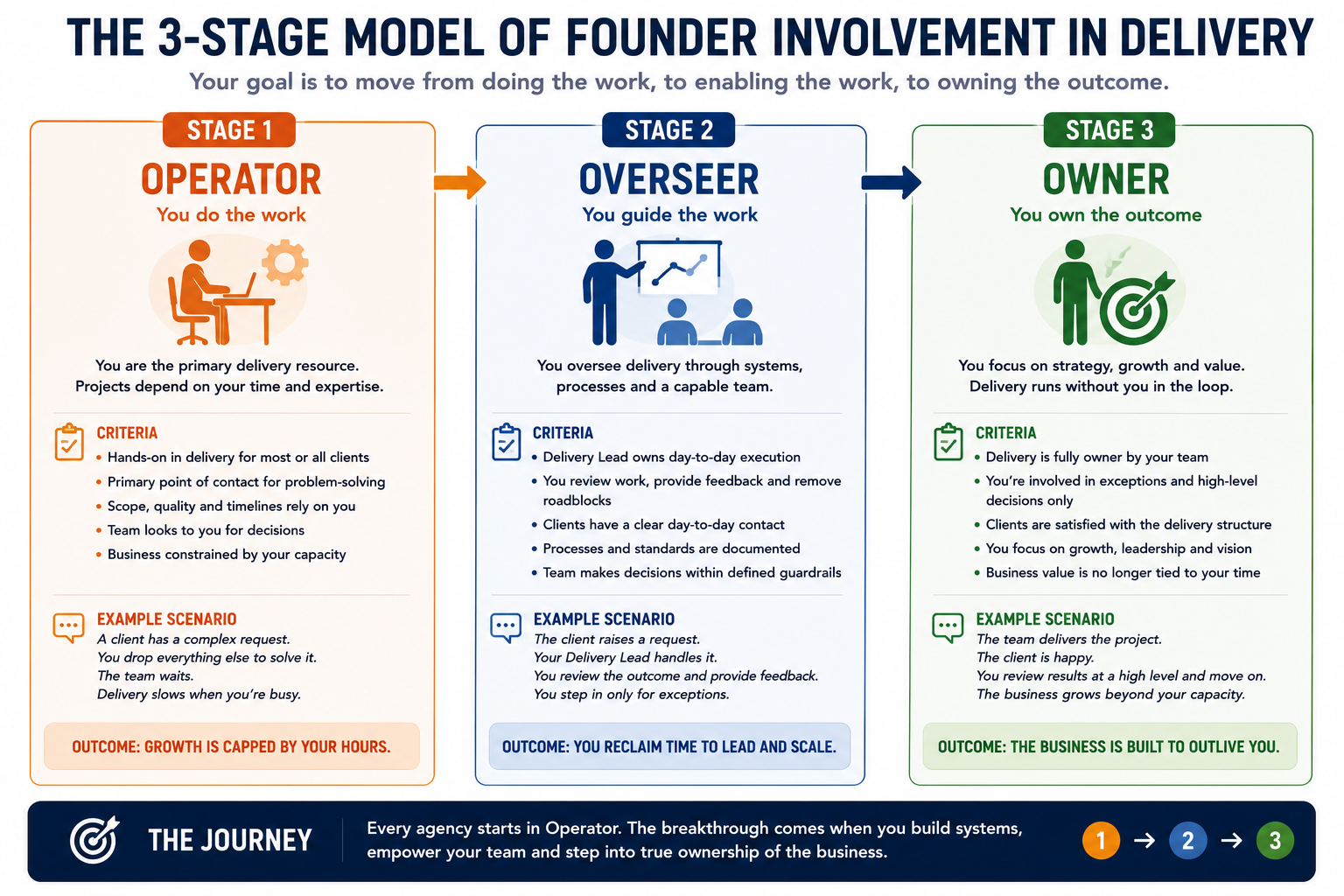
There are three stages of founder involvement in delivery:
Most founders are stuck at Operator or Overseer. The objective is not to step back overnight, but to move, account by account, toward Owner.
Why staying in delivery is holding your agency back
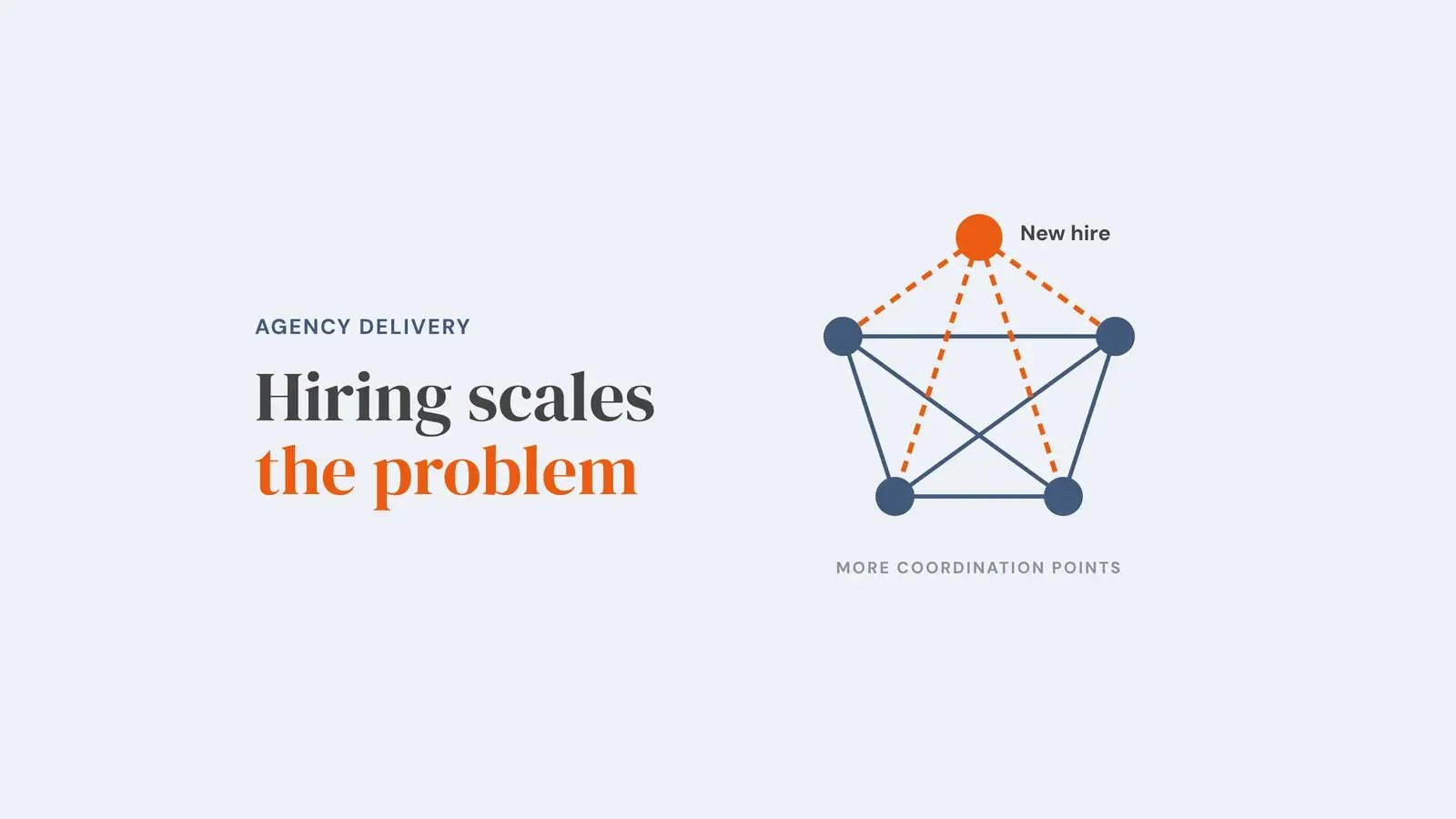
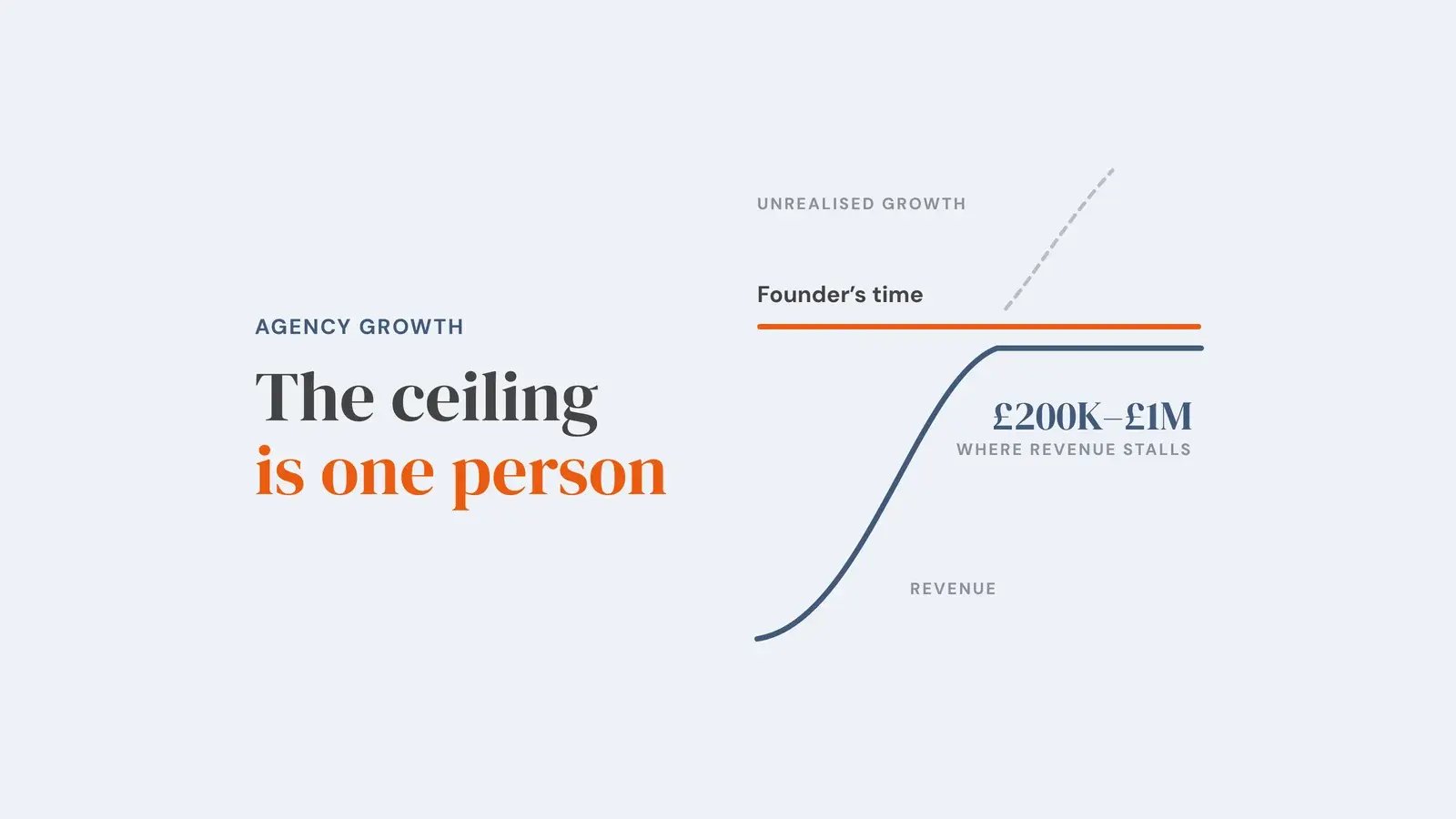
When you are the primary delivery resource, your agency cannot grow beyond your available hours, and every new client adds to your workload rather than your team's.
There are three effects worth naming:
- A hard revenue ceiling: You can only handle as many clients as your personal capacity allows.
- A team that never fully develops: You absorb the complex work, so your people never build the capability or confidence to handle it independently.
- A business with limited sale value: Founder-dependent agencies typically sell at 1–2x revenue. Agencies with documented, founder-independent delivery systems regularly attract 3–5x or more. (Estimate based on commonly cited agency acquisition benchmarks.)
Five signs your agency is too founder-dependent in delivery:
- Clients request you personally when problems arise
- No project has been delivered without your direct involvement
- Your team cannot make scope decisions without checking with you first
- You cannot take two weeks away without creating client risk
- Nothing is documented well enough for someone else to follow without asking questions
-Jul-23-2026-03-52-11-8363-PM.png?width=1536&height=1024&name=Generated%20image%201%20(1)-Jul-23-2026-03-52-11-8363-PM.png)
The playbook: document, delegate, detach
The best way for an agency founder to transition out of delivery is to follow three stages in strict order: document, delegate, then detach.
Attempting to delegate or hire before processes are documented is the most common and costly mistake; it transfers your habits, not a system.
Stage 1: Document
Capture how delivery actually works before you hand anything over. This means SOPs (standard operating procedures: clear, written step-by-step instructions for how work gets done), client communication templates, and quality checklists. Start with your highest-volume, most repeatable service types.
If knowledge lives only in your head, it cannot be handed over.
Stage 2: Delegate
Once processes are documented, appoint a Delivery Lead, someone who takes ownership of accounts, client communication, and quality control. Transfer clients progressively, starting with your least complex accounts.
Do not step back from all accounts at once. A phased handover protects quality and client trust.
Stage 3: Detach
Once your Delivery Lead handles accounts reliably, remove yourself from client-facing delivery. Stay available for genuine exceptions. Stop being the default.
6-step transition sequence:
- Audit which client accounts you are currently active on
- Document processes for your 3 most repeatable service types
- Identify your Delivery Lead candidate; look internally first
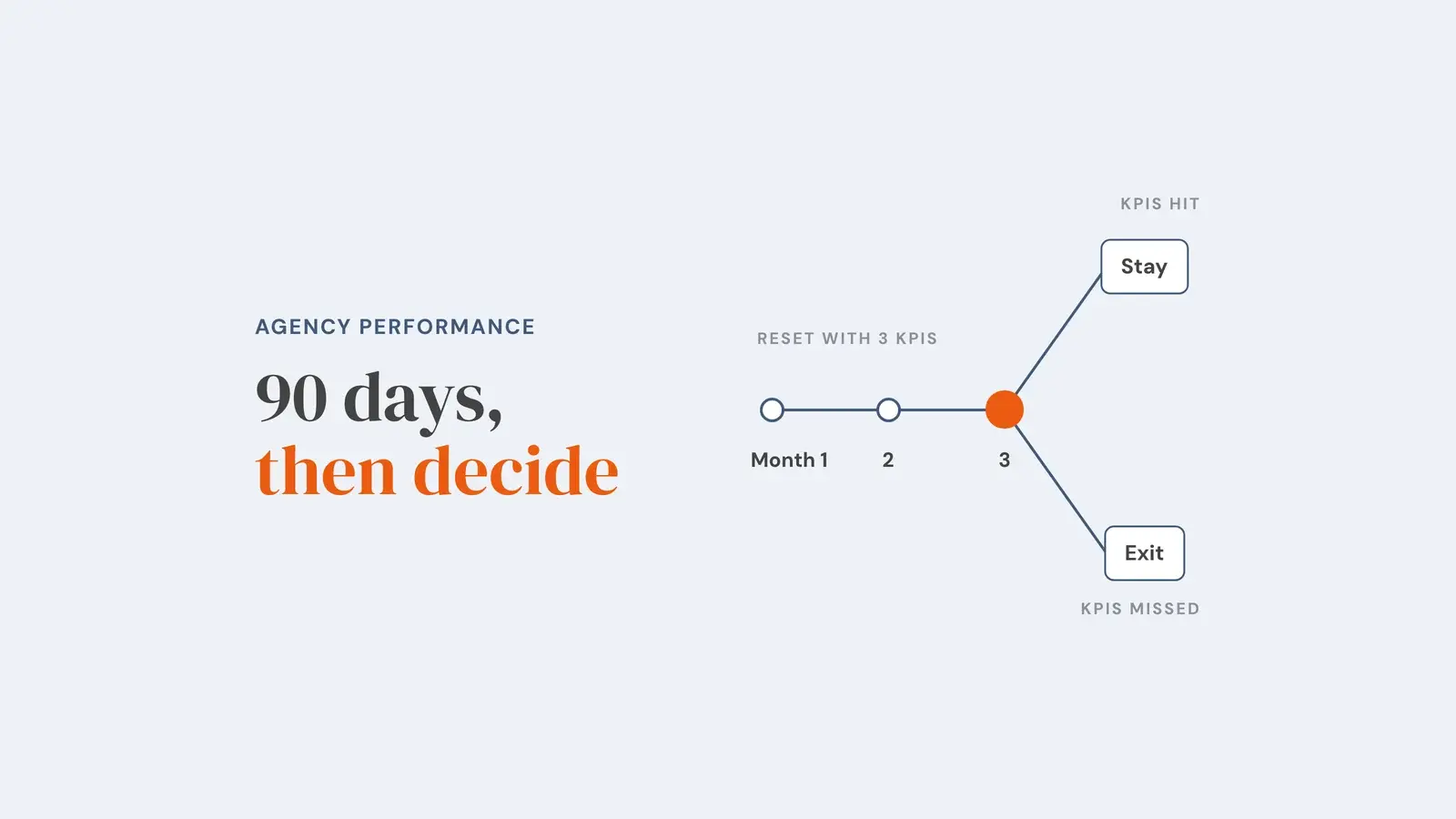
- Transfer 1–2 low-complexity accounts as a 60-day pilot
- Review client satisfaction and delivery quality at 60 days
- Expand the handover based on results, with clear go/no-go criteria at each stage
-Jul-23-2026-03-54-38-2233-PM.png?width=1024&height=1536&name=Generated%20image%201%20(2)-Jul-23-2026-03-54-38-2233-PM.png)
What it costs, and which approach works best
The direct annual cost of transitioning out of delivery typically ranges from £40,000–£120,000 ($50,000–$150,000) for a UK/US agency, depending on whether you promote internally or hire externally.
(Salary ranges are market estimates for UK agencies. Fractional COO fees are based on published rates from my Fractional COO for Agencies service.)
-2.png?width=1536&height=1024&name=Generated%20image%201%20(4)-2.png)
For most agencies under £2M ($2.5M) revenue, promoting a trusted internal team member outperforms external hiring on cost, speed, and cultural fit. External hires bring expertise but carry onboarding time and client-relationship risk. The key question is not whether to hire; it is whether your team has a capability gap or simply an authority gap.
Most of the time, it is the latter.
Simple estimation framework:
- Internal promotion: current salary + leadership uplift (typically £5,000–£15,000 ($6,250–$18,750)/year) + approximately 25 hours of your time to document processes upfront
- External hire: salary + recruitment fees (10–15% of first-year salary) + a 90-day ramp period during which you remain active in delivery
For structured support designing your delivery architecture and SOPs, my Agency Systems Consultancy is the right starting point. For embedded operational leadership during the transition itself, the Fractional COO for Agencies service is built for exactly that.
-Jul-23-2026-03-55-41-6413-PM.png?width=1536&height=1024&name=Generated%20image%201%20(3)-Jul-23-2026-03-55-41-6413-PM.png)
FAQs for agency founders stepping out of delivery
The most common questions agency founders ask about stepping out of delivery relate to timing, team readiness, and what to do when clients want to deal with them personally.
How long does the transition take?
Most founders complete a full transition in 6–18 months. The more thoroughly processes are documented at the start, the faster and more reliable the handover. Rushing the timeline is the most common reason transitions fail.
What if clients only want to deal with me?
This is a relationship architecture problem, not a client preference problem. The relationship was built around you personally, rather than around the agency. The fix is to introduce your Delivery Lead into client touchpoints before you step back, not after.
Should I hire before or after documenting processes?
After. Every time. Hiring before documentation means your new hire inherits your informal habits rather than a structured system. Document first, then hire into clarity.
What should I focus on once I am out of delivery?
Growth, sales, and the strategic direction of your agency; the activities only you can do, and that directly increase the long-term value of the business. The Agency Operating System™ (my own framework, referenced here for context) gives you a structured framework for working at that level. Also worth reading: How to Diagnose Broken Agency Operations (and Fix the Right Things).
Conclusion
For years, you have been your agency's most expensive delivery resource. Every brief, every client relationship, every quality check, routed through you.
You now have a clear sequence to change that: document your delivery processes, delegate to a capable Delivery Lead, and detach in stages. The transition is not one decision; it is a series of deliberate steps, each building on the last.
The longer it stays this way, the deeper the dependency becomes and the harder the exit gets. That's the sequence I built this article around.
How to take action now
- List every client account you are currently active on; that is your transition backlog
- Pick your 3 most repeatable service types and document those processes first
- Look internally for your Delivery Lead before considering an external hire
- Run a 60-day pilot: transfer one low-complexity account and measure the outcome
- If you need operational support to hold the transition accountable, book a scoping call
Relating reading
-
Why Agency Growth Stalls at Founder Capacity (Even With a Team)
-
Why Hiring Won't Fix Your Agency's Delivery Problems, and What Will
Ready for embedded support? Fractional COO for Agencies.

About the author
Tom Wardman is a Growth Independence Architect and agency operations consultant. He works with agency founders to install the pricing, delivery, and leadership systems that allow agencies to scale without founder dependency. He is the creator of the Agency Operating System™ and the author of Build a Trusted Brand. Every engagement is designed around one outcome: an agency that runs without him.
Pricing disclaimer: All GBP–USD price conversions are rounded estimates and correct at the time of publishing. Exchange rates fluctuate and figures should be treated as indicative only.
Topics: