

Your agency reports 40 qualified leads a month. Your sales team says almost none are worth a call. Both are telling the truth, because they are working from two different definitions of the same word.
I have sat on both sides of that table, inside agencies producing the report and inside businesses trying to reconcile it. The gap is almost never effort. It is structural: nobody agreed, in writing, what a qualified lead is, and a definition you did not write is one more part of your growth you do not own.
This article is for founders and marketing leads paying an external provider for lead generation. It gives you the qualified lead definition the best agencies work to, the five criteria behind it, and a four-step process for writing your own.
Takeaways
- A qualified lead matches your buyer profile, has a problem you solve, has buying influence, and is ready to act inside a defined window.
- It is not qualified until a salesperson has accepted it.
- Whoever writes the qualified lead definition controls what gets reported as success.
- Sales-accepted leads are the only lead metric that reconciles against closed revenue.
- One salesperson working 25 unqualified leads a month loses roughly £760 ($960) a month in selling time, or £9,100 ($11,500) a year, on the assumptions set out below.
- The definition belongs in your CRM as a filterable field, not in a proposal.
What is a qualified lead, and who gets to decide?
A qualified lead is a person who matches your buyer profile, has a problem you solve, has the authority or influence to buy, and is ready to talk within a defined timeframe. Filling in a form is not qualification. It is interest.
The more useful half of that sentence is who decides. Whoever writes the definition sets the standard their own work is measured against. That is a structural problem, not a trust problem. Good people produce distorted numbers inside a badly structured arrangement.
Why most qualified lead definitions are set too low
Most definitions describe an action the prospect took, because actions are easy to generate and easy to report. Downloads, form fills and score thresholds all rise with activity. Revenue does not have to move at all.
This is where the marketing qualified lead does most of its damage. An MQL is a score assigned by marketing, to a contact marketing sourced, against criteria marketing wrote. It says something real about content performance and nothing reliable about buying intent.
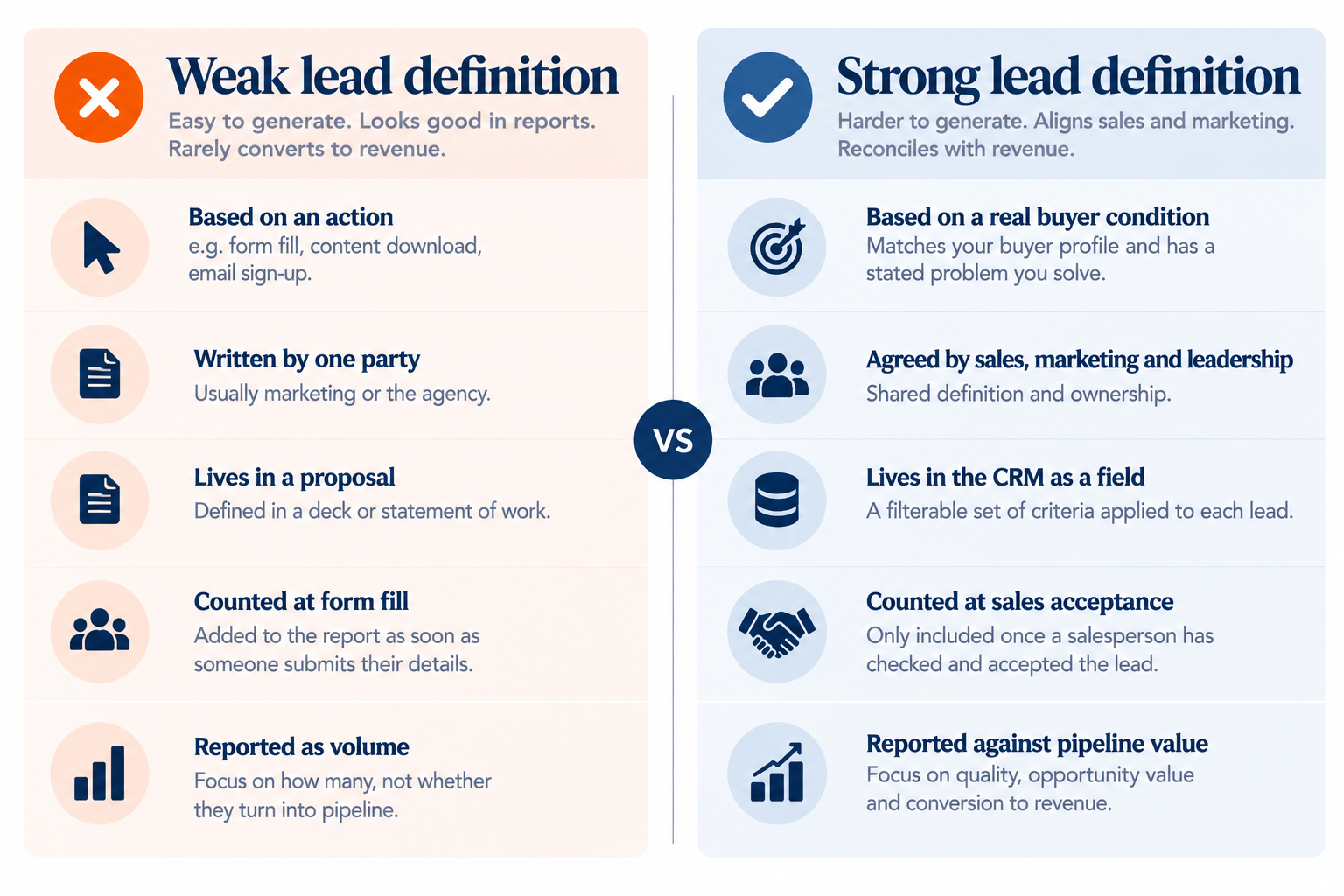
| Weak definition | Strong definition |
|---|---|
| An action taken | A condition the buyer is in |
| Written by one party | Agreed by sales, marketing and leadership |
| Lives in a proposal | Lives in the CRM as a field |
| Counted at form fill | Counted at sales acceptance |
| Reported as volume | Reported against pipeline value |
Related Reading: Agency Reporting Red Flags: Is Your Agency Hiding Poor Results?
The five criteria the best agencies insist on
The best agencies refuse to report a lead as qualified until it clears five criteria. Each one removes a specific category of false positive.
- Fit. The company matches your ideal customer profile on size, sector and geography.
- Problem. There is a stated problem your service addresses, not general interest in the topic.
- Influence. The contact holds the budget or sits close enough to the decision to move it.
- Timing. There is an identified window, usually inside 90 days, for a decision.
- Sales acceptance. A salesperson has checked the first four criteria and accepted the lead.
The first four are straightforward to agree in a room. The fifth is where the numbers actually change.
Why sales acceptance is the criterion that changes the numbers
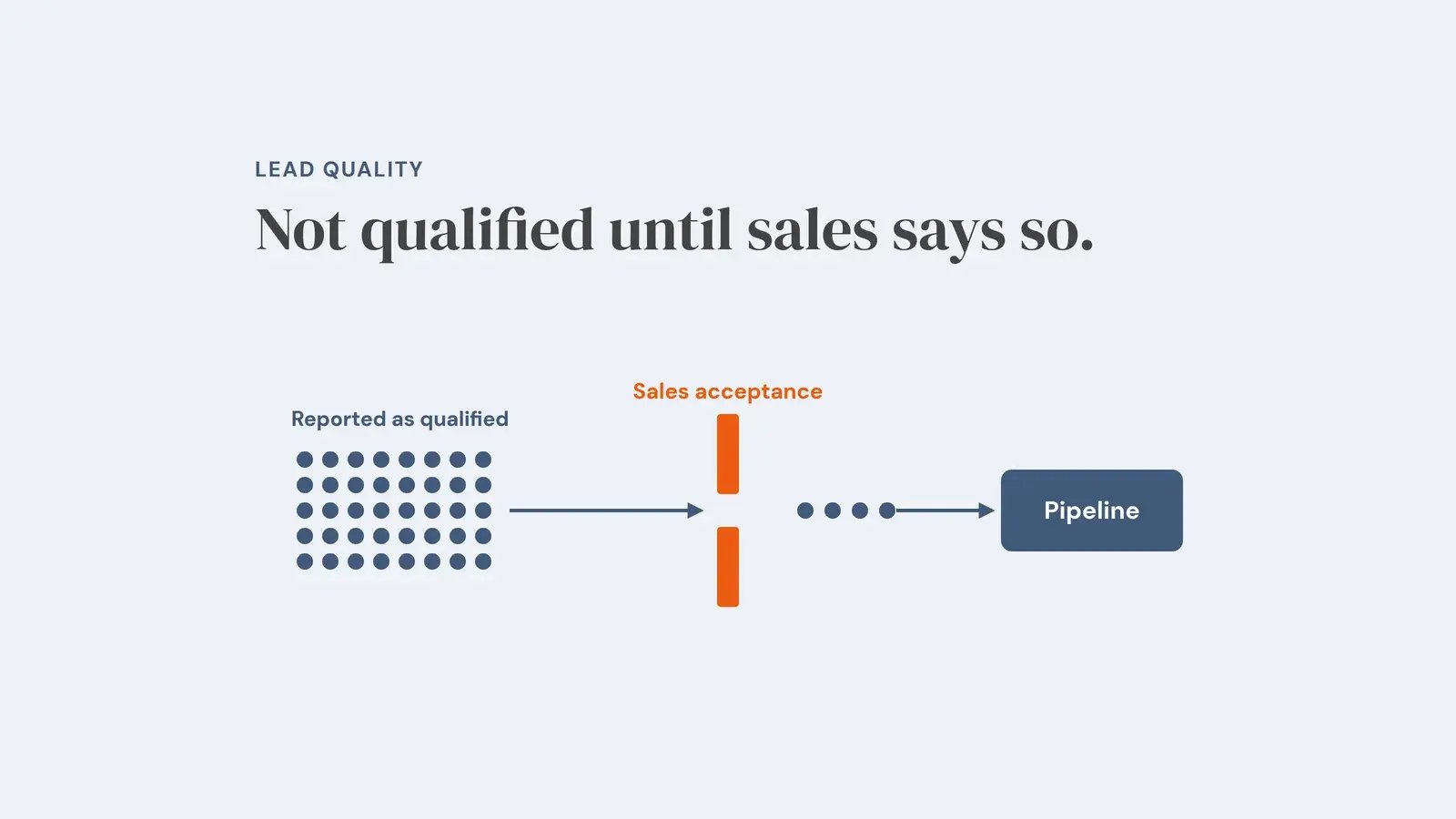
A lead is only qualified once a salesperson has looked at it and accepted it. Everything before that is a marketing opinion. Sales-accepted leads are the only count that reconciles against closed revenue, because they are the only ones a person carrying a quota has agreed are real.
Expect the first month to be uncomfortable. Reported volume drops, sometimes sharply, because leads that were being counted no longer clear the bar. Nothing has got worse. The measurement has caught up with reality, and the conversion rate from lead to opportunity rises as a direct result of the smaller denominator.
That is the pattern: volume falls, quality becomes visible, and the monthly call changes subject.
How to write your own qualified lead definition in four steps
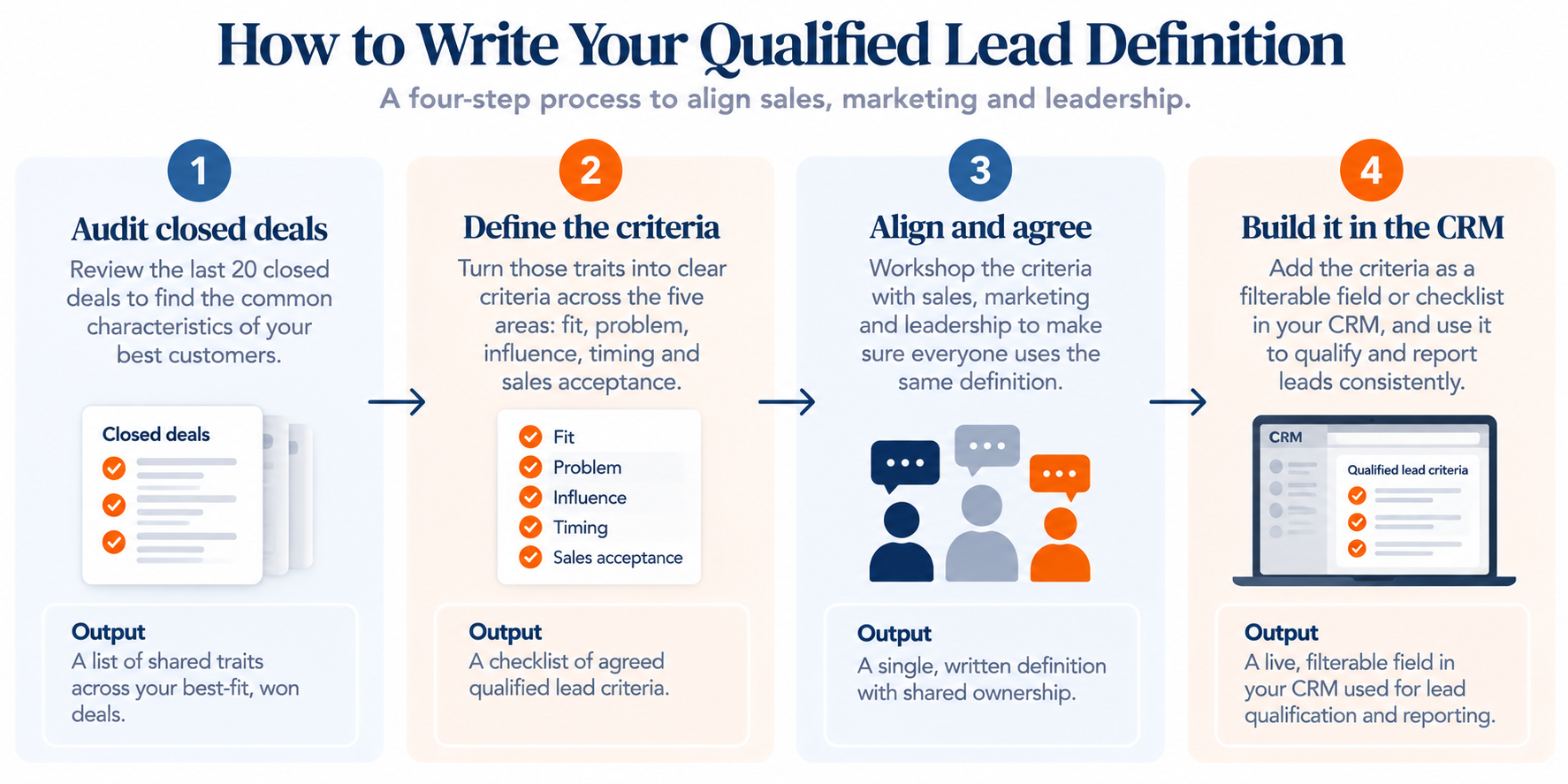
You can build a workable definition in one 90-minute session with sales, marketing and your CRM owner. The output is a checklist, not a paragraph.
- Audit the last 20 closed deals. Note what was true at first contact, not at signature.
- Extract the shared conditions. The three to five appearing in most deals become your criteria.
- Write it as a testable checklist. Each criterion answerable yes or no by someone who has never met the prospect.
- Wire it into the CRM. A required field for sales acceptance, and a filterable property per criterion.
Where the definition should live
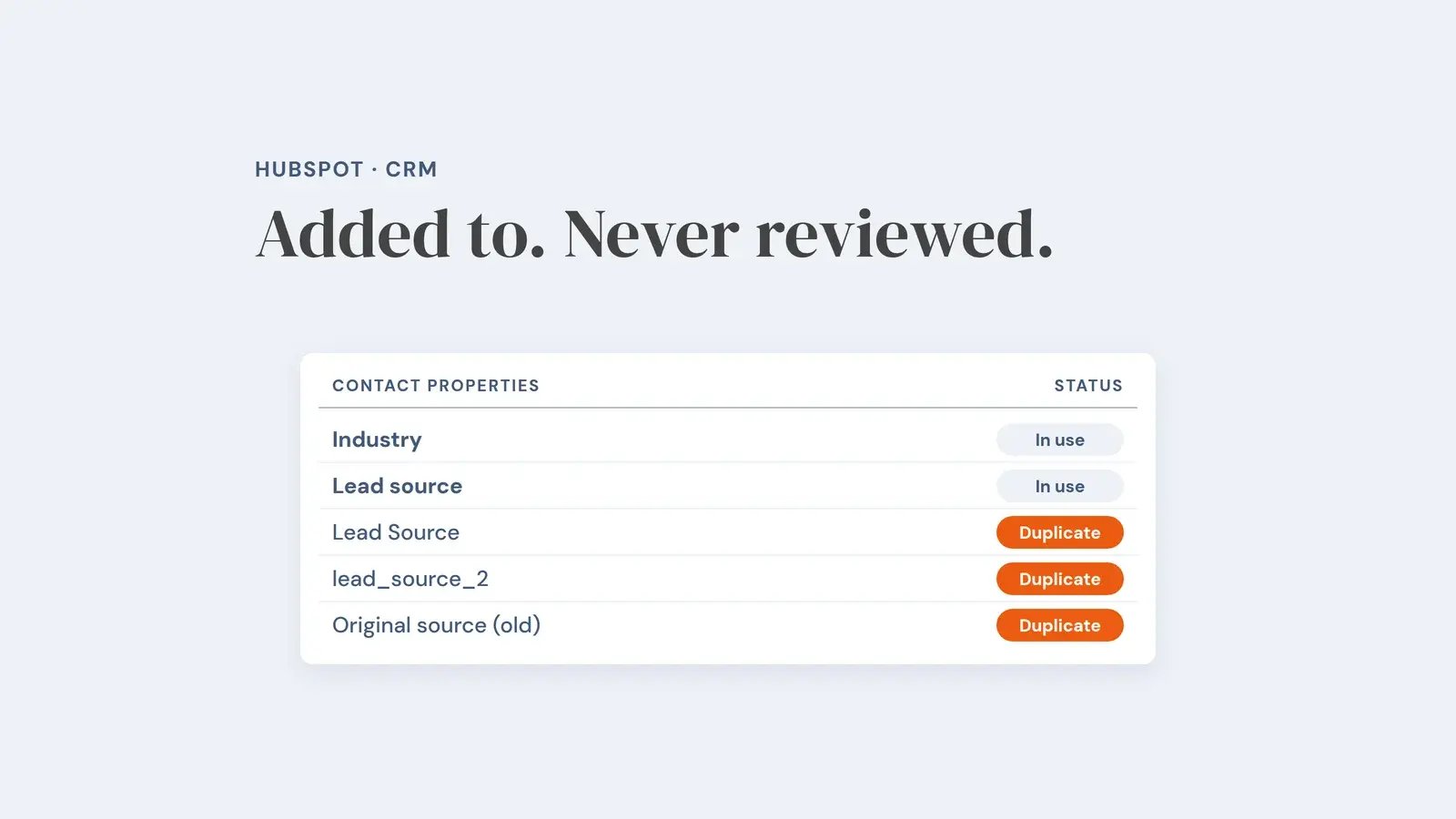
The definition belongs in your CRM as a field, not in a document. If it cannot be filtered on, it cannot be reported on, and it will drift within a quarter. If your portal cannot hold it, HubSpot Strategy & Implementation is where that gets fixed.
What a loose qualified lead definition costs your sales team
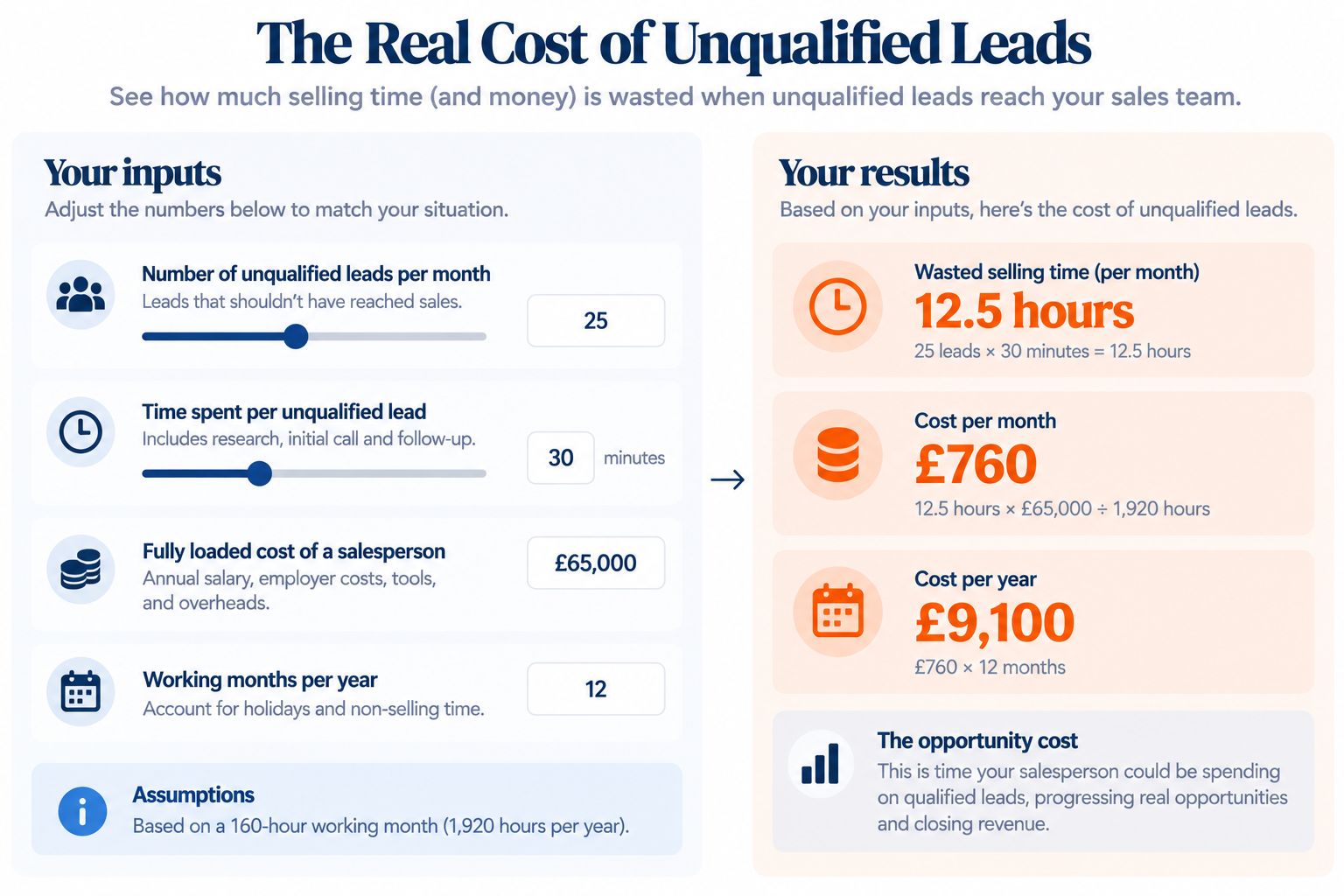
The cost of a loose definition is paid in your own team's selling time. The example below is an estimate built on stated assumptions, not published research. Swap in your own figures.
- Salesperson on a fully loaded cost of £60,000 ($76,000) a year, roughly £31 ($39) an hour. Adjust to your actual cost, including employer contributions.
- 25 leads a month reported as qualified that sales would not have accepted.
- 45 minutes on each in research, attempted contact and follow-up.
That is 18.75 hours, or £581 ($735) a month. Add the sales manager reviewing pipeline that was never real, at one hour a week and a fully loaded £45 ($57) an hour, and you add £180 ($230).
Total: roughly £760 ($960) a month, or £9,100 ($11,500) a year. The harder cost is the deals nobody worked instead.
(Unqualified leads per month × minutes spent each ÷ 60) × fully loaded hourly cost = monthly cost of a loose definition.
The 6 questions to ask your agency about lead quality
Ask for two things in writing: the qualified lead definition they report against, and the percentage of last quarter's qualified leads that sales accepted.
- What exact criteria must a contact meet to be counted as qualified?
- Who wrote those criteria, and when were they last reviewed?
- What percentage of last quarter's qualified leads were accepted by sales?
- How many became opportunities, and what was their combined value?
- Which criterion do most rejected leads fail on?
- What would our numbers look like if we added sales acceptance tomorrow?
Question six is the honest one. It tells you how much of your reporting depends on the current bar.
Frequently asked questions
Is an MQL the same as a qualified lead?
No. An MQL is scored by marketing on behaviour. A qualified lead has been accepted by sales on fit, problem, influence and timing. Never report the two interchangeably.
Who should own the definition, sales or marketing?
Neither alone. Sales holds the veto on acceptance, but the criteria are agreed jointly and signed off by leadership, so neither function can quietly move the bar.
How often should the definition be reviewed?
Quarterly. A definition written 18 months ago is measuring a business you no longer run.
What if my agency will not report sales-accepted leads?
Usually the honest answer is access: many agencies cannot see your CRM past the handoff and cannot report on a field they cannot see. Give them read access to the acceptance field first. If the reporting still does not appear, that tells you something different.
Does this apply to high-volume businesses?
Yes. The principle is that the revenue-carrying function sets the bar, not that a human checks every record. At volume, sales encodes the rules into the CRM once and audits a sample monthly. See this Gartner research on B2B buying group behaviour.
What changes once you own the definition
You started with two sets of numbers that would not reconcile. You now have a definition that produces one, and a checklist your team can apply this week without buying anything.
Ninety days after you wire acceptance into the CRM, the monthly report shows a smaller number sales does not dispute, a conversion rate you can forecast against, and a clear view of which criterion most leads fail on.
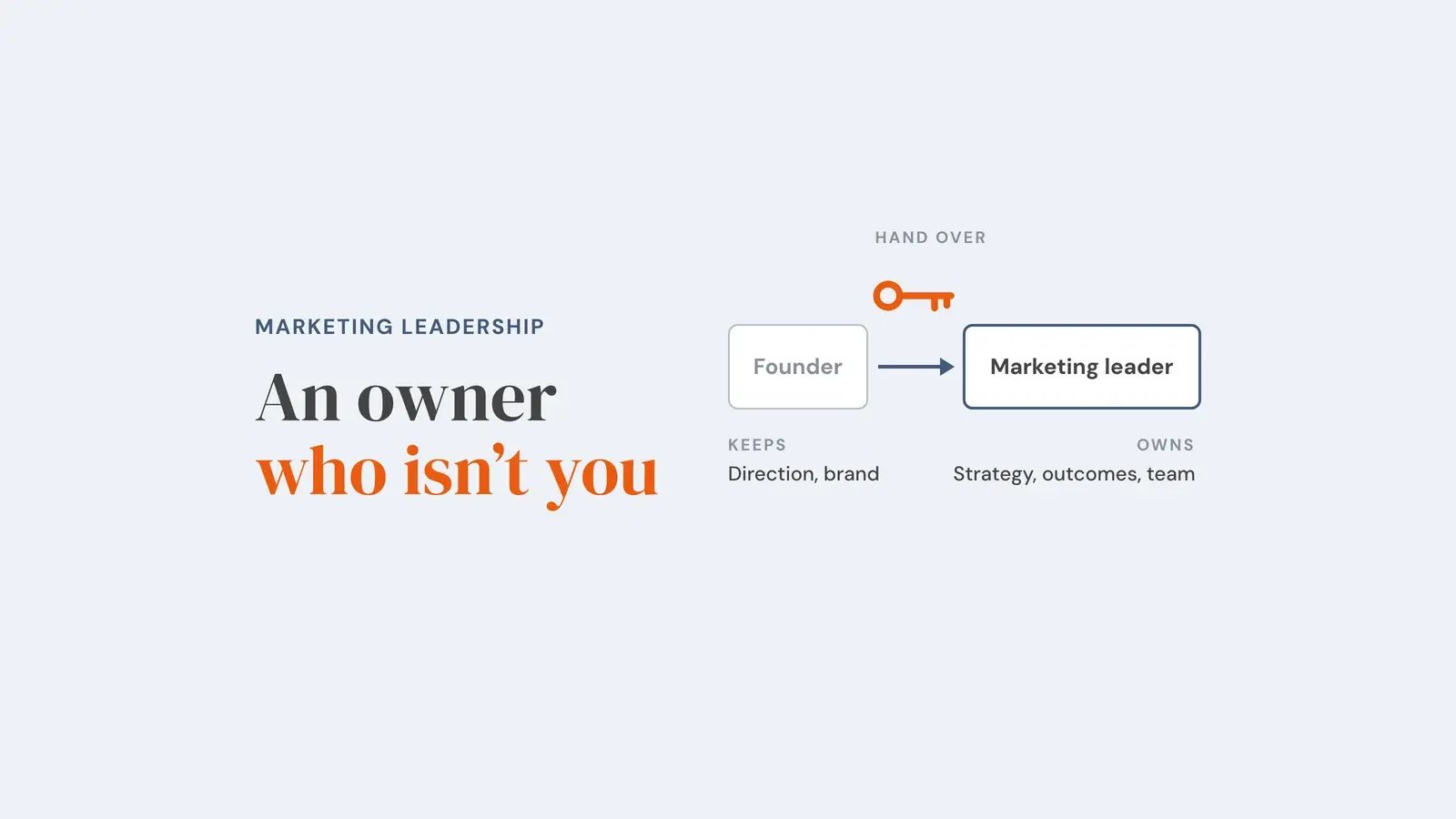
A qualified lead is one of several definitions that quietly determine what your marketing reports. Every one you do not own is a piece of dependency. Owning the definition is the cheapest version of owning your growth.
How to take action now
- Pull your last 20 closed deals and note what was true at first contact.
- Book the 90-minute session with sales, marketing and your CRM owner.
- Add a sales acceptance field to your CRM before the next reporting cycle.
- Send the six questions to your agency and keep the written answers.
For a wider read on where your marketing is structurally weak, the Marketing Debt Scorecard takes three minutes and returns a prioritised list. For the fuller picture, start with Agency Dependency: What It Is, What It Costs, And How To Escape It.

Pricing disclaimer: All GBP–USD price conversions are rounded estimates and correct at the time of publishing. Exchange rates fluctuate and figures should be treated as indicative only.