

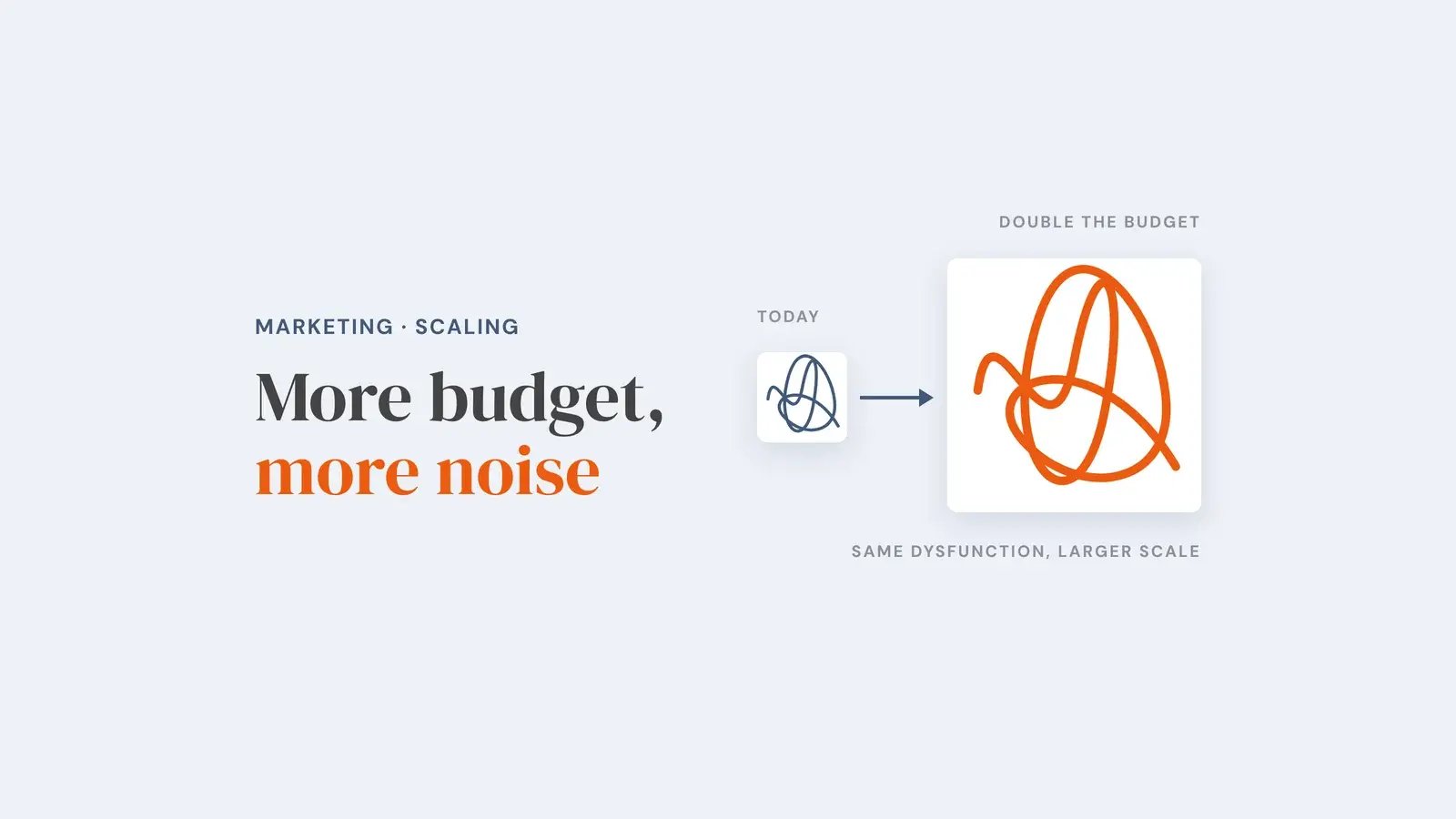
Does your marketing feel productive, or just busy? And if you doubled your marketing budget today, would you get double the results, or double the noise?
These are the two questions every founder and marketing leader should answer honestly before committing to scale. This article gives you a clear definition of what a healthy, scale-ready marketing function looks like, covering the 7 components that must be in place, the warning signs they are not, and a straightforward process for assessing your readiness before adding investment.
Key takeaways
-
A healthy marketing function is defined by aligned strategy, execution, data, and accountability, not by team size or budget.
-
Scaling a marketing function before it is structurally sound does not fix it. It funds the dysfunction at a larger scale.
-
There are seven core components a marketing function needs before scaling. If any one is entirely absent, more investment will accelerate the problem.
-
The clearest sign of an unready marketing function: nobody in the business can clearly explain what marketing is doing, why, or what it has produced.
-
In 2024, average B2B marketing budgets sat at 7.7% of company revenue. At the pre-scale stage, how that budget is allocated matters more than the total figure.
What is a healthy marketing function?
A healthy marketing function is one where strategy, execution, data, and accountability are aligned well enough that increasing investment produces reliably better results, not just more activity.
It is not defined by team size or budget. A team of two with clear positioning, a repeatable lead-generation process, and a measurement framework is healthier than a team of twelve without those things.
The simplest test is whether everyone in your business can answer 3 questions consistently: who you are targeting, what you are saying to them, and how you know if it is working. If those answers differ depending on who you ask, the function is broken. That holds regardless of how much is being spent.
The table below shows what healthy and broken look like across 7 dimensions.
-2.png?width=1536&height=1024&name=Generated%20image%201%20(1)-2.png)
Why marketing health matters before you scale
Scaling an unhealthy marketing function does not fix the problems; it funds them at a larger scale.
When budget, headcount, or channels are added before a solid foundation exists, the result is consistently higher cost-per-acquisition, lower conversion rates, and an inability to attribute what is working. These problems compound as spend increases.
A business that adds paid media to an unclear positioning statement generates traffic it cannot convert. One that hires a content team before documenting its buyer journey produces content that nobody uses. Structure before scale is not optional, as it determines whether additional investment produces growth or just more cost.
The 7 components of a scale-ready marketing function
A scale-ready marketing function is built on 7 core components. Each can exist in a basic form at an early stage; what matters is that none of them are entirely absent.
- Clear positioning: Your business knows who it targets, what problem it solves, and why it is the right choice, documented, not assumed. Scale-ready indicator: sales and marketing use the same language to describe your ideal client.
- A documented content strategy: You have a plan for what content you produce, who it serves, and what it is designed to achieve. Scale-ready indicator: content decisions are made against a strategy, not based on what feels relevant that week.
- Defined buyer journeys: You understand how buyers research, evaluate, and decide, and your marketing maps to each stage. Scale-ready indicator: you can name the top 5 questions buyers ask before they choose you.
- A functioning lead-generation engine: At least one channel reliably generates qualified leads. Scale-ready indicator: you can trace leads back to a specific source and action.
- A measurement framework: You track outcomes, not just activity, and metrics connect to revenue. Scale-ready indicator: your monthly report answers "what did this produce?", not just "what did we do?"
- Sales and marketing alignment: Both functions agree on what a qualified lead looks like and how it is handed over. Scale-ready indicator: a written service-level agreement (SLA), or at minimum a shared written definition, exists between both teams.
- Explicit team ownership: Every component of your marketing has a named owner. Scale-ready indicator: you can assign responsibility for each component above without ambiguity.
-2.png?width=1024&height=1536&name=Generated%20image%201%20(2)-2.png)
Common signs your marketing function isn't ready to scale
The clearest sign that a marketing function is not ready to scale is that nobody in the business can clearly explain what marketing is doing, why, or what it has produced.
Other warning signs include:
- No attribution: Spend is happening, but the team cannot explain which activity drove which outcome.
- Single-channel dependency: All leads come from one source, typically referrals or one paid channel. That is fragility, not a foundation.
- No documented strategy: Decisions are made reactively, based on trends or whatever is most urgent that week.
- Conflicting definitions of a lead: Marketing and sales disagree on what qualifies, and no written SLA exists to resolve it.
- Output-only reporting: Reports count posts published or emails sent, not pipeline contribution or revenue impact.
- Previous investment left no lasting asset: When spend stops, the pipeline stalls. Nothing was built that remains.
What should marketing investment look like at this stage?
Before scaling, most growing B2B businesses should invest between 7–12% of revenue in marketing, but how that budget is split matters more than the total.
Gartner's 2024 CMO Spend Survey reported average marketing budgets at 7.7% of company revenue. At the pre-scale stage, the priority should be building repeatable assets over short-term paid spend that disappears the moment it stops.
Simple calculation: If your annual revenue is £2m ($2.5m), a 10% marketing budget gives you £200,000 ($250,000)/year, roughly £16,700 ($20,875)/month. At the pre-scale stage, no more than 25% of that should go to paid channels until positioning, content infrastructure, and measurement are operational.
How to assess and strengthen your marketing function before scaling
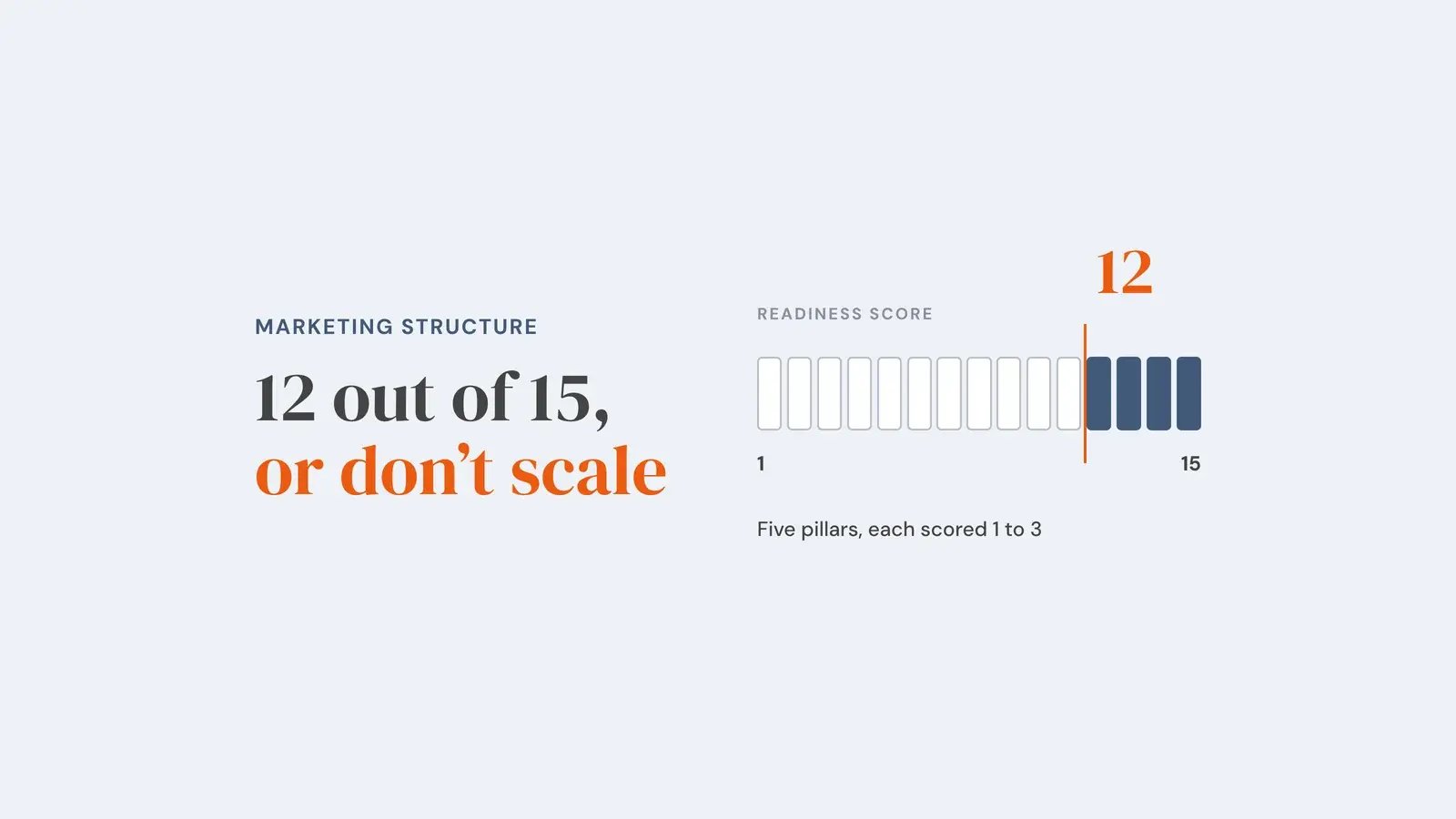
The fastest way to assess your readiness is to score each of the 7 components on a 3-point scale: missing, partially in place, or fully operational.
From there, follow 5 steps:
- Audit against the 7 components: Involve both sales and marketing. Disagreement between them is itself a signal.
- Classify gaps versus risks: A missing measurement framework is a gap. No positioning at all is a risk. Fix risks first.
- Prioritise by impact: Missing alignment between sales and marketing will cost you more than an imperfect content calendar.
- Define your minimum viable marketing foundation: For most businesses, this means: clear positioning, one reliable lead source, and a basic measurement framework.
- Set a scale trigger: Agree in advance what "ready to scale" looks like, for example: "We will increase paid spend when our lead-to-close rate exceeds 20% for 3 consecutive months."
The goal is not perfection across all 7 components. It is to eliminate any component that is entirely absent; those cause the most damage under increased investment.
Consider starting with a 90-Minute Marketing Triage™ if you need a structured external view of where your biggest gaps sit. See also: Directionless Marketing: Why It Happens & How to Fix It for a closer look at what happens when structure is missing entirely.
Frequently asked questions
Do I need a full marketing team before I scale?
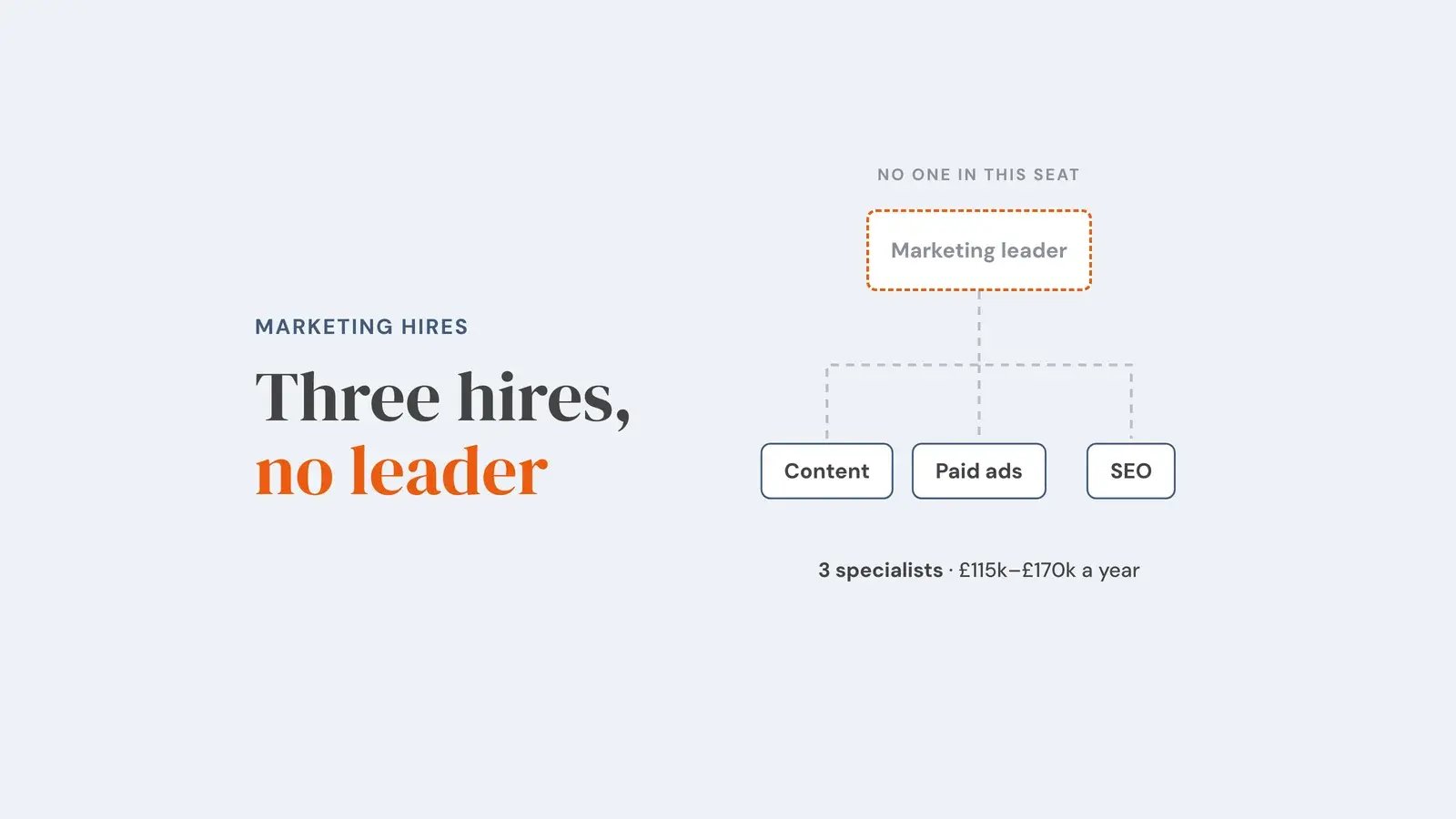
No. Scale-readiness is about structure, not headcount. A single marketer with a documented strategy, defined processes, and a measurement framework is more ready to scale than a team of 5 without those things. See: Marketing Leadership in Founder-Led Businesses: What Good Looks Like for what appropriate resourcing looks like at different stages.
What is the difference between a marketing strategy and a marketing plan?
A strategy defines who you target, what position you hold, and how you intend to build demand. A plan translates that into specific activities, timelines, and budgets. A plan without a strategy produces activity without direction, which is how most marketing functions end up reactive.
What should a marketing function look like at £1m–£5m ($1.25m–$6.25m) revenue?
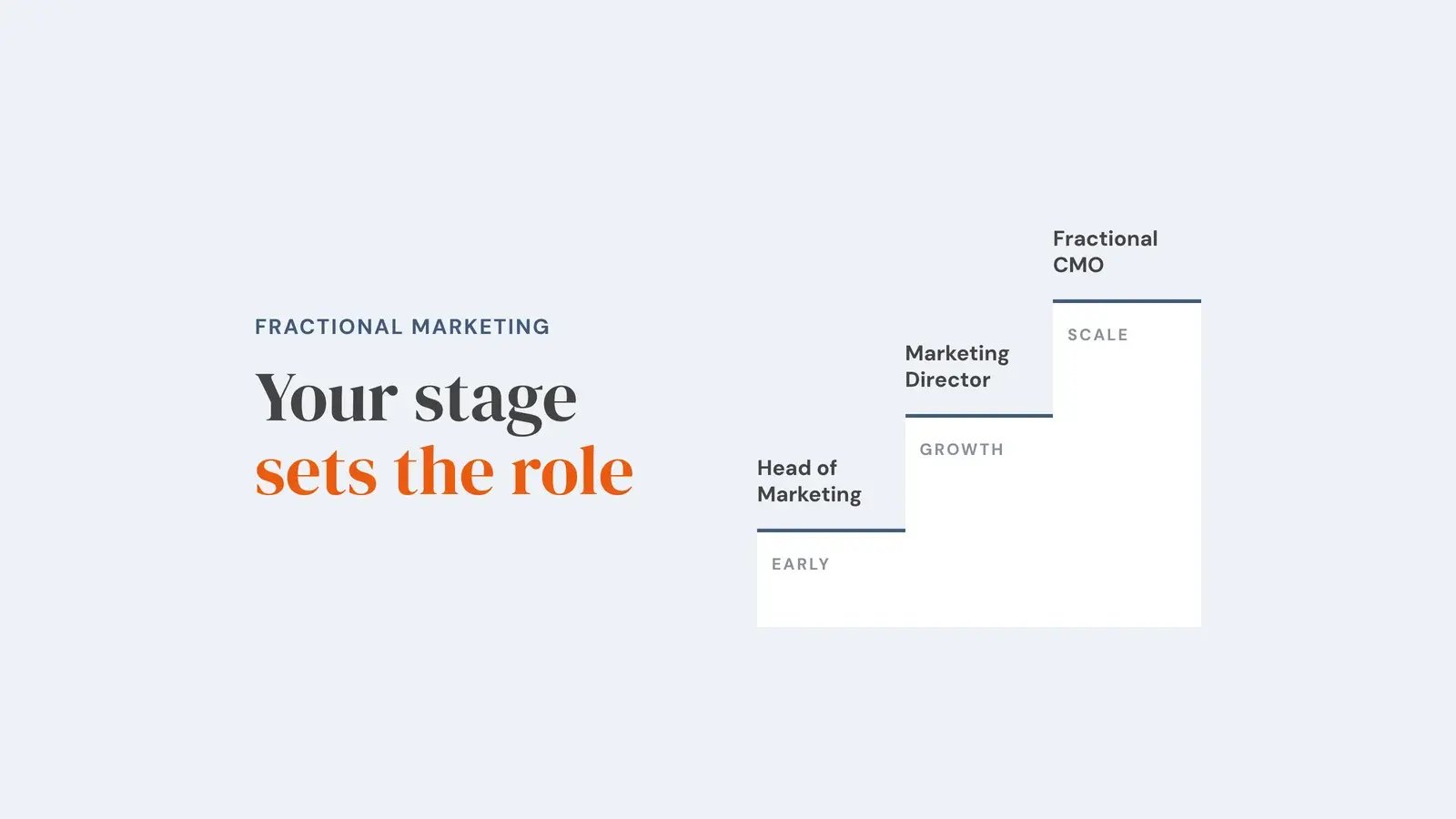
At this stage, a healthy function typically includes documented positioning, a content-led lead-generation approach, basic CRM and attribution, and one person with clear ownership of the system, internal or fractional. My Fractional Marketing Director service is built specifically for businesses at this stage.
Conclusion
You came into this article asking whether your marketing is productive or just busy, and whether more budget would bring more results or more noise. You now have a clear definition, a 7-component benchmark, and a practical process for answering both questions honestly.
The next step is straightforward: score your function, identify what is entirely absent, and set a clear trigger before adding more investment. Scaling a structured function accelerates growth. Scaling a broken one accelerates cost.
How to take action now
- Score your marketing function against the 7 components using the 3-point scale above.
- Identify any component that is entirely absent and treat it as a priority fix before scaling.
- Use the 5-step audit framework to define your minimum viable marketing foundation.
- Book a 90-Minute Marketing Triage™ for a structured external assessment of your gaps.
- Book a discovery call to discuss what a scale-ready marketing function looks like for your business.
Your next step: Read Directionless Marketing: Why It Happens & How to Fix It to see exactly what it costs a business when this structure is never put in place.

About the author
Tom Wardman is a fractional marketing consultant and Growth Independence Architect™ working with founder-led B2B businesses to replace agency dependency with self-sufficient growth systems. As one of the UK's first 5 certified Endless Customers™ coaches, trained directly under Marcus Sheridan, Tom has helped businesses across industries build the structural marketing foundations that make growth predictable and owned. He is the author of Build a Trusted Brand and the creator of the In-House Growth Engine™ framework.
Pricing disclaimer: All GBP–USD price conversions are rounded estimates and correct at the time of publishing. Exchange rates fluctuate and figures should be treated as indicative only.