

Does your agency run without you, or are you still the answer to every operational escalation? And if you are considering bringing in a Fractional COO, do you know exactly what you are committing to before you sign?
Uncertainty about the process is one of the main reasons agency founders delay this decision. This article gives you a clear, phase-by-phase breakdown of the first 90 days of a Fractional COO engagement: what happens, what you should receive, and how to tell whether it is working. This breakdown is drawn from direct experience delivering Fractional COO engagements for UK digital and creative agencies.
It is written for agency founders and leadership teams at agencies between roughly £1m and £10m ($1.25m–$12.5m) in revenue, where operational complexity has outgrown founder capacity but a full-time C-suite hire is not yet justified. Figures in this article are based on UK and US agency engagements.
Key takeaways
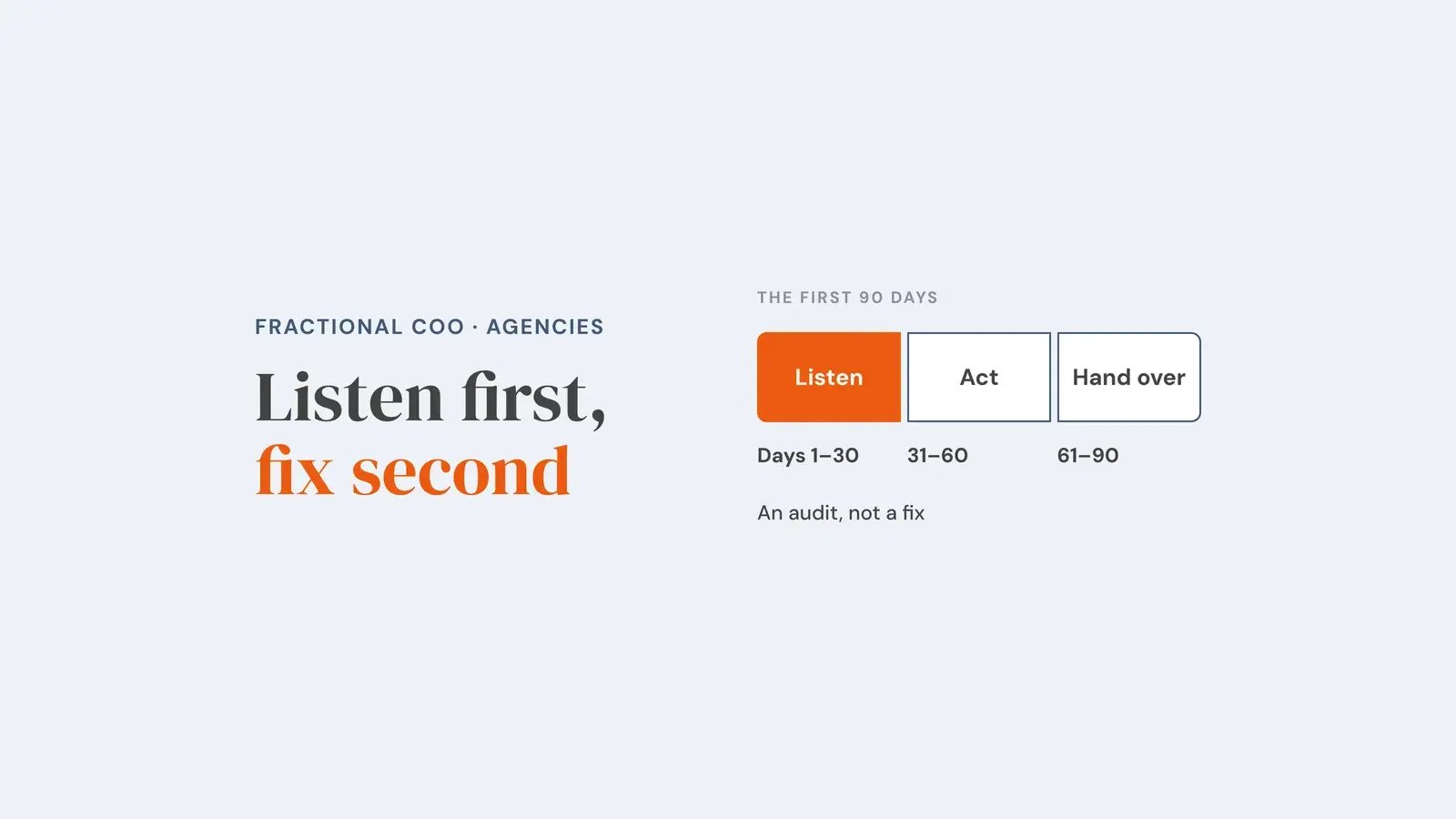
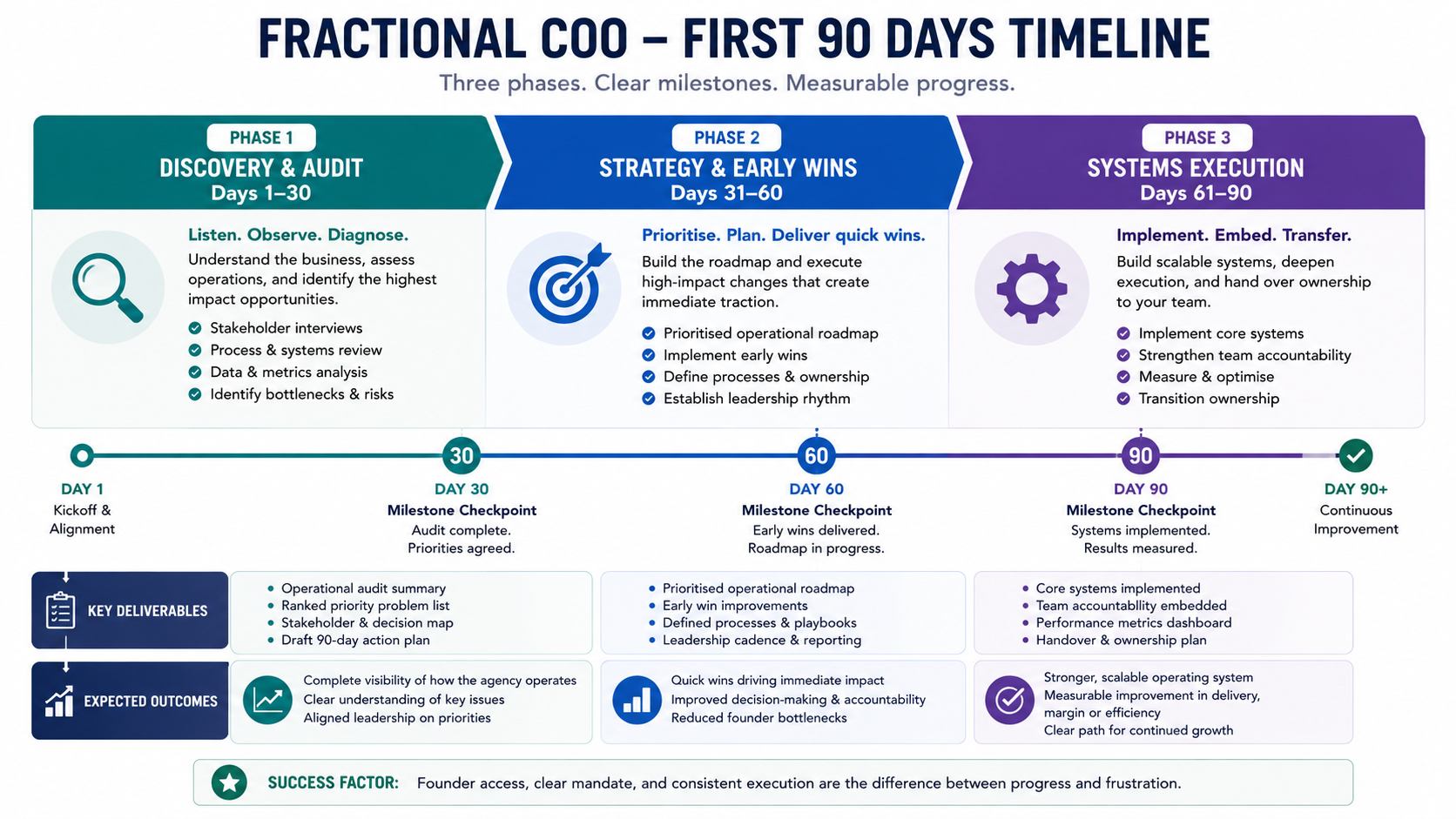
- A Fractional COO engagement runs in three phases: discovery and audit (days 1–30), strategy and early wins (days 31–60), and systems execution (days 61–90).
- In the UK and US, Fractional COO packages for agencies range from £4,200 to £6,900 per month ($5,250–$8,625), on a minimum 6-month commitment.
- The most common reason these engagements fail in the first 90 days is a lack of founder access, not a lack of expertise.
- By day 90, agencies should see specific, measurable improvements in delivery, margin, or decision-making accountability, not just documented activity.
- Agencies that treat the Fractional COO as an embedded leadership team member, rather than an outside contractor, almost always see faster results.
What is a fractional COO and how do agencies engage one?
A Fractional COO is a senior operations executive who works with your agency on a part-time or contract basis, providing strategic and operational leadership without the cost or commitment of a full-time hire.
For digital marketing, creative, and specialist agencies, the role typically focuses on delivery consistency, team structure, margin protection, and removing the founder as the operational bottleneck.
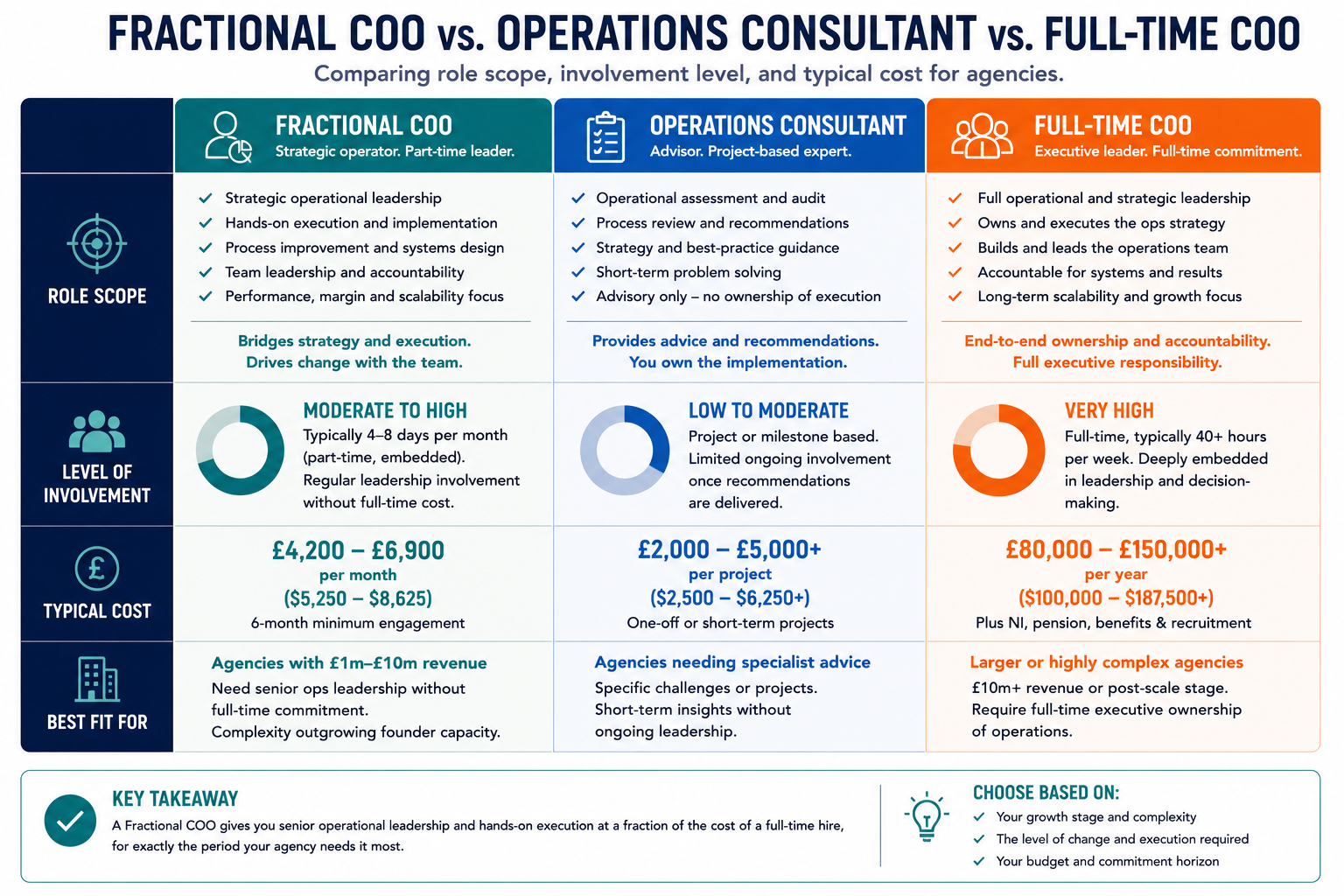
This is structurally different from hiring a consultant, an operations manager, or a full-time COO:
- A consultant, who advises without driving execution
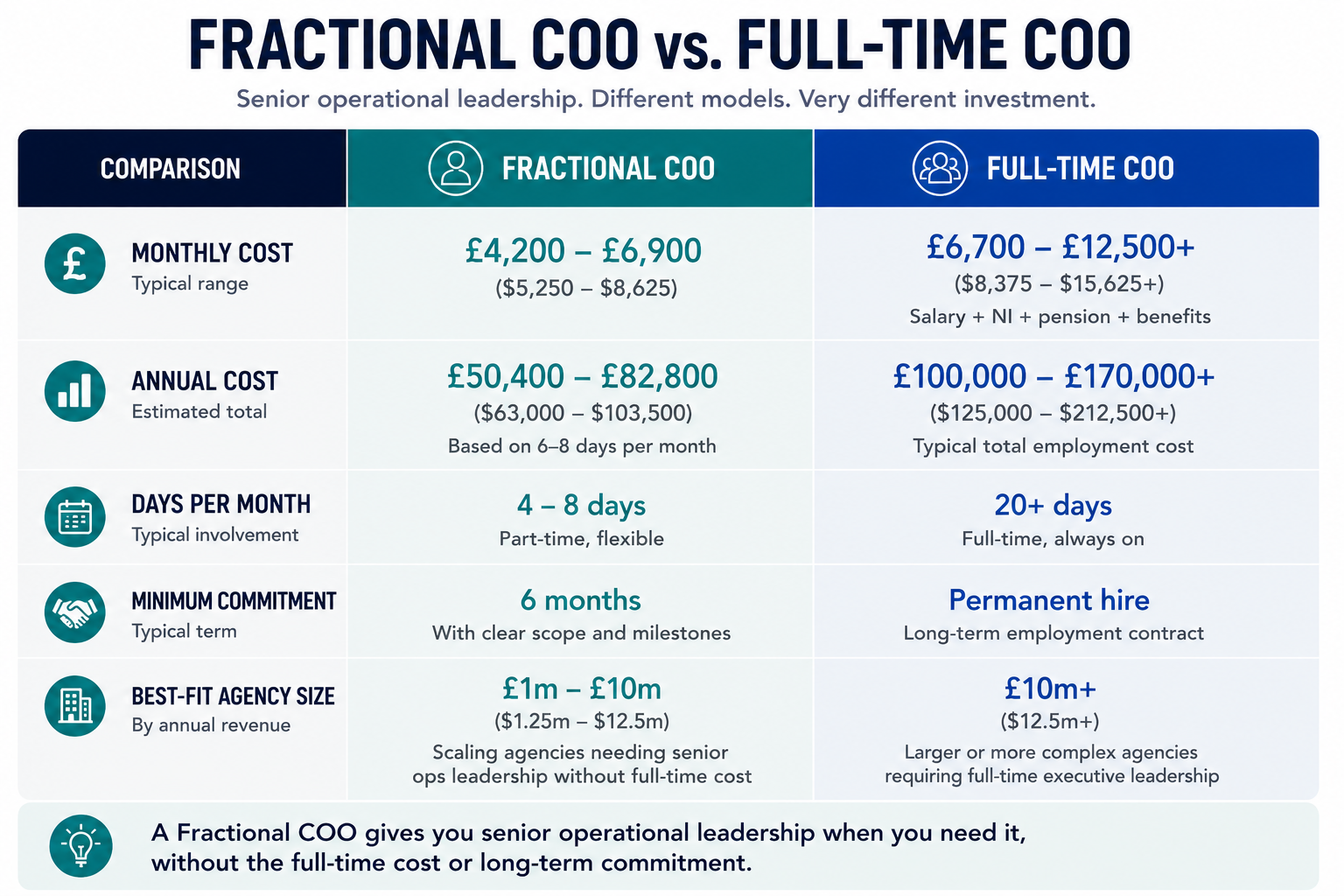
- A full-time COO, who typically costs £80,000–£150,000+ ($100,000–$187,500+) in salary, before employer's National Insurance, pension, and recruitment fees
- An operations manager, who executes but does not lead at a strategic level
The fractional model gives agencies senior operational capability at a fraction of the full-time cost, during the period when they need it most. Engagements are structured around a fixed number of days per month, most sit between 4 and 8, over a minimum of 6 months.
Days 1–30: discovery, operational audit, and diagnosis
In the first 30 days, a Fractional COO's primary job is to listen, observe, and audit, not to fix things. Rushing to solutions before understanding the structural reality of the agency produces the wrong answers.
This phase typically covers structured interviews with department leads, a review of delivery data and client profitability, an assessment of current processes and tooling, and identification of the agency's most urgent operational bottlenecks.
4 things your agency should receive by day 30
- An operational audit summary with documented findings
- A ranked priority problem list
- A stakeholder map showing where decisions currently sit
- A draft 90-day action plan
The Fractional COO will ask how decisions escalate, what happens when the founder is unavailable, how delivery quality is measured, and where project margin tends to erode. This phase sets the direction for everything that follows; it cannot be compressed without compromising the quality of everything built on top of it.
Days 31–60: strategy, prioritisation, and early wins
By day 31, the Fractional COO should shift from diagnosis to action, presenting a prioritised operational roadmap and beginning to drive the first meaningful changes.
For most agencies, this phase targets the highest-friction areas identified in the audit: capacity planning, delivery consistency, team accountability, or pricing and scope control.
5 common early wins delivered in days 31–60:
- A documented capacity model so the agency stops over-committing
- A defined escalation process that routes operational decisions away from the founder
- A standardised project kickoff process that reduces delivery variation
- Clearer scope boundaries on new proposals to protect margin
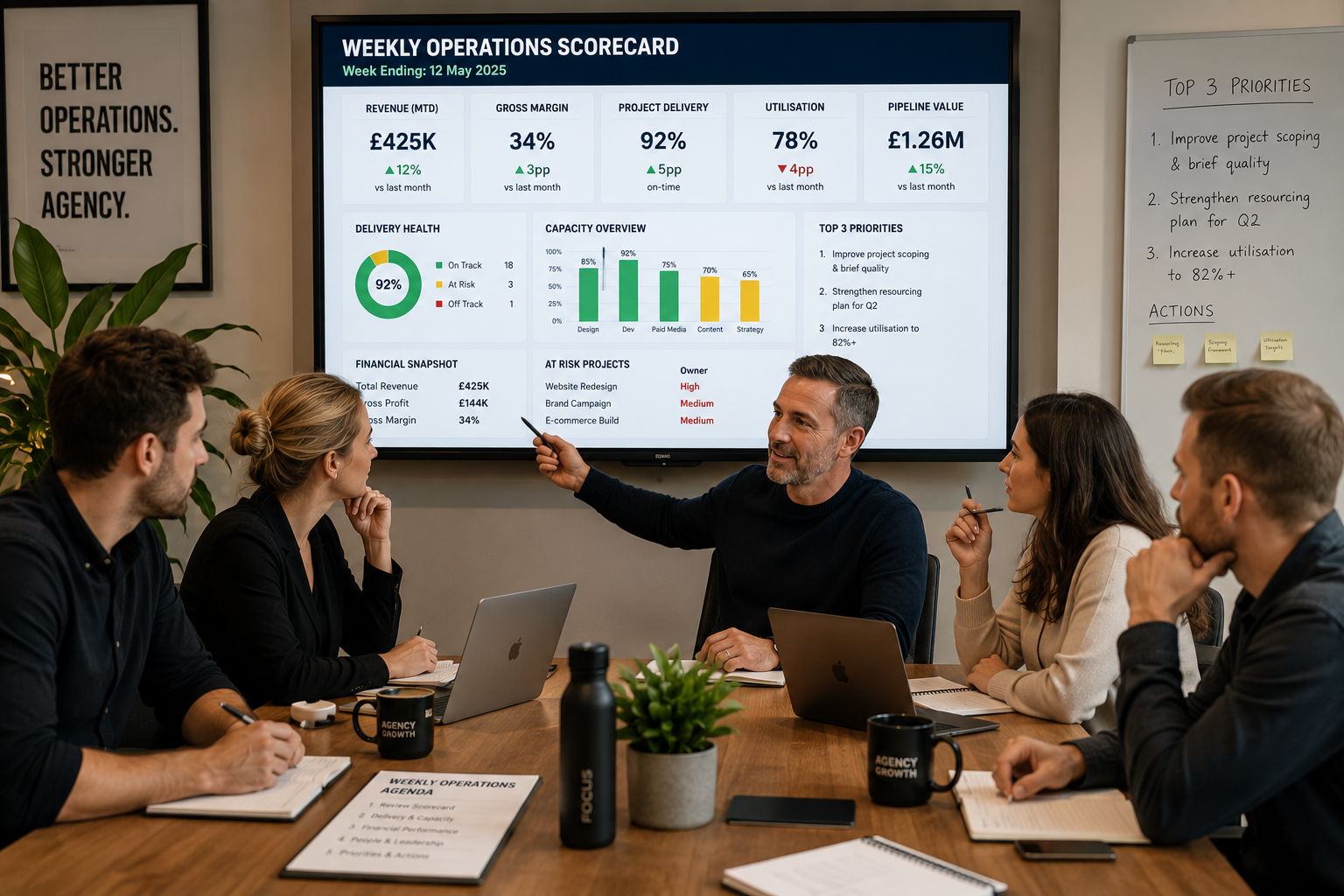
- A weekly leadership rhythm that replaces reactive firefighting with structured accountability
To avoid role confusion, agree the Fractional COO's areas of authority before day 31. Without clarity on where the mandate sits, progress stalls and friction builds with existing team members.
Days 61–90: execution, systems, and measurable outcomes
The final phase is where implementation deepens and the Fractional COO begins transferring ownership of new processes back to your internal team.
By day 90, you should be pointing to specific, measurable improvements, not just documented activity.
What measurable outcomes should you see by day 90?
- Fewer decisions escalating to the founder
- Faster or more consistent delivery cycles
- Improved margin on at least one service line
- A team that can describe how the agency operates without needing to ask
What does a fractional COO cost for agencies?
Transparency note: as a Fractional COO offering this service directly, I have a clear interest in how it is positioned and priced. I have included market context alongside my own figures so you can assess both.
My Fractional COO packages for agencies range from £4,200 to £6,900 per month ($5,250–$8,625), depending on scope and the number of operational support days required. All engagements run on a minimum 6-month commitment, enough time to install structure that actually holds.
Simple cost framework
- Monthly investment × 6 months = minimum engagement cost
- At £5,500 ($6,875) per month, a 6-month engagement costs £33,000 ($41,250)
- A full-time COO hire typically costs £95,000–£130,000 ($118,750–$162,500) all-in during year one, including salary, employer's National Insurance (15%), pension, and recruitment fees
For a £1m–£5m ($1.25m–$6.25m) agency, the fractional model covers 4–8 days of senior operational leadership per month at a fraction of the permanent hire cost, and without the long-term structural commitment.
These figures are based on published UK and US agency engagement pricing. See full agency services pricing here.
Common problems in the first 90 days, and how to avoid them
The most common reason a Fractional COO engagement fails in its first 90 days is not a lack of expertise; it is a lack of access. The COO cannot get meaningful time with the founder, key data is siloed, or internal resistance blocks progress.
6 early warning signs the engagement is going off track
- The Fractional COO cannot access financial data or delivery metrics
- Leadership meetings are regularly cancelled or shortened
- Team members have not been told why the engagement is happening
- The founder continues making operational decisions that bypass the new process
- There is no agreed definition of success at day 90
- The Fractional COO is positioned as an outside vendor rather than a leadership team member
Agencies that brief their team properly, give the Fractional COO genuine access to data and leadership time, and align on a shared definition of success almost always see stronger first-90-day results. Structural change requires internal cooperation, not just external expertise.
Frequently asked questions
The most common questions agency leaders ask before starting a Fractional COO engagement relate to time commitment, contract structure, preparation, and what comes next.
How many days per week does a Fractional COO work with an agency?
Most packages cover 4–8 days per month, roughly 1–2 days per week. This delivers embedded senior operational leadership without the cost of a full-time hire.
Should we sign a 90-day or a longer contract?
A minimum 6-month commitment is standard. The first 90 days establish the foundations; the following months embed and transfer them. Signing for 90 days only rarely produces lasting structural change.
What should we prepare before day one?
Have delivery data, financial reports by client or service line, and your current team structure documented and accessible. The faster the Fractional COO can access context, the more useful the discovery phase becomes.
What happens after the first 90 days?
Most agencies continue the engagement, moving from initial implementation into deeper systems work. The goal is always structural independence, not ongoing reliance on fractional leadership. See how my Fractional COO service is structured within the Agency Operating System™.
Pulling it together
You now have a clear picture of what the first 90 days of a Fractional COO engagement actually involves. Before bringing in a Fractional COO, the most important thing is structure: a defined phase plan, agreed success metrics at each milestone, and a leadership team that is briefed and bought in from day one.
The operational problems causing founder dependency, margin erosion, and delivery inconsistency inside your agency will not resolve themselves by waiting. A structured engagement gives you a defined path from where you are now to an agency that runs without you at the centre of everything.
How to take action now
- Map your agency's current operational bottlenecks before any engagement begins
- Define what success looks like at day 30, 60, and 90 before signing anything
- Agree the Fractional COO's areas of authority with your leadership team upfront
- Brief your team on why the engagement is happening before day one
- Book a scoping call to assess whether a Fractional COO is the right fit for your agency
Related reading: Why Agency Growth Stalls at Founder Capacity (Even With a Team)

About the author
Tom Wardman is a Fractional COO, Fractional CGO, and systems consultant for agency founders. He works with digital marketing and creative agencies through the Agency Operating System™ to install operational structure, fix commercial architecture, and remove founder dependency, so the agency runs without the founder at the centre of everything.
Pricing disclaimer: All GBP–USD price conversions use a fixed house rate of £1 = $1.25 and should be treated as indicative only.
Topics: