

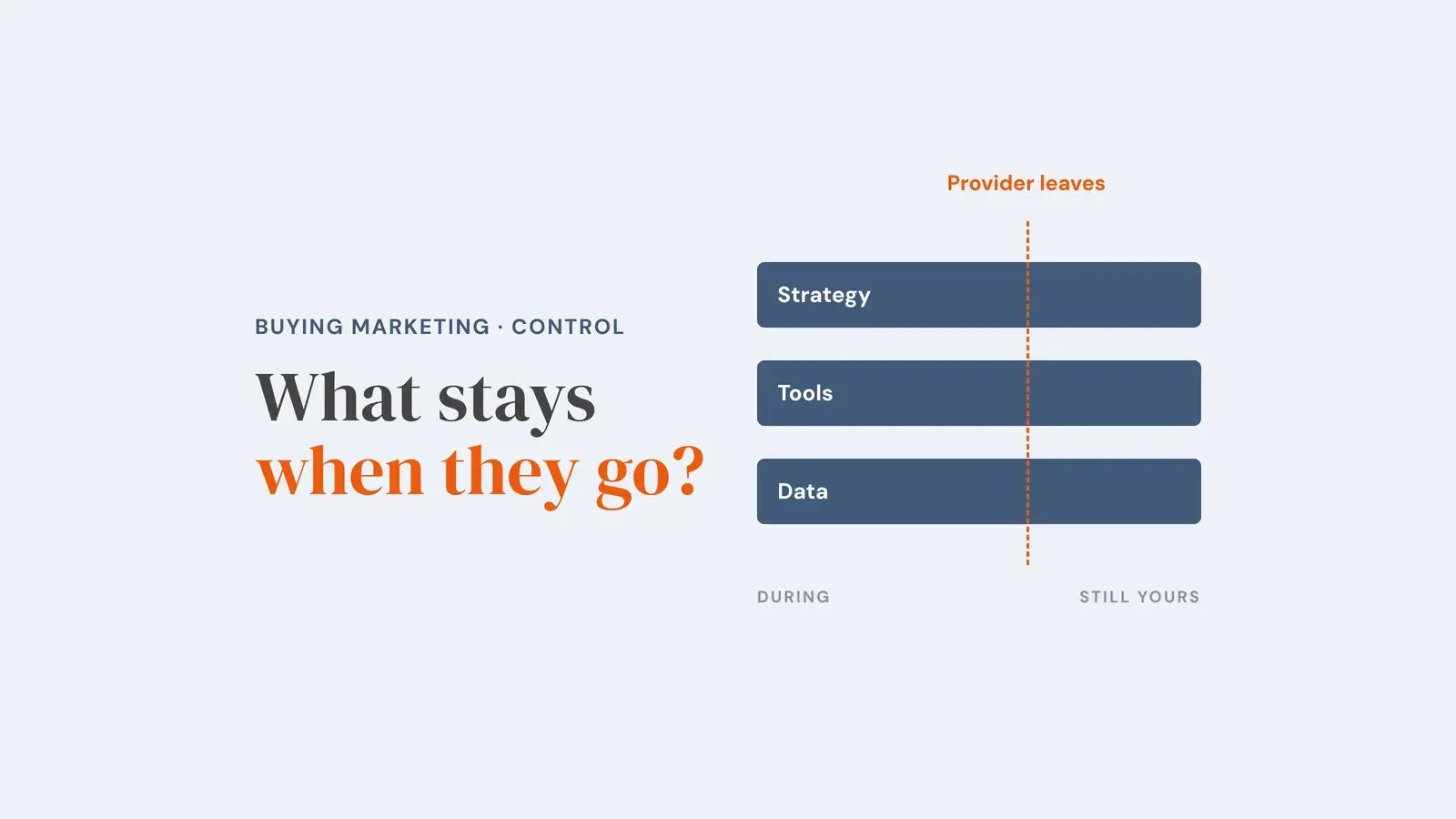
Are you paying for marketing support that only functions while you keep paying for it? And if your current provider disappeared tomorrow, how much of your marketing would survive?
I've spent the past several years as a fractional marketing consultant and certified Endless Customers coach, working inside founder-led B2B businesses to untangle exactly this problem.
This article is for founders and marketing leaders who want measurable results from external support, without surrendering control of their strategy, data, or growth engine. You will learn which models create dependency, how to structure any engagement so you retain full ownership, and what to look for before you sign anything.
Key takeaways
- Dependency-free marketing support is structured so that strategy, tools, and data remain owned by your business, not your provider.
- Marketing support typically costs between £1,500 and £15,000+ ($1,875–$18,750+) per month in 2026. The model you choose determines whether you are building an asset or renting one. (Estimate based on published market data and my own published pricing.)
- Fractional CMOs and embedded specialists typically create the least dependency because knowledge transfers directly to your internal team.
- Before signing any contract, confirm admin access to all platforms, define knowledge-transfer milestones, and agree an exit plan upfront.
- The five lowest-dependency models share one principle: ownership of strategy, tools, and data must sit with you, not the provider.
What is dependency-free marketing support?
Dependency-free marketing support is a model where external help is deliberately structured to build your internal capability, not replace it.
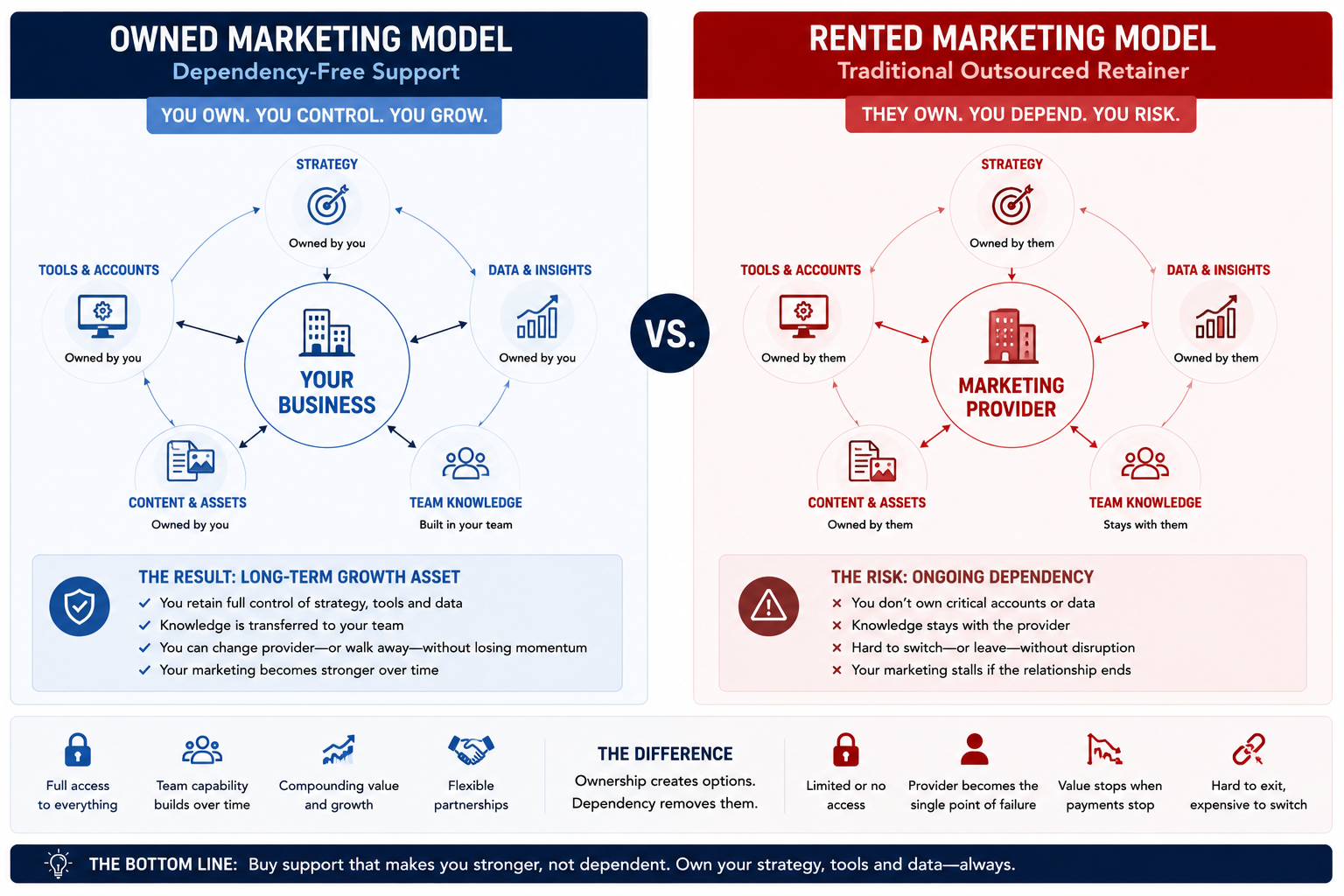
Unlike a traditional retainer, where strategy, tools, and knowledge sit with the provider, a dependency-free approach keeps institutional knowledge, platform access, and strategic control inside your business throughout the engagement.
In practice, this means three things:
- You own every account and platform from day one: ad accounts, CRM, analytics
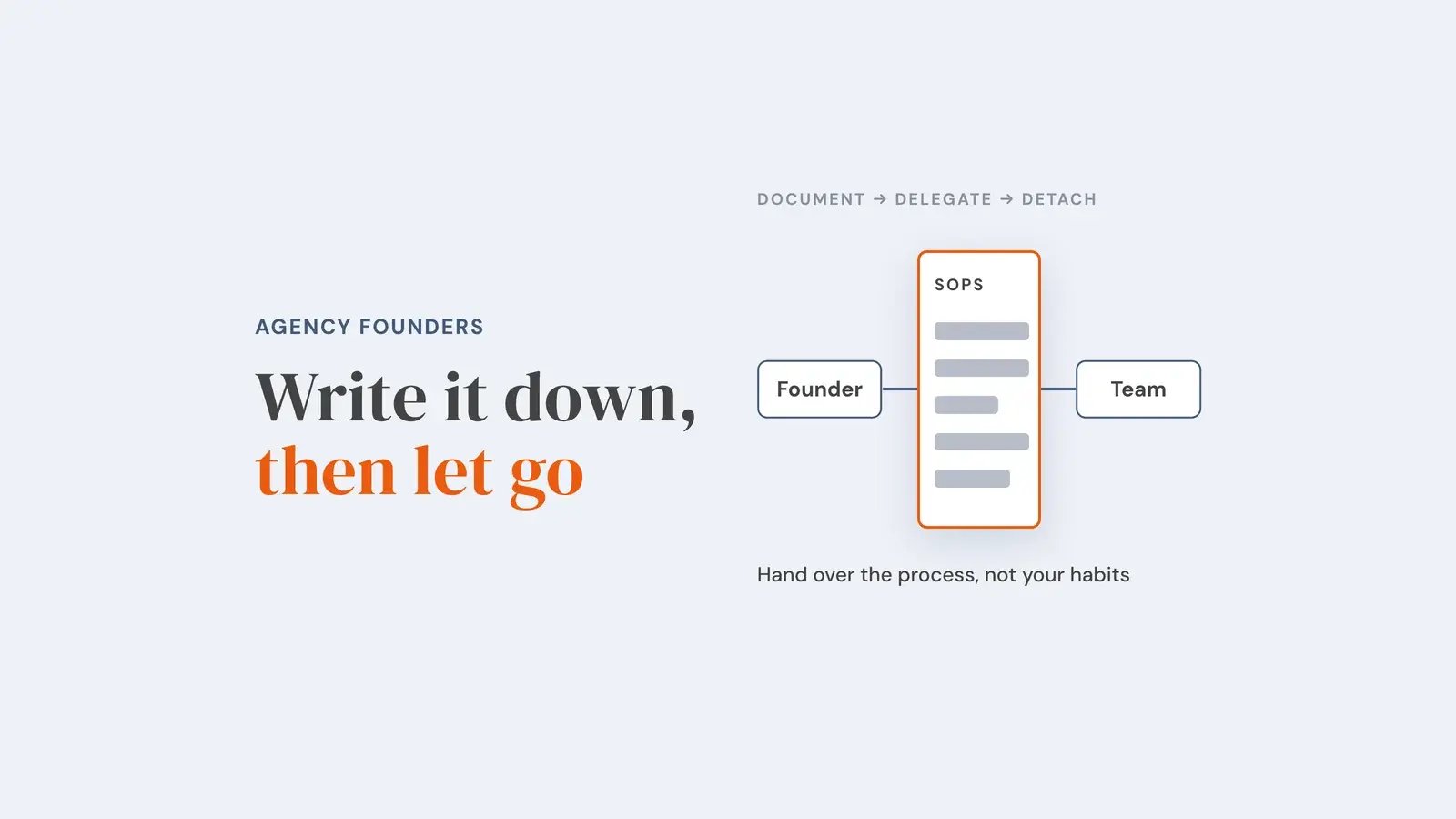
- You hold a documented strategy you could hand to someone else tomorrow
- You could exit the relationship without your pipeline collapsing
The distinction is not about cost. It is about what remains when the engagement ends.
Why do businesses become dependent on marketing providers?
Marketing dependency develops when a business outsources not just execution, but strategy, tool ownership, and institutional knowledge, leaving nothing transferable if the relationship ends.
It often starts quietly. An agency sets up your ad accounts, configures your CRM, and manages your reporting. Within 12 months, only they know how any of it works.
A common misconception is that dependency only happens with large agencies. Freelancers and small retainers create it just as easily, often more quietly.
Warning signs you may already be too dependent:
- You do not have admin access to your own ad accounts or CRM
- Your strategy exists only in your provider's head or their internal systems
- You have never received a strategy document you could hand to another team
- Reporting arrives in a dashboard you cannot export or replicate
- You are unclear what happens to your data if the relationship ends today
Related Reading: Agency Incentive Misalignment: Why Your Agency's Goals Aren't Yours
What does marketing support cost, and what are you actually paying for?
Marketing support typically costs between £1,500 and £15,000+ ($1,875–$18,750+) per month, depending on the model, scope, and whether strategic leadership is included. (Ranges based on published UK market data and my own published pricing.)
The more relevant question is whether you are paying to build your own capability, or to indefinitely rent someone else's.
A traditional agency retainer at £5,000 ($6,250) per month costs £180,000 ($225,000) over three years. At the end of it, the agency still owns the systems.
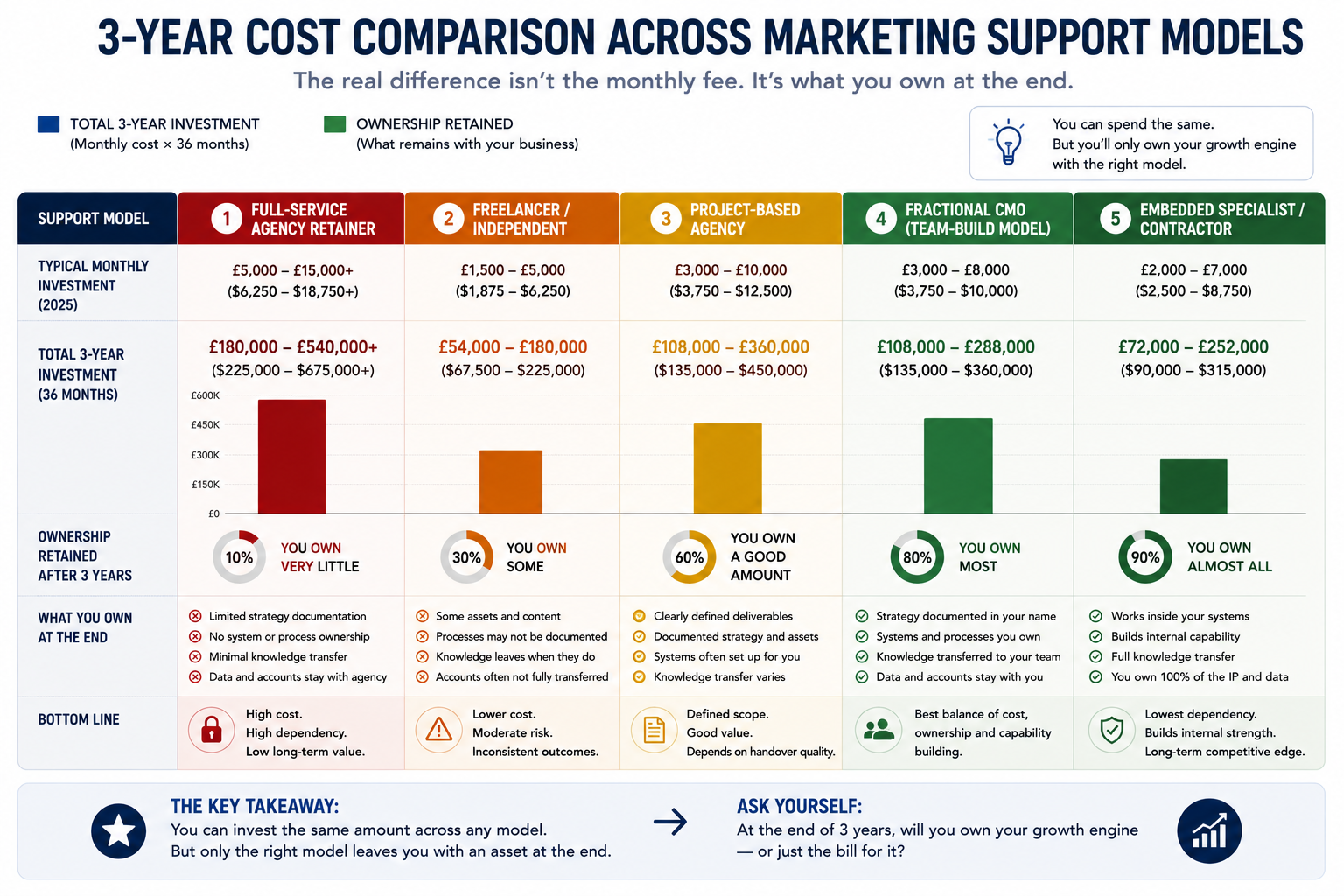
Agency vs. freelancer vs. fractional CMO: which model creates least dependency?
Fractional CMOs and embedded marketing specialists typically create the least dependency because they operate inside your business, transfer knowledge to your team, and are scoped to build internal capability from the start.
Full-service agencies score lowest on knowledge transfer, partly by design. Their model is built on ongoing retainers, not on making themselves redundant.
A note on bias: I work as a fractional marketing consultant, which is the model this section rates highest. Weigh that context alongside the reasoning above rather than taking the ranking on trust alone.
The 5 best ways to buy marketing support without creating dependency
The five most effective ways to buy marketing support without dependency all share one principle: ownership of strategy, tools, and data must sit with you, not the provider.
- Fractional CMO with an internal team-build mandate: Strategic leadership scoped to transfer decision-making capability to your team over a defined period.
- Project-based agency with full handover deliverables: A defined scope with documented outputs your team can run independently.
- Training-led retainer (the agency teaches; you execute): The provider builds your team's capability rather than simply doing the work. My Kickstart Training is built exactly this way.
- Embedded specialist with a documented playbook output: A specialist who works inside your business and leaves a repeatable system behind.
- Managed-exit retainer with capability milestones: An engagement with structured handover points that reduce provider involvement by design.
Related Reading: Stop Outsourcing Everything: Why the Best Agencies Focus on Teaching, Not Just Doing
How to structure any marketing engagement to stay in control
To avoid dependency, every marketing engagement, regardless of provider type, needs explicit tool ownership, knowledge-transfer milestones, and an exit-readiness plan agreed before work begins.
This six-step framework applies whether you are engaging a global agency or a solo freelancer:
- Audit what you currently own: Identify which accounts, platforms, and documents already sit under your control.
- Define ownership in the contract upfront: Admin access to all platforms must be yours from day one, not transferred later.
- Set knowledge-transfer milestones: Agree specific checkpoints where documented systems are handed to your team.
- Require living strategy documentation: The strategy must live in your systems, in a format your team can use without the provider.
- Maintain admin access to all platforms: You should never need to request access to your own accounts.
- Schedule a quarterly exit-readiness check: Ask: if this engagement ended today, what could we not do?
Contract clauses worth insisting on:
- Full admin access to all accounts on day one
- Ownership of all strategy documents and creative assets
- No proprietary reporting dashboards you cannot export
- Clear data portability and offboarding terms
Green flags and red flags when evaluating marketing support providers
The clearest green flag in any marketing provider is a willingness to document their strategy, train your team, and hand over full platform access at any stage. The clearest red flag is resistance to any one of those three things.
| Green flags | Red flags |
|---|---|
| Gives you admin access without being asked twice | Delays or resists handing over platform access |
| Keeps strategy documented in your systems, not theirs | Strategy exists only in their heads or internal tools |
| Trains your team as part of the engagement | Treats knowledge transfer as outside scope |
| Reporting is exportable and replicable | Reporting lives in a dashboard only they control |
| Talks openly about what happens if you leave | Goes vague or defensive when you ask about exit terms |
Related Reading: Marketing Agency Red Flags: 7 Lies Agencies Tell & What To Ask Instead
Frequently asked questions about buying marketing support
Can I get strong marketing results without a long-term agency retainer?
Yes. Project-based agencies, fractional specialists, and training-led retainers can all deliver measurable results without open-ended commitments. The key is defining clear outcomes and ownership terms before work starts.
What should I always own in-house?
Always own: strategy documentation, platform admin access, brand assets, CRM data, and reporting frameworks. Specialist execution, such as paid media, can be outsourced on a project basis, provided you retain account ownership and data.
How do I know if I am already too dependent on my current provider?
Ask: if this provider stopped responding tomorrow, could your team continue marketing independently for 30 days? If the answer is no, dependency already exists.
How do I transition away from a dependent marketing relationship without losing momentum?
Request full account admin access immediately. Ask for all strategy documents and creative assets. Run a parallel period where your team shadows the provider before the relationship ends, and document every process before the exit date.
Conclusion
You came to this article with a sense that something about your marketing arrangement felt fragile, that results were conditional on continued payments.
You now have a clearer picture. Dependency is not inevitable. It is a structural problem, and it has a structural fix. The right support builds a capability that stays inside your business long after the engagement ends.
Related Reading: Agency Not Delivering ROI: What to Do and When to Leave
How to take action now
- Audit which platforms you currently have admin access to
- Request your strategy documentation from your current provider; if it does not exist, that is your starting point
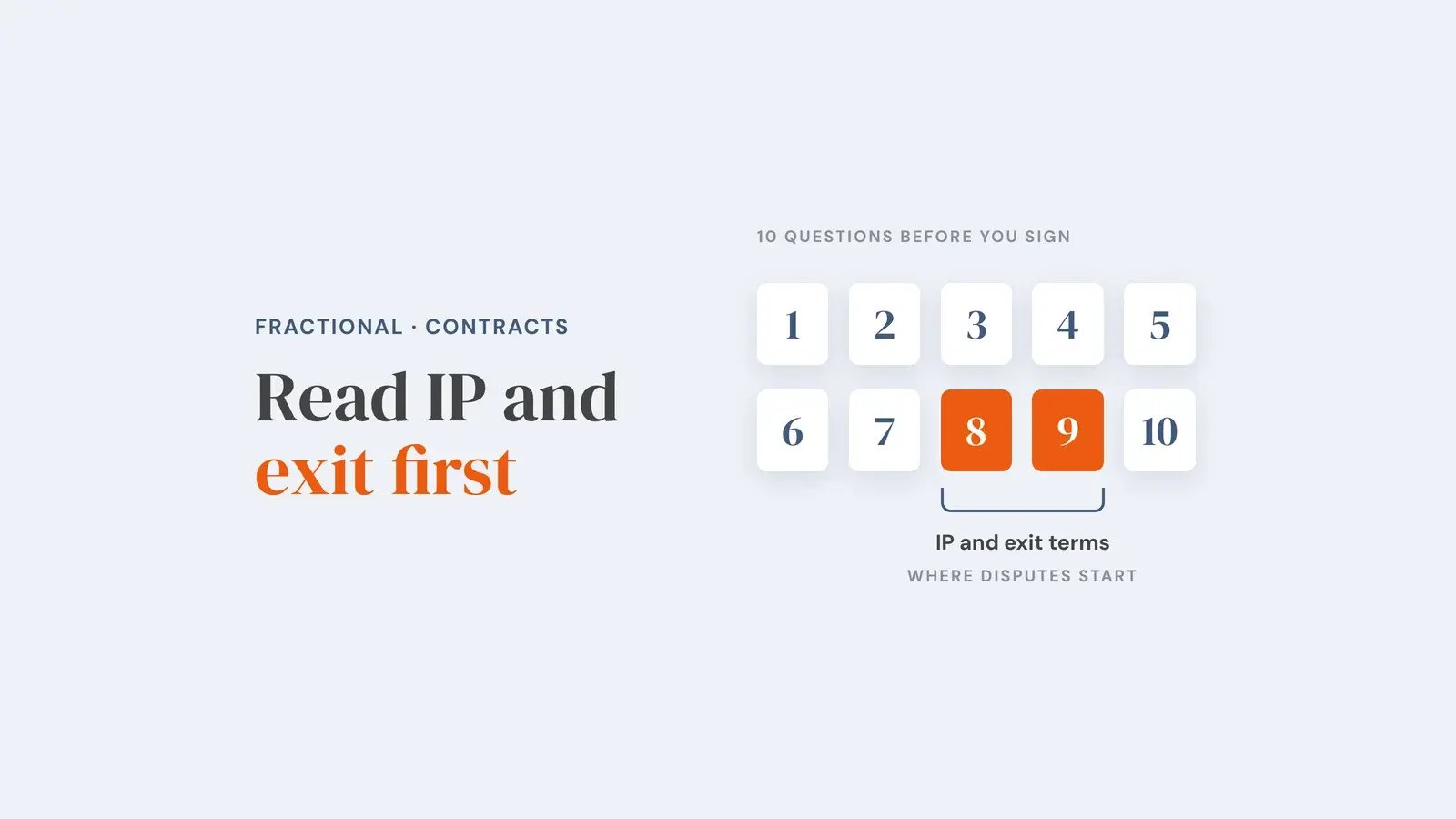
- Review your contract for data portability and exit terms
- Use the green/red flag table above before signing any new agreement
Take the Marketing Debt Scorecard to identify your biggest structural weaknesses.
If you are ready to replace dependency with a growth system your team fully owns, book a no-pressure call to talk through where you are.

About the author
Tom Wardman is a fractional marketing consultant and Growth Independence Architect working with founder-led B2B businesses across the UK. He installs self-sufficient growth systems, ones his clients own and operate without ongoing external reliance. Tom is one of the UK's first five certified Endless Customers coaches, trained directly under Marcus Sheridan, and the author of Build a Trusted Brand. His work sits at the intersection of strategic leadership, capability transfer, and structural marketing architecture.
Pricing disclaimer: All GBP–USD price conversions are rounded estimates and correct at the time of publishing. Exchange rates fluctuate and figures should be treated as indicative only.
Topics: