

Are you at a stage where growth is stalling, and you're wondering whether you need strategic leadership or hands-on marketing execution?
Have you looked at CMO salaries and consultant rates, only to feel more confused about which investment actually delivers results for your business?
This article will compare the real costs, time-to-impact, and long-term value of both options so you can make a confident, ROI-driven decision. You'll find break down salary versus retainer fees, hidden costs, timelines to results, skill set differences, and show you real client results, so you'll know exactly which choice fits your business stage, budget, and growth goals.
Note: All figures shown in GBP first, followed by USD equivalent (approx.).
CMO salary vs marketing consultant fees: True cost comparison
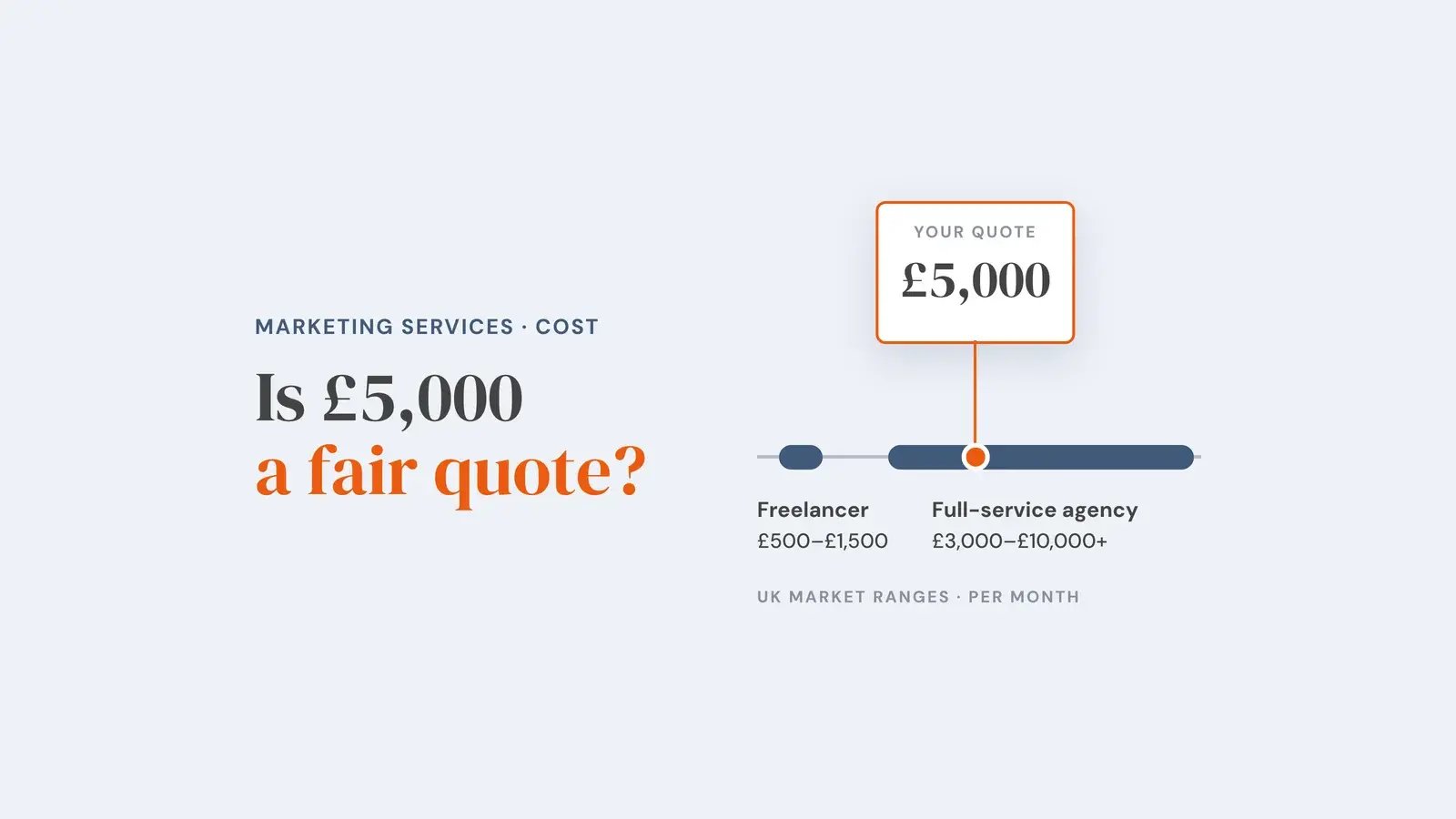
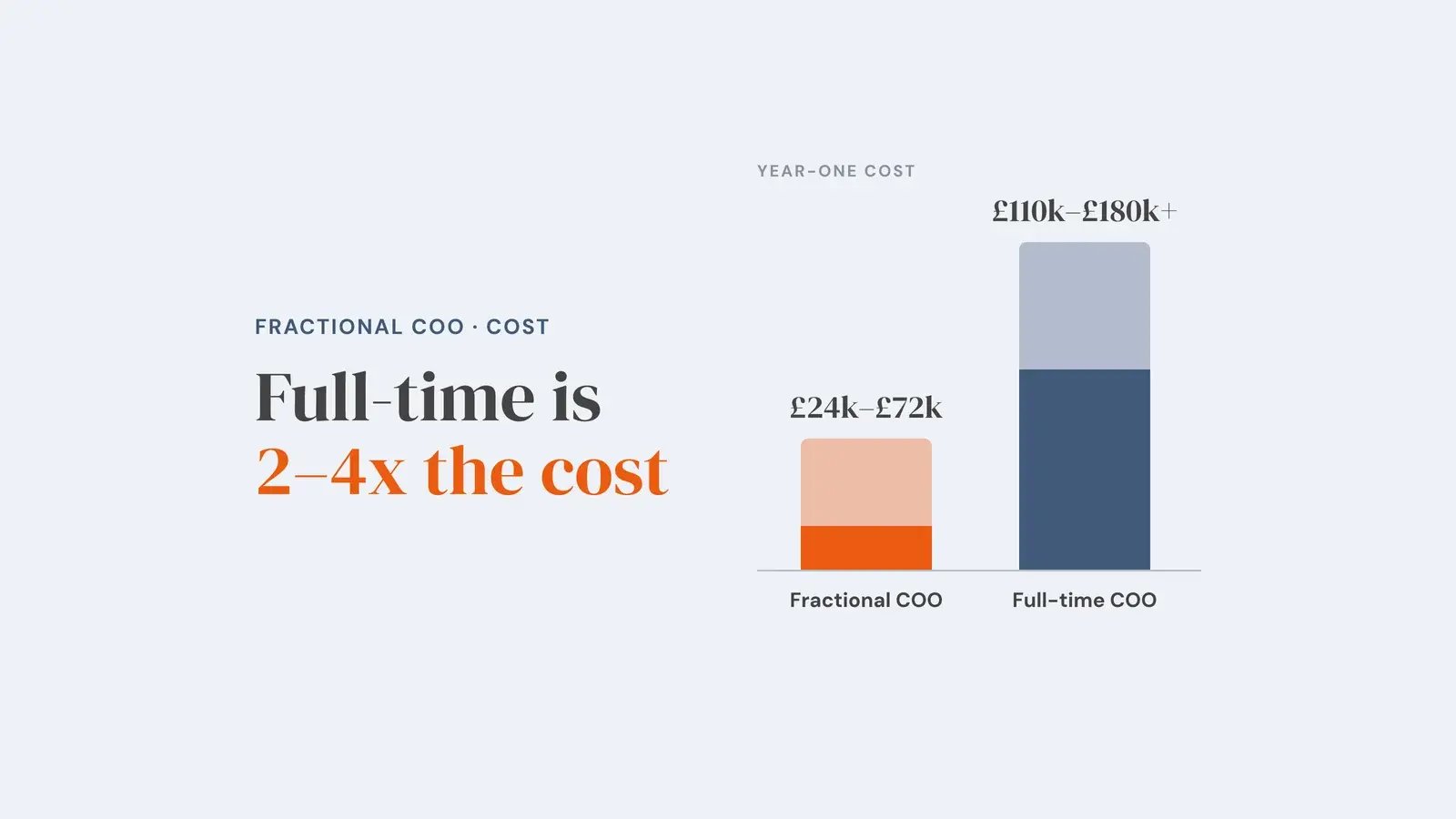
A senior CMO typically costs £100,000-£200,000+ ($125,000-$250,000+) annually in salary alone, while an experienced marketing consultant ranges from £500-£2,000 ($625-$2,500) per day or £3,000-£15,000 ($3,750-$18,750) monthly on retainer.
However, the true cost comparison extends far beyond base compensation to include benefits, equipment, training, and the hidden costs of recruitment and onboarding. CIPD's 2026 resourcing and talent planning report puts the median cost of hiring a senior manager or director at around £3,500, before any executive search fees for a hard-to-fill role.
Full cost breakdown: CMO vs marketing consultant
| Cost Category | CMO (Annual) | Marketing Consultant (Annual) |
|---|---|---|
| Base salary/fees | £100,000-£200,000 ($125,000-$250,000) | £36,000-£180,000 ($45,000-$225,000) |
| Benefits & pension | £15,000-£30,000 ($18,750-$37,500) | £0 |
| Equipment & office | £5,000-£10,000 ($6,250-$12,500) | £0 |
| Training & development | £3,000-£8,000 ($3,750-$10,000) | £0 |
| Recruitment costs | £15,000-£25,000 ($18,750-$31,250) | £0 |
| Total Annual Cost | £138,000-£273,000 ($172,500-$341,250) | £36,000-£180,000 ($45,000-$225,000) |

The cost difference becomes more dramatic when you factor in:
CMO hidden costs:
- 3-6 month recruitment process
- Onboarding time (typically 90-120 days to full productivity)
- Management overhead and performance reviews
- Potential redundancy costs if role doesn't work out
Marketing consultant advantages:
- Immediate availability (often within 2-4 weeks)
- No ongoing employment obligations
- Flexible engagement terms
- Access to broader skill sets without additional hiring
Skill sets and expertise: CMO vs marketing consultant
CMOs bring deep strategic leadership and internal company knowledge, while marketing consultants offer specialised expertise across multiple industries and current best practices from diverse client work.
The key difference lies in breadth versus depth: CMOs develop intimate knowledge of your specific business, while consultants bring fresh perspectives and proven methodologies from working with dozens of similar companies.
CMO strengths
Strategic leadership excellence:
- Board-level strategic thinking and planning
- Long-term vision development and execution
- Internal stakeholder management and alignment
- Team building and leadership development
Deep company integration:
- Intimate understanding of company culture
- Internal process optimisation
- Cross-departmental relationship building
- Institutional knowledge accumulation
Resource management:
- Budget planning and resource allocation
- Hiring and team development strategies
- Technology stack decisions and implementations
- Vendor relationship management
Marketing consultant strengths
Diverse industry experience:
- Cross-sector best practices and benchmarks
- Rapid pattern recognition and problem-solving
- Fresh perspectives unconstrained by internal politics
- Access to latest tools and methodologies
Specialised expertise:
- Deep knowledge in specific marketing disciplines
- Current expertise in emerging trends and technologies
- Proven frameworks from multiple implementations
- Network of specialist partners and resources
Agile implementation:
- Rapid deployment of tested strategies
- No learning curve on modern marketing tools
- Objective outside perspective on challenges
- Flexibility to pivot strategies quickly
Marketing consultant vs CMO: Which delivers faster results?
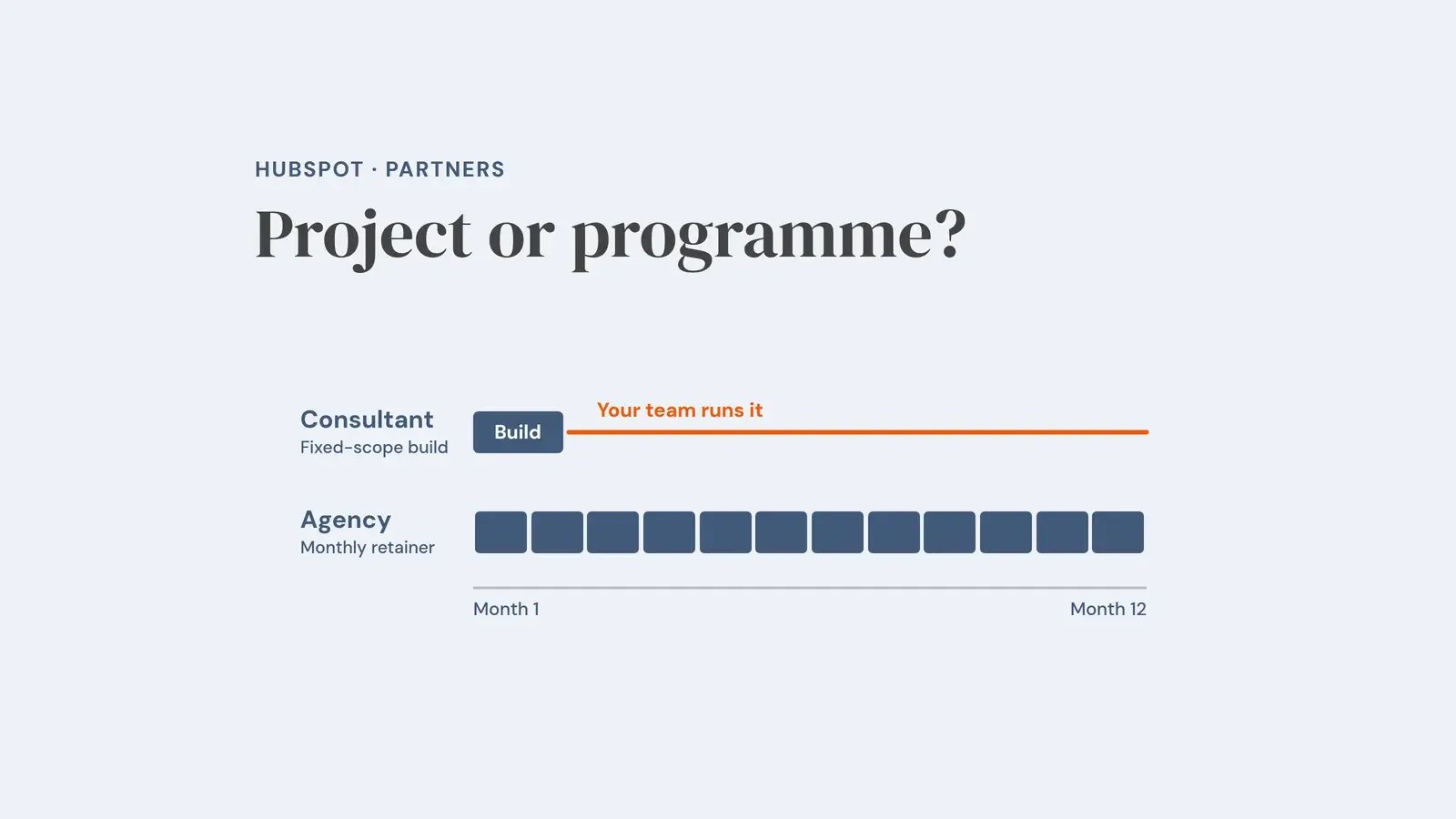
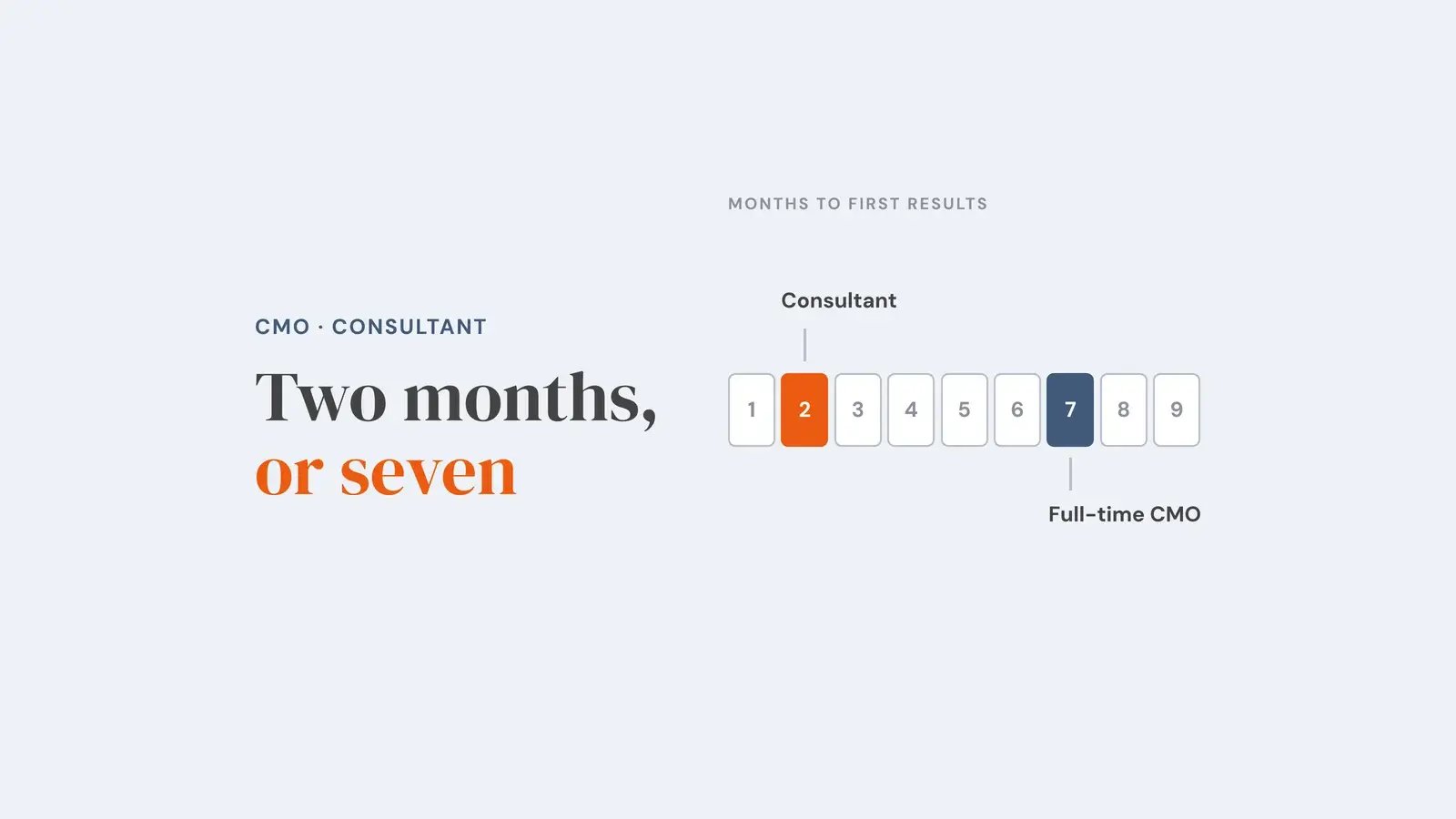
Marketing consultants typically begin delivering measurable results within 30-60 days due to their focused expertise and immediate availability, while CMOs may require 3-6 months to fully understand the business and implement strategic changes.
Consultants can start immediately without lengthy recruitment processes, but CMOs offer long-term strategic continuity that builds compound value over years.
Time to impact comparison
Marketing consultant timeline:
- Week 1-2: Initial audit and strategy development
- Week 3-4: Implementation begins
- Month 2: First measurable improvements
- Month 3: Clear results and optimisation
CMO timeline:
- Month 1-2: Recruitment and interview process
- Month 3-4: Onboarding and business understanding
- Month 5-6: Strategy development and team alignment
- Month 7-9: Implementation and initial results

Factors affecting speed of results
Consultant advantages for quick wins:
- Immediate start dates (typically 2-4 weeks notice)
- Pre-existing expertise in your industry/challenges
- Access to proven frameworks and tools
- No internal politics or bureaucracy to navigate
CMO advantages for long-term value:
- Deep company knowledge development
- Internal relationship building and trust
- Strategic continuity across multiple years
- Team development and succession planning
ROI comparison: CMO vs marketing consultant
Marketing consultants often deliver higher short-term ROI due to lower costs and faster implementation.
CMOs typically provide better long-term ROI for larger companies through sustained strategic leadership, team development, and deep market positioning, though the payback period is longer.
ROI analysis framework
Short-term ROI (Year 1):
| Metric | CMO | Marketing Consultant |
|---|---|---|
| Investment | £150,000-£250,000 ($187,500-$312,500) | £40,000-£120,000 ($50,000-$150,000) |
| Time to results | 6-9 months | 1-3 months |
| Payback period | 8-12 months | 3-6 months |
Long-term ROI (3-5 years):
| Metric | CMO | Marketing Consultant |
|---|---|---|
| Cumulative investment | £450,000-£750,000 ($562,500-$937,500) | £120,000-£360,000 ($150,000-$450,000) |
| Strategic value | Very high | Moderate-High |
| Team development | Excellent | Good |
| Market position | Deep integration | Strong results |
Real results
Here are named results from my own work, which you can read in full on my success stories page:
- Global climate consultancy: 44% more qualified opportunities, with marketing and sales working as one.
- IDS Media: replaced a fragmented CRM with a HubSpot system their team runs.
The key difference: consultants excel at rapid improvements and cost efficiency, while CMOs build long-term competitive advantages and organisational capabilities.
When to hire a CMO over a marketing consultant
Companies should hire a CMO when they have a marketing team of five or more to lead, need full-time strategic leadership, or require someone to build and manage large internal marketing teams.
CMOs are also essential for businesses undergoing major brand transformations, preparing for IPOs, or operating in highly regulated industries where deep institutional knowledge is critical.
Clear CMO indicators
Business size and complexity:
- Annual revenue above £20 million ($25 million)
- Marketing team of 5+ people requiring leadership
- Multiple product lines or market segments
- Complex B2B sales cycles exceeding 6 months
Strategic requirements:
- Board-level marketing representation needed
- Major brand repositioning or transformation
- IPO or acquisition preparation requiring marketing leadership
- Highly regulated industry requiring compliance expertise
Organisational needs:
- Building long-term competitive moats
- Developing next-generation marketing leaders
- Creating proprietary marketing methodologies
- Establishing thought leadership in your industry
Market position goals:
- Category creation or market definition
- Long-term brand building (5+ year horizon)
- Complex partnership and channel strategies
- International expansion requiring local expertise
Industry-specific CMO advantages
Technology companies:
- Product marketing and go-to-market strategy
- Technical audience education and trust building
- Developer relations and community building
- Scaling marketing operations through hypergrowth
Healthcare/Life sciences:
- Regulatory compliance and approval processes
- Clinical data communication and trust building
- Healthcare provider relationship management
- Patient education and safety communication
Financial services:
- Regulatory compliance and risk communication
- Trust building in high-stakes decision environments
- Complex product explanation and education
- Long-term client relationship development

When a marketing consultant is the better investment
Marketing consultants are ideal for startups and businesses that need expert-level marketing without the full-time commitment and cost of a senior executive. Harvard Business Review notes that small and medium-sized firms often struggle to access and afford senior talent, which is why part-time senior leaders have grown in popularity.
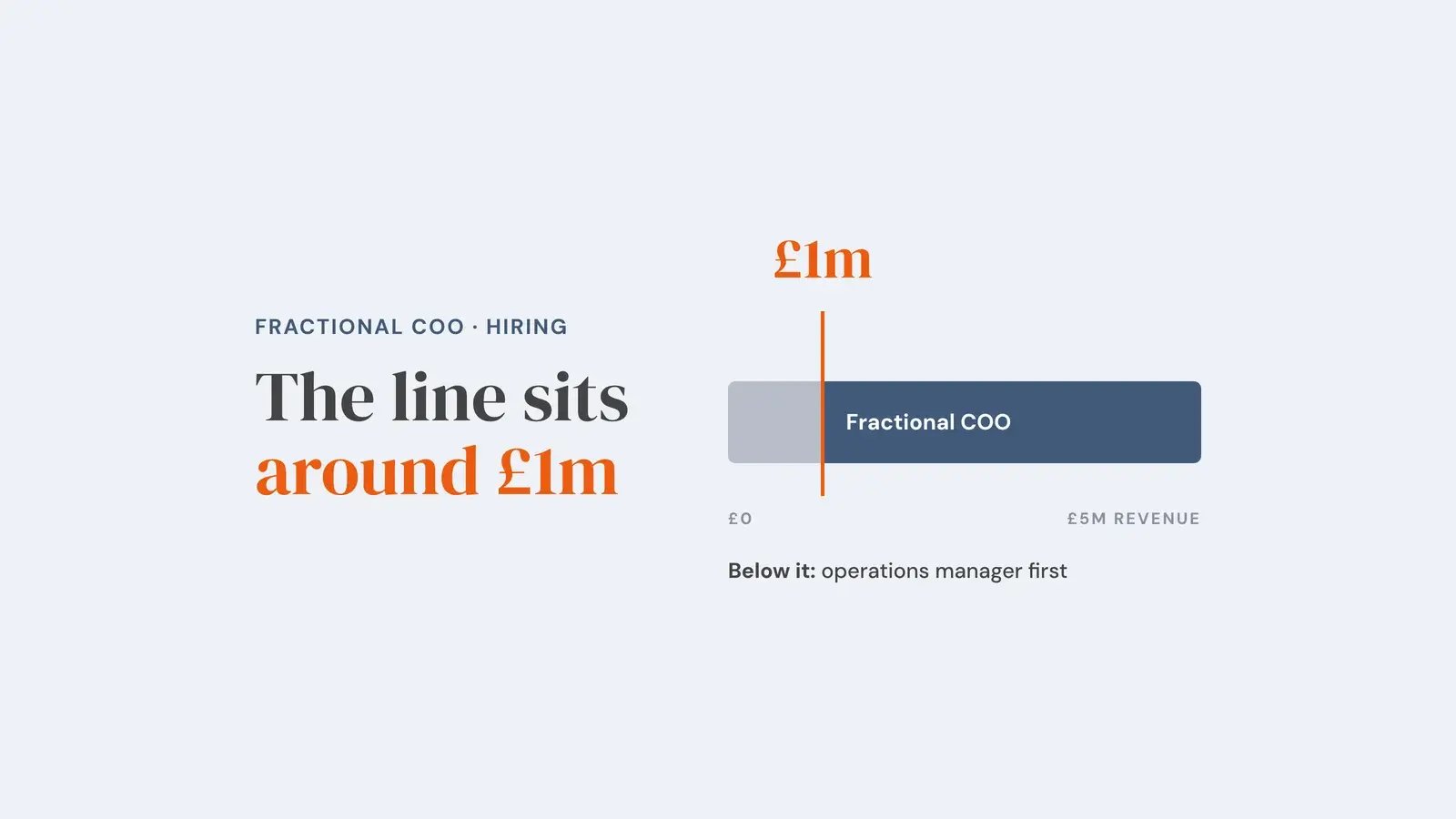
They're also the smart choice for specific project work, digital transformation initiatives, or when you need to test new markets and strategies before making permanent hires. If you're at £1m–£20m and need someone to do the work as well as advise, a fractional marketing director is usually the better buy.
Clear consultant indicators
Business stage and size:
- Annual revenue under £1 million ($1.25 million), or a specific gap to fill
- Marketing team of fewer than 5 people
- Startup or scale-up phase requiring agility
- Budget constraints preventing executive hires
Specific project needs:
- HubSpot implementation and optimisation
- Content strategy development and execution
- Digital transformation initiatives
Testing and validation:
- New market entry strategies
- Product launch campaigns
- Marketing channel experiments
- ROI validation before scaling
Skill gap solutions:
- Specialised expertise not available internally
- Short-term intensive support needs
- Knowledge transfer and team training
- Objective outside perspective on challenges
Industry-specific consultant advantages
Professional services:
- Trust-building content and thought leadership
- Sales enablement and proposal improvement
- Digital presence and lead generation
- Client education and nurturing systems
Manufacturing:
- B2B buyer education and technical content
- Sales process optimisation and alignment
- Digital transformation and automation
- Customer success and retention strategies
SaaS/Technology:
- Rapid growth marketing and scaling
- Product adoption and onboarding optimisation
- Content marketing and SEO strategies
- Marketing automation and lead scoring
Find out more by reading this Harvard Business Review study on fractional executives vs full-time hires
Making the right choice: CMO or marketing consultant?
The decision ultimately depends on your company size, growth stage, budget, and whether you need ongoing strategic leadership or specific expertise and execution.
Consider starting with the Marketing Diagnostic, then using a fractional marketing director who does the work and trains your team, and hiring in-house as the role steps down.
Decision framework: 5 key questions
1. What's your annual revenue and growth trajectory?
- Under £1M ($1.25M): Marketing consultant likely optimal
- £1M-£20M ($1.25M-$25M): Fractional marketing director who does the work
- Over £20M ($25M) with a team of five or more to lead: CMO viable
2. What's your marketing team situation?
- No team/1-2 people: Marketing consultant for hands-on help
- 3-5 people: Consultant for expertise, CMO for leadership
- 5+ people: CMO needed for team management and development
3. What's your timeline and budget reality?
- Need results in 1-3 months: Marketing consultant
- Can wait 6-12 months for results: CMO acceptable
- Budget under £100K ($125K) annually: Consultant only viable option
4. What type of marketing support do you need?
- Specific projects/skills: Marketing consultant
- Ongoing strategy and execution: Either option works
- Long-term competitive positioning: CMO preferred
5. What's your long-term growth vision?
- Rapid scaling and flexibility needed: Start with consultant
- Building for IPO/acquisition: CMO required
- Sustainable long-term growth: Either approach works
Recommended decision matrix
| Business Profile | Best Choice | Why |
|---|---|---|
| Startup (under £1M/$1.25M revenue) | Marketing Consultant | Cost efficiency, flexibility, immediate expertise |
| Growing business (£1-20M/$1.25-25M revenue) | Fractional Marketing Director | Sets the strategy, does the work, trains the team and steps down |
| Established (£20M+/$25M+ revenue, team of five or more) | CMO | Team management, strategic leadership, board representation |
| Project-specific needs | Marketing Consultant | Focused expertise, defined timeline, clear ROI |
| Long-term positioning | CMO | Sustained focus, relationship building, market development |
The hybrid approach: Best of both worlds
Many successful businesses use a hybrid approach:
Start with marketing consultant to:
- Prove marketing ROI and build business case
- Establish marketing systems and processes
- Train internal team and build capabilities
- Test strategies and optimise approaches
Transition to CMO when:
- You have a marketing team of five or more to lead
- Marketing team grows to 5+ people
- Strategic complexity requires full-time focus
- Board-level representation becomes necessary
This approach minimises risk while maximising returns, allowing you to invest in proven marketing systems before committing to executive overhead. The risk of getting a senior hire wrong is real: the Recruitment and Employment Confederation estimates a poor mid-manager hire on £42,000 can cost a business more than £132,000.
Choosing the right marketing leadership for your business
The CMO versus marketing consultant decision isn't about which option is "better". Instead, it's about matching the right expertise to your business stage, budget, and growth goals.
Marketing consultants deliver rapid, cost-effective results for companies under £20M ($25M) revenue that need specialised skills without executive overhead. CMOs provide strategic leadership and long-term competitive advantages essential for larger organisations requiring sustained market positioning and team development.
If you're sitting there right now, frustrated because growth has stalled and you don't know whether to hire or bring in outside help, here's what matters: start where you are. Most businesses benefit from proving marketing ROI with consultant expertise before committing to full-time executive overhead. You can always scale up later.
The smartest path is usually to start with the Marketing Diagnostic, use a fractional marketing director who does the work and trains the team, and hire in-house as the role steps down. A CMO makes sense only when there is a team of five or more to lead.
As a Fractional Marketing Director, I believe a fractional director can often deliver results faster, especially for companies not yet ready for a full-time executive. That said, I've seen plenty of businesses where a CMO was absolutely the right choice. The decision should always be driven by your specific circumstances, not by what someone like me offers.
If you want to explore the broader landscape of marketing support options, read my article Me vs a Marketing Agency: How I Compare to understand how agencies compare to both CMOs and consultants.
If you're still unsure which direction to take, schedule a quick strategy call with me. We'll look at your size, budget, and goals to figure out what kind of marketing leadership gives you the best ROI, without locking into the wrong hire. Book a consultation here.