

Key Takeaways
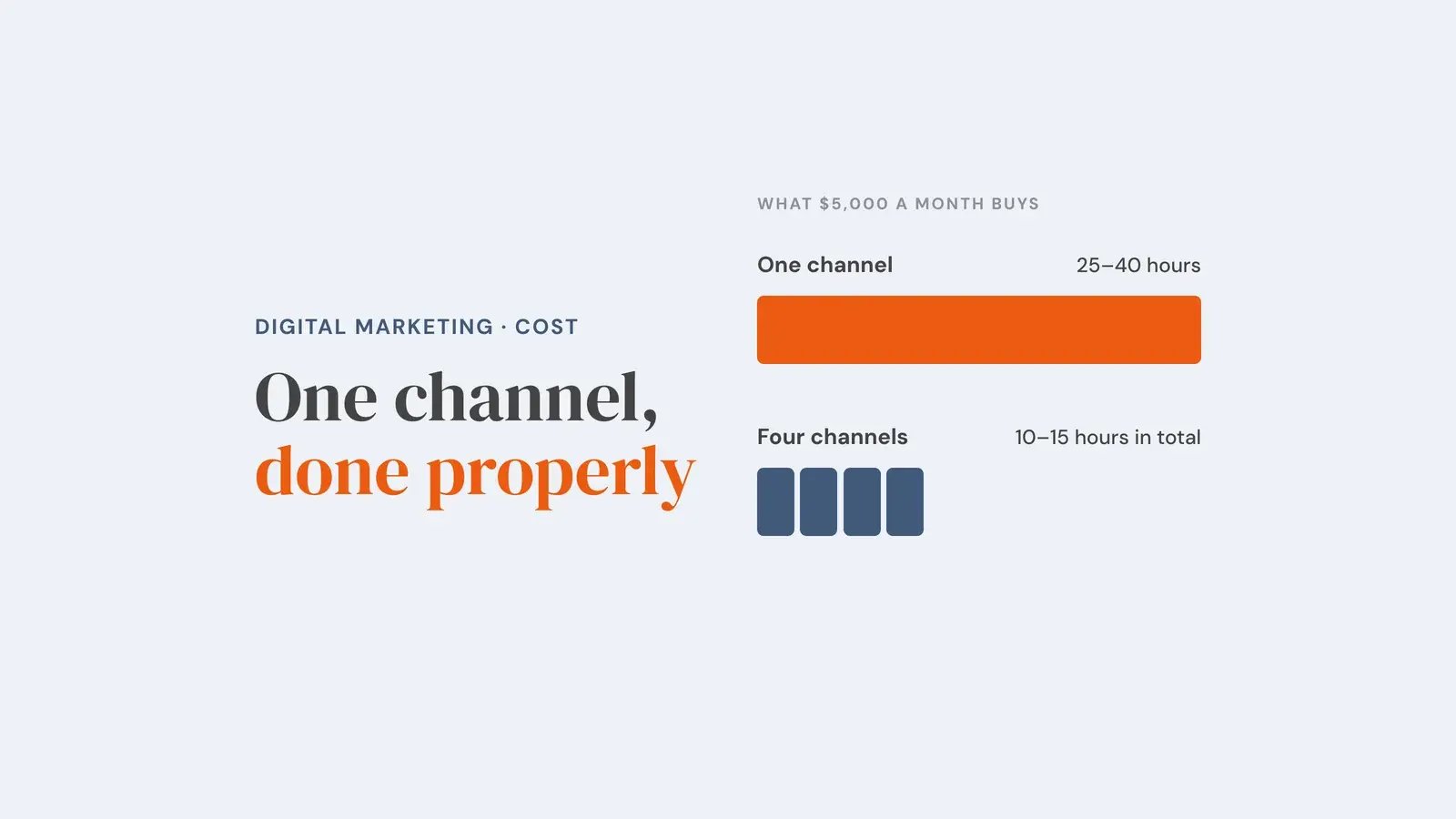
- $5,000/month buys depth in one marketing channel, not meaningful dominance across four.
- Expect 25–40 hours of experienced execution, transparent reporting, and KPI-driven management at this budget level.
- In SEO, PPC, content, or social, $5K delivers mid-tier output with clear limits, enterprise results require higher investment.
- Spreading $5,000 across multiple services typically results in maintenance-level activity, not growth.
- A realistic target for most mid-margin B2B businesses is a 3:1–6:1 return within 6–12 months, if you choose the right channel and execution partner.
Are you trying to work out whether $5,000 a month will actually move the needle, or whether you're about to burn through a quarter's budget on activity that looks busy but delivers nothing? Get this wrong and you're not just out of pocket. You've lost time, delayed growth, and potentially made a hiring decision based on a marketing function that was never working properly.
This article breaks down exactly what $5,000/month (£3,750) buys across each major digital marketing service type, including the deliverables, the limitations, and the signals that tell you whether you're getting fair value. By the end, you'll know which approach fits your situation and what to watch out for before signing a contract.
Having worked with businesses investing anywhere from £2,000 ($2,500) to £75,000+ ($93,750+) per month in marketing, I've seen exactly what $5K buys, and where businesses waste it.
What $5,000/month typically gets you
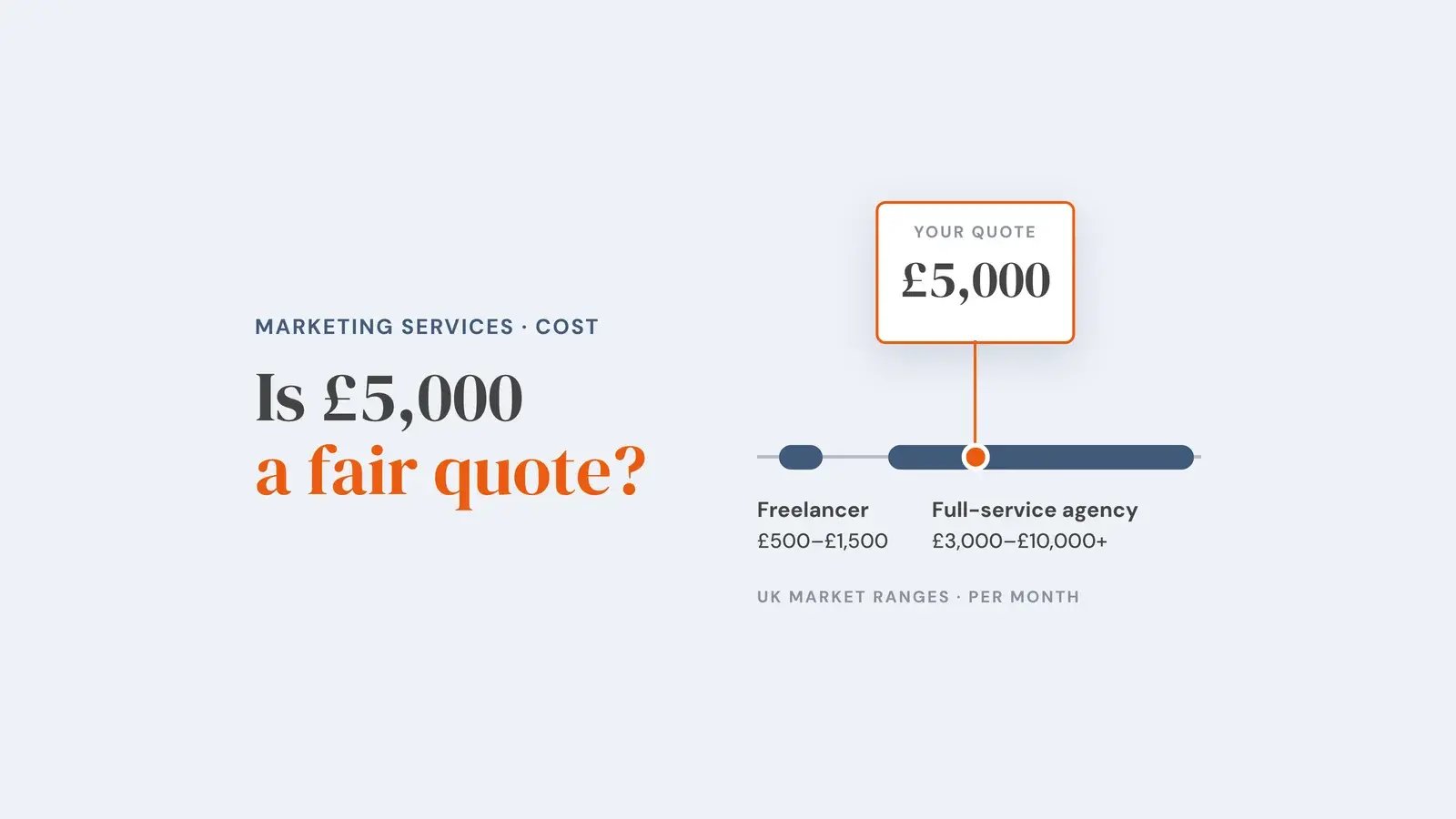
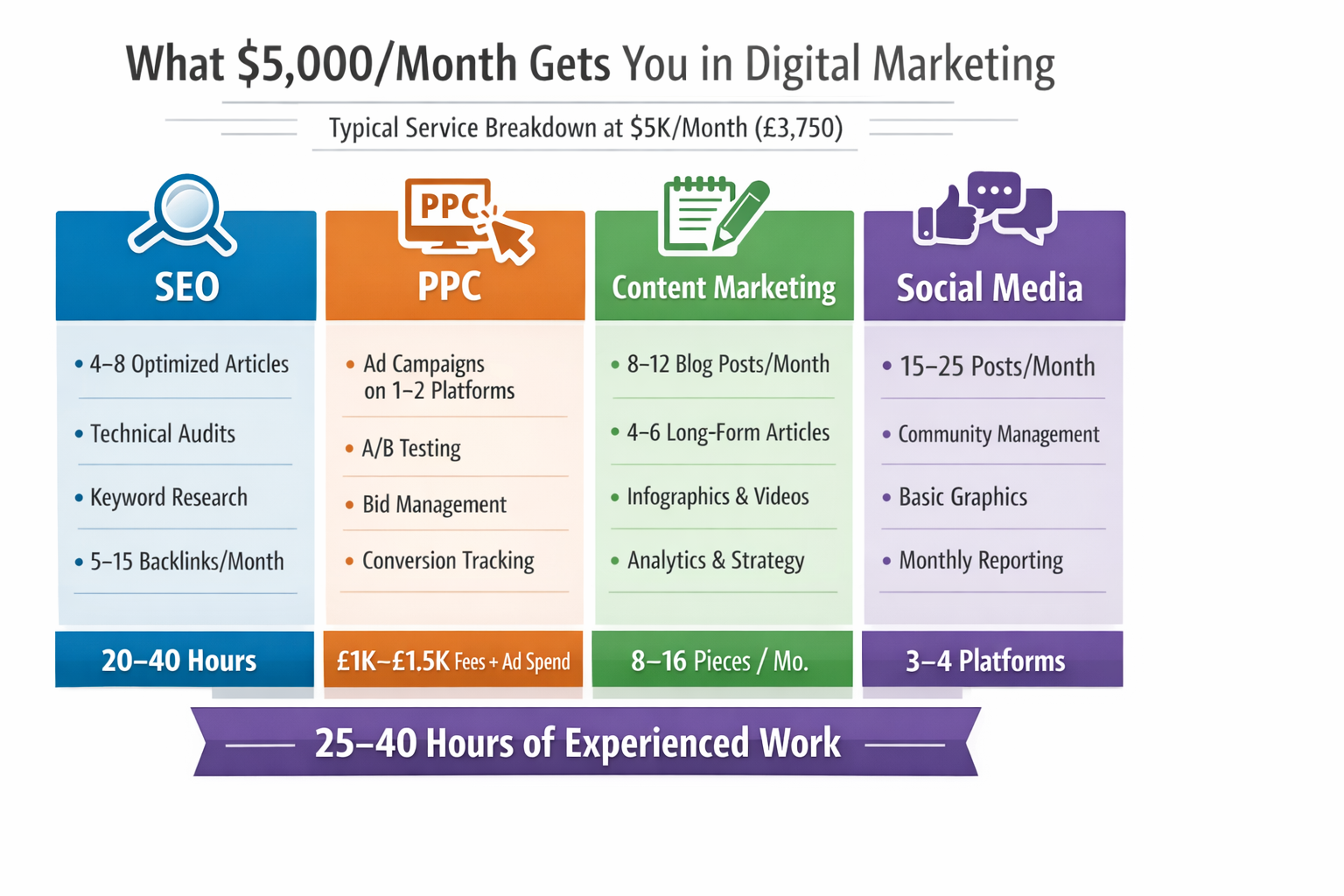
At $5,000/month (£3,750), you can afford depth in one channel, not dominance across all of them.
Regardless of service type, a budget at this level should give you:
- 25–40 billable hours of work from experienced practitioners (not junior staff or offshore teams)
- A dedicated account manager or strategist with regular monthly check-ins
- Performance reporting tied to agreed KPIs
- Active campaign management and optimisation based on data
The quality and depth of that work depends almost entirely on whether you focus your budget or spread it thin.
SEO at $5,000/month: What's included?
For $5,000/month (£3,750), a good SEO agency typically delivers 20–40 hours of work, covering technical audits, content optimisation, link building, and monthly reporting.
Expect four to eight optimised content pieces, ongoing technical maintenance, and a dedicated account manager. Most mid-tier agencies at this budget include keyword research, basic competitor monitoring, and five to fifteen backlinks from relevant websites each month.
What's usually not included: high-authority link acquisition from major publications, international SEO across multiple languages, or e-commerce SEO for large product catalogues. Those typically require budgets above $7,500/month (£6,000).
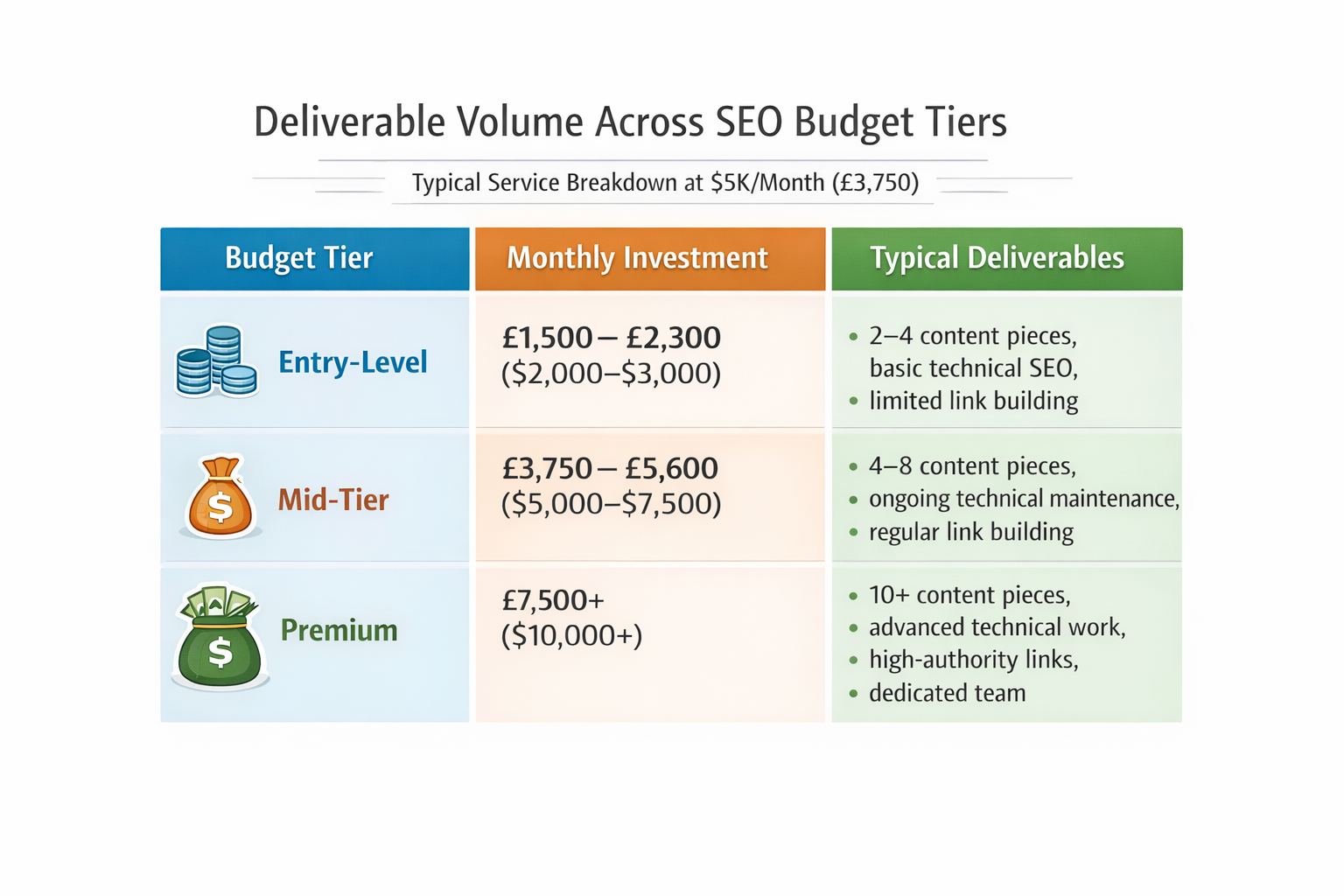
| Budget Tier | Monthly Investment | Typical Deliverables |
|---|---|---|
| Entry-level | £1,500–£2,300 ($2,000–$3,000) | 2–4 content pieces, basic technical SEO, limited link building |
| Mid-tier | £3,750–£5,600 ($5,000–$7,500) | 4–8 content pieces, ongoing technical maintenance, regular link building |
| Premium | £7,500+ ($10,000+) | 10+ content pieces, advanced technical work, high-authority links, dedicated team |
PPC and paid media at $5,000/month
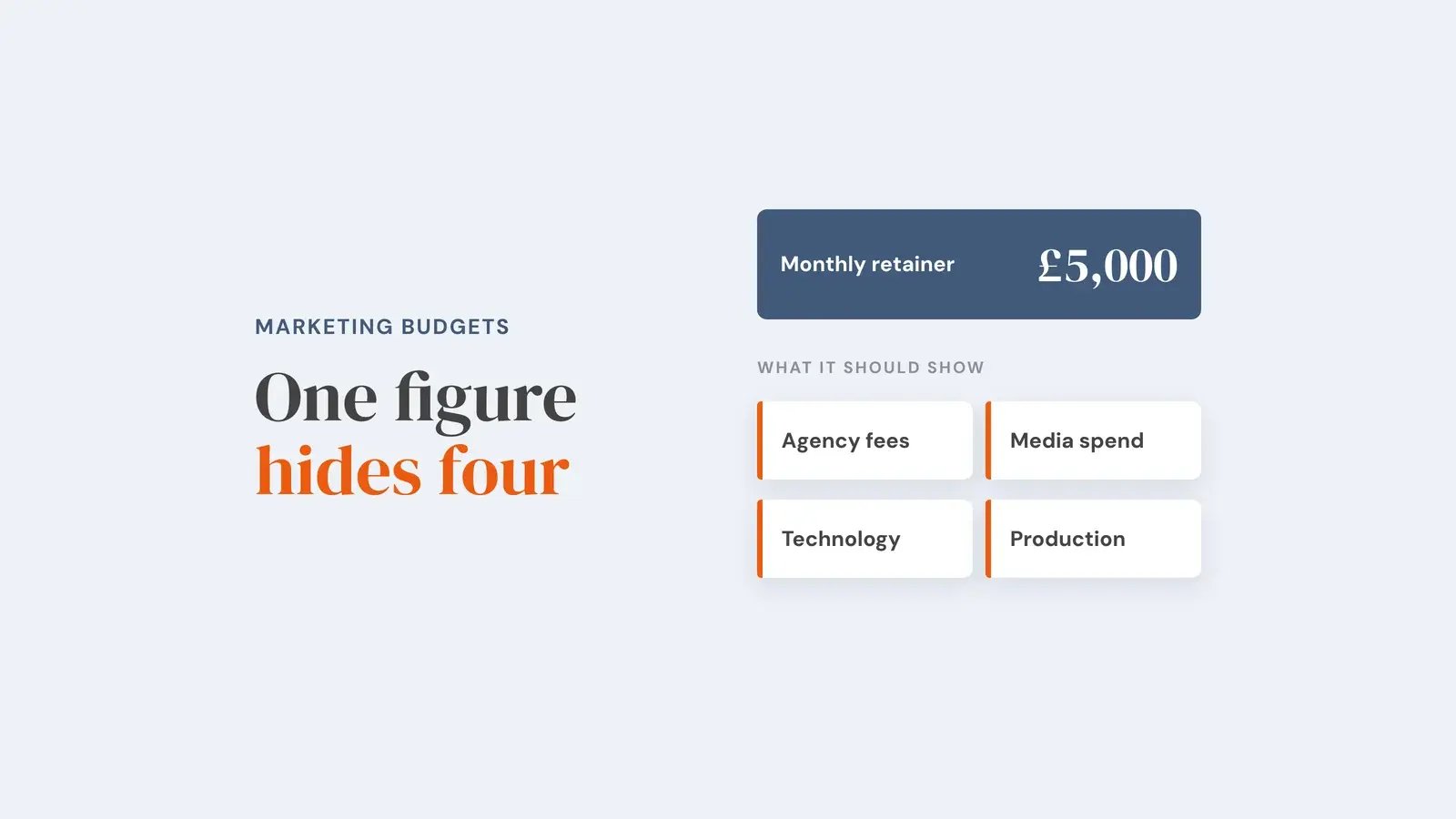
A $5,000/month PPC budget typically splits between agency fees (£1,000–£1,500 / $1,500–$2,000) and actual ad spend (£2,250–£2,750 / $3,000–$3,500), so less of your money reaches the platforms than you might expect.
At this level, most agencies cover campaign setup and optimisation across one to two platforms (typically Google Ads and Meta), A/B testing of ad copy, conversion tracking, and weekly bid management.
If you need campaigns running across more than two platforms, like Google, Meta, LinkedIn, TikTok, $5,000 won't stretch far enough for meaningful results on any of them.
Content marketing at $5,000/month
Five thousand dollars a month (£3,750) in content marketing typically delivers eight to sixteen pieces of content depending on format, depth, and how much strategy work is included.
This budget usually covers strategy, production, editing, basic SEO optimisation, and performance analytics. What it rarely covers: paid distribution, influencer outreach, advanced video production, or podcast editing.
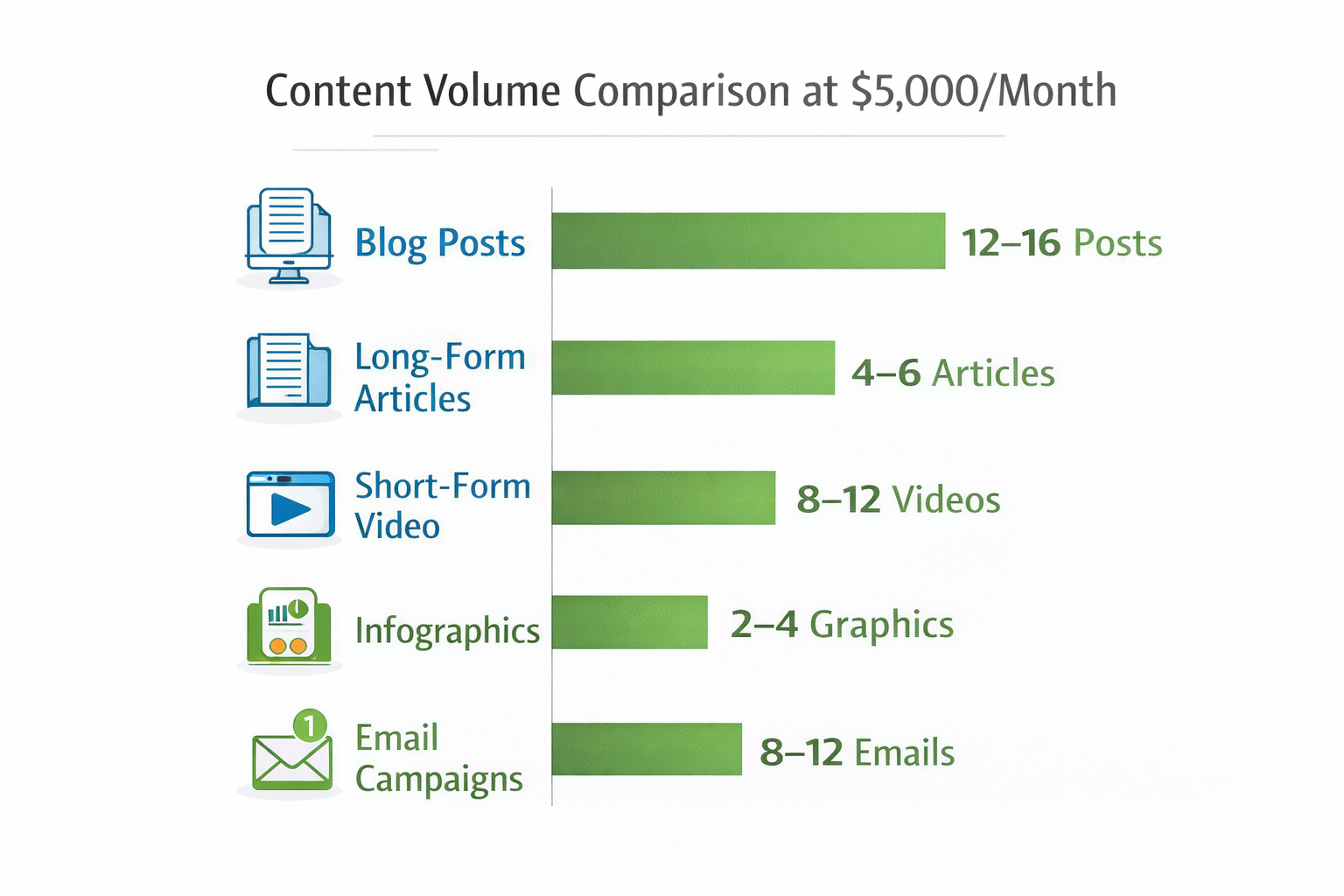
| Content Type | Volume at £3,750/month |
|---|---|
| Blog posts (800–1,200 words) | 12–16 posts |
| Long-form articles (2,000+ words) | 4–6 articles |
| Short-form video | 8–12 videos |
| Infographics | 2–4 graphics |
| Email campaigns | 8–12 emails |
Social media management at $5,000/month
At $5,000/month (£3,750), social media management typically covers content creation and posting across three to four platforms, community management during business hours, and monthly strategy and reporting.
Most agencies at this tier deliver fifteen to twenty-five posts per month, basic graphic design, and responses to comments and messages within twenty-four hours on weekdays. You'll usually get either a small paid social budget or short-form video production, not both.
What's excluded at this price: influencer management, 24/7 community management, professional filming, and crisis response support.
And this is where many businesses make the mistake.
The problem with spreading $5k across everything
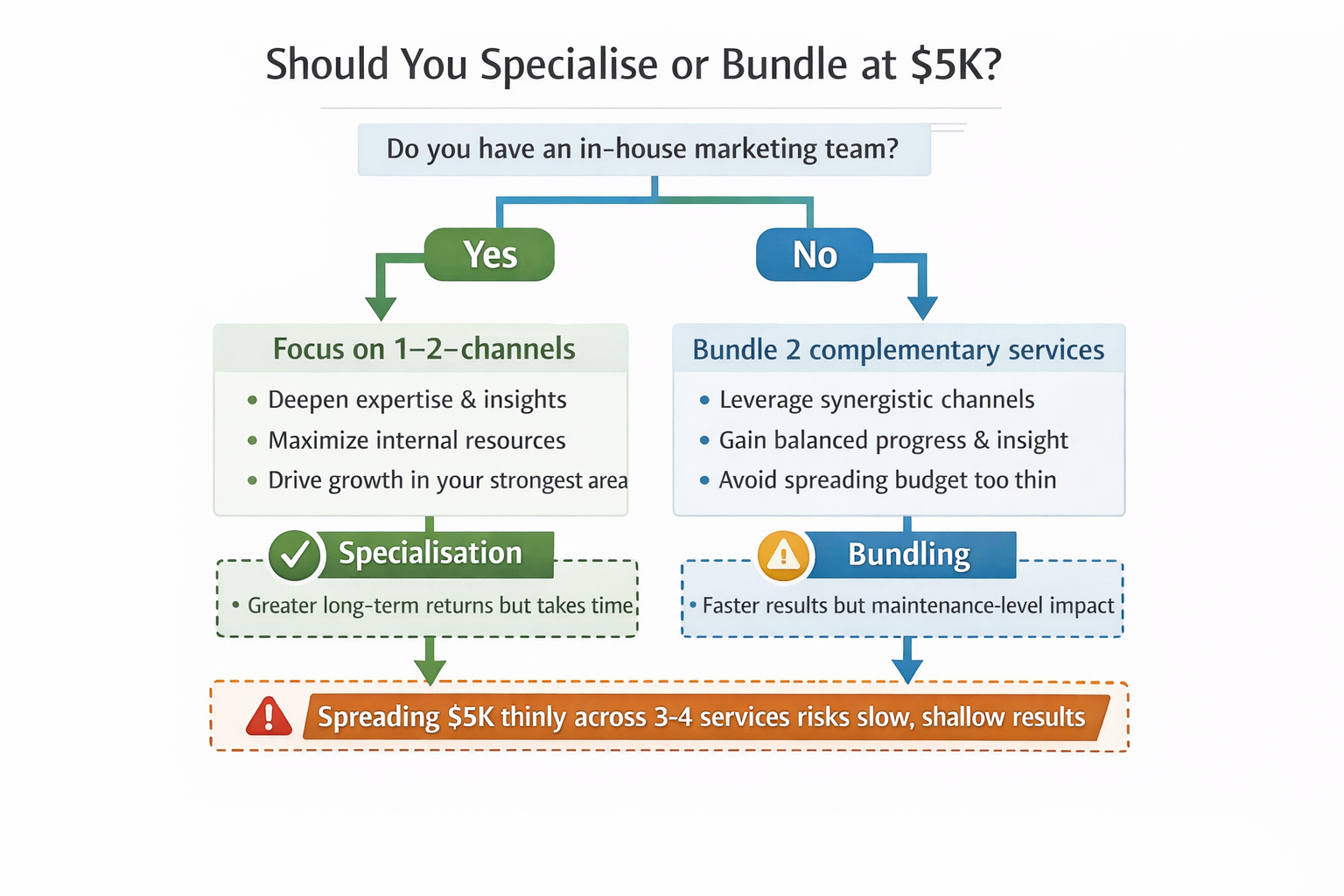
Splitting a $5,000/month budget across SEO, PPC, content, and social results in roughly ten to fifteen hours of total work per month, enough for maintenance, not growth.
Most experienced marketing advisers recommend focusing on one to two channels where your audience is most active. The bundled approach can work when two complementary services support each other, SEO and content, for example, or PPC with landing page optimisation. It fails when you try to run four channels simultaneously on a budget built for one.
When $5,000/month isn't enough for meaningful growth
The most common issue at this budget level is misaligned expectations; many buyers expect enterprise-level output that requires £7,500–£11,250 ($10,000–$15,000) monthly to deliver properly.
Red flags that suggest you may need a larger budget:
- Your industry has extremely high cost-per-click rates (£15–£75+ / $20–$100+ per click in legal, insurance, or finance)
- You're competing against businesses spending £75,000+ ($93,750+) monthly in your niche
- You need results within 90 days — timelines can't be compressed without more resource
- Your website needs significant technical work before marketing can be effective
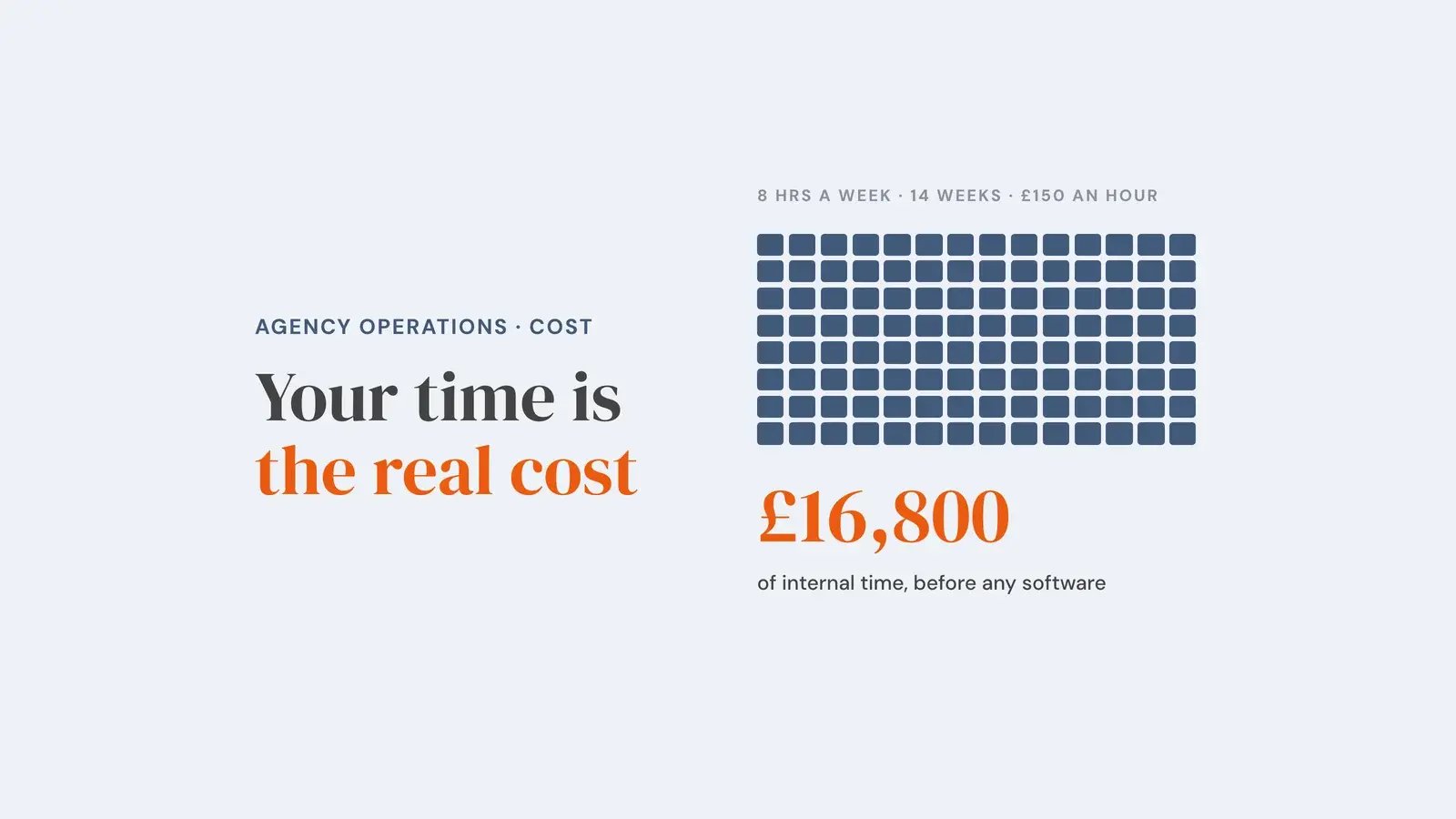
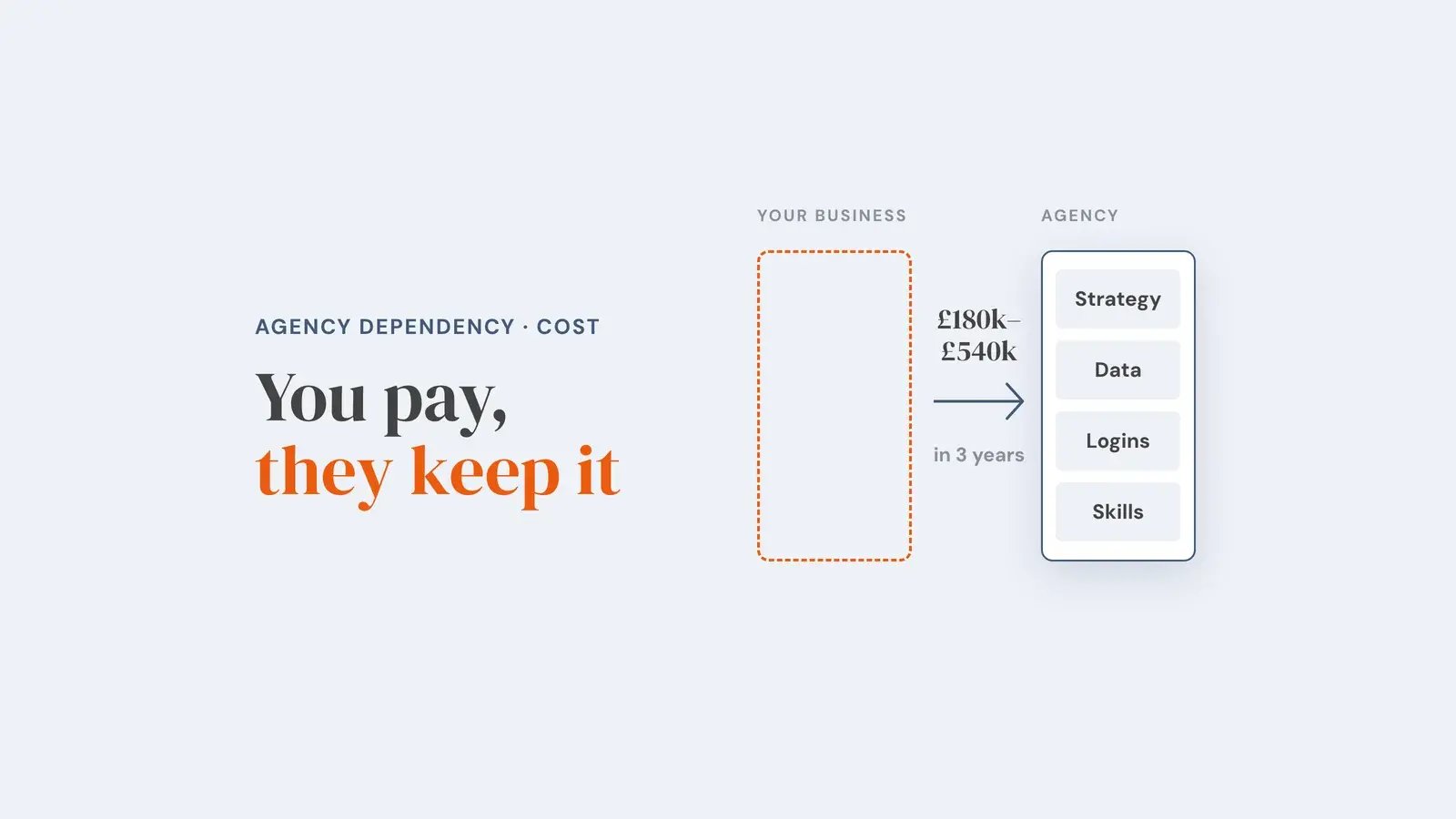
When $5,000 isn't enough, you're often better served by building internal marketing capability than paying for inadequate external support.
To be clear: there are also situations where a well-scoped agency relationship is the right answer, particularly when you need fast execution in a channel you have no in-house expertise in. The question is whether you're getting what the budget can actually deliver.
How to know if you're getting fair value at $5,000/month
Fair value at $5,000/month (£3,750) means 25–40 billable hours from experienced practitioners, transparent reporting, direct access to strategists, and measurable month-on-month progress.
Green flags: monthly strategy calls with decision-makers, proactive recommendations, results improving quarter-over-quarter, itemised reporting.
Red flags: account coordinators standing in for strategists, vague reports with no recommendations, no improvement after three to six months, resistance to sharing time allocation, pressure to sign long contracts before proving results.
A well-run campaign at £3,750 monthly ($5,000) can reasonably aim to generate £11,250–£22,500 ($15,000–$30,000) in new revenue within six to twelve months; a three-to-one to six-to-one return. This is a reasonable benchmark in most mid-margin B2B industries, though it will vary with margin, sales cycle length, and channel chosen. If you're not tracking toward positive ROI by month six, something needs to change.
$5,000/month is not the right budget if…
Transparency matters more than a sale, so here's who this budget level genuinely isn't right for.
$5,000/month is not the right starting point if you're in a highly competitive paid search market where CPCs routinely exceed £15–£75 ($20–$100) per click. It's not right if you need meaningful results in under 90 days. It's not right if your website is technically broken and needs rebuilding before any marketing can work. And it's not right if you're expecting to run four or five channels simultaneously at a level that drives real growth.
In any of those scenarios, either the budget needs to be larger, the scope needs to be narrower, or a different model: fractional leadership, internal capability building, or a phased approach, will serve you better.
Conclusion
You now know what $5,000/month (£3,750) realistically buys across the major digital marketing service types, and where the gaps are.
As someone who has built and repaired marketing systems at every budget level, I can tell you this: clarity beats scale at $5K. One channel, done properly, outperforms four channels done cheaply every time.
If you're wondering whether building internal marketing capabilities makes more sense than ongoing agency fees, and what a realistic transition looks like, read this next: In-House vs Outsourced Marketing: What's Best for Scaling B2B Growth? You'll find a side-by-side cost comparison that makes the decision considerably clearer.
Ready to build marketing your team will actually own?

About the Author
I'm Tom Wardman, and I've built, fixed, and scaled marketing systems from both sides — in-house and agency. I've seen what works when you're trying to generate reliable revenue growth, and I've cleaned up the mess when expensive agencies deliver reports instead of results. Today, I help business leaders build internal marketing capabilities through fractional marketing leadership, hands-on training, and strategic guidance. I've worked with businesses spending £2,000 ($2,500) to £75,000+ ($93,750+) monthly on marketing, and I know exactly where money gets wasted and where it drives genuine return.
Pricing Disclaimer: All GBP–USD price conversions are rounded estimates based on an approximate rate of £1 = $1.25 and are correct at the time of publishing. Exchange rates fluctuate and figures should be treated as indicative only.