
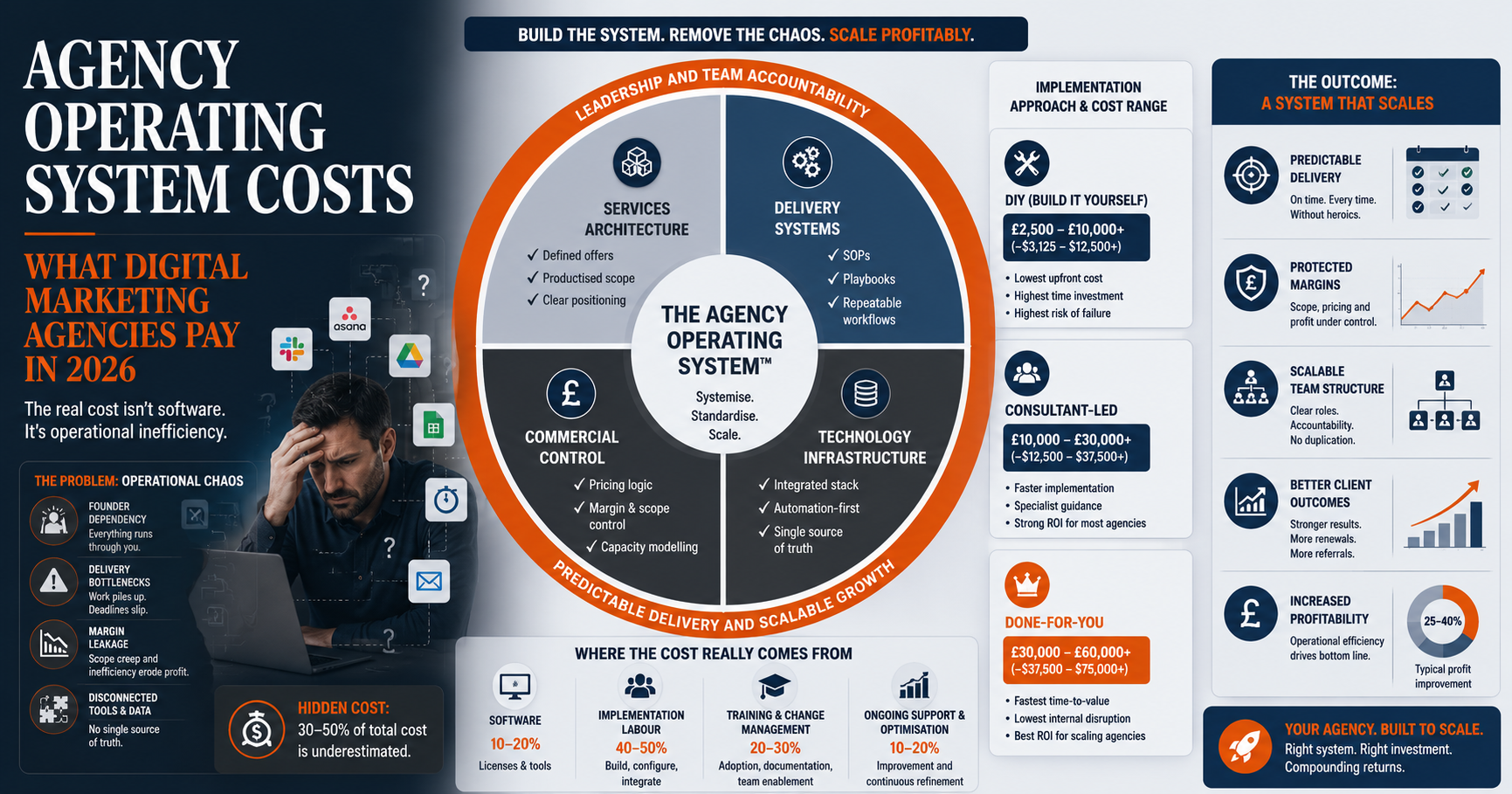
Does your agency have a repeatable system for delivering client work, or does everything still run through you? And if a key team member left next week, would your delivery hold up?
If those questions are uncomfortable, this article is for you. Unlike generic cost guides that publish vague ranges without context, this one breaks down exactly what an agency operating system costs by approach and agency size, including the hidden costs most agencies only discover after they have started. No assumptions. No discovery call required.
Full disclosure: I offer a done-for-you Agency Operating System™ implementation service, which I reference later alongside alternative approaches. My agency services pricing is published transparently; no discovery call required to see a number.
Key takeaways
- Installing an agency operating system (AOS) in 2025 typically costs between £2,500 and £60,000+ (~$3,125–$75,000+), depending on approach and agency size.
- Software is rarely the biggest cost; implementation labour, training, and change management are the primary drivers.
- DIY builds have the lowest upfront cost but the highest total cost of ownership, with most self-builders taking 3–6 months longer than specialist-led implementations.
- Agencies billing above £400,000 (~$500,000) per year consistently see better long-term ROI from consultant-led or done-for-you approaches.
- The most common mistake is budgeting only for software and underestimating internal time costs by 30–50%.
What is an Agency Operating System™?
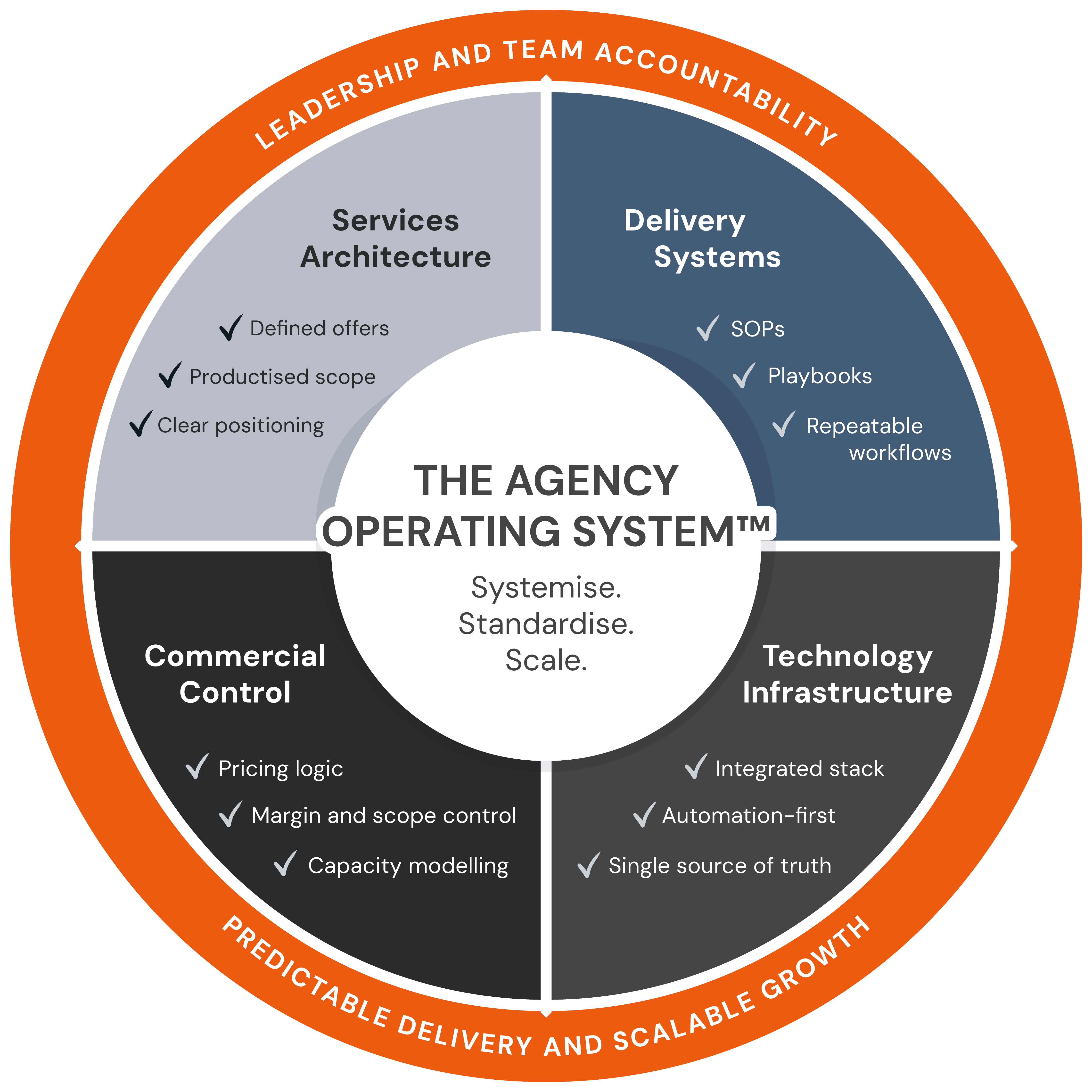
An Agency Operating System™ is the integrated combination of frameworks, workflows, tools, and role structures that govern how a digital marketing or creative agency plans work, delivers to clients, and scales its operations. It is sometimes referred to as an agency workflow system or agency operations framework, but the principle is the same: one connected structure, not a collection of disconnected tools.
Unlike standalone project management software, a true Agency Operating System™ connects strategy, finance, client delivery, and team performance into one repeatable system, not just a set of apps and templates.
A complete Agency Operating System™ typically includes:
- A defined meeting cadence and decision-making rhythm
- A role accountability chart, who owns what, with no ambiguity
- Client onboarding and offboarding workflows
- Service delivery playbooks and SOPs (standard operating procedures: documented, step-by-step processes)
- Financial dashboards, pricing logic, and margin controls
- A performance reporting rhythm
Buying ClickUp is not the same as installing an Agency Operating System™. The software is one component. The system is the architecture underneath it.
What does it cost to install an agency operating system?
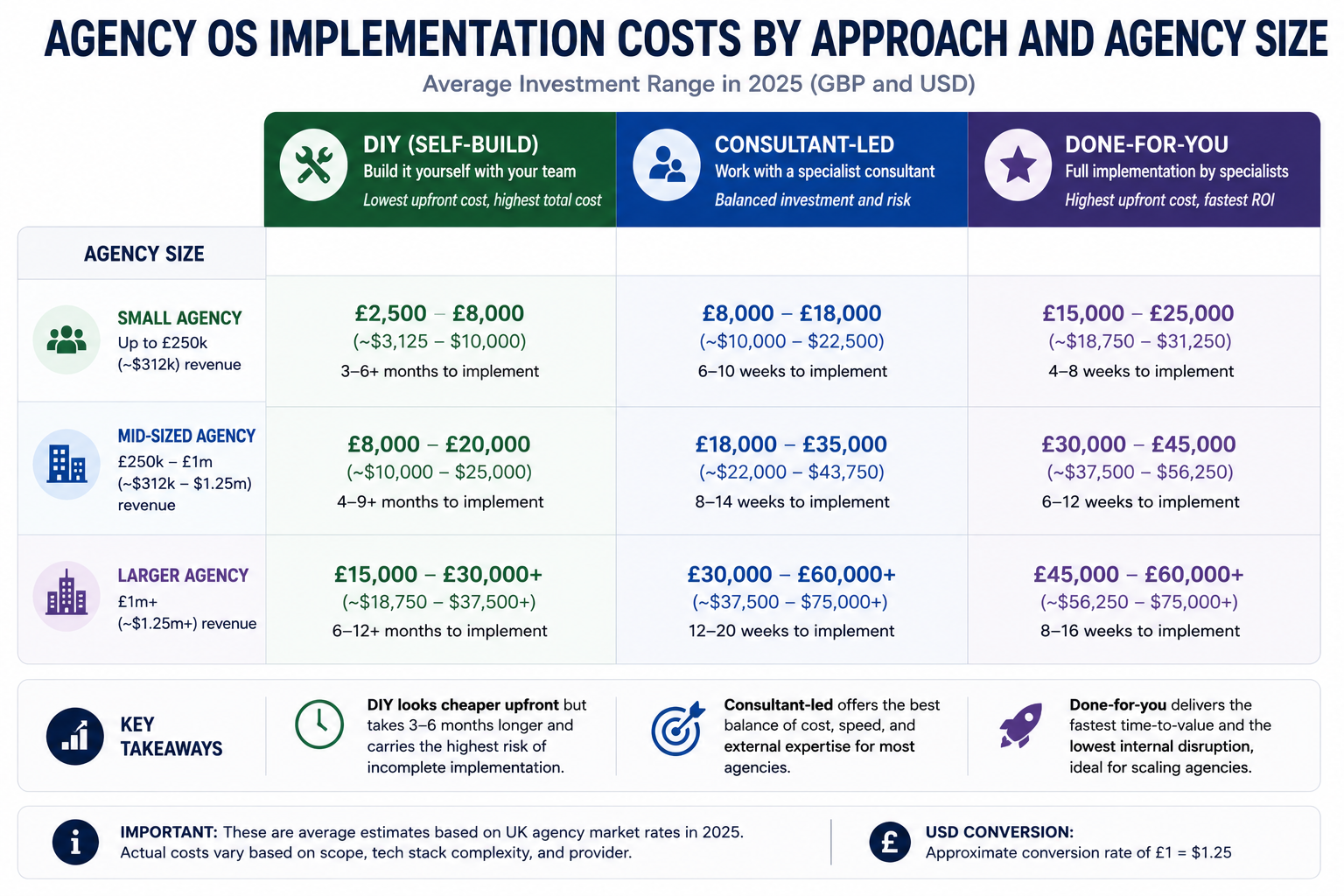
Installing an Agency Operating System™ typically costs between £2,500 and £60,000+ ($3,125–$75,000+), depending on whether you build it yourself, work with a specialist consultant, or invest in a done-for-you implementation.
Most agencies underestimate their true total cost by focusing only on software fees, which are almost always the smallest line item.
These are estimates based on UK agency consultancy market rates. Actual costs depend on agency size, tech complexity, and provider. Treat ranges as indicative.
What are the main cost components?
The four primary cost drivers of an agency operating system are software licensing, implementation labour, training and change management, and ongoing optimisation or support.
Most agency owners budget only for software, which is typically the smallest component. The real cost sits in the time and expertise required to build, embed, and run the system properly.
Figures are market estimates. Where no independently verified source exists, ranges are derived from published UK agency services pricing. The breakdown below illustrates typical ranges for each component by agency size.
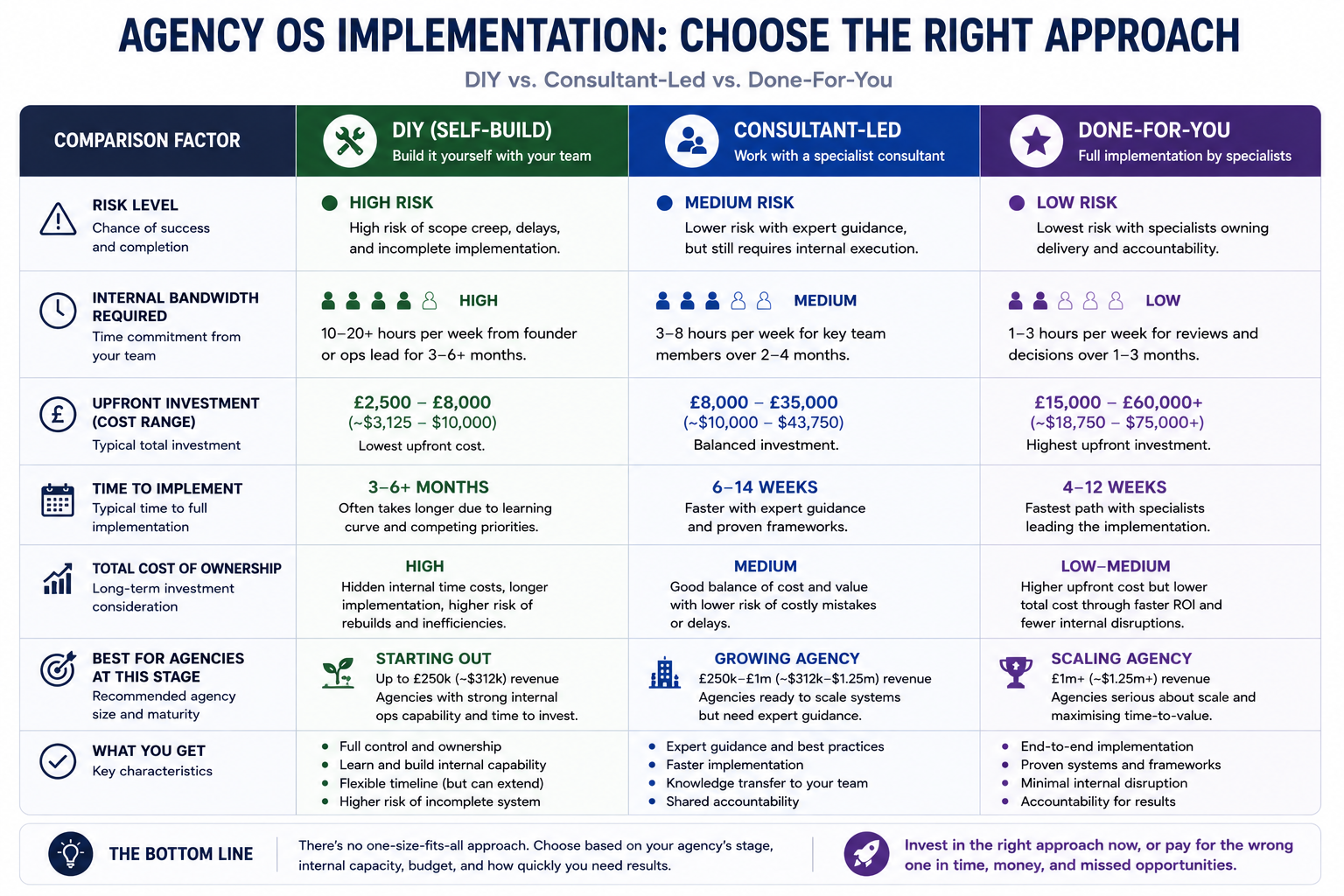
DIY vs. consultant-led vs. done-for-you: which approach costs less overall?
A DIY Agency Operating System™ has the lowest upfront cost but the highest total cost of ownership; agencies that self-build typically spend 3–6 months longer in implementation and face a significantly higher risk of abandonment before the system is fully embedded.
Done-for-you implementations cost more upfront but consistently deliver faster time-to-value and lower internal disruption, making them the stronger financial decision for agencies billing above £400,000 ($500,000) per year.
Use this formula to estimate your real DIY cost before committing:
Hidden DIY cost:
(Hours spent per week by founder or ops lead) x (weeks to implement) x (your effective hourly rate) + software costs
Example: 8 hours/week × 14 weeks × £150/hr ($187.50/hr) = £16,800 ($21,000) in internal time, before you have paid for a single tool.
If that figure is higher than a consultant-led engagement, DIY is not the cheaper option.
For context, my Agency Operating System™ is a done-for-you framework built specifically for this transition. Agency services pricing is published transparently, meaning no discovery call is required to see a number.
Hidden costs agencies consistently underestimate
The single most underestimated cost in any Agency Operating System™ implementation is internal time; specifically, the billable hours lost when your team is learning, configuring, and troubleshooting a new system rather than serving clients.
Six costs agencies rarely budget for:
- Data migration from legacy tools: project management platforms, spreadsheets, shared inboxes
- Integration development between platforms that do not connect by default
- A productivity dip during the transition window, typically 4–8 weeks
- Management overhead for sustaining adoption after go-live
- Scope rebuilding when the initial OS design does not match how the team actually works
- Change management time; the cost of staff resistance and re-training
Agencies that skip an operations audit before implementation consistently rebuild sections of their system once live reality does not match the original design. That adds both cost and delay.
How do you choose and install an Agency Operating System™ without wasting money?
Choosing and installing an agency operating system follows five steps: audit your current operations, define your non-negotiables, shortlist providers or frameworks, plan a phased rollout, and appoint an internal OS owner before implementation begins.
- Audit current operations: Map where delivery breaks, where margin leaks, and where you are the bottleneck (1–2 weeks, internal time)
- Define non-negotiables: Decide which pillars are highest priority: delivery systems, pricing structure, team accountability, or tech stack (1 week)
- Shortlist options: Compare general frameworks like EOS, specialist agency operations consultants, and done-for-you providers such as my Systems & Pricing Consultancy (1–2 weeks)
- Plan a phased rollout: Install delivery systems first; avoid rebuilding everything at once
- Appoint an internal OS owner: The person responsible for maintaining and improving the system after go-live
Agencies that skip Step 1 consistently report longer timelines and higher costs — because they end up redesigning parts of the system once they see how it actually runs.
Frequently asked questions about Agency Operating System™ costs
The most common questions agency owners ask about operating system costs centre on implementation timelines, minimum viable investment, and realistic return.
How long does it take?
-
DIY: 6–12 months.
-
Consultant-led: 3–6 months.
-
Done-for-you: 1–4 months, depending on agency complexity.
Can a small agency afford a proper OS?
Yes. A solo or micro agency (1–5 staff) can build a functional OS using tools like ClickUp or Notion for under £1,500/year (~$1,875/year). The investment is primarily time.
What ROI should agencies expect?
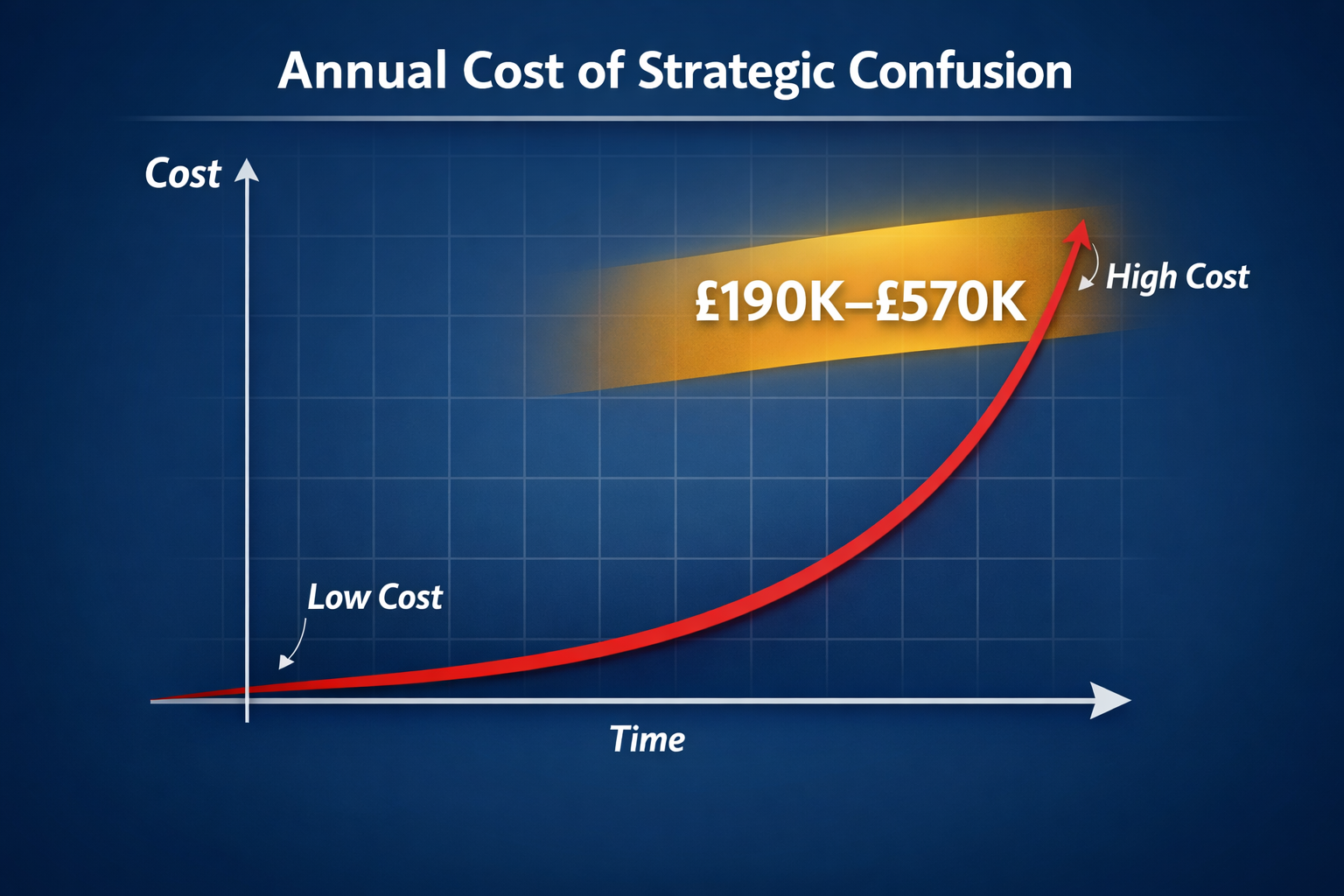
Operational inefficiency typically erodes 15–30% of potential agency profit. For a £1m ($1.25m) agency, that is £150,000–£300,000 ($187,500–$375,000) per year in margin leakage My work with agency clients has produced results including a 55% increase in project fees after moving from hourly billing to structured pricing, and a 35% improvement in profitability following a full operations restructure.
Is EOS the same as an Agency Operating System™?
No. EOS is a general business framework applicable across industries. A specialist Agency Operating System™ is adapted specifically for client delivery, service scope, and the commercial model of an agency.
Conclusion
You started this article asking whether your agency has a repeatable delivery system, and what it would actually cost to build one. Now you have the answer.
The decision is not between cheap and expensive. It is between paying once for structure or paying indefinitely for the chaos that replaces it.
Most agencies that delay OS implementation are not saving money. They are compounding the cost of margin leakage, founder dependency, and inconsistent delivery, month after month. The operational inefficiency you are carrying right now has a price. The question is whether you keep paying it, or invest in removing it.
How to take action now
- Run a basic operations audit: map where delivery breaks and where margin disappears
- Choose the implementation approach that fits your billing level and internal capacity
- Budget for internal time costs, not just software, before you start
- Appoint an internal OS owner before implementation begins, not after
If you want to discuss the right starting point for your agency, book a scoping call.
The Agency Operating System™ exists because most agency founders are capable of building something great; they just need the structure to stop rebuilding it every six months.
Related article: Fractional COO for agencies: do you actually need one

About the author
Tom Wardman is a Growth Independence Architect who works with digital marketing and creative agency founders to replace operational chaos with documented, scalable systems. He designed the Agency Operating System™, a four-pillar framework that standardises delivery, protects margins, and removes founders from the centre of day-to-day operations. He is the author of Build a Trusted Brand and one of the UK's first certified coaches in the Endless Customers methodology. Tom has worked inside agencies and alongside founder-led businesses across the UK, giving him direct experience of the structural problems that erode profit and trap founders in their own operations.
Pricing disclaimer: All GBP–USD price conversions are rounded estimates and correct at the time of publishing. Exchange rates fluctuate and figures should be treated as indicative only.
Topics: