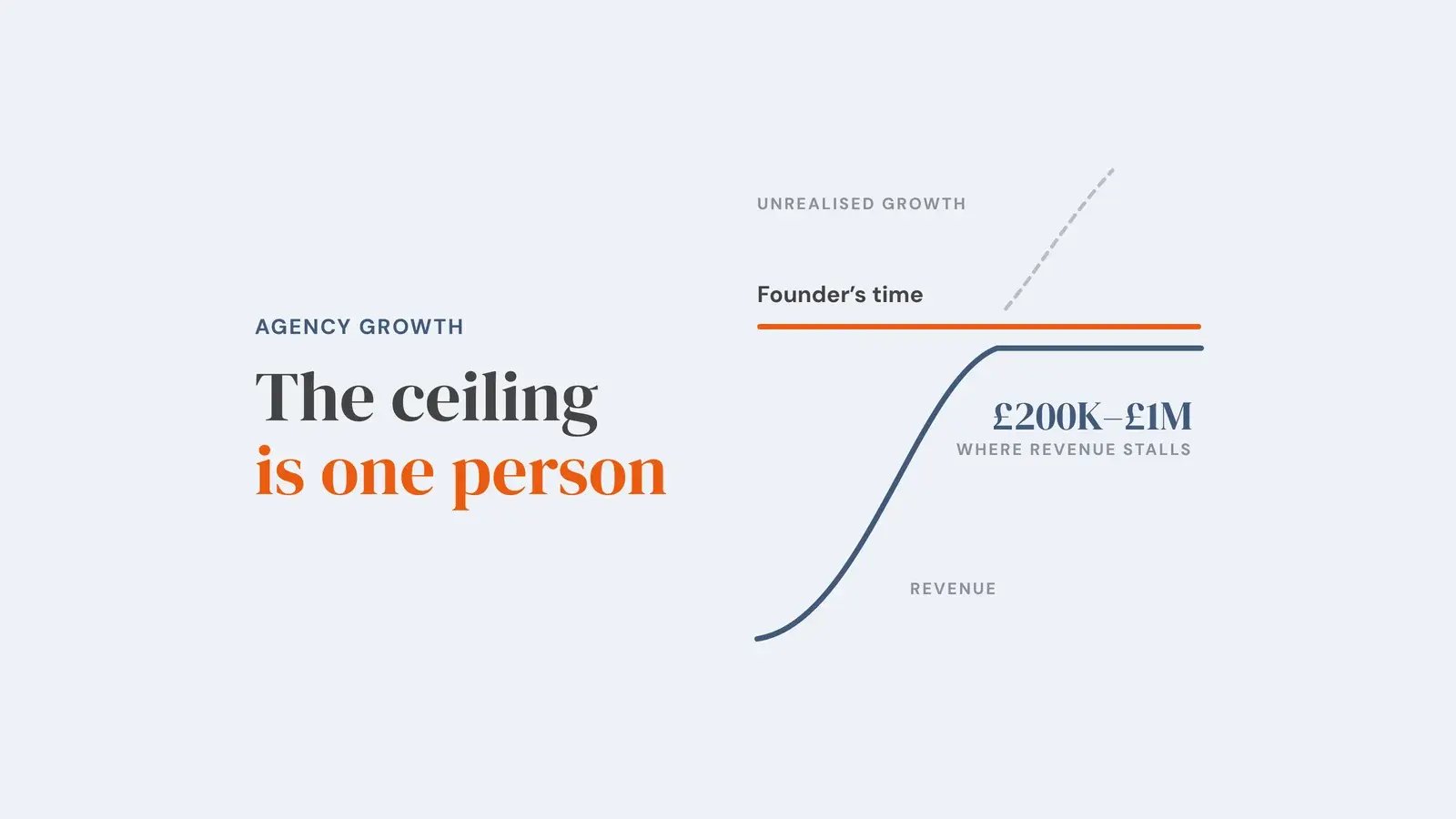


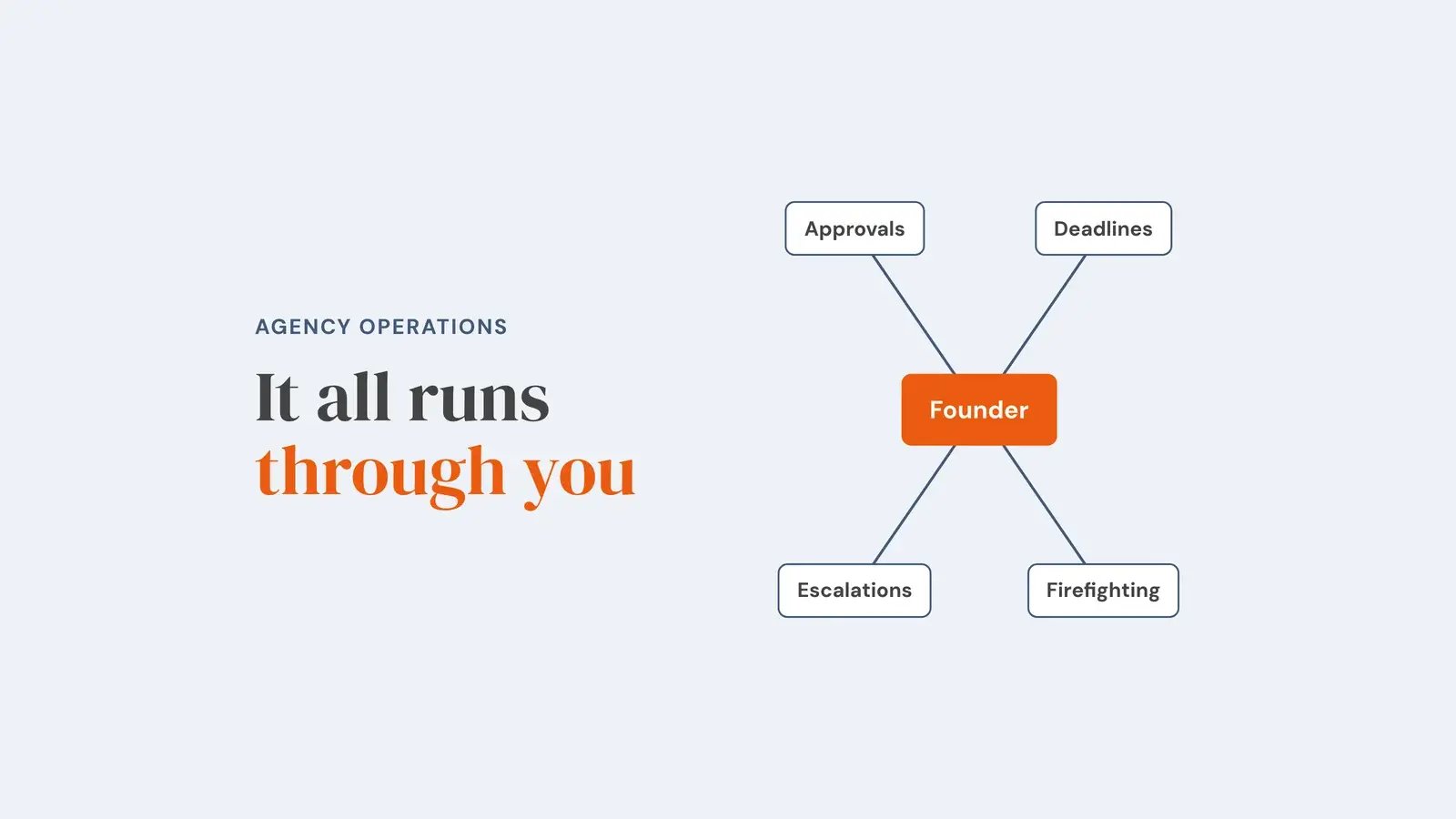
If your agency is growing but delivery keeps breaking, you're likely stuck in the middle of everything, approvals, firefighting, missed deadlines, and client escalations that should never reach you.
At what point does that stop being "part of the job" and start becoming the biggest constraint to your growth?
For digital, creative, and performance agency founders with 10–50 people, this is the defining operational question. In this guide, you'll learn exactly when a fractional COO makes sense, what it will cost you, and how to make the decision with confidence, rather than guesswork.
A note on perspective: I provide fractional COO services to agencies, and I've worked with 20+ agency founders at this stage, helping them move from founder-led delivery to structured operations. I've done my best to give you an honest, balanced view, including the situations where this kind of hire isn't the right answer.
Key takeaways
- A fractional COO provides part-time strategic operational leadership, typically costing £4,200–£8,000/month ($5,600–$10,700), far less than a full-time hire.
- Your agency likely needs one if delivery depends on the founder, team performance is inconsistent, or growth is outpacing your structure.
- Agencies with fewer than 8–10 people, or with no documented processes yet, are usually not ready, a systems audit is the better first step.
- A fractional COO sets operational direction. An operations manager executes. A full-time COO does both, daily, at much higher cost.
- A structured 5-step framework can move you from gut feeling to a defensible, clear-headed decision.
What is a Fractional COO and what do they do for an agency?
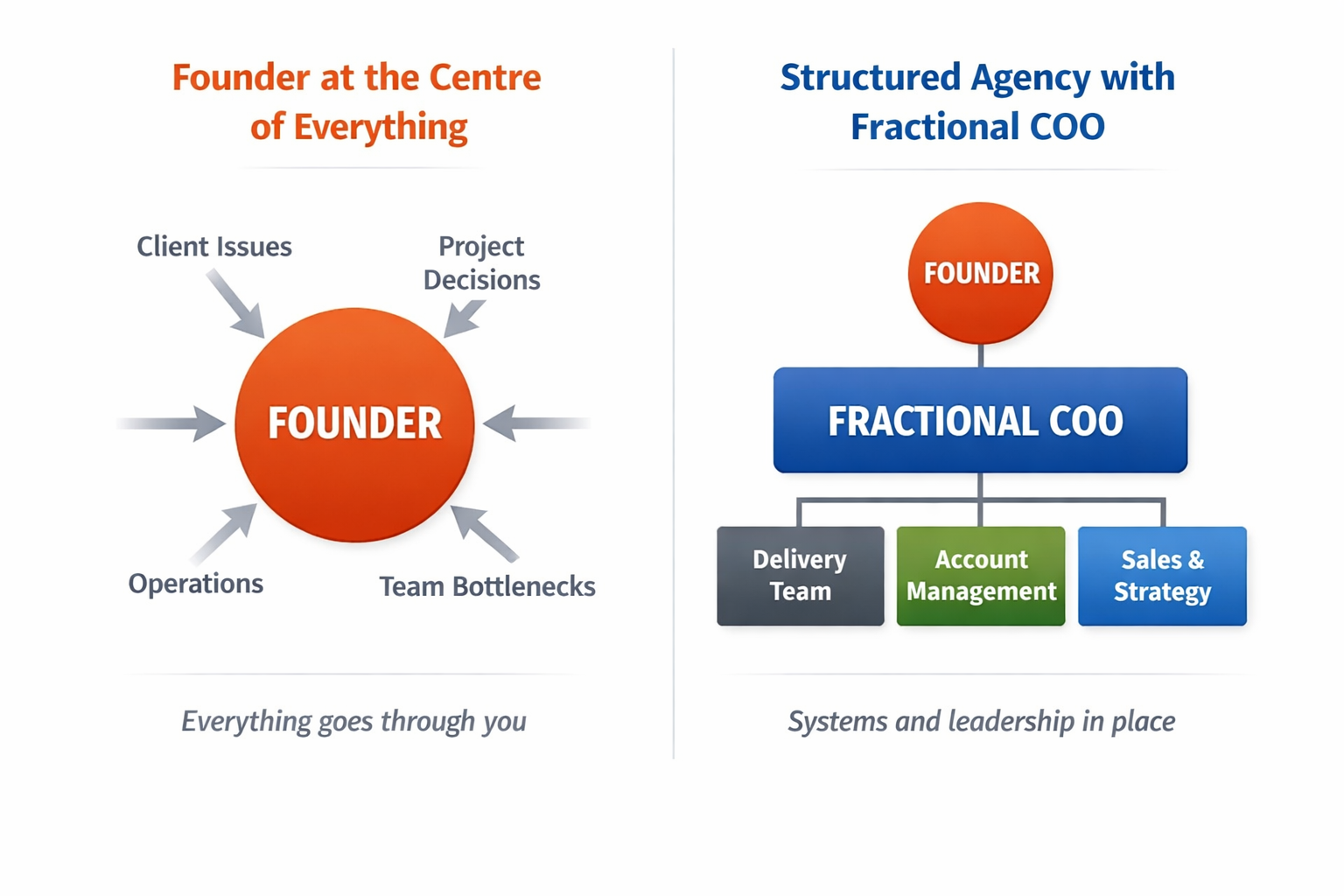
A Fractional COO is an experienced chief operating officer who works with your business part-time or on contract, providing senior operational leadership without the cost or commitment of a full-time hire. For agencies, this typically means someone who owns the operational layer: building systems, managing team accountability, and removing the founder from the centre of day-to-day delivery.
For agencies, this means someone who owns the operational layer, building systems, managing team accountability, and removing the founder from the centre of day-to-day delivery.
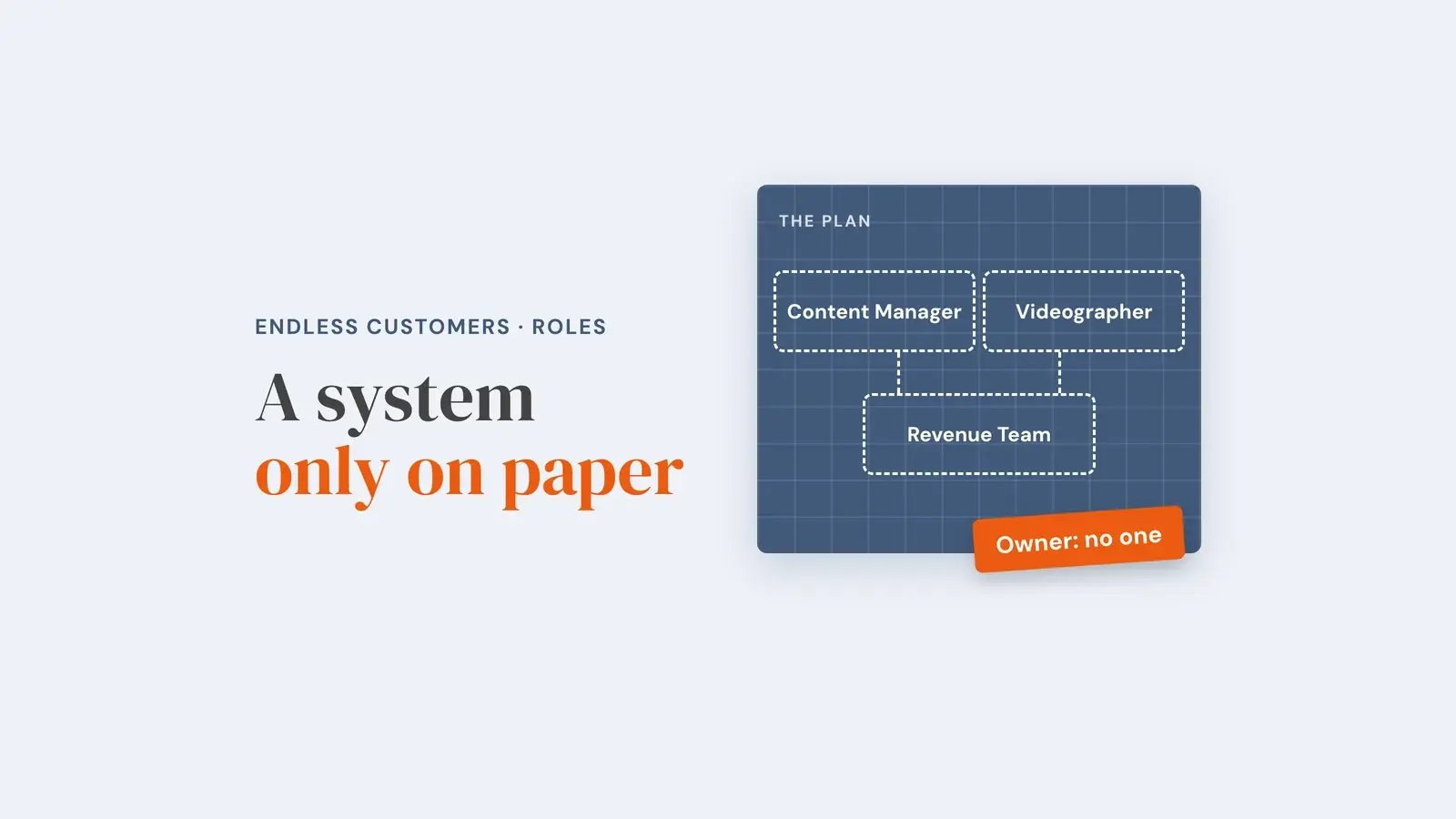
Before vs. after: what this looks like in practice. In a founder-dependent agency, every delivery decision flows through one person. Processes live in people's heads, not in documented systems. A fractional COO changes that: within a typical 6-month engagement, delivery accountability moves to the team, SOPs are in place, and the founder can step back from operational firefighting.
Core responsibilities typically include:
- Designing and documenting delivery processes and SOPs
- Managing team performance and accountability structures
- Capacity planning and resource forecasting
- KPI tracking and operational reporting
- Onboarding and offboarding workflows
- Cross-functional coordination between delivery, account management, and sales
The critical distinction: a fractional COO sets operational direction. They are not executing tasks; they are the architect of how your agency runs.
What signs suggest your agency needs a fractional COO?
Your agency likely needs a fractional COO if you're experiencing recurring delivery bottlenecks, founder-dependent decision-making, inconsistent team performance, or growth that is visibly outpacing your internal structure.
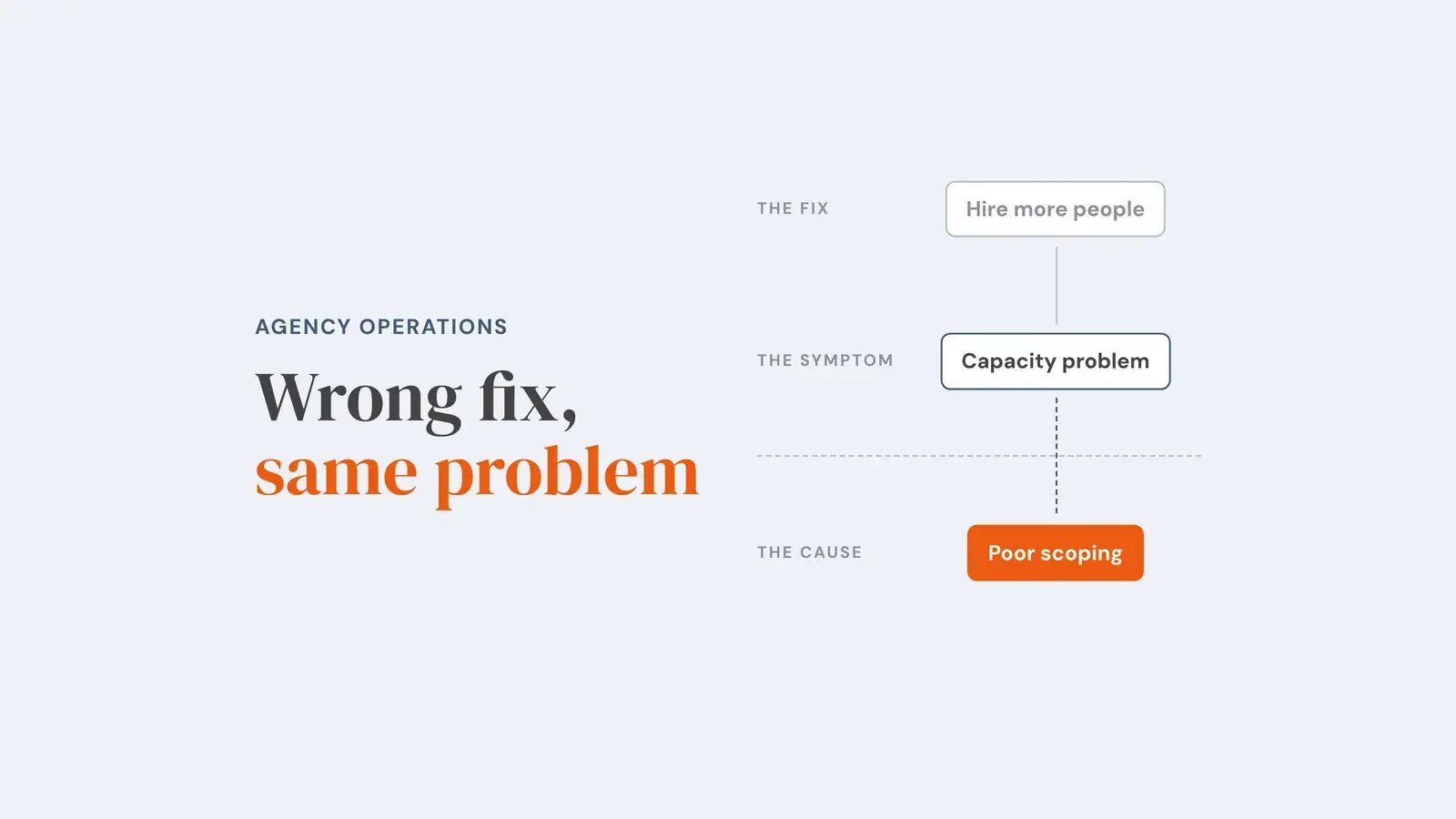
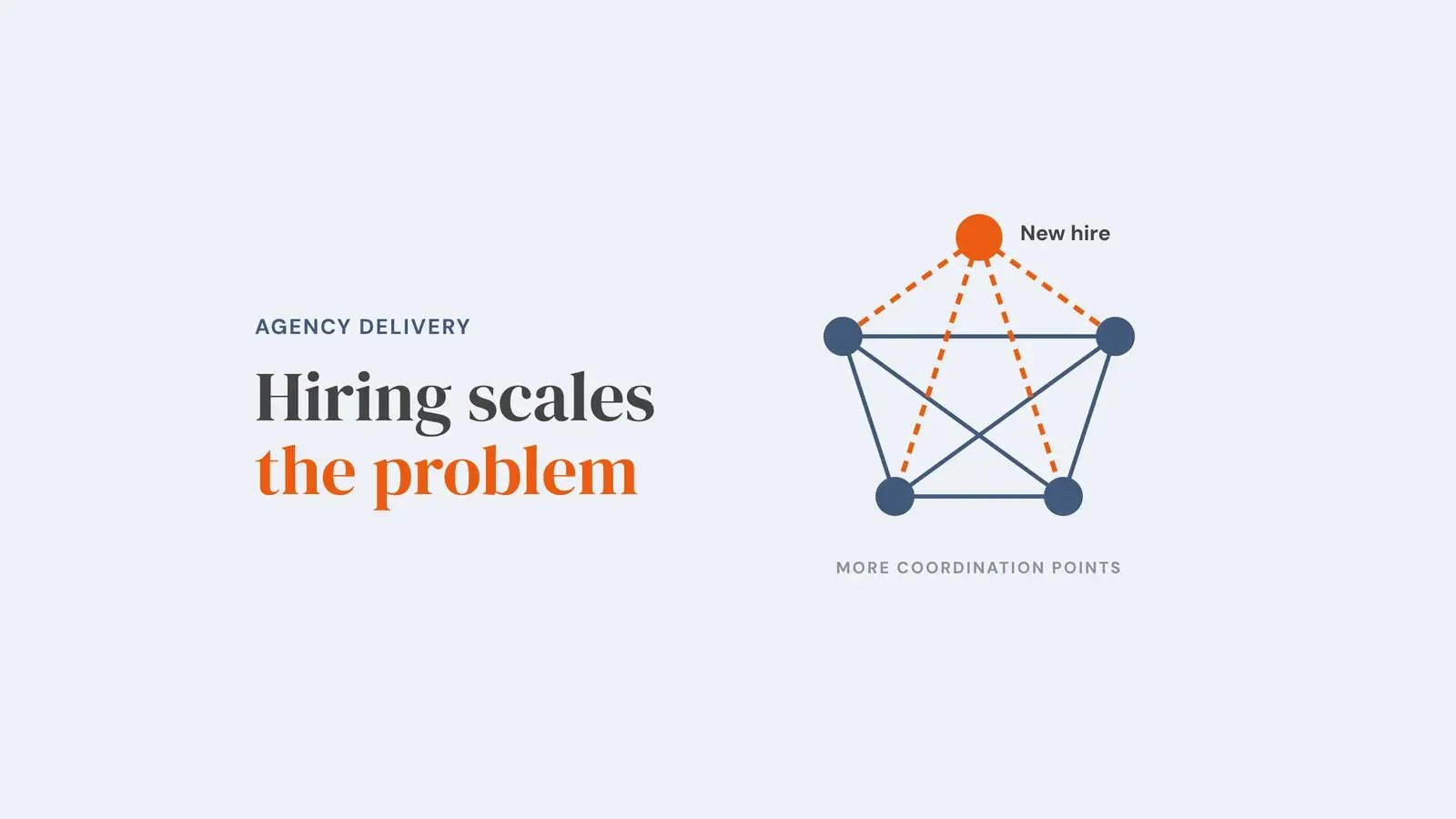
These are not signals that you need more staff or better tools. They signal that dedicated operational leadership is the missing layer. The distinction matters: hiring more people into a broken system typically makes the problem worse, not better. (If you're unsure whether your problems are structural or executional, a systems audit is the right starting point.)
Operational warning signs: when execution is breaking down
- You're still involved in most client delivery decisions
- Delivery quality varies depending on who's on the project
- Problems escalate to the founder rather than getting resolved by the team
- Processes live in people's heads, not in documented systems
Growth-stage triggers: when you're scaling faster than your structure supports
- You're adding headcount but delivery is not getting more consistent
- Capacity cannot be forecast with any confidence
- New business conversations are being delayed because operations feel fragile
- Leadership time is consumed by firefighting, not strategy
If three or more of these apply, a fractional COO is not premature, it's overdue. In most agencies I've worked with at this stage, three or more simultaneous signals indicate the operational gap has reached a scale where targeted leadership, rather than incremental fixes, is what actually moves things forward.
When your agency probably doesn't need a fractional COO yet
If your agency has fewer than 8–10 team members, is still validating its core service model, or already has a capable operations lead in place, a fractional COO is likely premature and may not deliver meaningful ROI.
Many agency founders seek operational leadership too early, before the problems a COO is designed to solve exist at a scale that justifies the investment. In practice, this often means spending £4,000–£6,000 ($5,000–$7,500) per month on strategic leadership for problems that a well-structured systems audit at a fraction of the cost would have resolved.
You probably don't need one yet if:
- You have fewer than 8 full-time staff
- Delivery is inconsistent because the service model is still being defined
- No core processes have been documented at all (a systems audit is the right first step)
- An operations manager is in place but hasn't been given proper authority
- Budget is too constrained to sustain a 6-month minimum commitment
The right first step in most of those situations is a one-off systems audit, not fractional leadership.
Fractional COO vs. full-time COO vs. operations manager: which does your agency need?
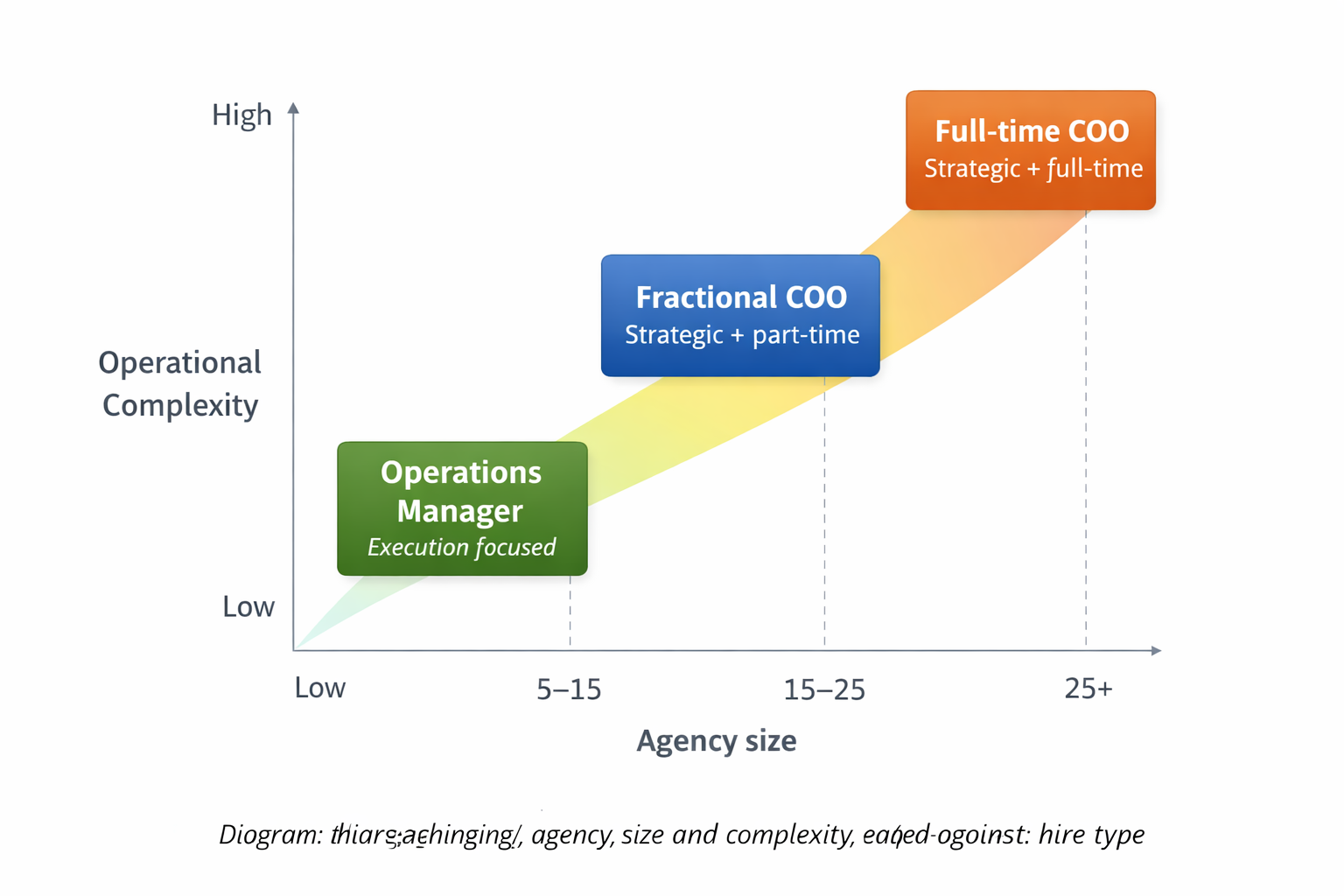
A fractional COO provides part-time strategic operational leadership; a full-time COO delivers that same leadership daily at significantly higher cost; and an operations manager handles execution without the same strategic authority.
| Role | Typical monthly cost (UK) | Days/week | Focus | Suits agencies with |
|---|---|---|---|---|
| Fractional COO | £4,200–£8,000 ($5,600–$10,700) | 1–3 | Strategic + structural | 10–15+ staff |
| Full-time COO | £8,000–£14,000 ($10,700–$18,700) | 5 | Fully strategic, daily | 25+ staff |
| Operations Manager | £2,500–£4,600 ($3,300–$6,100) | 5 | Execution-focused | Any size |
Full-time COO and operations manager monthly figures are estimates derived from typical UK salary ranges. These are indicative only and will vary by seniority, location, and agency type.
Under-hiring means the root problems persist. Over-hiring drains cash before the role can prove its value. The decision that matters most is matching the role to your agency's actual stage and problem type, not hiring the most impressive-sounding title.
If your problem is structure, hire a COO. If it's execution, hire an operations manager.
How much does a fractional COO cost for agencies?
A fractional COO typically costs agencies between £4,200 and £9,000/month ($5,600–$12,000), depending on days-per-week engagement, seniority, and scope.
| Engagement level | Days/week | Indicative monthly cost |
|---|---|---|
| Light | 1 day | £2,500–£4,200 ($3,300–$5,600) |
| Mid-range | 2 days | £4,200–£6,500 ($5,600–$8,700) |
| Intensive | 3+ days | £6,500–£9,000 ($8,700–$12,000) |
These are market-rate estimates for experienced agency operations leaders in the UK. Actual costs vary by geography, seniority, and scope.
My Fractional COO for Agencies packages start from £4,200/month ($5,600/month) on a 6-month minimum; full details are available on the Agency Services Pricing page.
The more relevant number is not the monthly cost, but what operational fragility is currently costing you in margin leakage, avoidable churn, and stalled capacity.
Here's a concrete illustration: imagine a £1m ($1.25m) agency where account managers are spending 20% of their time on internal coordination that documented processes would eliminate. That's wasted margin before you factor in client churn from delivery inconsistency. Operational inefficiency typically erodes 15–30% of potential agency profit, for a £1m ($1.25m) agency, that's an estimated £150,000–£300,000/year ($187,500–$375,000/year). (Figure based on my own client diagnostic work across agency engagements, not independently verified from a large sample.)
If operational drag is costing more than the engagement, the investment calculus is straightforward.
How to decide if you need a fractional COO: a 5-step framework
To decide whether your agency needs a fractional COO, work through five questions: diagnose your operational pain, audit who owns operations today, calculate the cost of inaction, compare your realistic options, and define what success looks like within 90 days.
- Step 1: Diagnose the pain. Write down the three operational problems consuming most of your time. Are they structural (accountability gaps, delivery inconsistency, scaling chaos) or executional? Structural problems point toward a COO.
- Step 2: Audit who owns operations. If the honest answer is "nobody" or "me by default" --- that's the gap a fractional COO fills.
- Step 3: Calculate the cost of inaction. Estimate what margin leakage, team turnover, or lost capacity is costing your agency per month. If that number exceeds the COO investment, the decision becomes straightforward.
- Step 4: Compare your realistic options. A systems audit may close the gap more cheaply. An operations manager may be sufficient if problems are executional. A fractional COO makes sense when the gap is strategic leadership.
- Step 5: Define 90-day success. What would your agency look like if the role worked? If you cannot answer that clearly, scope the problem first before making any hire.
This framework moves agency owners from gut feeling to a structured decision.
What to look for when hiring a fractional COO for your agency
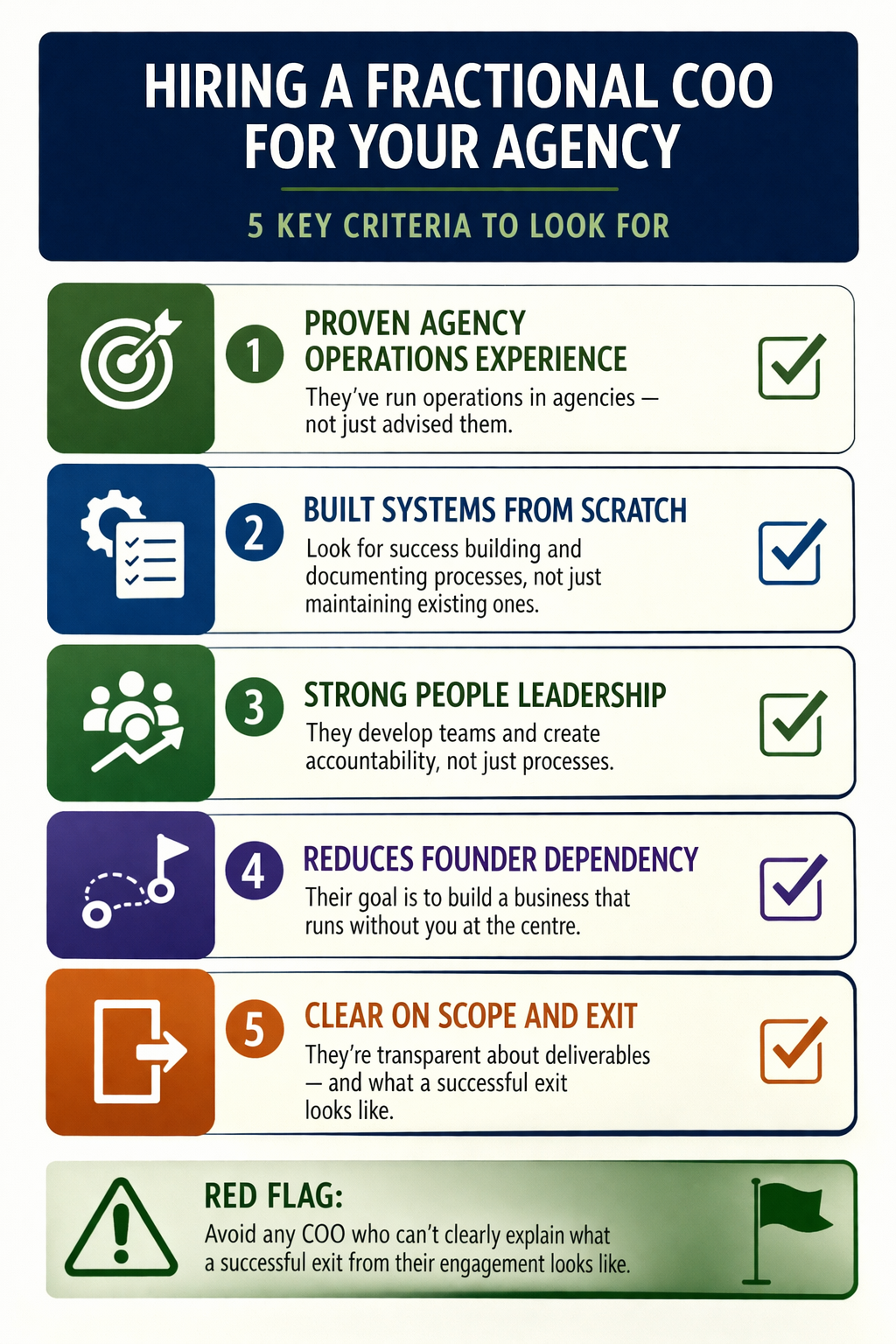
When hiring a fractional COO for your agency, prioritise candidates with direct agency operations experience, a track record of building scalable delivery processes, strong people leadership, and the ability to operate strategically without full-time presence.
Agency operations are distinct from other industries. The right fractional COO understands retainers, project scoping, resourcing, and client delivery cycles. A generalist consultant without agency background is a common and expensive mistake, one agency founder I worked with had previously engaged a senior operations consultant at £5,000/month ($6,250/month) who had no retainer model experience and spent the first three months producing frameworks that didn't map to how the agency actually worked.
Look for:
- Proven agency operations experience, not just generic business consulting
- Evidence of documented systems built from scratch, not inherited ones maintained
- Ability to coach and develop existing team members
- A clear method for reducing founder dependency, not extending their own involvement
- Transparency about what the engagement will and will not cover
🚩 Red flag: any COO candidate who cannot describe what a successful exit from their engagement looks like.
Frequently asked questions about fractional COOs for agencies
The most common questions agency owners ask about fractional COOs relate to cost, timing, and how the engagement fits alongside an existing team.
How many hours per week does a fractional COO typically work?
Most engagements run 1–3 days per week (8–24 hours). The right level depends on operational complexity and team size.
At what revenue or headcount should an agency consider one?
Agencies with 10–15+ staff and revenue above £500,000–£1m ($625,000–$1.25m) are typically at the right stage. Below that, a systems audit is usually more appropriate.
How long does a typical engagement last?
Most run 6–18 months. My Fractional COO for Agencies engagements require a minimum 6-month commitment, enough time to install structure that actually holds.
Can a fractional COO work alongside an existing operations manager?
Yes, and this is often ideal. The COO provides strategic direction and acts as a coach; the operations manager owns day-to-day execution.
What's the difference between a fractional COO and a business consultant?
A consultant advises. A fractional COO installs systems, leads people, and holds operational accountability. One tells you what to fix. The other owns fixing it.
What results should I expect in the first 90 days?
Typically: a documented operational audit, clear accountability structures in place, and the founder removed from at least one recurring delivery bottleneck. The first 90 days are about diagnosis and architecture, visible structural change, not just recommendations.
What does onboarding a fractional COO look like?
Most engagements begin with a structured diagnostic: reviewing delivery processes, interviewing key team members, and mapping where accountability breaks down. Within the first 2–4 weeks, you'll have a prioritised operational roadmap. From there, the COO works in a defined cadence, typically one to two days per week, building systems and coaching the team to own them. If you're considering this, the Agency Services Pricing page covers what different engagement levels look like in practice.
Conclusion
You started with one question: does your agency actually need a fractional COO, or is it an expensive answer to a problem you don't yet have?
If you're still the person holding every operational thread together: approvals, firefighting, escalations that should never reach you, the answer is yes. The structural problems that demand this kind of leadership don't resolve themselves; they compound.
You now have a decision framework, cost benchmarks, and an honest comparison of your alternatives. You don't need to guess anymore, you have what you need to move from uncertainty to a clear-headed call.
If you're still in the middle of delivery every day, that's the signal. The question isn't whether you need operational leadership eventually. It's whether the cost of delay is greater than the cost of the engagement.
This is exactly the transition I help agency founders make, from being the bottleneck to building an operational structure that runs without them.
Your next steps:
- Run through the 5-step framework and write down honest answers for your agency
- If processes aren't yet documented, start with a systems audit first
- Review my Agency Services Pricing page to understand what a fractional COO engagement looks like at different levels
- If the answer is yes, book a scoping call to map your agency's specific operational structure
Ready to explore whether a fractional COO is the right fit for your agency? Book a no-obligation scoping call.

About the author
Tom Wardman is a Growth Independence Architect and agency operations specialist. He works with agency founders to replace founder dependency with documented systems, scalable delivery, and operational structures their teams can run without them. His Agency Operating System™ covers services architecture, delivery systems, commercial control, and technology infrastructure --- built for agencies that want to scale without the founder at the centre of everything.
Pricing disclaimer: All GBP–USD price conversions are rounded estimates and correct at the time of publishing. Exchange rates fluctuate and figures should be treated as indicative only.
Topics: