
Are you watching potential customers slip through your fingers while competitors somehow close deals you should be winning?
Is your marketing failing to build the trust needed to drive consistent sales growth, and do you know exactly why?
In this article, you'll discover the hidden costs of ignoring buyer questions, how trust is quietly leaking from your pipeline, and why companies that embrace transparency now will dominate their markets for years to come.
As someone who has guided hundreds of businesses through implementing the Endless Customers System™ and witnessed the transformation firsthand, you'll see what's really at stake when companies delay adopting radical transparency and customer-focused marketing principles, and why the companies thriving today are those brave enough to say what others won't, show what others hide, and sell the way buyers actually want to be sold to.
Why most businesses are stuck in the trust deficit trap (and losing revenue daily)
The vast majority of businesses today are operating in a trust deficit that's costing them customers, revenue, and market share without them even realising it.
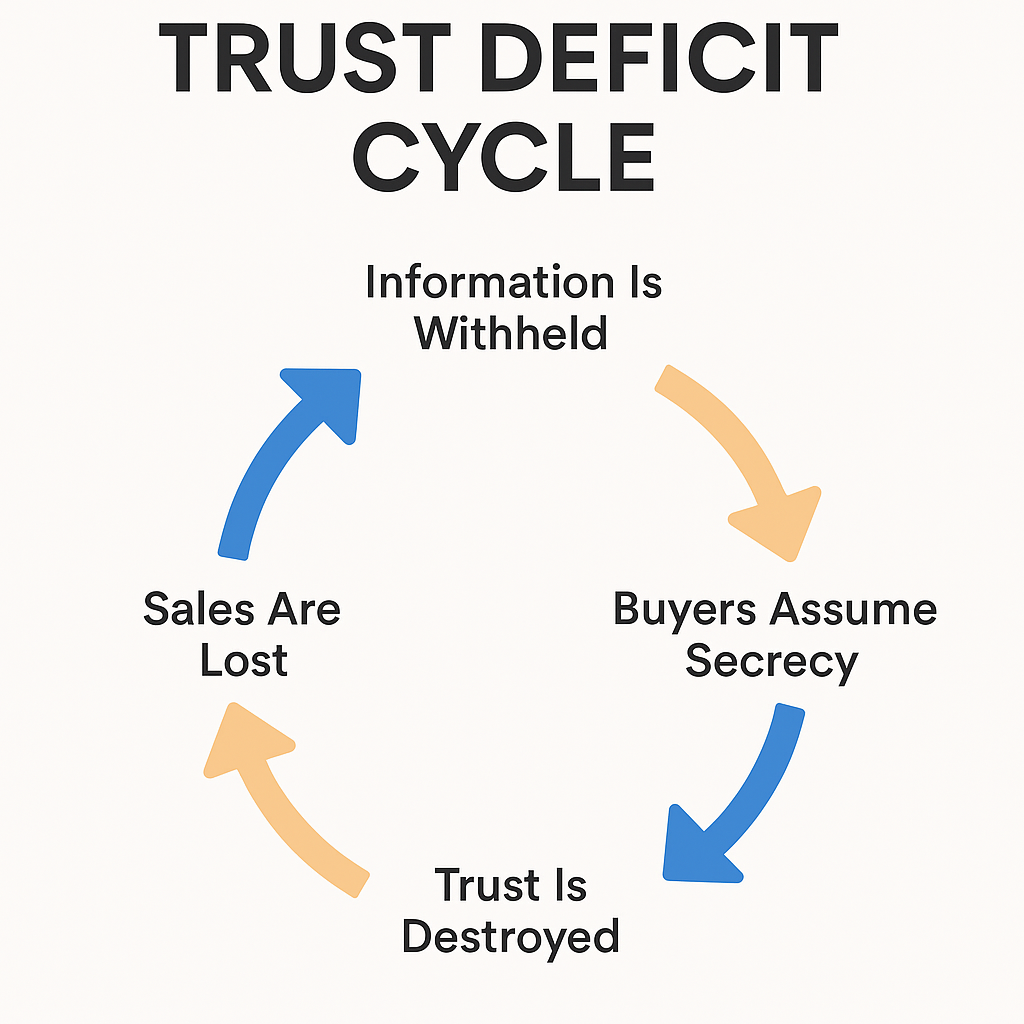
When buyers can't find the information they need online, like pricing, comparisons, and honest answers, they automatically assume companies are hiding something. This destroys trust before a sales conversation even begins.
Consider this: when was the last time you visited a website, couldn't find pricing information, and thought, "Of course they can't show prices; there are just too many variables"? Probably never.
The moment buyers feel like you're hiding anything from them online, trust is gone, and trust is the only currency that matters in today's market.
Most companies justify their secrecy with familiar excuses: "Every solution is complex," "Our competitors will find out what we charge," or "We'll scare customers away." But these justifications only prove how deeply they're trapped in outdated thinking.
How ostrich marketing Is killing your customer acquisition (and feeding your competitors)
Ostrich marketing—the practice of avoiding difficult questions and tough topics that buyers actually want answered—is the single biggest reason why companies lose prospects to competitors.
Like the mythical ostrich that buries its head in the sand when facing problems, businesses routinely ignore the toughest questions buyers want answered online. Instead of addressing pricing, problems, and comparisons head-on, they force frustrated prospects into "sales processes" that feel manipulative and outdated.
This avoidance strategy is completely backwards. While you're hiding from difficult conversations, your buyers are desperately searching for exactly this information to make confident purchasing decisions.
The companies winning today aren't necessarily the best; they're the most trusted, and trust comes from being willing to discuss what others won't.
Every time your team debates "Should we say that online?" or "Should we show that online?", ask yourself: "Are we being the ostrich right now?" If the answer is yes, you're actively damaging your competitive position.
The hidden revenue leak in your sales pipeline (and how to plug it)
Companies that don't embrace radical transparency are experiencing longer sales cycles, more stalled deals, and higher customer acquisition costs because prospects can't find the trust-building information they need.
This revenue leak appears in multiple ways:
- Extended sales cycles: Prospects spend weeks researching elsewhere instead of engaging with your content
- Higher abandonment rates: Qualified leads disappear when they can't find answers to basic questions
- Increased price sensitivity: Without value education, buyers default to comparing prices alone
- Lower close rates: Sales teams struggle without trust-building content to support their efforts
Every day you avoid addressing buyer questions directly on your website, you're essentially forcing qualified prospects to research your competitors instead.
Your marketing team creates content they think works, while your sales team finds it unhelpful, and leadership watches opportunities slip away.
The mathematics are simple: when buyers can't find the information they need from you, they'll get it somewhere else. Usually from a competitor who understands that education builds trust, and trust drives sales.
Why your competitors are winning deals you should be closing
Businesses that refuse to discuss what others won't—like pricing, problems, and honest comparisons—are losing market share to competitors who embrace transparency, even when their product or service is superior.
Here's what's happening: while you're protecting information, your smartest competitors are becoming the trusted authority by answering the exact questions you're avoiding. They're not necessarily better—they're just more trusted.
This trust gap manifests in several ways:
- Search rankings suffer: Google rewards helpful, comprehensive content that answers buyer questions
- Referrals decrease: Happy customers struggle to recommend you when they can't explain your value clearly
- Sales conversations start from zero: Prospects arrive uninformed and sceptical instead of educated and interested
- Price objections increase: Without value education, every conversation becomes about cost
Your competitors aren't necessarily better than you—they're simply building more trust by addressing the hard questions you're avoiding.
Recommended reading: Harvard Business Review's The B2B Elements of Value
The compound effect of ignored customer questions (why small gaps become big losses)
Every unanswered buyer question on your website represents lost trust, extended sales cycles, and reduced close rates that compound over time into significant revenue losses.
This compound effect works against you in multiple ways:
| Problem Area | Short-term Impact | Long-term Consequence |
|---|---|---|
| Unanswered pricing questions | Lost leads | Industry commoditisation |
| Hidden comparison data | Longer research cycles | Competitor advantage |
| Avoided problem discussions | Increased objections | Reputation damage |
| Generic value propositions | Lower engagement | Brand irrelevance |
When prospects can't find answers to their most pressing concerns, they either choose a competitor who addresses these questions or delay their purchase indefinitely. Both outcomes cost you revenue, but the delay scenario is particularly dangerous because it creates a backlog of indecision in your market.
Think about your own buying behaviour: when you can't find the information you need, how long do you wait before looking elsewhere? Most buyers give companies less than 48 hours to provide the answers they need before moving on.
The pride cycle: How success turns into complacency (and kills market position)
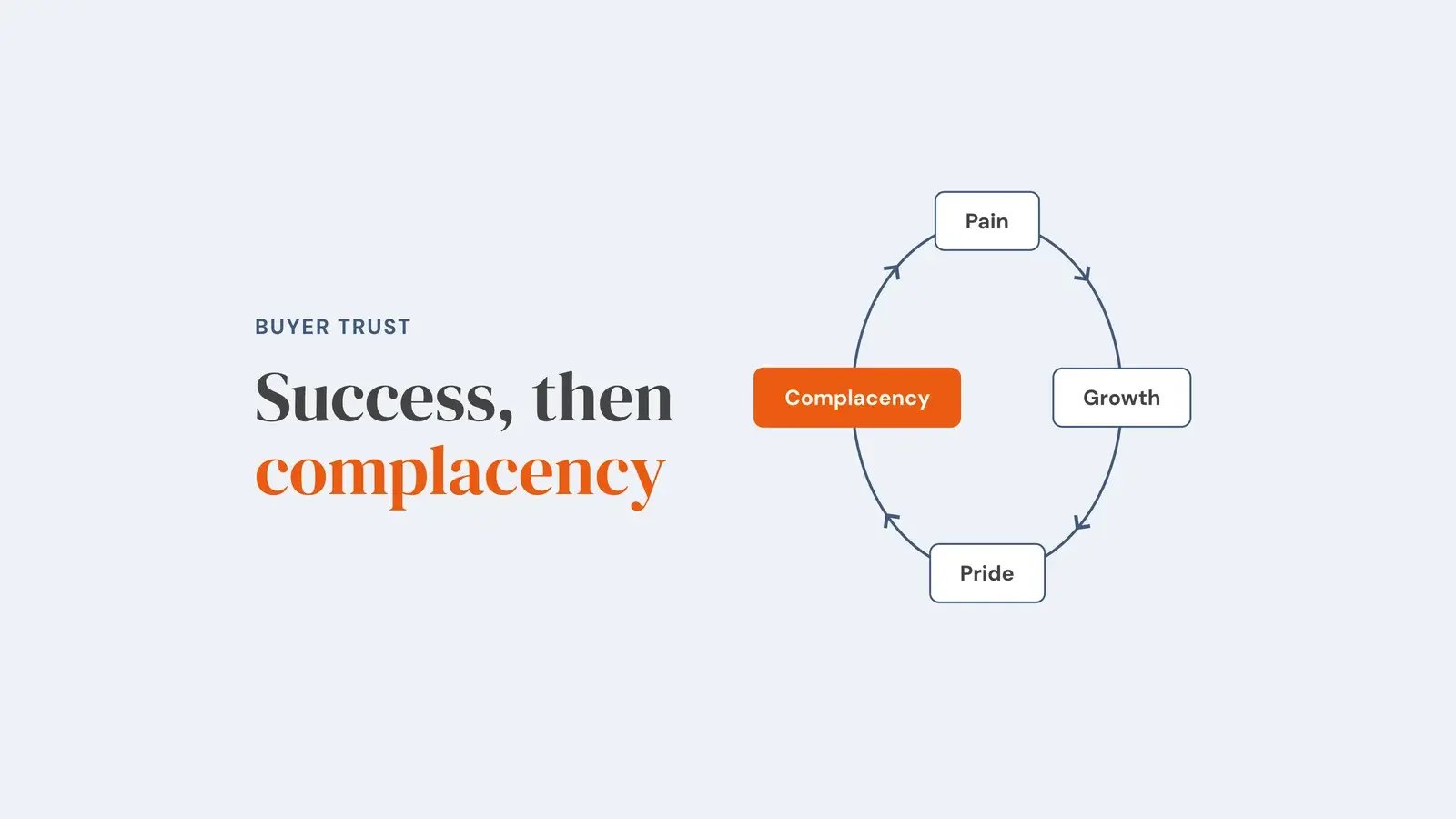
The pride cycle—moving from pain to growth to pride to complacency—has killed more successful companies than any competitor ever could, because it causes businesses to stop doing the small things that built their success.
This cycle follows four predictable stages:
- Pain: Innovation is born when your back is against the wall
- Growth: New approaches build momentum and drive results
- Pride: Success breeds confidence that becomes dangerous arrogance
- Complacency: You stop doing the little things that got you there
Companies like Blockbuster, Kodak, and BlackBerry didn't fail due to lack of resources or talent; they failed because success bred complacency. They stopped innovating when they were successful, forgot that markets never stop evolving, and dismissed new threats as irrelevant.
The same pattern happens with marketing approaches—businesses that found success with traditional methods resist adopting transparency-based strategies because "that's not how we've always done it."
Meanwhile, hungrier competitors embrace these approaches and gradually steal market share.
The antidote is maintaining your hunger even in abundance, continuing to obsess over customer questions especially when you're the market leader.
Status quo marketing is costing you authority, trust, and sales
While you're playing it safe with generic, risk-averse marketing, your most aggressive competitors are capturing market attention by addressing topics you're too afraid to discuss.
This opportunity cost compounds monthly:
- Content production: Your team creates safe, generic content while competitors publish helpful, specific answers
- Search visibility: Google rewards comprehensive, helpful content that actually answers searcher questions
- Industry authority: Someone will become the go-to expert in your space—if it's not you, it's your competitor
- Customer education: Buyers need to learn about your industry somewhere; you're letting competitors control that narrative
Every month you delay implementing transparent, customer-focused content strategies, you're allowing competitors to establish themselves as the trusted authority in your space.
Through my In-House Sales and Marketing Mastery programme, I've seen businesses transform their market position within months by simply addressing the questions their competitors avoid. The companies that move first gain an advantage that becomes increasingly difficult for others to overcome.
When you're not the trusted brand: Why price becomes your only weapon
Companies that aren't recognised as the most known and trusted brand in their market are forced to compete primarily on price, leading to compressed margins and commoditised positioning.
This creates a downward spiral:
- Price competition intensifies: Without trust-based differentiation, every deal becomes a bidding war
- Margins compress: You're forced to cut prices to win business
- Value perception decreases: Buyers see your offering as interchangeable with competitors
- Customer loyalty weakens: Relationships become transactional rather than trust-based
- Market vulnerability increases: You're exposed to every new competitor and economic shift
Without trust-based differentiation, businesses become vulnerable to every new competitor, economic downturn, and market shift because they lack the customer loyalty that comes from being truly trusted.
My Company Alignment Workshop helps leadership teams understand exactly why this happens and how to reverse it. When your sales, marketing, and leadership teams unite around proven principles that build trust, you stop competing on price and start competing on value.
The alternative—remaining the "other option" in buyers' minds—means accepting smaller margins, harder sales, and constant competitive pressure. Most businesses don't realise they're making this choice until it's almost too late.
Can you afford to ignore the Endless Customers System?
You came to this article because somewhere, deep down, you know your marketing isn't building the trust your business needs to grow consistently.
We've explored how failing to address buyer questions openly leads to lost deals, extended sales cycles, and stalled growth, and how the pride cycle keeps successful businesses trapped in outdated approaches while hungrier competitors steal market share.
Ready to stop losing deals to competitors who understand trust? My Company Alignment Workshop unites your sales, marketing, and leadership teams around proven principles that build customer trust and drive sustainable growth. Let's discuss how to transform your team's potential and make your marketing work for your business.

Topics: