

Key Takeaways
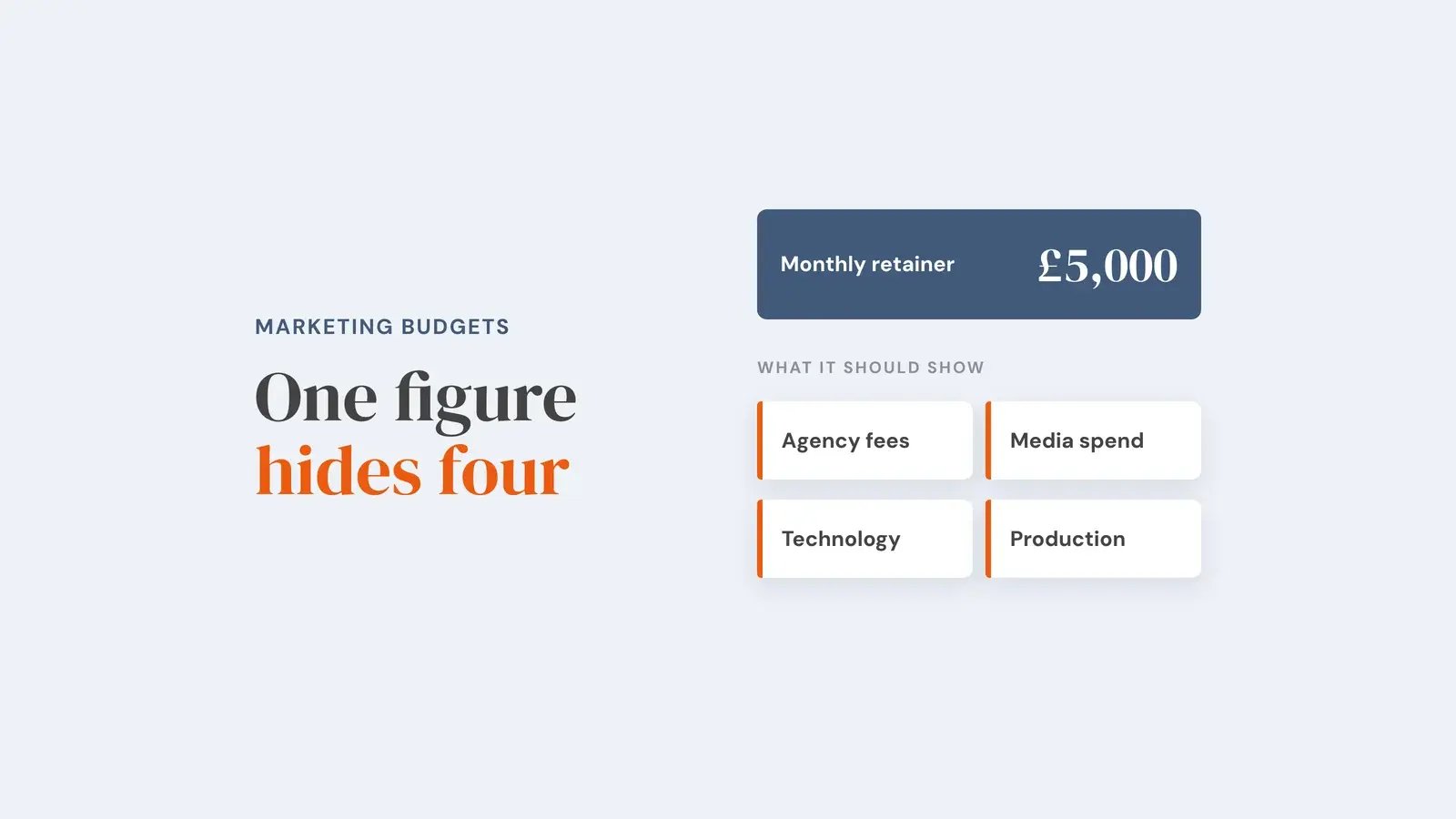
- A marketing retainer fee covers five core cost categories: strategic planning and account management, creative and content production, media buying or distribution costs, tools and technology overhead, and reporting and optimisation.
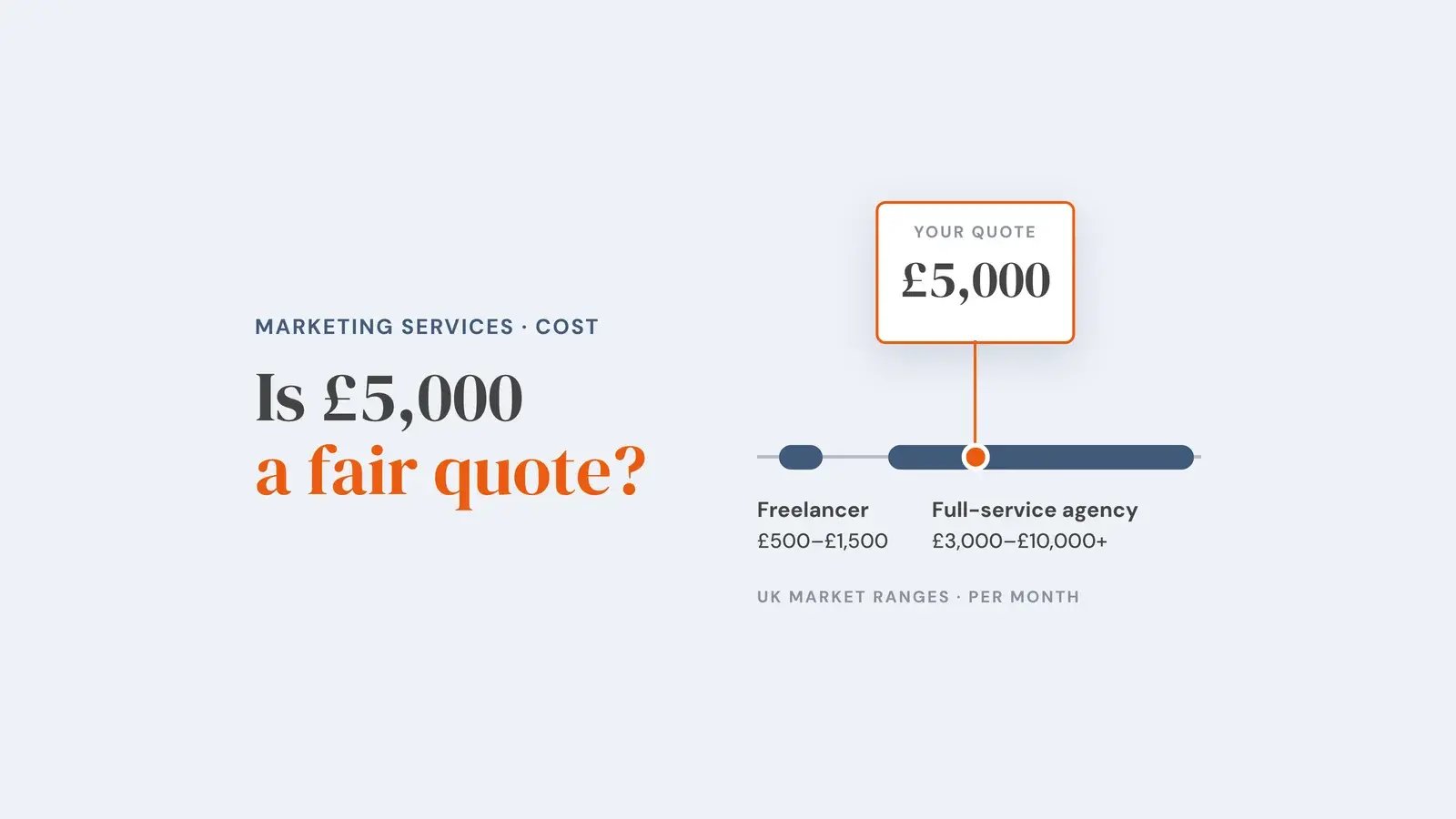
- Marketing retainer fees typically range from £3,000 to £25,000+ ($3,750–$31,250+) per month, depending on scope, agency size, and service complexity.
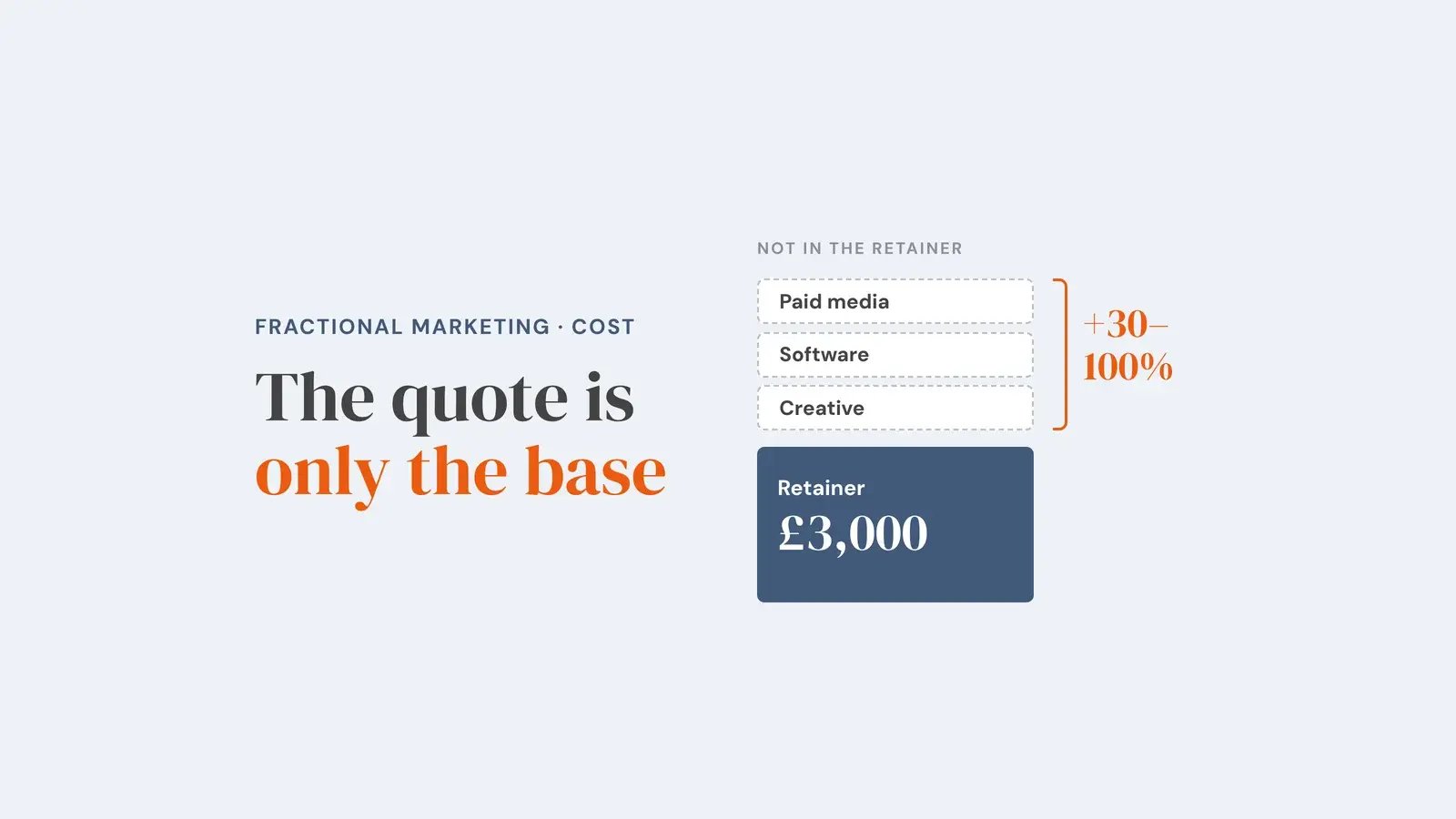
- Your retainer should never include ad spend, third-party media costs, premium software licences purchased on your behalf, or large one-time projects outside the agreed scope.
- To evaluate whether a retainer quote represents fair value, divide the monthly fee by the agency's hourly rate to determine how many hours you're purchasing, then map those hours against your expected deliverables.
- Successful retainer relationships require monthly reconciliation meetings where you review hours spent, deliverables completed, and results achieved against the agreed scope.
Are you staring at a marketing retainer proposal and wondering, "Is this quote even fair?"
If you don't know what you're actually paying for, you risk wasting thousands on vague "support" that doesn't drive results. Too many businesses sign agreements without knowing whether they're paying for strategy, execution, or just access to an agency's time.
This article breaks down exactly where your money goes in a typical retainer. You'll learn what should and shouldn't be included, how to calculate fair value, and what red flags to watch out for before signing.
What is a marketing retainer?
A marketing retainer is a recurring monthly or quarterly fee paid to an agency or consultant in exchange for a predetermined scope of ongoing marketing services. Unlike project-based billing, retainers provide consistent access to marketing expertise, resources, and execution capacity.
Most retainers fall into one of three types:
- Hourly bank retainer: You purchase a set number of hours per month (e.g., 40 hours) at an agreed rate, usable across any marketing tasks
- Deliverable-based retainer: You pay a fixed fee for specific outputs each month (e.g., 4 blog posts, 2 email campaigns, 1 strategy session)
- Value-based retainer: Pricing ties to business outcomes or access to senior expertise rather than hours or deliverables
The structure you choose affects how costs are allocated and what flexibility you have month to month.
What are you actually paying for in a marketing retainer?
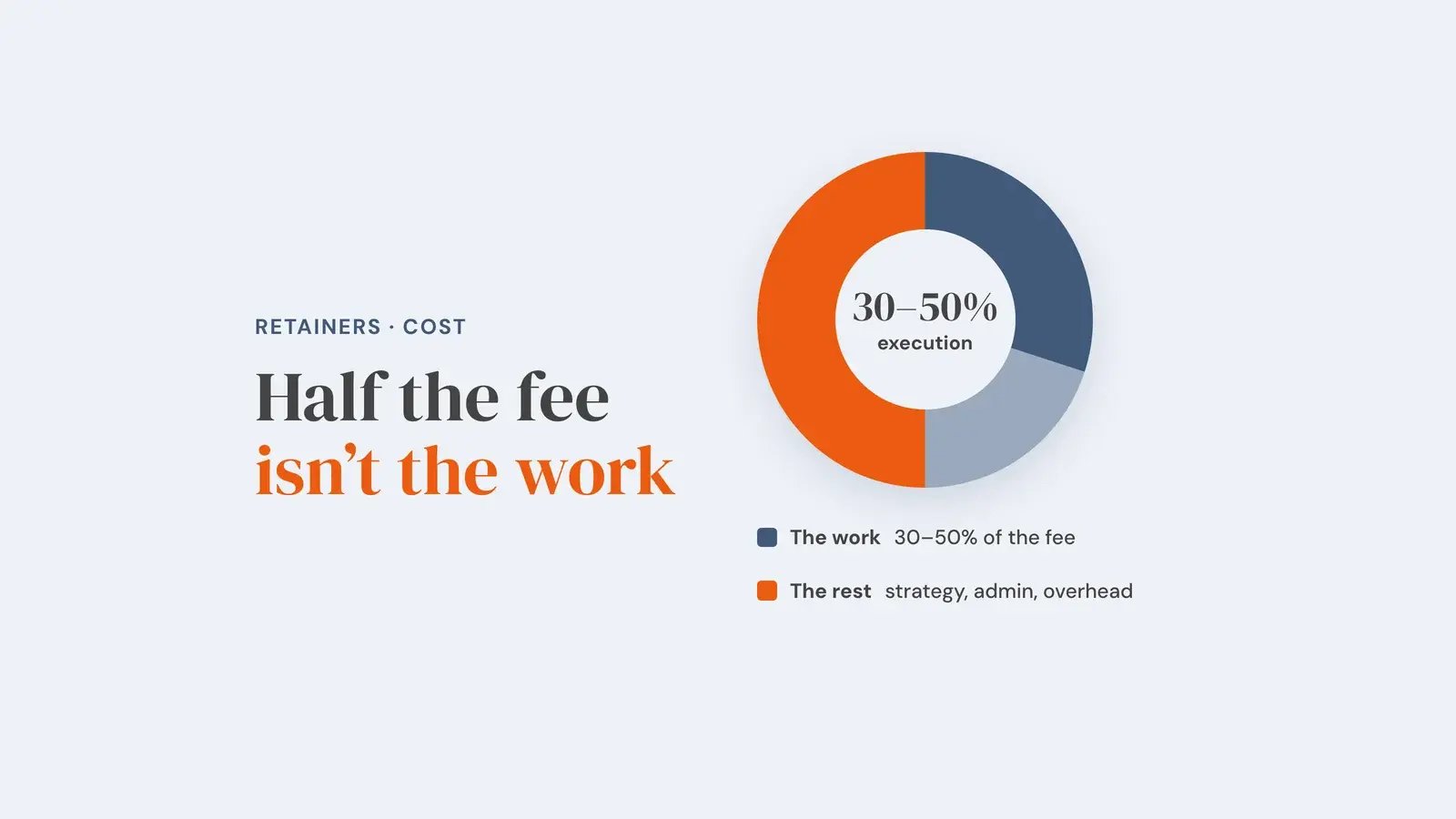
A marketing retainer fee covers five core cost categories: strategic planning and account management, creative and content production, media buying or distribution costs, tools and technology overhead, and reporting and optimisation. Understanding how agencies allocate your budget across these categories helps you evaluate whether you're getting fair value.
Here's how a typical retainer breaks down:
| Cost Category | Typical % | £5,000/month ($6,250) | £10,000/month ($12,500) | £20,000/month ($25,000) |
|---|---|---|---|---|
| Strategy & account management | 20-25% | £1,000-£1,250 ($1,250-$1,563) | £2,000-£2,500 ($2,500-$3,125) | £4,000-£5,000 ($5,000-$6,250) |
| Creative & content production | 35-45% | £1,750-£2,250 ($2,188-$2,813) | £3,500-£4,500 ($4,375-$5,625) | £7,000-£9,000 ($8,750-$11,250) |
| Media buying/distribution | 10-15% | £500-£750 ($625-$938) | £1,000-£1,500 ($1,250-$1,875) | £2,000-£3,000 ($2,500-$3,750) |
| Tools & technology | 10-15% | £500-£750 ($625-$938) | £1,000-£1,500 ($1,250-$1,875) | £2,000-£3,000 ($2,500-$3,750) |
| Reporting & optimisation | 10-15% | £500-£750 ($625-$938) | £1,000-£1,500 ($1,250-$1,875) | £2,000-£3,000 ($2,500-$3,750) |
- Strategy and account management hours cover monthly planning sessions, performance reviews, campaign strategy development, and your dedicated account manager's time communicating with your team.
- Creative and content production labour represents the largest portion of most retainers; this is the copywriters, designers, videographers, and developers actually creating your marketing assets.
- Media buying or distribution costs include the labour to plan, execute, and manage paid campaigns or content distribution (not the ad spend itself, which should be separate).
- Tools and technology overhead covers the agency's subscriptions to marketing platforms they use to deliver your work; think design software, analytics tools, project management systems, and a portion of their CRM or automation platform costs.
- Reporting and optimisation pays for the analysts and strategists who monitor campaign performance, compile reports, and recommend improvements based on data.
Typical monthly retainer costs by business size
Marketing retainer fees typically range from £3,000 to £25,000+ ($3,750–$31,250+) per month, depending on scope, agency size, and service complexity. Small businesses often start with £3,000–£7,500 ($3,750–$9,375) per month retainers for foundational services, while mid-market companies invest £10,000–£25,000 ($12,500–$31,250) per month for multi-channel execution.
| Tier | Monthly Cost | Typical Deliverables | Team Size | Avg Hourly Rate |
|---|---|---|---|---|
| Small Business | £3,000-£7,500 ($3,750-$9,375) | 1-2 channels, basic strategy, 4-8 content pieces/month | 2-3 people | £125-£150 ($156-$188) |
| Mid-Market | £10,000-£25,000 ($12,500-$31,250) | Multi-channel execution, advanced strategy, 12-20+ pieces/month | 4-6 people | £150-£200 ($188-$250) |
| Enterprise | £25,000+ ($31,250+) | Full marketing dept replacement, complex campaigns, unlimited content | 6-10+ people | £200-£250+ ($250-$313+) |
Retainer costs vary by business size and marketing maturity. A startup building its first marketing engine pays less than an established company scaling multi-channel campaigns across international markets.
How hourly rates affect total retainer cost matters more than most buyers realise. An agency charging £150 ($188) per hour that works efficiently delivers better value than one charging £125 ($156) per hour but taking 30% longer on every task.
Always calculate the effective hours you're purchasing: divide your monthly retainer by the agency's blended hourly rate to see actual capacity.
Costs that should never be included in a marketing retainer
Your retainer should never include ad spend, third-party media costs, premium software licences purchased on your behalf, or large one-time projects outside the agreed scope.
These are pass-through or project-based expenses that should be billed separately with transparent markup policies disclosed upfront.
Here's what to expect as separate line items:
- Paid advertising spend: Your Facebook Ads, Google Ads, LinkedIn Ads, or other media budgets should appear as separate costs, sometimes with a 10-15% management markup
- Third-party subscriptions: Marketing automation platforms, premium analytics tools, or software licences purchased specifically for your account
- Stock photography and premium assets: Shutterstock licences, custom illustrations from freelancers, or premium font licences
- Video production crews: Professional videographers, studios, actors, or equipment hire for high-production shoots
- Website hosting and domain fees: Server costs, CDN services, SSL certificates
- Large one-time projects: Website redesigns, rebrand initiatives, or major campaign launches that exceed normal monthly scope
- Freelance specialists: Subject matter experts, translators, or niche specialists brought in for specific projects
Typical agency markups on pass-through costs range from 10-20%. This covers the administrative work of managing vendors and the risk of fronting payment. If an agency refuses to disclose markup percentages, that's a warning sign.
Marketing retainer vs. project fees vs. hourly billing
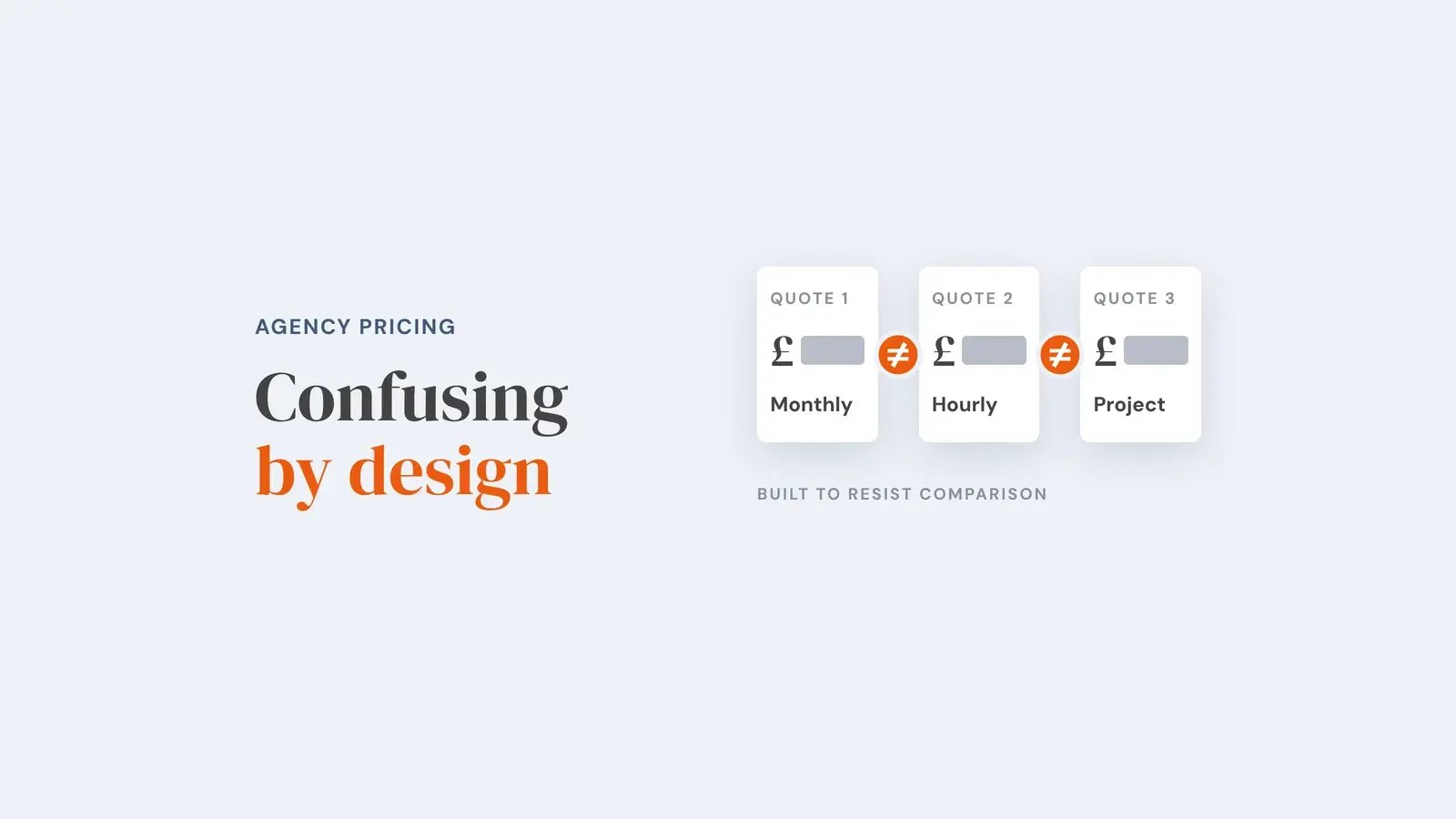
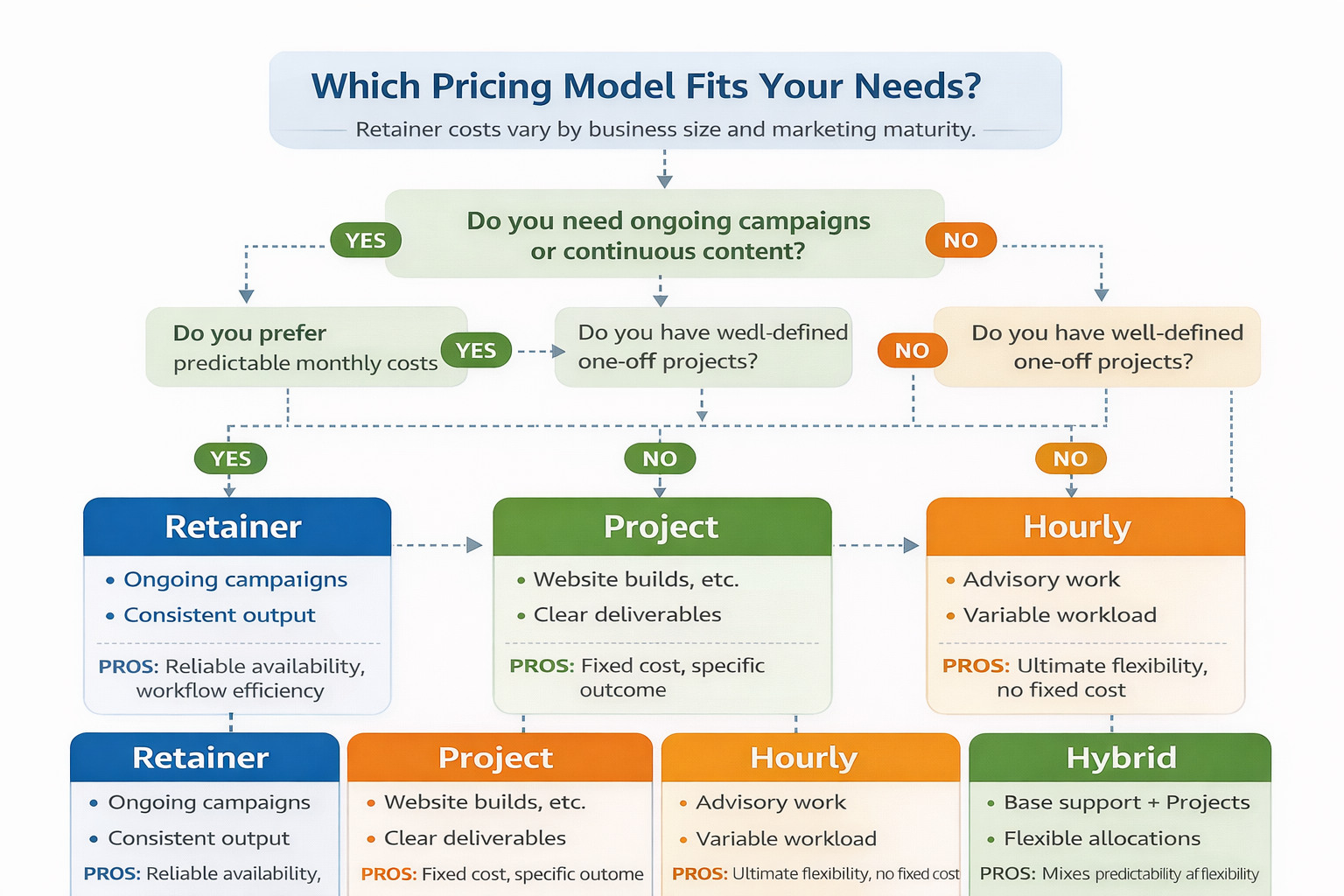
Unlike project fees with fixed deliverables or hourly billing that fluctuates monthly, retainers provide predictable costs in exchange for ongoing availability and consistent output. Retainers work best when you need continuous marketing support, while project fees suit one-time initiatives and hourly billing fits unpredictable or advisory needs.
| Pricing Model | Best For | Pros | Cons |
|---|---|---|---|
| Retainer | Ongoing campaigns, continuous content needs, long-term partnerships | Predictable monthly costs, priority access, workflow efficiency | Less flexibility, unused hours may not roll over |
| Project | Website builds, rebrands, campaign launches, defined scope work | Clear deliverables, fixed total cost, defined end date | No ongoing support, higher hourly rates, scope creep costs extra |
| Hourly | Advisory work, unpredictable needs, small businesses testing agencies | Pay only for what you use, ultimate flexibility | Unpredictable monthly costs, no priority access, administrative overhead |
| Hybrid | Businesses needing base support plus variable project work | Combines predictability with flexibility | More complex to manage and invoice |
My done-for-you Fractional Marketing Director services work on monthly retainers starting from £2,000 ($2,500) per month because consistent marketing execution requires reliable capacity and planning cycles.
How to evaluate if a retainer quote is fair value
To evaluate whether a retainer quote represents fair value, divide the monthly fee by the agency's hourly rate to determine how many hours you're purchasing, then map those hours against your expected deliverables.
A well-structured retainer should provide 30-50% more efficiency than equivalent hourly billing due to workflow optimisation and reduced administrative overhead.
Use this simple formula:
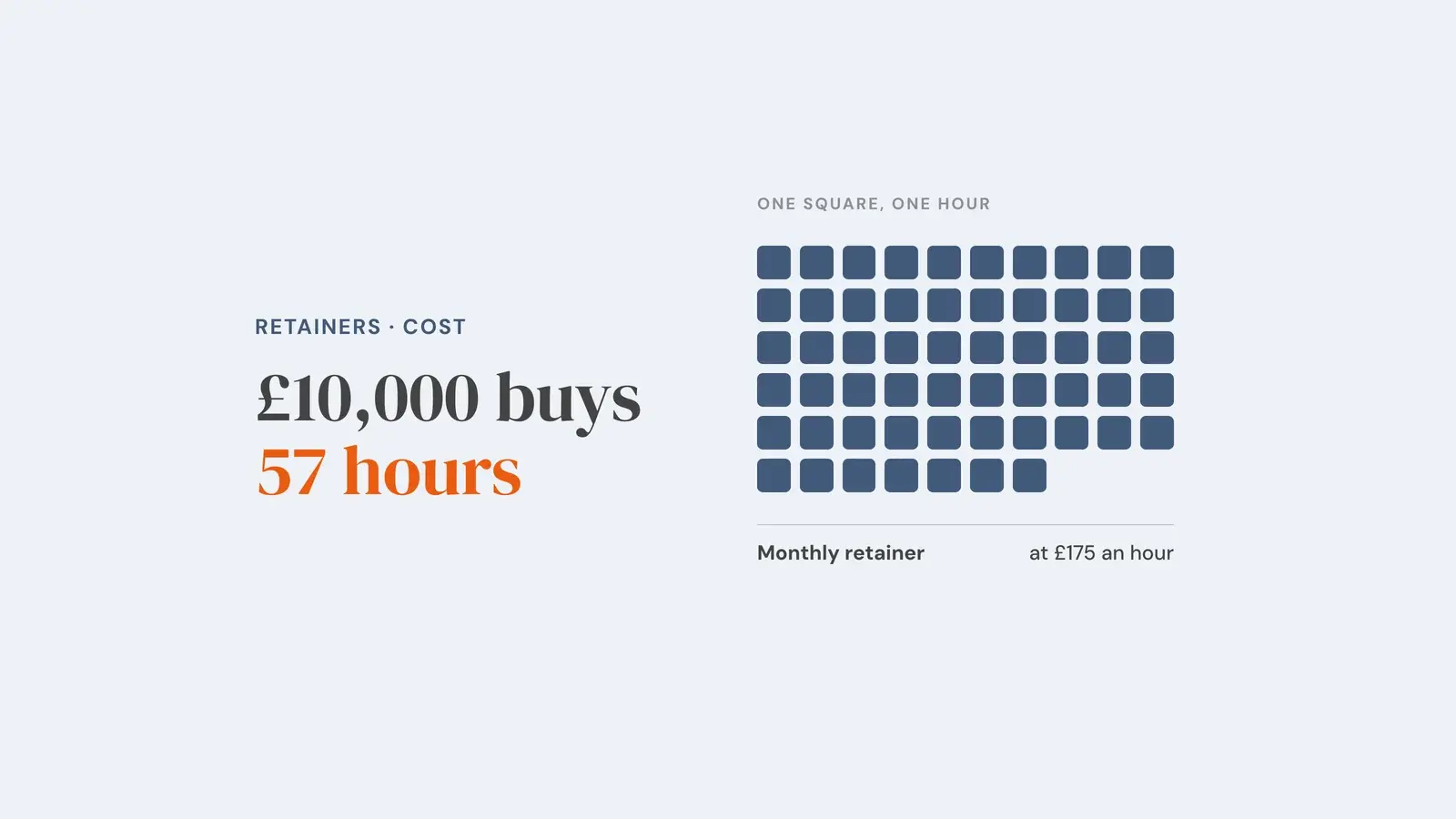
Monthly Retainer ÷ Blended Hourly Rate = Hours Available
Example: £10,000 ($12,500) ÷ £175 ($219) per hour = 57 hours per month
Now assess whether 57 hours realistically produces your expected deliverables. Four blog posts might require 12-16 hours. Two email campaigns might need 8-10 hours. Monthly social content could take 15-20 hours. Strategy and reporting meetings consume another 8-10 hours. That's roughly 43-56 hours, fitting within your purchased capacity.
Calculate your effective cost per deliverable by dividing the retainer by the number of key outputs. If you're paying £8,000 ($10,000) per month for 8 blog posts, 4 email campaigns, and 20 social posts, that's roughly £250 ($313) per blog, £500 ($625) per email campaign, and £100 ($125) per social post. Compare those unit costs against market rates or freelance quotes.
Warning signs of overpriced retainers:
- Agencies refusing to disclose how many hours the retainer purchases
- More than 30% of the retainer allocated to "account management" or "strategy" without clear deliverables
- Vague scope descriptions like "ongoing marketing support" without specific outputs or capacity limits
- Requiring 12+ month commitments before proving results
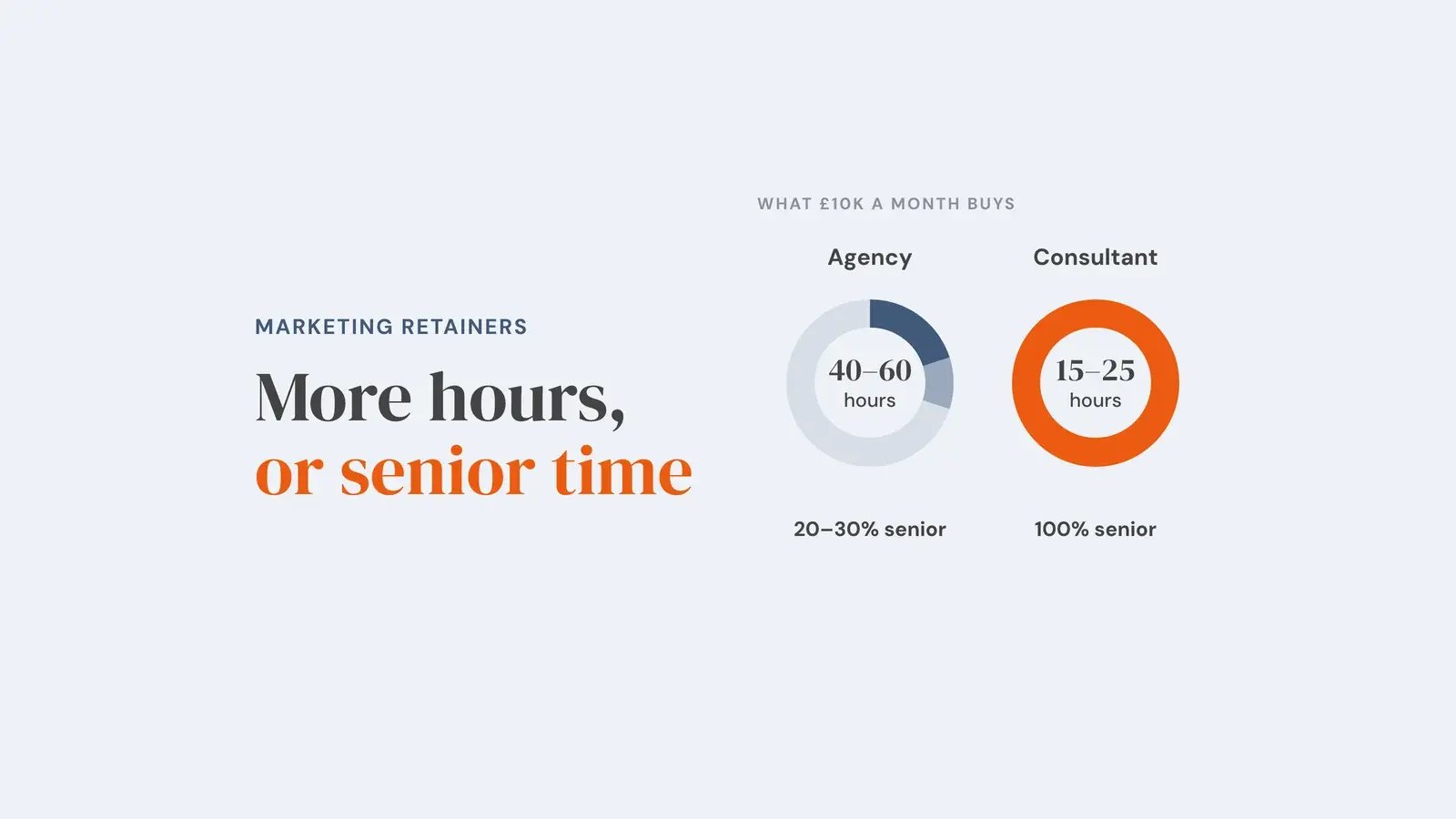
- Charging premium rates but staffing your account with junior team members
What to look for in a retainer agreement
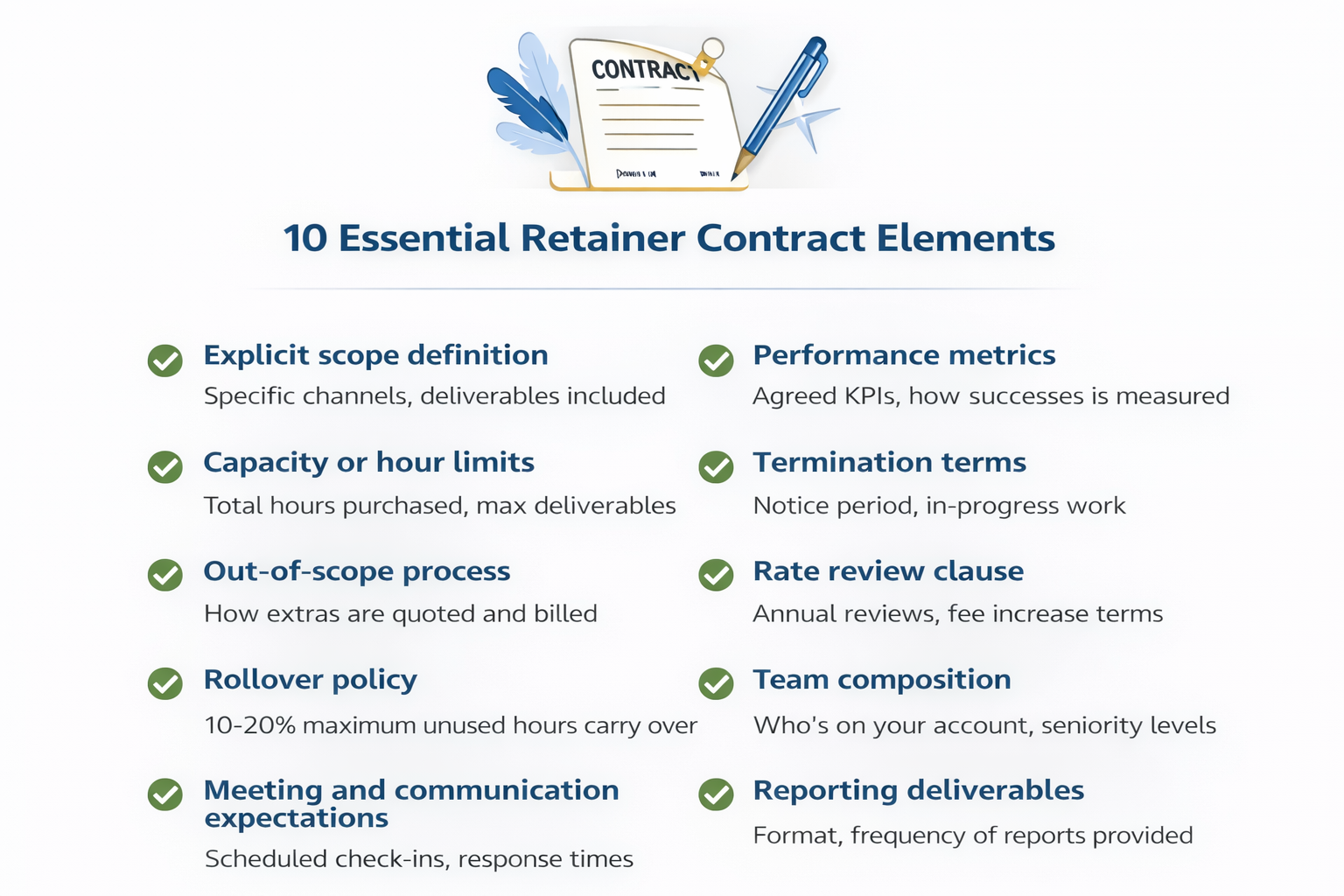
A transparent retainer agreement must clearly define scope boundaries, deliverable expectations, hour banks or capacity limits, termination clauses, and how out-of-scope requests are handled. The best retainer contracts also specify reporting cadence, performance metrics, and annual rate review terms.
Your contract should include these elements:
- Explicit scope definition: Specific channels, deliverable types, and quantities included each month
- Capacity or hour limits: Clear statement of total hours purchased or maximum deliverables per category
- Out-of-scope process: How additional requests are quoted, approved, and billed
- Rollover policy: Whether unused hours or deliverables carry forward to the next month (typically 10-20% maximum)
- Meeting and communication expectations: Scheduled check-ins, response time commitments, reporting frequency
- Performance metrics: Agreed KPIs and how success will be measured
- Termination terms: Notice period required (typically 30-90 days), what happens to in-progress work, asset ownership
- Rate review clause: When and how fees may increase (annual reviews are standard)
- Team composition: Who's assigned to your account, their seniority levels, what happens if they leave
- Reporting deliverables: Format, frequency, and depth of performance reports included
Asset ownership and access matter more than most buyers realise. Confirm that you retain ownership of all content, creative assets, and data generated during the engagement, and that you'll receive source files, not just final outputs.
How to structure a retainer that works for your business
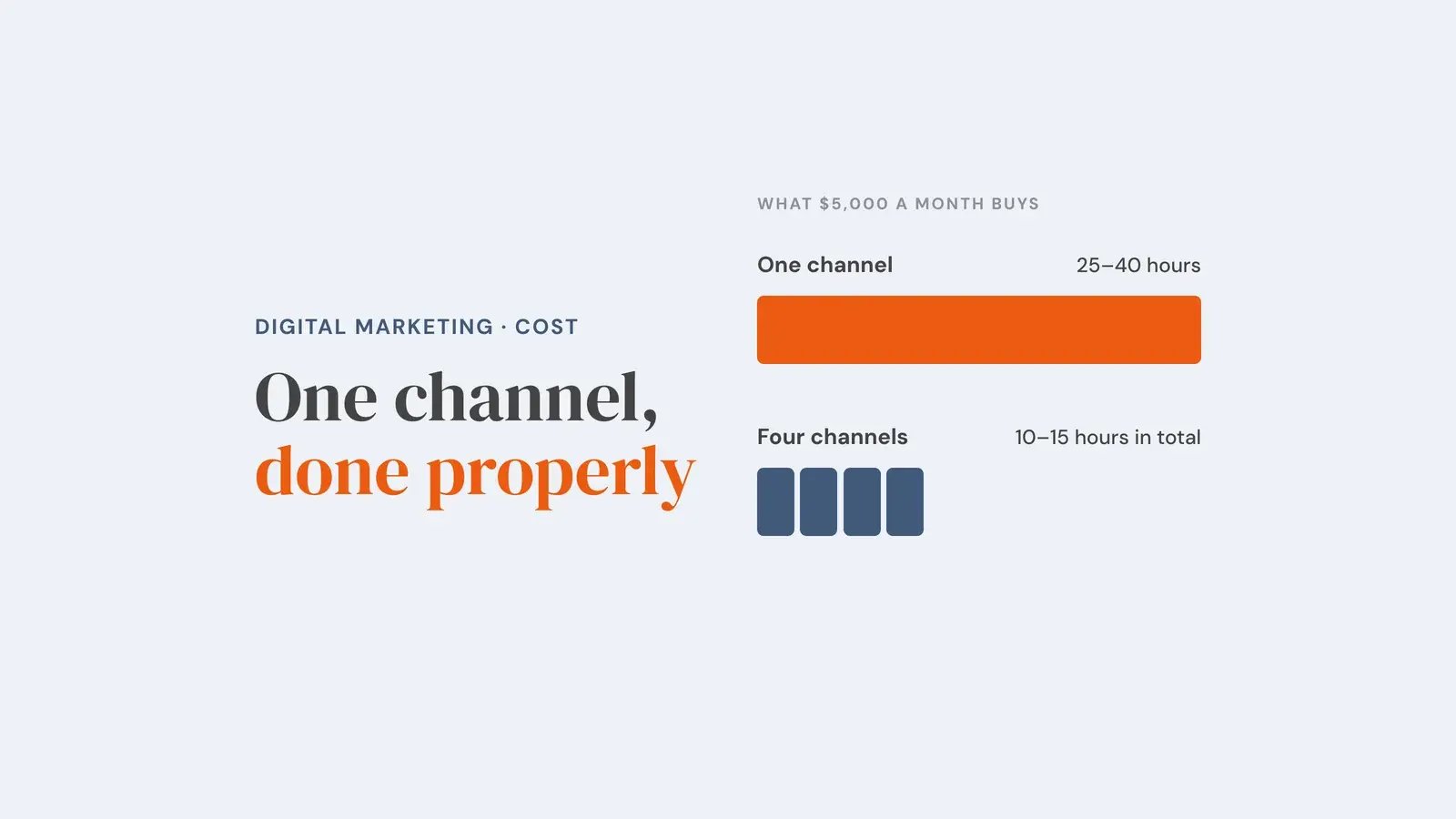
The most effective retainers start with a 90-day pilot at reduced scope to test agency fit and communication rhythms before committing to longer terms. Build your retainer around 2-3 priority marketing channels rather than spreading budget thinly across every possible tactic.
Follow this five-step process:
- Identify your top 2-3 marketing priorities: Where do you need consistent execution most? Focus there first rather than trying to do everything.
- Choose between capacity-based and deliverable-based structure: If your needs vary month to month, buy hours. If you need predictable outputs, commit to specific deliverables.
- Start with a 3-month pilot at 60-70% of full scope: Test the relationship before committing to your complete wish list. Better to add services after proving success than to overpay upfront.
- Build in quarterly scope reviews: Schedule formal check-ins every 90 days to assess what's working, adjust priorities, and reallocate budget to higher-performing channels.
- Separate recurring work from project work: Keep ongoing content production, campaign management, and optimisation in your retainer. Bill website updates, rebrands, or launches separately.
The right structure depends on your internal capabilities. If you have strong strategists but lack execution capacity, buy deliverable-based retainers for production work. If you need strategic guidance but have in-house creators, my Fractional CMO services provide strategic leadership without the execution overhead.
Best practices for managing and optimising your retainer
Successful retainer relationships require monthly reconciliation meetings where you review hours spent, deliverables completed, and results achieved against the agreed scope. Track actual hours or outputs monthly to ensure you're using your full allocation and adjust scope quarterly based on business priorities.
Follow these practices to maximise retainer value:
- Request detailed time tracking reports monthly: See exactly where hours go and which activities deliver the best results
- Maintain a running backlog of marketing tasks: Always have more work queued than capacity allows so you never waste purchased hours
- Front-load strategic work in the first 90 days: Use early months for foundational strategy, competitor research, and planning, execution becomes more efficient after this investment
- Schedule standing weekly or fortnightly check-ins: Short 30-minute syncs prevent miscommunication and keep projects moving
- Review performance metrics monthly, not just quarterly: Waiting 90 days to assess results wastes three months of retainer fees on underperforming tactics
- Negotiate scope adjustments quarterly: As business priorities shift, reallocate retainer capacity to higher-impact channels
- Plan exit strategy upfront: Know what happens if you cancel—asset handover processes, transition support, notice periods
When to renegotiate or exit a retainer: If you're consistently using less than 80% of your purchased capacity three months running, reduce scope. If the agency can't meet deadlines or quality standards two months in a row, that's a red flag. And if business results don't improve within 6-9 months, something's fundamentally wrong with either the strategy or the execution.
Frequently asked questions about marketing retainer costs
These are the most common questions businesses ask when evaluating marketing retainer pricing and structure. Each answer provides specific guidance to help you make informed decisions about retainer investments.
Can I pause my retainer if business slows down?
Most agencies require 30-60 days' notice to pause or cancel retainers, and some don't allow pauses at all. Build pause terms into your initial agreement if seasonal business fluctuations are likely. Some agencies offer reduced "maintenance retainers" at 30-40% of full cost to keep the relationship warm during slow periods.
Should I pay for unused hours if we don't use our full allocation?
Standard retainer agreements don't refund unused hours—you're purchasing capacity and priority access, not just completed work. However, you can negotiate 10-20% rollover allowances so unused hours carry into the next month. If you regularly use less than 70% of purchased capacity, renegotiate a smaller retainer.
How often do retainer fees typically increase?
Most agencies review rates annually, with increases ranging from 3-5% for inflation adjustments to 10-15% when expanding scope significantly. Lock in rate terms for at least 12 months in your initial agreement, and request 60-90 days' notice before any fee increases.
What's a reasonable cancellation notice period?
Thirty days' notice is standard for retainers under £5,000 ($6,250) per month. Sixty days is common for £5,000-£15,000 ($6,250-$18,750) per month retainers. Ninety days applies to larger engagements exceeding £15,000 ($18,750) per month. Negotiate notice periods before signing, some agencies demand 6-12 months, which creates unfair vendor lock-in.
Do monthly retainers include strategic planning or just execution?
This varies dramatically by agency and price point. Retainers under £5,000 ($6,250) per month typically include minimal strategy, mostly execution of your direction. £7,500-£15,000 ($9,375-$18,750) per month retainers should include monthly strategic planning sessions. Above £15,000 ($18,750) per month, you should receive comprehensive strategy development, not just tactical execution.
Conclusion
At the end of the day, navigating marketing retainers shouldn't feel like gambling with your budget.
You came here unsure about what your monthly fee is actually buying—and now you know exactly how to break it down, spot red flags, and protect your investment. The difference between a fair retainer and an overpriced one often comes down to transparency: agencies willing to show how they allocate hours, what deliverables you're actually purchasing, and what costs remain separate.
Your next step: Read "Agency vs Fractional CMO: Which Marketing Strategy Partner Is Right for Your B2B Company?" to determine which service model best fits your needs.
I'm Tom Wardman, and my goal isn't to trap you in a long-term retainer; it's to help you build a marketing engine you'll eventually own. Whether you need done-for-you execution, done-with-you strategic guidance, or done-by-you training, the focus is building your internal marketing capability, not creating permanent dependency.

About the Author
I'm Tom Wardman, and I've built, scaled, and fixed marketing operations from both sides, in-house and agency. I've seen where retainers deliver brilliant value and where they become expensive dependencies that never end. Everything I do now, whether hands-on delivery through my Fractional Marketing Director services or strategic leadership through Fractional CMO engagements, focuses on building marketing capabilities you'll actually own. I help business leaders and their teams generate steady revenue growth by creating marketing engines that work long after our engagement ends.
Pricing Disclaimer: All GBP–USD price conversions are rounded estimates and correct at the time of publishing. Exchange rates fluctuate and figures should be treated as indicative only.