

Key Takeaways
- A poor marketing hire typically costs £120,000–£180,000 ($150,000–$225,000) for mid-level roles when including all direct and indirect expenses over 12–18 months
- The indirect costs of a bad hire often exceed direct expenses by 2–3x, including wasted campaign budgets, lost productivity, and team morale damage
- Small businesses (under 50 employees) suffer disproportionately, with bad hires representing 15–25% of annual marketing budget versus 5–8% for enterprises
- The most reliable predictors of hiring failure include inability to discuss specific metrics from past campaigns and lack of hands-on experience with claimed tools
- Structured hiring processes including skills-based assessments and paid trial projects reduce bad marketing hires by 60–80%
You've just spent four months recruiting, interviewing, and onboarding a marketing manager. Three months later, campaigns are failing, your team is demoralized, and your growth runway is vanishing.
The real cost of that hiring mistake? Far more than you budgeted for.
This article is for business owners, founders, and hiring managers who need to understand the true financial impact of a poor marketing hire before making their next recruitment decision. You'll get concrete numbers, a calculation framework for your specific situation, and proven strategies to avoid costly mistakes.
We'll cover what qualifies as a bad hire, the direct and hidden costs you'll face, how these costs vary by company size, and the hiring practices that reduce failures by more than half.
What qualifies as a poor marketing hire?
A poor marketing hire is an employee who fails to meet performance expectations, lacks necessary skills for the role, or creates cultural friction that reduces team productivity within their first 6–18 months. This includes marketers who require excessive supervision, deliver substandard work, or fail to generate measurable ROI despite adequate resources and onboarding.
Poor marketing hires typically fall into three categories:
1. Skills gap hires
This is where they claim expertise they don't possess. They can talk about strategy but can't execute campaigns, or they list tools on their CV they've barely used. You hired someone with a beautiful resume and a 'Head of Growth' title, but they'd never touched Google Ads or email automation tools directly.
The root cause? Most companies hire for what sounds impressive rather than testing what candidates can actually do. They ask about strategic vision when they should be asking candidates to walk through how they'd set up conversion tracking or debug a campaign underperforming by 60%.
2. Cultural misfits
In this case, they may have the technical skills but clash with your team's working style, resist feedback, or create friction that reduces overall productivity. They might be brilliant individual contributors who can't collaborate, or perfectionists who miss every deadline because nothing meets their standards.
3. Wrong-fit hires
They are capable marketers who simply don't match your actual needs. You hired for brand strategy when you needed demand generation, or brought in a senior strategist when you needed hands-on execution.
Strategy defines what to do and why. Execution gets it done. This happens when companies don't clarify whether they need strategic thinking or tactical execution—or when the hiring manager writes a job description focused on what they wish they needed rather than what their business actually requires right now.
The damage compounds over time. A marketer who needs constant direction wastes both their salary and their manager's productive hours. By the time you recognise the problem, address it through performance management, and eventually part ways, you've lost 9–18 months and significant budget.
How much does a bad marketing hire really cost? (with breakdown)
The direct costs of a poor marketing hire typically range from £60,000 to £180,000 ($75,000–$225,000) for a mid-level marketing role, including salary, benefits, recruiting fees, and severance.
For a marketing manager earning £55,000 ($68,750) annually, companies spend approximately 1.5x to 2x their annual salary when accounting for all direct expenses from hire to termination.
Here's how these costs break down over a typical 12–15 month cycle:
| Cost Category | Mid-Level Marketer (£55K) | Senior Marketer (£80K) |
|---|---|---|
| Salary (12 months) | £55,000 ($68,750) | £80,000 ($100,000) |
| Benefits & NI (20–30%) | £11,000–£16,500 ($13,750–$20,625) | £16,000–£24,000 ($20,000–$30,000) |
| Initial recruitment costs | £5,500–£13,750 ($6,875–$17,188) | £12,000–£24,000 ($15,000–$30,000) |
| Onboarding & training | £3,000–£5,000 ($3,750–$6,250) | £4,000–£8,000 ($5,000–$10,000) |
| Severance (if applicable) | £5,000–£10,000 ($6,250–$12,500) | £10,000–£20,000 ($12,500–$25,000) |
| Replacement recruitment | £5,500–£13,750 ($6,875–$17,188) | £12,000–£24,000 ($15,000–$30,000) |
| Total Direct Costs | £85,000–£114,000 ($106,250–$142,500) | £134,000–£180,000 ($167,500–$225,000) |
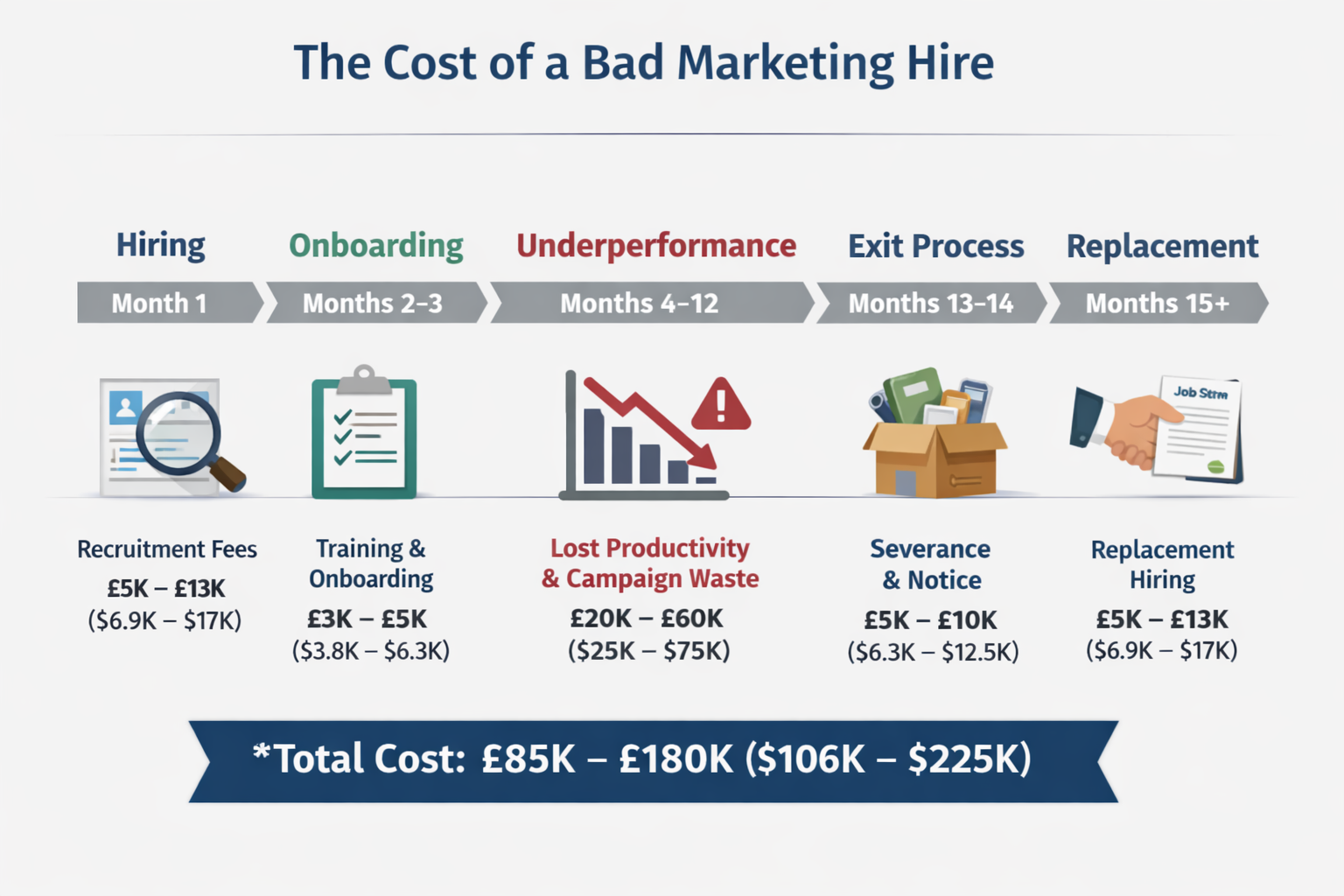
Recruitment costs alone typically run 10–30% of annual salary, depending on whether you use internal resources, job boards, or specialist recruiters. If the first hire fails, you'll pay these costs twice within 18 months.
These figures assume a relatively quick recognition and exit. Many companies wait 15–18 months before acting, adding another 6–9 months of unproductive salary to the bill.
Hidden costs that multiply the real damage
The indirect costs of a poor marketing hire often exceed direct expenses by 2–3x, encompassing lost productivity, damaged campaigns, and team morale decline.
A single underperforming marketer can derail £35,000–£110,000 ($43,750–$137,500) in campaign budgets, delay product launches by 3–6 months, and cause high-performers to disengage or leave.
The hidden costs compound in ways that rarely appear on financial reports:
Wasted campaign spend and failed initiatives
Poor targeting, weak creative, or technical mistakes mean your advertising budget delivers minimal returns. A marketer who doesn't understand proper attribution or testing burns through £3,000–£8,000 ($3,750–$10,000) monthly with nothing to show for it.
Missed revenue opportunities
That product launch that should have happened in Q2 gets pushed to Q4 because your marketing hire couldn't execute. Lost first-mover advantage and delayed market entry can cost 20–40% of potential first-year revenue for that product line.
Management time diverted from growth activities
Your marketing director or you (the founder) spend 10–15 hours weekly managing, correcting, or redoing work. At a £100,000 ($125,000) annual salary, that's £12,000–£18,000 ($15,000–$22,500) of leadership time lost per year.
Team productivity drain and morale damage
High-performers compensate for the weak link, working longer hours and feeling resentful. Within 6–8 months, you risk losing your best people, with replacement costs of 1.5–2× their salaries.
If campaign ROI starts dropping and your sales team disengages from marketing meetings, it may not be a campaign problem; it could be a personnel issue.
Technical debt and process breakage
Poorly configured marketing automation, incorrectly structured campaigns, and broken tracking create problems that persist long after termination. Fixing these issues takes specialist time and often external consultancy.
Brand and reputation damage
A mis-hire sends out an email campaign with broken links to 50,000 contacts. Or they post content that misrepresents your product capabilities, creating customer service escalations. Or they mismanage a crisis response on social media, amplifying rather than containing damage. Customer-facing mistakes, inconsistent messaging, and poor-quality campaigns damage relationships that took years to build. This cost is difficult to quantify but very real.
How poor marketing hires impact different company sizes
A bad marketing hire costs small businesses (under 50 employees) disproportionately more, representing 15–25% of annual marketing budget versus 5–8% for enterprises.
Startups and scale-ups face existential risks when a mis-hire controls their entire marketing function or go-to-market strategy during critical growth phases.
| Company Size | Annual Marketing Budget | Bad Hire Cost | % of Budget | Recovery Time | Business Impact |
|---|---|---|---|---|---|
| Startup (1–20) | £50,000–£200,000 ($62,500–$250,000) | £80,000–£150,000 ($100,000–$187,500) | 20–25% | 12–18 months | Threatens runway and growth targets |
| Small (21–100) | £200,000–£800,000 ($250,000–$1,000,000) | £100,000–£200,000 ($125,000–$250,000) | 15–20% | 9–15 months | Delays market positioning and revenue goals |
| Mid-Market (101–500) | £800,000–£3,000,000 ($1,000,000–$3,750,000) | £120,000–£250,000 ($150,000–$312,500) | 8–12% | 6–12 months | Slows specific initiatives and team morale |
| Enterprise (500+) | £3,000,000+ ($3,750,000+) | £150,000–£300,000 ($187,500–$375,000) | 5–8% | 6–9 months | Contained to specific team or function |
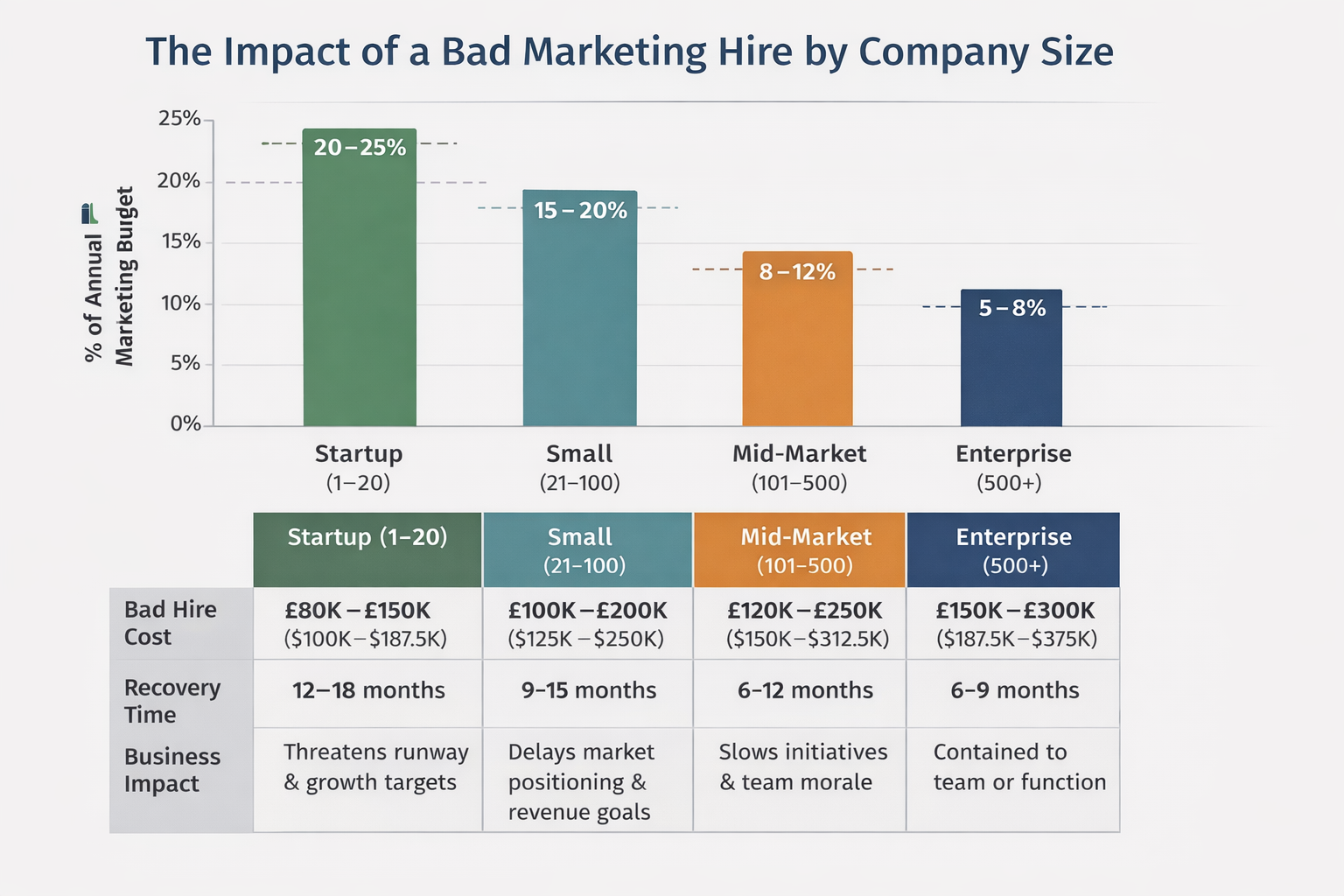
For startups, a single bad marketing hire can consume your remaining runway. If you have 18 months of cash and spend 6 months with the wrong person plus another 6 months finding and onboarding their replacement, you've used two-thirds of your time without meaningful progress.
Most small businesses can't absorb a single bad hire without delay or disruption. Your sales team has no marketing support, your product launch gets delayed, and competitors gain ground while you're stuck in hiring mode again.
Mid-market and enterprise companies have more resilience but still face significant damage. The opportunity cost of delayed initiatives, damaged team dynamics, and lost strategic momentum affects performance for quarters after the person leaves.
What problems does a bad marketing hire create beyond money?
Beyond financial losses, poor marketing hires create cascading operational problems including broken processes, damaged vendor relationships, and institutional knowledge gaps that persist long after termination.
Teams often spend 6–12 months recovering from strategic missteps, rebuilding campaign infrastructure, and repairing relationships with sales, product, and external partners.
If your sales team has stopped collaborating with marketing or your CRM data has become unreliable, you may be dealing with strategic debt from a mis-hire.
The non-financial damage includes:
- Strategic misalignment that takes quarters to correct. Wrong positioning, confused messaging, or misguided channel strategies require systematic unwinding and rebuilding.
- Damaged cross-functional relationships. Sales stops trusting marketing. Product teams become reluctant to collaborate. Rebuilding this trust takes 6–9 months of consistent delivery from the replacement hire.
- Technical debt in your marketing technology stack. Poorly configured CRM integrations, broken automation workflows, and incorrect data structures require specialist cleanup costing £5,000–£15,000 ($6,250–$18,750).
- Lost institutional knowledge. The failed hire took information with them and didn't document processes. Your replacement starts from scratch rather than building on foundations.
- Team burnout from covering gaps. Your remaining marketers work excessive hours, delay personal development, and lose faith in leadership's hiring decisions.
- Customer and prospect confusion from inconsistent messaging. Mixed brand messages, contradictory positioning, and tactical chaos damage the trust you've worked years to build.
These operational scars last longer than the financial hit. Even after hiring the right replacement, you're recovering from strategic mistakes and rebuilding credibility internally and externally.
Symptoms your team is still recovering from a poor hire
- Marketing and sales meetings feel tense or unproductive
- Campaign performance data is incomplete or unreliable
- Veteran team members seem disengaged or quietly job-hunting
- External partners (agencies, vendors) ask cautious questions about direction
- Customer-facing teams report confusion about messaging or positioning
How to calculate the total cost of a marketing mis-hire for your business
To calculate your true exposure, multiply the role's annual salary by 3–4x for senior positions and 2–3x for individual contributors, then add lost opportunity costs specific to your growth stage.
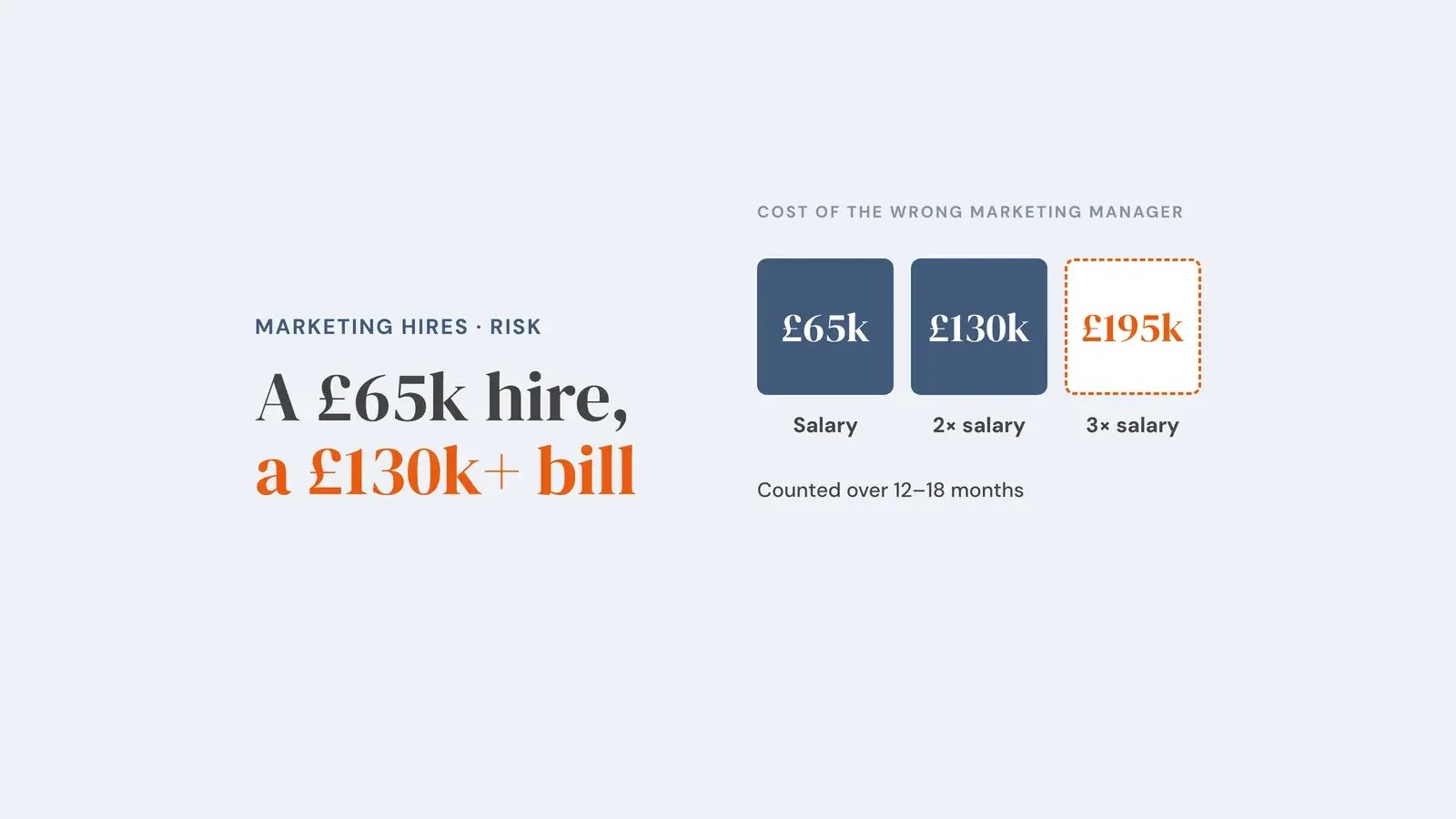
A £65,000 ($81,250) marketing manager mis-hire typically costs £130,000–£195,000 ($162,500–$243,750) when including all direct, indirect, and opportunity costs over a 12–18 month cycle.
Follow these steps to estimate your specific risk:
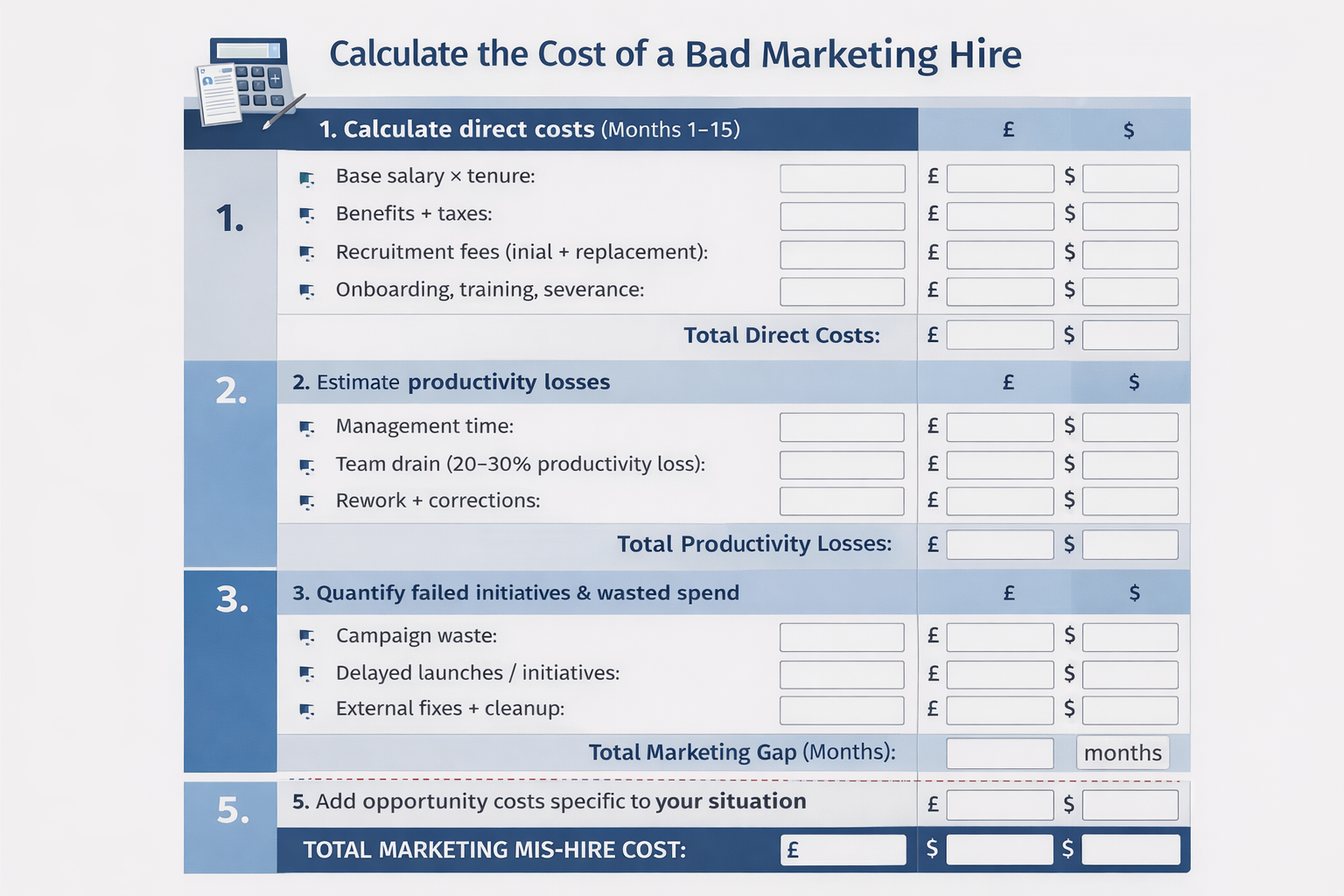
1. Calculate direct costs (Months 1–15)
- Base salary x tenure (usually 12–15 months)
- Benefits and employer taxes (20–30% of salary)
- Recruitment fees (10–30% of salary for initial + replacement hire)
- Onboarding and training costs (£3,000–£8,000 / $3,750–$10,000)
- Severance if applicable (0–6 months salary)
2. Estimate productivity losses
- Management time diverted (10–15 hours weekly × manager's hourly rate × months)
- Team productivity drain (20–30% reduction across 2–3 people for 6–9 months)
- Rework and corrections (£500–£2,000 / $625–$2,500 monthly)
3. Quantify failed initiatives and wasted spend
- Campaign budgets with poor/no returns (average monthly spend × months of tenure)
- Delayed launches or initiatives (estimated revenue impact of 3–6 month delay)
- External fixes needed (technical cleanup, process rebuilding: £5,000–£15,000 / $6,250–$18,750)
4. Factor in replacement timeline
- Time to recognise problem and decide to act: 3–6 months
- Notice period or exit process: 1–3 months
- Time to hire replacement: 2–4 months
- Replacement onboarding to full productivity: 3–6 months
- Total gap in effective marketing capability: 9–19 months
5. Add opportunity costs specific to your situation
- For startups: Percentage of runway consumed, missed funding milestones
- For growth companies: Market share lost to competitors, delayed expansion
- For established businesses: Customer acquisition cost increase, deal pipeline impact
Example calculation for £65,000 ($81,250) Marketing Manager:
- Direct costs: £85,000–£110,000 ($106,250–$137,500)
- Productivity losses: £20,000–£30,000 ($25,000–$37,500)
- Campaign waste and delays: £25,000–£55,000 ($31,250–$68,750)
- Total: £130,000–£195,000 ($162,500–$243,750)
- Multiplier: 2.0–3.0× base salary
This framework helps you confirm whether your risk falls in that £130,000–£195,000 ($162,500–$243,750) range, or significantly higher depending on your company size, campaign budgets, and opportunity costs.
Red flags that predict a poor marketing hire
The most reliable predictors of marketing hiring failure appear during the interview process: inability to discuss specific metrics from past campaigns, lack of hands-on experience with claimed tools, and misalignment between their expertise and your actual needs.
Warning signs in the first 90 days include resistance to feedback, inability to prioritise without excessive direction, and consistent missed deadlines despite adequate resources.
During the hiring process (before you offer):
- Vague answers about past performance. They talk about "helping with" campaigns but can't cite specific metrics, conversion rates, or attribution data they personally influenced.
- Tool name-dropping without depth. They list HubSpot, Google Analytics, and marketing automation on their CV but can't walk through how they'd solve a specific problem using those platforms.
- No portfolio or work samples. For roles requiring content, design, or campaign work, they have excuses for why they can't share anything from previous positions.
- Inability to explain strategy-to-execution flow. They discuss high-level concepts but become unclear when asked how they'd implement them in your specific context.
- Poor cultural signals. They speak negatively about previous teams, blame others for failed projects, or show rigidity about "how things should be done."
- Mismatched ambitions. They're interviewing for a hands-on role but only want to discuss strategy, or vice versa.
- Reference check inconsistencies. Former managers give lukewarm feedback or can't provide concrete examples of strong performance.
- They insist on rewriting the job description during the interview. Rather than clarifying understanding, they're trying to reshape the role to match what they want to do.
- They refuse to take a paid test task. Strong candidates welcome the opportunity to demonstrate their skills. Those who resist often lack confidence in their abilities.
Warning signs in the first 90 days (after they've started):
- Excessive direction needs. They struggle to prioritise or move forward without detailed instructions on every task.
- Resistance to feedback. They become defensive when receiving constructive input or repeat mistakes after correction.
- Consistent deadline misses. Projects take significantly longer than discussed, without proactive communication about delays.
- Quality gaps. Work requires extensive revision or doesn't meet basic standards you'd expect for their claimed experience level.
- Poor stakeholder relationships. Sales, product, or other teams avoid working with them or escalate concerns to you.
- If you spot three or more of these first-90-days signals, address them immediately. Early intervention costs less than waiting for performance reviews. The longer you wait, the more you signal that poor performance is acceptable.
8 proven hiring practices to prevent marketing mis-hires
Companies that reduce bad marketing hires by 60–80% implement structured hiring processes including skills-based assessments, paid trial projects, and multi-stakeholder interviews focused on role-specific competencies.
The most effective approach combines a detailed scorecard aligned to your first-year success metrics, a 2–4 hour working session simulating real job challenges, and thorough reference checks asking specific performance questions.
Most businesses still rely on interviews and CVs alone—and that's where 70% of hiring mistakes begin. Interviews reveal how candidates present themselves under optimal conditions. Skills assessments reveal how they actually work.
Here are proven practices that dramatically improve hiring outcomes:
1. Define success metrics before writing the job description
List 3–5 specific outcomes you need this person to achieve in their first 12 months. Write your job spec around these outcomes rather than generic responsibilities.
2. Use skills-based assessments for every finalist
For content roles, assign a brief or blog post. For campaign managers, ask them to audit one of your existing campaigns and present improvements. Pay them £200–£500 ($250–$625) for 3–4 hours of work.
3. Implement structured scorecards for all interviewers
Create 8–12 criteria rated 1–5, tied directly to your success metrics. Require interviewers to provide evidence for each score, not just gut feel.
4. Conduct working sessions, not just interviews
Spend 2–3 hours working through a real problem together. You'll learn more about their thinking, collaboration style, and execution capability than from any interview question.
5. Ask reference checks the right questions
Instead of "Would you rehire them?", ask "What percentage of their projects met deadlines without manager intervention?" and "How much direction did they need compared to others at their level?"
6. Involve the people they'll work with most closely
If they'll support sales, have your sales director interview them. If they'll manage vendors, test their vendor management thinking.
7. Trial periods with clear checkpoints
Structure the first 90 days with specific deliverables and review gates at 30, 60, and 90 days. Make continuation contingent on meeting these checkpoints.
8. Be willing to walk away
If your top candidate shows red flags, restart the search. The cost of a longer hiring process is far less than the cost of a bad hire.
I work with businesses to build hiring frameworks that identify the right marketing talent first time. The process I teach includes scorecard templates, interview question banks, and assessment projects tailored to your specific needs.
Should you invest in recruiting help or hire marketing in-house?
Specialised marketing recruiters cost 15–25% of first-year salary but reduce mis-hire rates by 40–50% compared to general job boards or internal HR teams without marketing expertise.
The breakeven calculation is straightforward: if a recruiter charging £13,000 ($16,250) prevents one £150,000+ ($187,500+) mis-hire over three placements, they've saved your company £124,000 ($155,000) in net costs.
| Approach | Cost | Timeline | Mis-Hire Rate | Best For |
|---|---|---|---|---|
| Job boards + internal HR | £500–£2,000 ($625–$2,500) | 8–16 weeks | 35–45% | Large companies with experienced HR and clear role requirements |
| General recruiters | 12–20% of salary (£7,000–£13,000 / $8,750–$16,250) | 6–12 weeks | 25–35% | Standard roles in competitive markets with good internal interviewing capability |
| Specialised marketing recruiters | 15–25% of salary (£9,000–£16,000 / $11,250–$20,000) | 4–10 weeks | 12–18% | Complex marketing roles, niche skills, or when you lack internal marketing expertise |
| Fractional/contract first | £400–£800 ($500–$1,000) per day, 2–3 days weekly | Immediate start | 8–12% (conversion to permanent) | Testing fit before commitment, interim needs, or building capability before hiring |
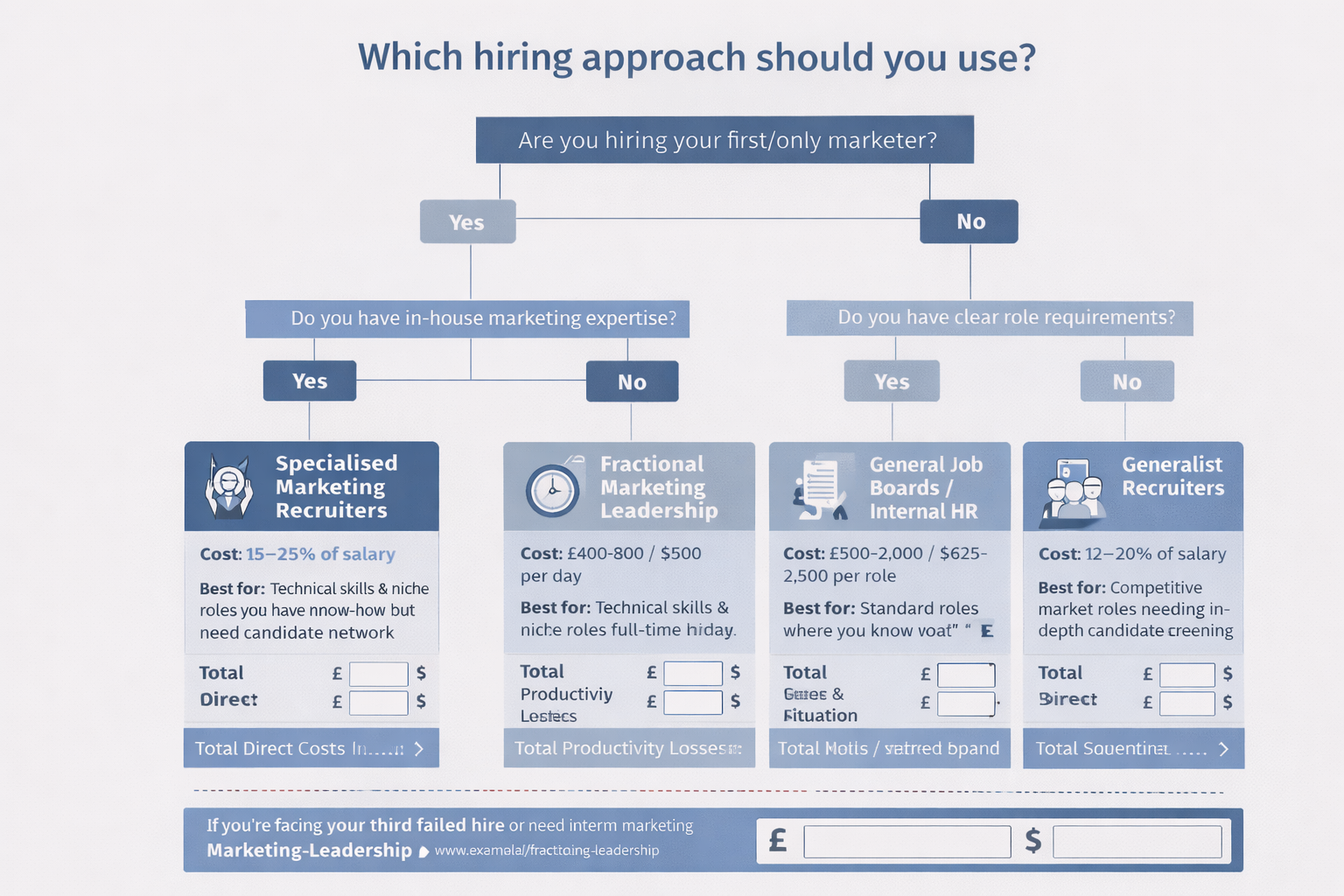
General job boards work when you have experienced marketing leadership internally who can assess candidates and know exactly what "good" looks like for your needs. If you're hiring your first marketing person or your only marketer, this approach has the highest failure rate.
Specialist marketing recruiters bring sector knowledge and candidate networks you can't access through LinkedIn posts. They pre-qualify candidates on technical skills, reducing your time investment. The fee feels steep but pays for itself if it prevents one bad hire.
The fractional or contract-to-hire approach lets you test before committing. You work together for 3–6 months, see their actual output, and convert to permanent only if it's clearly working. This reduces mis-hire risk by 70–80% but requires flexibility in how you structure the role.
When fractional marketing leadership makes more sense than hiring
If you're facing your third failed hire or still don't know exactly who you need, my Company Alignment Workshop gives you the clarity to get it right this time. We define the specific outcomes you need, build the hiring criteria around those outcomes, and create assessment tools that reveal actual capability.
My done-with-you marketing leadership service provides an alternative to hiring when you need strategic direction without full-time headcount. You get senior marketing expertise and execution oversight without the hiring risk.
Frequently asked questions about marketing hiring costs
These are the most common questions companies ask when evaluating the financial and operational risks of marketing hiring decisions. Each answer provides specific benchmarks to inform your hiring budget and process design.
How long does it typically take to recognise a bad marketing hire?
Most companies take 4–7 months to recognise a hiring mistake and another 2–4 months to act on it. The clearer your success metrics and 90-day checkpoints, the faster you'll identify problems. Best-practice companies know within 60–90 days through structured performance reviews tied to specific deliverables.
Can you recover some costs if you act quickly?
Yes. Exiting within the first 6 months typically costs 40–60% less than waiting 12–15 months. You save 6–9 months of unproductive salary, reduce wasted campaign spend, and limit team morale damage.
Fast action also preserves your market opportunity by letting you restart the search sooner. Many employment contracts include probation periods (usually 3–6 months) with reduced notice requirements, lowering severance costs.
What's the average tenure of a mis-hired marketer?
Poor marketing hires typically last 11–15 months from start date to last day. This includes 4–7 months of growing concerns, 2–3 months of performance management, 1–2 months notice period, and sometimes extended garden leave. The longer tenure isn't because they improve; it's because companies delay difficult decisions.
Are contract-to-hire arrangements worth the extra cost?
Usually yes, despite costing 15–25% more than direct hiring. Contract-to-hire reduces mis-hire risk by 70–80% and lets you assess real performance over 3–6 months before committing to permanent employment. For senior roles (£70,000+ / $87,500+), the risk reduction justifies the premium. For junior roles, standard hiring with strong 90-day checkpoints may be more cost-effective.
How much should I budget for replacing a failed marketing hire?
Budget the same recruitment costs again (10–30% of salary) plus any interim coverage needed. If using specialist recruiters, expect £9,000–£20,000 ($11,250–$25,000) for mid-to-senior roles.
Also factor in 2–4 months without effective marketing coverage while you search, which compounds the opportunity cost. Consider interim or fractional support to maintain momentum during the replacement search.
Conclusion
You now understand how much poor hires cost—and how preventable they are. A bad marketing hire costs £130,000–£195,000 ($162,500–$243,750) for a mid-level role—and significantly more in lost opportunities, damaged relationships, and strategic delays.
Too many companies waste 12–18 months on a single hiring mistake, burning cash and momentum while competitors advance.
The companies that avoid these costly mistakes don't rely on instinct. They use scorecards, working sessions, and trial projects. They involve the right stakeholders and walk away from candidates with red flags, even when they're desperate to fill the role.
Use the cost calculator in this article to understand your specific exposure. Define your hiring success metrics before writing job descriptions. Build checkpoints at 30, 60, and 90 days with clear deliverables.
If you need a structured path to hiring right the first time, I can help.
How to take action now
- Define 3–5 specific outcomes you need your next marketing hire to achieve in their first 12 months before writing the job description
- Create an interview scorecard with 8–12 criteria tied to these outcomes, rated 1–5 with space for evidence
- Design a paid skills assessment (2–4 hours, £200–£500 / $250–$625) that simulates a real challenge they'll face in the role
- Structure 30-day, 60-day, and 90-day checkpoints with specific deliverables and clear go/no-go decisions
- Calculate your specific mis-hire exposure using the framework in this article to justify investment in better hiring practices
Before your next marketing hire, read about building marketing capability without hiring risk.
If you're concerned about making the wrong marketing hire, or recovering from one, I can help. My Company Alignment Workshop gets your leadership team clear on exactly what marketing capabilities you need and how to structure your hiring process to find them.
About the Author
Tom Wardman helps businesses build trust-driven marketing systems that generate predictable revenue growth without agency dependency. With experience both in-house and within agencies, he understands what actually works versus what sounds good in theory. He has helped companies across professional services, B2B, manufacturing, and healthcare build internal marketing capabilities that drive measurable results. He's the author of Build a Trusted Brand and a certified marketing coach who works with businesses doing £1–£50 million in annual revenue.
Pricing Disclaimer: All GBP–USD price conversions are rounded estimates and correct at the time of publishing. Exchange rates fluctuate and figures should be treated as indicative only.