
Does your agency feel genuinely invested in your business growth, or does something feel slightly off when budget conversations come around? Have you ever noticed that the recommendation is almost always to spend more, rather than to first optimise what is already running?
The structure behind that instinct is worth understanding. In this article, you will learn exactly how the most common agency compensation models create structural conflicts of interest, and what you can do about it: how retainers, commissions, and hourly billing each create an incentive gap; how to identify the warning signs in your current agency relationship; and the steps that will move you toward a better-aligned arrangement.
Key Takeaways
- The agency incentive problem is structural, not ethical. Most agencies are paid in ways that reward retention and spend, not client results.
- Retainer models reward relationship continuity, media commission rewards higher spend, and hourly billing rewards more hours; none of these directly incentivise your outcomes.
- The clearest warning sign of incentive misalignment is when your agency recommends increasing budget before optimising what is already being spent.
- Multiple industry studies document significant overpayment in commission-based media arrangements, the ISBA/PwC Programmatic Supply Chain Transparency Study (2020) found 15% of UK programmatic spend entirely unattributable.
- Fixing this starts with auditing your agency's fee structure, then renegotiating toward outcome-linked pay with independent measurement.
What is the agency incentive problem?
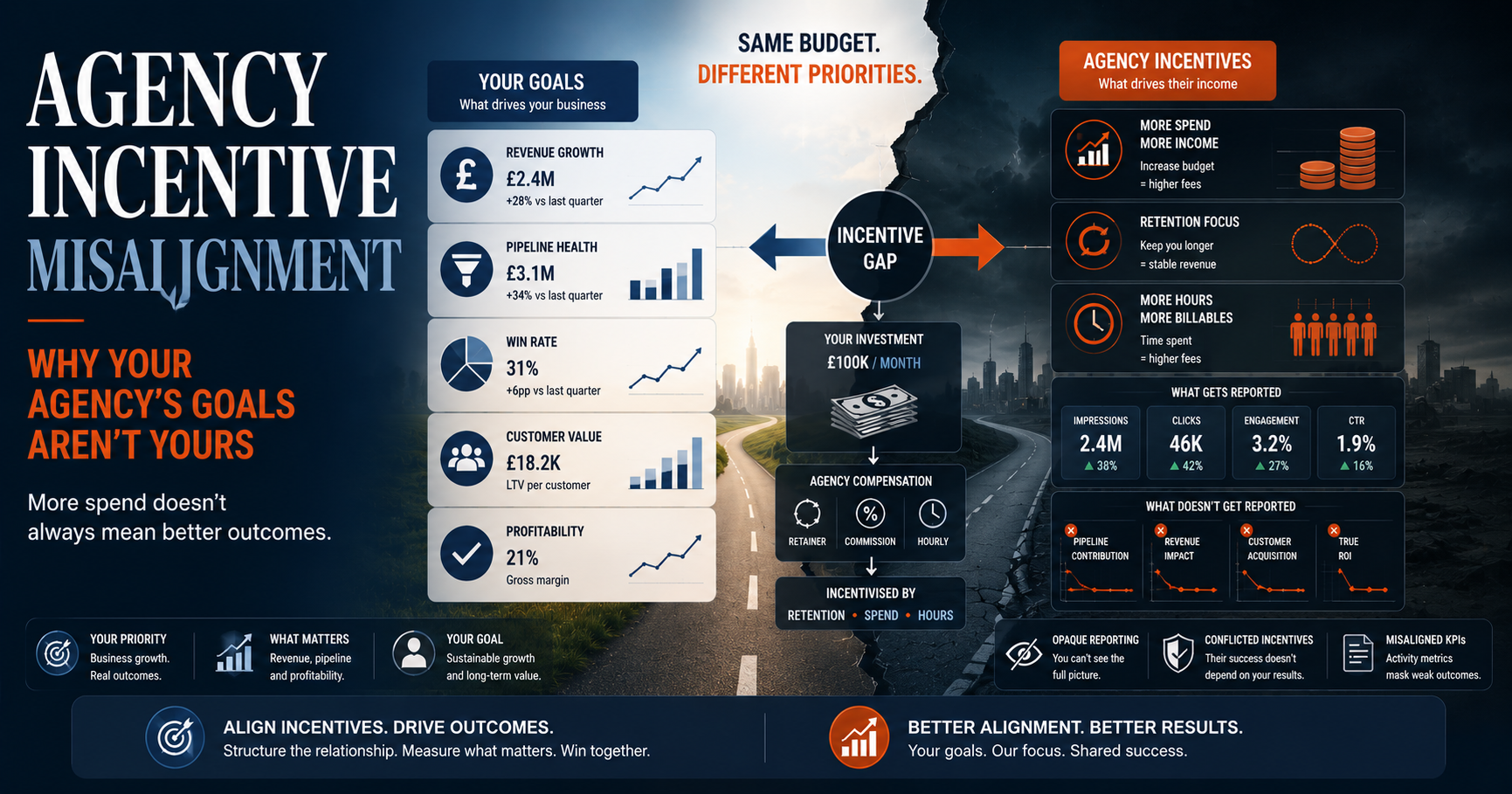
The agency incentive problem is the structural misalignment between how most marketing agencies are compensated and what actually drives results for their clients.
This is not primarily a question of agency ethics. Most agency teams are well-intentioned. The problem is a design flaw built into the most common compensation models, each of which can reward agency behaviour that does not directly benefit you.
What is agency incentive misalignment? Your agency earns more by doing things that may not help your business, such as growing your media spend, sustaining a long retainer, or logging more billable hours.
How agency compensation models create conflicts of interest
The three most common agency payment structures, such as retainers, media commissions, and hourly billing, each contain built-in incentives that can conflict with what clients actually need.
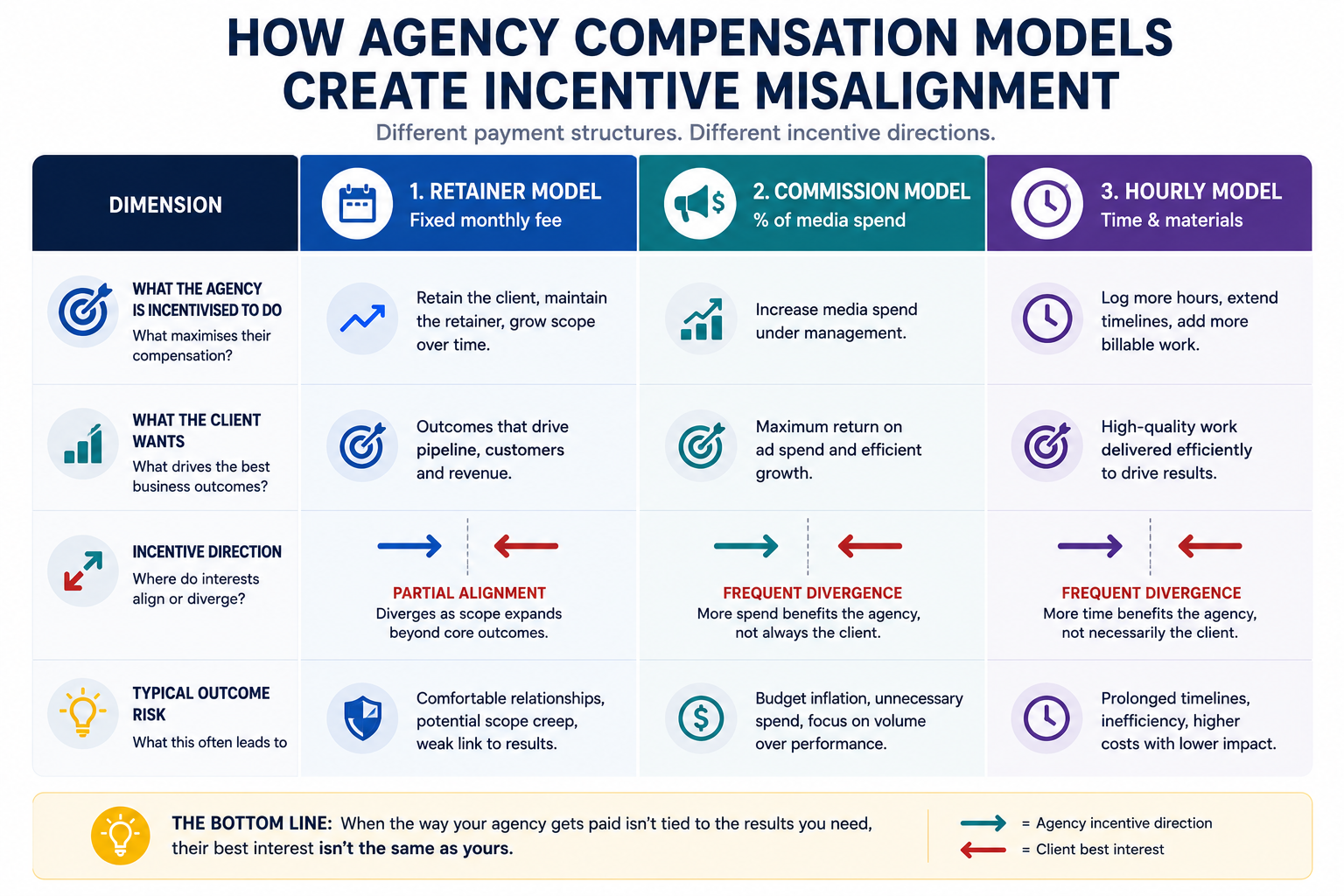
Commission-based media buying deserves particular scrutiny. If an agency earns 15% of your media spend, a recommendation to increase your monthly budget from £10,000 ($12,500) to £20,000 ($25,000) doubles their income, regardless of whether it doubles your results. This does not mean every such recommendation is wrong. It means the financial incentive to make it exists independent of your outcomes, and that is worth understanding before the next budget conversation.
Warning signs your agency's incentives don't match yours
The clearest warning sign of agency incentive misalignment is when your agency recommends increasing budget before optimising what is already being spent.
Other observable red flags include:
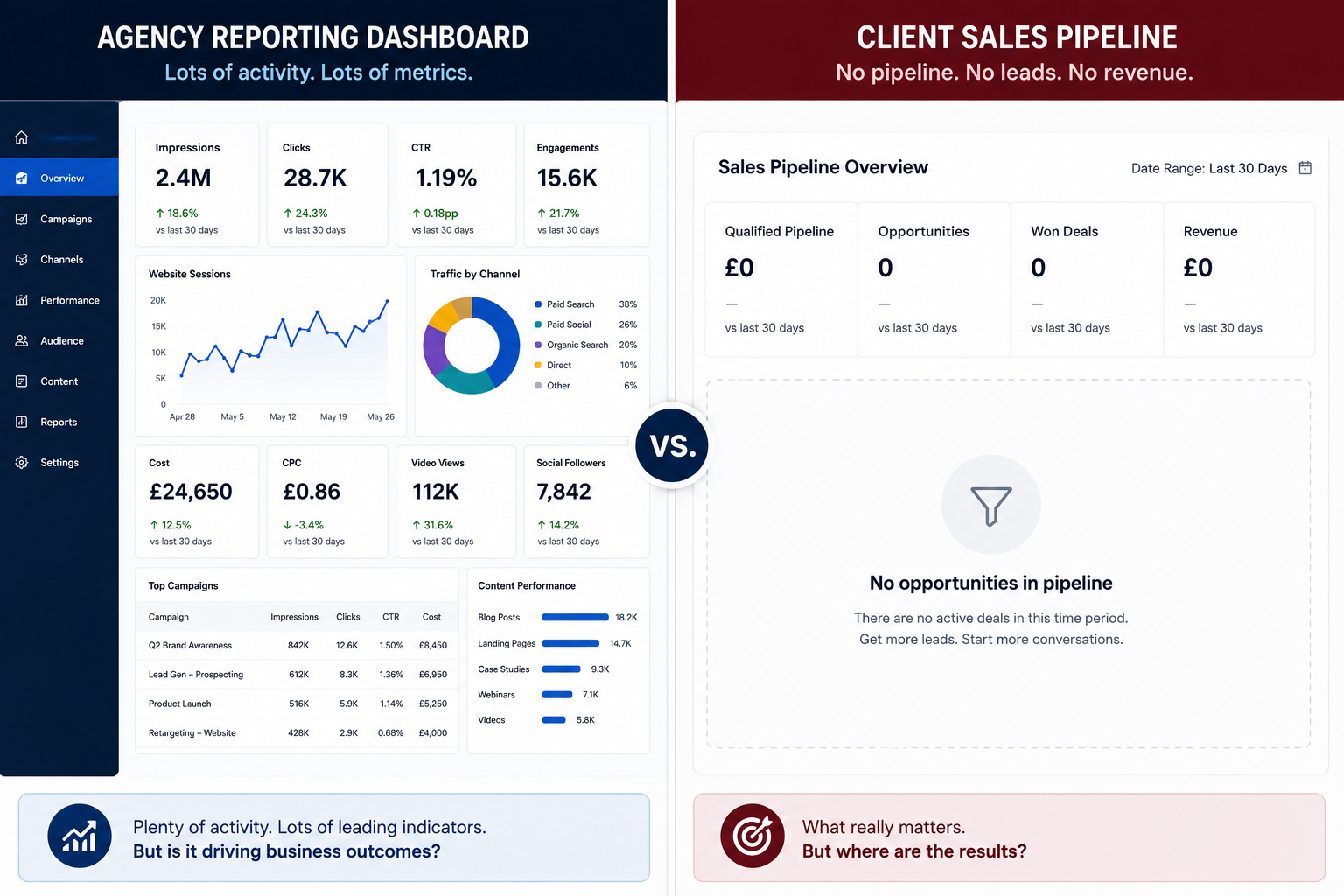
- Reporting focuses on impressions, reach, and engagement, not pipeline or revenue contribution
- Reporting tools are owned by the agency, not your business
- Resistance to third-party attribution or independent tracking
- Long notice periods or punitive exit clauses in your contract
- Media invoices that do not clearly reconcile against actual placements
- Every problem is presented as requiring more spend or more time
- Success metrics are defined by the agency, not agreed jointly with you
Individually, some of these may have reasonable explanations. In combination, they signal a structural problem, not a one-off oversight.
What does agency incentive misalignment actually cost?
Agency incentive misalignment costs businesses through inflated media spend, prolonged underperformance that goes unchallenged, and strategies chosen for agency convenience rather than client growth.
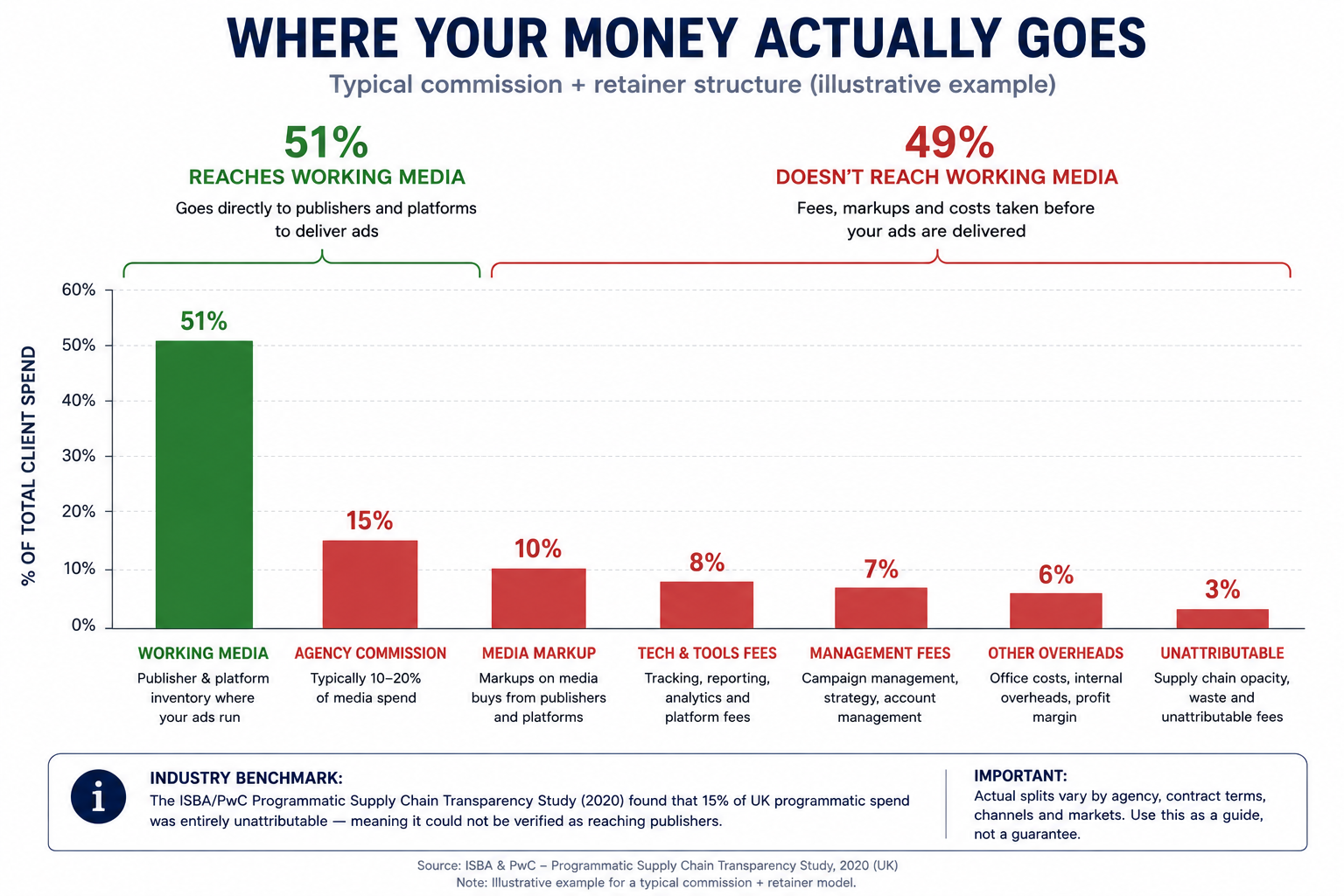
A 2020 study by ISBA and PwC found that only 51% of UK advertiser spend in programmatic media actually reached publishers, with 15% of the supply chain entirely unattributable (ISBA Programmatic Supply Chain Transparency Study, 2020).
Illustrative cost breakdown (figures are estimates only)
Actual splits vary by contract and agency model. Treat these as illustrative starting points.
Agency compensation models compared: Which structures align better?
Performance-based and outcome-linked models create the strongest alignment because the agency only earns more when the client measurably wins.
Pure performance models carry their own risks, including short-termism and a bias toward easily attributable channels. A hybrid structure is often the most practical starting point.
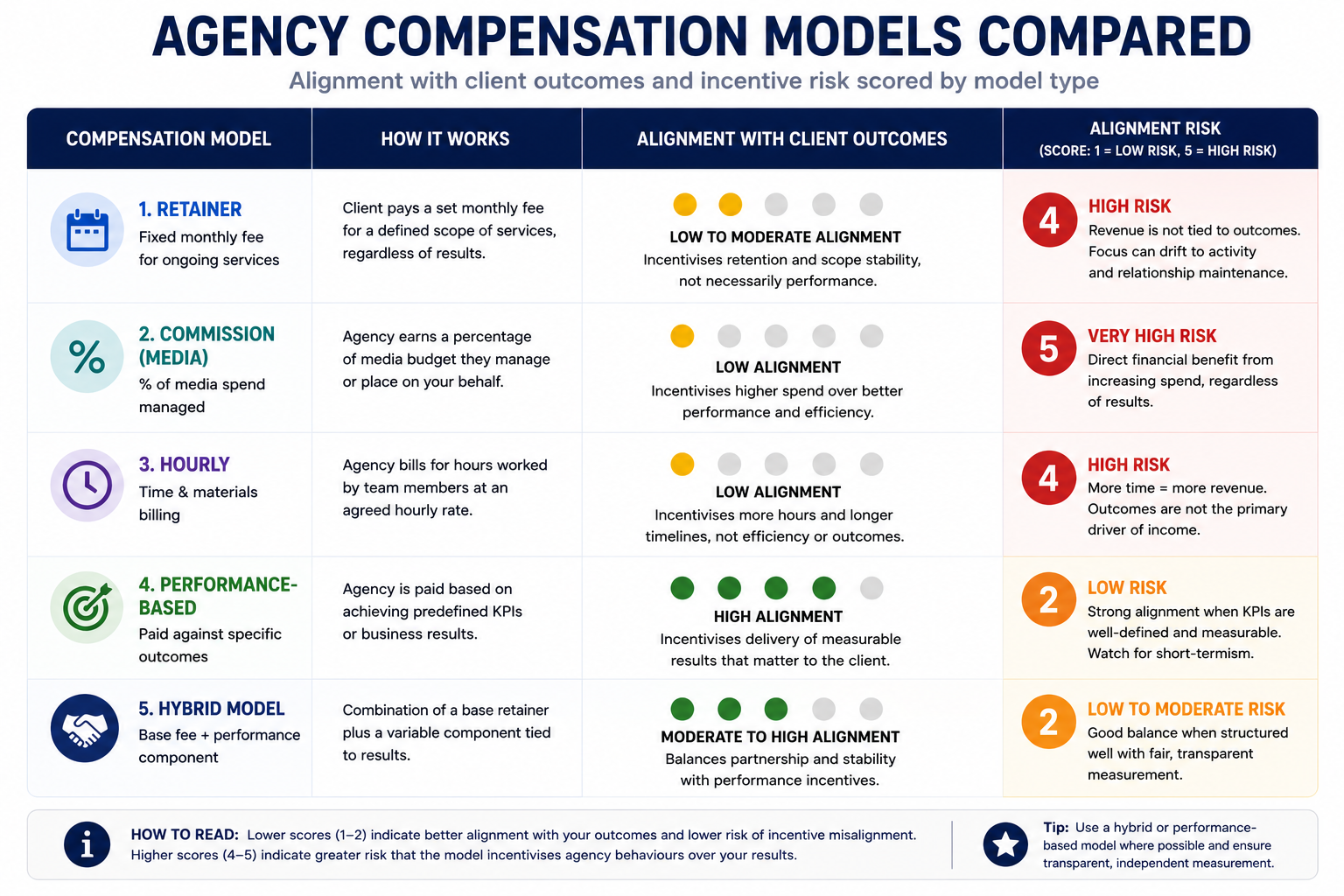
A hybrid model, being a modest base fee plus an outcome-linked component, is the structure most likely to produce consistent alignment without exposing either party to unreasonable risk.
How to fix the agency incentive problem: A step-by-step approach
Fixing agency incentive misalignment starts with auditing how your agency is compensated and mapping every fee structure to the behaviour it actually rewards.
- List every fee your agency charges: Retainer, commission, production markups, tool reselling, and any performance bonuses.
- Map each fee to the behaviour it incentivises: Ask: does this reward the agency for your outcomes, or for their activity?
- Request a full media reconciliation: A clear breakdown of gross spend, net spend, and what the agency earns from each placement.
- Propose outcome-linked pay: Start by tying 20–30% of the agency fee to KPIs your business defines and measures independently.
- Introduce independent measurement using analytics or attribution tools your team owns and controls, not a dashboard the agency manages.
- Reset your reporting to show pipeline and revenue contribution, not the activity metrics the agency self-reports.
- Renegotiate exit clauses so they are proportionate and do not penalise you for reducing scope when performance falls short.
Related article: Why Marketing Retainers Fail, and Why Outcome-Based Marketing Wins
How to choose an agency with genuinely aligned incentives
If you are currently evaluating agencies, or approaching a contract renewal, the following applies directly. The single most important criterion is whether an agency will tie a meaningful portion of their fee to outcomes you define, not metrics they control.
Use these five questions in any pitch or contract review:
- Will you accept a portion of your fee linked to agreed revenue or pipeline targets?
- Can we access a full media reconciliation showing exactly where spend goes?
- Are the reporting tools and platforms owned by us, or by you?
- Does your standard reporting show revenue contribution, or only activity metrics?
- Is your contract exit clause proportionate, or punitive if we reduce scope?
Agencies that answer these questions openly, rather than deflecting, are structurally safer choices regardless of their creative credentials.
Related article: How Digital Marketing Agencies Use Vanity Metrics to Hide Poor Performance
Frequently asked questions
Is the agency incentive problem illegal or just unethical?
In most cases, it is neither; it is a contractual design problem. Agencies are not obligated to align their incentives with yours unless the contract requires it. The issue is opacity, not fraud.
Do in-house teams solve the incentive problem?
Partially. In-house teams remove commission conflicts, but introduce different misalignments, including teams optimising for role preservation rather than business results. The structure still needs deliberate design. Recommend reading: In-House Growth Engine™
How do I know if my agency is marking up media costs?
Request a full media reconciliation showing gross spend, net spend, and agency earnings separately. If they cannot produce this clearly, that response is an answer in itself.
Should I always choose a performance-based agency?
Not necessarily. Pure performance models can push agencies toward tactics that are easy to track but not always most effective. A hybrid structure with independently verified metrics is usually the more reliable option.
Conclusion
If you have been operating with a quiet suspicion that your agency's goals and yours don't fully overlap, that instinct is worth acting on.
Most businesses reach this point not because something went obviously wrong, but because the design of most agency relationships makes it easy to assume alignment exists when it does not. You now have a clear picture of how retainers, commissions, and hourly billing create incentive gaps, and a practical framework for auditing and renegotiating toward a structure that actually serves your business.
How to take action now
- Audit your current agency contracts against the warning signs listed above
- Request full media reconciliation from any commission-based partner
- Propose a hybrid fee structure with at least one outcome-linked component
- Introduce independent tracking tools your business owns and controls
- Use the five criteria questions above in your next agency review or pitch
If your current setup feels opaque or misaligned, the 90-Minute Marketing Triage™ is a structured diagnostic session that identifies exactly where the structural gaps sit and what to address first.

About Tom Wardman
Tom Wardman is a fractional marketing consultant and Growth Independence Architect™ who helps founder-led B2B businesses replace agency dependency with self-sufficient growth systems they own and control. With experience on both the agency and in-house side, Tom designs marketing engines that clients can run without him, reducing external reliance over time rather than extending it. He is the author of Build a Trusted Brand and one of the UK's first five certified coaches in the Endless Customers™ methodology.
Pricing disclaimer: All GBP–USD price conversions are rounded estimates and correct at the time of publishing. Exchange rates fluctuate and figures should be treated as indicative only.
Topics: