

Key Takeaways
- A "strategy first" agency approach requires clients to purchase a standalone strategy engagement (30–90 days, £11,000–£56,000 / $13,750–$70,000 USD) before any execution begins. The hidden cost is 60–120 days of delayed execution and lost market opportunity, often totalling £37,000+ ($46,250+ USD) before any customer-facing work goes live.
- Strategy-first becomes a delay tactic when the agency refuses any implementation without it, can't explain what specific decisions it will inform, or when the strategist won't be involved in execution.
- Integrated strategy and execution models start with lightweight discovery (1–3 weeks) and refine strategy based on real campaign performance within 30–45 days.
- If you've already committed to a strategy-first engagement, immediately negotiate milestone-based deliverables with execution tied to each phase.
Are you being told your agency "needs" three months of strategy work before a single ad can launch? Are you wondering whether that's protecting your results, or padding their revenue?
In this article, you'll learn when strategy-first agency models are truly necessary, when they're red flags, and how to avoid wasting months and tens of thousands of dollars on unvalidated planning.
We'll walk through real costs, common warning signs, and what to ask (or renegotiate) if you've already signed.
What is a "strategy first" agency approach?
A "strategy first" agency approach is a service model where agencies require clients to purchase and complete a standalone strategy engagement, typically 30 to 90 days, before any implementation, content creation, or campaign execution begins.
This is usually sold as a separate deliverable, often ranging from £11,000 to £56,000 ($13,750 to $70,000 USD), resulting in strategic documents, buyer personas, messaging frameworks, or channel recommendations.
Typical strategy-first deliverables include:
- Market research and competitive analysis
- Buyer persona development
- Messaging and positioning frameworks
- Channel strategy and media planning recommendations
- Content strategy roadmaps
- Brand guidelines and voice documentation
The strategy phase is sold as a prerequisite to "getting it right," but buyers rarely see execution begin until months after signing the contract.
Why strategy-only phases cost more than you think
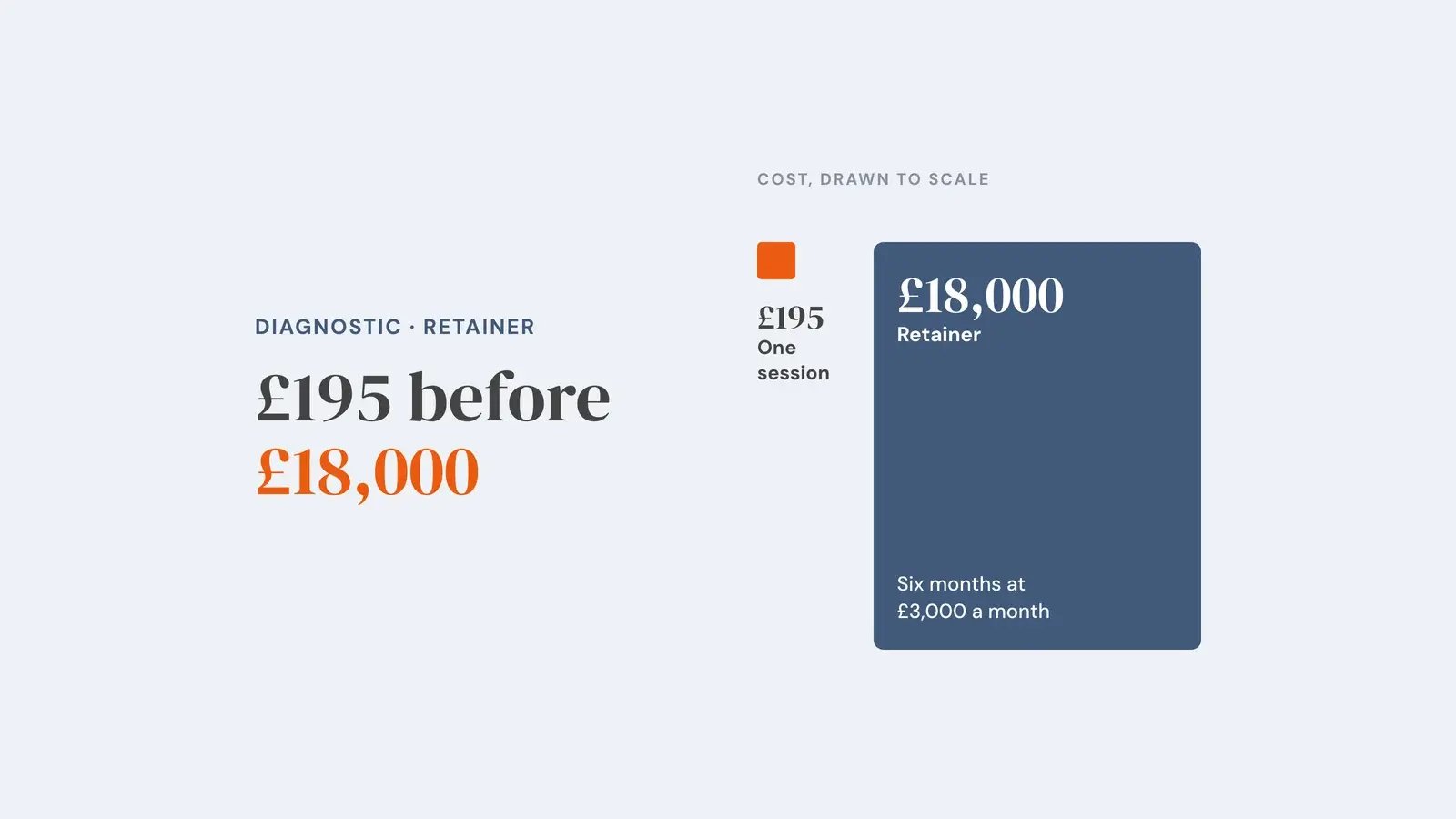
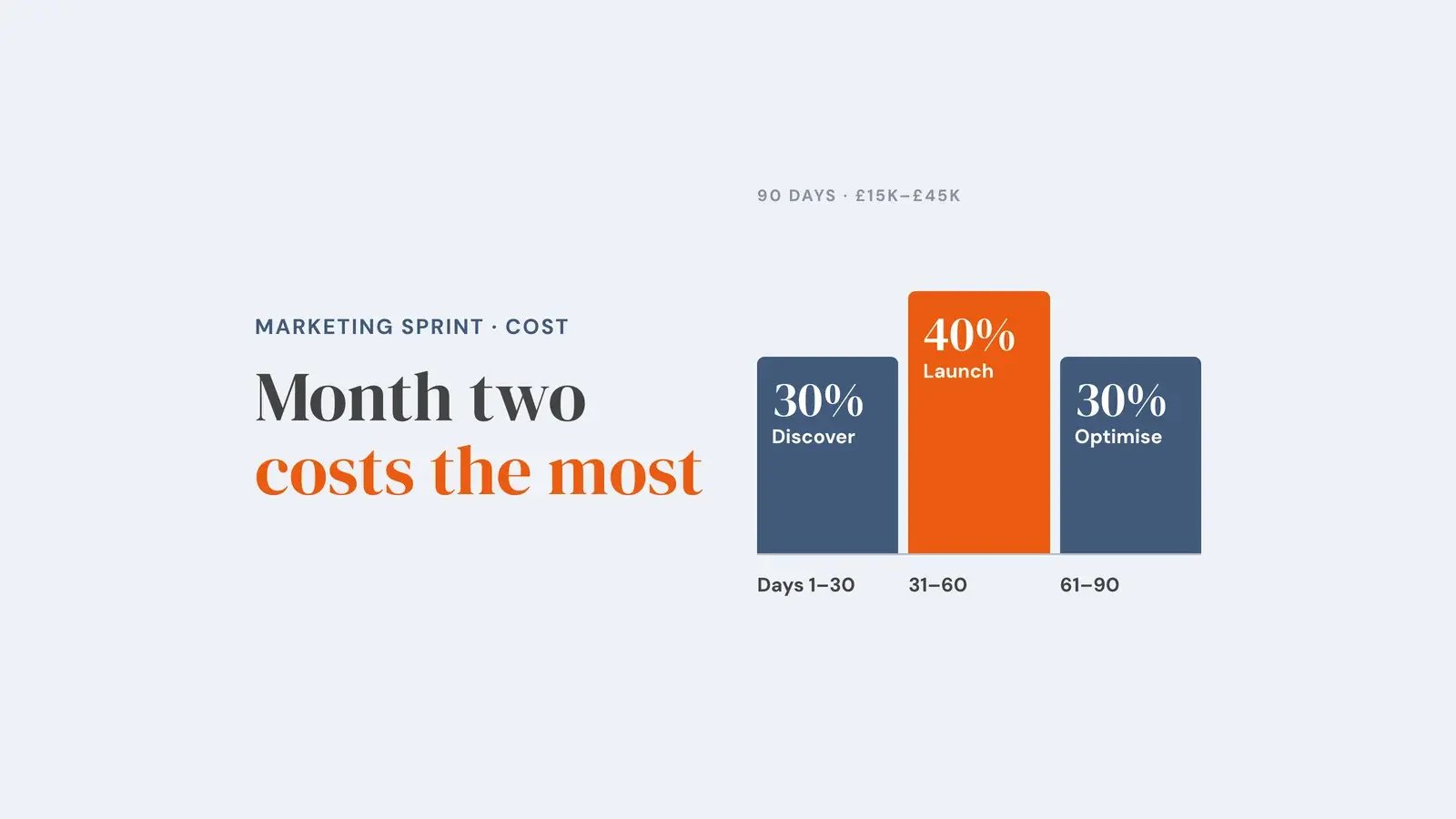
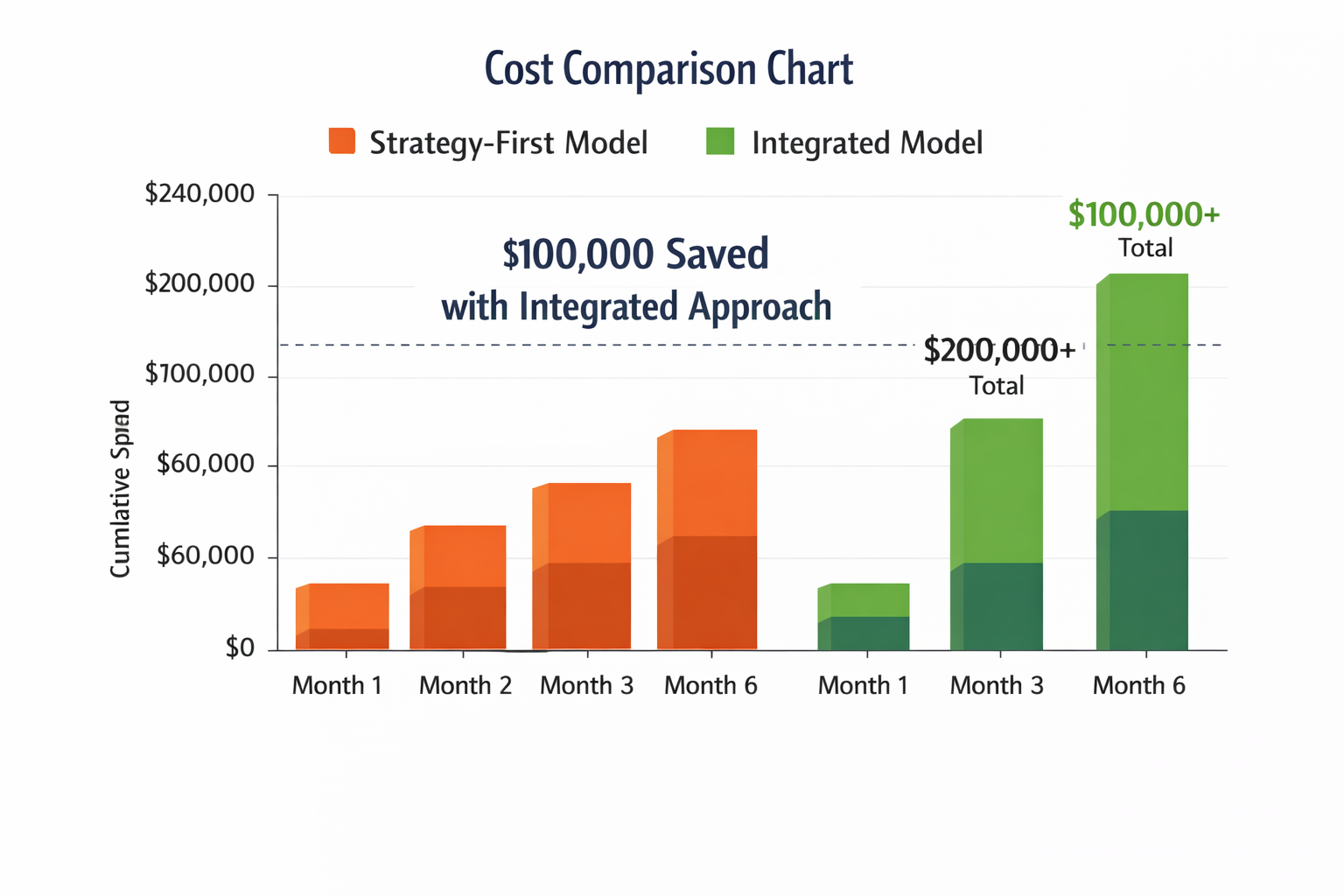
The upfront cost of a strategy-first engagement typically ranges from £11,000 to £56,000 ($13,750 to $70,000 USD) depending on agency size and scope, but the hidden cost is the 60 to 120 days of delayed execution and lost market opportunity.
When you add the retainer that follows (usually £6,000–£19,000 / $7,500–$23,750 USD per month), you're often spending £37,000+ ($46,250+ USD) before seeing any customer-facing work go live.
What you're paying for vs. what you're not getting
You're paying for research, workshops, documentation, and recommendations. What you're not getting is validation, testing, or results. The strategist builds frameworks based on assumptions, not market feedback.
The real cost: time to first result
| Cost Type | Strategy-First Model | Integrated Model |
|---|---|---|
| Strategy phase cost | £11,000–£56,000 ($13,750–$70,000 USD) | Included in onboarding (£0–£7,500 / $0–$9,375 USD) |
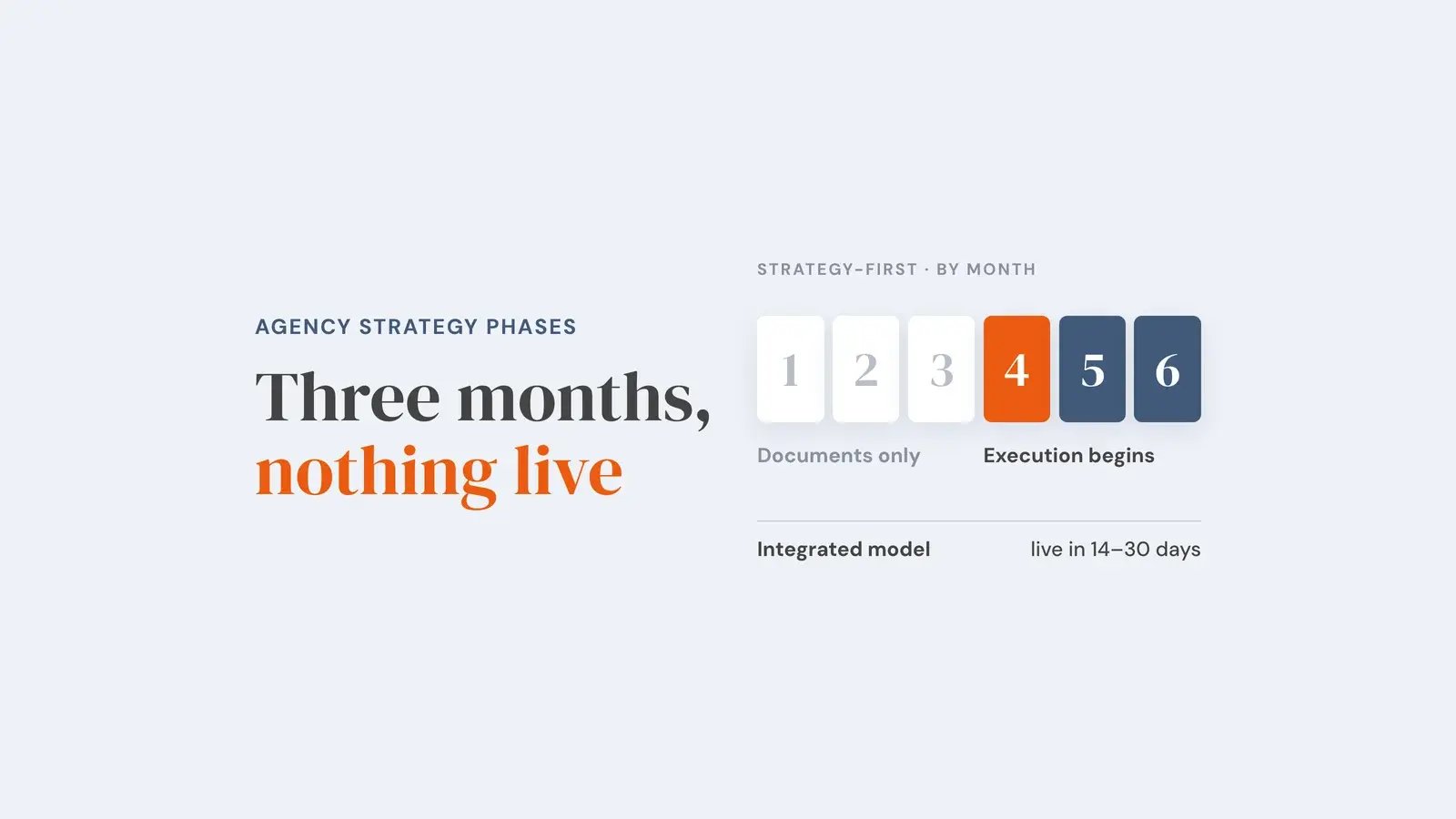
| Time to first campaign live | 60–120 days | 14–30 days |
| Monthly retainer (months 1–6) | £6,000–£19,000 ($7,500–$23,750 USD) | £6,000–£19,000 ($7,500–$23,750 USD) |
| Total spend before first result | £47,000–£170,000 ($58,750–$212,500 USD) | £24,000–£94,000 ($30,000–$117,500 USD) |
| Opportunity cost (lost revenue) | 3–4 months of potential leads | Minimal (campaigns live within weeks) |
Risks and warning signs of strategy-first models
The "strategy first" model creates three core problems: it delays measurable results by months, it separates the strategist from accountability for execution, and it often delivers documents that sit unused because they weren't built in the context of real campaigns.
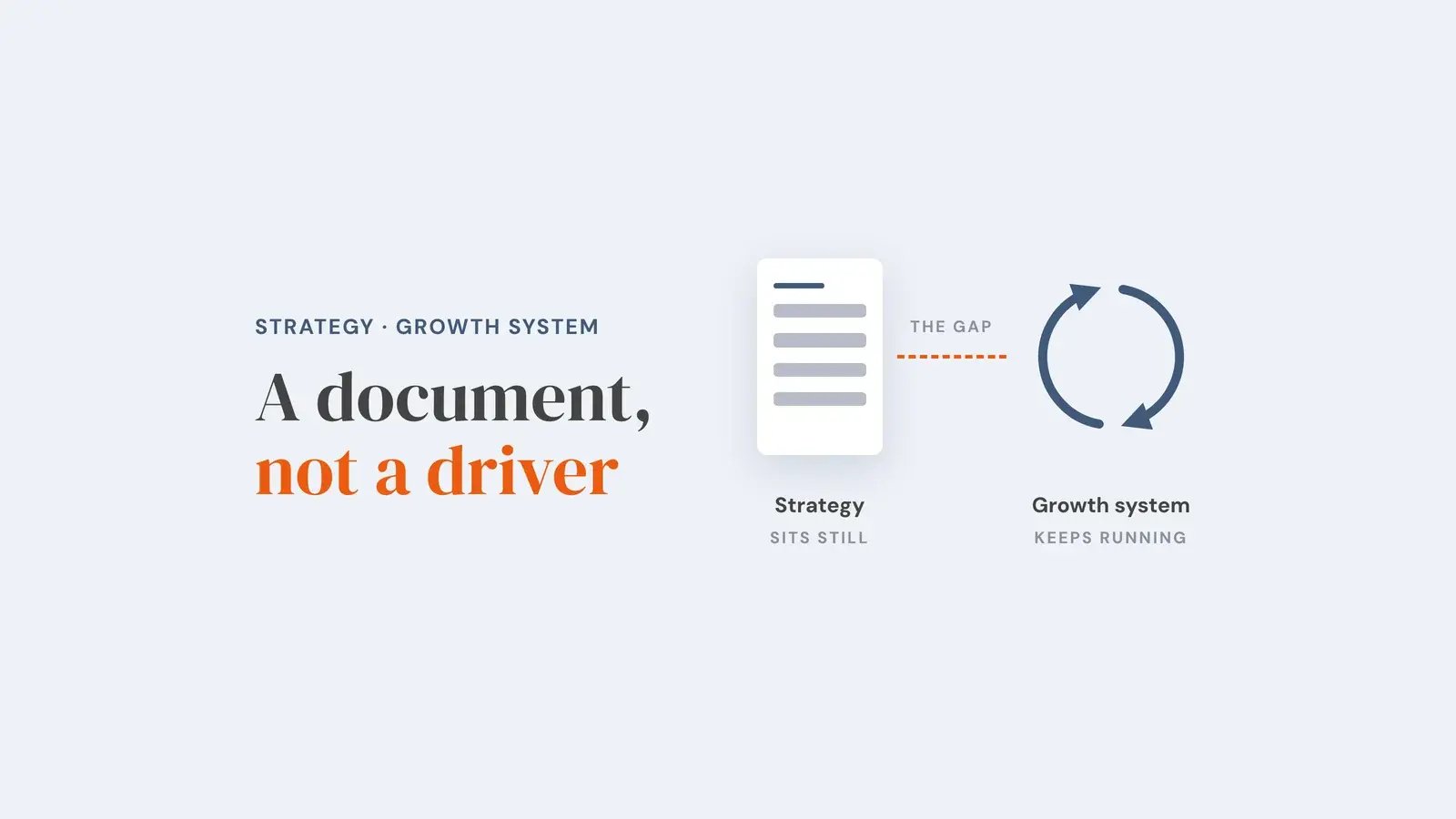
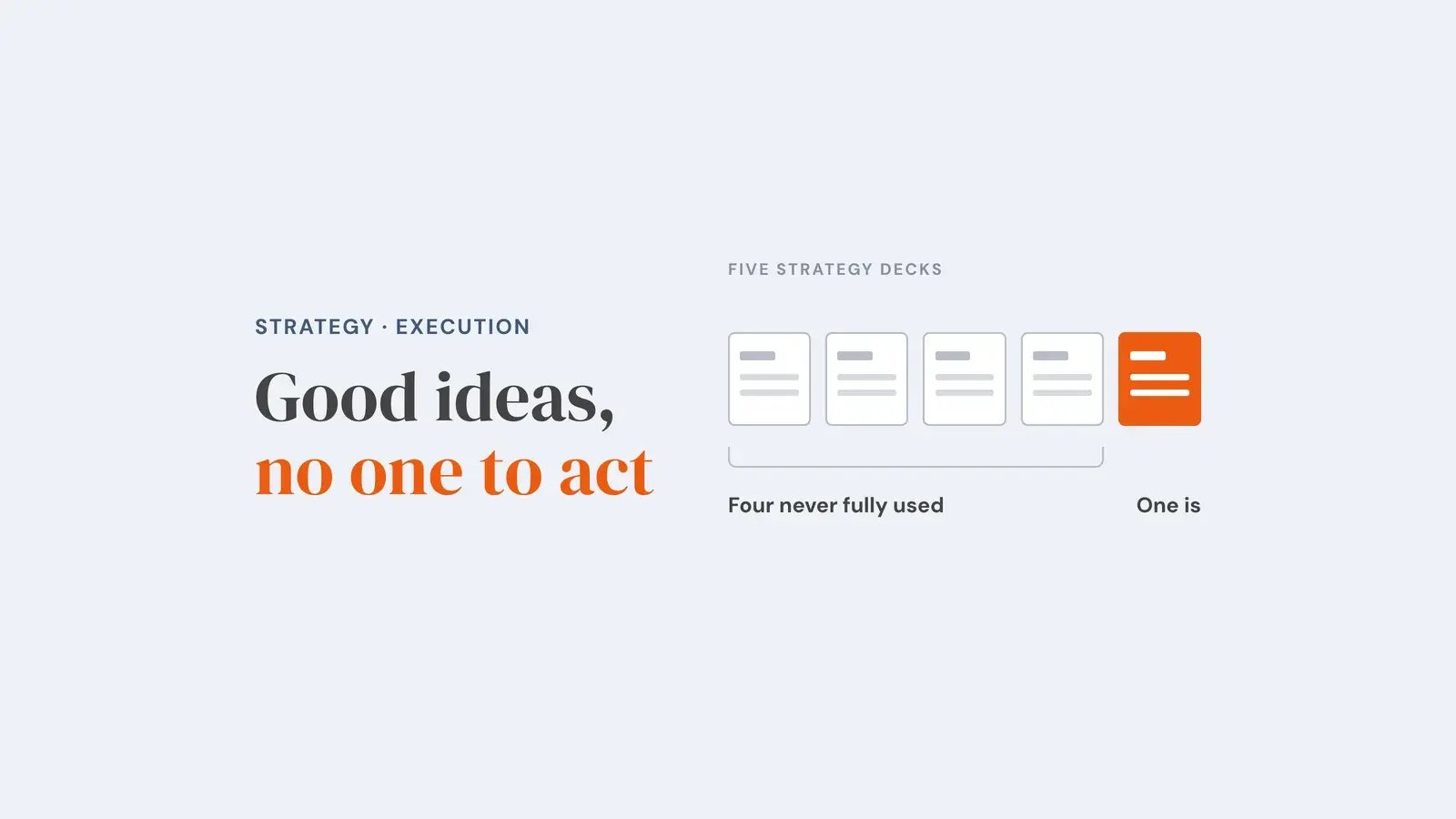
Buyers frequently report receiving beautiful slide decks that their internal teams don't know how to operationalise, leaving them paying twice, once for strategy, again for someone to actually do the work.
Core risks this model creates
- Delayed market feedback: You're three months in before real customers see or respond to anything, meaning your strategy is based on assumptions, not validation.
- No accountability for results: The strategist hands off a document and moves on. If campaigns fail, the execution team blames the strategy; the strategist blames execution.
- Documents that don't translate: Strategic frameworks look impressive in presentations but lack the specificity needed for execution teams to implement them.
- Sunk cost pressure: After investing £30,000+ ($37,500+ USD) in strategy, you feel obligated to continue with that agency even if early execution results disappoint.
- Inflexibility: Markets shift during 90-day strategy phases. By the time execution begins, competitive landscapes, customer priorities, or channel algorithms may have changed.
- Internal team frustration: Your team watches the clock tick while paying an agency to research what they often already know.
Red flags to watch for
The clearest warning sign is when an agency can't start any execution work—even low-risk tests or content, until a multi-month strategy phase is complete and paid for. Other red flags include: the strategist won't be part of the execution team, no clear milestones tied to business outcomes, or the agency refuses to provide examples of how past strategies led to measurable results.
Watch for these specific red flags:
- The agency refuses to begin any work until the full strategy fee is paid and the entire strategy document is delivered.
- No pilot or test campaigns are included during the strategy phase—it's 100% research and documentation.
- The strategist disappears after delivery, with a different team taking over execution who weren't involved in strategy development.
- Vague descriptions of what the strategy will include, with no clear deliverables, milestones, or decision points outlined.
- No performance benchmarks or success metrics are defined for the strategy engagement itself.
- The agency can't show you examples of previous strategy documents or explain how past clients used them to achieve specific results.
- Resistance to scoping a shorter or phased approach, even when you already have some strategic foundations in place.
- The strategy timeline keeps extending as the agency "discovers" additional research needed.
When strategy-first is legitimate vs. when it's a delay tactic
A strategy phase is legitimate when you're entering a new market, rebranding, or lack any foundational marketing infrastructure, situations where execution without direction would waste more money than the strategy costs.
It becomes a delay tactic when the agency refuses to do any implementation work without it, can't explain what specific decisions the strategy will inform, or when the strategist won't be involved in execution.
| Legitimate Strategy Need | Delay Tactic Red Flags |
|---|---|
| You're launching in a completely new market or geography | Agency won't start any work—even low-risk content—without full strategy payment |
| You're rebranding and need new positioning across all channels | Strategist won't be part of the execution team after handoff |
| You have no documented buyer personas, value propositions, or ICPs | Agency can't provide examples of how past strategies led to measurable results |
| Your current marketing has no measurement framework or goals | Strategy deliverables are all documents, no pilots or tests |
| You're pivoting business models entirely | Agency refuses to scope a partial or phased strategy approach |
| Multiple internal stakeholders have conflicting visions | The strategy phase is longer than 6–8 weeks with no interim deliverables |
How strategy-first compares to integrated strategy and execution
Integrated strategy and execution models build strategic frameworks iteratively, starting with a lightweight discovery phase (1–3 weeks) and refining strategy based on real campaign performance and customer feedback.
Unlike strategy-first, integrated models put strategists and executors in the same room from day one, so strategic recommendations are tested and validated within 30–45 days instead of theoretical documents delivered in month three.
| Factor | Strategy-First Model | Integrated Model |
|---|---|---|
| Time to first result | 60–120 days | 14–30 days |
| Accountability structure | Strategist and executor separate; blame-shifting common | Same team owns strategy and execution |
| Cost structure | Large upfront payment, then separate retainer | Strategy cost absorbed into execution retainer |
| Strategy validation method | Assumptions and research | Live campaign testing and customer feedback |
| Flexibility to pivot | Low (strategy locked before execution begins) | High (strategy adjusts based on performance data) |
| Strategist involvement | Ends after document delivery | Ongoing throughout campaign lifecycle |
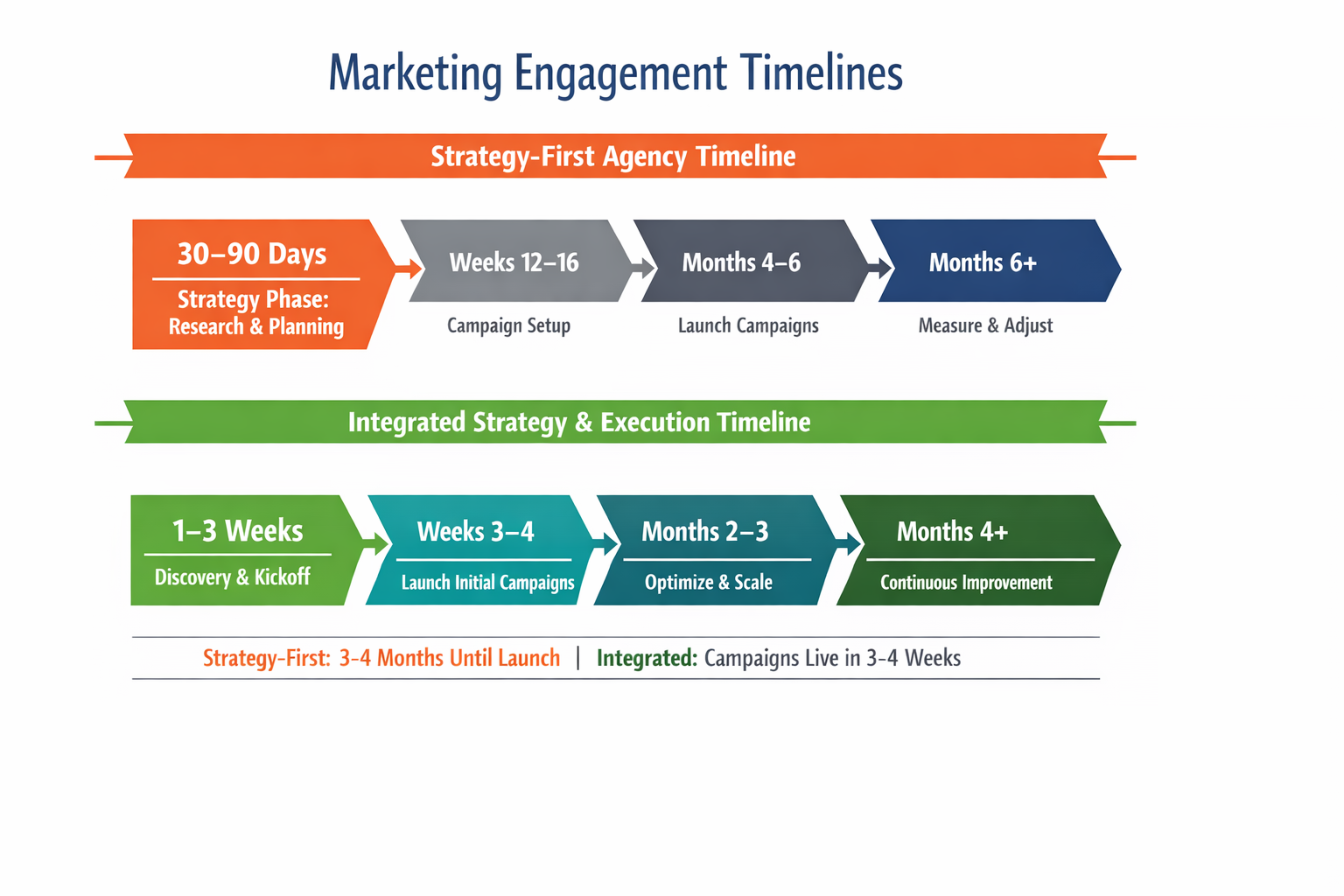
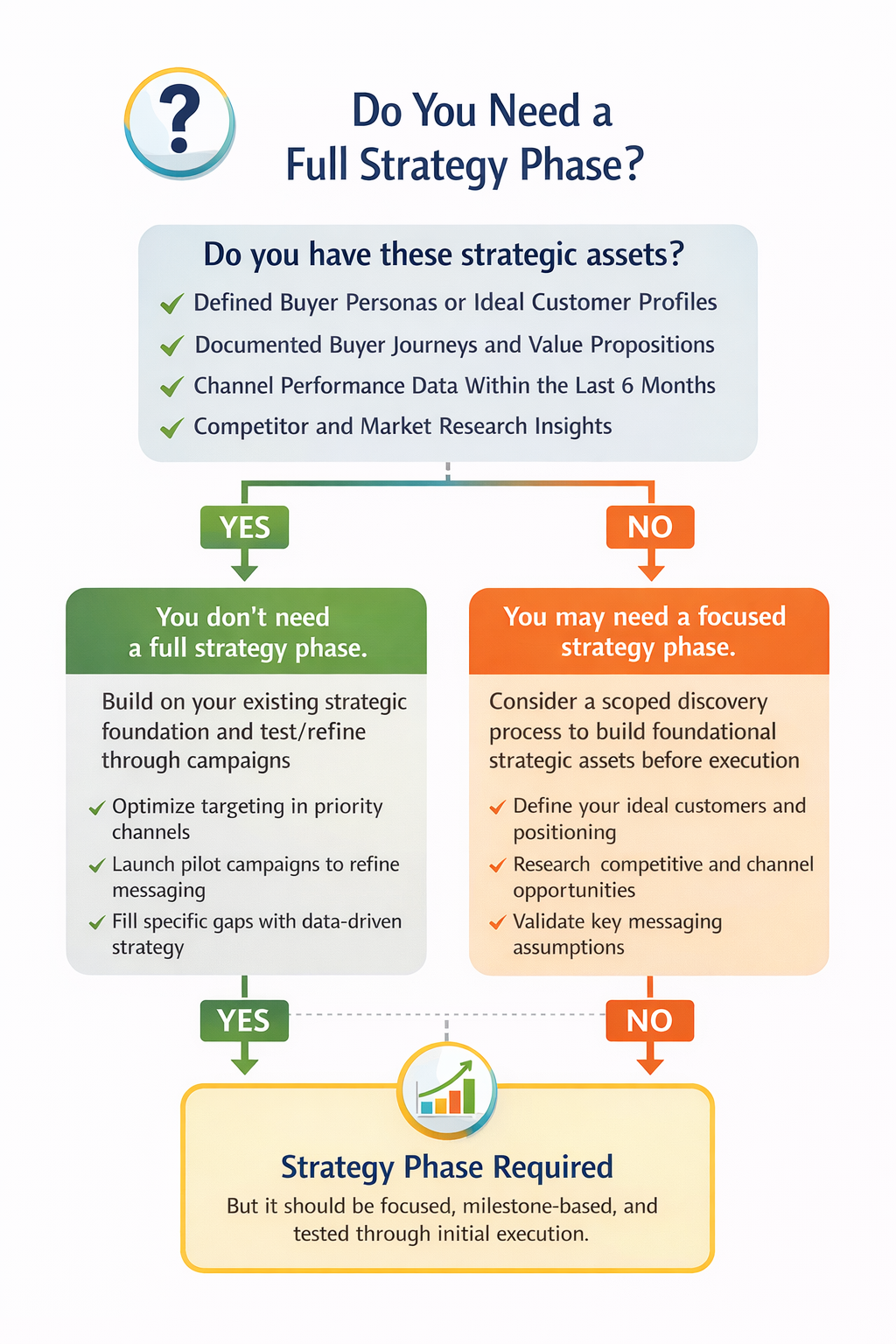
Timeline comparison: 6 months with each model
- Strategy-first: Months 1–3 are spent on research and documentation. Months 4–6 begin execution, with limited results and no time to iterate based on learnings.
- Integrated: Months 1–2 include discovery and first campaigns launching. Months 3–6 refine and scale based on real performance data, with multiple iteration cycles completed.
Do you actually need a strategy phase?
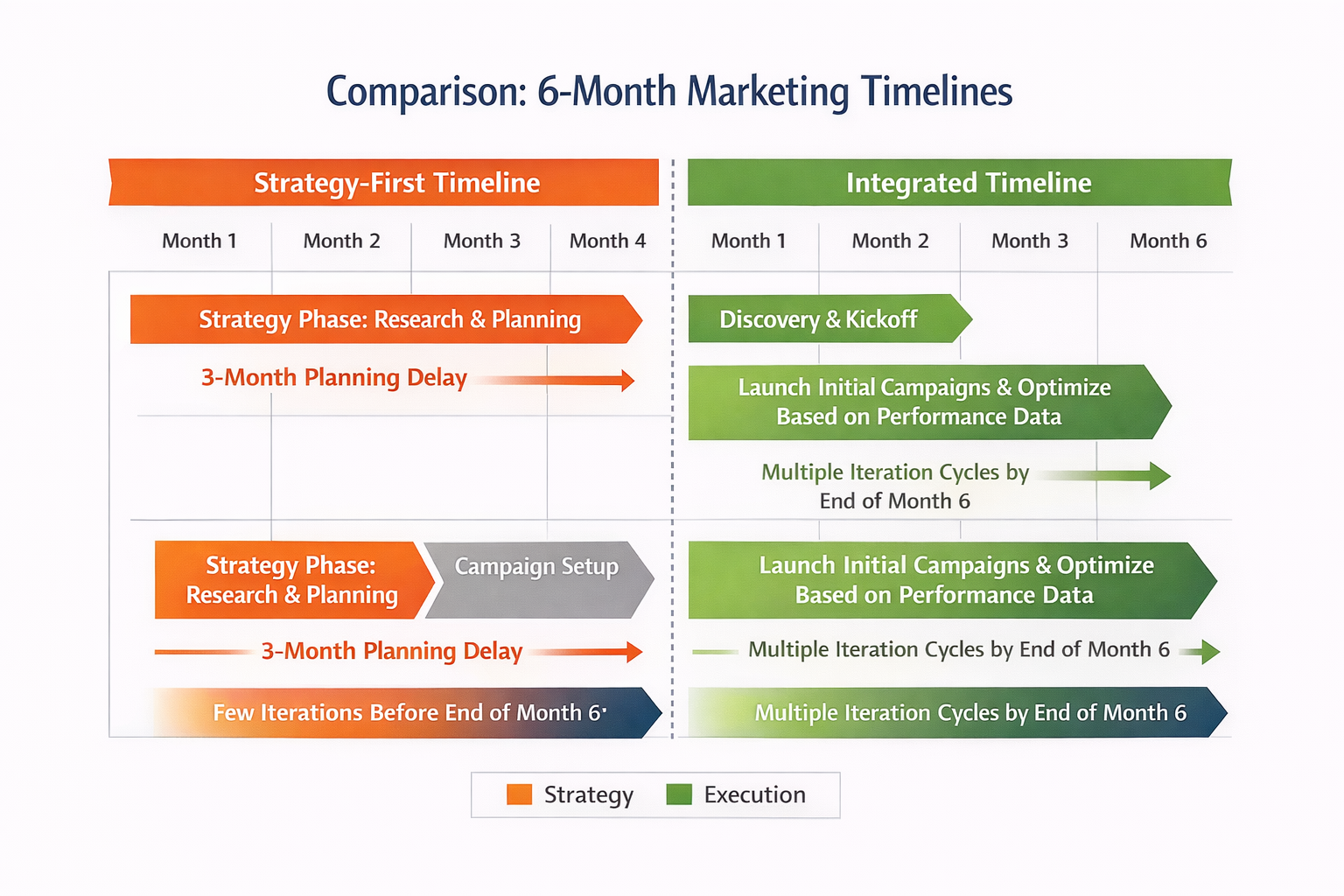
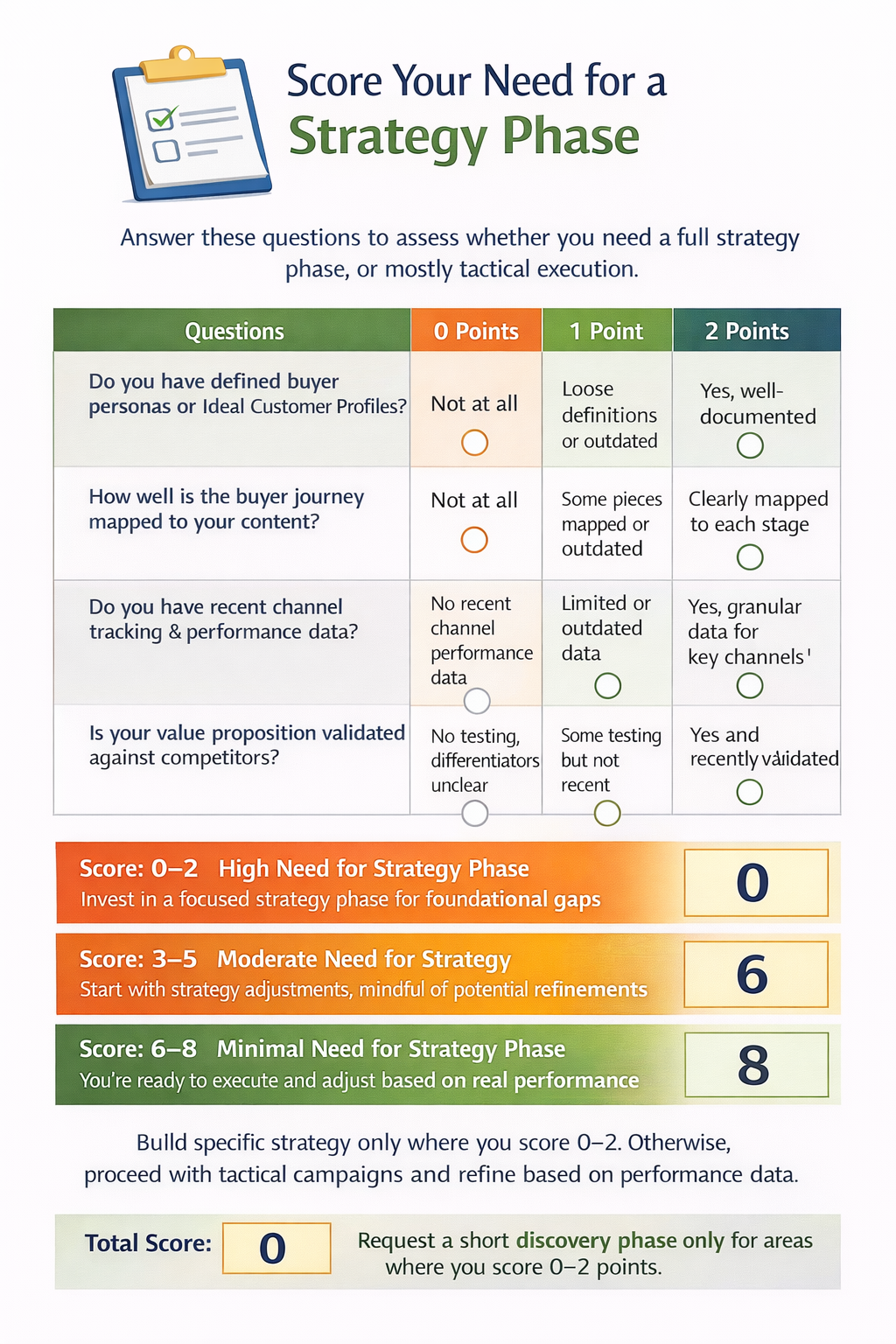
Start by auditing what strategic assets you already have: if you have defined ICPs, documented buyer journeys, clear value propositions, and channel performance data, you likely don't need a full strategy engagement. If you're missing foundational elements or entering entirely new markets, a strategy phase may be valuable—but it should be scoped to fill specific gaps, not reboot your entire marketing function.
Questions to ask before agreeing to a strategy phase
- What strategic assets do we already have? List your existing personas, positioning documents, content strategies, and performance data. If you have most of these, you need refinement, not recreation.
- What specific decisions will this strategy inform? If the agency can't answer with concrete examples ("It will determine which three channels we prioritise and the budget allocation for each"), that's a warning sign.
- Can we test strategic hypotheses during the strategy phase? Legitimate strategy work should include at least one pilot campaign or content test to validate assumptions.
- Who will execute the strategy, and will they be involved in creating it? Strategy created without executor input often fails in implementation.
- What happens if the strategy reveals we need a different approach than expected? Flexible agencies adjust scope and pricing; inflexible ones charge you for a full strategy regardless of findings.
What to do if you've already been sold a strategy-first engagement
If you've already committed to a strategy-first engagement, immediately negotiate milestone-based deliverables with execution tied to each phase, so you're not waiting 90 days for a single PDF. Request that at least one strategic recommendation be implemented and tested during the strategy phase itself, turning it into a working proof-of-concept rather than a theoretical document.
Here's what you can do now:
- Request a revised timeline that breaks the strategy phase into 2–3 milestones (e.g., weeks 3, 6, and 9) with interim deliverables and feedback loops.
- Negotiate a pilot campaign to run during the strategy phase that tests one core hypothesis (e.g., messaging, channel, or audience segment).
- Ensure the execution team reviews each strategic deliverable before it's finalised, so you're not building strategy in a vacuum.
- Define clear success criteria for the strategy engagement itself, what will make it "worth it" beyond just receiving a document?
- Build in an exit clause if the strategy phase reveals your needs are different than originally scoped, allowing you to adjust without paying for unnecessary work.
What a healthy strategy-execution partnership should look like
A healthy agency-strategy relationship starts with a short discovery phase (2–4 weeks, often included in onboarding) that produces a working hypothesis, not a final plan, which is then tested and refined through live campaigns.
The strategist remains involved throughout execution, adjusting recommendations based on performance data, customer feedback, and competitive shifts—not disappearing after delivering a deck.
Look for these characteristics:
- Strategy and execution teams work together from day one, with no handoff or blame-shifting between departments.
- Strategic recommendations include implementation guidance, not just high-level frameworks that require interpretation.
- Testing and validation are built into the process—you're not waiting months to see if the strategy works.
- The strategist stays involved during execution, reviewing performance data and adjusting recommendations based on real results.
- You own the strategy—it's documented in ways your internal team can understand, use, and build upon without ongoing agency dependency.
- Strategy development is iterative, with regular check-ins and adjustments rather than a single "big reveal" at the end.
- Costs are transparent and proportional—you're not paying £50,000 ($62,500 USD) for research you could have conducted internally with guidance.
My approach focuses on building marketing capabilities you own, not strategies you depend on agencies to interpret. Whether through fractional CMO guidance or hands-on marketing support, I work alongside your team to develop strategy that's tested, refined, and yours to control. Learn more about my Done With You services.
Frequently asked questions about strategy-first agencies
Buyers evaluating agency proposals often have similar questions about whether a required strategy phase is standard practice or a revenue tactic. Here are the most common questions we hear from companies in the consideration stage.
Is it normal for agencies to require a strategy phase before starting work?
Some discovery or planning is standard—2 to 4 weeks is reasonable. Requiring a separate 90-day, £30,000+ ($37,500+ USD) strategy engagement before any execution is not standard practice. Many successful agencies integrate strategy into their onboarding and refine it based on campaign performance.
How long should a strategy engagement take?
For most established businesses with existing marketing, 2–4 weeks of discovery and strategic planning is sufficient to begin execution. If you're entering entirely new markets or have zero marketing infrastructure, 6–8 weeks may be justified, but it should include testing and validation, not just documentation.
Should the same team doing strategy also handle execution?
Yes. When the strategist isn't accountable for execution results, strategy becomes theoretical rather than practical. The best outcomes happen when strategic thinking and execution expertise are combined in one team.
What if the agency says our industry requires extra strategy time?
Ask for specific examples of what industry factors require additional strategy work and how that translates to better campaign performance. If they can't provide concrete reasoning beyond "your industry is complex," they're likely padding the timeline.
Can I negotiate out of the strategy phase?
Absolutely. If you already have strategic foundations (personas, positioning, channel data), request a shortened discovery phase instead. A flexible agency will adjust their approach; an inflexible one may not be the right partner.
Conclusion
You now know how to spot when strategy-first is necessary—and when it's a costly delay tactic.
Most businesses can't afford to wait 90 days for marketing to start. You need campaigns live and validated within weeks, not months.
Use the checklist and comparison tables in this article to evaluate your agency proposal, or renegotiate terms if you've already signed.

About the Author
I'm Tom Wardman, and I've worked on both sides of the agency-client relationship, first as Head of Client Delivery at a growing agency, then as an in-house marketing leader. That's where I saw the disconnect: most businesses don't need more outsourced work, they need clearer systems, trusted guidance, and internal capability.
Today, I help business leaders build marketing engines they actually own through fractional CMO support, hands-on marketing management, and team training. As an Endless Customers Certified Coach, I focus on trust-building marketing that creates sustainable growth, not ongoing dependency.
Pricing Disclaimer: All GBP–USD price conversions use an approximate exchange rate of £1 = $1.25 and are rounded estimates correct at the time of publishing. Exchange rates fluctuate and figures should be treated as indicative only.