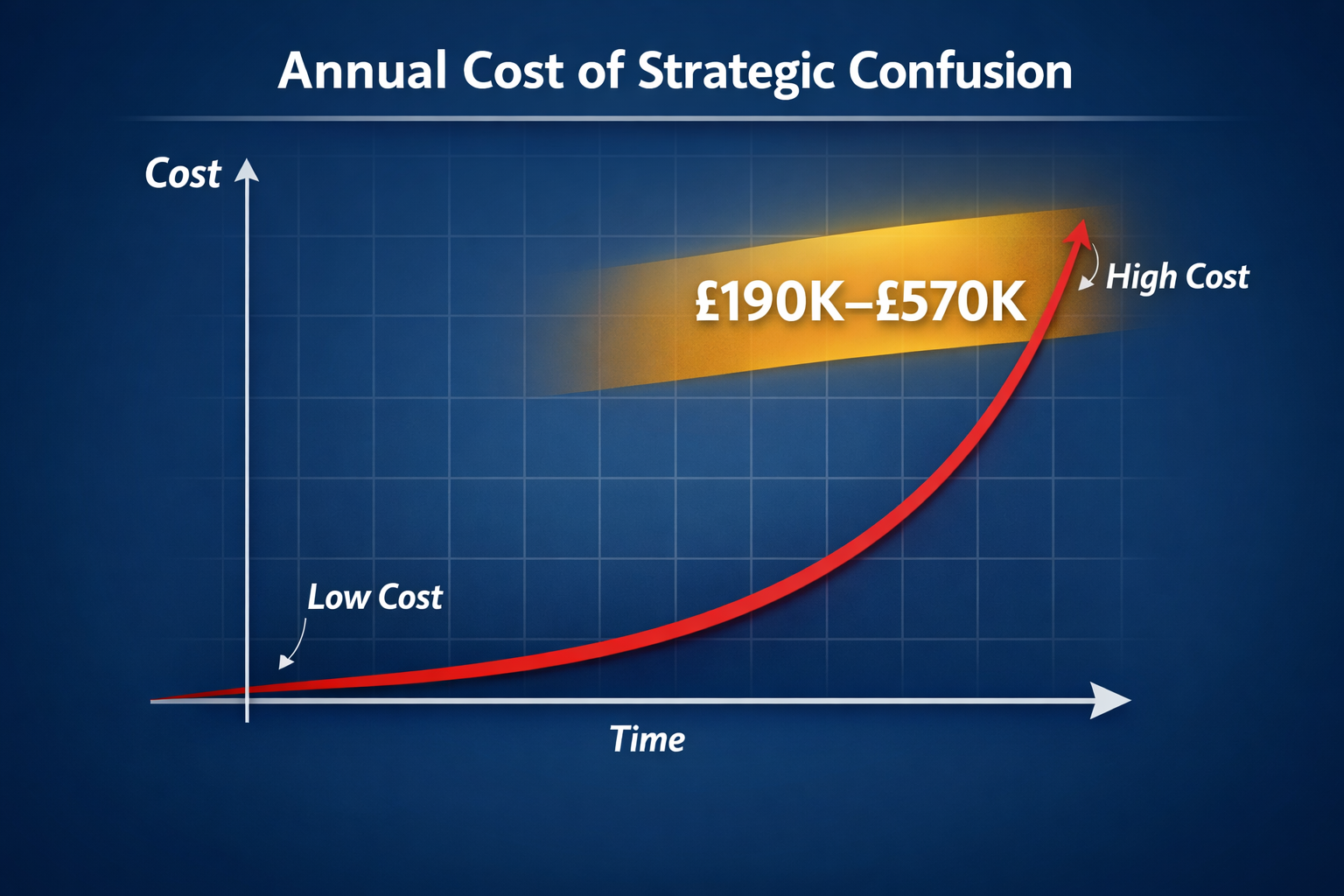



If you're an agency founder approaching a senior operations hire, here's the financial picture most people never actually run.
What does a fractional COO actually cost an agency over 12 months? And how does that compare to the true all-in cost of a full-time hire, beyond the salary figure on the job description?
This article gives you the real numbers: every cost line that actually hits your P&L in year one, for both models. We'll cover what fractional COO pricing typically looks like across different engagement tiers, how to calculate the full cost of a full-time hire, and a structured framework for deciding which model fits your agency's current stage.
Disclosure: I work as a fractional COO for agencies. The comparison below is structured to give you an accurate picture of both models, including the limitations of the fractional approach.
Key takeaways
- A fractional COO typically costs an agency £24,000–£72,000 ($30,000–$90,000) over 12 months, depending on days per month.
- A full-time COO costs £110,000–£180,000+ ($137,500–$225,000+) in year one once salary, employer National Insurance, pension, and recruitment fees are included.
- The cost gap is widest in year one, where full-time hiring front-loads recruitment and ramp costs before the hire is fully effective.
- For most agencies under £3m ($3.75m) in annual revenue, a fractional COO is the stronger financial and operational fit.
- Full-time COO hires tend to make sense above £5m ($6.25m), where delivery team size and operational complexity genuinely fill the role every day.
What is a fractional COO and what do they do for agencies?
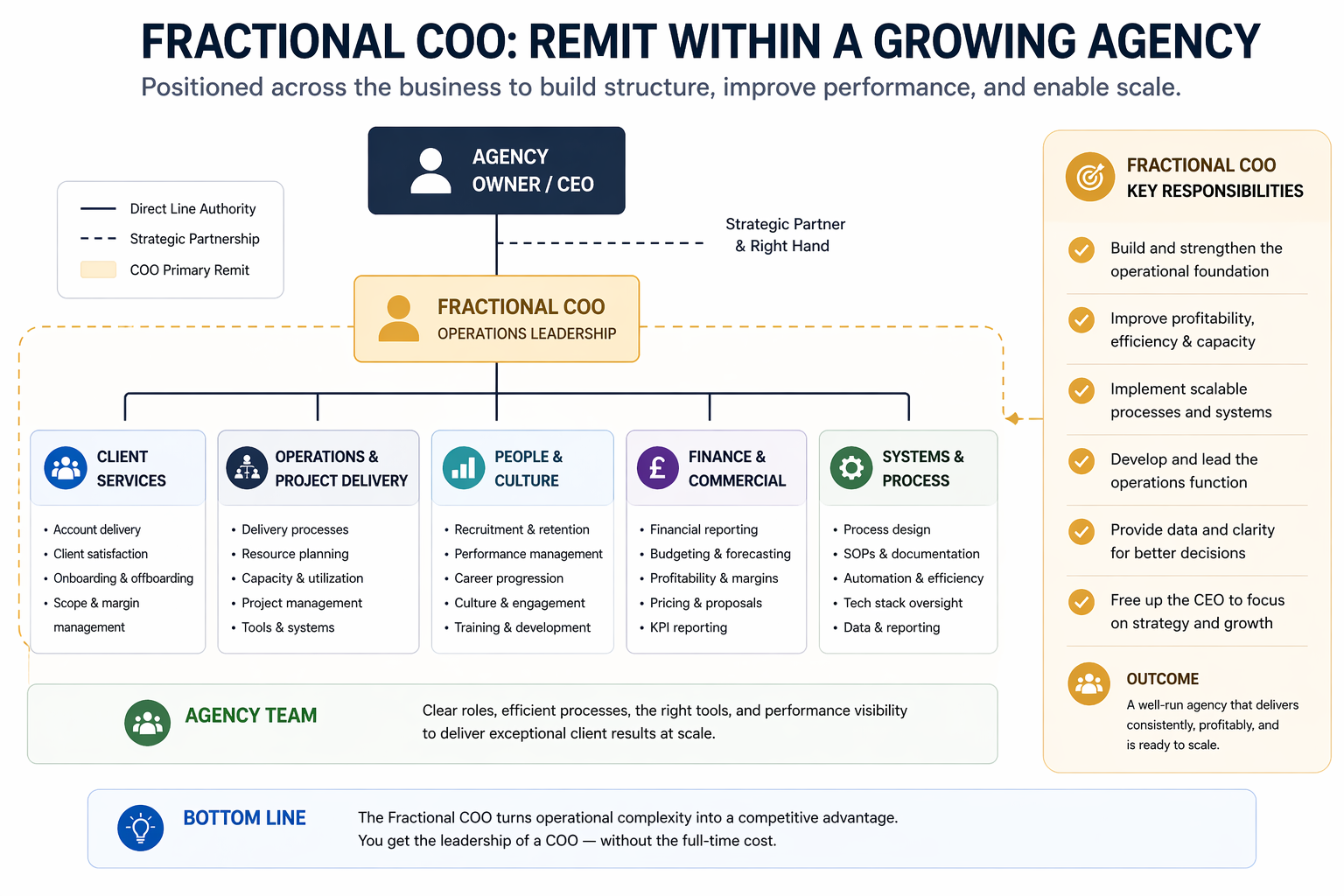
A fractional COO is an experienced chief operations officer who works with your agency on a part-time or fixed-term basis, typically 1–3 days per week — providing senior operational leadership across delivery, capacity, pricing, and team accountability, without a full-time employment commitment.
What does a fractional COO cost an agency over 12 months?
A fractional COO typically costs a UK agency between £24,000 and £72,000 ($30,000–$90,000) over 12 months, and unlike a full-time hire, there are very few costs beyond the retainer itself.
No recruitment fee. No employer National Insurance contribution. No ramp-up period billed at full cost while someone finds their feet. What you agree is what you pay.
There is, however, a real onboarding investment at the start of any fractional engagement. Briefing, context-building, and team alignment typically take 2–4 weeks of founder time before the COO reaches full operational effectiveness. That cost doesn't appear on an invoice, but it's worth factoring in.
| Tier | Days per month | Monthly retainer | 12-month total |
|---|---|---|---|
| Light-touch | 4 days |
£2,000–£3,000 |
£24,000–£36,000 ($30,000–$45,000) |
| Mid-level | 8 days | £3,000–£4,500 ($3,750–$5,625) |
£36,000–£54,000 ($45,000–$67,500) |
| Embedded | 12 days | £4,500–£6,000 ($5,625–$7,500) |
£54,000–£72,000 ($67,500–$90,000) |
Retainer ranges are indicative estimates based on UK market rates for senior agency operations consultants at the time of publishing. Rates vary by specialism and seniority.

What does a full-time COO cost an agency over 12 months?
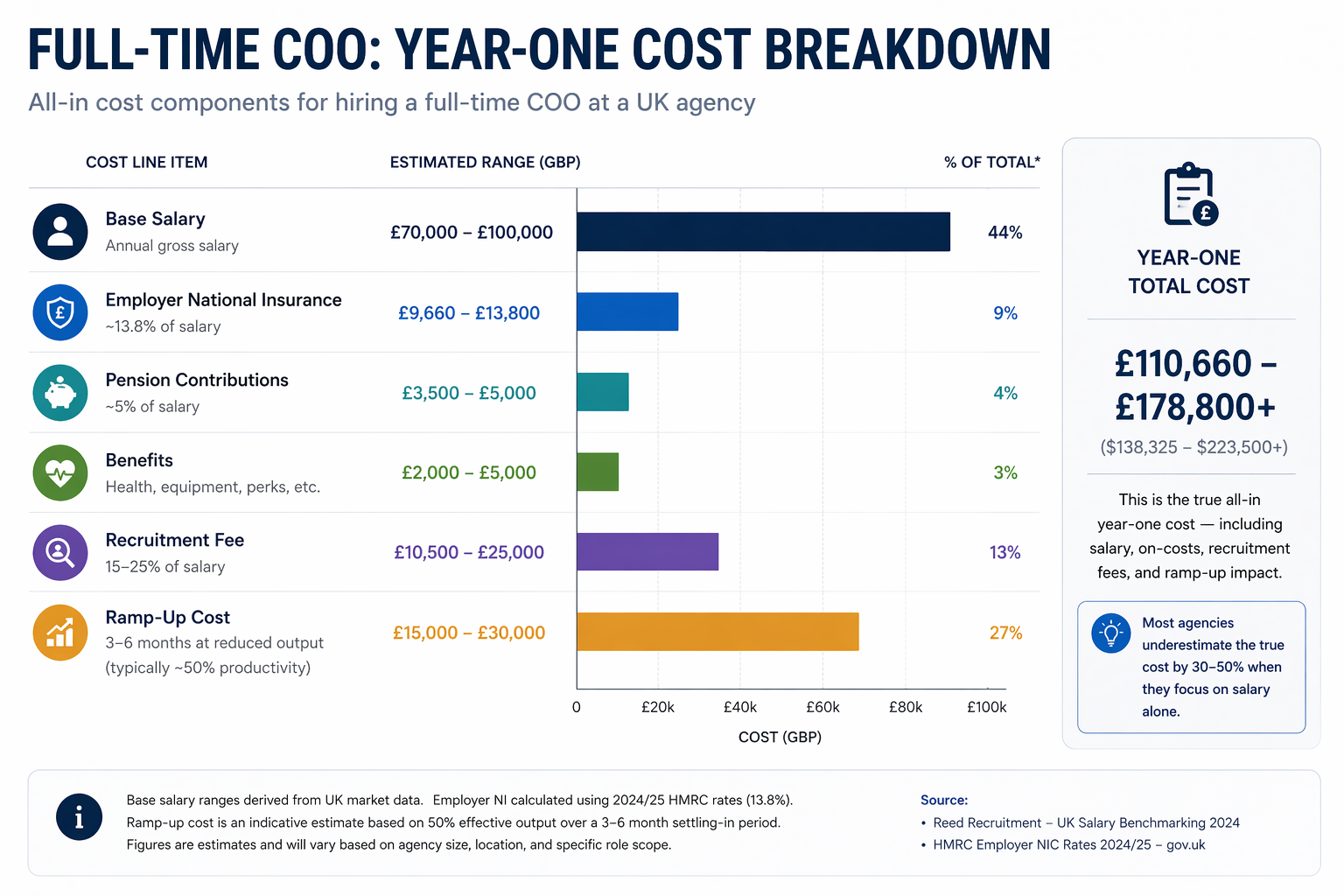
The all-in 12-month cost of a full-time COO for a UK agency typically ranges from £110,000 to £180,000+ ($137,500–$225,000+), and most agency owners significantly underestimate this because they anchor to base salary alone.
Recruitment fees of 15–25% of salary, employer National Insurance at 13.8%, pension contributions, and a 3–6 month productivity ramp all compound on top of what looks like a straightforward payroll cost.
| Cost line | Estimated range |
|---|---|
| Base salary | £70,000–£100,000 ($87,500–$125,000) |
| Employer National Insurance (13.8%) | £9,660–£13,800 ($12,075–$17,250) |
| Pension contributions (5%) | £3,500–£5,000 ($4,375–$6,250) |
| Benefits (health, equipment, etc.) | £2,000–£5,000 ($2,500–$6,250) |
| Recruitment fee (15–25% of salary) | £10,500–£25,000 ($13,125–$31,250) |
| Ramp-up cost (3–6 months at reduced output) | £15,000–£30,000 ($18,750–$37,500) |
| Year-one total | £110,660–£178,800 ($138,325–$223,500) |
Base salary ranges derived from UK market data. Employer NI calculated using 2024/25 HMRC rates (gov.uk. Ramp-up cost is an indicative estimate based on 50% effective output over a 3–6 month settling-in period.
Quick calculation framework to run your own year-one total:
Base salary
- 13.8% employer NI
- 5% pension
- benefits estimate
- 20% recruitment fee
- (salary ÷ 2 × ramp months ÷ 12)
= your realistic year-one total
Example: A £85,000 ($106,250) base salary, assuming a 6-month ramp, runs through the framework as follows: £85,000 + £11,730 + £4,250 + £3,500 + £17,000 + £21,250 = approximately £142,730 ($178,413) in year one.
Fractional vs full-time: side-by-side 12-month comparison
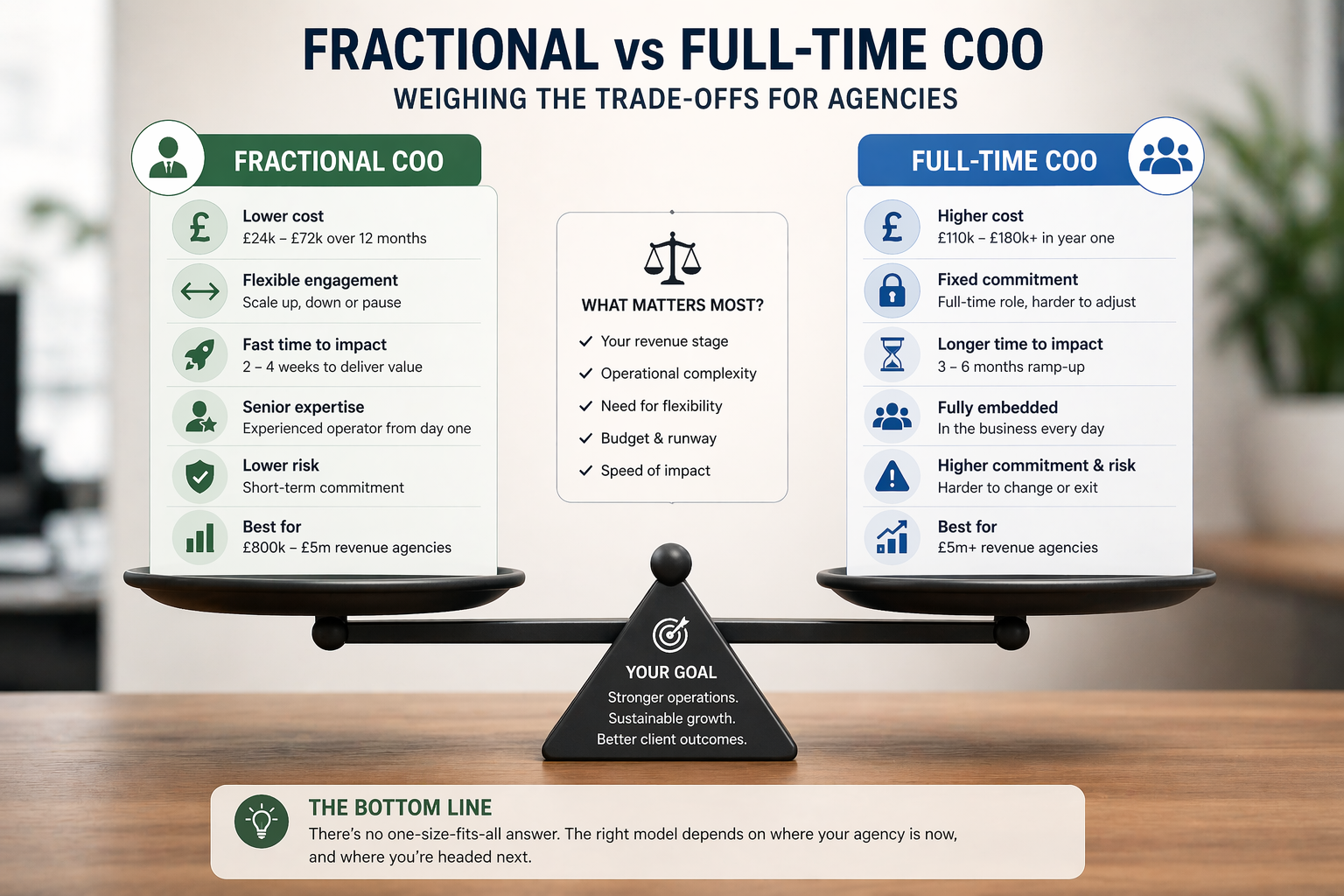
Over 12 months, a full-time COO hire typically costs an agency 2–4x more than a fractional engagement delivering a comparable operational output.
The gap is widest in year one. Full-time costs front-load recruitment and onboarding, while a fractional COO is generally at full operational effectiveness within 30 days of starting.
| Variable | Fractional COO | Full-time COO |
|---|---|---|
| 12-month cost | £24,000–£72,000 ($30,000–$90,000) | £110,000–£180,000+ ($137,500–$225,000+) |
| Time to full productivity | 2–4 weeks | 3–6 months |
| Availability | Part-time, fixed days per month | Full-time, daily presence |
| Flexibility at contract end | High, exit at contract end | Low, notice periods, redundancy risk |
| Additional year-one costs beyond base salary | Retainer only | NI, pension, recruitment, ramp |
| Exit cost if not working | Low | High (1–3 months' salary + legal risk) |
Note: "availability" and "flexibility" work differently for each model; neither is inherently better. Which matters more depends on what your agency actually needs from the role.

What are the risks of going fractional, and when does full-time make more sense?
Both models carry real structural risks. The right choice depends on your agency's operational maturity, team size, and whether the problems you are solving are genuinely full-time in scope.
Fractional COO key drawbacks:
- Limited hours mean slower response when operational problems move fast
- The fractional COO may work across multiple agencies simultaneously, which can dilute focus at critical moments
- Not suited to agencies needing daily senior presence across a large team
- Relationship continuity can be fragile on shorter contracts
Full-time COO key drawbacks:
- High year-one cost before the hire reaches full productivity
- Expensive and complex to exit if the fit is wrong
- Smaller agencies often lack enough senior-level work to justify the overhead
- Requires full employment infrastructure — payroll, benefits, HR process
Which model fits your agency's stage?
For most agencies under £3m ($3.75m) in annual revenue, a fractional COO is the stronger financial and operational choice, delivering senior-level leadership at a fraction of the fixed cost, with flexibility to scale or exit as the business evolves.
Full-time COO hires make structural sense above £5m ($6.25m), where a large enough delivery team and genuine daily operational complexity can fill the role from day one.
For agencies sitting between £3m ($3.75m) and £5m ($6.25m), the right answer depends on cash flow, operational urgency, and whether the problems being solved are systems-building tasks (fractional) or permanent leadership gaps (full-time).
A fractional COO is likely the right move if:
- Annual revenue is below £3m ($3.75m)
- You need systems built, not a permanent operational seat filled
- Cash flow cannot support a £100,000+ ($125,000+) annual fixed cost
- You want flexibility to scale scope as the agency grows
A full-time COO is likely the right move if:
- Annual revenue is above £5m ($6.25m)
- Your delivery team has 20+ people requiring daily senior oversight
- Operational complexity spans multiple departments simultaneously
- The role is genuinely full-time in scope from the start
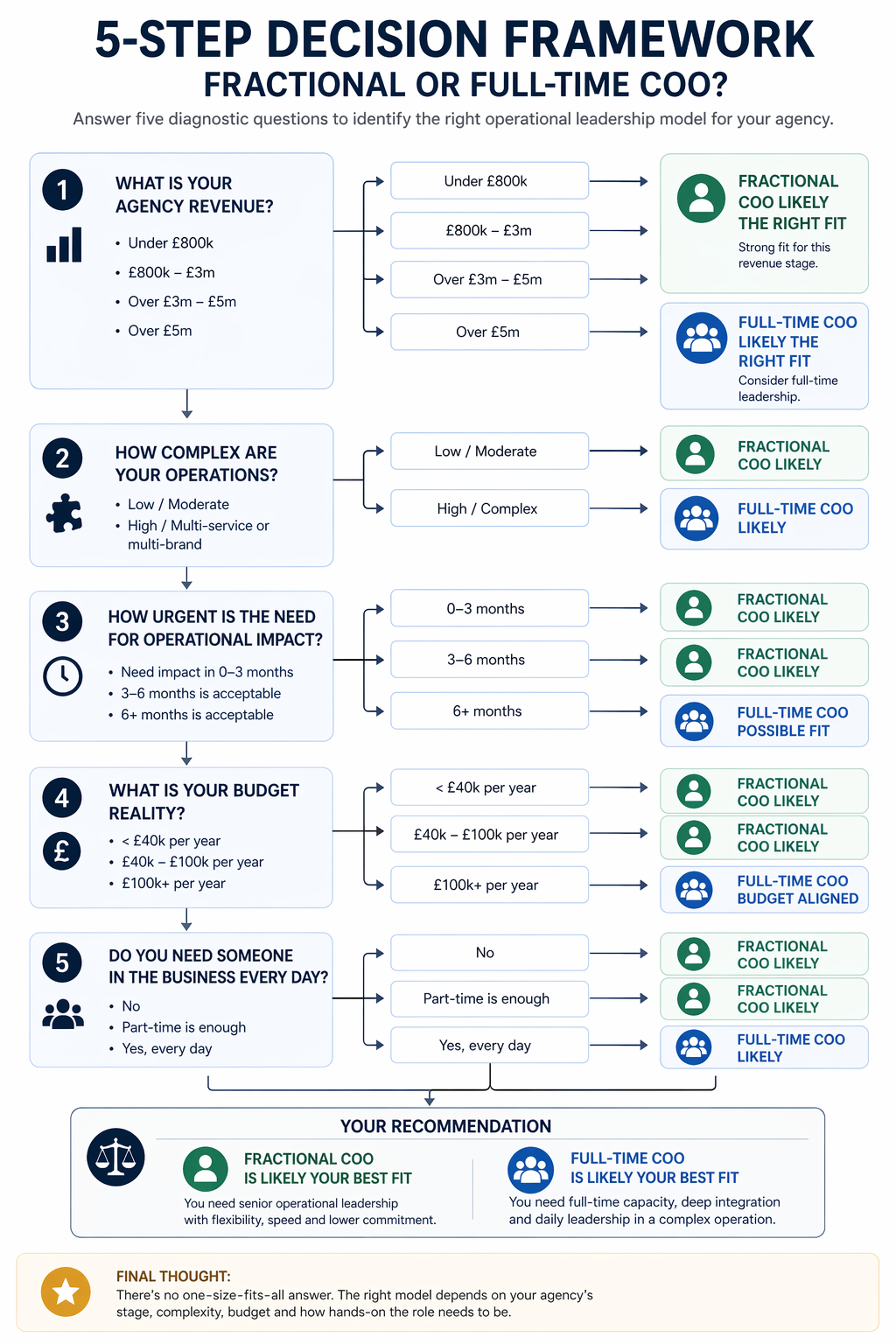
How to decide: a 5-step framework for agency owners
Before committing to either model, work through five structured questions covering revenue, operational complexity, cash flow, urgency, and whether the problems you are solving are full-time in scope.
- What is your current annual revenue? Below £3m ($3.75m): fractional is typically the stronger fit. Above £5m ($6.25m): full-time becomes financially viable. Between the two: use the remaining questions to decide.
- Is the operational need daily or periodic? If you need senior presence across your delivery team every day, full-time is the right structure. If the primary need is systems-building and periodic oversight, fractional delivers that at a significantly lower cost.
- Can your cash flow absorb a £100,000+ ($125,000+) annual fixed cost right now? If not, a fractional engagement removes that risk entirely while still moving the operational agenda forward.
- How urgent is the operational fix? A fractional COO typically begins within weeks. A full-time hire takes 3–6 months to reach full effectiveness once recruitment, notice periods, and onboarding are factored in.
- What does success look like in 12 months? Documented systems and a self-sufficient team? Fractional is usually the faster and cheaper route to that outcome. A permanent operational seat with daily leadership accountability? Full-time may be the right call.
The most common agency hiring mistake is defaulting to a full-time hire because it feels more serious, rather than because it is the right fit for the business at its current stage.
Conclusion
You came to this article needing a clear financial picture of two very different hiring models. You now have the cost ranges, the hidden cost breakdown, a worked example, and a structured framework to apply to your own situation.
The financial case for fractional is strongest below £3m ($3.75m) in revenue. The case for a full-time hire gets stronger above £5m ($6.25m). In between, the decision depends on your cash flow, your operational complexity, and how urgently you need the fix, not on which model sounds more credible.
How to take action now
- Run your own year-one total using the full-time cost framework in this article
- Compare it against the fractional retainer tier that matches your operational need
- Work through the 5-step decision framework with your current revenue and team size
- Define the scope before approaching any candidate: days per month, key priorities, and a clear 12-month outcome
Both the fractional and full-time decision sit within a broader operational picture. Whether you hire fractionally or full-time, the underlying framework, the systems, structures, and leadership accountability that make any COO effective, needs to be in place first. That's the foundation the Agency Operating System™ is built around.
If you are ready to explore whether a fractional COO is the right fit for your agency, view my Fractional COO for Agencies service page or see transparent pricing on the Agency Services Pricing page, no discovery call needed to access the numbers.
To understand the broader operational framework these services sit within, explore the Agency Operating System™.

About the Author
Tom Wardman is a Growth Independence Architect and agency operations consultant. He works with agency founders to install the pricing, delivery, and leadership systems that allow agencies to scale without founder dependency or margin erosion. His work is structured around the Agency Operating System™, a three-stage framework that moves agencies from operational fragility to documented, scalable control. Tom has worked inside and alongside agencies at every growth stage, and writes from direct operational experience.
Pricing disclaimer: All GBP–USD price conversions are rounded estimates and correct at the time of publishing. Exchange rates fluctuate and figures should be treated as indicative only.
Topics: