

Key Takeaways
- Marketing-business goal misalignment occurs when marketing activities, metrics, and budgets don't directly support your company's strategic business objectives
- Misaligned marketing can waste 20–40% of marketing budget — representing £20,000 to £400,000+ ($26,800 to $536,000+) annually depending on company size
- The clearest warning sign is when marketing reports strong performance metrics whilst the business struggles to hit revenue targets
- Fixing misalignment starts with mapping your marketing objectives against your top 3–5 business priorities to identify gaps
- Sustainable alignment requires quarterly reviews, shared success metrics connected to revenue, and integrated planning processes
Are board meetings becoming tense because the marketing numbers don't translate into revenue? Is the CEO quietly questioning whether the marketing budget is working? Are marketing reports presented and then largely ignored?
If any of that sounds familiar, you're likely dealing with marketing-business goal misalignment, where marketing activities look successful on paper but don't drive the outcomes your company actually needs.
Having helped leadership teams realign marketing strategies across multiple industries, I've seen how quickly misalignment erodes growth and confidence. It rarely starts as a dramatic failure. It creeps in gradually, through inherited KPIs, communication gaps, or a business pivot that outpaced the marketing strategy update.
This article is for business owners, marketing directors, and executives who suspect their strategy has drifted away from what matters most to the business. Here's what you'll learn:
- How to diagnose whether misalignment is your real problem
- What it's costing you in wasted budget and hidden revenue loss
- A proven five-step framework to realign marketing with revenue
What is marketing-business goal alignment?
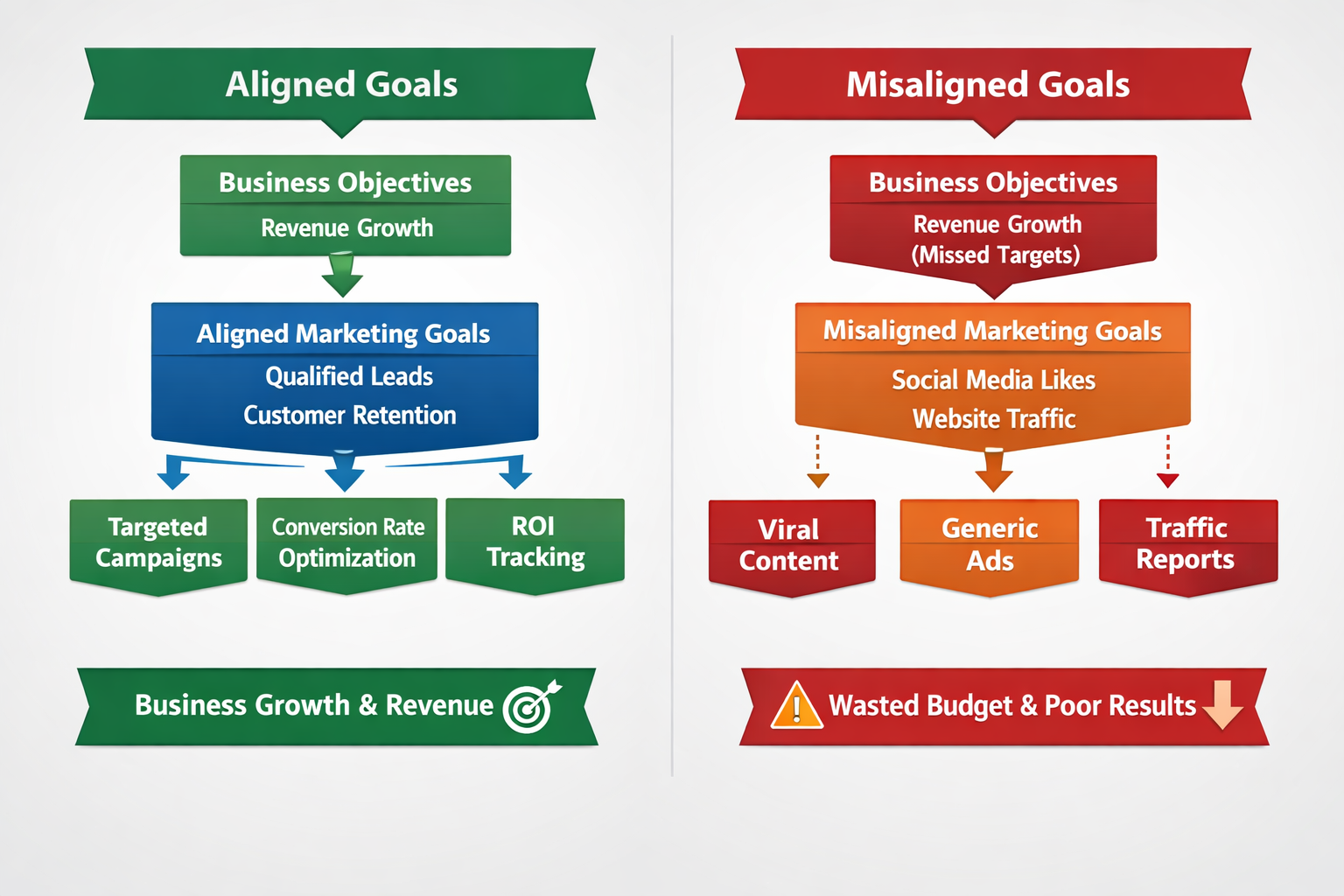
Marketing-business goal alignment occurs when your marketing activities, metrics, and resource allocation directly support your company's strategic business objectives. When aligned, every campaign, channel, and pound spent connects to measurable outcomes that matter to your bottom line, whether that's revenue growth, market expansion, customer retention, or profitability.
Alignment means your marketing team and the wider business are literally working toward the same definition of success. Your marketing team measures performance using metrics that executives care about, not just vanity numbers like impressions or social followers.
For example, if your business priority is expanding into manufacturing clients, an aligned marketing strategy would focus budget on manufacturing-specific content, target decision-makers in that sector, and measure success by manufacturing pipeline value, not total website traffic.
What are the most common signs your marketing strategy is misaligned?
The clearest sign of misalignment is when your marketing reports strong performance metrics—impressions, engagement, or even leads—whilst your business struggles to hit revenue or growth targets. Other warning signs include marketing and sales teams working toward conflicting goals, campaigns that don't reflect product priorities, and executives who view marketing as a cost centre rather than a growth driver.
Watch for these specific symptoms:
- Marketing celebrates hitting lead volume targets whilst sales complains about lead quality
- Your marketing budget allocation doesn't match your business priority ranking
- Marketing metrics rarely appear in board meetings or executive reviews
- Product launches happen without coordinated marketing support
- Marketing creates content the sales team never uses
- Executives can't articulate what marketing is trying to achieve
- Marketing operates on different planning cycles than the rest of the business
If three or more of these apply to your business, you likely have a misalignment problem — not just an execution issue.
What problems does marketing misalignment actually cause?
When your marketing is misaligned, you experience a cascade of operational and financial problems: wasted budget on low-impact activities, internal friction between departments, slower decision-making, and ultimately missed revenue targets. The consequences compound over time, eroding stakeholder confidence in marketing and creating a culture where teams optimise for vanity metrics instead of business outcomes.
| Problem Category | Specific Symptoms | Business Impact |
|---|---|---|
| Financial waste | Budget spent on channels/tactics that don't drive priority outcomes | 20–40% of marketing budget wasted |
| Revenue leakage | Leads don't match sales criteria; marketing doesn't support high-value opportunities | Longer sales cycles; lower close rates |
| Team friction | Marketing and sales blame each other for poor results; product teams frustrated | High turnover; slow execution |
| Strategic drift | Marketing becomes reactive and tactical rather than strategic | Lost competitive advantage |
| Trust erosion | Executives lose confidence in marketing's business value | Budget cuts; reduced influence |
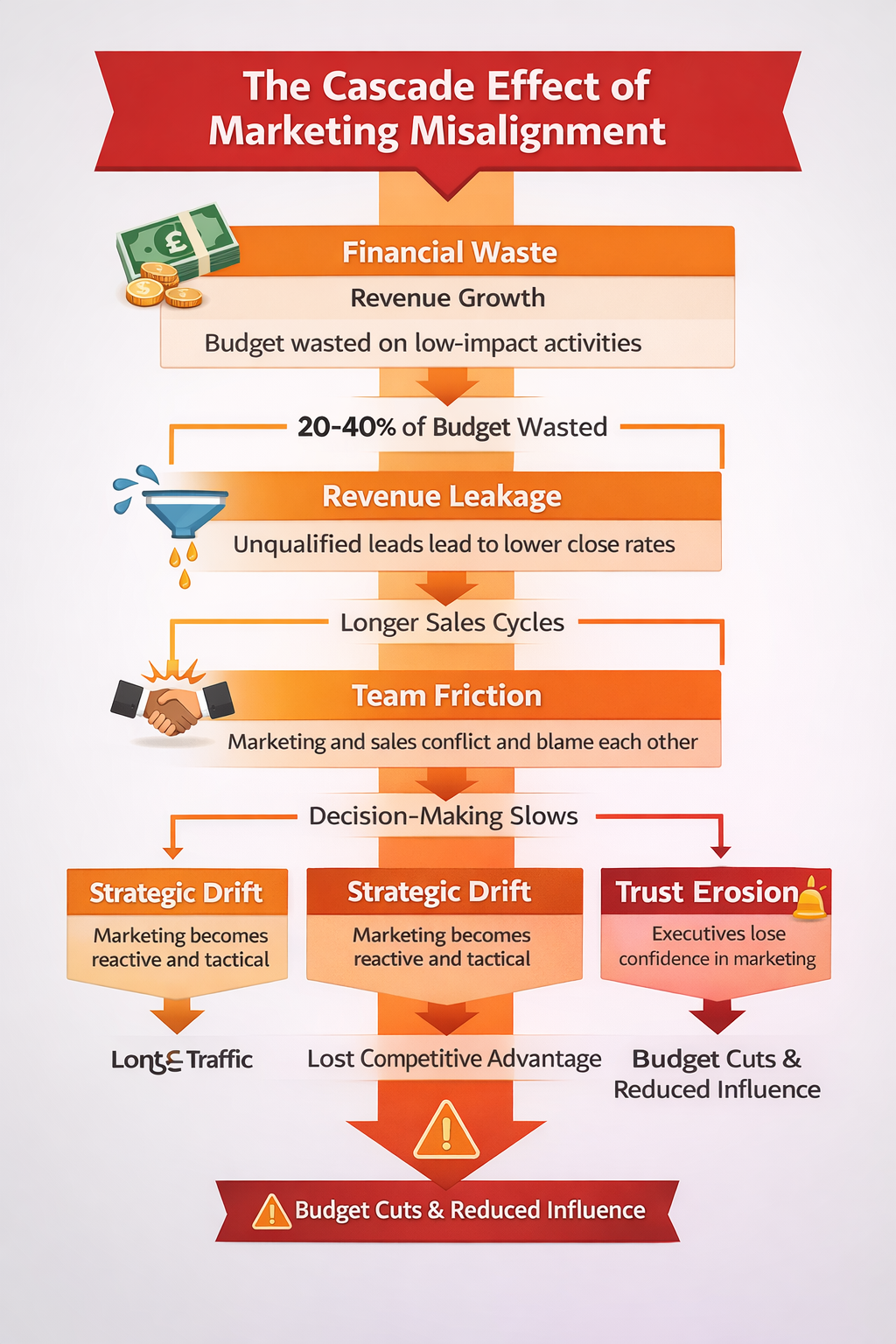
The most dangerous aspect is that misalignment creates a vicious cycle. When marketing doesn't deliver business results, budgets get cut, which makes it harder to deliver results, which further damages credibility. And it's worth noting: misalignment isn't always marketing's fault. Often, the root cause lies in how business priorities are communicated, or not communicated, to the marketing team.
Why does marketing-business misalignment happen?
Misalignment typically stems from one of four root causes: poor communication between marketing and executive leadership, inherited metrics that no longer serve the business, organisational silos that prevent cross-functional planning, or rapid business pivots that outpace marketing strategy updates. In many cases, marketing teams are optimising for goals that made sense at one stage of company growth but haven't evolved as the business matured or shifted direction.
Here are the most common root causes:
- Communication gaps: Marketing leadership doesn't participate in strategic business planning, so they don't know what actually matters to executives or how priorities have shifted.
- Legacy metrics: The marketing team inherited KPIs from a previous leader or earlier growth stage (e.g., awareness metrics when the business now needs retention).
- Organisational silos: Marketing, sales, product, and finance operate independently without shared goals or regular cross-functional planning sessions.
- Rapid business evolution: The company pivoted strategy, changed target markets, or shifted business models, but marketing strategy wasn't updated accordingly.
- Skill gaps: Marketing teams lack the commercial literacy to translate business goals into marketing objectives, or executives don't understand how marketing drives business outcomes.
Understanding which root cause applies to your situation determines how you fix the problem. This is also why misalignment is rarely solved by adding more campaigns; the issue is strategic, not executional.
How much does marketing misalignment cost businesses?
Whilst exact costs vary by company size and industry, research suggests that misaligned marketing can waste 20–40% of marketing budget on low-impact activities, representing tens of thousands to millions in lost investment annually. Beyond direct waste, misalignment creates hidden costs: your sales team spends time on unqualified leads, product launches underperform, customer acquisition costs rise, and revenue growth stalls despite increased marketing spend.
| Company Size | Typical Marketing Budget | Estimated Annual Waste | Hidden Costs |
|---|---|---|---|
| Startup/SMB | £50,000–£150,000 ($67,000–$201,000) | £10,000–£60,000 ($13,400–$80,400) | Missed growth opportunities; founder time diverted to fixing marketing |
| Mid-market | £300,000–£1m ($402,000–$1.34m) | £60,000–£400,000 ($80,400–$536,000) | Sales team inefficiency; longer sales cycles; lower win rates |
| Enterprise | £2m–£10m+ ($2.68m–$13.4m+) | £400,000–£4m+ ($536,000–$5.36m+) | Strategic misallocation; competitive disadvantage; board-level confidence issues |
These figures represent direct waste only. The true cost includes opportunity cost, what you could have achieved if resources had been properly focused, plus the compounding effect of lost time and credibility.
Marketing misalignment vs strategy execution problems: what's the difference?
Before you conclude that your strategy needs a complete overhaul, it's worth asking a different question: is this actually a misalignment problem, or are you dealing with an execution failure? The distinction changes everything about how you fix it.
Marketing misalignment is a strategic problem, your marketing plan doesn't support business objectives, whilst execution problems occur when a well-aligned strategy is implemented poorly due to resource constraints, skill gaps, or process breakdowns. A misaligned strategy will fail even with perfect execution because you're solving the wrong problem, whereas execution issues can be fixed with better operations, training, or tools.
| Factor | Marketing Misalignment | Poor Execution |
|---|---|---|
| Definition | Strategy doesn't support business goals | Strategy is sound but implementation fails |
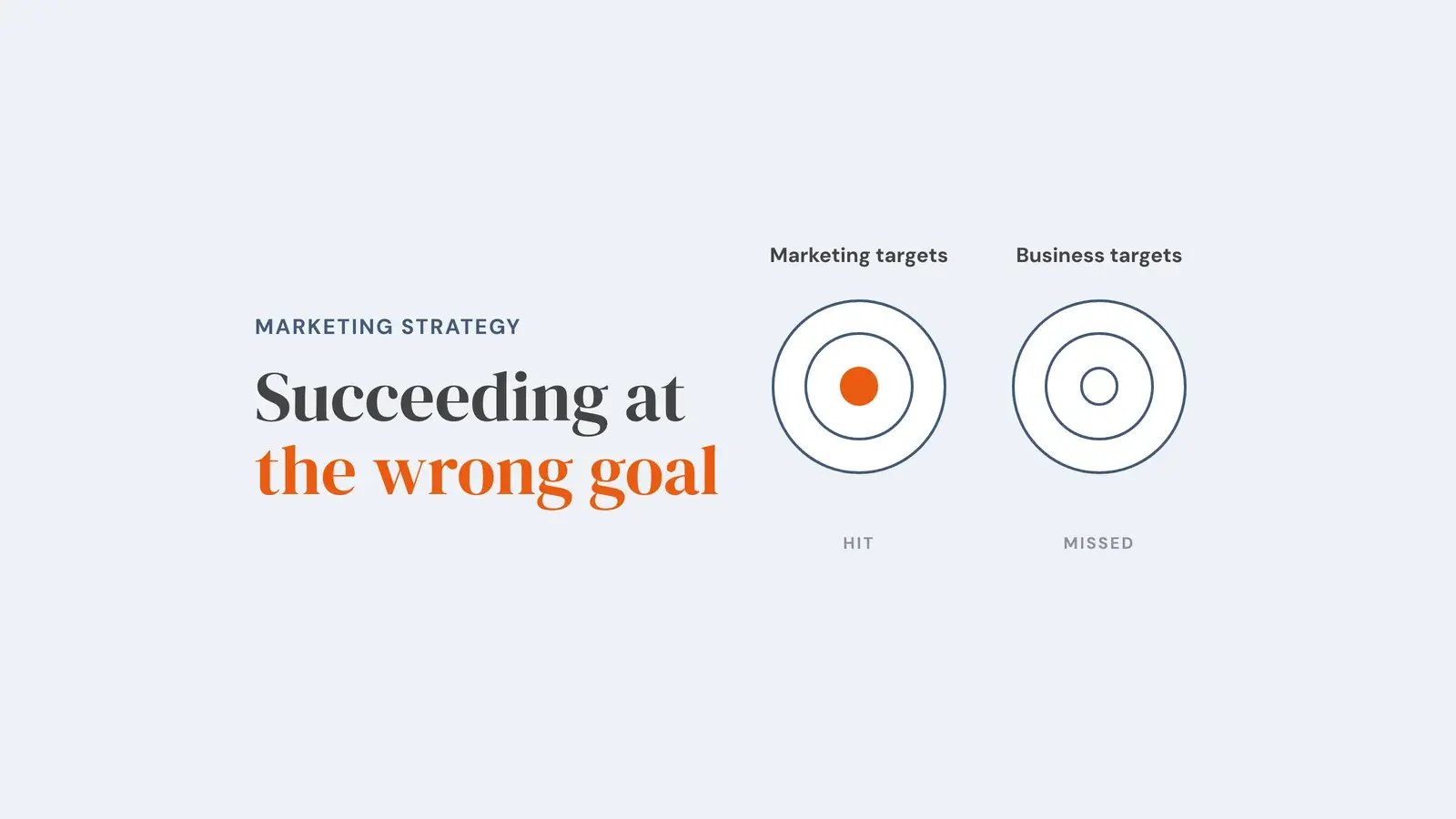
| Symptoms | Marketing hits its targets but business doesn't | Marketing misses its own targets |
| Root cause | Communication gaps; wrong priorities | Resource constraints; skill gaps; process issues |
| Who owns the fix | Senior leadership (CMO + executives together) | Marketing operations or team leads |
| Solution | Strategic realignment and goal-setting | Better processes, training, tools, or resources |
| Timeline to fix | 3–6 months | 1–3 months |
Diagnosing which problem you have is straightforward: if your marketing team consistently hits their stated goals but the business isn't seeing results, you have an alignment problem. If marketing is missing its own targets, start by fixing execution before assuming strategy is the issue.
How do you diagnose marketing-business goal misalignment?
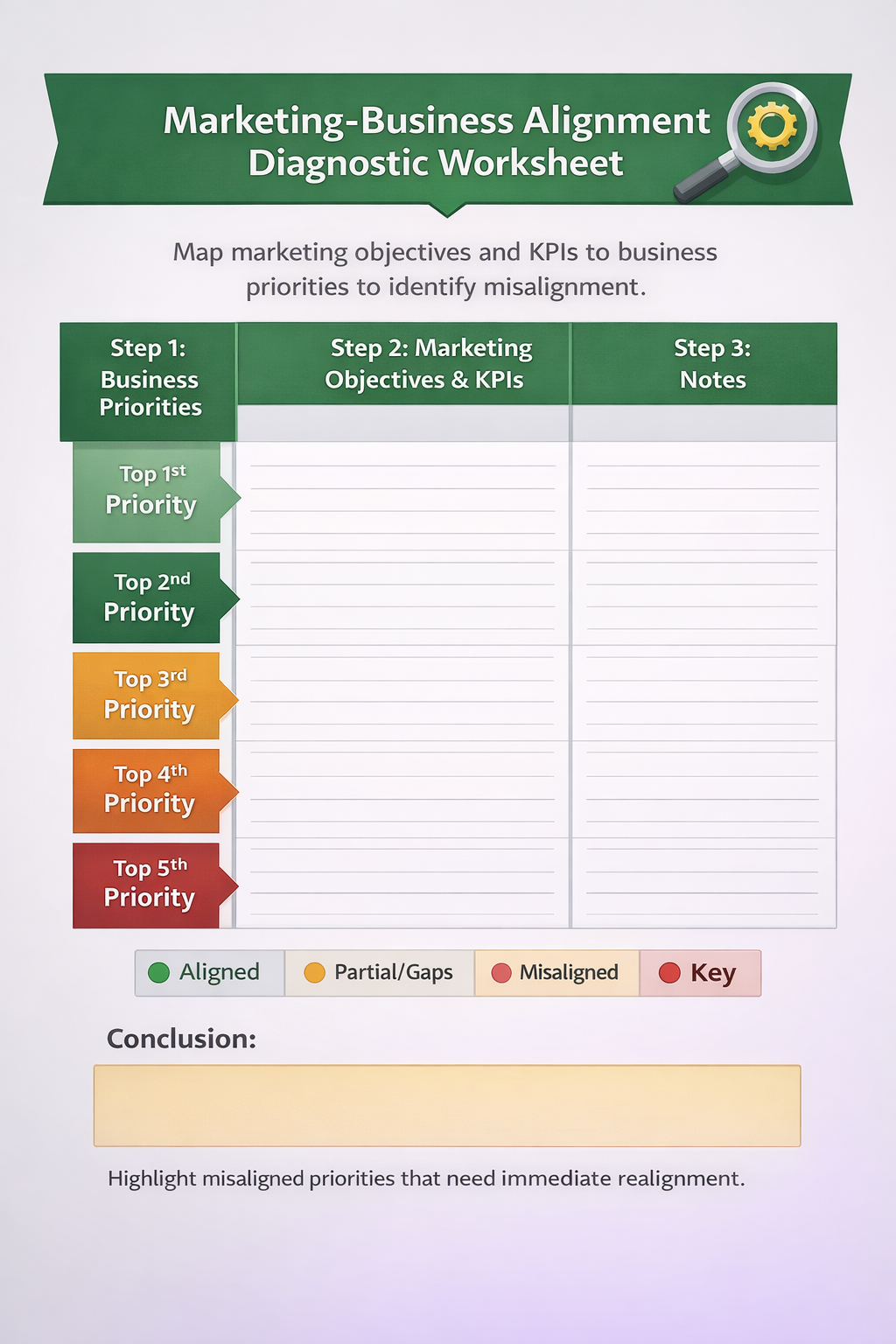
Start by mapping your current marketing objectives and KPIs against your company's top 3–5 business priorities for the next 12 months — gaps in this mapping reveal misalignment. Follow this with stakeholder interviews (sales, product, finance, executives) to understand whether marketing activities support their goals, and analyse whether marketing budget allocation matches business priority ranking.
Use this five-step diagnostic framework:
- List your top 3–5 business priorities (from board meetings, strategic plans, or exec conversations) with specific targets and timeframes.
- Document your current marketing objectives and KPIs exactly as your team tracks them today, including what success looks like.
- Map each marketing objective to a business priority using a simple matrix — you'll immediately see which priorities have no marketing support and which marketing activities don't connect to priorities.
- Interview 5–8 key stakeholders (sales leadership, product, CFO, CEO) asking: "How does marketing support your goals?" and "What would marketing need to do differently to be more valuable?"
- Analyse budget allocation by calculating what percentage of marketing spend goes toward each business priority — if your #1 priority gets 15% of budget whilst your #4 priority gets 40%, you've found misalignment.
This diagnostic typically takes 2–3 weeks and will give you a clear picture of where alignment breaks down.
To give you a sense of what this looks like in practice: one manufacturing business I worked with had a clear board-level priority of expanding into enterprise accounts. When we ran this diagnostic, we found that over 60% of their marketing budget was still allocated to SME lead generation, the focus of the previous growth stage. Within one quarter of reallocation, their enterprise pipeline had doubled in value. Their marketing team wasn't failing; they were succeeding at the wrong objective.
What's the best way to realign your marketing strategy with business goals?
The most effective realignment process begins with a joint planning session between marketing leadership and executive stakeholders to establish shared definitions of success and explicitly connect marketing metrics to business outcomes.
From there, audit your current activities using an impact matrix (high/low business impact vs. high/low resource investment), eliminate or reduce low-impact work, and reallocate resources toward initiatives that directly advance priority business goals.
Here's the action plan:
- Hold a cross-functional alignment workshop (4–6 hours with CMO, CEO, Sales Director, Product/Operations leads, and CFO) to agree on business priorities, translate them into marketing objectives, and establish shared success metrics
- Create an activity audit listing every recurring marketing programme, campaign, and initiative with its resource cost and contribution to business priorities
- Build an impact matrix plotting each activity by business impact (high/low) and resource investment (high/low)
- Make hard decisions: Stop low-impact work regardless of how long you've done it; reduce investment in low-impact/high-resource activities; protect and expand high-impact work
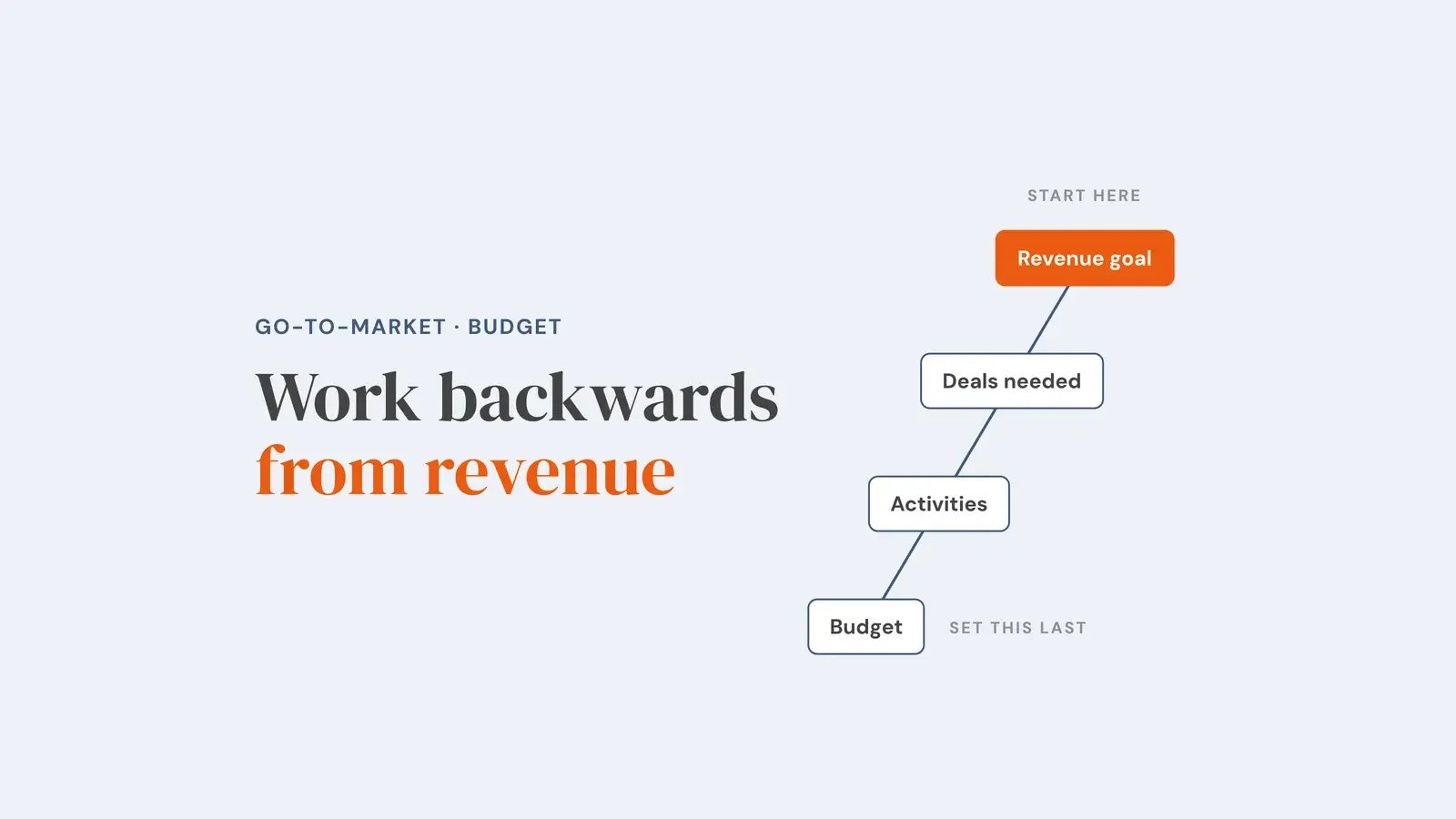
- Redesign your marketing KPIs so every metric connects directly to a business outcome (e.g., replace "website traffic" with "manufacturing sector pipeline generated")
- Establish ongoing alignment mechanisms including quarterly reviews, shared planning cycles, and regular cross-functional check-ins
The entire realignment process typically takes 6–12 weeks from diagnosis to full implementation, though you'll see quick wins within the first month by stopping obvious misaligned activities.
What key criteria ensure ongoing marketing-business alignment?
Sustainable alignment requires four ongoing practices: quarterly alignment reviews between marketing and executive leadership, shared success metrics that connect marketing activity to revenue or strategic outcomes, integrated planning processes that include marketing in business strategy discussions, and feedback loops that allow marketing to adjust as business priorities shift.
Aligned companies treat marketing as a strategic growth lever, not a support function, ensuring marketing leaders have visibility into business performance and authority to shift resources based on changing priorities.
Maintain alignment using these criteria:
- Marketing participates in strategic planning: Your CMO or marketing director attends board/exec meetings and contributes to business strategy, not just executes against it.
- Shared metrics and dashboards: Key stakeholders view the same performance dashboard showing how marketing drives business outcomes.
- Quarterly formal alignment reviews: Structured sessions every 90 days to confirm priorities, adjust strategy, and reallocate resources.
- Commercial accountability: Marketing is measured on business outcomes (pipeline, revenue, customer value) not just marketing activity.
- Integrated planning cycles: Marketing, sales, product, and finance plan together using the same timeframes and assumptions.
Organisations that follow these criteria typically maintain alignment even as business priorities shift, because adjustment becomes routine rather than requiring major realignment projects.
Frequently asked questions about marketing-business misalignment
When I speak with leadership teams about this problem, there are five questions that come up in almost every conversation. Here are honest answers to each.
How long does it take to fix marketing misalignment?
Diagnosis takes 2–3 weeks, strategic realignment takes 6–12 weeks, and you'll typically see measurable improvements within 3–6 months. Quick wins (like stopping obvious low-impact activities) can happen within the first month. Full transformation, where marketing consistently drives business outcomes, usually takes 12–18 months because it requires behaviour change, not just strategy changes.
Who is responsible for ensuring alignment: marketing or executives?
Both, but executives must lead the process. Marketing cannot align itself to business goals it doesn't fully understand or influence. The CEO, board, or exec team must include marketing in strategic planning, communicate priorities clearly, and hold marketing accountable to business outcomes — not just marketing metrics.
Can you fix misalignment without changing your marketing team?
Often, yes, if the root cause is communication gaps or unclear priorities rather than capability issues. Many misalignment problems stem from organisational structure or leadership communication, not marketing team competence. However, if your marketing team lacks commercial literacy or resists outcome-based accountability, you may need to upgrade skills through training or hiring.
What's the quickest win when realigning marketing strategy?
Stop spending budget on activities that don't support your top business priority. Most companies find 15–30% of marketing budget goes to legacy programmes, "nice to have" initiatives, or inherited tactics no one can connect to current business goals. Cutting these immediately frees resources for high-impact work and sends a clear signal that things are changing.
How often should you review marketing-business alignment?
Quarterly reviews are the sweet spot for most businesses. Monthly is too frequent (strategy needs time to work), and annually allows too much drift. Quarterly reviews let you adjust course based on business performance, market changes, and what's working whilst maintaining strategic consistency.
Conclusion
Misalignment is fixable, but only once you've named it clearly.
If your marketing is misaligned, it's costing you more than wasted budget. It's costing you board confidence, sales team morale, and the compounding growth you should be generating.
The frameworks in this article give you clarity on where to start: map your marketing objectives to your top business priorities, run stakeholder interviews to find the gaps, audit your activities using an impact matrix, and rebuild your KPIs around business outcomes rather than marketing activity.
If you want a leadership partner to audit your marketing-business alignment and rebuild it around revenue, not vanity metrics, that's precisely what my Fractional CMO services are designed to do.

About the Author
I'm Tom Wardman, and I help business leaders build marketing capabilities that drive sustainable growth. Having guided marketing teams across various industries through strategic realignment, I specialise in translating business objectives into marketing strategies that actually deliver results. My approach focuses on building internal capability and knowledge transfer, not creating dependency. Whether through fractional leadership, hands-on execution, or team training, I work to ensure your marketing becomes a genuine growth driver aligned with what your business actually needs.
Pricing disclaimer: All GBP–USD price conversions are rounded estimates and correct at the time of publishing. Exchange rates fluctuate and figures should be treated as indicative only.
Topics: