

Are the same problems appearing month after month, like missed deadlines, shrinking margins, team friction, no matter what you try? Have you hired, changed tools, or restructured and found yourself back in the same place six months later?
The issue is almost certainly not what you think it is. Most agency problems keep coming back because they've been misidentified, not because they're unsolvable.
This article is for agency owners and operations leads who want to find out what's actually broken, not guess at it. You'll get a 5-area audit framework, a step-by-step diagnostic process, and a clear way to decide whether to run it yourself or bring in outside help.
Key takeaways
- Broken agency operations shows up as repeating patterns, not isolated failures.
- Most agency leaders misdiagnose their ops problems by treating visible symptoms instead of structural root causes.
- A reliable ops diagnostic covers 5 areas: client delivery, financial health, people and capacity, sales and pipeline, and systems.
- Undiagnosed operational dysfunction typically costs agencies 15%–30% of annual revenue in hidden losses.
- Agencies under 15 people can usually self-diagnose with a structured framework; larger or more complex agencies benefit from external support.
What does 'broken agency ops' actually mean?
Broken agency operations refers to any recurring dysfunction in the systems, processes, or people structures that prevent your agency from delivering work profitably, consistently, and at scale.
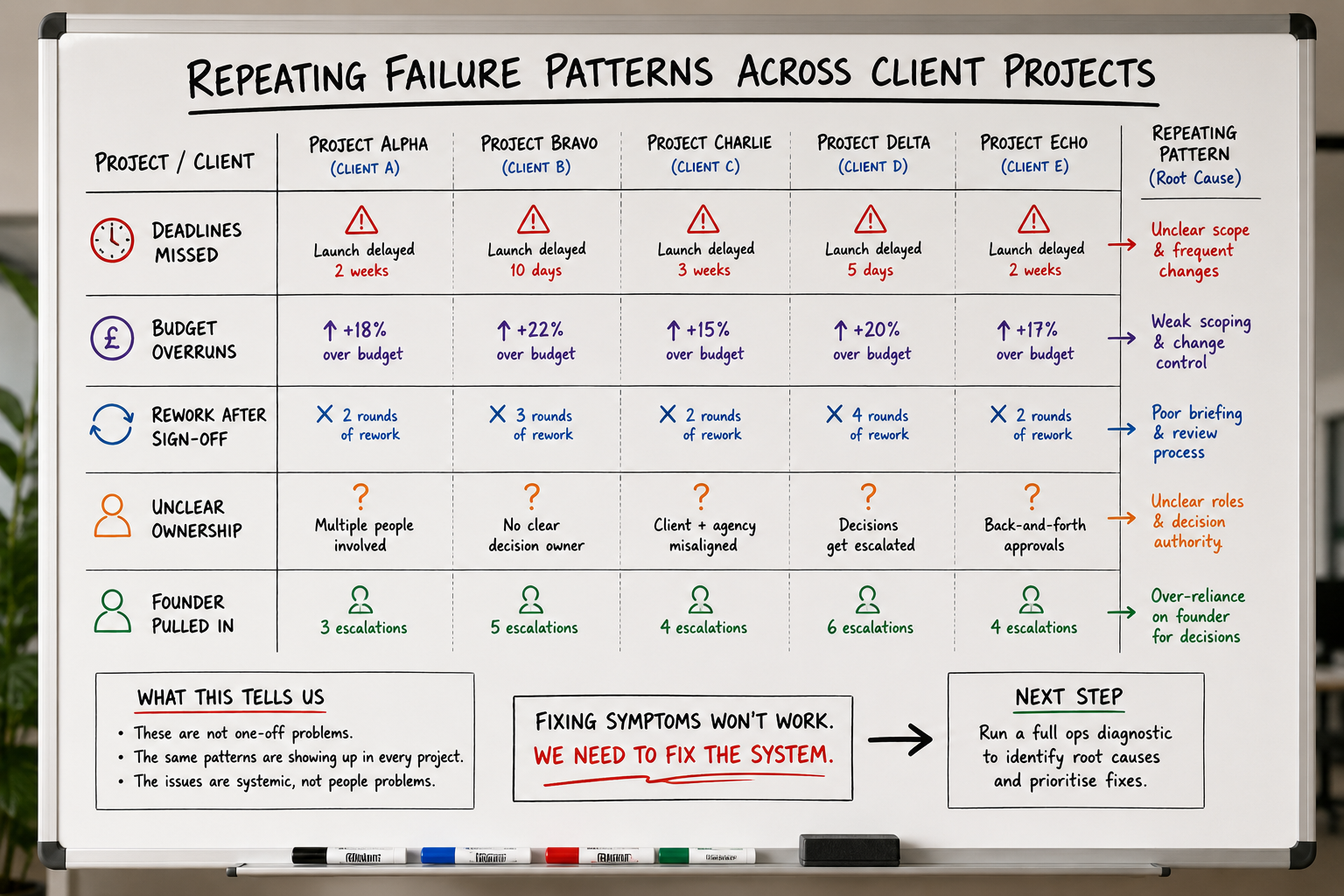
The word "recurring" matters. A one-off project failure is not a broken operation. The same type of failure happening again and again, that is.
These patterns are easy to dismiss individually, but they build quietly into serious financial and cultural damage.
Five hallmarks of operational dysfunction, as opposed to one-off problems:
- Deadlines miss regularly, even on straightforward work
- Margins erode project by project without a clear cause
- Work gets redone after sign-off
- No one is certain who owns a given decision
- The founder gets pulled into every client escalation
Why agencies misdiagnose their own operational problems
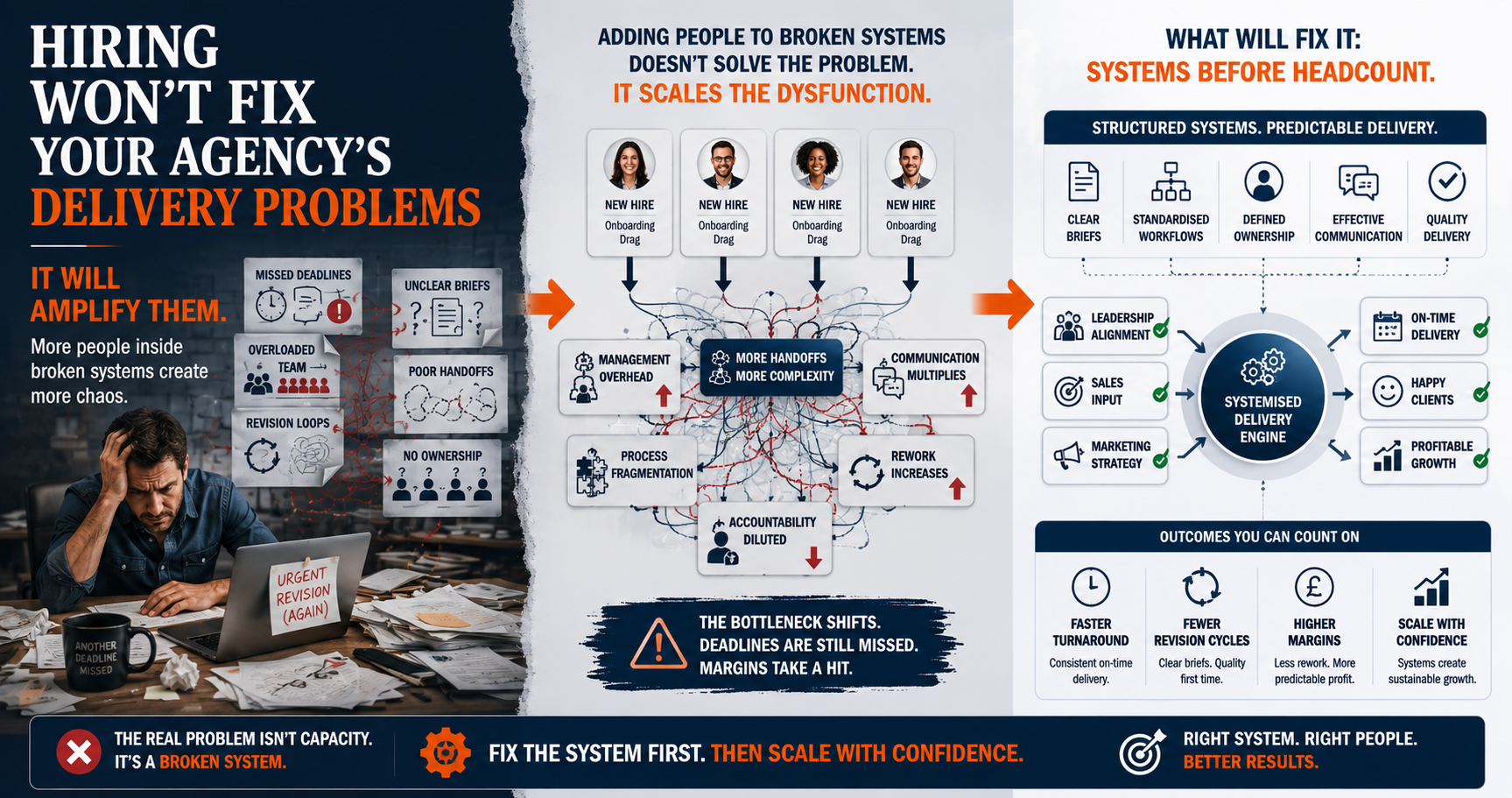
Most agencies treat the symptom rather than the cause, hiring more people to fix a capacity problem when the real issue is poor scoping, or switching project management tools when the actual problem is unclear accountability.
This misdiagnosis happens because the people closest to the pain are inside the system, reacting in real time. They don't have the distance to see the full picture.
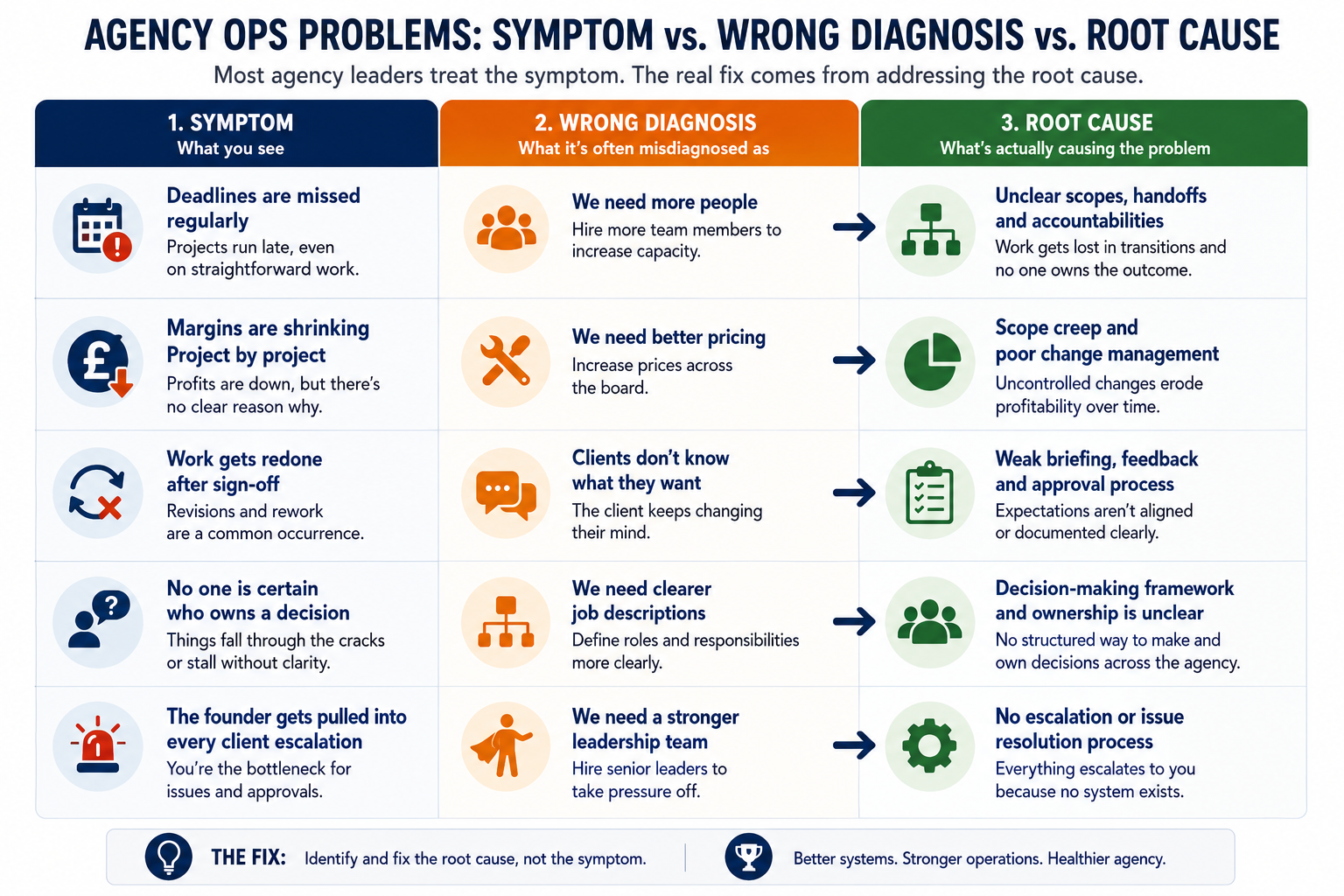
Fixing the wrong thing doesn't just waste money. It often makes the real problem harder to see.
The 5 core areas to audit in any agency operations diagnostic
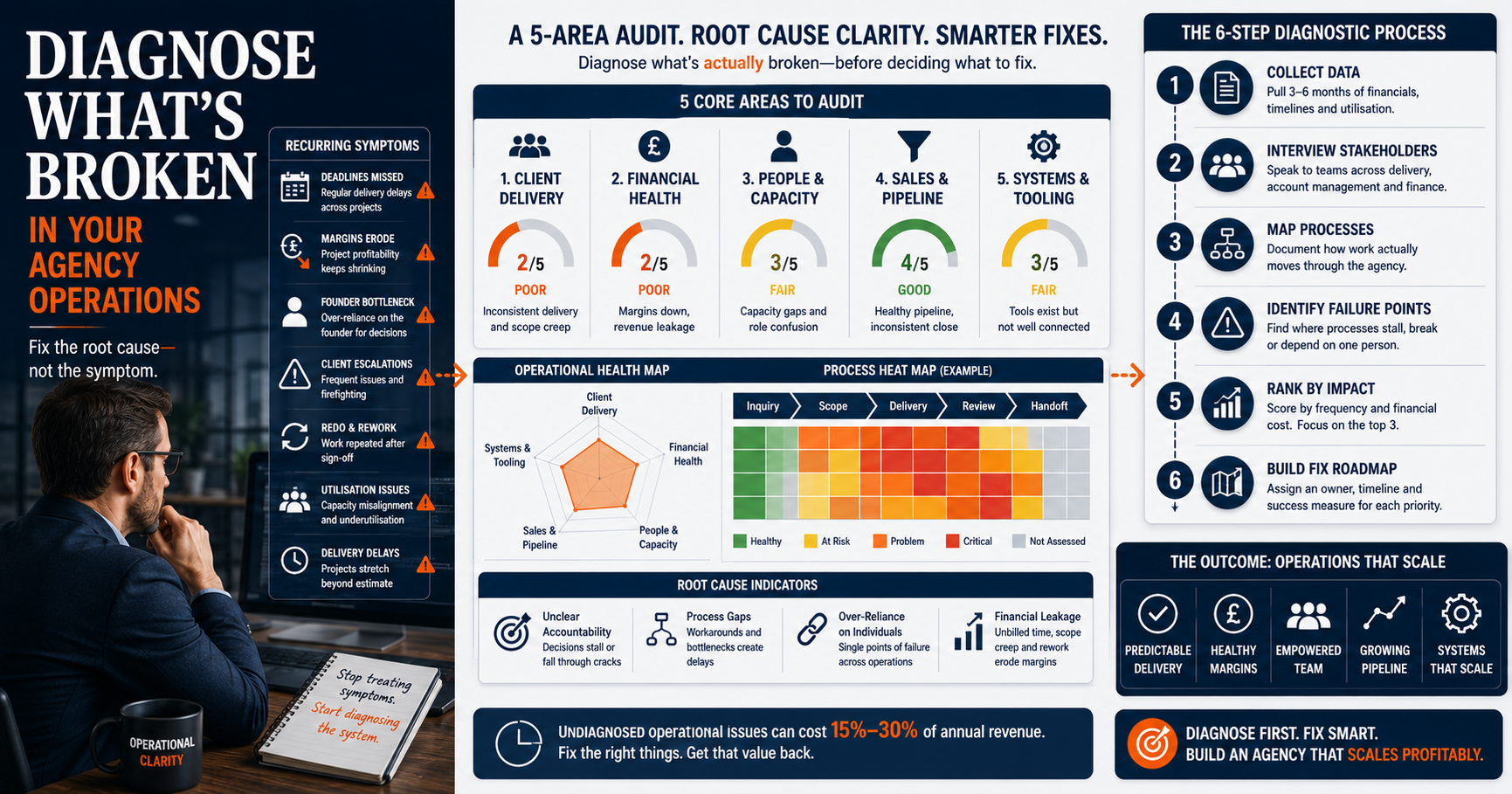
A reliable agency ops diagnostic covers 5 functional areas: client delivery, financial health, people and capacity, sales and pipeline, and internal systems and tooling.
Auditing all 5, not just the loudest one, is what separates a real diagnosis from a reactive fix that creates a new problem somewhere else.
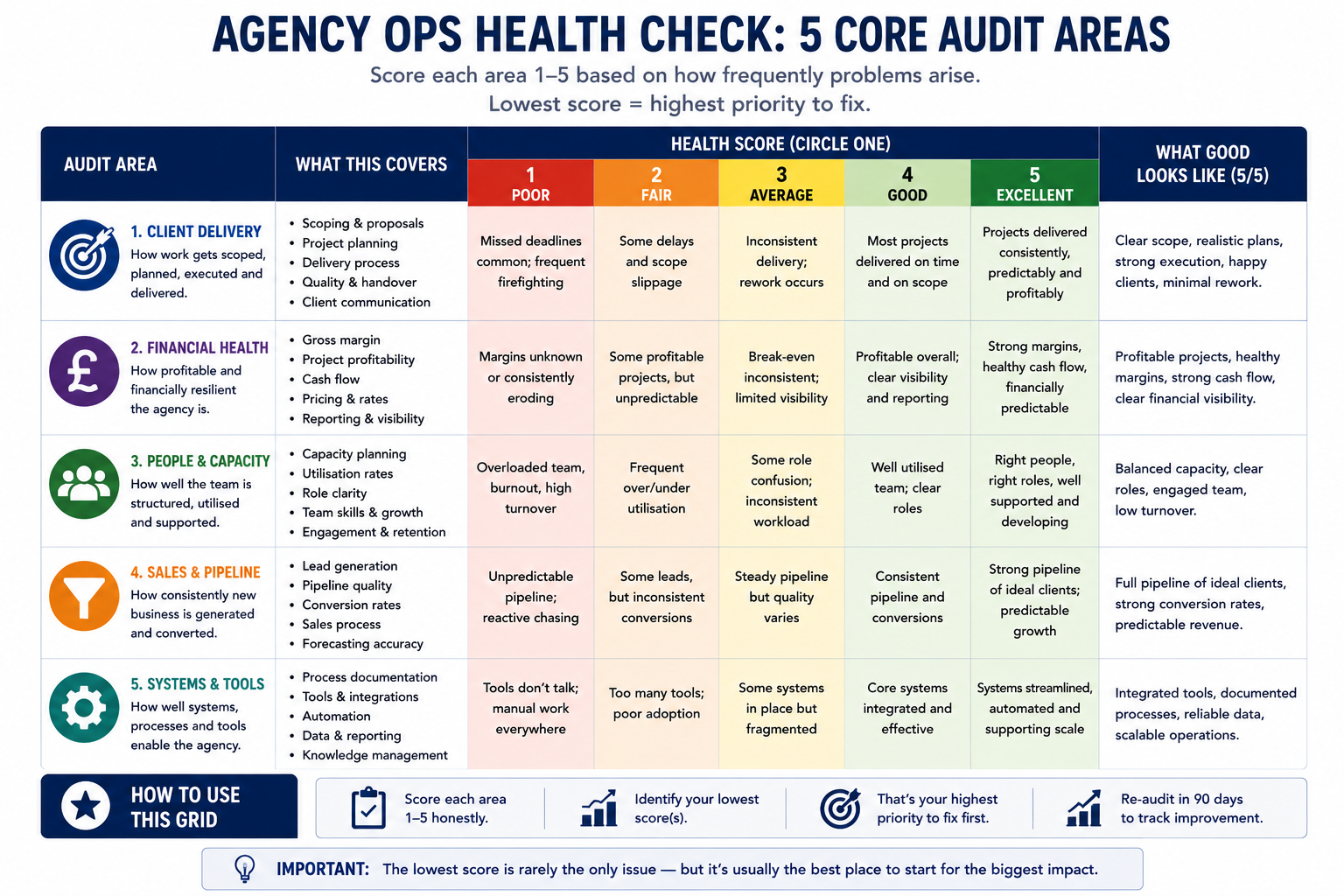
Score each area 1–5 based on how frequently problems arise. The lowest-scoring area is rarely the only one that needs attention, but it's usually the right place to start.
Step-by-step: how to run an agency ops diagnosis
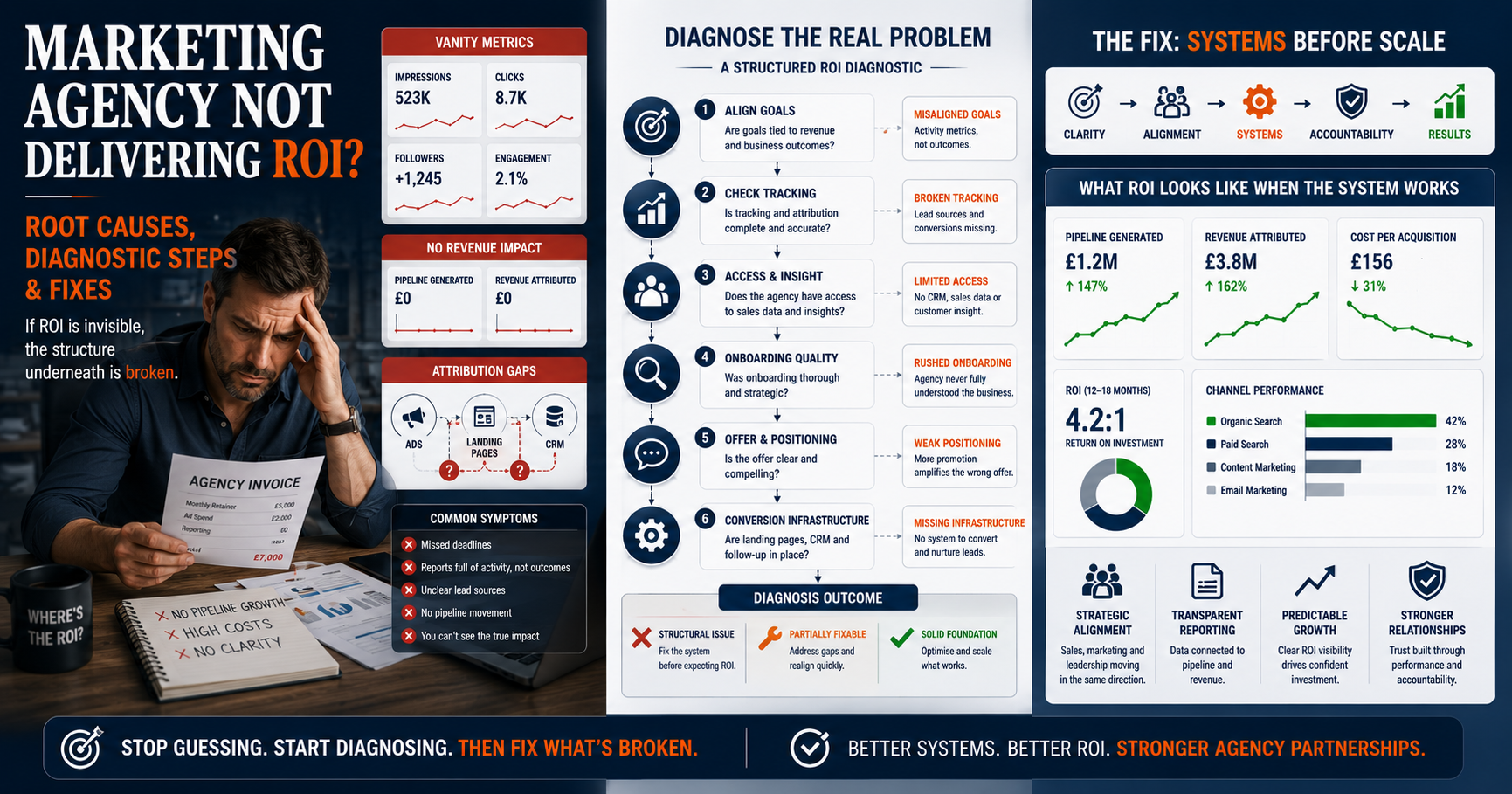
Running a structured agency ops diagnosis takes between 1 and 3 weeks and follows a clear sequence: gather data, interview stakeholders, map processes, identify failure points, and rank by impact.
Skipping the data-gathering phase, or mapping processes without speaking to your team first, is the most common reason these exercises produce nothing actionable.
- Collect data: Pull 3–6 months of project financials, delivery timelines, and utilisation reports. Don't rely on memory.
- Interview stakeholders: Speak to 4–6 people across delivery, account management, and finance. Ask what's breaking, not what they'd fix.
- Map current processes: Document how work actually moves through your agency, not how it's meant to.
- Identify failure points: Mark where processes stall, break down, or depend on one person to hold them together.
- Rank by impact: Score each failure point on frequency and financial cost. Focus on the top 3.
- Build a fix roadmap: Assign an owner, a timeline, and a success measure to each priority before you change anything.
The real cost of leaving broken agency ops undiagnosed
Undiagnosed operational dysfunction typically costs agencies between 15% and 30% of annual revenue, in rework, staff turnover, client churn, and unbilled time.
Note: This range is an estimate drawn from operational benchmarks reported by the Agency Management Institute and similar consultancy research; no single published study covers all categories, so treat it as indicative.
Because these costs are spread across projects, timesheets, and HR budgets, most agency leaders significantly underestimate the damage until they run a formal audit.
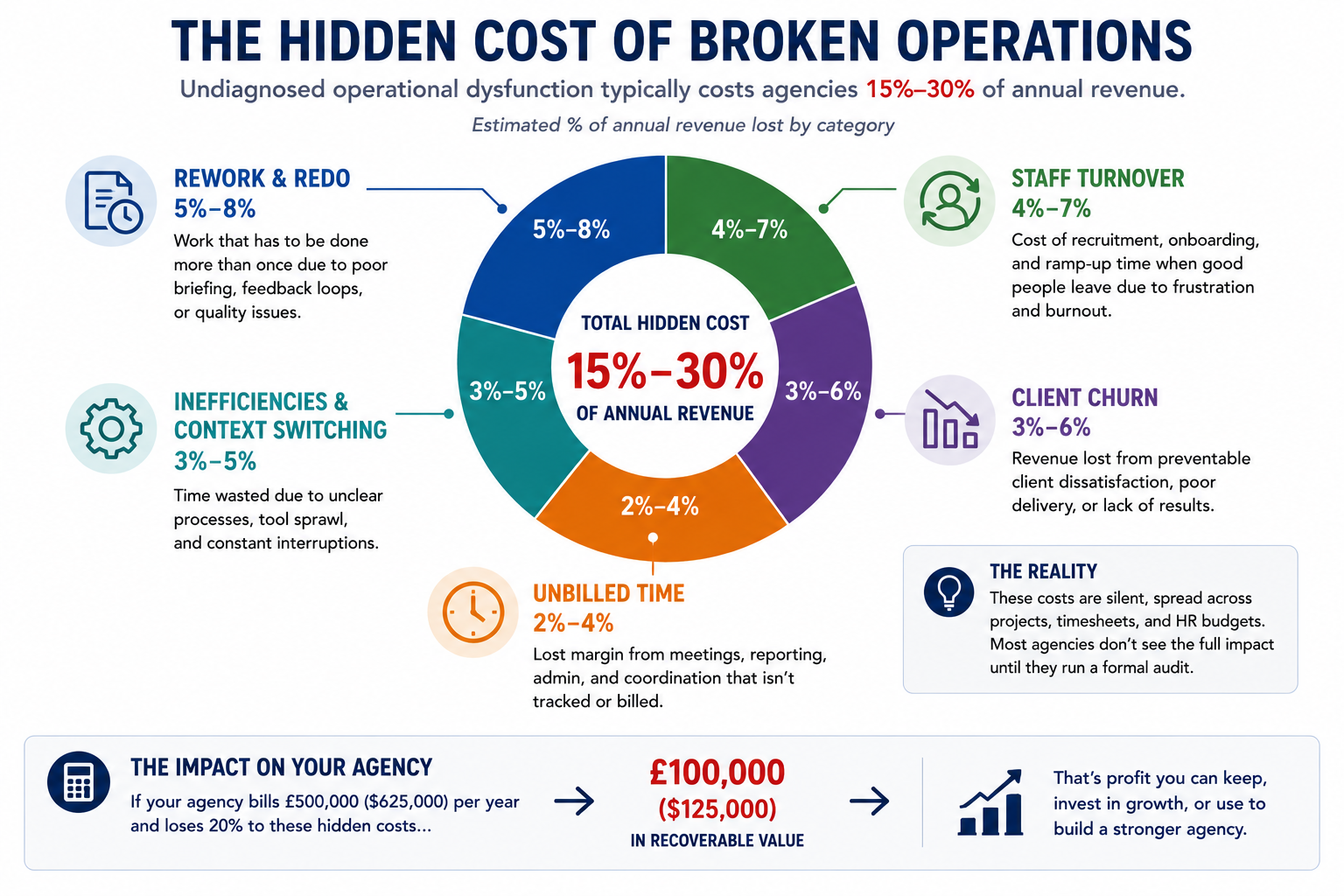
A simple check: if your agency bills £500,000 ($625,000) per year and loses 20% to these hidden costs, that's £100,000 ($125,000) in recoverable value, before you win a single new client.
DIY diagnosis vs. hiring an agency ops consultant: which is right for you?
Note: I offer an agency ops diagnostic service myself, so I have a commercial interest in recommending external support. I've aimed to give you honest criteria for deciding either way.
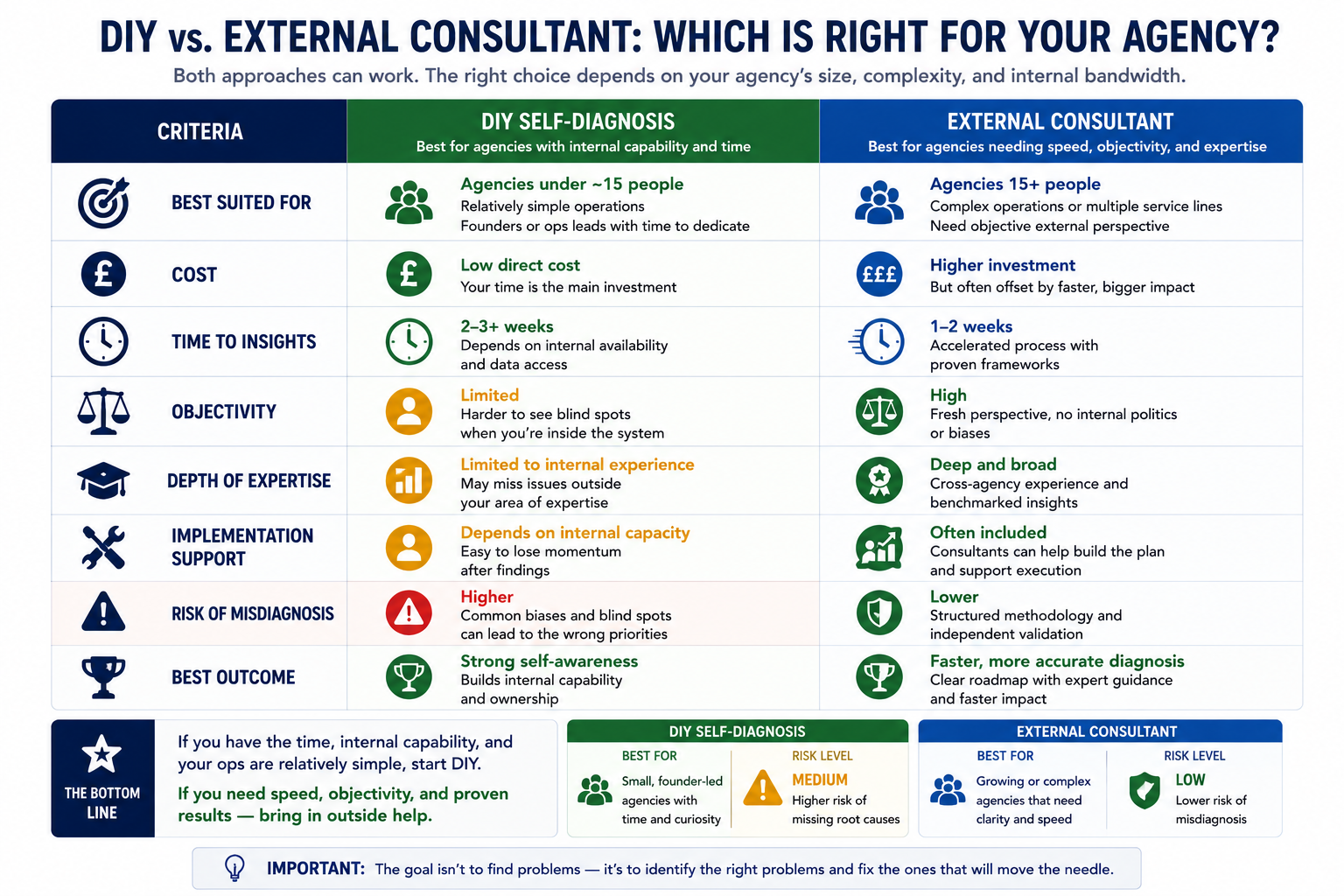
Agencies under 15 people with a willing leadership team can usually run a credible self-diagnosis using a structured framework. Agencies above that size, or those with deeply entrenched cultural issues, typically get more accurate results from an external consultant.
The key trade-off is objectivity. Internal teams often lack the psychological safety to surface the real problems, particularly when the root cause involves founder behaviour or leadership gaps.
Frequently asked questions about diagnosing agency ops
The most common questions agency leaders ask about ops diagnosis centre on timing, team involvement, and what to do once the findings are in.
How long does an agency ops diagnosis take?
Between 1 and 3 weeks for most agencies. Larger agencies with more complex structures may need up to 6 weeks to gather sufficient data across all 5 audit areas.
Who in the agency should be involved?
At minimum: the founder or MD, a delivery lead, and a finance or ops manager. Include account managers if client delivery is the primary area of concern.
What do I do once I know what's broken?
Rank fixes by impact and effort. Address the top 3 issues before touching anything else. Trying to fix everything simultaneously produces nothing.
Will the diagnostic process slow down delivery?
Stakeholder interviews take 30–45 minutes per person. Data collection runs in parallel with live work. A well-run diagnostic causes minimal disruption.
How often should we run an ops audit?
Once formally when recurring problems first surface, then as a lighter review every 6–12 months as the agency grows and changes structure.
Where do you go from here?
You've spent months, possibly years, working around the same problems without fully understanding what's driving them. Now you have a framework to separate a symptom from a root cause, and a clear process to identify which of the 5 operational areas is actually breaking down.
The most common mistake at this point is still doing nothing, waiting for a quieter moment that never comes. Every month you delay the diagnostic is another month of margin erosion, rework costs, and avoidable churn, costs that accumulate silently until they force a crisis.
How to take action now
- Score your agency across the 5 audit areas on a 1–5 scale today
- Identify your 3 lowest-scoring areas and pull 3 months of data for those first
- Interview at least 3 team members using a consistent set of questions
- Map the process for your most common project type and mark exactly where it breaks
- Decide whether you'll run the full diagnostic internally or bring in outside support
Related reading
-
Why Hiring Won't Fix Your Agency's Delivery Problems, and What Will
-
Why Agency Growth Stalls at Founder Capacity (Even With a Team)
If you'd rather have the diagnostic done properly and quickly, my Systems Audit gives you a prioritised operational roadmap in 3 weeks, from £2,500 ($3,125). See full transparent pricing or book a scoping call; no pitch, no pressure, just a clear picture of where your agency is breaking down and what to do first.

About the author
Tom Wardman is an agency operations and growth consultant who works with digital marketing and creative agencies to build the systems, processes, and leadership structures needed for profitable, founder-independent growth. Having worked inside and alongside agencies for years, Tom designed the Agency Operating System™, a structured framework for replacing operational fragility with predictable, owned performance.
Pricing disclaimer: All GBP–USD price conversions are rounded estimates and correct at the time of publishing. Exchange rates fluctuate and figures should be treated as indicative only.
Topics: