



Are you evaluating a marketing agency that sounds impressive in the pitch but vague when you ask for specifics? Are you wondering whether those promises will hold once a contract is signed?
If so, you're likely feeling at least one of these right now: a growing sense that budget is about to be committed to promises that can't be verified; pressure from the business to do something about growth; or the quiet fear that getting this wrong will cost you credibility as much as it costs the company money. Those concerns are well-founded. Bad agency relationships don't just drain budget, they stall momentum, lock you out of your own accounts, and leave your team starting over months later.
Having worked on both sides of the agency–client relationship, in-house at growth-stage B2B businesses and alongside agencies serving clients from £500k ($625k) to £20m ($25m) in revenue, I've seen exactly how misleading language enters the pitch process and how it damages businesses that don't spot it in time.
This article gives you a clear framework for spotting misleading claims before you spend a penny. By the time you've finished reading, you'll be able to confidently identify and reject the 7 most common marketing agency red flags within a single proposal review, with the counter-questions to ask before you sign anything.
It's written for founders and marketing leaders at the evaluation stage, before any budget changes hands.
Key takeaways
- A marketing agency lie is any claim that creates a false expectation about results, ownership, process, or pricing, deliberate or not.
- The 7 most common lies agencies tell cover guarantees, proprietary processes, asset ownership, vanity metrics, full-service claims, exclusivity, and unrealistic timelines.
- Honest agencies confirm asset ownership in writing, report on revenue outcomes, and give you a line-item cost breakdown before you sign anything.
- Businesses typically lose 3–12 months of marketing momentum recovering from a poor agency relationship (estimated figure based on reported client recovery patterns, no single industry benchmark currently exists).
- A five-step vetting process, completed before signing, removes the majority of agency risk before any budget is committed.
What counts as a marketing agency 'lie', and why does it matter?
A marketing agency lie is any claim, guarantee, or framing that creates a false expectation about results, ownership, process, or pricing, whether made deliberately or through careless optimism.
It's worth being direct about this: most agencies don't set out to mislead. Many of these patterns emerge from sales culture, internal pressure to close deals, or genuine optimism about what's possible. That doesn't make them less damaging to the businesses on the receiving end, but it does mean the solution is asking better questions, not assuming bad intent.
These misleading statements almost always surface during the sales pitch, before any contract is signed. That's what makes them damaging. By the time a claim proves false, you've already committed budget, time, and internal credibility to the decision.
Here's a representative example of how this plays out: a founder is promised "full ownership of all assets." That's said on the introductory call. It never makes it into the contract. Twelve months and £30,000 ($37,500) later, when the relationship breaks down, the agency retains access to the ad accounts and the website CMS. The founder must rebuild from scratch. This pattern, verbal assurance and absent contract clause makes for a costly exit, one that is a commonly reported failure in agency relationships.
The cost goes beyond the monthly fee. A poor agency relationship typically means lost access to your own accounts, months of marketing inertia, and the full process of finding and onboarding a replacement, none of which appears on an invoice.
The 7 patterns below are the ones that appear most consistently in failed agency relationships.
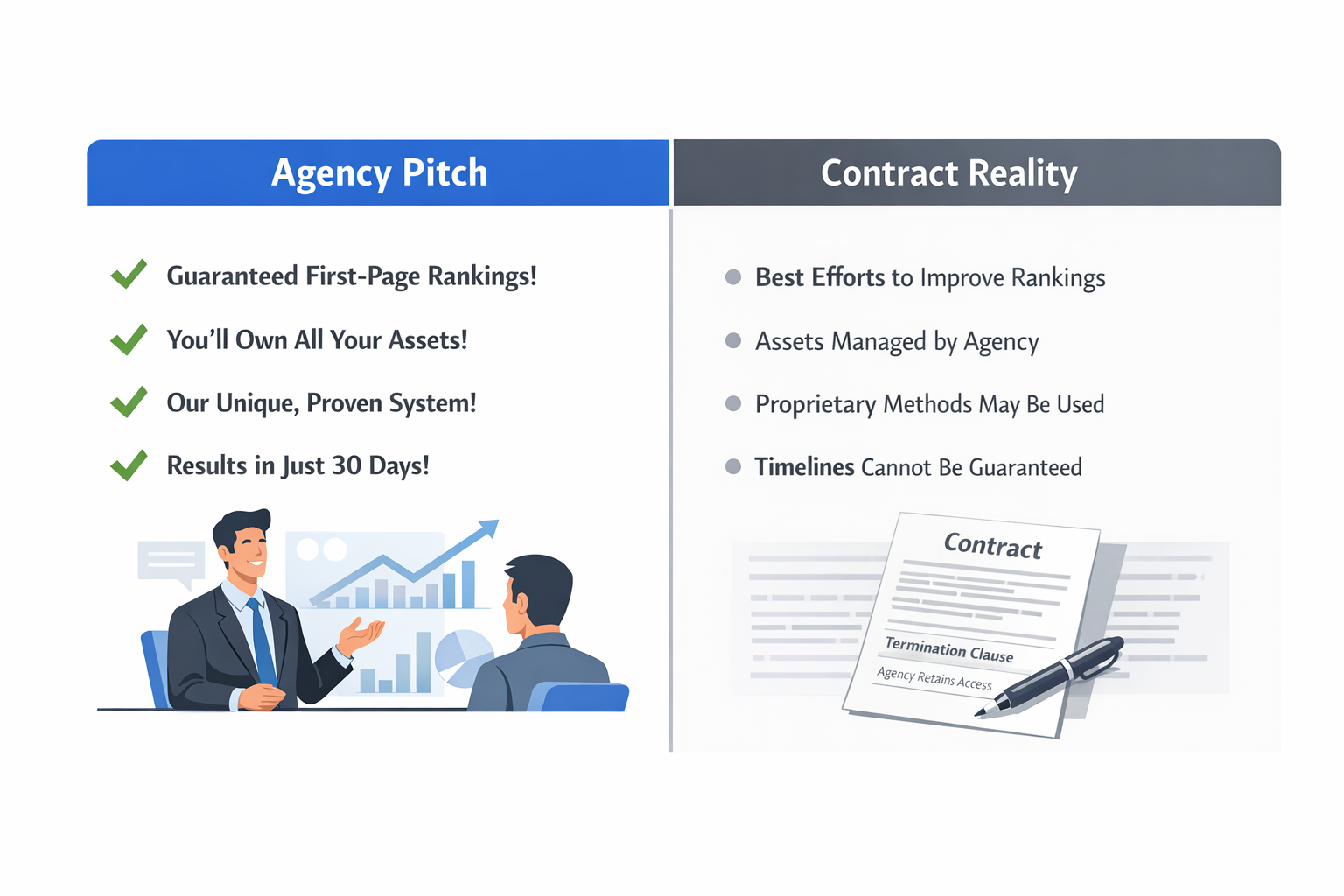
The 7 most common marketing agency red flags
The 7 most common lies are: guaranteed search rankings, vague proprietary processes, verbal promises of asset ownership, vanity metrics dressed up as ROI, full-service capability claims, industry exclusivity, and guaranteed results within 30 days.
Each one is designed, consciously or not, to win the sale rather than set an accurate expectation.
Red flags about guarantees, process, and who owns what (lies 1–3)
| # | The lie | Why it's misleading | Real-world example | Listen for |
|---|---|---|---|---|
| 1 | "We guarantee page-one Google rankings" | Google explicitly states no one can guarantee organic rankings | An agency wins the contract promising first-page positions. Six months in, rankings have barely moved. The contract has no recourse clause. | "Guaranteed results", "top positions" |
| 2 | "We use a proprietary methodology" | Rarely documented or verifiable; usually standard practice repackaged | Ask to see the methodology before signing. Most agencies respond with something like "we'll walk you through it once we've scoped the project", which typically means there's no documented framework to share. | "Proprietary", "unique system" |
| 3 | "You'll own all your assets" | Ownership of accounts, content, and IP must be confirmed in writing, not said verbally | A business exits after 9 months. The agency retains admin access to the Google Ads account. The client must rebuild their campaign history from zero. | "Everything is yours" (said on a call, never signed) |
Red flags about results, exclusivity, and timelines (lies 4–7)
| # | The lie | Why it's misleading | Real-world example | Listen for |
|---|---|---|---|---|
| 4 | "Look at our impressions and engagement" | Impressions don't pay invoices; revenue-linked metrics are what matter | Monthly reports show growing reach and engagement. Pipeline hasn't moved in four months. The agency has no answer for why. | "Reach", "visibility uplift", "awareness" |
| 5 | "We're a true full-service agency" | Most agencies subcontract large portions of execution — which creates three problems: quality inconsistency (you don't know who's actually doing the work), accountability gaps (the agency can blame the freelancer), and margin pressure (subcontractors are often briefed quickly and paid little) | The agency wins the content brief. The actual writing is outsourced to a freelancer you've never met, with no editorial oversight. | "We handle everything end to end" |
| 6 | "We only work with one business per industry" | Exclusivity is rarely contractual or enforced | A competitor signs with the same agency three months later. The exclusivity was never written into either contract. | "Exclusive partner", "no conflict of interest" |
| 7 | "You'll see results within 30 days" | Most content and SEO programmes take 3–12 months to compound | Quick wins are promised. A month in, the only deliverable is a "strategy document." There's no plan for what happens after. | "Quick wins", "immediate impact", "fast results" |
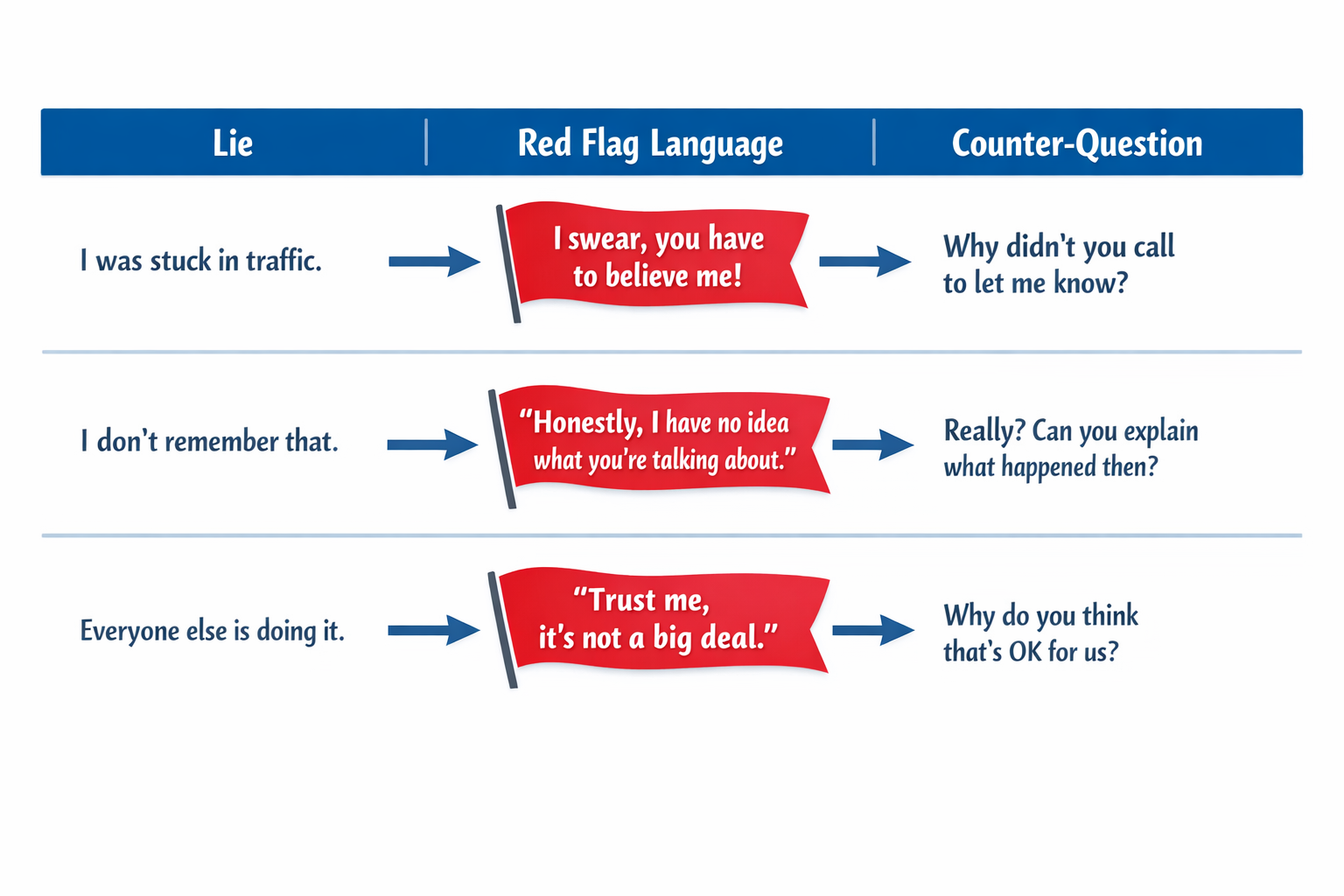
What to ask instead: the questions that cut through agency spin
For every common agency lie, there is a direct, verifiable counter-question that forces specificity and reveals whether a promise can actually be kept.
This is the moment where buyer control shifts. Asking these questions before signing, not after, separates transparent agencies from those relying on vague language to close deals. In practice, most agency pitches are structured to maintain forward momentum: discovery call, proposal, onboarding. These questions interrupt that flow. The agencies that welcome the interruption are the ones worth talking to. The ones who deflect are telling you something important.
| Lie / spin phrase | Counter-question to ask | What a good answer looks like |
|---|---|---|
| "Guaranteed rankings" | "Can you show me Google's policy on ranking guarantees?" | Acknowledges they cannot guarantee rankings; explains what they can influence |
| "Proprietary process" | "Can I see your documented methodology before I sign?" | Shares a clear, step-by-step framework upfront |
| "You'll own everything" | "Can you confirm ownership of all accounts and content in the contract?" | Confirmed in writing, not verbally — with specifics on ad accounts and creative |
| "Look at our engagement" | "Can you show a case study with revenue or pipeline outcomes?" | Revenue or qualified lead data, not impressions or follower counts |
| "We're exclusive in your sector" | "Is that exclusivity clause in the written contract?" | A defined exclusivity clause with named boundaries and enforceable terms |
If you want to pressure-test an agency fast, use these two questions, most buyers never ask them:
- "What happens to my accounts if I cancel with 30 days' notice tomorrow?": A good agency answers this without flinching. A bad one becomes vague or defensive.
- "Can I speak to a client you've lost — not just your success stories?": Almost no agency volunteers this. The ones willing to provide it are demonstrating genuine confidence in their work.

If you want to avoid overpaying for unclear retainers, and understand what genuine pricing transparency looks like, read this article: Why Every Agency Should Publish Their Pricing.
What does honest marketing agency pricing actually look like?
Transparent marketing agency pricing clearly separates management fees, ad spend, software costs, and any performance bonuses, with no bundled fees that obscure where money is actually going.
Honest agencies provide this breakdown unprompted. When an agency resists giving a clear cost structure, that reluctance is itself a red flag worth noting.
Today, typical UK agency pricing falls into three models:
| Fee model | What it should cover | Typical UK range |
|---|---|---|
| Monthly retainer | Strategy, content, account management, reporting | £1,500–£10,000/month ($1,875–$12,500) |
| Project-based | Audits, website builds, one-off campaigns | £2,500–£20,000 ($3,125–$25,000) |
| Performance-based | % of attributed revenue or leads generated | 10–20% of attributed revenue |
Note: Ranges are estimated 2026 UK market figures based on published agency pricing data and market observation. Actual costs vary by sector and agency size.
Why does agency pricing vary so widely?
The gap between £1,500 ($1,875) and £10,000 ($12,500) per month is not arbitrary. The key drivers are:
- Team seniority: Cheaper agencies often assign junior account managers once the pitch team has closed the deal
- Work done in-house vs. subcontracted: Full-service claims frequently mask a subcontracting model where execution is outsourced to freelancers at thin margins
- Strategy depth: Lower-priced retainers typically cover execution only; genuinely strategic work commands a premium because it requires experienced people to deliver it
- Reporting quality: Agencies that invest in revenue-attributed reporting have higher overheads and price accordingly
What low pricing usually signals
A retainer priced significantly below market rate (below £1,500/$1,875/month in the UK) almost always involves one or more of the following: subcontracted execution, a junior team, template-driven strategy, or a model that depends on volume to be commercially viable. None of these are automatically disqualifying, but they should be understood before you sign.
If you're an early-stage business that needs execution over strategy, a lower-cost model can make sense, provided you understand exactly what you're buying and who is doing the work. The risk comes when low pricing is presented as full-service senior expertise. That gap between what's implied and what's delivered is where most agency disappointment originates.
Good value at any price point means: Knowing what you're getting, who will do the work, how results will be measured, and what happens to your assets if you leave. If you can get clear answers to all four, the fee is secondary.
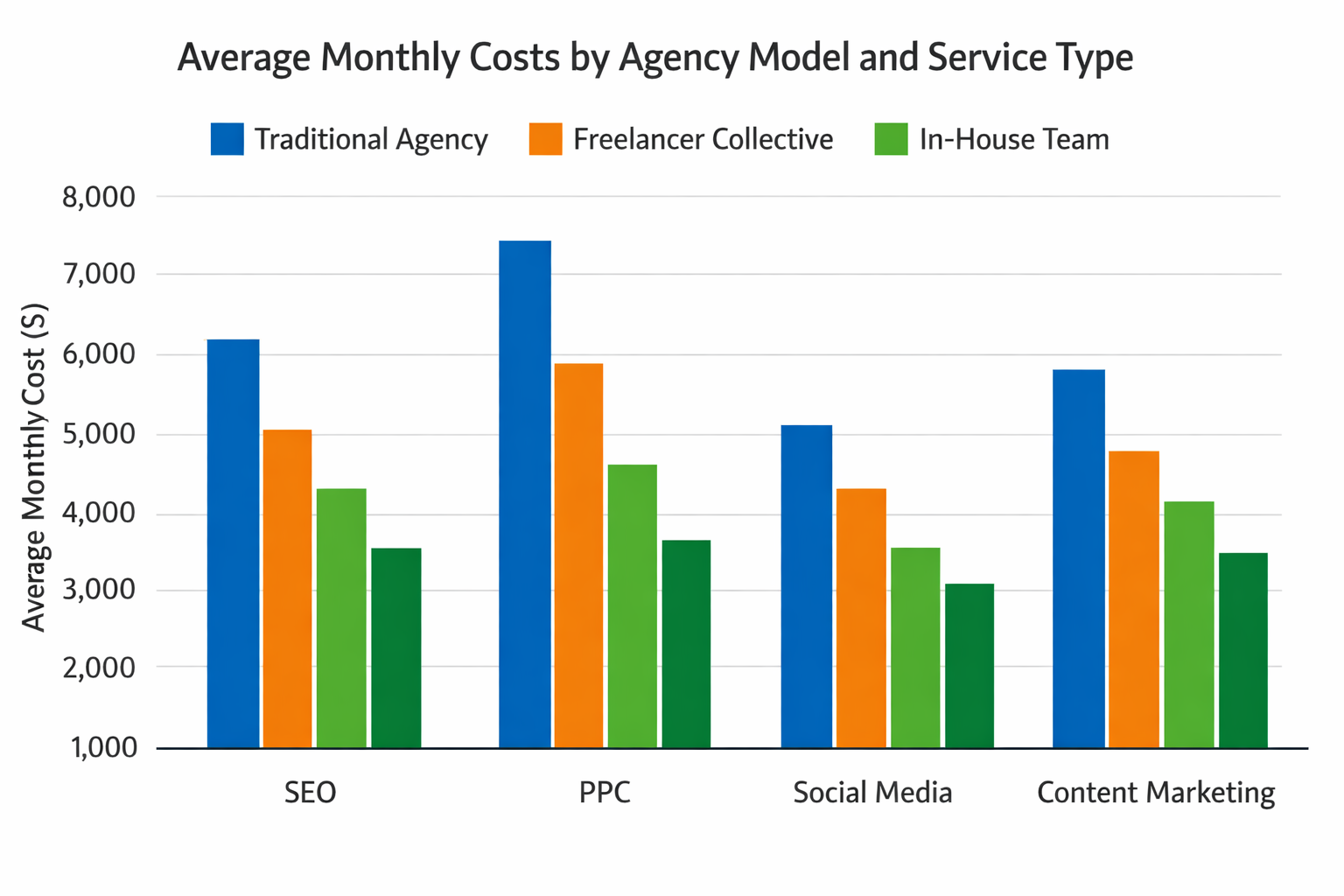
If you want to understand exactly what sits behind a typical retainer fee, and what you should expect for your budget, read this article: What You're Really Paying For with a Marketing Retainer.
The hidden costs of hiring the wrong marketing agency
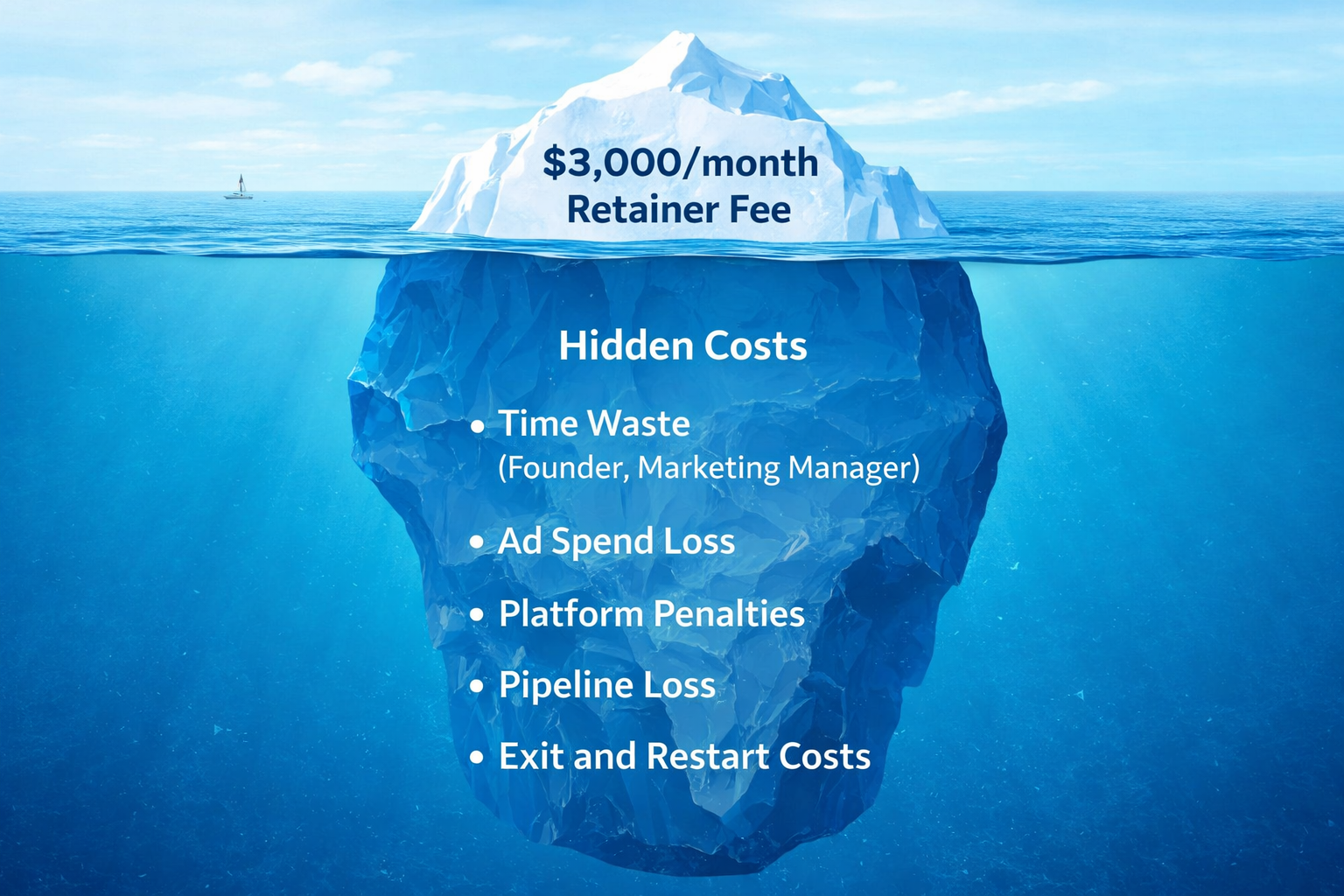
The true cost of a misleading agency extends well beyond the monthly retainer, to wasted ad spend, internal time, potential platform penalties, and the cost of starting the whole process over.
Businesses typically absorb all of the following when an agency relationship fails:
- Retainer fees paid for underperforming work, often 6–12 months before anyone acts
- Mismanaged ad spend, estimated at £5,000–£25,000 ($6,250–$31,250) per year for UK SMEs (estimated; no single published benchmark exists)
- Google Ads quality score damage from poorly structured campaigns, which can take months to recover
- Internal time cost, founder or marketing manager hours spent managing, chasing, and reviewing agency output
- Brand and trust damage, off-brand content or poor SEO practice that harms your visibility in both traditional and AI-powered search
To put a realistic figure on it: a business on a £3,000/month ($3,750/month) retainer that stays with an underperforming agency for 9 months, while running £2,000/month ($2,500/month) in mismanaged ad spend, could absorb £45,000+ ($56,250+) in direct costs, before accounting for internal time, lost pipeline, and the cost of starting over. That total never appears on a single invoice. It accumulates line by line.
It's useful to separate these into two categories. The visible costs, retainer fees, ad spend, appear on invoices and are easy to track. The invisible costs, quality score damage, lost momentum, internal time, brand harm, don't show up anywhere until the damage is already done. This is why cheap agencies so often become expensive decisions: the upfront fee looks low while the invisible costs quietly compound.
Businesses typically lose 3–12 months of marketing momentum recovering from a poor agency relationship. That cost never appears on any invoice.
Honest agencies vs. misleading ones: how do they actually compare?
Honest and misleading agencies differ most clearly across five dimensions: reporting transparency, asset ownership, timeline realism, case study quality, and fee clarity.
| Dimension | Honest agency | Misleading agency |
|---|---|---|
| Reporting | Revenue and pipeline outcomes | Impressions, reach, and vanity metrics |
| Asset ownership | Confirmed in writing before signing | Assumed verbally, avoided in contracts |
| Timeline promises | Realistic 3–12 month projections | "30-day results" guarantees |
| Case studies | Named clients with revenue or pipeline data | "A client in your sector" — no specifics |
| Fee structure | Line-item breakdown provided upfront | Bundled retainer with vague scope |
Comparing these dimensions side by side during the proposal stage lets you make a confident decision before any budget is committed. If you see the right-hand column appearing consistently in a proposal, vague metrics, verbal ownership assurances, 30-day guarantees, you now know exactly what that signals.
Now that you know how to identify misleading agencies, the next step is understanding how to evaluate them before you sign.
5 steps to vet a marketing agency before you sign anything
Knowing how to choose a marketing agency well comes down to one thing: asking the right questions before you commit, not after. The marketing agency red flags covered above give you the language to identify problems. This five-step process gives you the structure to act on them.
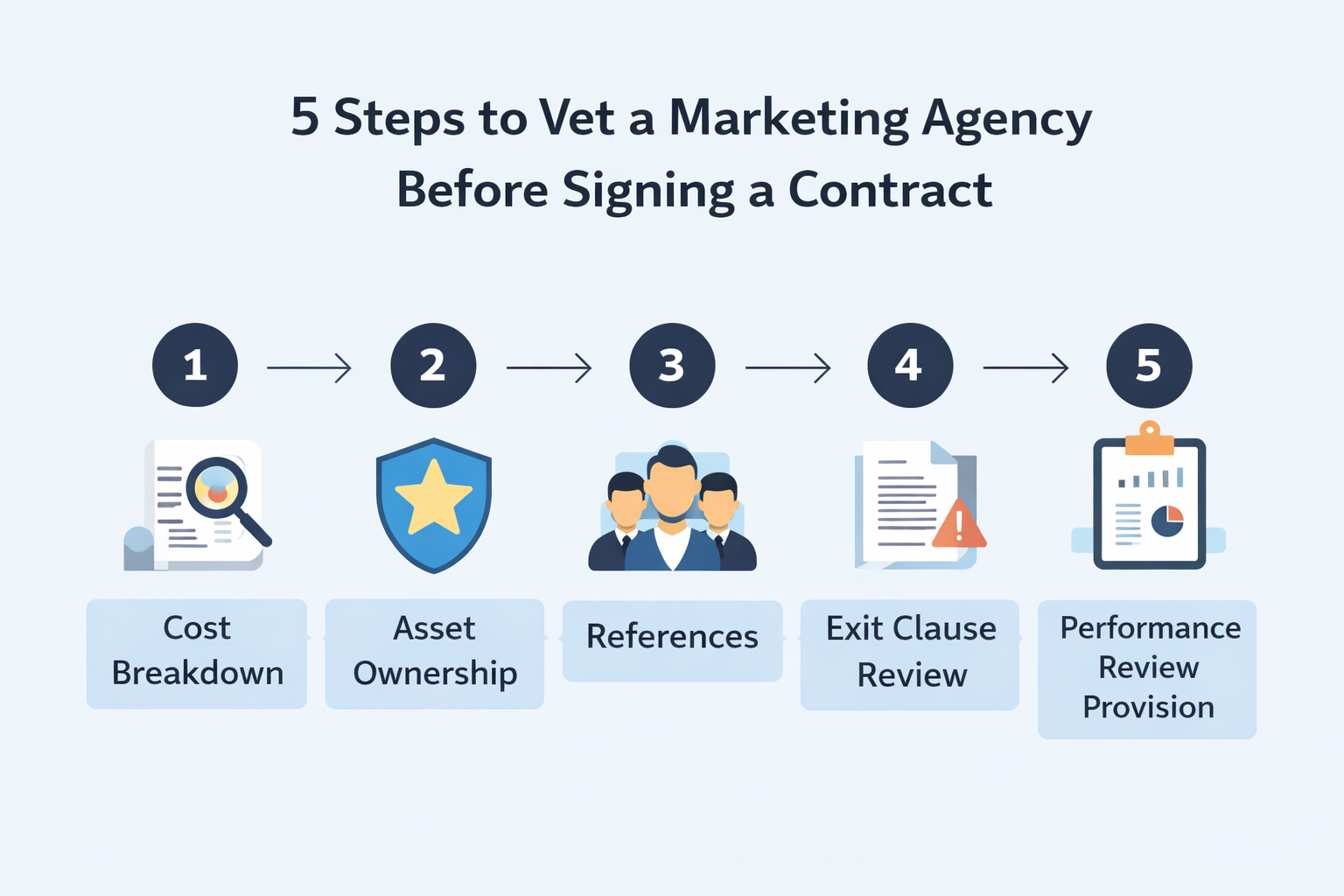
To vet a marketing agency effectively before committing, work through these five steps before signing anything:
- Request a line-item cost breakdown: Management fees, ad spend, software, and any performance elements should be separated clearly
- Confirm asset ownership in writing: Not verbally; this must be in the contract before you sign
- Ask for three client references in your sector: Contact them independently
- Review the exit clause: Understand exactly what notice is required and what happens to your accounts and assets if you leave
- Insist on a 90-day performance review provision: With agreed metrics, so underperformance can be documented and addressed early
This process can be completed in under two weeks and significantly reduces the most common sources of agency risk before significant budget is spent. It won't eliminate all risk, no vetting process can, but it removes the gaps that cause the most expensive failures.
What should I look for in a marketing agency contract?
Focus on three clauses:
- Asset ownership: Who legally owns the website, ad accounts, and all creative produced?
- Exit terms: What notice is required, and what happens to your assets if you leave?
- Reporting obligations: What will be measured, how often, and in what format?
Red flag: any contract that avoids, delays, or deflects on any of these three points. If you hear this, pause immediately, a reputable agency will not need to hesitate.
How do I check a marketing agency's real track record?
Ask for three client references in your industry and contact them independently. Ask: "Did results match what was promised, and did you retain full ownership of your accounts when the engagement ended?"
A reputable agency gives references without hesitation.
Frequently asked questions about marketing agency honesty
Can a marketing agency genuinely guarantee Google rankings?
No agency can guarantee specific organic search rankings. Google's own documentation explicitly states this. Any agency making this promise is either misinformed or deliberately overstating what they can deliver.
Who legally owns my website, ad accounts, and creative assets?
Ownership depends entirely on what is written in your contract — not what is said verbally. Unless ownership is explicitly assigned to you in writing before signing, the agency may retain rights to accounts, content, and creative on exit.
How long should I realistically wait to see results from a marketing agency?
Most content, SEO, and brand programmes take 3–12 months to produce meaningful results. Paid search can work faster, but sustainable pipeline growth is rarely visible under 90 days. Any guarantee of significant results within 30 days warrants close scrutiny.
How can I tell if an agency's reported metrics are genuine?
Ask for metrics tied to revenue, qualified leads, or pipeline contribution — not impressions or follower counts. If an agency cannot link their activity to commercial outcomes, that is a structural gap worth understanding before you commit.
How do I exit a contract with a marketing agency that isn't delivering?
Review your exit clause and document underperformance in writing before serving notice. If the agency refuses to transfer accounts or assets you legally own on exit, this becomes a contractual matter; seek legal advice if they fail to comply.
Conclusion
You came to this article because something felt off, a pitch that sounded too confident, promises that couldn't quite be pinned down, or a nagging sense that you were being sold to rather than advised.
You now have the language for what that feeling was pointing at. The 7 most common marketing agency red flags are not obscure or rare, they appear in almost every agency pitch. The difference is knowing what to listen for, and having the questions to ask when you hear them.
The risk of getting this wrong is real. A poor agency relationship doesn't just cost money, it costs momentum, credibility, and months of marketing progress your business won't get back. Most of that damage is invisible until it's already done.
Instead of relying on instinct, you now have a structured way to evaluate any agency with confidence. Businesses that apply this framework don't just avoid bad agencies, they enter every new relationship on better terms, with clearer expectations and better contractual protection from day one.
Use the counter-questions. Run the five-step vetting process before you sign. Insist on written ownership confirmation. And if any agency resists those steps, that resistance is your answer.
How to take action now
- Use the 7 counter-questions above the next time you receive an agency proposal
- Book a 90-Minute Marketing Triage™, a structured 90-minute session to diagnose what's broken before committing to a new provider
- Take the free Marketing Debt Scorecard to identify what's structurally weak in your marketing today
- If you're ready to move away from agency dependency entirely, explore the In-House Growth Engine™, a structured path to a growth system your team owns and runs without me
Read next: What the Best Modern Marketing Partners Do Differently: Transparency, AI, and Actual Strategy

About the author
Tom Wardman is a fractional marketing consultant and Growth Independence Architect™ who helps founder-led B2B businesses replace agency dependency with structured, self-sufficient growth systems. With experience on both sides of the agency–client relationship, in-house and agency-side, Tom designs marketing engines that businesses own, operate, and understand without relying on external providers to keep them running.
Pricing disclaimer: All GBP–USD price conversions are rounded estimates and correct at the time of publishing. Exchange rates fluctuate and figures should be treated as indicative only.
Topics: