

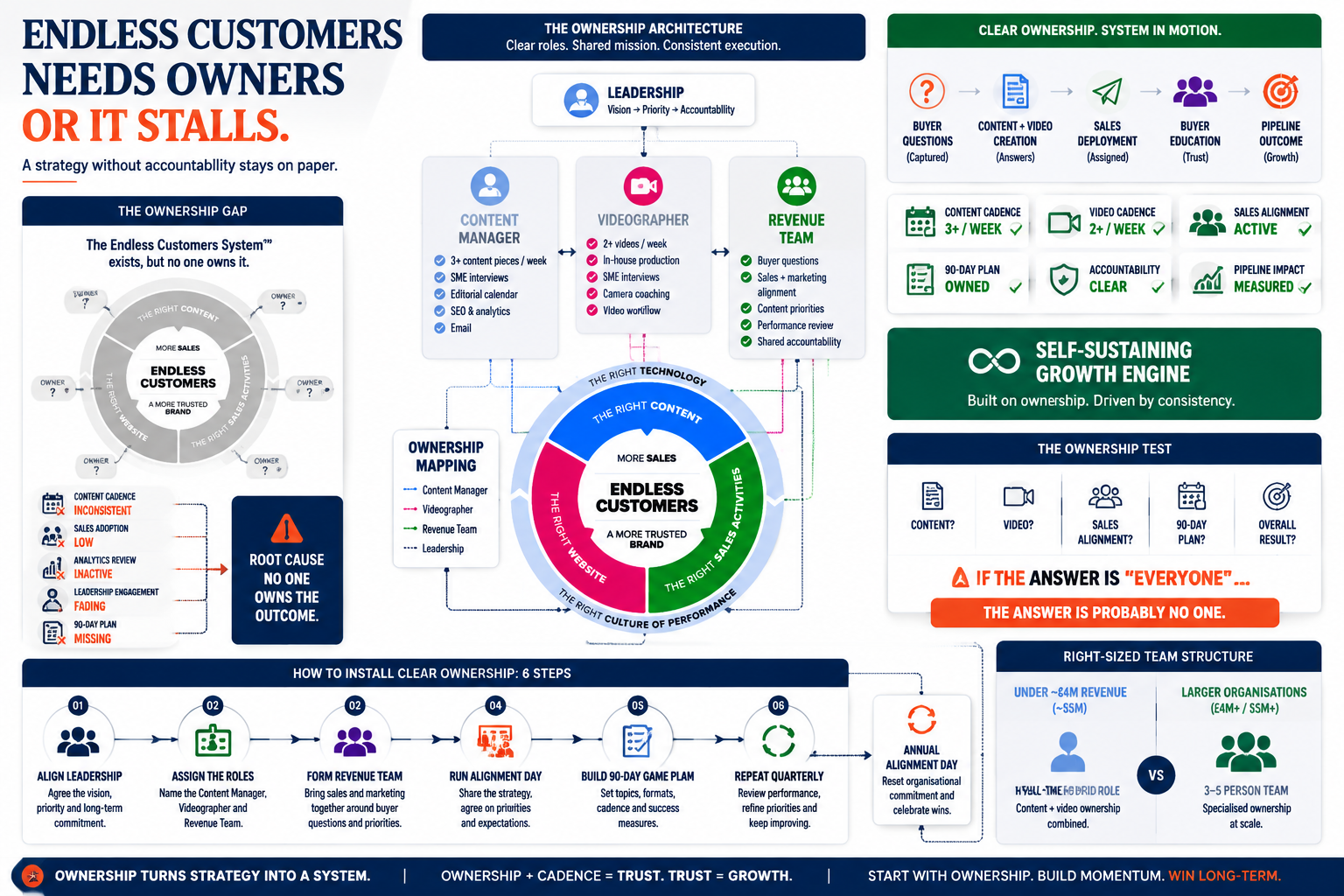
You adopted the Endless Customers System™. You read the book, trained the team, maybe even started publishing content. So why has progress stalled at 3 months, or 3 articles?
Is the strategy itself the problem, or is something structural missing inside your business?
I've spent the past several years as one of the UK's first five certified Endless Customers coaches, trained directly under Marcus Sheridan, helping founder-led businesses fix exactly this problem.
This article is for founders and senior leaders whose Endless Customers implementation has lost momentum. You will learn why ownership, not strategy, is the deciding factor, what breaks down without it, and exactly how to fix it.
The framework does not fail because it is flawed. It fails when no one inside the organisation is clearly responsible for driving it.
Key takeaways
- The Endless Customers System™ requires three named ownership roles to function: a Content Manager, a Videographer, and a Revenue Team.
- When no one clearly owns the Endless Customers strategy, content stalls, sales and marketing fragment, and the trust-building engine stops producing results.
- Outsourcing Endless Customers to an external agency almost always falls short; agency content lacks the authenticity and front-line expertise that builds real buyer trust.
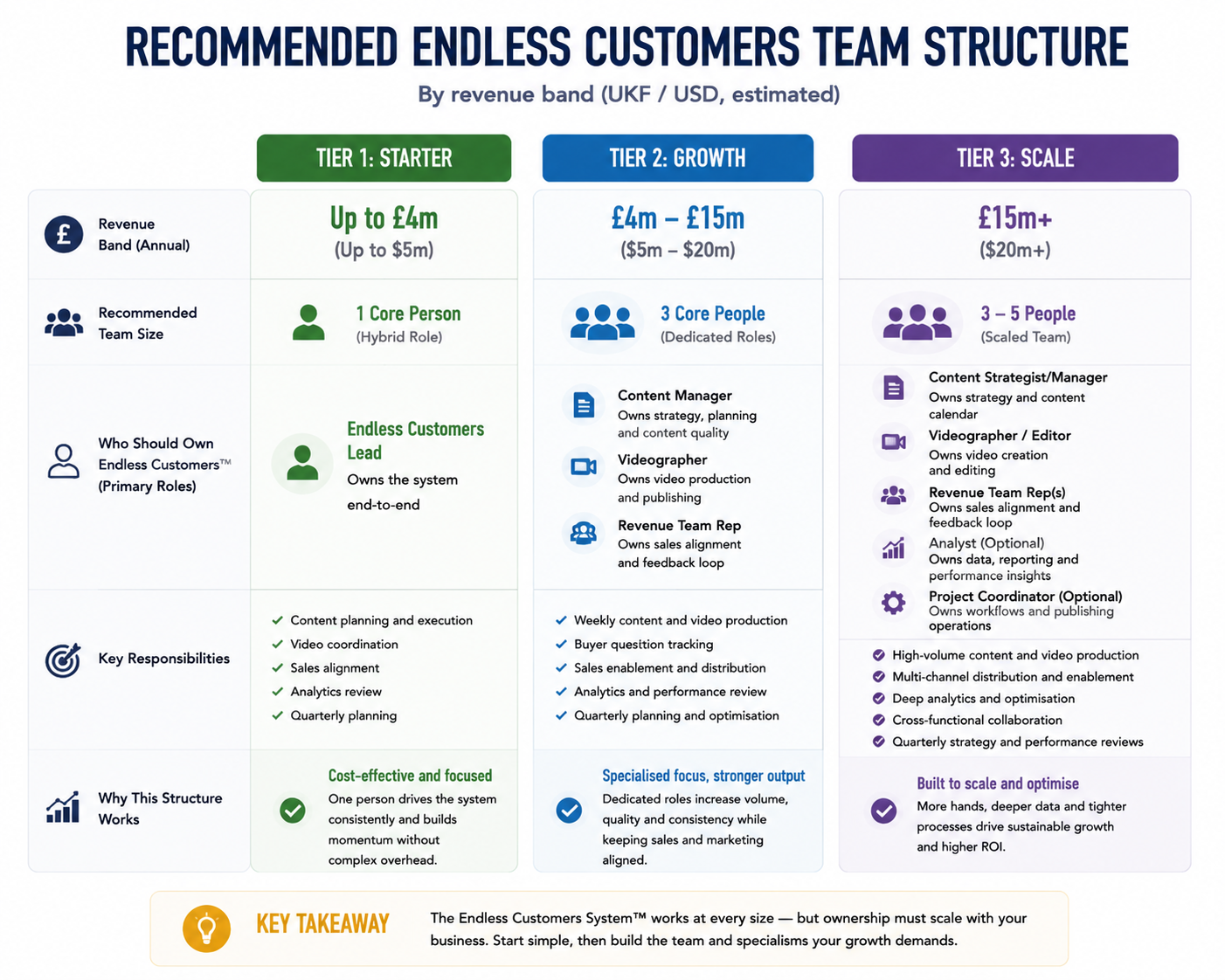
- Ownership structure scales with revenue: businesses under approximately £4m ($5m) typically need one full-time hybrid role; larger businesses need a team of 3–5.
- Clear ownership is established in six steps, starting with leadership alignment and locked in through 90-day quarterly planning cycles.
What is the Endless Customers framework, and why does ownership sit at its core?
The Endless Customers System™ is a business system designed to make companies the most known and trusted brand in their market by producing educational content, on a fixed weekly cadence, that answers buyers' real questions across The Big 5 topics: Cost & Price, Problems, Versus & Comparisons, Reviews, and Best in Class.
Unlike a campaign, Endless Customers is an operational and cultural shift. It requires named people to own specific functions every week: content production, video creation, sales alignment, and leadership accountability. Without those owners in place, the system exists only on paper.
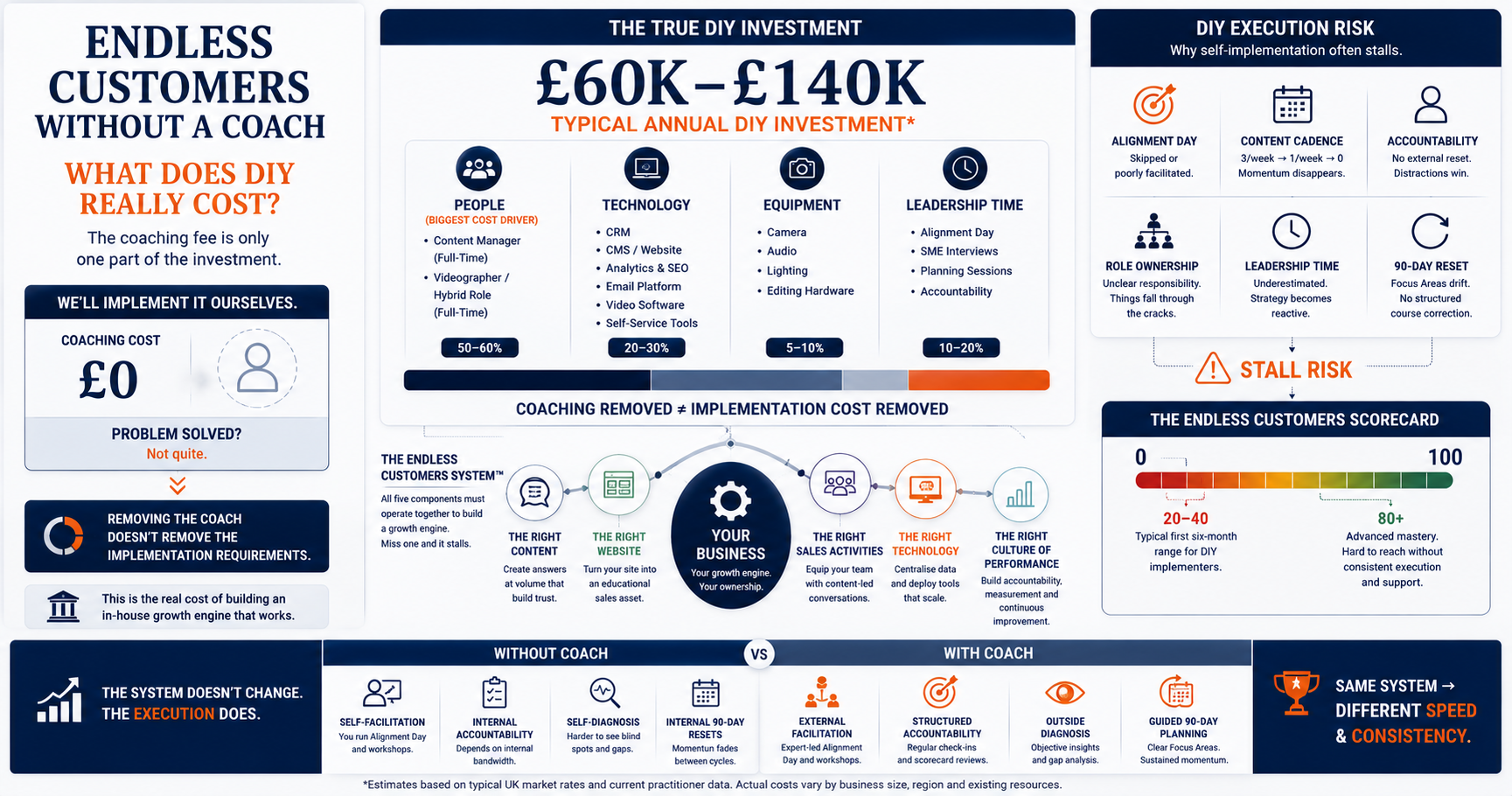
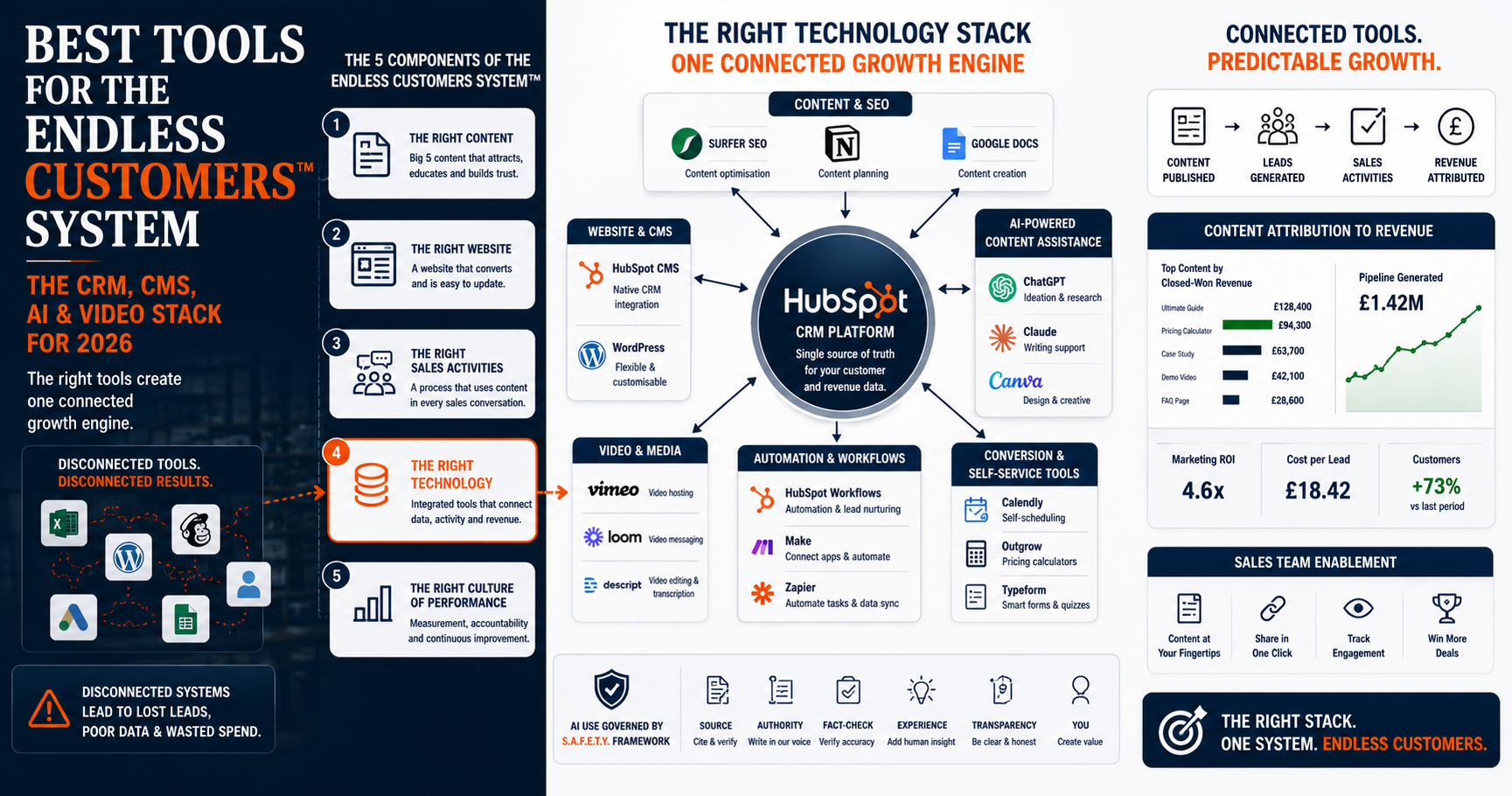
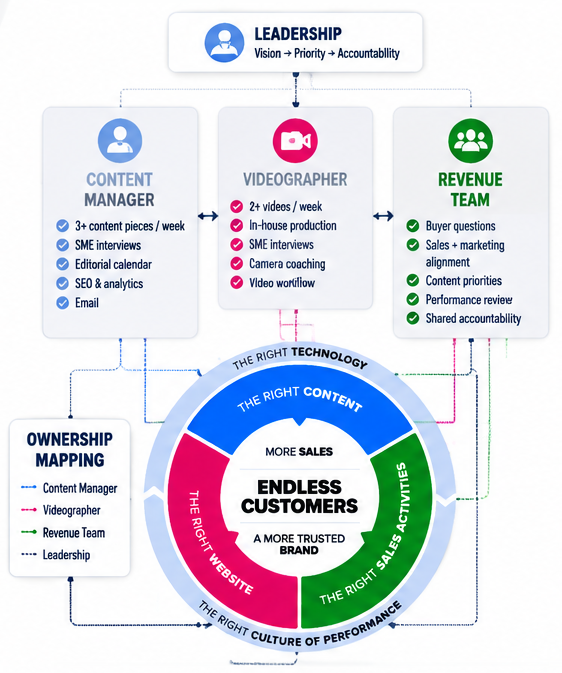
The five components of Endless Customers each require clear internal accountability:
What actually breaks down when no one owns the Endless Customers strategy?
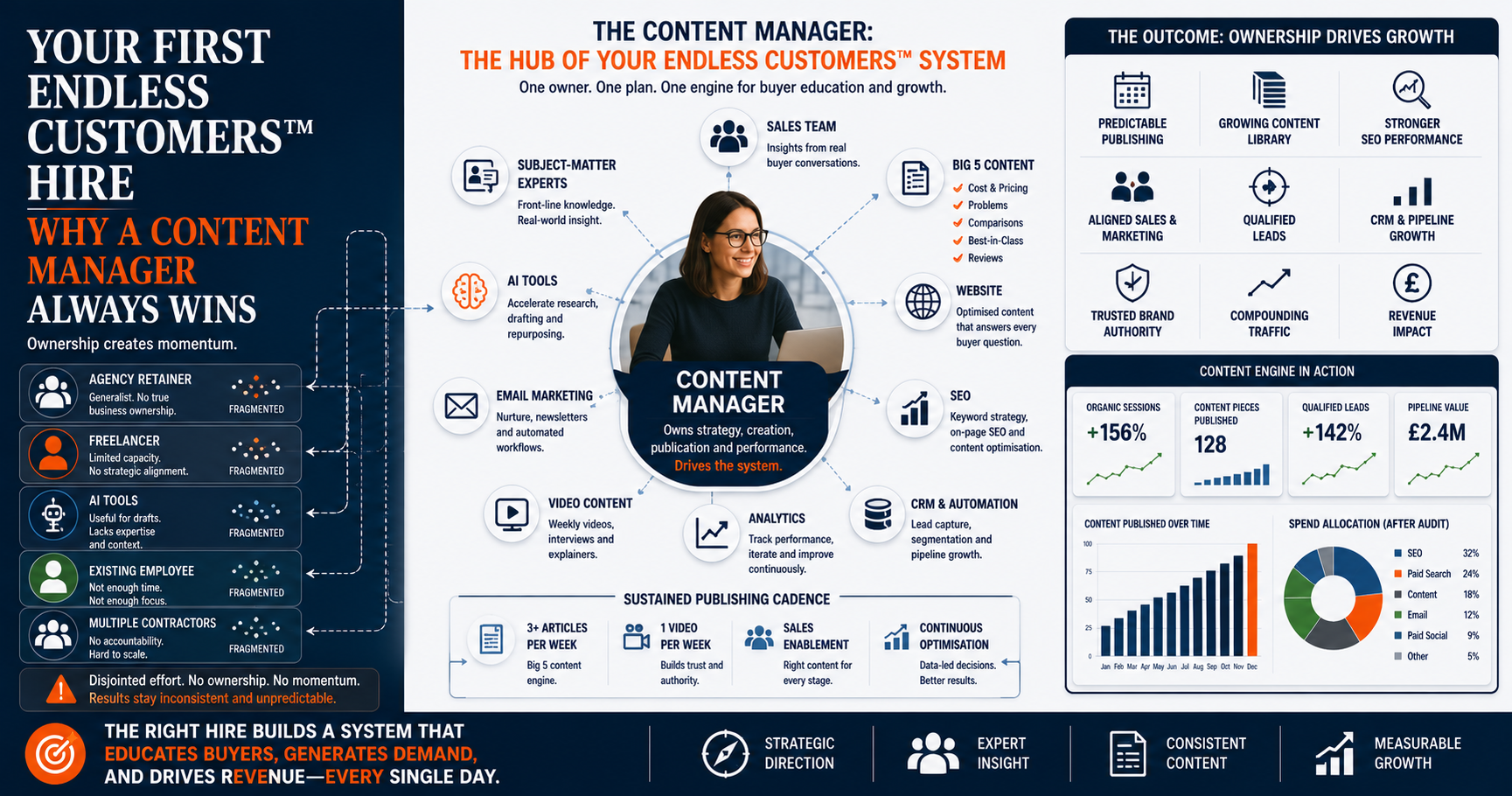
When no single person or team is clearly accountable for the Endless Customers System™, content production stalls, sales and marketing fragment into separate silos, and buyers are left without the educational resources they need to make a confident purchase decision.
This is the most common reason businesses adopt the Endless Customers strategy with genuine enthusiasm and then, 6 months later, have little to show for it. Not because the system is flawed. Because ownership was never clearly established.
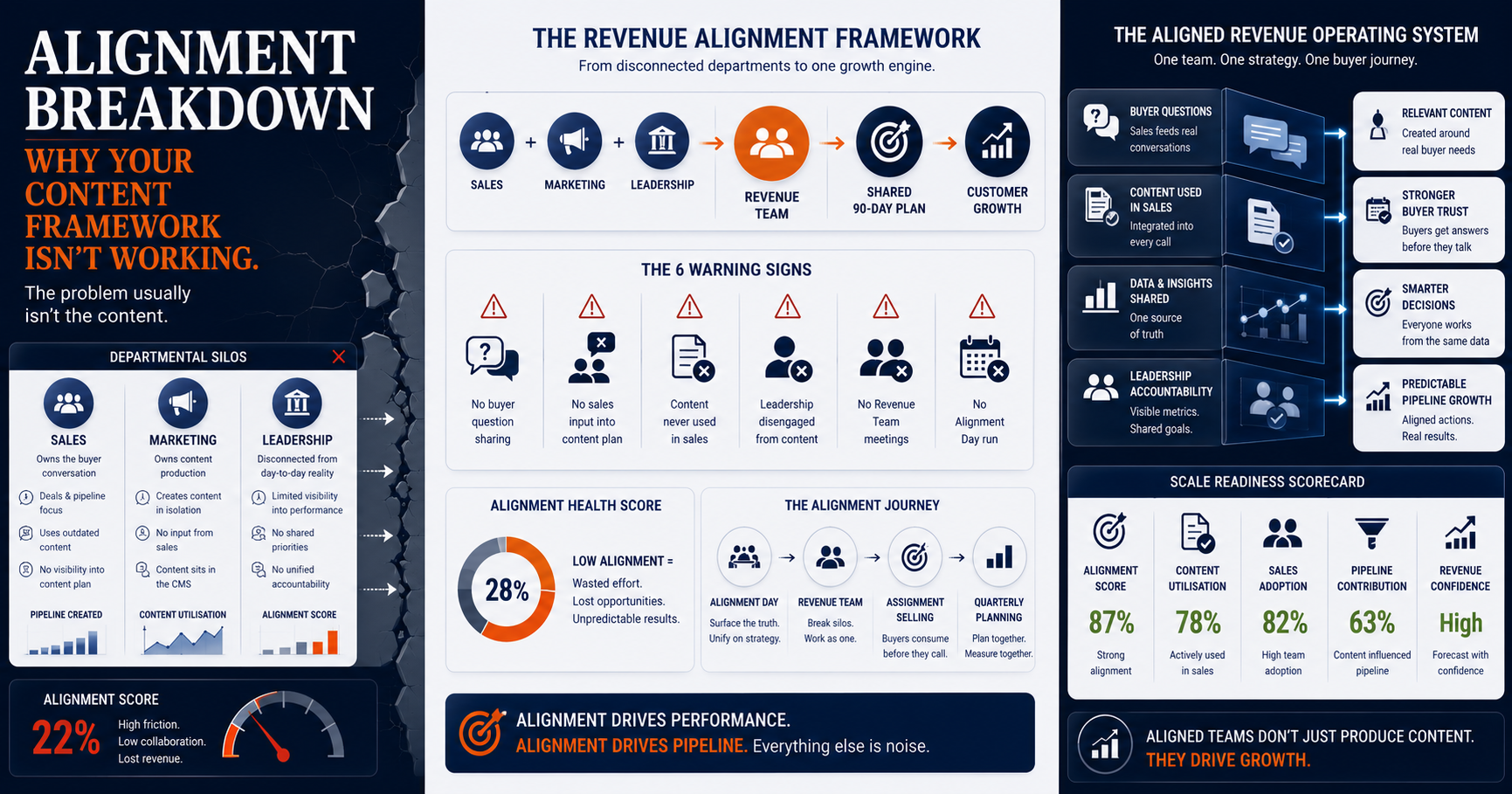
The five most common breakdown symptoms:
- Content published inconsistently, or abandoned entirely after the initial burst
- Sales team ignores marketing assets and reverts to old habits
- Analytics are not reviewed, so nobody knows what is working
- Leadership disengages after the launch excitement fades
- No 90-day plan exists to focus effort and maintain momentum
Each symptom has the same root cause: nobody owns the outcome.
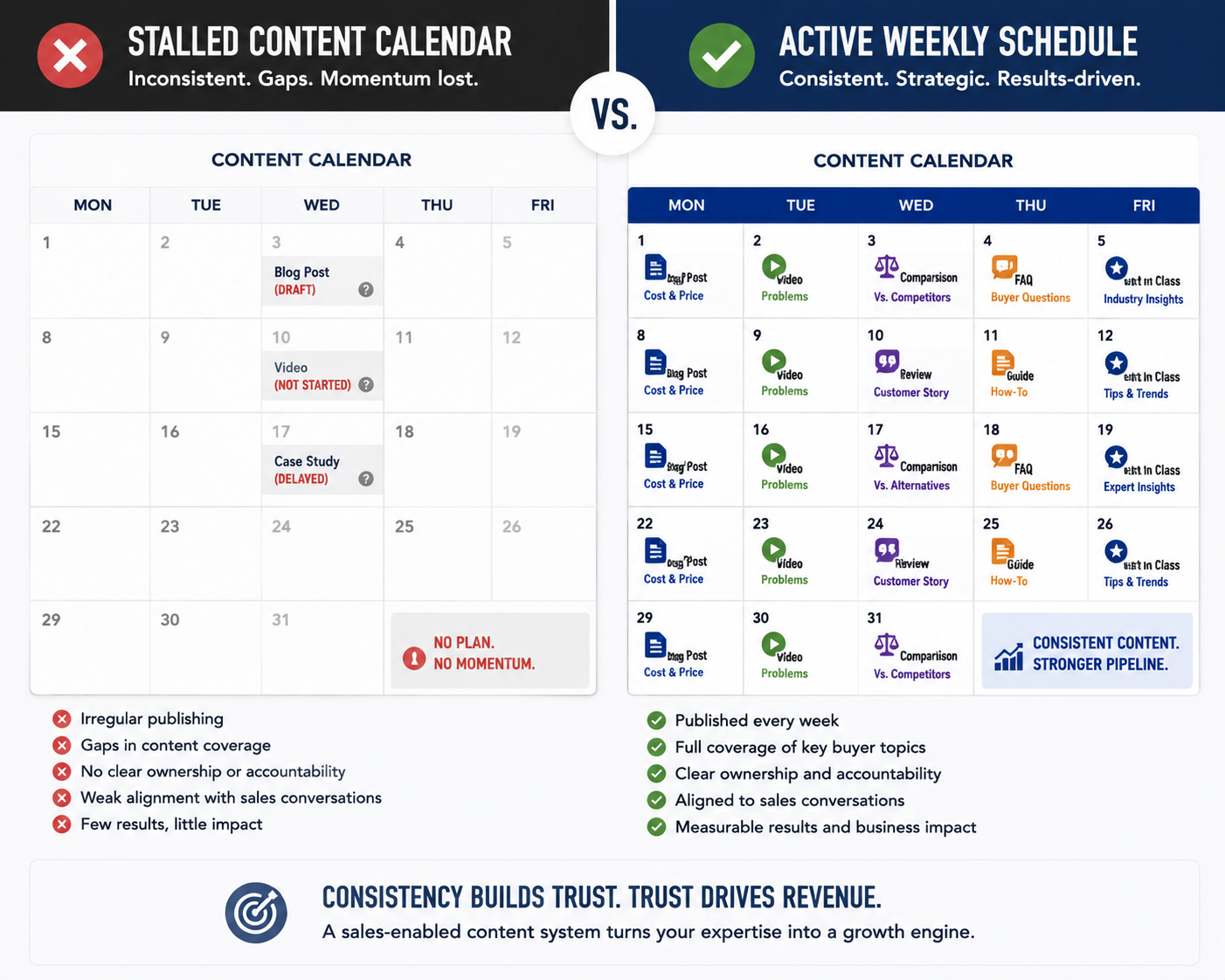
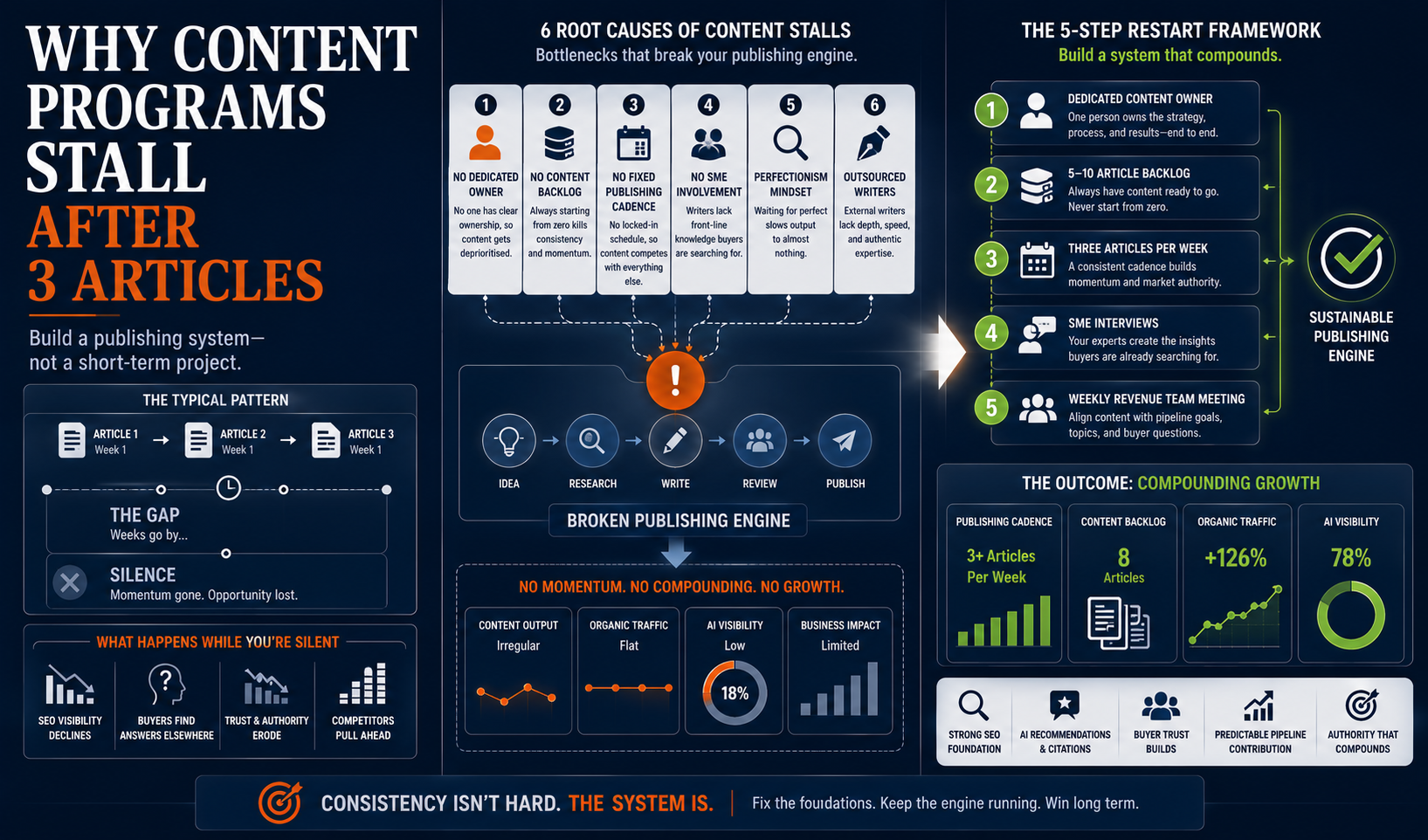
Related Reading: Why Most Content Programs Stall After 3 Articles (And How to Fix It)
What does a lack of clear ownership actually cost your business?
A lack of clear ownership in the Endless Customers System™ costs businesses in missed leads, wasted marketing spend, prolonged sales cycles, and a slower path to becoming the most trusted brand in their market.
The investment required to assign proper ownership depends on company size:
The upside of getting ownership right is documented. Sheffield Metals hired Thad Barnette as an in-house videographer with no prior metal roofing experience. By interviewing internal subject matter experts on a fixed weekly cadence, his team produced over 500 videos, generating more than 60 qualified leads per week and over £16m (approx. $20 million) in attributed sales within a few years. (Source: Endless Customers, estimate based on company-reported figures)
That result came from one person with clear accountability and a consistent publishing cadence. Nothing more complex than that.
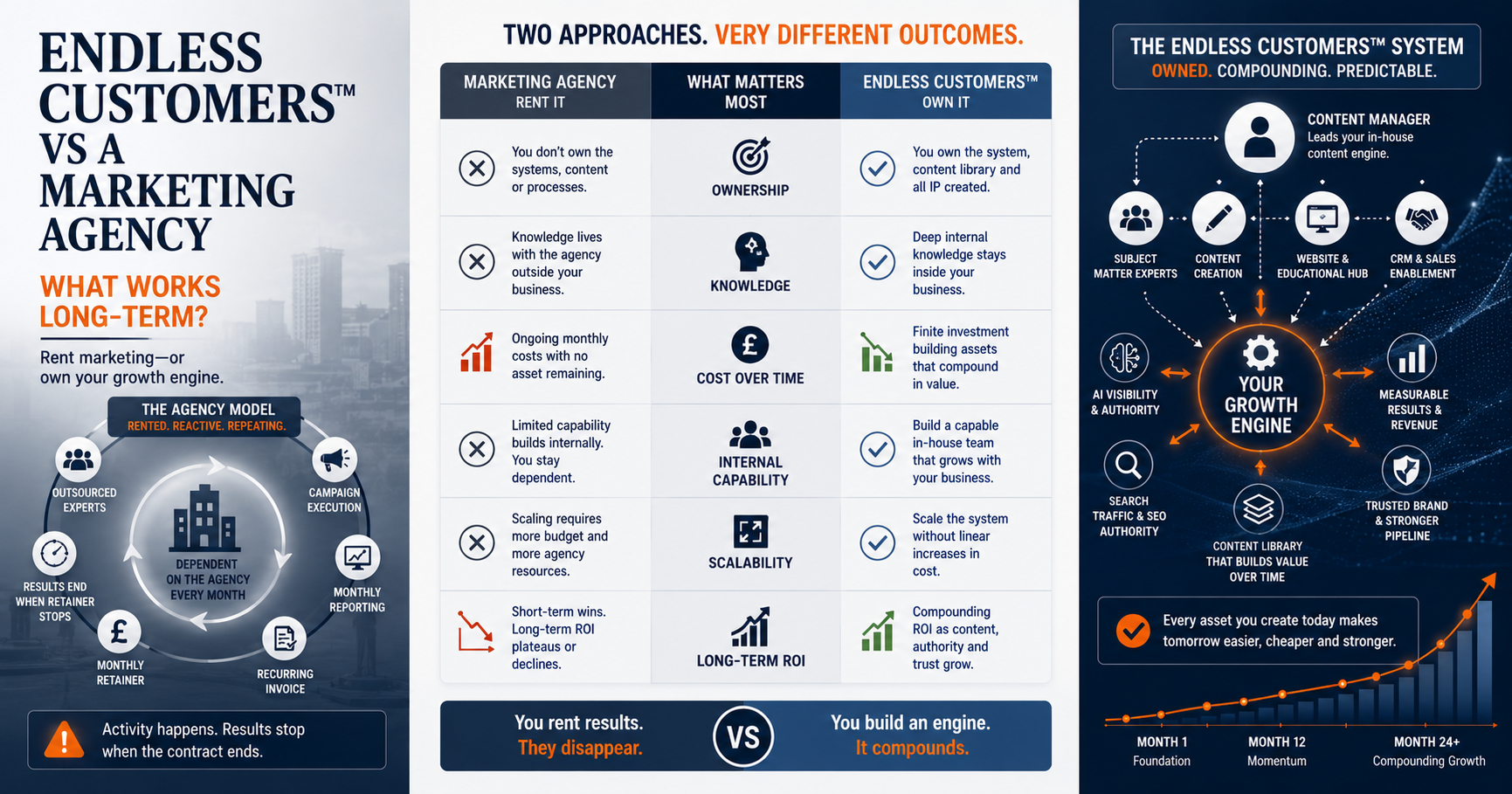
Why can't an agency own this strategy for you?
Outsourcing the Endless Customers System™ to an external marketing agency almost always falls short, because agency-produced content lacks the front-line expertise, authentic passion, and real buyer insight that only your internal team can provide.
Buyers can sense the difference between content from someone who lives and breathes your product and content assembled by an external team working from a brief.
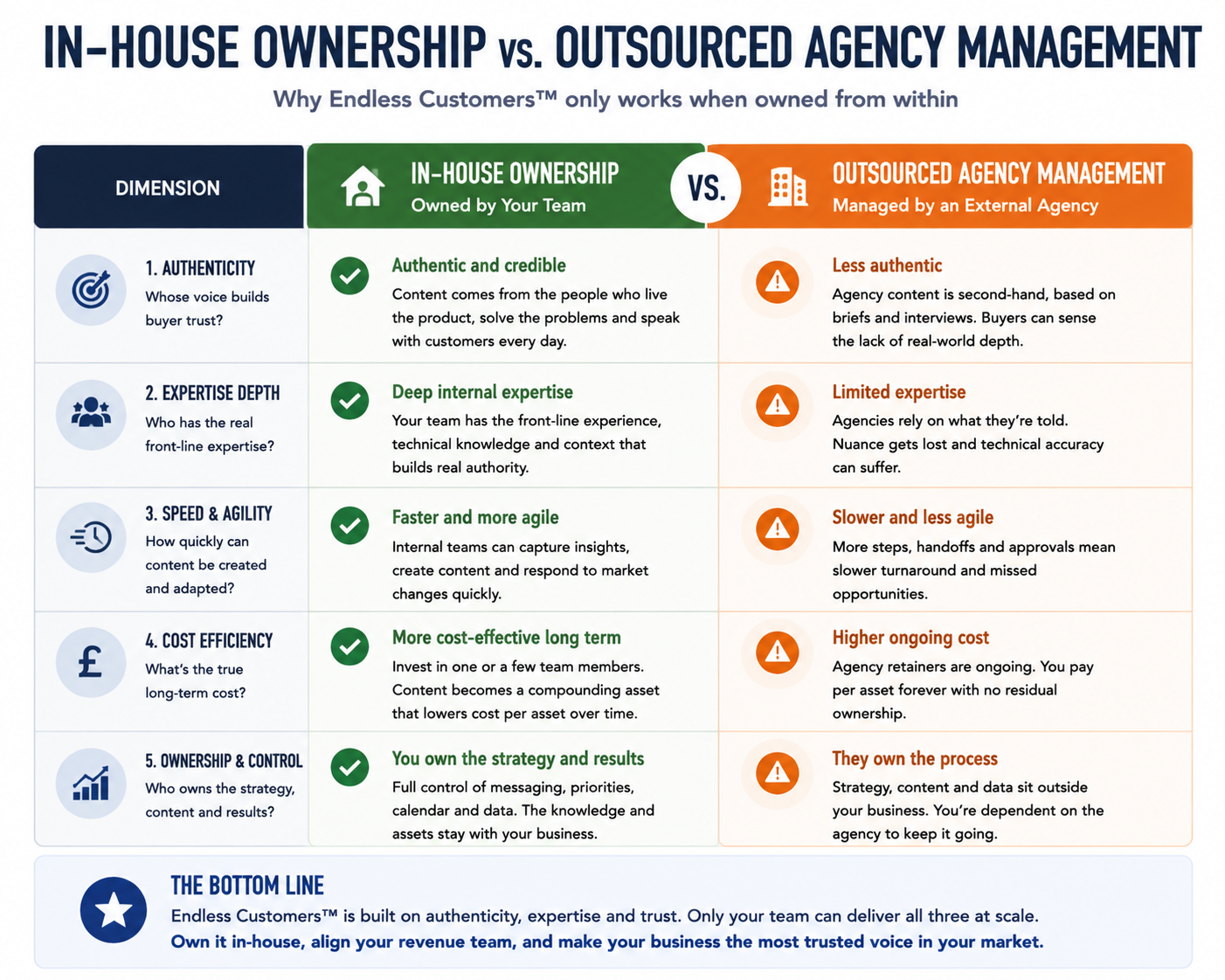
An agency can support implementation, and a coach can accelerate it, but neither can own it in your place.
Related Reading: Endless Customers vs Marketing Agency: What Works Long-Term
What are the 3 ownership roles every Endless Customers implementation must have?
Every successful Endless Customers implementation is anchored by three clear ownership roles: a Content Manager who drives written and strategic content, a Videographer who leads in-house video production, and a Revenue Team that unites sales, marketing, and leadership around a single customer acquisition mission.
Miss even one of these roles, or treat them as part-time additions to someone's existing job, and the content engine will not produce the volume or consistency needed to build genuine buyer trust at scale.
- Content Manager: Publishes 3 or more pieces of content weekly. Interviews internal subject matter experts. Owns SEO, analytics, email marketing, and the editorial calendar.
- Videographer: Produces at least 2 videos per week. Manages all in-house video production. Coaches team members to appear confidently on camera.
- Revenue Team: A cross-functional group of sales, marketing, and leadership that meets regularly. Shares live buyer questions, reviews content performance, plans editorial priorities, and holds shared accountability for results.
A direct warning from the Endless Customers methodology: "I've seen it hundreds of times: Companies get excited about the Endless Customers strategy but think they can skip the Revenue Team piece. Don't make this mistake." (Source: Endless Customers)
Related Reading: Why Endless Customers Fails Without Sales Buy-In (And How to Fix It)
How to establish clear ownership in your organisation: a step-by-step plan
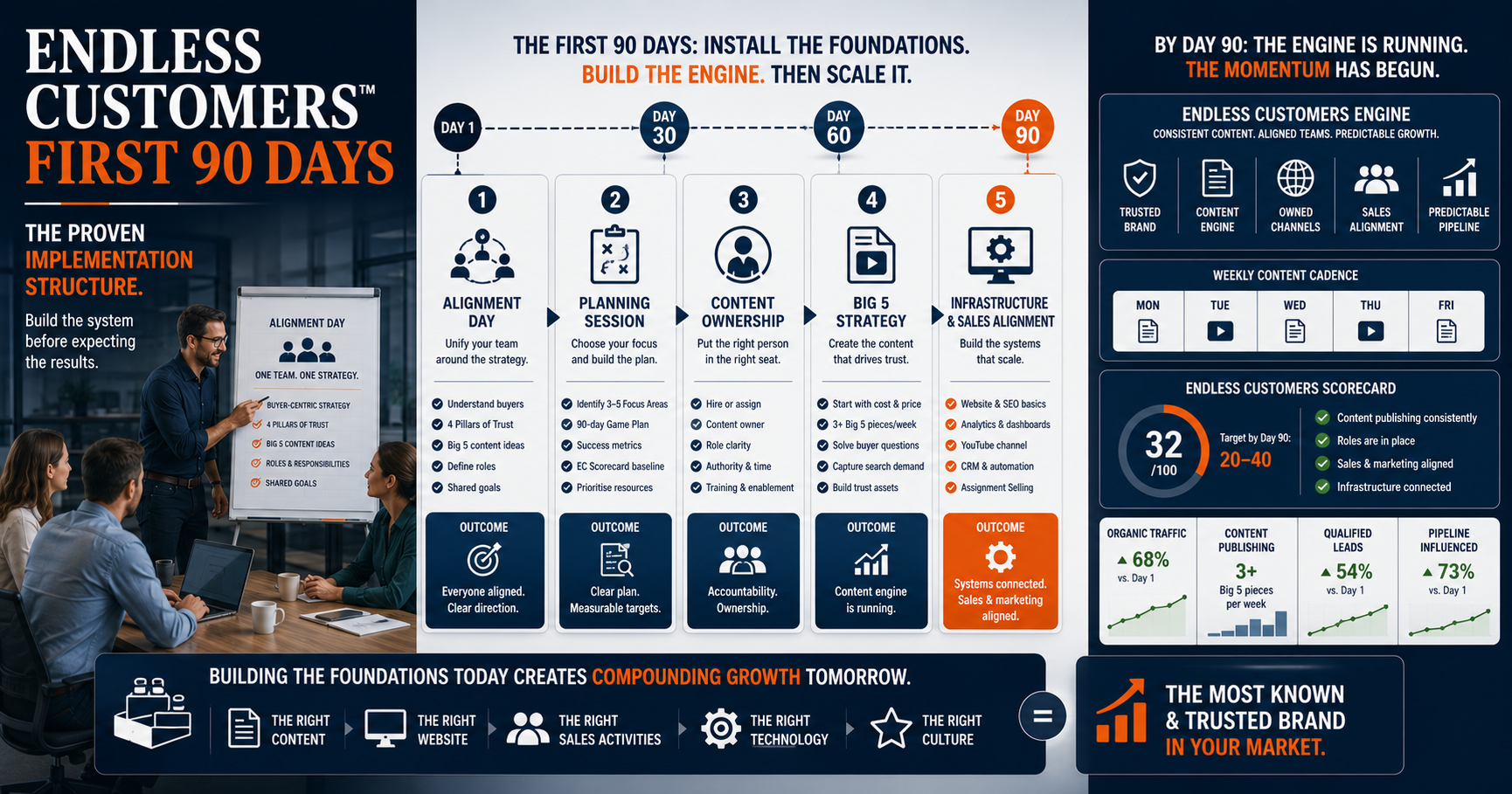
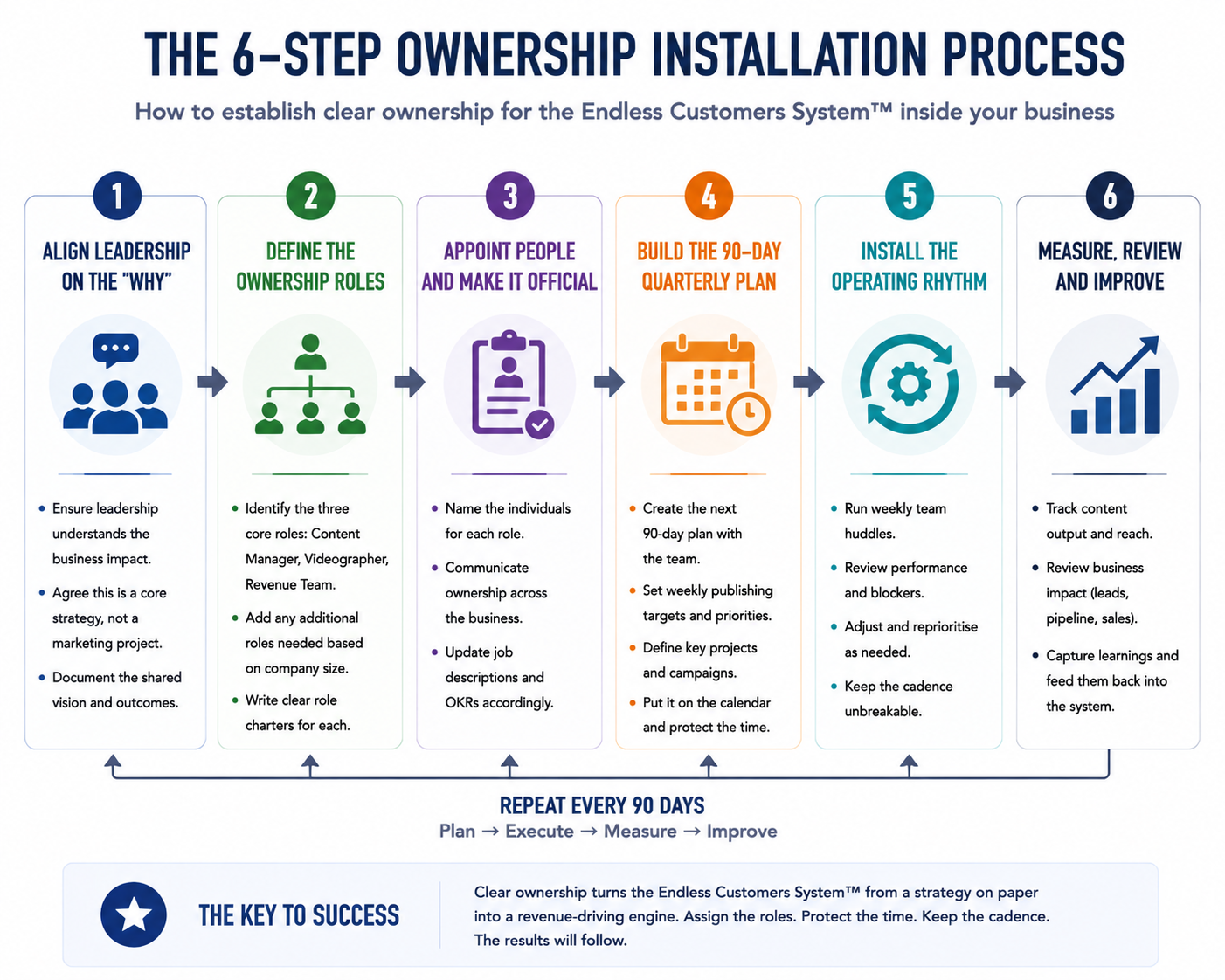
Establishing clear ownership in the Endless Customers System™ follows a 6-step sequence: align leadership first, assign specific roles, run Alignment Day, build a 90-day Game Plan, repeat the quarterly cycle, and hold an annual Alignment Day to prevent old habits from creeping back.
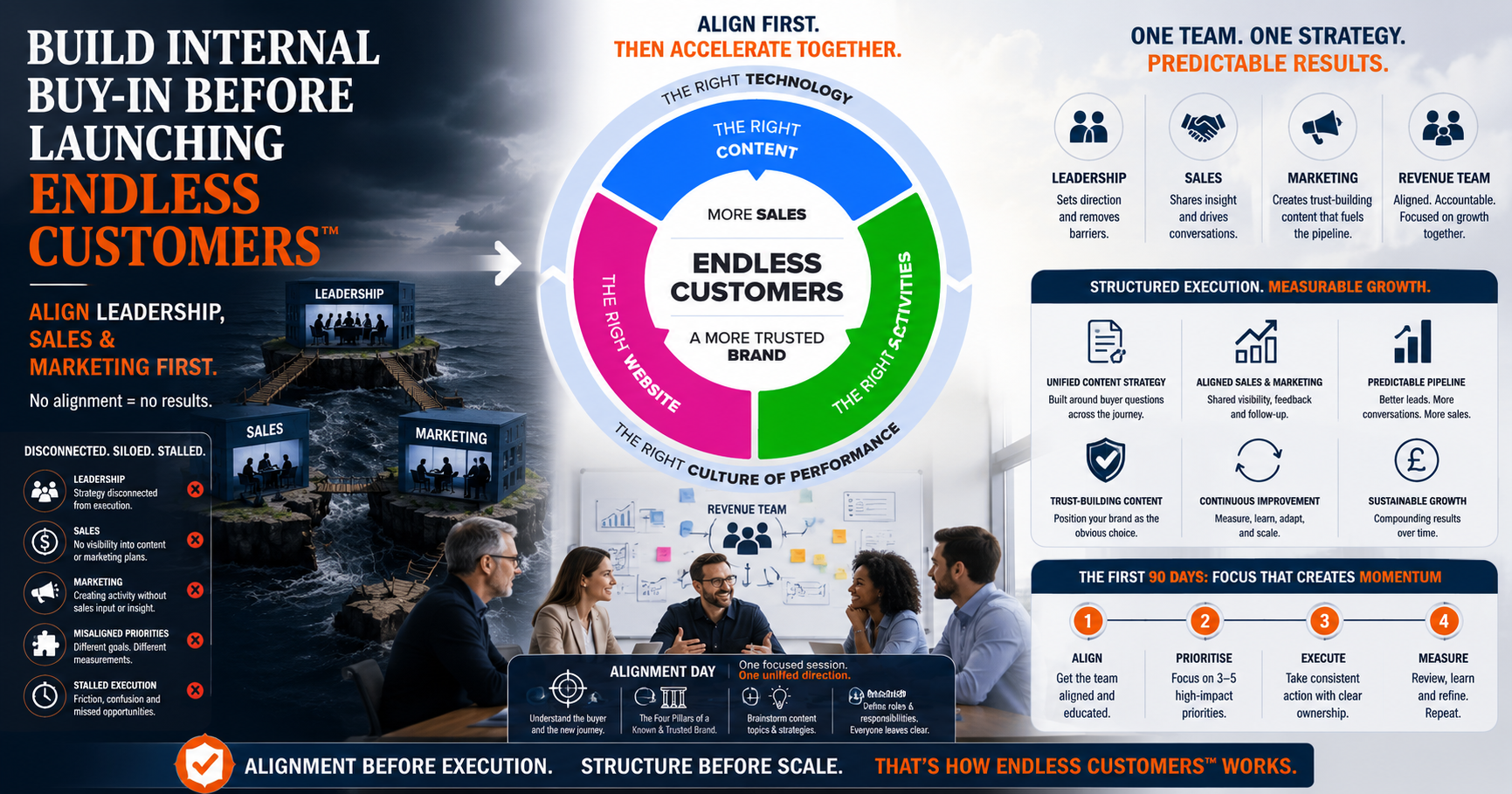
- Align leadership: Before anyone else is involved, leadership must genuinely commit to the strategy. Without that, ownership at every other level becomes fragile.
- Hire or assign a Content Manager and Videographer: These are full-time roles. They cannot be additions to someone's existing job.
- Form the Revenue Team: Bring sales, marketing, and leadership into a regular meeting structure with shared goals and shared accountability.
- Run Alignment Day: A structured three-hour session that unifies the whole organisation around Endless Customers principles. My Growth Alignment Intensive™ is built specifically for this; it includes company-wide training, a sales and marketing audit, and your first 90-day plan.
- Build a 90-day Game Plan: Identify 3–5 Focus Areas. Assign a named owner to each. Set a timeline.
- Repeat quarterly and annually: Review progress at the end of each 90-day period and reset. Hold an annual Alignment Day as your team evolves.
Frequently asked questions
Can one person serve as both Content Manager and Videographer?
Yes, for businesses below approximately £4m ($5m) in revenue, a single full-time hybrid role is workable. As the business grows, the two roles should be separated to maintain publishing volume and quality.
What if budget does not allow a dedicated hire yet?
At the earliest stage, a senior leader or the business owner takes personal ownership of the content function. The goal is not a perfect team from day one. It is accountability from day one.
How does the Revenue Team differ from a standard marketing meeting?
A Revenue Team includes sales, marketing, and leadership in the same room, with shared accountability across the full buyer journey. A standard marketing meeting rarely includes sales and almost never establishes shared ownership of outcomes.
What role should the CEO play?
Leadership sets the vision and holds the strategy accountable. The CEO does not need to produce content, but must make clear that Endless Customers is a business priority, not a marketing experiment.
Conclusion
You have invested time and effort in a strategy built to produce real results. The Endless Customers System™ does not fail because the framework is wrong. It fails when ownership is unclear, part-time, or absent entirely.
The businesses that make Endless Customers work long-term are not necessarily the ones with the biggest budgets. They are the ones that assign a Content Manager, bring video production in-house, build a Revenue Team, and hold a consistent 90-day planning cadence. That structure is what turns a strategy into a self-sustaining growth engine.
How to take action now
- Audit who currently owns each of the five Endless Customers components in your business
- Identify your single biggest ownership gap and address it before anything else
- Start a Revenue Team meeting cadence this quarter, even if it is just thirty minutes
- Book a Growth Alignment Intensive™ to align your full team around a shared ownership plan in one session
Related Reading: Endless Customers First 90 Days: The Proven Implementation Structure
Ready to install clear ownership inside your business? Explore the Endless Customers™ Implementation programme.

About the author
Tom Wardman is a fractional marketing consultant and one of the UK's first five certified Endless Customers coaches, trained directly under Marcus Sheridan. He works with founder-led B2B businesses to install self-sufficient growth systems their teams own and operate without ongoing external dependency. His Endless Customers™ Implementation programme moves businesses from fragile, outsourced marketing to full in-house ownership over 18–24 months.
Pricing disclaimer: All GBP–USD price conversions are rounded estimates and correct at the time of publishing. Exchange rates fluctuate and figures should be treated as indicative only.
Topics: