

Is your sales process working against you? Does your sales team spend the first 20 minutes of every appointment teaching basics a prospect could have Googled? Are you closing one in four meetings and struggling to understand why the other three walked away?
Assignment Selling is the structural answer. This article covers what it is, how the 3 W's framework works in practice, what to assign at each sales stage, and what real businesses have achieved by putting it to work, giving you everything you need to evaluate whether it belongs in your own sales process.
It is written for sales leaders, founders, and marketing teams at B2B companies who want higher close rates and shorter sales cycles without adding headcount.
Key takeaways
- Assignment Selling is the practice of requiring prospects to consume specific educational content before a sales conversation takes place, not suggesting it, requiring it.
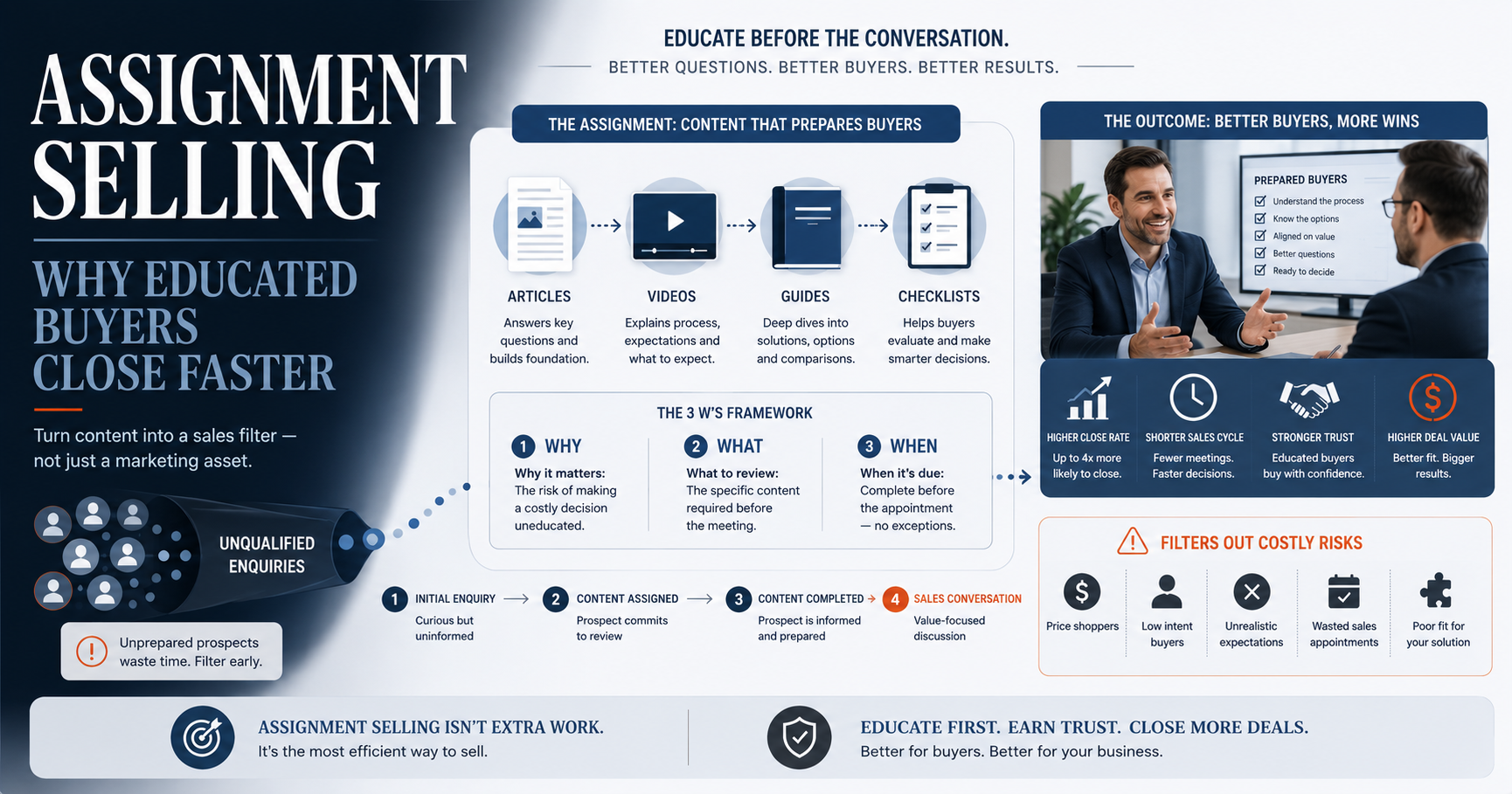
- Prospects who read 30 or more pages of content before their first appointment at River Pools bought 80% of the time, compared to 25% for those who hadn't, a four-times difference.
- The 3 W's framework (Why, What, When) turns a casual content suggestion into a firm pre-meeting commitment.
- CSI Accounting & Payroll grew their average sale price by 39.7% by year two, simply by requiring prospects to complete homework before sales calls.
- Assignment Selling works in any industry where buyers go through a consideration phase, from professional services and manufacturing to SaaS and home improvement.
- Assignment Selling only works when your sales process is documented. Without clearly defined stages, there is no structure to attach content assignments to.
What is Assignment Selling?
Assignment Selling is the strategic practice of requiring prospects to consume specific educational content, such as articles, videos, or self-assessment tools, before a sales conversation takes place, in order to improve close rates and shorten sales cycles.
Coined by Marcus Sheridan in Endless Customers, the approach treats content not as a marketing asset, but as a direct sales tool deployed at precise stages of the buying journey.
The word requiring is deliberate. Assignment Selling is not a gentle nudge; it is a structured commitment your prospect makes before you give them time in your diary. If they refuse, that itself is useful information. Someone preparing to make a significant financial decision who is unwilling to spend 20 minutes reading about it is unlikely to become a good client.
Why does Assignment Selling matter?
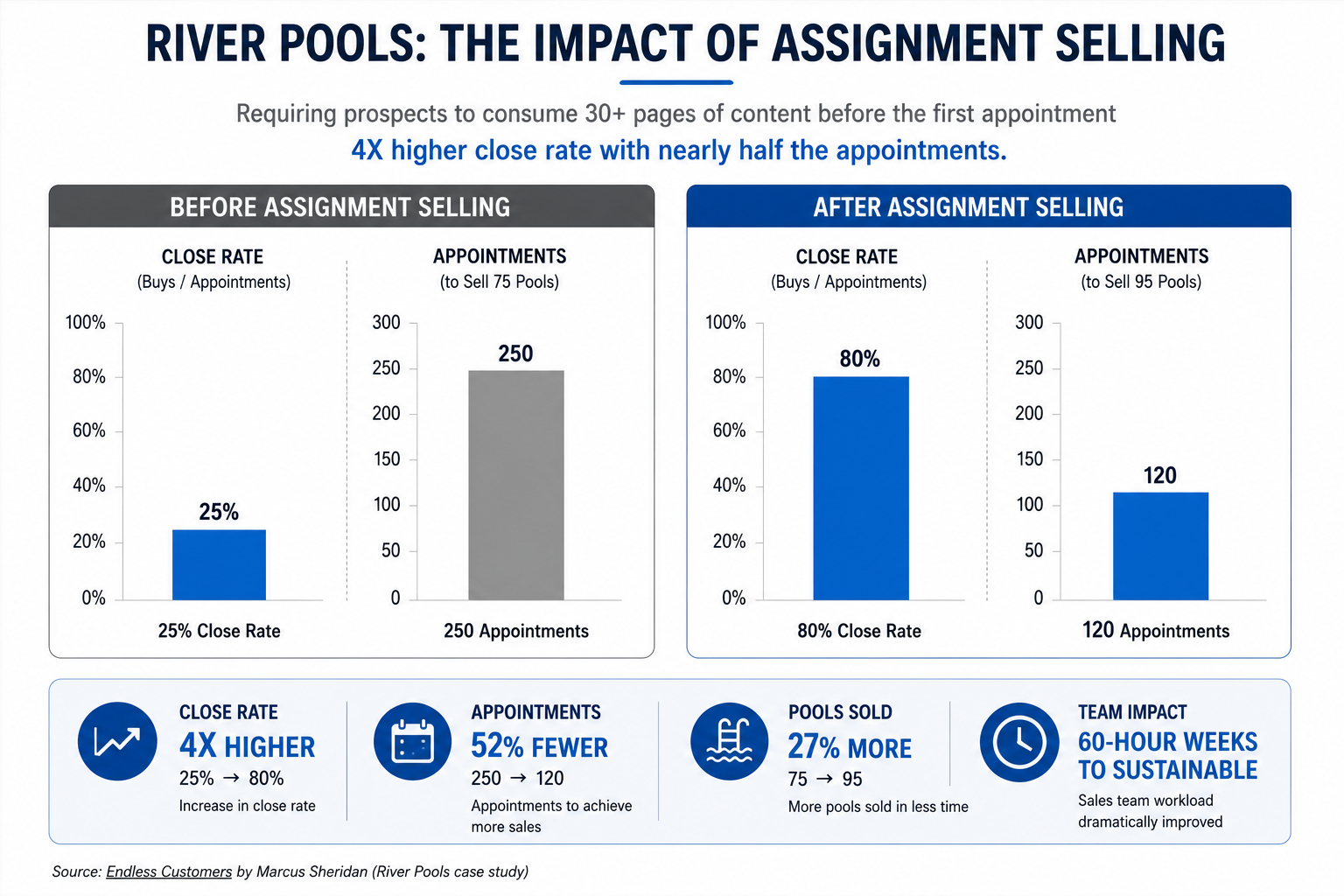
At River Pools, prospects who consumed 30 or more pages of content before their first sales appointment bought 80% of the time, compared to just 25% for those who hadn't read anything, a four-times difference in close rate.
Marcus Sheridan discovered this pattern through HubSpot analytics while comparing buyers and non-buyers who had both submitted quote requests. He immediately restructured the sales process around a content threshold.
Within one year, River Pools went from selling 75 pools across 250 appointments to selling 95 pools across just 120 appointments.
The sales team stopped working 60-hour weeks. Fewer appointments, better-qualified prospects, dramatically higher closes. No new hires required.
How does Assignment Selling work? The 3 W's framework
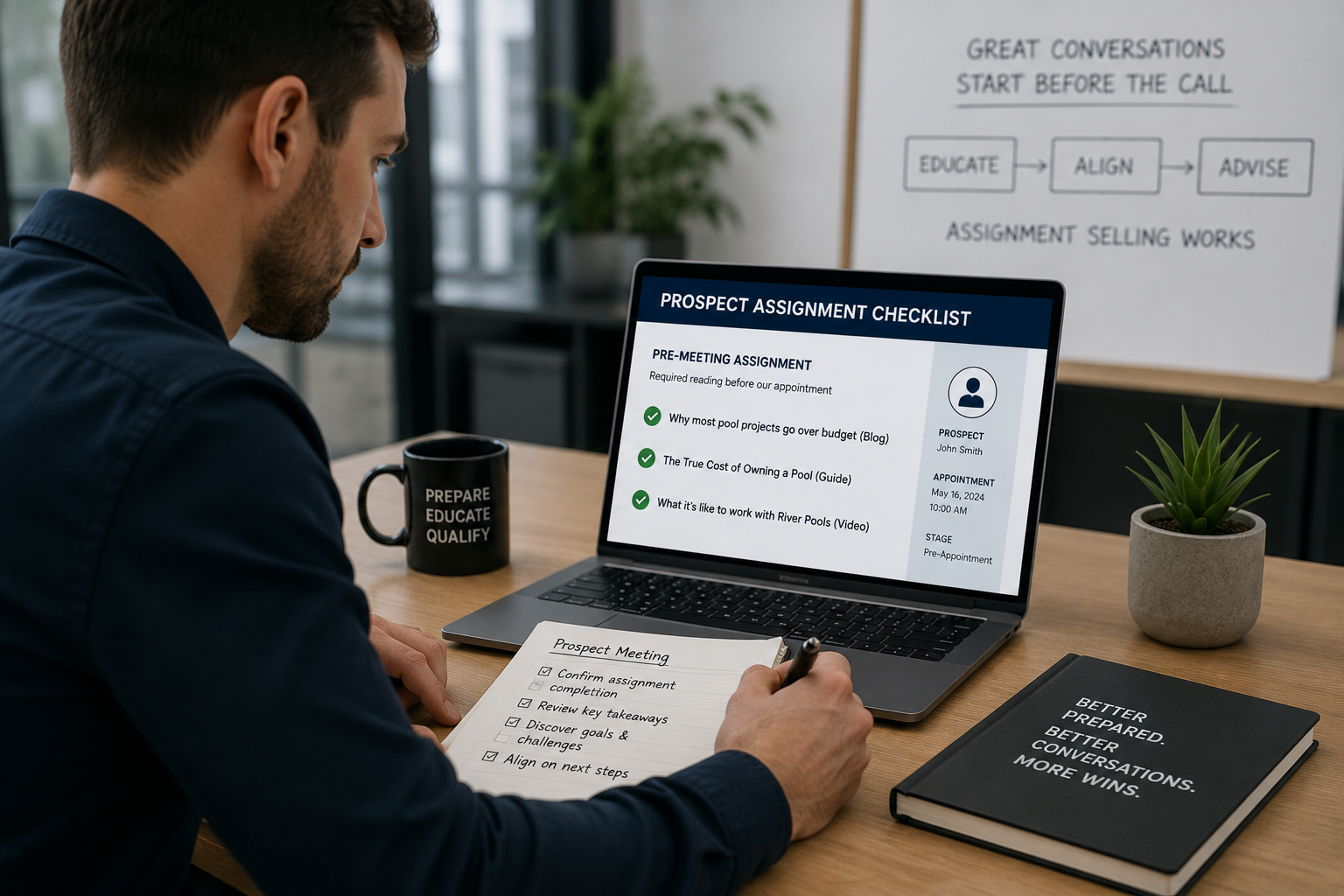
Assignment Selling is built on three core elements known as the 3 W's: Why it matters (the risk of going into a major purchase uneducated), What the assignment is (the specific content to review), and When it is due (a clear deadline before the appointment).
Here is how the script sounds in practice, based on how River Pools applied it:
"Of course, I'd love to come out and give you a quote. But you're getting ready to spend a lot of money, and if you're going to spend a lot of money, I know you don't want to make any mistakes. So to make sure you don't, I'm going to send you a couple of things you're going to love…"
Without all three W's, the assignment becomes a casual suggestion — and casual suggestions do not produce commitments or filter out poor-fit buyers.
The follow-up the morning of the appointment confirms completion:
"Just calling to make sure you had a chance to review the materials. This way, we can hit the ground running when we meet."
If the prospect has not completed the assignment, the recommendation is to delay. Prospects unwilling to invest 20 minutes before a significant purchase almost always buy on price alone.
What content should you assign, and at which stage?
The right content depends on where the buyer is in their journey — different assets serve different purposes at each stage of the sales process.
| Sales stage | Buyer mindset | Recommended content type | Purpose |
|---|---|---|---|
| First contact / enquiry | Curious, early research | Educational blog post or overview video | Build credibility, set expectations |
| Pre-appointment | Evaluating options | "What it's like to work with us" page or bio video | Reduce friction, address common concerns before the call |
| Post-appointment | Comparing providers | Pricing or cost article, comparison guide | Accelerate decision-making, reduce objections |
| Pre-close | Ready to decide | Case study or results video | Reinforce trust, validate the investment |
A prospect's willingness to consume content is a reliable signal of their readiness to buy. You do not need a full content library to begin. One bio video and a short "what to expect" page is enough to start, then build the library stage by stage as your process matures.
Real results: what companies have achieved with Assignment Selling
CSI Accounting & Payroll grew their average sale price by 10.19% in year one and 39.7% by year two, not by selling harder, but by only meeting with prospects who had already been educated on the value of the service.
CSI created targeted content including a "What it's like working with CSI" article and an 80% video addressing the most common pre-sale questions. They then made it a non-negotiable that prospects complete both before any sales call.
As owner Brian Paulson put it:
"Assignment Selling didn't just change our sales process, it revolutionised it. We're closing better deals with clients who genuinely value what we offer."
The pattern across both companies is the same: educating prospects before the meeting raises both close rates and average deal value at the same time. It is a pattern that holds across industries, professional services, manufacturing, SaaS, and home improvement businesses applying the same principle report consistent results.
Common problems and pitfalls with Assignment Selling
The most common reason Assignment Selling fails is that the business has no clearly defined sales process, making it impossible to deliver the right content at the right stage. Without that foundation, Assignment Selling has nowhere to sit.
In practice, the businesses that struggle most with implementation share three characteristics: no documented sales process, no content mapped to stages, and no management accountability to enforce it. These are structural problems with structural fixes, but they need to be addressed before Assignment Selling can do its job.
Other frequent mistakes:
- Framing the assignment as optional: "It'd be great if you could take a look" produces no commitment
- No management buy-in: If sales managers do not enforce it, the team will not either
- Assigning too much content at once: Start with one high-value piece, not five
- Skipping the Why: Without explaining the risk of being underprepared, the request feels arbitrary
Additional reading: Why Endless Customers Fails Without Sales Buy-In (And How to Fix It)
Assignment Selling vs. traditional sales follow-up
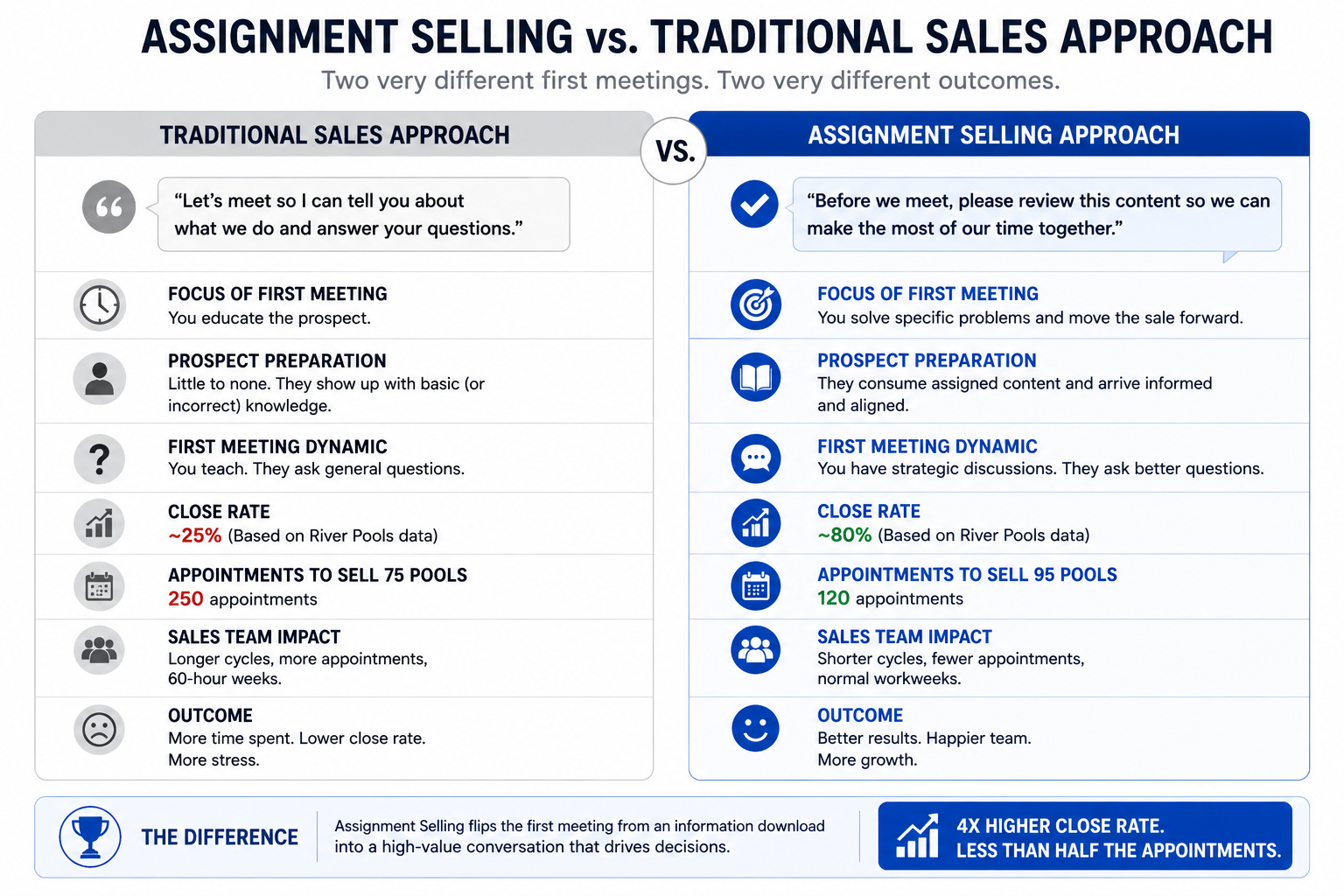
Traditional sales follow-up sends content to prospects as a courtesy or soft nudge. Assignment Selling requires content consumption as a condition of the appointment, which fundamentally changes buyer commitment before you ever meet.
The differences show up at every stage of the process:
- Commitment level: Traditional follow-up is optional and easily ignored; Assignment Selling is a stated condition of your time, which signals mutual respect for the process from the outset.
- Prospect quality: Follow-up content reaches anyone on your list; Assignment Selling filters out low-intent buyers before they ever sit across from your sales team.
- Conversation quality: Traditional appointments often start from scratch; Assignment Selling means prospects arrive informed, which shifts the conversation from education to evaluation.
- Close rates: Follow-up content rarely moves the needle on conversion; requiring content consumption before the appointment has been shown to double or quadruple close rates in documented cases.
The core difference is structural. One is a courtesy. The other is a filter.
How to implement Assignment Selling in your business
Implementing Assignment Selling starts with mapping a solid sales process, then layering in content assignments at each defined stage.
- Map your buyer's journey: Identify every milestone from first contact to closed won
- Define each stage with clear entry and exit criteria so your team knows when to assign what
- Document the process: Treat it like a pilot's checklist: simple, consistent, non-negotiable
- Train through role-play: Practise the 3 W's script until it sounds natural, not scripted
- Identify two or three sales champions to pilot the approach and generate early proof
- Build content stage by stage: Begin with a bio video and one pre-appointment piece, then expand
See: Is Your Business Ready for Endless Customers? What It Takes to Succeed for a readiness assessment before you start]
My Endless Customers™ Implementation programme embeds Assignment Selling as the foundation of the first 90-day sprint, with the sales team trained and using the 3 W's framework before the quarter ends.
Frequently asked questions about Assignment Selling
Does Assignment Selling work in every industry?
Assignment Selling works in any industry where buyers go through a consideration phase before purchasing. Professional services, manufacturing, SaaS, accountancy, home improvement; if a typical buyer takes more than one conversation to decide, Assignment Selling applies.
What if a prospect refuses to complete the homework?
Treat refusal as a qualification signal, not a problem to overcome. A prospect unwilling to invest 20 minutes learning before a major financial decision is almost always buying on price alone, and rarely becomes a satisfied long-term client. Delaying or declining the appointment is the right call.
How much content do I need before I can start?
You need one piece. A short bio video and a "what to expect" overview are enough to begin. Assignment Selling scales with your content library over time; it does not require a complete one to start.
How do I measure whether Assignment Selling is working?
Track your close rate separately for prospects who completed the assignment versus those who did not. Compare average deal value across both groups. A simple spreadsheet tracking these two numbers over 90 days will tell you everything you need to know. The Endless Customers™ Implementation includes a structured scorecard that makes these metrics visible from the first 90 days, but you can start measuring immediately, before any formal programme.
Where to go from here
Assignment Selling works. The data is clear, the framework is simple, and the only real requirement is a sales process worth building on.
The businesses that struggle with Assignment Selling tend to share the same underlying issues: no documented process, no content mapped to stages, and no management accountability to enforce the habit. These are fixable, but they need to be addressed in the right order.
Start here
- Audit your current sales process: do you have clearly defined stages with entry and exit criteria?
- Identify one high-value piece of content you could assign before your next appointment
- Write the 3 W's script for your own industry and test it on your next five calls
- Track your close rate as a baseline before you change anything
If building that structure is something you want help with, the Endless Customers™ Implementation is designed to do exactly that.
Book a scoping call to explore whether the Endless Customers™ Implementation programme is the right structure for building this properly inside your business.

About the author
Tom Wardman is a marketing strategist, Growth Independence Architect™, and one of the UK's first five certified coaches in the Endless Customers methodology, trained directly under Marcus Sheridan. He works with founder-led B2B businesses to replace agency dependency with self-sufficient growth systems their teams own and operate. His Endless Customers™ Implementation programme embeds Assignment Selling as a foundational practice within an 18–24 month capability transfer, building the internal sales and marketing muscle that removes the need for ongoing external support.
Pricing disclaimer: All GBP–USD price conversions are rounded estimates and correct at the time of publishing. Exchange rates fluctuate and figures should be treated as indicative only.
Topics: