



Are you about to sign an agency retainer without being sure it fits where your business actually is? Or are you weighing whether a fractional arrangement makes more sense than an in-house hire?
If you choose the wrong marketing model, you don't just waste budget, you lose months of momentum, stall pipeline growth, and create dependency you can't easily undo. The financial and strategic cost of getting this decision wrong is significant, and most businesses only realise it six to twelve months in.
After working with dozens of B2B businesses to restructure underperforming marketing functions, one thing is clear: the "best" model depends entirely on your stage, structure, and goals, not what worked for someone else.
In this article, you'll find a direct cost comparison, a head-to-head trade-off table, ROI guidance by revenue stage, and a five-step decision framework to help you choose the right model with confidence.
Key takeaways
- The three main marketing models are agency (outsourced delivery), in-house (employed team), and fractional (senior part-time leadership).
- In 2025, agencies typically cost £3,000–£15,000+ ($4,000–$20,000+) per month; in-house functions run £60,000–£200,000+ ($80,000–$270,000+) per year; fractional support ranges from £2,000–£8,000 ($2,700–$10,700) per month.
- No model universally delivers the best ROI; the right choice depends on revenue stage, marketing maturity, and whether you need strategy or execution.
- Fractional models typically deliver the strongest ROI per pound for businesses under £5m ($6.7m) revenue.
- Most growth-stage businesses benefit from a hybrid approach rather than choosing one model exclusively.
What each marketing model actually means for your business
When you choose a marketing model, you're deciding how much control, cost, and capability your business will own, and that decision shapes your marketing trajectory for years, including how dependent you become on external providers.
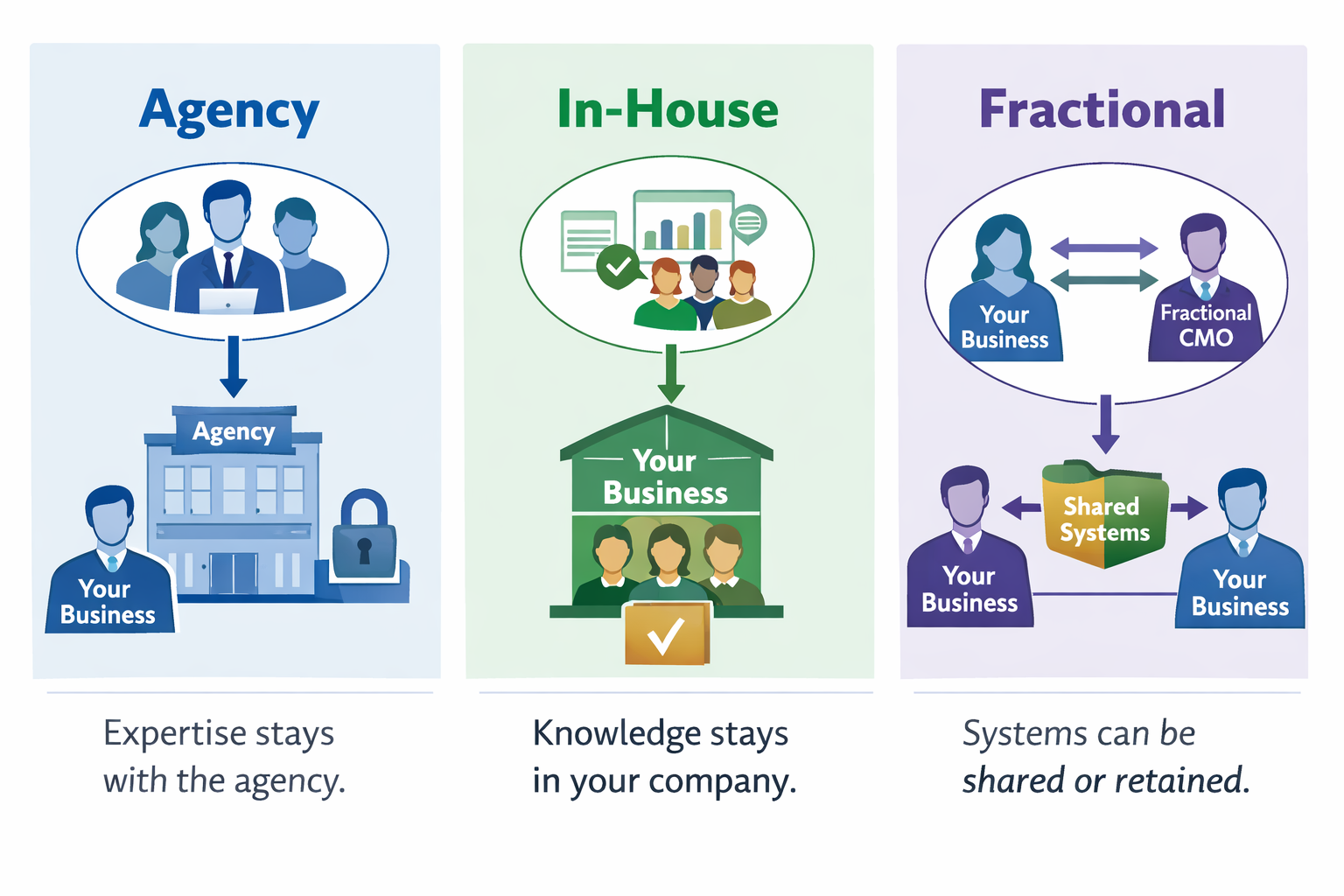
The three main marketing engagement models are: agency (outsourcing activity to an external firm), in-house (employing full-time marketing staff), and fractional (retaining a senior marketer on a part-time, flexible basis). Each represents a different trade-off between cost, control, speed, and strategic depth.
| Model | What it means | Best described as |
|---|---|---|
| Agency | External firm manages your marketing | Outsourced delivery |
| In-house | Full-time employed marketers | Internal team |
| Fractional | Senior marketer, part-time engagement | Flexible leadership |
The defining difference is ownership: agencies retain the knowledge and systems when you stop paying; in-house teams build internal capability over time; and fractional arrangements can go either way depending on how the engagement is scoped.
How much does each model cost?
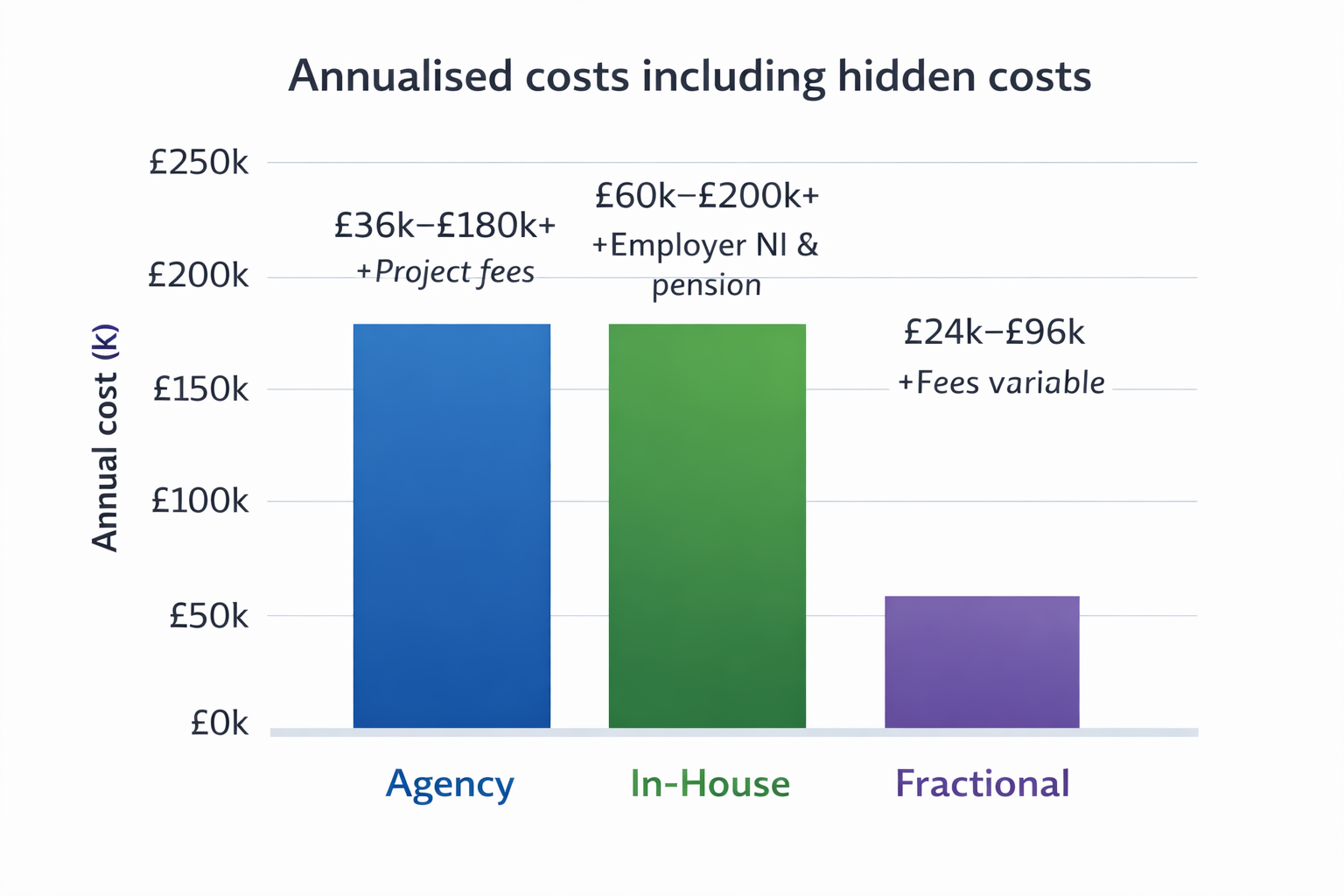
In 2025, a full-service agency typically costs £3,000–£15,000+ ($4,000–$20,000+) per month on retainer; an in-house marketing function commonly runs £60,000–£200,000+ ($80,000–$270,000+) per year in salaries; and fractional support ranges from £2,000–£8,000 ($2,700–$10,700) per month.
In-house hires carry employer on-costs of 20–30% above salary, meaning a £70,000 ($93,750) marketing manager hire actually costs £91,000–£100,000 ($121,000–$133,000) once you factor in employer National Insurance, pension contributions, and recruitment fees.
Agencies often add project fees and ad-spend management on top of retainers, and fractional costs vary considerably by seniority, hours committed, and whether execution is included.
| Model | Monthly cost | Annualised | Key hidden costs |
|---|---|---|---|
| Agency | £3k–£15k+ ($4k–$20k+) | £36k–£180k+ ($48k–$240k+) | Project extras, junior staff on accounts |
| In-house | £5k–£16.7k ($6.7k–$22.4k) | £60k–£200k+ ($80k–$270k+) | Employer NI, pension, recruitment |
| Fractional | £2k–£8k ($2.7k–$10.7k) | £24k–£96k ($32k–$128k) | Execution often excluded from scope |
Most mid-market B2B businesses fall toward the middle of these ranges — but the hidden costs column is where the real differences emerge.
Data & benchmarks
- A traditional agency retainer at £5,000 ($6,700) per month costs £180,000 ($241,000) over three years, and the systems stay with the agency when you leave (estimate based on published pricing at on my website)
- My Fractional CMO packages range from £4,700–£7,000 ($6,300–$9,400) per month on a minimum six-month term.
- Employer NI and pension add approximately 20–30% to a UK marketing salary (estimate; verify against current HMRC guidance)
A quick note on bias: As a fractional CMO, I naturally see this model perform well in many cases, but it is not the right fit for every business, and this article reflects those trade-offs openly.
Assumptions: UK-based B2B businesses. In-house monthly costs derived from typical marketing manager to head-of-marketing salary ranges; treat as estimates. Verify against Reed.co.uk Salary Guide.
Agency vs in-house vs fractional: a head-to-head comparison
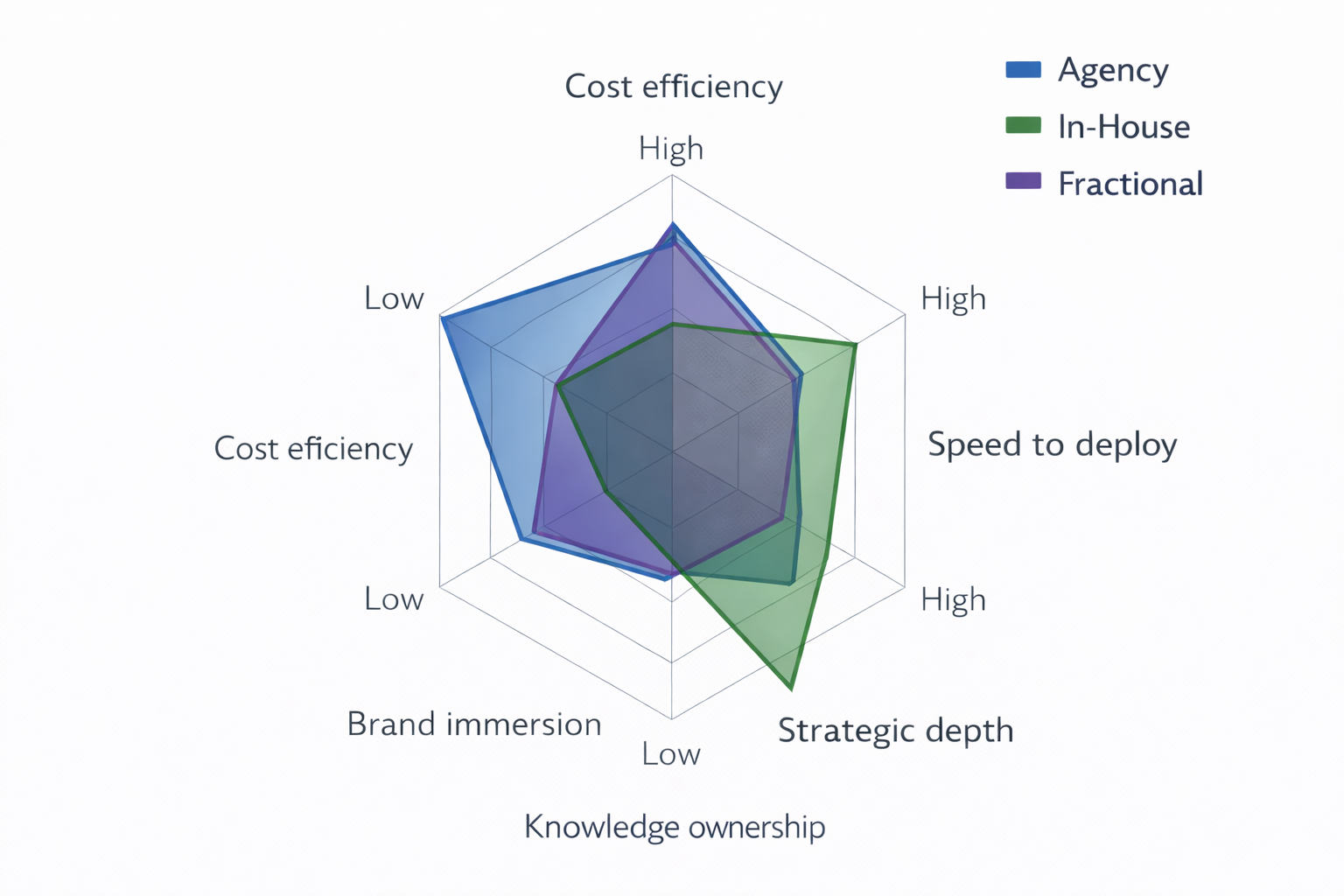
Agencies deliver the broadest skill set and fastest deployment; in-house teams offer the deepest brand immersion and executional control; and fractional marketers provide senior strategic leadership without the full-time overhead.
The ratings below are based on typical UK B2B engagements across businesses between £1m and £20m ($1.3m–$27m) in revenue. Individual results will vary depending on the quality of the provider, clarity of strategy, and level of internal alignment.
| Criteria | Agency | In-house | Fractional |
|---|---|---|---|
| Cost efficiency | Medium | Low | High |
| Speed to deploy | High | Low | High |
| Skill breadth | High | Medium | Medium |
| Strategic depth | Medium | Medium | High |
| Brand immersion | Low | High | Medium |
| Knowledge ownership | Low | High | Medium |
No single model wins across every dimension; the decision turns on which trade-offs matter most at your current stage of growth.
Common problems and drawbacks with each model
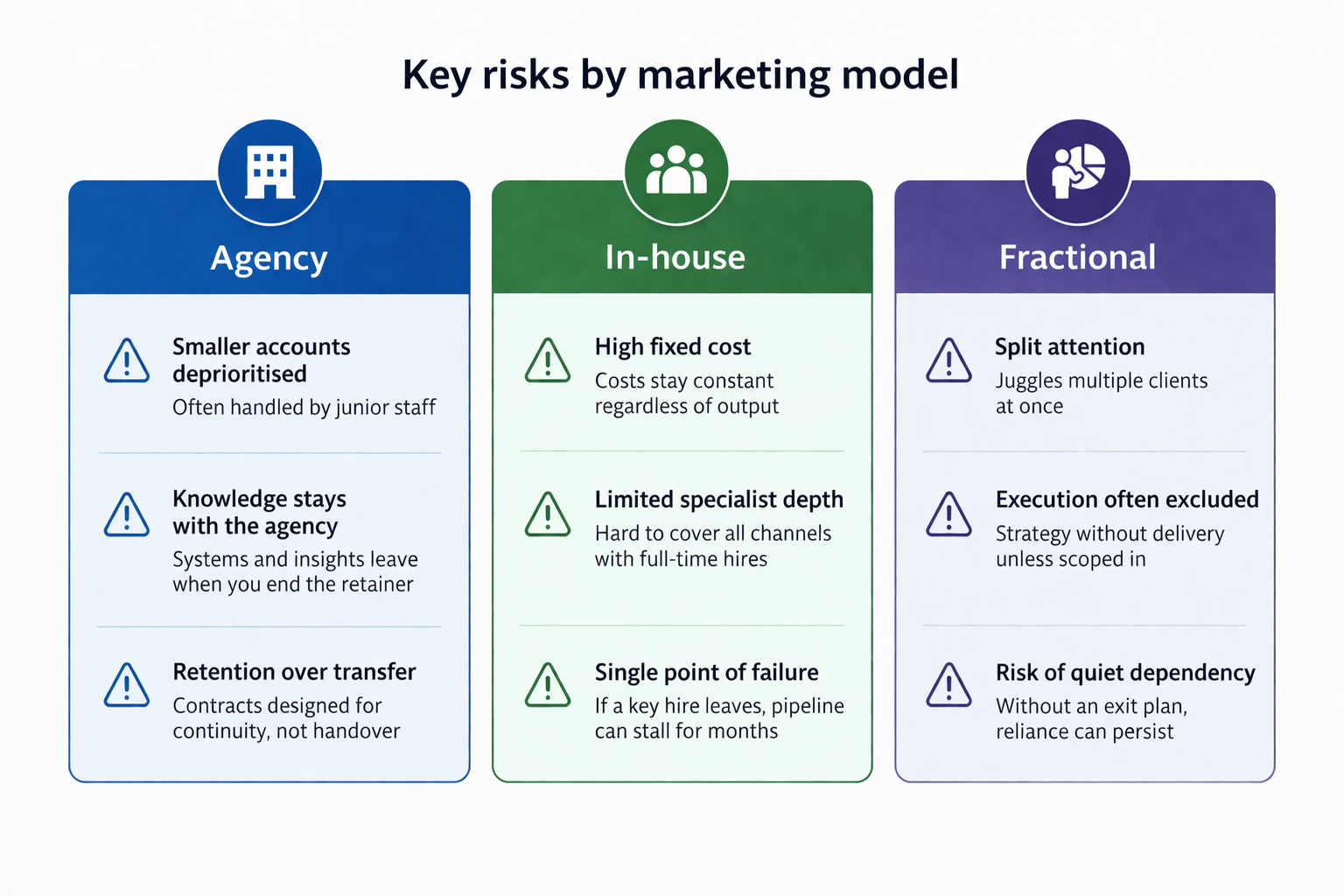
Every marketing model carries meaningful risks, identifying them before you commit is how you avoid the most costly ones.
Agency:
- Smaller accounts are often deprioritised and handed to junior staff
- Knowledge and systems stay with the agency when you leave
- Retainer structures are designed for continuity, not capability transfer, which means you may continue paying even when performance stalls
In-house:
- High fixed costs regardless of output or business performance
- Limited specialist depth across all channels
- If your only marketing manager leaves, your pipeline can stall for months while you recruit, onboard, and rebuild momentum
Fractional:
- Attention may be split across multiple clients at once
- Execution is frequently out of scope
- Without a defined exit plan, dependency can quietly return
The right safeguard across all three models is the same: define accountability structures, KPIs, and exit conditions before you sign anything.
Which model typically delivers the best ROI?
There is no single model that universally delivers the best marketing ROI, the strongest return depends on your revenue stage, existing marketing capability, and how effectively the engagement is structured and managed.
| Revenue stage | Best-fit model | Core reason |
|---|---|---|
| Under £1m ($1.3m) | Fractional | Senior thinking without full-time cost |
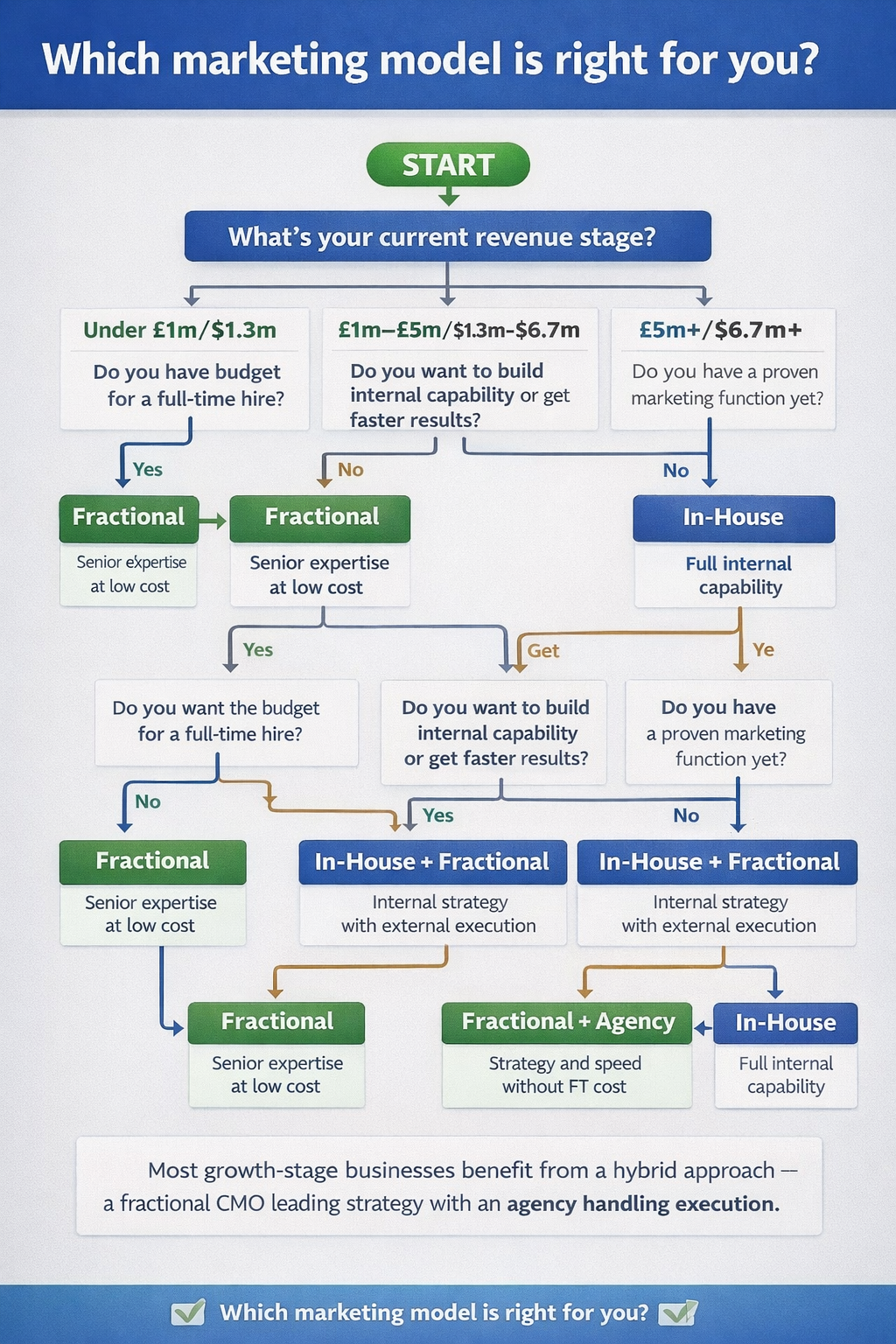
| £1m–£5m ($1.3m–$6.7m) | Fractional + agency hybrid | Strategy and execution without a full team |
| £5m–£20m ($6.7m–$27m) | In-house + fractional oversight | Volume justifies headcount; senior strategy still adds value |
| £20m+ ($27m+) | In-house | Full internal capability delivers the best long-term return |
Fractional models consistently deliver strong ROI per pound for businesses under £5m ($6.7m); in-house generates the highest long-term ROI once marketing volume and repeatability justify the ongoing headcount.
ROI estimation framework:
(Revenue generated by marketing - Total marketing cost) / Total marketing cost x 100 = ROI %
Include fees, salary on-costs, tools, and ad spend in your total cost figure. If direct revenue attribution is not yet possible, use pipeline value as a working proxy.
Worked example: A business at £2m ($2.7m) revenue invests £3,500 ($4,688) per month in a fractional CMO, £42,000 ($56,250) annually. If that engagement generates £210,000 ($281,250) in tracked pipeline value, the ROI is 400%. The same £42,000 ($56,250) invested in a mid-tier agency retainer might generate equivalent pipeline, but if that pipeline was generated without building internal capability, future ROI depends on continued spend rather than compounding ownership.
Which marketing model is best for your business (and when to switch)
To choose the right model, you need to answer these six questions first, because the "best" option on paper is rarely the best option for your specific stage, budget, and capability.
Key criteria to evaluate before making a decision
- Budget ceiling: What can you realistically sustain for 12 months or more?
- Revenue stage: Pre-growth, scaling, or established?
- Marketing maturity: Building from scratch or strengthening what already exists?
- Strategy vs. execution: Do you need someone to lead or someone to do?
- Speed required: Under pipeline pressure, or building for the long term?
- Risk tolerance: How exposed are you if an engagement underperforms?
A five-step decision framework
- Audit your current capability: What do you already have? What is missing?
- Define your primary objective: More leads, better strategy, or building internal capability?
- Set a realistic budget: Include all costs: fees, tools, on-costs, and your own management time.
- Map to the right model: Use the stage table above to match your objective to a model.
- Define success metrics before you sign: Set clear KPIs and review points before any contract starts.
Most growth-stage businesses benefit from a hybrid approach, such as a fractional CMO directing strategy while an agency handles execution, rather than treating the three models as mutually exclusive.
Frequently asked questions
The most common questions buyers ask when comparing these models centre on cost thresholds, timing, and how to measure returns fairly.
Can I use more than one model at the same time?
Yes, and for most growth-stage businesses, that is the right move. A fractional CMO directing strategy alongside an agency handling execution is a common and effective combination.
What is the difference between a fractional CMO and a marketing consultant?
A fractional CMO takes ongoing strategic ownership of your marketing function on a part-time basis. A consultant typically delivers a project or recommendation without ongoing accountability for results. See my Fractional CMO service page for more detail.
How do I measure ROI from an agency or fractional arrangement?
Track pipeline generated, cost per qualified lead, and revenue influenced, not activity metrics. Set these benchmarks before the engagement starts, not three months in.
Which model works best for B2B companies?
B2B businesses at growth stage (£1m–£5m / $1.3m–$6.7m) typically see the strongest results from fractional or hybrid models. Agencies suit project-based or channel-specific needs; in-house makes sense once marketing volume is consistent and repeatable.
When should a startup use an agency rather than hire in-house?
When you need fast execution across multiple channels and do not yet have the volume to justify a full-time hire. Agencies offer speed and breadth; in-house builds ownership over time.
At what budget should I switch from fractional to in-house?
A useful tipping point is when your marketing activity is consistent enough to justify a full-time salary and when the volume of work exceeds what a part-time engagement can realistically deliver. For most UK B2B businesses, that threshold tends to emerge around £5m–£8m ($6.7m–$10.7m) in revenue, but capability need, leadership gaps, and execution volume matter as much as revenue alone.
Conclusion
Before reading this, you had a real decision to make, and probably not enough structured information to make it with confidence.
You now have what you need: cost comparisons, trade-off data, ROI benchmarks by stage, and a five-step framework to guide your next move.
The next step is straightforward: make a decision based on your current stage, not what worked for someone else, and not the model that sounds most credible in a pitch. The businesses that get this right build scalable, self-sufficient growth. The ones that don't stay stuck in cycles of dependency, paying for marketing they don't own, and restarting from scratch every time a relationship ends.
If you want to apply this framework to your own business, this is exactly the work I do with B2B companies, helping them move from fragmented, dependent marketing to structured, self-sufficient growth systems.
How to take action now
- Take the Marketing Debt Scorecard to identify the specific gaps limiting your marketing ROI before you invest further
- Read Fractional CMO vs full-time marketing hire: which is more cost-effective? before making a hiring decision
- Explore the In-House Growth Engine™ to understand how staged marketing ownership works in practice
- Book a 90-Minute Marketing Triage™ for a clear, structured diagnosis before signing anything
Related article: Fractional CMO vs marketing consultant: which one does your business actually need?
If you are ready to move from a model built on dependency to one built on ownership, book a call to explore my Fractional CMO and marketing services.

About the author
Tom Wardman is a fractional marketing consultant and Growth Independence Architect™ working with founder-led B2B businesses across the UK. He specialises in replacing agency dependency with self-sufficient growth systems, building marketing engines that transfer fully to internal teams. Tom is one of the UK's first five certified coaches in the Endless Customers™ methodology and the author of Build a Trusted Brand.
Pricing disclaimer: All GBP–USD price conversions are rounded estimates and correct at the time of publishing. Exchange rates fluctuate and figures should be treated as indicative only.