



Key Takeaways
-
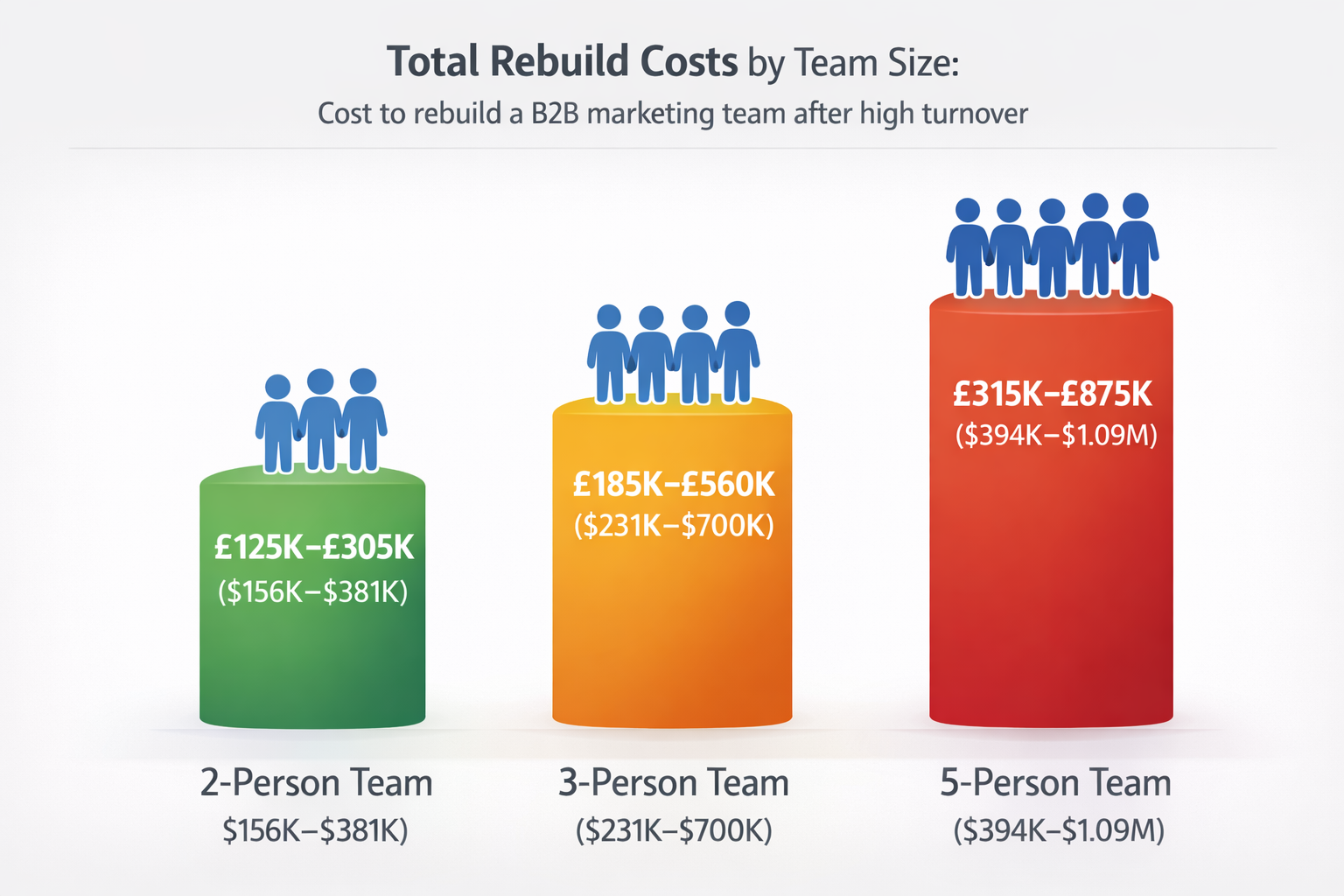
Rebuilding a B2B marketing team after high turnover typically costs £185,000–£560,000 ($231,250–$700,000), equivalent to 18–24 months of departed employees' combined salaries.
-
Hidden costs account for 60–80% of total rebuild expenses, including 3–6 month ramp periods, lost productivity, and stalled pipeline development.
-
Direct hiring costs for three mid-level B2B marketers alone total £34,000–£64,000 ($42,500–$80,000) before their first day.
-
Most rebuilds take 9–15 months to reach full operational capacity, with 60–70% of costs concentrated in the first six months while generating only 20–40% of normal output.
-
Redesigning team structure costs 15–30% more upfront but reduces future turnover by 40–60% and improves marketing ROI within 12–18 months.
Your marketing team is walking out the door. Each departure bleeds budget, momentum, and institutional knowledge, and you're still expected to hit pipeline targets.
As a Fractional CMO who has guided B2B companies from £2m to £50m ARR through team rebuilds, I've seen the true costs that finance spreadsheets miss.
In this article, you'll learn:
- The total cost range for rebuilding a B2B marketing team: £185,000–£560,000 ($231,250–$700,000)
- A detailed breakdown of direct and hidden costs, with timelines
- How to decide whether to backfill roles or redesign your team structure
- Seven specific strategies to minimise rebuild costs by 25–40%
This article is for: B2B founders, CEOs, and revenue leaders facing multiple marketing departures who need to understand the full financial impact before committing to a rebuild plan.
This article is not for: Early-stage startups without an established marketing function, or solo marketers looking for career advice.
What does it mean to rebuild a B2B marketing team after turnover?
Rebuilding a B2B marketing team after turnover means replacing lost talent, restructuring roles, and restoring operational capacity following the departure of multiple marketing employees within a compressed timeframe.
This process goes beyond simple backfilling. You're re-establishing institutional knowledge, redefining team structure, and regaining momentum on campaigns and pipeline generation.
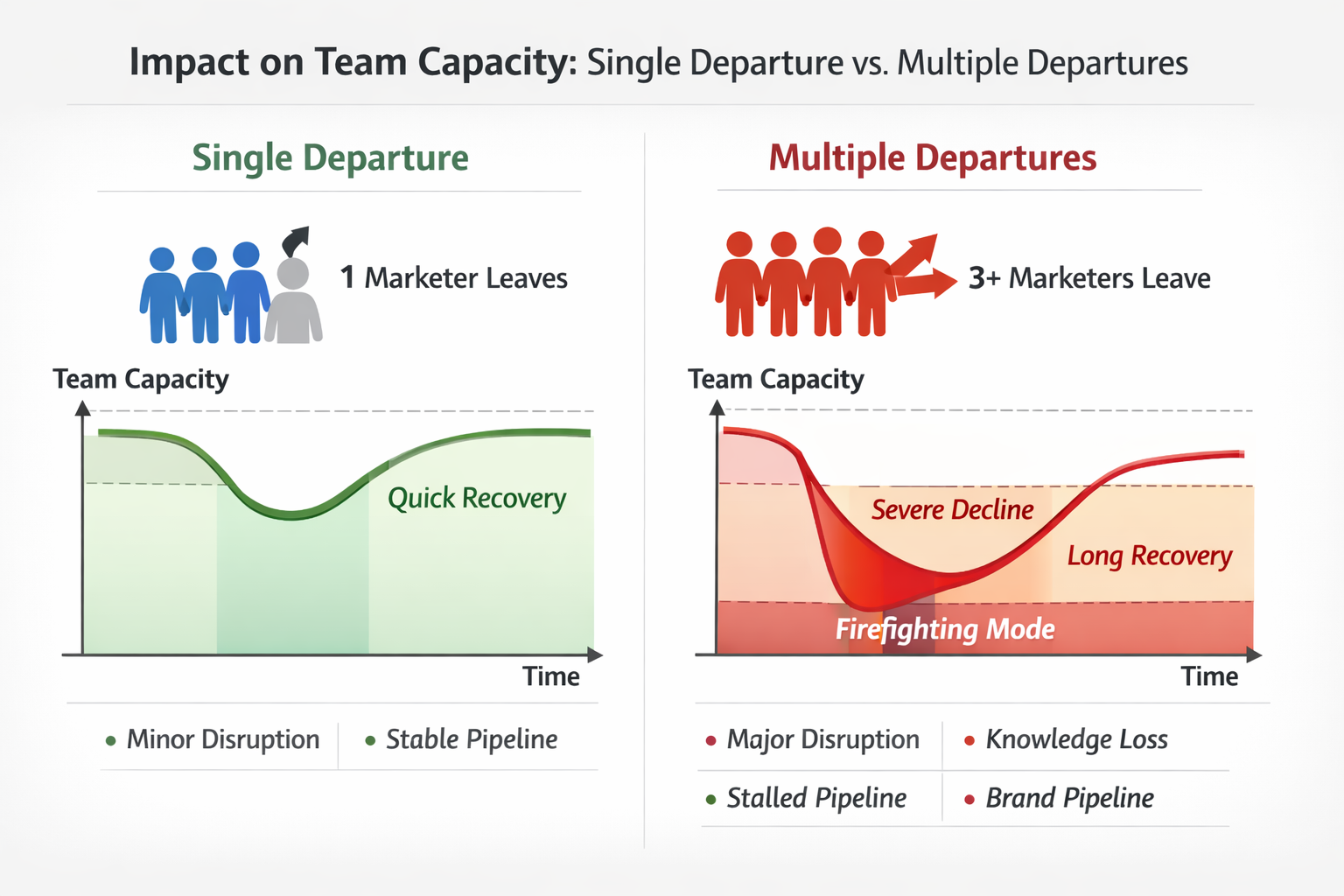
When one marketer leaves, it's manageable. When three leave within six months, you're facing a rebuild. The difference matters because rebuild scenarios compound costs: recruitment runs in parallel, knowledge transfer becomes impossible, and the remaining team collapses under firefighting duties.
How much does it cost to rebuild a B2B marketing team after high turnover?
The total cost to rebuild a B2B marketing team after high turnover typically ranges from £185,000 to £560,000+ ($231,250 to $700,000+) depending on team size, seniority levels, and geography. Most mid-market B2B companies spend 18–24 months of the departed employees' combined salaries when factoring in all direct and indirect costs.
This figure includes recruitment fees, onboarding expenses, productivity loss, interim agency or contractor support, technology resets, and the revenue impact of delayed campaigns.
| Cost Category | Percentage of Total | Typical Range (3-person team) |
|---|---|---|
| Direct hiring costs | 15–20% | £28,000–£75,000 ($35,000–$93,750) |
| Productivity loss during ramp | 30–40% | £56,000–£150,000 ($70,000–$187,500) |
| Interim coverage (agency/contractors) | 15–25% | £28,000–£94,000 ($35,000–$117,500) |
| Revenue impact from delayed campaigns | 20–30% | £37,500–£112,000 ($46,875–$140,000) |
| Knowledge transfer gaps & rework | 10–15% | £19,000–£56,000 ($23,750–$70,000) |
What are the direct costs of hiring replacement B2B marketers?
Direct hiring costs for B2B marketing roles typically include recruiter fees (15–25% of base salary per hire), job board subscriptions (£375–£3,750 / $469–$4,688), background checks (£38–£150 / $48–$188 per candidate), relocation assistance (up to £11,250 / $14,063 for senior roles), and signing bonuses (10–20% of base for competitive hires).
For a team of three mid-level marketers—demand gen manager, content manager, marketing ops specialist—direct hiring costs alone often total £34,000–£64,000 ($42,500–$80,000) before the first day of work.
Breakdown for three mid-level hires:
- Recruitment fees: £22,500–£45,000 ($28,125–$56,250) at 20% average
- Job boards and sourcing tools: £750–£2,250 ($938–$2,813)
- Background checks and screening: £225–£450 ($281–$563)
- Signing bonuses (if needed): £7,500–£15,000 ($9,375–$18,750)
- Relocation (one senior hire): £0–£11,250 ($0–$14,063)
These costs scale dramatically with seniority. A Marketing Director replacement adds £30,000–£50,000 ($37,500–$62,500) in direct costs alone.
What are the hidden and indirect costs of B2B marketing team turnover?
Hidden costs of marketing team turnover account for 60–80% of total rebuild expenses and include lost productivity during the 3–6 month ramp period, knowledge transfer gaps that delay campaign execution, interim agency or freelance coverage (£3,750–£18,750 / $4,688–$23,438 per month), and the compounding revenue impact of stalled pipeline development.
Many B2B companies underestimate these indirect costs, which can exceed £150,000 ($187,500) for a small team when factoring in delayed product launches, paused ABM programmes, and the sales team's reduced lead flow.
| Direct Costs | Indirect Costs | Example Impact |
|---|---|---|
| Recruiter fees | Lost productivity (3–6 months at 40–60% capacity) | Campaigns delayed by 2–4 months |
| Job board subscriptions | Knowledge transfer gaps | Re-learning vendor relationships, platform setups |
| Background checks | Interim agency coverage | £7,500–£22,500 ($9,375–$28,125) per month |
| Signing bonuses | Revenue impact from stalled pipeline | 15–30% drop in MQLs for 6–9 months |
| Relocation assistance | Second-wave departures from overwork | Additional 1–2 team members leave |
The revenue impact is often the largest hidden cost. If your marketing team generates £75,000 ($93,750) in pipeline monthly, a 50% productivity drop over six months equals £225,000 ($281,250) in lost opportunity.
![Chart showing cumulative cost comparison: direct vs. indirect costs over 12 months]](https://tomwardman.com/hs-fs/hubfs/image-png-Feb-02-2026-06-48-07-6690-PM.png?width=1536&height=1024&name=image-png-Feb-02-2026-06-48-07-6690-PM.png)
What operational problems does high marketing turnover create for B2B companies?
High marketing turnover disrupts brand consistency, erodes sales and marketing alignment, damages vendor and agency relationships, and creates a negative signal to prospects and customers who notice frequent LinkedIn departures and campaign inconsistencies.
Operationally, turnover forces remaining team members into firefighting mode, delays strategic initiatives by 6–12 months, and often triggers a second wave of departures as workload stress and uncertainty compound. These aren't just operational headaches—they translate directly into revenue risk that boards and investors will scrutinise.
Key problems beyond cost:
- Brand voice inconsistency: Every new hire interprets messaging differently, creating customer confusion
- Sales enablement breakdown: New marketers don't understand the product, buyer objections, or sales process nuances
- Technology debt: Platforms sit unused because no one knows how they were configured or why
- Lost vendor relationships: Agency partners, freelancers, and suppliers start over with new contacts
- External perception damage: Prospects notice instability and question your company's health
- Strategic paralysis: Long-term initiatives (ABM, content programmes, demand gen infrastructure) stall for 12+ months
Should you rebuild the same team structure or redesign it?
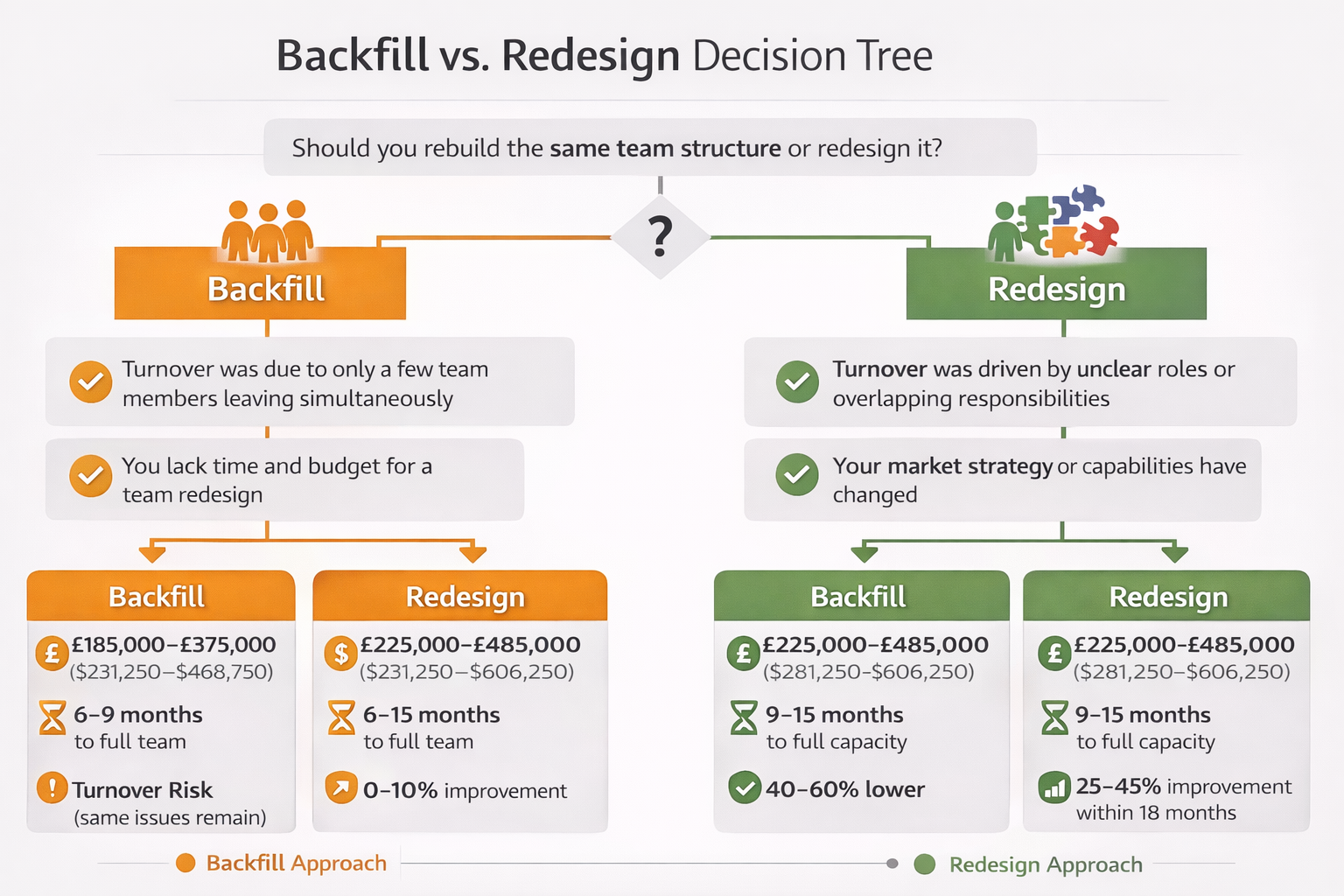
Most B2B companies should treat high turnover as an opportunity to redesign team structure rather than simply backfilling roles, especially if turnover was driven by strategic misalignment, unclear ownership, or skills gaps in emerging areas like product marketing or revenue operations.
Redesigning costs 15–30% more upfront due to consulting fees, revised job architecture, and potential salary adjustments, but typically reduces future turnover by 40–60% and improves marketing ROI within 12–18 months.
| Approach | Upfront Cost | Timeline | Turnover Risk | ROI Improvement |
|---|---|---|---|---|
| Backfill Approach | £185,000–£375,000 ($231,250–$468,750) | 6–9 months to full team | High (same issues remain) | 0–10% improvement |
| Redesign Approach | £225,000–£485,000 ($281,250–$606,250) | 9–15 months to full capacity | 40–60% lower | 25–45% improvement within 18 months |
When to redesign instead of backfill:
- Turnover was driven by unclear roles or overlap
- Your market strategy has shifted (e.g., PLG, ABM, product-led)
- Sales and marketing were misaligned before departures
- You lack capabilities in emerging areas (AI, revenue ops, community)
What factors increase or decrease B2B marketing team rebuild costs?
Rebuild costs vary significantly based on six primary factors: the seniority and specialisation of lost roles (director-level turnover costs 2–3× more than coordinator-level), your employer brand strength (companies with strong reputations fill roles 40% faster), geographic market (coastal US roles cost 30–50% more than remote-first or secondary markets), urgency and timeline pressure (expedited searches add 20–35% in fees), internal recruiting capability, and whether you retain institutional knowledge through documentation.
Companies that invest in structured offboarding, knowledge capture, and alumni networks can reduce rebuild costs by 25–40% compared to those experiencing abrupt departures.
Six cost factors ranked by impact:
- Role seniority and specialisation: Director-level: £75,000–£150,000 ($93,750–$187,500) per role vs. Mid-level: £45,000–£75,000 ($56,250–$93,750)
- Employer brand strength: Strong brand: 30–45 days to hire vs. Weak brand: 60–90 days (doubles interim costs)
- Geographic market: London/NYC: +30–50% salary premiums vs. Remote/regional: baseline costs
- Timeline urgency: Expedited search: +20–35% recruiter fees vs. Standard timeline: 15–20% fees
- Internal recruiting capability: In-house recruiter: saves £15,000–£30,000 ($18,750–$37,500) per hire vs. External only
- Knowledge retention: Structured offboarding: reduces ramp time by 30–50% vs. Abrupt departure: full ramp period
How do you minimise costs when rebuilding a B2B marketing team?
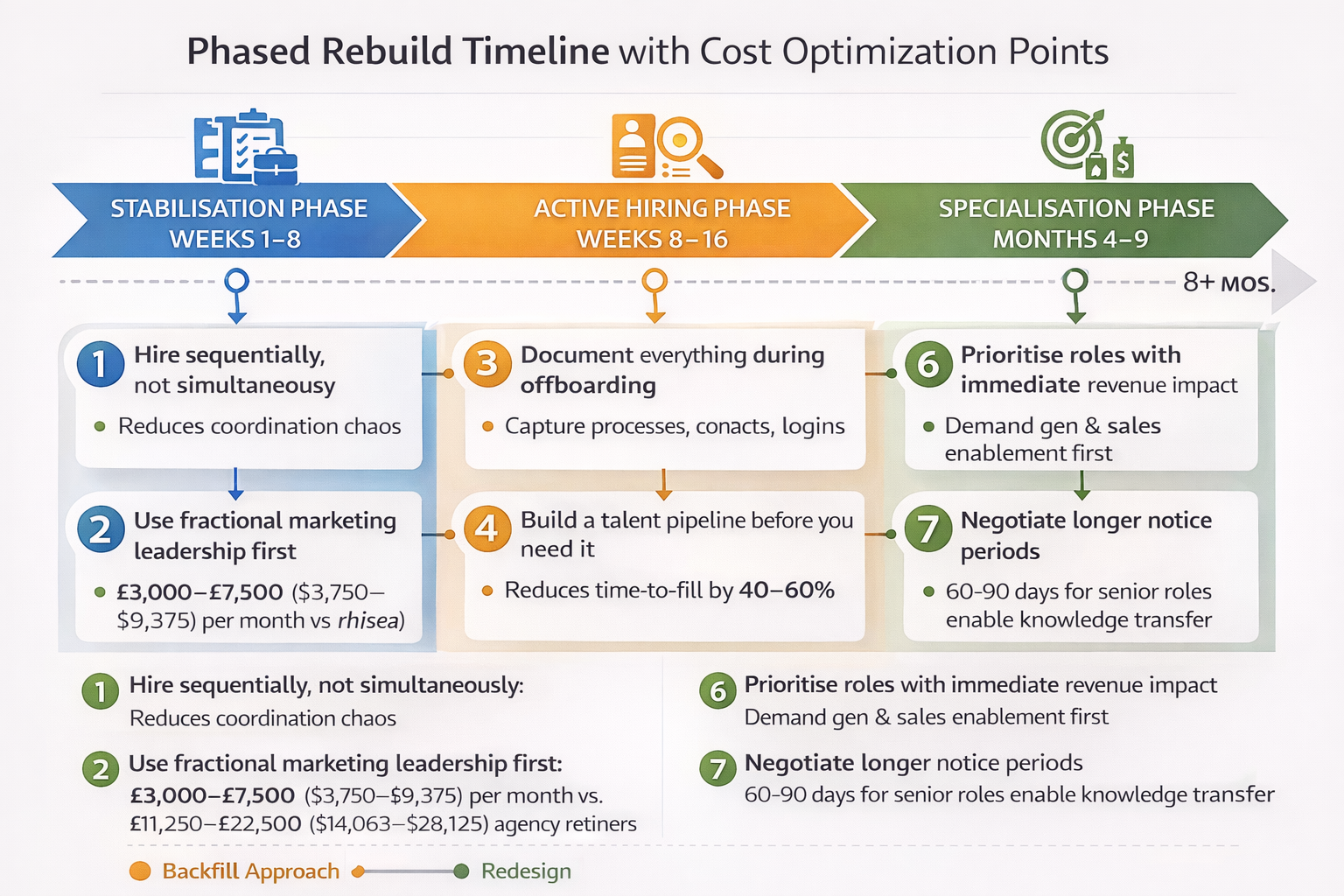
To minimise the cost to rebuild a B2B marketing team, prioritise critical roles sequentially rather than hiring simultaneously. Leverage fractional or interim marketers for immediate coverage (£112–£225 / $140–$281 per hour vs. £11,250–£22,500 / $14,063–$28,125 in agency retainers). Invest in structured onboarding and documentation systems that reduce ramp time by 30–50%, and build an evergreen talent pipeline before turnover occurs.
The most cost-effective rebuilds follow a phased approach: stabilise operations with contractors (weeks 1–8), hire foundational roles with strategic impact (weeks 8–16), then add specialised roles once leadership and systems are established (months 4–9).
Seven cost-minimisation strategies:
- Hire sequentially, not simultaneously: Reduces coordination chaos and allows each hire to contribute to onboarding the next
- Use fractional marketing leadership first: A fractional CMO or Marketing Director (£3,000–£7,500 / $3,750–$9,375 per month) provides strategy whilst you hire
- Document everything during offboarding: Capture processes, logins, vendor contacts, campaign calendars, and strategic context
- Build a talent pipeline before you need it: Maintain relationships with potential hires to reduce time-to-fill by 40–60%
- Invest in structured onboarding: Detailed onboarding programmes cut ramp time from 6 months to 3–4 months
- Prioritise roles with immediate revenue impact: Demand gen and sales enablement roles deliver ROI faster than brand or content roles
- Negotiate longer notice periods: 60–90 day notice periods for senior roles enable proper knowledge transfer
A note on fractional leadership: I offer fractional CMO services, so I'm naturally inclined to recommend this approach. That said, fractional leadership isn't right for every situation; if you have strong internal strategy capability and only need execution support, interim contractors or agency coverage may be more cost-effective.
What is the typical timeline and cost curve for a B2B marketing team rebuild?
Most B2B marketing team rebuilds follow a 9–15 month timeline from first departure to full operational capacity, with costs concentrated in months 2–6 (recruitment and onboarding) and productivity gradually recovering in months 7–12 as new hires ramp.
The cost curve is front-loaded: expect to spend 60–70% of total rebuild budget in the first six months while generating only 20–40% of the team's normal output during that period.
Typical rebuild timeline (3-person team):
- Months 1–2: Stabilisation phase: Remaining team in crisis mode, interim coverage secured, recruitment launched (30% productivity, 15% of total cost)
- Months 2–4: Active hiring phase: Interviews, offers, notice periods (25% productivity, 35% of total cost)
- Months 4–6: Early onboarding phase: First hires starting, still learning systems (40% productivity, 20% of total cost)
- Months 7–9: Ramp phase: Team executing but not yet optimised (65% productivity, 15% of total cost)
- Months 10–12: Optimisation phase: Team approaching full capacity (80% productivity, 10% of total cost)
- Months 13–15: Full capacity reached: Team operating at pre-turnover levels (95–100% productivity, 5% of residual cost)
Frequently asked questions about B2B marketing team rebuild costs
Below are answers to the most common questions B2B leaders ask when calculating the true cost to rebuild a B2B marketing team after turnover.
How long does it take new B2B marketers to reach full productivity?
New B2B marketers typically reach 70–80% productivity in 3–4 months and full productivity in 5–7 months, depending on role complexity, company size, and onboarding quality. Demand gen and marketing ops roles take longer (6–9 months) due to technical platform knowledge, whilst content and social roles ramp faster (3–5 months). Companies with structured onboarding programmes reduce these timelines by 30–40%.
Is it cheaper to use agencies or rebuild an in-house team?
For temporary gaps (3–6 months), agencies cost 15–30% less than full rebuilds, but for 12+ month needs, in-house teams become 40–60% more cost-effective. A mid-level agency retainer runs £5,000–£15,000 ($6,250–$18,750) monthly, equivalent to one senior in-house marketer, but provides less strategic ownership and institutional knowledge. The break-even point is typically 8–10 months.
What's the ROI of investing in retention vs. accepting turnover?
Investing £15,000–£30,000 ($18,750–$37,500) annually in retention programmes delivers 300–600% ROI by preventing turnover that costs £185,000–£560,000 ($231,250–$700,000) per rebuild event. Prevention is dramatically cheaper than cure, but most companies underfund retention until after costly turnover occurs.
Should you hire senior leaders or individual contributors first?
Hire a senior leader (Marketing Director or CMO) first if your team is 3+ people or strategy was unclear; hire individual contributors first if you have interim leadership and immediate execution gaps. Senior hires cost more upfront (£75,000–£150,000 / $93,750–$187,500 total cost) but reduce downstream hiring mistakes and rework that can add £37,500–£75,000 ($46,875–$93,750) in wasted effort.
How do you calculate the revenue impact of marketing team turnover?
Calculate revenue impact by multiplying your team's average monthly pipeline contribution by the percentage productivity loss over the rebuild period. Formula: (Monthly Pipeline × Productivity Loss % × Duration in Months) = Revenue Impact. Example: £75,000 ($93,750) monthly pipeline × 50% loss × 6 months = £225,000 ($281,250) impact. Add the cost of delayed product launches or campaigns using their expected revenue contribution.
Conclusion
You now know the true cost to rebuild a B2B marketing team after turnover extends far beyond recruitment fees. You're looking at £185,000–£560,000 ($231,250–$700,000) in total costs, 9–15 months to reach full capacity, and compounding problems that ripple through your entire go-to-market motion.
The hidden danger isn't the money; it's rebuilding the same dysfunctional structure that caused turnover in the first place. Without addressing root causes like role clarity, strategic alignment, and leadership gaps, you'll face another expensive rebuild within 18–24 months.
Before posting job descriptions, audit your current situation. Identify whether unclear roles, skills gaps, or strategic misalignment contributed to departures. Calculate your specific rebuild costs using the frameworks above. This assessment takes 2–3 hours and can save six figures in misdirected hiring.
Ready to rebuild your marketing team strategically? Explore my Fractional CMO and leadership service.
Related reading: Fractional CMO vs. Marketing Director: Which Does Your B2B Business Need?

About the Author
I'm Tom Wardman, and I've spent the past decade helping B2B companies build marketing teams and systems that generate predictable revenue rather than constant firefighting. As a Fractional CMO and Marketing Director, I've guided businesses through team rebuilds, strategic redesigns, and the painful transitions that follow high turnover. I focus on one thing: building marketing capability that survives after I leave, because dependency isn't a business model; it's a trap.
Pricing Disclaimer: All GBP–USD price conversions use an approximate exchange rate of £1 = $1.25 and are correct at the time of publishing. Exchange rates fluctuate and figures should be treated as indicative only.
Topics: