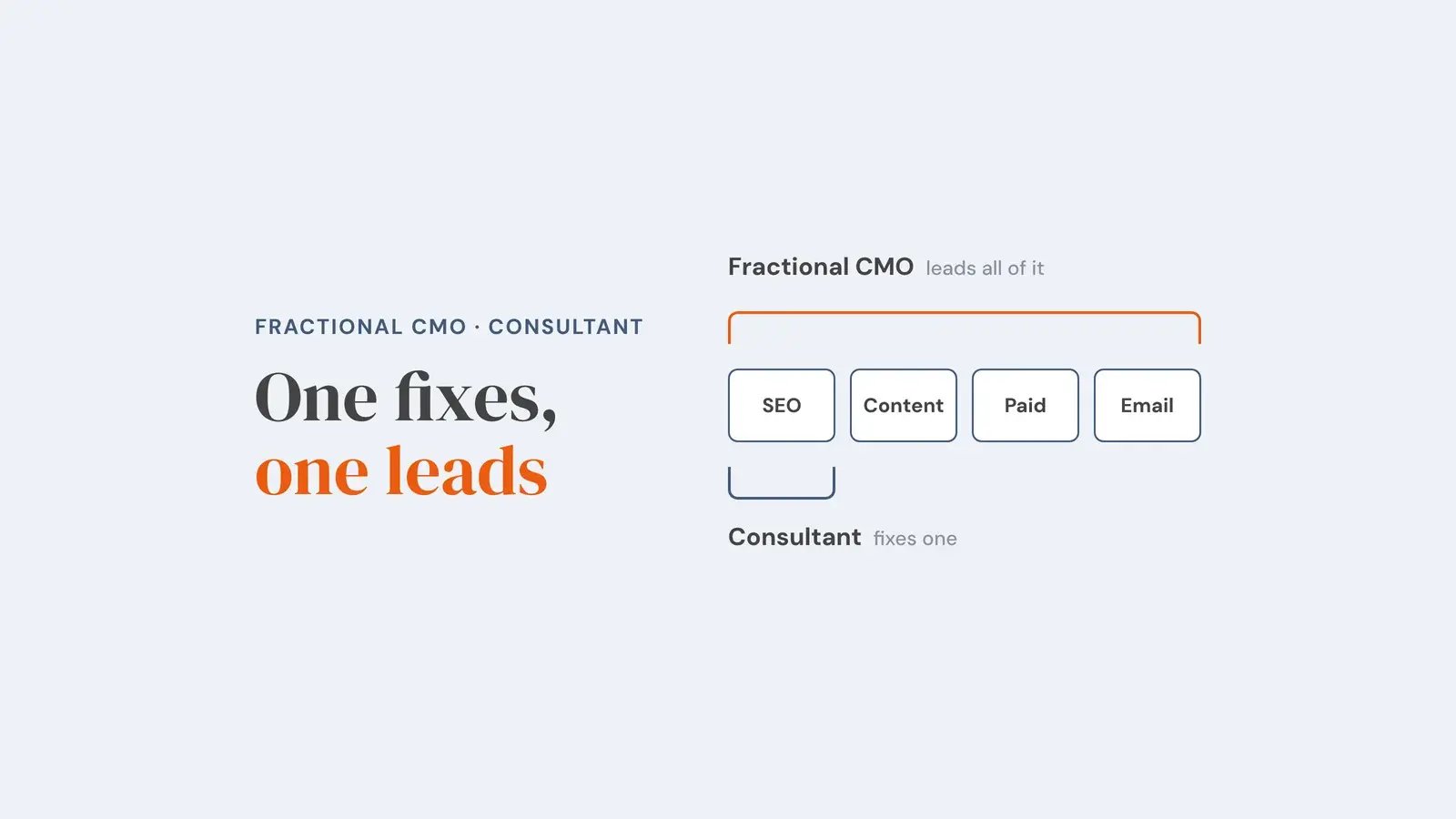


Does your agency feel operationally stuck, but you cannot decide whether you need someone to lead the change or someone to manage the day-to-day? Are you weighing up two different hires without a clear picture of what each one actually does?
As a fractional COO working exclusively with agencies, I see this same decision point come up at the same handful of revenue and growth stages, again and again, and I see the same mis-hire happen when the two roles get confused.
This article gives you a direct comparison of a fractional COO and an agency operations manager, what each role covers, what each costs, and which one fits your current situation. It is written for agency founders and directors making a hiring decision at a growth inflection point, and it will help you avoid a costly mis-hire by matching the right role to the right problem.
Key takeaways
- A fractional COO sets operational strategy and makes structural decisions; an agency operations manager executes and maintains systems that already exist.
- Fractional COO engagements typically cost £3,000–£12,000/month ($3,750–$15,000); a full-time agency operations manager costs £35,000–£60,000/year ($43,750–$75,000).
- The right hire depends on whether your agency has a strategy problem or an execution problem; these are not the same thing.
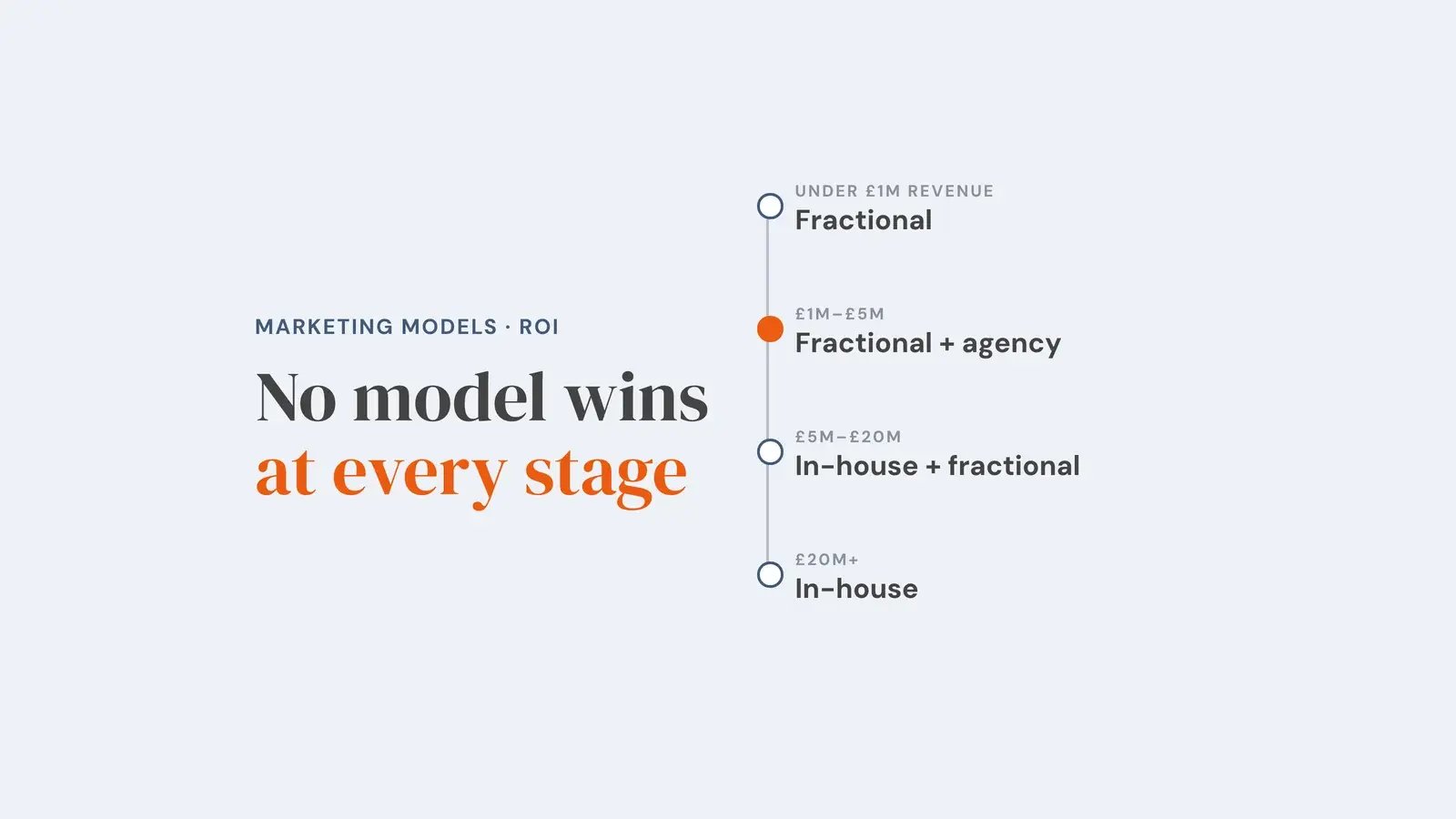
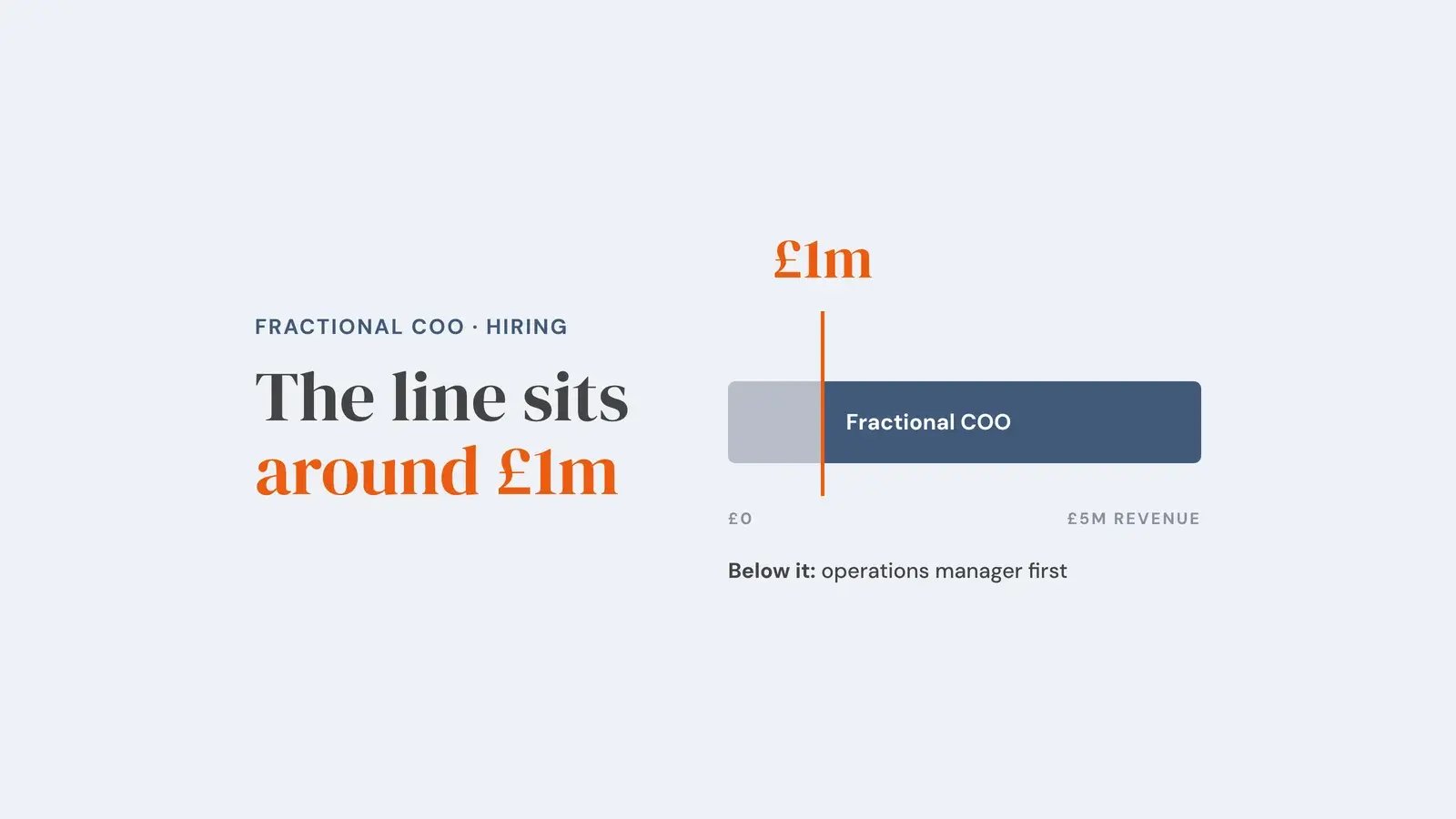
- Most agencies below £1m revenue are better served by an operations manager first; agencies between £1m–£5m facing structural dysfunction are most likely to need a fractional COO.
- The most common mis-hire is bringing in an operations manager to fix a problem that requires executive-level decision-making.
What is a fractional COO and what is an agency operations manager?
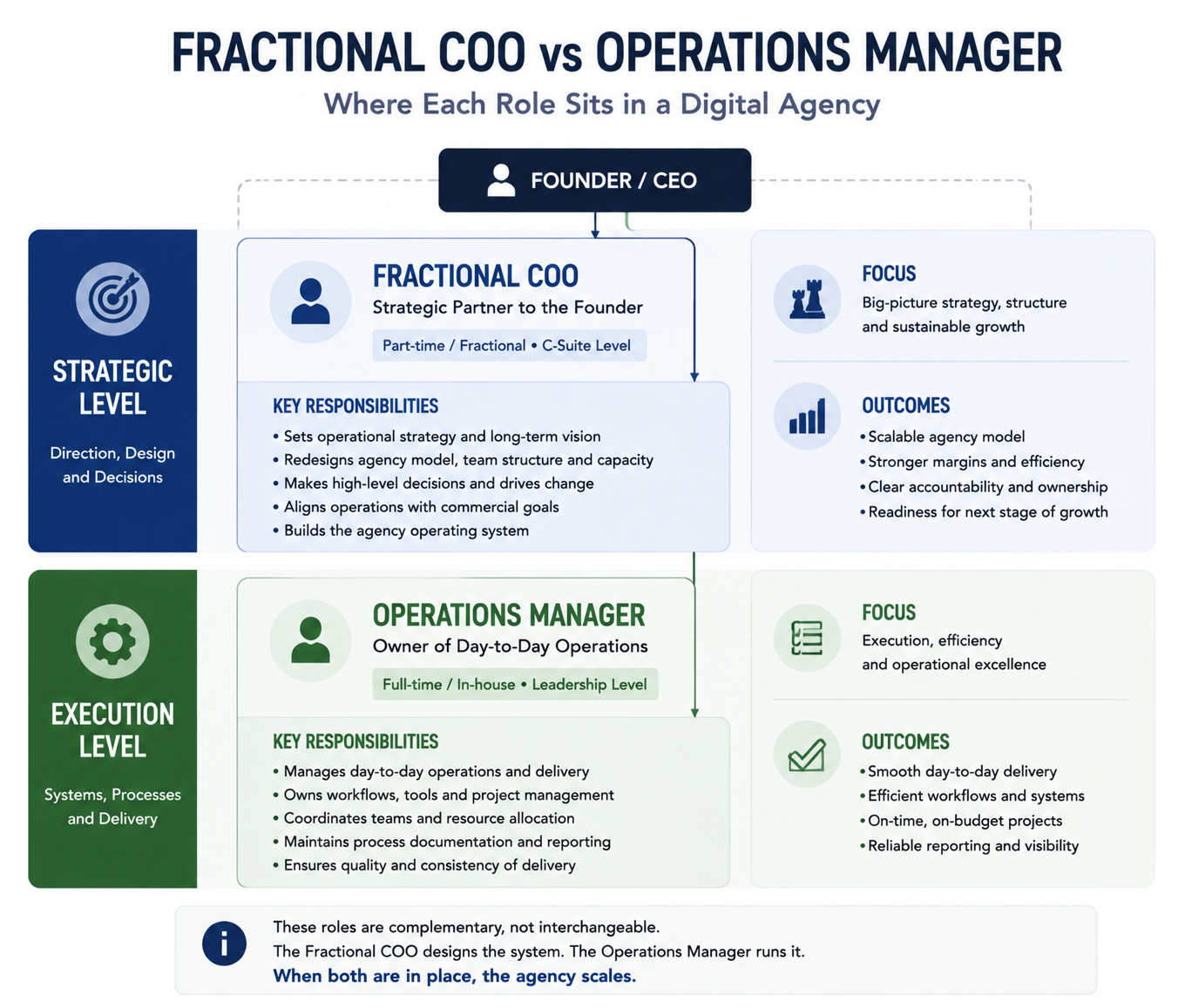
A fractional COO is a senior executive hired on a part-time or contract basis to lead an agency's entire operational strategy, typically reporting directly to the founder or CEO. The "fractional" element means you get C-suite experience without a full-time salary; the COO works across a set number of days per month, focused on structural decisions rather than day-to-day task management.
An agency operations manager is usually a full-time, in-house hire responsible for executing processes, managing workflows, tools, team coordination, and delivery systems rather than setting top-level operational direction. They keep the machine running; they are not expected to redesign it.
How do the two roles differ in scope, authority, and strategic focus?
The core difference is one of strategic authority: a fractional COO sets the operational vision and makes structural decisions, while an operations manager implements and maintains the systems that already exist.
In practice, a fractional COO might redesign an agency's delivery model, restructure team accountability, or lead a transition from project-based to retainer work. An operations manager would not typically own those decisions.
Decisions owned by a fractional COO
- Redesigning service delivery structures and capacity models
- Setting team accountability frameworks
- Leading operational change during a growth pivot
- Building or overhauling an agency operating system
Decisions owned by an operations manager
- Managing project workflows and delivery tools
- Coordinating team task ownership and communication
- Maintaining process documentation and reporting
- Tracking delivery performance against set standards
What does a fractional COO cost compared to an agency operations manager?
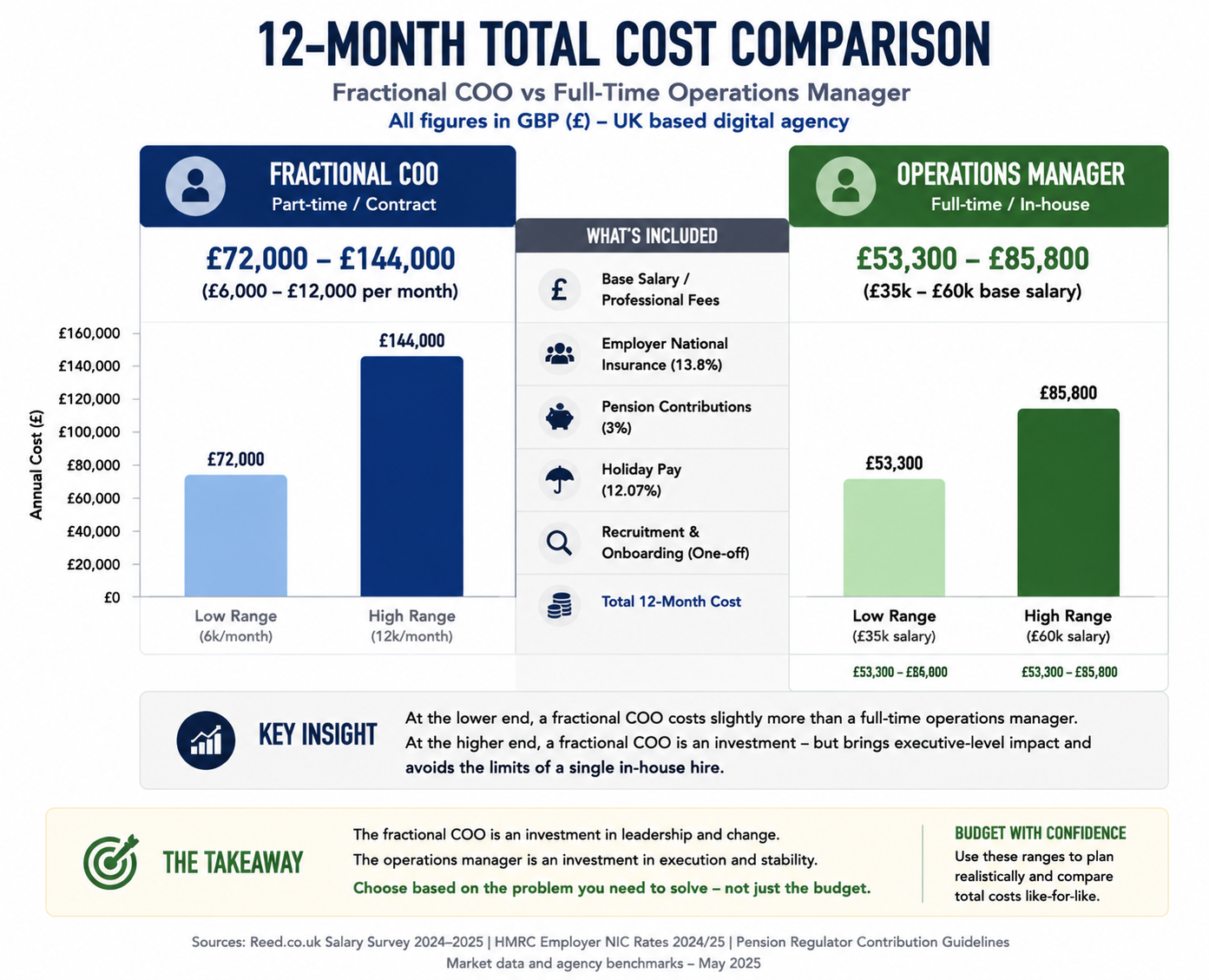
A fractional COO typically costs between £3,000 and £12,000 per month ($3,750–$15,000) depending on provider seniority, engagement scope, and the number of committed days. My own Fractional COO packages for agencies range from £4,200–£6,900/month ($5,250–$8,625) with a minimum six-month engagement.
A full-time agency operations manager in the UK generally commands a salary of £35,000–£60,000 per year ($43,750–$75,000), which is roughly £2,900–£5,000/month ,but that figure excludes employer National Insurance (15% above the secondary threshold), pension contributions, holiday cover, and recruitment costs.
Salary benchmarks based on 2024–2025 UK market data (Source: Reed.co.uk salary data.) Fractional COO ranges are market estimates based on published pricing across UK providers and should be treated as indicative.
What problems does each role solve, and where does each fall short?
A fractional COO is best suited to structural and strategic problems: chaotic growth, unclear accountability, eroding margins, or the complete absence of operational leadership at founder level.
An operations manager is the stronger fit when direction is already clear and you need someone to own execution, manage delivery teams, and maintain system integrity day-to-day.
Problems a fractional COO solves:
- Founder is still acting as de facto head of operations at £1m+ revenue
- Delivery margins are shrinking without a clear structural explanation
- The agency is pivoting its service model or moving to retainers
- No one at leadership level owns operational decisions
Problems an operations manager solves:
- Delivery is noisy and needs a consistent process owner
- Tools and workflows exist but are poorly coordinated
- Headcount is growing and team communication is breaking down
Where each falls short: A fractional COO cannot fix an execution problem if there is no one managing day-to-day delivery beneath them. An operations manager cannot make the structural decisions needed at a growth inflection point; that requires executive authority.
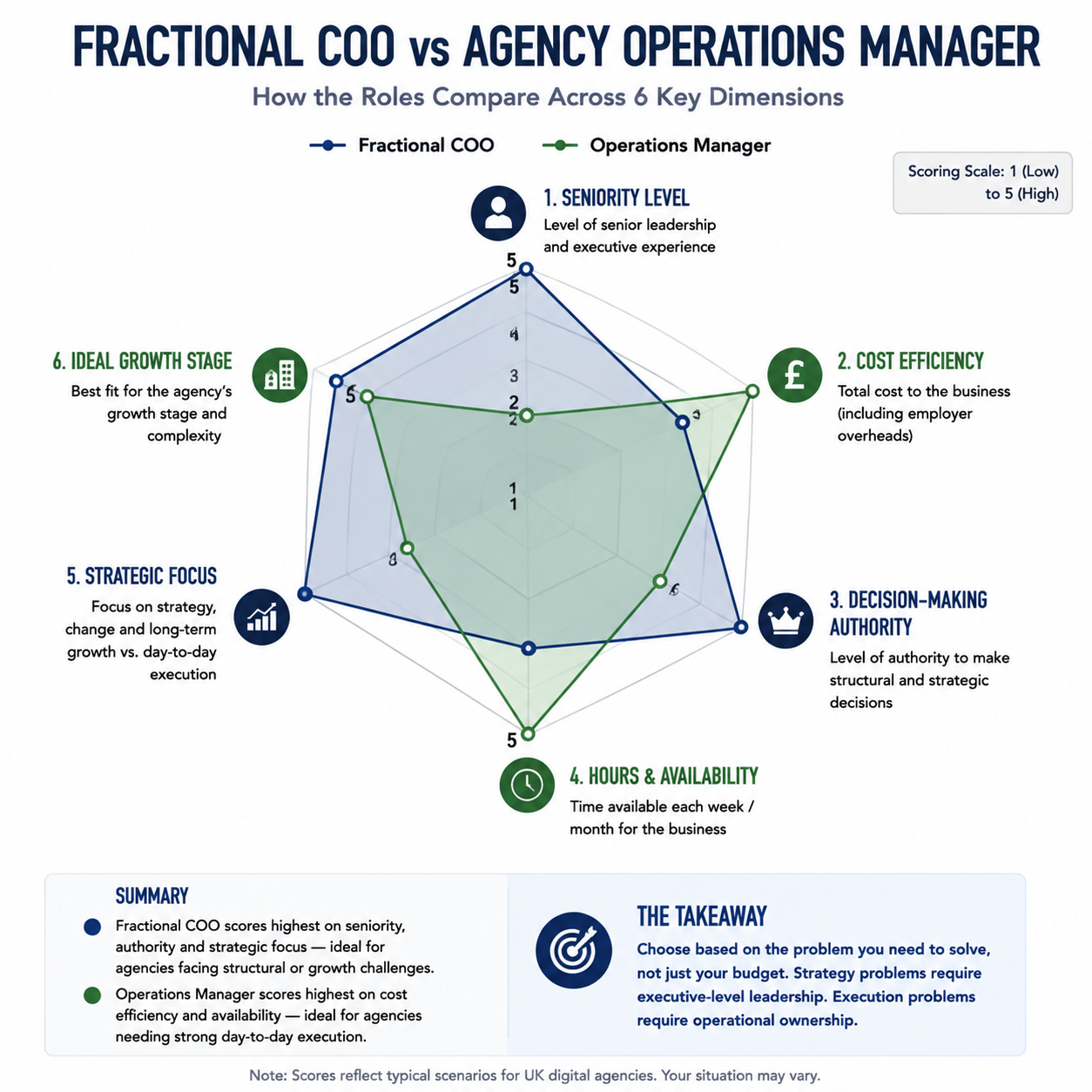
How do fractional COO and agency operations manager roles compare, side by side?
When compared directly, these two roles differ across six dimensions: seniority, engagement model, cost, decision-making authority, time commitment, and the agency growth stage each is designed to serve.
Which agencies need a fractional COO vs an operations manager?
Agencies scaling rapidly, facing structural dysfunction, or pivoting their service model are most likely to need a fractional COO rather than an operations manager.
Here are 5 common scenarios with a direct verdict:
- You are a founder still managing delivery at £1.5m revenue: Fractional COO. You need someone to take structural ownership, not manage tasks.
- Your agency runs reasonably well but needs a process owner as you grow from 5 to 10 people: Operations manager. The foundation exists; you need execution capacity.
- Your margins are shrinking and you cannot explain why: Fractional COO. This is a structural diagnosis problem. See: How to Diagnose Broken Agency Operations (and Fix the Right Things)
- You have hired 3 people in 6 months and delivery coordination is breaking down: Operations manager, with a systems audit first to clarify what they will be managing.
- You are moving from project work to retainers and the delivery model is under strain: Fractional COO. Restructuring a delivery architecture requires executive-level design, not workflow management.
How do you decide which role your agency needs? A 5-step decision framework
Choosing between a fractional COO and an operations manager comes down to 5 questions that map your operational problem to the right level of hire.
What is the nature of the problem? Structural issues, such as accountability gaps, margin erosion, delivery model failure, need a COO. Workflow and coordination issues need an operations manager.
Do you need strategy or execution? If someone needs to decide how the agency operates, that is a COO function. If someone needs to carry out those decisions, that is an operations manager function.
What is your current revenue? Most agencies below £800k–£1m benefit from an operations manager first. Above £1m with structural problems, a fractional COO is more appropriate.
Is the need temporary or permanent? Fractional engagements suit time-bound structural challenges. A full-time operations manager suits an ongoing execution need.
What can your budget realistically sustain? A fractional COO at £4,200–£6,900/month ($5,250–$8,625) is a higher monthly spend but avoids a long-term fixed headcount commitment.
Working through these in order will help you avoid bringing in an operations manager to fix a problem that requires executive-level thinking. See: Fractional COO For Agencies: Do You Actually Need One?
Frequently asked questions
Can an operations manager do what a fractional COO does?
No. An operations manager can maintain and improve existing systems, but does not carry the authority or strategic remit to design or overhaul them. This distinction matters most at a structural inflection point.
At what revenue stage should an agency hire a fractional COO?
Most agencies see the strongest return between £1m and £5m revenue, when operational complexity outpaces the founder's capacity to manage it alone.
Can an agency have both a fractional COO and an operations manager?
Yes, and in growing agencies this is a common structure. The fractional COO sets direction and owns structural decisions; the operations manager runs day-to-day execution. Clear role boundaries are needed to avoid duplication. See: Fractional COO Vs Full-Time Hire: The True 12-Month Cost Breakdown
Is a fractional COO worth the cost for a small agency?
For most agencies under £800k revenue, a fractional COO is unlikely to deliver a proportionate return. A systems audit or a well-briefed operations manager is a more appropriate starting point.
Conclusion
You came here with one decision to make: which operational role does your agency actually need right now?
You now have the framework to answer it. The question is not which role sounds more impressive; it is whether your agency has a strategy problem or an execution problem. If your operational structure is unclear, your delivery model is breaking under growth pressure, or no one at leadership level owns operations; that is a fractional COO problem. If your systems are sound but need consistent management; that is an operations manager problem.
How to take action now
- Use the 5-step decision framework above to categorise your operational problem before speaking to anyone
- Audit your current delivery structure to confirm whether systems exist or need to be built
- Get clear on your 12-month budget: a fractional COO is flexible but monthly; a full-time operations manager is a fixed employment cost
- If you are between £1m and £3m revenue and unsure, a systems audit is often the right first step before committing to either hire
- If you are leaning toward a fractional COO, speak to one before finalising the operations manager brief; it often clarifies exactly what you need
If you are ready to identify which operational gap your agency is working with, I offer Fractional COO services for agencies with clear published pricing and a structured engagement model; no vague proposals, no open-ended commitments.

About the author
Tom Wardman is an operational strategist and fractional COO working exclusively with digital marketing and creative agencies. He specialises in building the systems, structures, and leadership capacity that allow founder-led agencies to grow without increasing their dependency on the founder. His work focuses on structural clarity, delivery architecture, and the transfer of operational capability, so agencies can run independently when the engagement ends.
Pricing disclaimer: All GBP–USD price conversions are rounded estimates and correct at the time of publishing, calculated at a fixed rate of £1 = $1.25. Exchange rates fluctuate and figures should be treated as indicative only.
Topics: