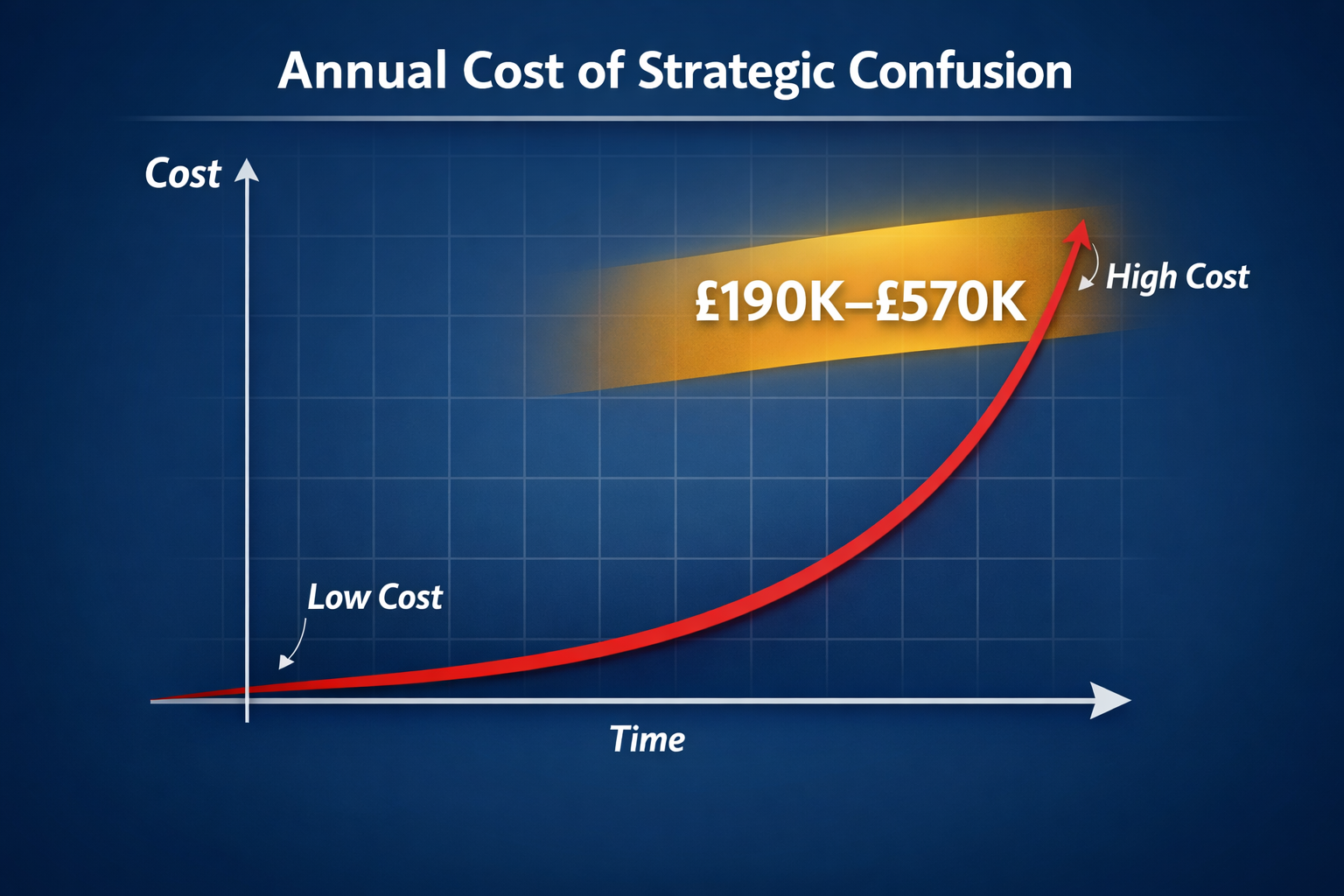



Key Takeaways
- £10k ($12,500)/month = established SME tier, suited to businesses with £2m–£15m ($2.5m–$18.75m) annual revenue expecting measurable pipeline growth
- Agency = 40–60 blended hours across 2–4 channels, with at least one senior account lead
- Consultant = 15–25 senior hours, typically a fractional CMO or head of growth embedded with your team
- Biggest risk = scope creep, clients expect full-funnel execution across 5+ channels, but the budget only supports 2–3 done well
- Best model = hybrid, a senior strategist (£4k–£6k / $5k–$7.5k) managing specialist agencies or freelancers (£4k–£6k / $5k–$7.5k) handling execution
You've been quoted £10,000 ($12,500) per month for marketing support, and now you're wondering whether you're about to invest in real growth… or just another expensive experiment.
Is it enough for proper strategic thinking, or will you get stretched-thin juniors? Should you choose an agency or a consultant? And most importantly, what tangible deliverables should you expect for that investment?
If you've been burned by agencies that over-promised and under-delivered, or you're under pressure to justify marketing spend to your board, you're not alone. Owner-managed SMEs and founder-led B2B firms between £3m–£10m ($3.75m–$12.5m) revenue feel this tension constantly: the money is significant enough to expect results, but not so large that waste is easily absorbed.
This article is for business leaders and marketing directors evaluating £10k ($12,500)/month proposals. You'll learn exactly what different providers deliver at this price point, how to spot value versus waste, and which service model matches your situation. By the end, you'll know how to audit any proposal and make a confident hiring decision.
What does £10k per month represent in marketing services?
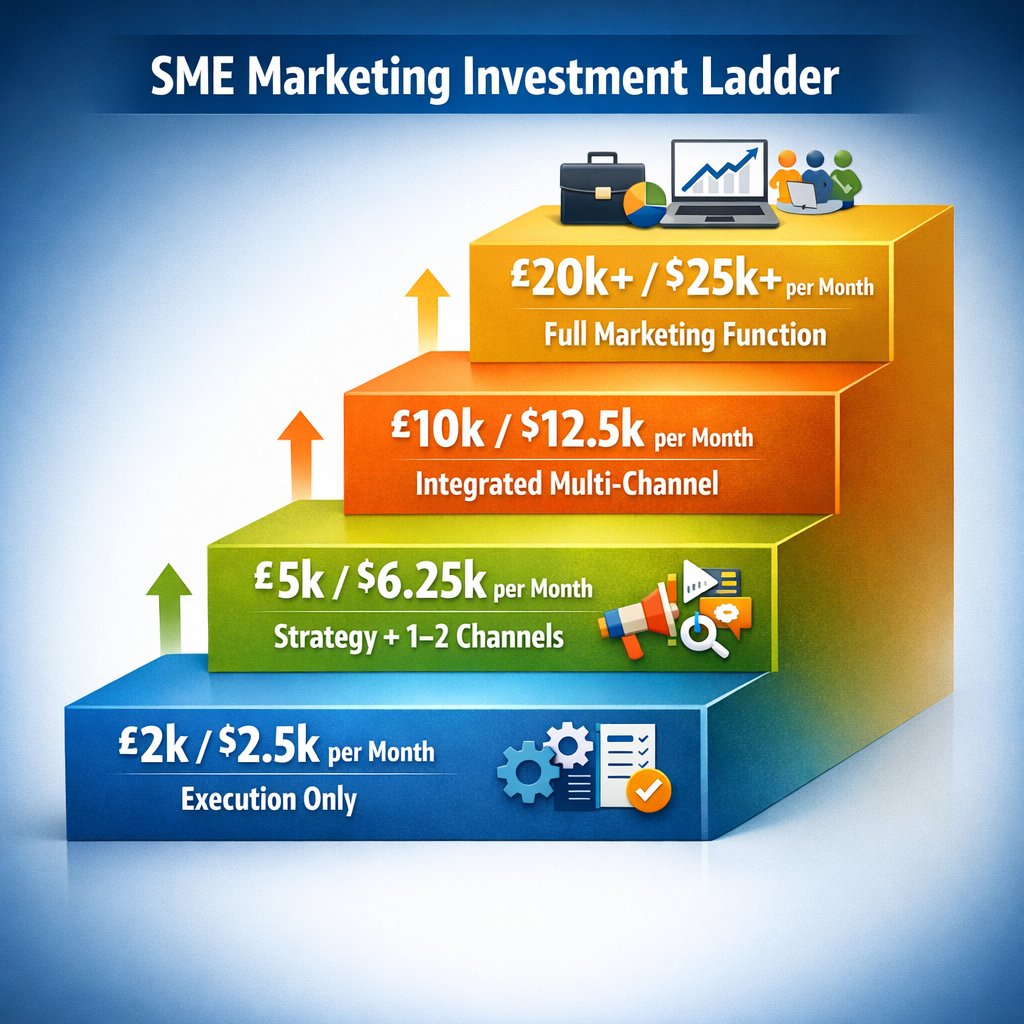
£10,000 ($12,500) per month sits in the 'established SME to mid-market' tier of marketing investment, typically suited to businesses with £2m–£15m ($2.5m–$18.75m) annual revenue or those expecting marketing to generate measurable pipeline growth.
At this level, you're no longer buying junior execution or ad hoc support; you should expect senior strategic oversight, multi-channel coordination, and accountability for commercial outcomes.
This budget represents a serious commitment to marketing as a growth function. At minimum, it should include:
- Strategic planning and quarterly roadmapping tied to business objectives
- Active management of 2–4 core channels (not token presence across everything)
- Regular commercial reporting showing contribution to pipeline, revenue, or CAC
If a proposal doesn't include these table stakes, the pricing is inflated or the scope is wrong.
What does a marketing agency deliver for £10k per month?
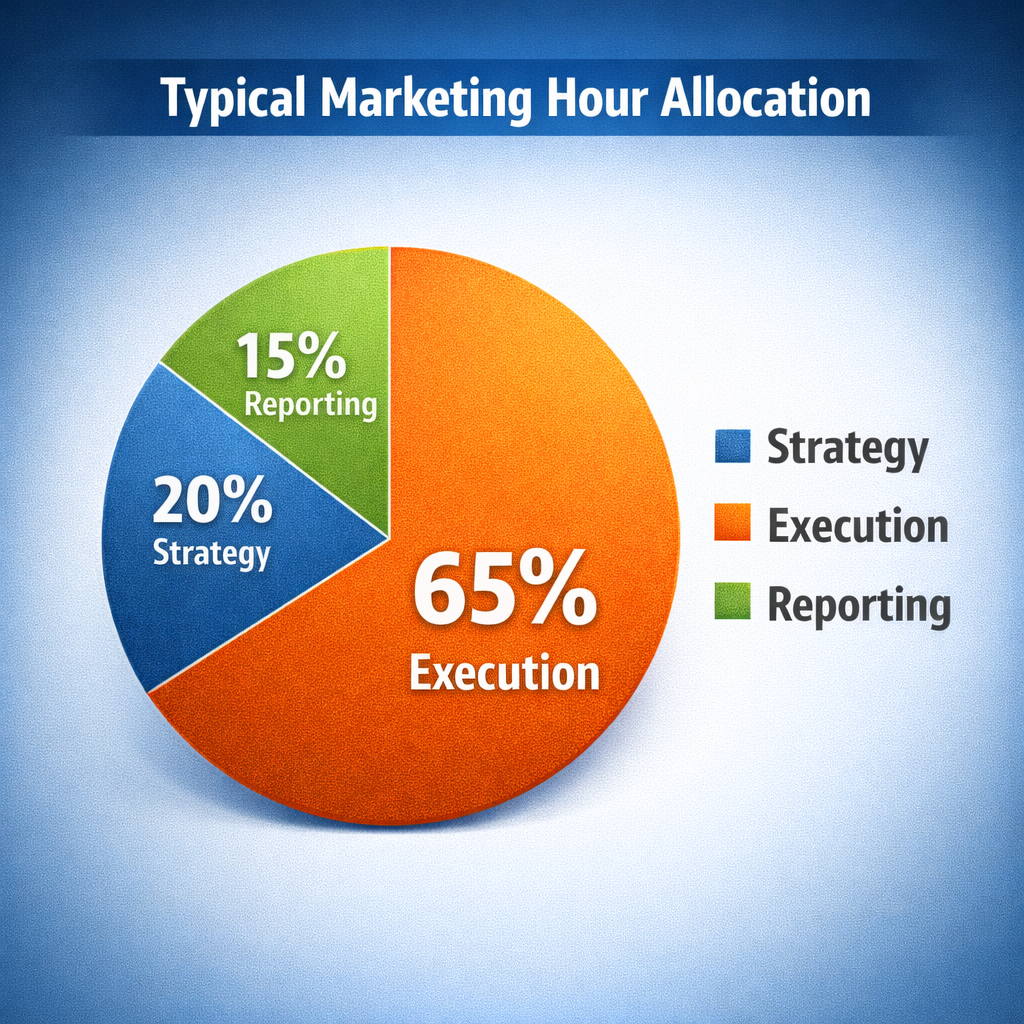
A £10,000 ($12,500) monthly retainer with a full-service or specialist agency typically buys 40–60 hours of blended team time, spread across strategy, execution, and reporting, with at least one senior lead managing your account.
Most agencies at this price point will assign a dedicated account director or strategist (8–12 hours/month), supported by mid-level specialists in 2–4 channels such as paid media, content, SEO, or email.
Here's what that typically looks like broken down by channel:
- Paid media management: Campaign setup, ongoing optimisation, monthly reporting (12–15 hours)
- Content marketing: 4–8 pieces per month, including articles, social posts, or email campaigns (15–20 hours)
- SEO: Technical audits, on-page optimisation, link building (8–12 hours)
- Email or marketing automation: Workflow setup, campaign execution, list management (6–10 hours)
- Reporting and strategy calls: Monthly performance reviews and planning (4–6 hours)
| Agency Type | Hours/Month | Team Structure | Channel Coverage | Best For |
|---|---|---|---|---|
| Full-service | 40–50 | Account director + 2–3 specialists | 3–4 channels | Businesses needing broad coverage |
| Specialist boutique | 50–60 | Senior lead + focused team | 2 channels done deeply | Companies with clear channel priorities |
The key limitation: you get breadth of activity but limited senior thinking time. Most hours go to execution, not strategy development.
What you get from a senior marketing consultant at £10k/month
A senior independent consultant charging £10,000 ($12,500) per month will typically deliver 15–25 hours of their own time, focused on strategy, leadership, and high-leverage execution rather than production or media buying. Consultants at this level often act as fractional CMOs or heads of growth, embedding with your internal team to build capability, set direction, and oversee external specialists or junior hires.
At current UK day rates (£800–£1,500 / $1,000–$1,875 per day for senior consultants), £10k ($12,500)/month translates to roughly 7–12.5 days. Most consultants at this level deliver:
- Strategic roadmap and quarterly planning tied to commercial goals
- Team leadership and capability building for internal staff or junior hires
- Vendor and agency management including brief-writing and performance oversight
- High-leverage execution such as messaging frameworks, campaign concepts, or funnel design
- Board-level reporting and stakeholder management with P&L-linked metrics
You're not hiring someone to write every blog post or build every email — you're hiring expertise to make better decisions, move faster, and build marketing capability that outlasts the engagement.
Agency vs consultant at £10k/month: Which gives you more?
Agencies deliver more total hours and cross-channel execution capacity at £10k ($12,500)/month, but consultants offer deeper strategic thinking, faster decision-making, and closer integration with your business.
The right choice depends on whether you need a team to do marketing (agency) or a senior leader to run marketing and coordinate others (consultant).
| Criteria | Agency at £10k ($12,500)/month | Consultant at £10k ($12,500)/month |
|---|---|---|
| Hours delivered | 40–60 hours/month | 15–25 hours/month |
| Seniority of time | 20–30% senior | 100% senior |
| Channel breadth | 3–4 channels active | 2–3 channels strategically managed |
| Strategy depth | Functional (campaign-level) | Commercial (business-level) |
| Speed of decisions | Slower (internal approvals) | Faster (direct access) |
| Flexibility | Contract-bound | Highly adaptable |
| Team integration | External partner | Embedded leadership |
| Scalability | Easy to add hours/channels | Requires adding other resources |
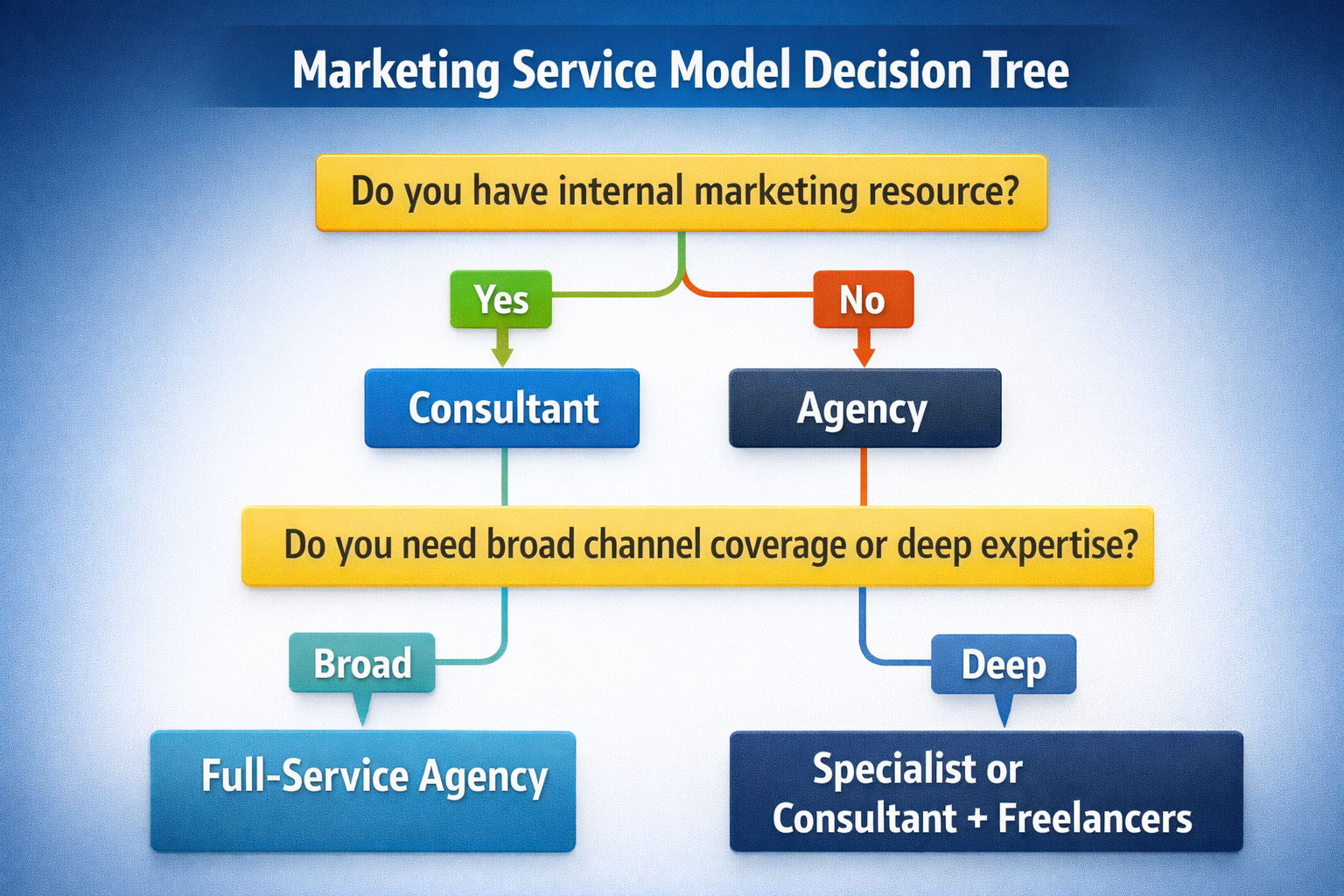
Choose an agency if you lack internal marketing resource and need hands doing the work. Choose a consultant if you have some capability but need strategic leadership, or if you're building an internal function and need someone to lead it.
For example, a B2B services firm at £5m ($6.25m) revenue with two junior marketers often gets far more value from a fractional CMO who can lead that team and manage specialist freelancers than from an agency retainer where most hours go to execution your internal team could handle with proper direction.
Common problems and limitations at the £10k/month level
The most common issue at £10k ($12,500)/month is scope creep: clients expect full-funnel, always-on execution across 5+ channels, but the budget only supports 2–3 channels done well or strategic oversight with selective execution.
You may also encounter 'blended rate' inefficiency, where agencies pad hours with junior work to hit the retainer, or consultants who oversell strategy and under-deliver on implementation support.
Other frequent problems include:
- Reporting theatre: Beautiful dashboards with vanity metrics (impressions, clicks) rather than commercial outcomes (pipeline value, revenue contribution, CAC)
- Lack of senior access: Your account director appears in month one, then you only see junior delivery staff
- Channel fragmentation: Spreading budget too thinly across platforms means nothing is done well enough to generate results
- Misaligned KPIs: The agency optimises for metrics that don't matter to your business (e.g., social engagement when you need B2B leads)
- Hidden costs: Media spend, tools, content production, or design work billed separately, inflating true monthly cost to £15k+ ($18,750+)
The fix: be ruthlessly clear about priorities. Pick 2–3 channels that matter most, define commercial outcomes upfront, and insist on monthly P&L-level reporting.
How to tell if your £10k/month marketing spend is working
To assess value, track three metrics: the ratio of senior to junior hours you're receiving, the commercial outcomes (pipeline, revenue, CAC) tied to marketing activity, and whether the agency or consultant proactively holds themselves accountable to these numbers.
A good benchmark: at least 30% of your retainer should go to senior strategic time, and you should see measurable contribution to revenue or lead quality within 90 days.
Use this 7-point evaluation framework:
- Ask for monthly time breakdowns by seniority level — if you can't get this, you're being sold opacity
- Check if they can explain the trade-offs between channels and why they've prioritised certain activities
- Insist on P&L-level reporting — how many leads, at what cost, with what close rate?
- Test their commercial literacy — do they understand your customer acquisition economics or just marketing metrics?
- Measure capability transfer — is your team learning, or are they just taking orders?
- Review decision speed — how long between identifying an opportunity and executing on it?
- Audit actual deliverables against promises — are you getting what was sold, or has scope quietly narrowed?
If you can't answer these questions confidently, you're likely overpaying for underperformance.
This framework also works as a buyer checklist before signing any proposal. Print it out, bring it to your next agency review, and ask every question directly. If they can't answer clearly, that tells you everything you need to know.
Best service models and team structures for £10k/month
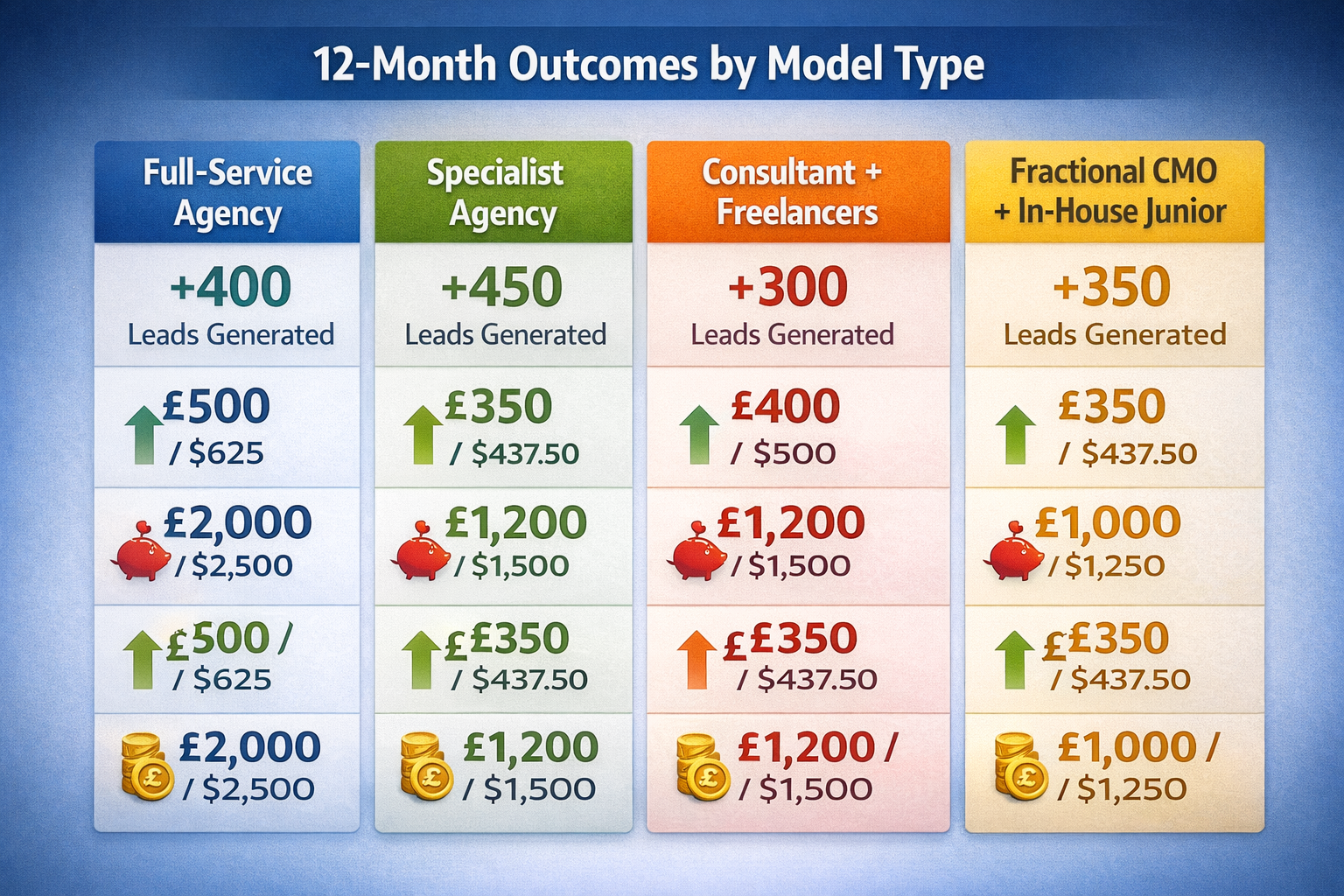
The highest-performing £10k ($12,500)/month engagements typically use a hybrid model: a senior consultant or fractional CMO (£4k–£6k / $5k–$7.5k) setting strategy and managing a specialist agency or freelancer pool (£4k–£6k / $5k–$7.5k) handling execution.
Alternatively, a specialist agency focused on 2–3 core channels (e.g., paid media + conversion optimisation, or content + SEO) often outperforms a generalist trying to cover everything.
| Service Model | Monthly Cost Breakdown | Pros | Cons |
|---|---|---|---|
| Full-service agency | £10k ($12,500) all-in | One contract, broad coverage, established processes | Diluted focus, junior-heavy teams, slower decisions |
| Specialist agency | £8k–£10k ($10k–$12,500) | Deep expertise, better results in core channels | Narrow scope, requires other support for additional channels |
| Senior consultant + freelancers | £5k ($6,250) consultant + £5k ($6,250) freelancers | Strategic clarity, cost-effective execution, flexible | Requires management, multiple contracts |
| Fractional CMO + in-house junior | £6k ($7,500) CMO + £4k ($5,000) equivalent internal cost | Builds permanent capability, full alignment | Slower to start, requires hiring |
My recommendation: start with focused expertise. A specialist doing 2 channels brilliantly beats a generalist doing 5 channels poorly.
Full transparency: as a fractional CMO, I obviously believe in senior-led hybrid models, but that approach won't suit every business. If you have zero internal marketing resource and need immediate execution across multiple channels, an agency is likely the faster path.
FAQ: £10k/month marketing spend
How many hours should I expect for £10k/month?
For £10k ($12,500)/month, agencies typically deliver 40–60 blended hours, while senior consultants deliver 15–25 strategic hours.
The difference isn't about value — it reflects the seniority and focus of the work. An agency delivers volume through a team; a consultant delivers leverage through expertise. Ask explicitly for monthly time breakdowns by role and seniority level.
Should I hire an agency or a consultant at this budget level?
Choose an agency if you need a team executing across multiple channels; choose a consultant if you need strategic leadership, team development, or someone to manage other vendors. If you already have internal marketing staff or contractors, a consultant often makes more sense. If you're starting from zero execution capacity, an agency is usually faster.
What channels can £10k/month realistically cover?
Two to three channels done properly, or 4–5 channels with limited depth. High-performing businesses focus on where their buyers are most active. For B2B, that's often LinkedIn + SEO + email. For D2C, it might be paid social + content + conversion optimisation. Don't spread the budget across everything — you'll just execute poorly everywhere.
How long before I should see results?
Early indicators (lead volume, engagement quality): 60–90 days. Commercial impact (pipeline contribution, revenue attribution): 4–6 months.
Anyone promising instant transformation is overselling. Marketing compounds — early months build foundations, later months harvest returns. Plan for at least 6 months to judge properly.
What should be included vs. what costs extra?
Strategy, execution, and reporting should be included. Media spend, paid tools, content production (video, design), and major website work often cost extra. Always ask: "What does the £10k ($12,500) cover, and what will I need to budget separately?" A good provider will give you a clear all-in monthly cost, not hide surprises.
Conclusion
If you've ever felt unsure whether your marketing spend is generating real growth or just activity, you're not alone. That uncertainty is exactly why articles like this exist, because you deserve to know what your money is buying before you sign a contract.
You now know exactly what £10,000 ($12,500) per month should buy: either 40–60 hours of blended agency time across 2–4 channels, or 15–25 hours of senior strategic expertise embedded with your team. You've seen the trade-offs between agencies and consultants, the common pitfalls at this budget level, and how to evaluate whether you're getting value or just activity.
The decision isn't about finding the cheapest option; it's about matching service model to your situation. If you need execution capacity, a focused agency makes sense. If you need leadership and capability building, a senior consultant delivers better long-term value.
How to take action now
- Audit your current or proposed £10k ($12,500)/month arrangement using the 7-point framework above
- Ask for monthly time breakdowns by seniority level and channel — if the provider won't give you this, walk away
- Define 2–3 priority channels based on where your buyers actually are, not where you think you "should" be
- Insist on P&L-level reporting from day one — pipeline value, revenue contribution, and CAC, not vanity metrics
- Plan for 6 months minimum to judge performance fairly — marketing compounds, it doesn't magic revenue overnight
Ready to build marketing that actually works? I offer fractional CMO and marketing director services from £2,000–£7,000 ($2,500–$8,750) per month, focused on building your internal capability rather than creating dependency. We'll develop strategy, lead your team, and create systems that outlast our engagement.

About the Author
I'm Tom Wardman, and I help business leaders build marketing engines they'll actually own. After years watching companies waste money on agencies that kept them dependent, I built a different model: hands-on support, strategic guidance, and comprehensive training that creates independence. I work as a fractional marketing director, CMO, and consultant with established SMEs and growing agencies who want marketing that generates steady revenue growth, not just activity. My approach is built on The Endless Customers System™, a proven framework for turning marketing into a reliable growth function.
Pricing Disclaimer: All GBP–USD price conversions are rounded estimates and correct at the time of publishing. Exchange rates fluctuate and figures should be treated as indicative only.
Topics: