


Key Takeaways
- Sales and marketing alignment means both departments work as a unified Revenue Team with shared ownership of the entire buyer's journey, not separate departments with different goals
- True alignment requires implementing seven best practices: conducting an Alignment Day, establishing regular Revenue Team meetings, engaging sales as content subject matter experts, documenting your sales process, integrating Assignment Selling, running quarterly planning sessions, and building a culture of continuous improvement
- Companies with aligned sales and marketing teams see measurable results—CSI Accounting increased their average sale price by 10.19% in year one and 39.7% in year two after implementing Assignment Selling
- The most significant investment isn't financial but cultural, requiring leadership commitment to break down departmental barriers and get comfortable with change
- Alignment works best for companies with £750,000–£75 million ($938,000–$94 million) in annual revenue who are ready to challenge industry norms and commit to long-term growth rather than seeking quick fixes
Your sales team thinks marketing wastes budget on leads that never convert. Your marketing team believes sales ignores the content they work so hard to create.
Sound familiar?
This disconnect costs you opportunities every single day—confused prospects who get different messages from different teams, wasted content that sits unused, longer sales cycles, and deals lost to competitors who present a unified front.
As a Certified Endless Customers Coach, I've helped dozens of companies break down these silos and rebuild their revenue operations from the inside out. This article is for business leaders, sales managers, and marketing directors who are tired of watching their teams work against each other instead of together.
By the end, you'll understand exactly how to align your sales and marketing teams using seven proven best practices that transform separate departments into a unified revenue engine—complete with specific steps, realistic timelines, and real results from companies that have done it.
If you're ready to stop the finger-pointing and start driving real revenue growth, here's how to make alignment actually work.
What is sales and marketing alignment in the Endless Customers System?
Sales and marketing alignment in the Endless Customers System™ means both departments work as a unified Revenue Team toward one mission: making your brand the most known and trusted in your market.
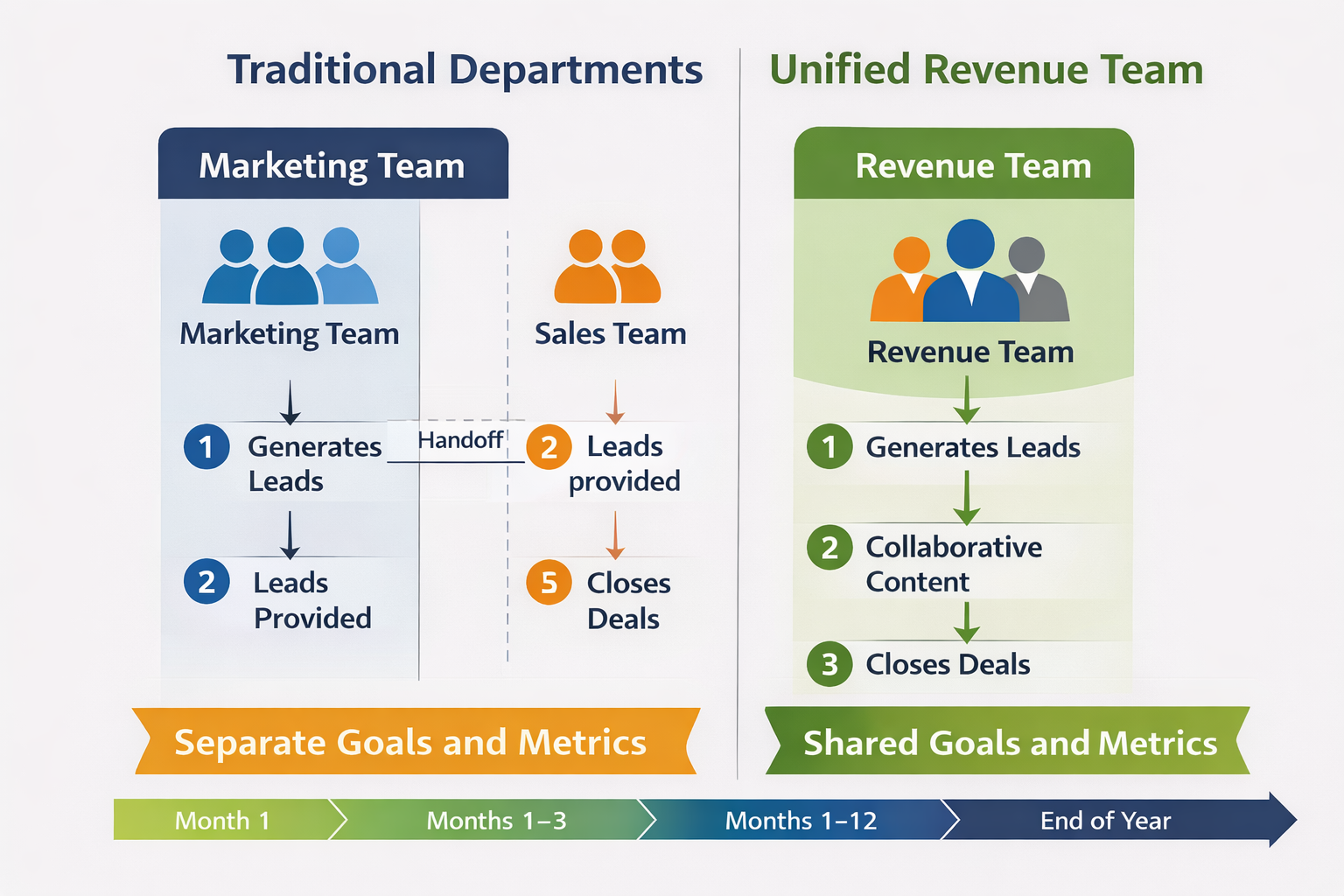
Unlike traditional structures where sales and marketing operate as separate islands, the Endless Customers approach requires full integration because buyers complete 80% of their journey before ever reaching out to sales.
When marketing handles the majority of the buyer's journey but sales still believes they control the entire process, you create a natural divide that damages results. The solution is creating a Revenue Team, bringing together marketing, sales, and leadership to work toward that single mission.
Think of your Revenue Team as the leadership team of your media company, driving content strategy and implementing proven principles throughout your organisation. Both sales and marketing share ownership of the entire buyer's journey and collaborate on content strategy, using marketing to make sales look great and sales insights to inform what marketing creates.
Sales and marketing alignment: What does it cost to implement?
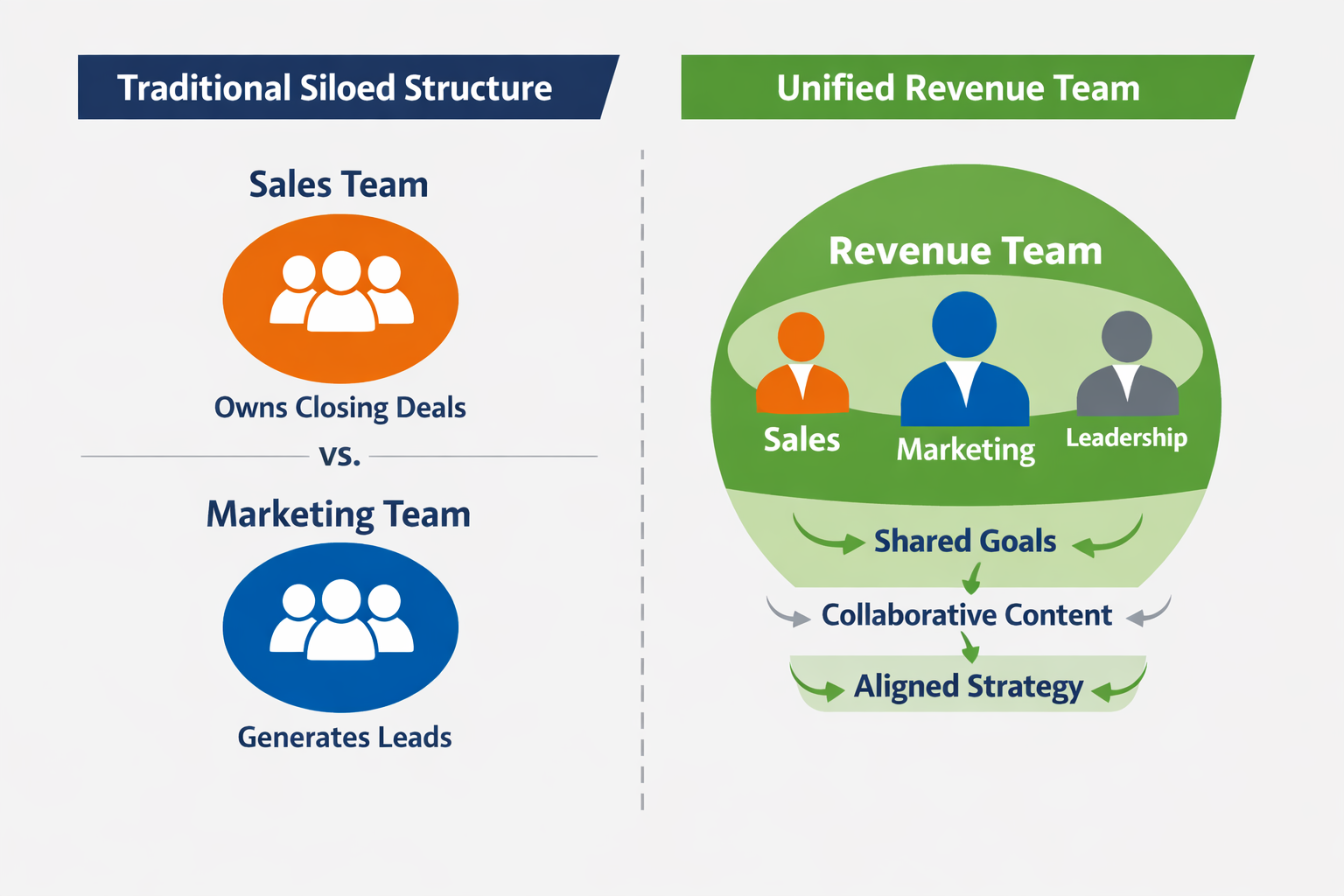
Implementing sales and marketing alignment with the Endless Customers System™ requires investment in three key areas: time commitment (starting with a 3-hour Alignment Day and ongoing quarterly planning sessions), team resources (both sales and marketing participation in content creation and regular meetings), and optional coaching support from an Endless Customers Certified Coach.
The time investment breaks down like this:
- Initial Alignment Day: 3 hours for entire customer-facing organisation
- Monthly Revenue Team meetings: 1-2 hours
- Quarterly Planning Sessions: 3-4 hours
- Content creation participation: 2-4 hours per week for sales subject matter experts (SMEs)
- Sales call reviews and training: 1-2 hours per week
While specific amounts vary by organisation size, most companies find the larger investment isn't financial but cultural, requiring leadership commitment and willingness to break down long-standing departmental barriers.
If you choose to work with me as your coach, expect an investment of £3,200–£4,000 ($4,000–$5,000) for a virtual or in-person Alignment Day, plus ongoing coaching packages ranging from £1,500–£4,000 ($1,875–$5,000) per month depending on the level of support your team needs.
Beyond coaching, budget for a content manager role (£30,000–£50,000 or $37,500–$62,500 annually), basic video equipment (£2,000–£5,000 or $2,500–$6,250), and CRM improvements if needed.
| Investment Area | Time Required | Financial Cost (GBP/USD) |
|---|---|---|
| Alignment Day (one-time) | 3 hours (full team) | £3,200–£4,000 / $4,000–$5,000 (with coach) |
| Monthly Revenue Team meetings | 1-2 hours/month | Internal time only |
| Quarterly Planning Sessions | 3-4 hours/quarter | Internal time only |
| Content Manager (annual) | Full-time | £30,000–£50,000 / $37,500–$62,500 |
| Video equipment (one-time) | Setup time | £2,000–£5,000 / $2,500–$6,250 |
| Monthly coaching (optional) | 2-4 sessions/month | £1,500–£4,000 / $1,875–$5,000 |
Sales and marketing alignment problems: What happens when teams work in silos
When sales and marketing work in silos, companies experience missed opportunities at every stage of the buyer's journey, from disconnected messaging that confuses prospects to sales teams that refuse to use marketing's content because they weren't involved in creating it.
Here's what misalignment looks like in practice:
Marketing creates content that doesn't support actual sales conversations. Sales ignores the materials marketing produces. Prospects receive conflicting messages about pricing, timelines, or capabilities. Each department blames the other when results fall short. Content investment gets wasted. Sales cycles drag on longer than they should. Close rates stay disappointingly low.
Sales and marketing alignment vs. traditional department structures
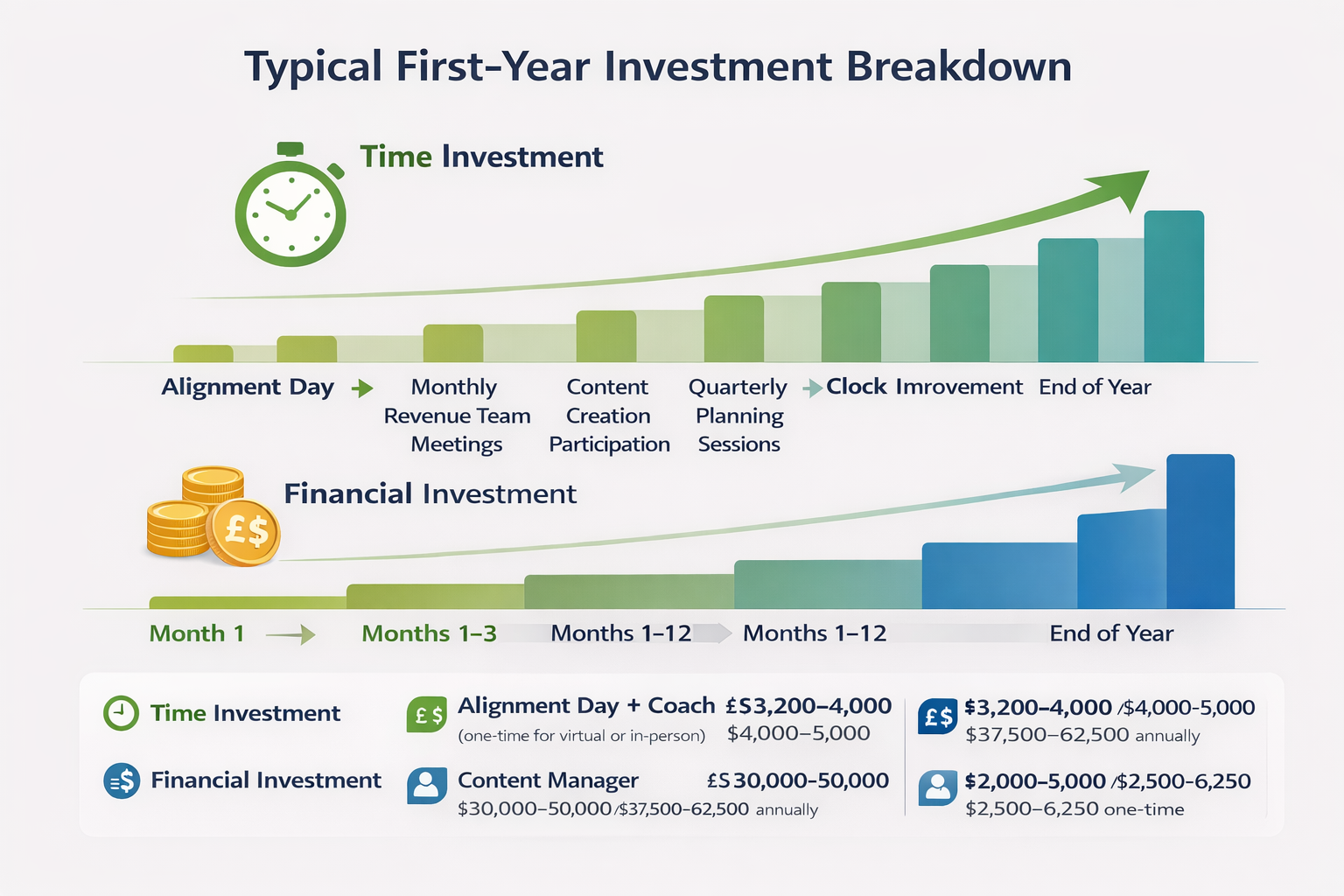
Traditional organisational structures separate sales and marketing into distinct departments with different goals, budgets, and accountability metrics; marketing owns lead generation while sales owns closing, creating a natural divide.
In traditional structures, marketing measures success by leads generated, website traffic, and content published. Sales measures success by deals closed, revenue booked, and quota attainment. These different success metrics naturally push teams in different directions.
The Endless Customers System™ replaces this model with a Revenue Team structure where both departments share ownership of the entire buyer's journey and collaborate on content strategy.
| Aspect | Traditional Structure | Revenue Team Approach |
|---|---|---|
| Goals | Separate (leads vs. closed deals) | Shared (brand trust and revenue) |
| Content Creation | Marketing-only activity | Collaborative with sales as SMEs |
| Communication Frequency | Occasional handoff meetings | Monthly Revenue Team meetings |
| Buyer Journey Ownership | Divided at "handoff point" | Shared end-to-end |
| Success Metrics | Department-specific KPIs | Unified revenue metrics |
| Accountability | Finger-pointing when results lag | Shared responsibility for outcomes |
The 7 best practices for sales and marketing alignment
Achieving true sales and marketing alignment requires following seven proven best practices that successful Endless Customers companies have used to drive results. These practices move beyond superficial collaboration to create a fundamental shift in how your organisation approaches customer acquisition.
1. Conduct an Alignment Day
Alignment Day is a focused 3-hour training session that unifies your entire customer-facing team—sales, marketing, leadership, and anyone who interacts with customers—around the principles of Endless Customers.
During this session, teams learn how buyers have changed, understand the Four Pillars of a Known and Trusted Brand, brainstorm content topics, and leave with clear understanding of their roles and responsibilities.
It's tempting to see this as a marketing effort alone or to leave out parts of the sales team; don't. When your entire customer-facing organisation isn't involved, gaps form, the strategy falls apart, and results suffer.
Outside facilitation often works better because your team hears from you constantly. When a coach delivers the same message, it resonates differently simply because it comes from outside the organisation. Make Alignment Day an annual event; teams evolve, new members join, and old habits resurface without regular reinforcement.
2. Hold monthly Revenue Team meetings
A Revenue Team brings together marketing, sales, and leadership for regular meetings where sales shares current buyer questions and objections, marketing presents performance metrics, and both teams collaborate on editorial calendar planning.
But meetings alone aren't enough; marketers must join sales calls to hear real buyer conversations firsthand, while sales teams need to understand marketing strategy and trends to see the bigger picture.
Your Revenue Team meeting agenda should cover current buyer questions and objections from the field, editorial calendar planning and content assignments, review of recently published content performance, marketing metrics and what's working, challenges and friction points blocking progress, and planning company-wide communications.
True immersion means marketers don't just plan content from their desks; they experience the questions, objections, and pain points as they happen on actual sales calls. Both teams share ownership of the entire buyer's journey, working together to create a seamless experience that converts prospects into customers.
3. Get sales involved in content as subject matter experts
Your best content won't come from marketing alone; it comes from sales teams willing to serve as subject matter experts (SMEs) who live on the front lines hearing customer pain points and mastering how to simplify complex ideas into clear, relatable solutions.
When sales actively participates in creating content, prospects begin requesting to work with specific salespeople by name, and the content becomes infinitely more practical and usable in actual sales conversations.
Getting sales involved requires training for on-camera performance and creating a culture where being visible builds your personal brand. The payoff is content that cuts straight to what prospects need most, with authenticity that can't be faked.
4. Document your sales process
A clearly documented, systematic, and repeatable sales process guides your team through each stage of converting a prospect into a customer, mapping out specific actions, milestones, and requirements at each stage.
Roughly 50% of organisations don't have a defined sales process, which makes Assignment Selling very difficult. Without clarity on stages, companies assign content that doesn't match the buyer's current needs, yielding minimal impact.
Think of your sales process like a pilot's checklist: focused on the key steps that can't be missed, without bogging down in unnecessary details, and regularly revised based on what works and what doesn't. Your process should adapt to meet buyers where they are, creating a seamless experience for them and greater efficiency for your team.
5: Integrate Assignment Selling
Assignment Selling is the practice of requiring prospects to consume specific educational content before sales conversations, which improves close rates and reduces sales cycles by ensuring buyers come to meetings informed and qualified.
Once you have your sales process defined, map helpful educational content to each step. Your team needs to know exactly what content to assign at each stage—early-stage prospects receive introductory articles or videos, while those closer to a decision get detailed case studies or product comparisons.
CSI Accounting & Payroll implemented Assignment Selling to weed out bargain hunters and engage prospects ready for long-term partnerships. They created targeted content and made it mandatory for prospects to complete their homework before calls.
The results? In the first year, CSI saw a 10.19% increase in average sale price. By year two, that increase soared to 39.7%. "Assignment Selling didn't just change our sales process, it revolutionised it," said owner Brian Paulson. "We're closing better deals with clients who genuinely value what we offer."
A prospect's willingness to consume content directly correlates with their readiness to buy.
6: Run quarterly planning sessions
Quarterly Planning Sessions help your leadership team identify 3-5 top priorities (Focus Areas) for the next 90 days, creating a clear Game Plan that outlines action steps, assigns ownership, and sets timelines for execution. This 90-day cadence strikes the perfect balance—giving your team enough time to make meaningful progress without letting things drag on or lose urgency.
At the end of each 90-day period, your team revisits progress, refines the approach, and sets the next Focus Areas. This iterative process keeps your team aligned, agile, and consistently moving forward. You can't tackle everything at once; quarterly planning forces focus on what matters most.
7: Build a culture of continuous improvement
A culture of continuous improvement means your sales team consistently uses the documented process, practices through role-play activities, records and regularly reviews their sales calls, and receives ongoing feedback from leadership.
Your sales process is only as effective as your team's ability to consistently execute it. This requires thorough initial training so everyone understands the process, regular role-play to refine approach and build confidence, recording and reviewing sales calls for improvement opportunities, ongoing feedback from leadership to maintain consistency, and continuous updates based on real-world experiences.
Use the Endless Customers Scorecard to track progress across all 10 components of the system; from content creation to website performance to sales activities—ensuring both teams remain accountable to shared goals.
Sales and marketing alignment FAQs: Common roadblocks and how to overcome them
How long does it take to see results?
Leading indicators appear within 30-90 days—sales teams using content in conversations, improved collaboration, better-qualified prospects. Lagging indicators like increased revenue typically appear within 6-12 months, with the most dramatic results showing up in months 12-24 for companies that stay committed.
What if our sales team resists being on camera?
Start with written content where sales contributes expertise through interviews. Build confidence gradually with one-to-one video emails before moving to published content. Training and leadership support make the difference—when leadership participates and celebrates those who step up, resistance decreases quickly.
Do we need to hire a coach or can we do this ourselves?
You can absolutely implement alignment yourself using the principles from the Endless Customers system. A coach accelerates progress by providing outside perspective, facilitating difficult conversations, and helping you avoid common mistakes. Companies with coaches typically move faster and achieve higher scores sooner.
That said, I'm sharing this approach because it's worked for dozens of companies I've coached—but coaching isn't always necessary. If you have a strong internal leader who can drive change and hold teams accountable, you may be able to implement these principles yourself. The core requirement is commitment and follow-through, whether that comes from internal leadership or external support.
How often should the Revenue Team meet?
Monthly meetings work best for most organisations—frequent enough to maintain alignment without becoming burdensome. Some companies add brief weekly check-ins during intense implementation periods. Quarterly meetings aren't frequent enough to maintain momentum.
What if we're too small to have separate sales and marketing teams?
The principles still apply even if the same people wear both hats. The key is adopting the mindset of shared ownership over the entire buyer's journey. A single person can create content, optimise the website, and conduct sales calls—as long as they approach it systematically with clear processes.
Who is sales and marketing alignment right for (and who it isn't for)?
Sales and marketing alignment through the Endless Customers system works best for companies with £750,000–£75 million ($938,000–$94 million) in annual revenue who are ready to challenge industry norms and commit to long-term growth rather than seeking quick fixes.
Alignment works best when you aspire to become the most known and trusted brand in your market, you're building for long-term growth (not seeking quarterly quick wins), you want to control customer acquisition instead of relying on agencies, you're tired of boring, soulless status quo in your industry, and leadership is ready to invest time and effort in transformation.
This approach isn't right for:
- Organisations where leadership isn't willing to invest time and effort
- Teams that resist being on camera or creating educational content
- Cultures not prepared to disrupt the status quo
- Businesses with very short sales cycles where buyers make quick, impulse decisions without educational content
Half-hearted implementation delivers half-hearted results. Alignment works brilliantly in B2B services, construction, healthcare, home improvement, insurance, manufacturing, home goods, and real estate, industries where buyers do significant research before purchasing.
Conclusion
Sales and marketing alignment isn't a nice-to-have; it's the difference between teams that blame each other when results lag and teams that celebrate shared wins together.
You've seen what misalignment costs: confused prospects, wasted content, longer sales cycles, and lost deals. You've also seen what's possible: companies like CSI Accounting increasing average sale price by 39.7%, Patrick Accounting transforming from dysfunction to collaboration, and prospects requesting specific salespeople by name at La-Z-Boy Southeast.
The seven best practices work because they address root causes, not symptoms. They create shared ownership, clear processes, and continuous improvement rather than superficial collaboration that falls apart under pressure.
No more teams talking past each other. No more wasted effort. It's time to work as one.
Where you go next depends on your commitment. Half-hearted implementation delivers disappointing results. Full commitment—Alignment Day, Revenue Team meetings, sales as content SMEs, documented processes, Assignment Selling, quarterly planning, and continuous improvement—transforms how your organisation acquires customers.
Ready to implement sales and marketing alignment systematically?
My In-House Sales & Marketing Mastery programme helps you implement these seven best practices systematically over 18-24 months, starting with a Company Alignment Workshop that gets everyone on the same page. Together we'll build the capabilities your business needs to end agency dependency and become the most trusted choice in your market.
Learn more about In-House Sales & Marketing Mastery.
How to take action now
- Schedule a conversation with your sales and marketing leaders about current alignment gaps
- Assess your current state using the Endless Customers Scorecard to identify priority areas
- Plan your Alignment Day for the entire customer-facing organisation within the next 90 days
- Document your existing sales process or commit to creating one this quarter
- Identify 2-3 sales team members willing to serve as content subject matter experts
About the Author
I'm Tom Wardman, a Certified Endless Customers Coach who helps businesses build sales and marketing capabilities that drive sustainable growth. I've worked both in-house and within agencies, giving me real-world understanding of the challenges you face when trying to align teams around a shared mission. Through my In-House Sales & Marketing Mastery programme and Company Alignment Workshop, I guide leadership teams through the exact process outlined in this article—building Revenue Teams, implementing Assignment Selling, and creating the culture of performance that makes alignment stick. My approach combines proven frameworks from the Endless Customers System™ with practical, hands-on training that turns theory into results.
Pricing Disclaimer
All GBP–USD price conversions are rounded estimates and correct at the time of publishing. Exchange rates fluctuate and figures should be treated as indicative only.