


Key Takeaways
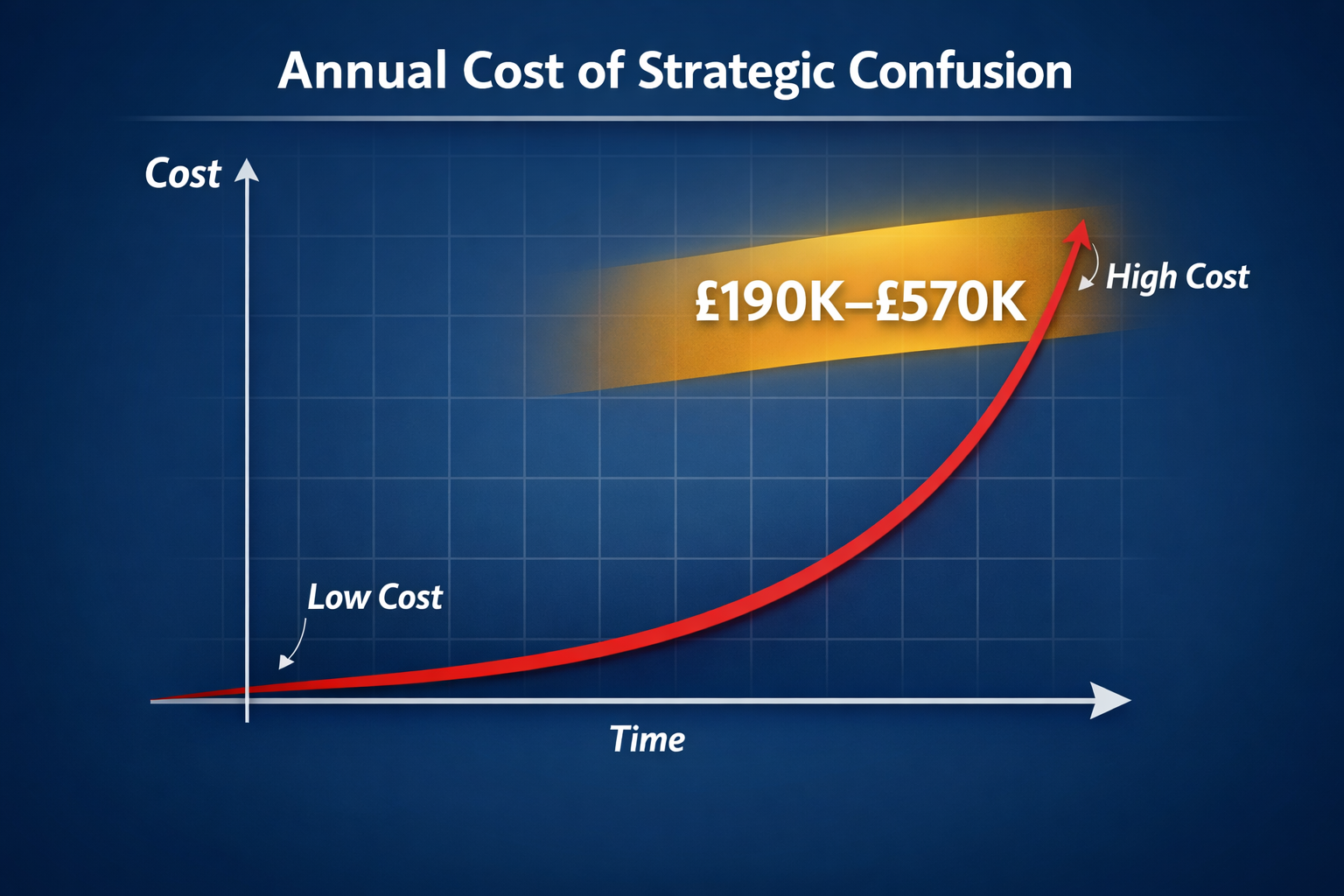
- A muddled marketing strategy typically costs mid-sized companies between £190,000 and £570,000 ($237,500–$712,500) annually in wasted salary, agency fees, technology spend, and opportunity cost.
- Organisations with documented, aligned marketing strategies generate 313% higher marketing ROI and 3.5x more qualified leads per pound spent compared to those executing disconnected tactics.
- Beyond direct expenses, muddled strategies create hidden costs including brand dilution, sales team friction, and prolonged sales cycles that increase customer acquisition cost by 30–60%.
- If fewer than 60% of your marketing activities can be traced to a specific revenue goal, you're likely spending £150,000–£380,000+ ($187,500–$475,000+) annually on strategic misalignment.
- Developing a clear marketing strategy requires an initial investment of £11,000–£57,000 ($13,750–$71,250) but delivers 3–5x returns within 12–18 months.
Are you constantly busy in marketing, but seeing no measurable progress?
Do you know what your lack of strategy is actually costing you?
In this article, I'll show you how to calculate your marketing waste, down to the penny, and what a focused strategy really costs instead. You'll discover the direct and hidden expenses of strategic confusion, see ROI comparisons between muddled and clear approaches, and get a practical framework for assessing your current situation.
By the end, you'll have everything you need to quantify your losses and chart a clear path toward marketing that drives measurable growth.
What a muddled strategy looks like (and why it's so common)
A muddled marketing strategy lacks clear objectives, prioritisation, or alignment between tactics and business goals, resulting in high activity levels with minimal measurable outcomes.
Organisations with muddled strategies often appear busy. They run multiple campaigns, post constantly on social media, and attend events, but they cannot trace these activities to revenue, pipeline growth, or customer acquisition. Your team might be working hard, but without strategic clarity, effort doesn't translate into results.
Muddled strategies show up as constant tactical pivots, technology purchased but rarely used, campaigns that don't connect to documented goals, and marketing teams unable to articulate how their work supports sales.
The direct costs: What muddled marketing actually costs you each year
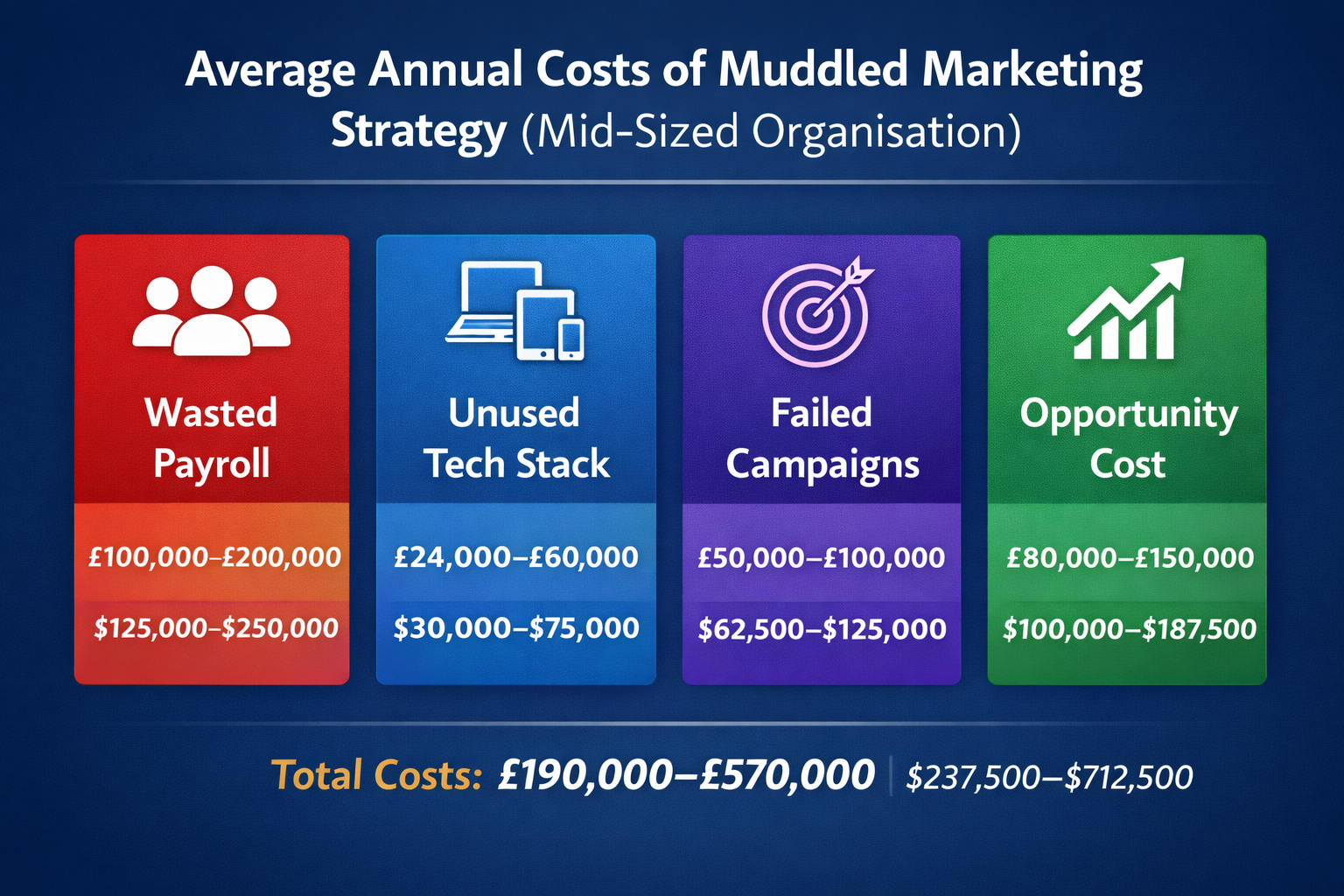
A muddled marketing strategy typically costs mid-sized companies between £190,000 and £570,000 ($237,500–$712,500) annually in wasted salary, agency fees, technology spend, and opportunity cost.
This figure accounts for team members executing misaligned tactics, platform subscriptions with less than 30% utilisation, creative assets that never convert, and sales time spent chasing unqualified leads generated by unfocused campaigns.
Wasted payroll and contractor spend
When your team lacks strategic direction, roughly 40–60% of their time goes toward activities that don't support documented business objectives.
For a four-person marketing team with an average salary of £50,000 ($62,500), that's £80,000–£120,000 ($100,000–$150,000) in wasted payroll annually. Add agency retainers for projects that miss the mark, and this figure climbs quickly.
Technology and tool bloat
Marketing teams without clear strategies accumulate technology subscriptions at twice the rate of strategically focused teams, with utilisation rates below 30%. The average mid-sized company maintains 12–20 marketing tools costing £24,000–£60,000 ($30,000–$75,000) annually, but only actively uses 4–6 of them.
| Cost Category | Small Business (£1–5m revenue) | Mid-sized (£5–25m revenue) | Enterprise (£25m+) |
|---|---|---|---|
| Wasted Payroll | £40,000–£80,000 ($50,000–$100,000) | £100,000–£200,000 ($125,000–$250,000) | £250,000–£500,000 ($312,500–$625,000) |
| Unused Tech Stack | £12,000–£24,000 ($15,000–$30,000) | £24,000–£60,000 ($30,000–$75,000) | £60,000–£150,000 ($75,000–$187,500) |
| Failed Campaigns | £20,000–£40,000 ($25,000–$50,000) | £50,000–£100,000 ($62,500–$125,000) | £150,000–£300,000 ($187,500–$375,000) |
| Opportunity Cost | £30,000–£60,000 ($37,500–$75,000) | £80,000–£150,000 ($100,000–$187,500) | £200,000–£400,000 ($250,000–$500,000) |
Hidden costs: Brand damage, sales churn, and lost trust
Beyond direct expenses, muddled marketing strategies create hidden costs that compound over quarters. These include diminished brand credibility, sales team friction, and prolonged sales cycles that increase customer acquisition cost by 30–60%.
When marketing cannot articulate clear ROI or lead quality deteriorates, sales teams often bypass marketing entirely. They build their own collateral and prospecting systems—creating duplicate costs and departmental silos.
The hidden costs include:
- Brand dilution and inconsistent messaging that confuses buyers and weakens your market position, making every subsequent campaign less effective
- Internal trust erosion between marketing and sales, leading to duplicate systems, wasted meetings, and territorial conflicts that slow decision-making
- Talent turnover and recruitment costs averaging £15,000–£30,000 ($18,750–$37,500) per role, with muddled teams experiencing 2–3x higher turnover rates
- Delayed time-to-market for products and campaigns, allowing competitors to capture opportunities you identified first
- Competitive disadvantage as focused competitors capture market share while your team remains stuck in tactical churn
- Leadership confidence loss resulting in budget cuts, reduced authority, and marketing treated as a cost centre rather than a growth driver
Why strategy confusion burns out teams and destroys results
Marketing teams operating without strategic clarity experience burnout rates 2–3x higher than focused teams, with average tenure dropping below 18 months and institutional knowledge evaporating. The downstream effects include inconsistent messaging across channels, inability to scale successful tactics, and leadership making budget decisions based on activity metrics rather than business impact.
Specific consequences include:
- Team members spending 15–20 hours per week in meetings trying to establish priorities that should already be documented
- Campaign launches delayed by 3–6 months while stakeholders debate fundamental strategic questions
- Sales rejecting 60–70% of marketing-generated leads, creating friction and duplicate prospecting systems
- CEO and board questioning marketing's contribution, leading to budget freezes or cuts despite market growth
- High-performing team members leaving for organisations with clearer strategic direction
The result is a vicious cycle: confusion breeds poor results, poor results breed pressure for quick wins, and pressure for quick wins breeds more tactical pivoting without strategic foundation.
Muddled vs. clear strategy: The ROI numbers that matter
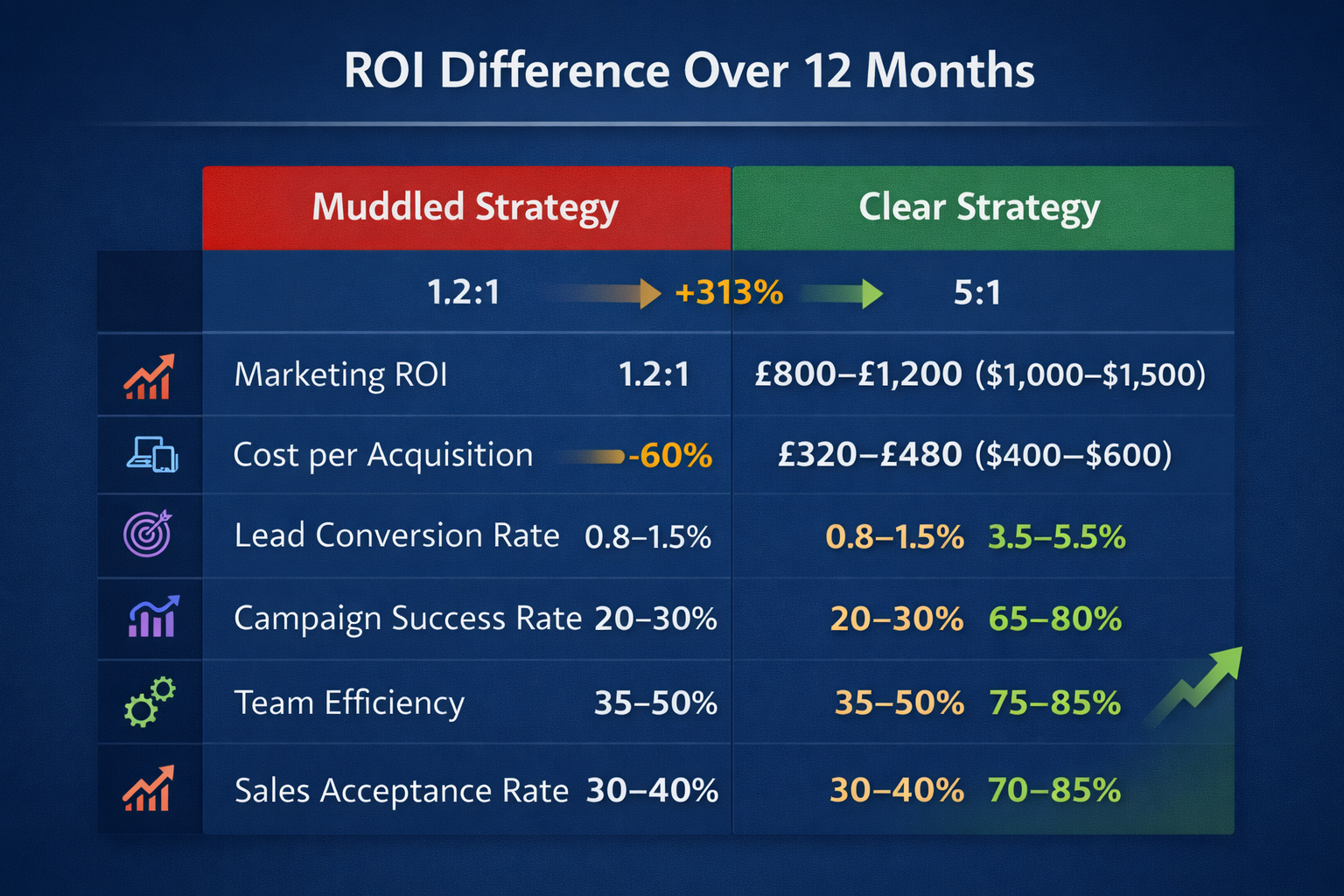
Organisations with documented, aligned marketing strategies generate 313% higher marketing ROI and 3.5x more qualified leads per pound spent compared to those executing disconnected tactics.
The difference becomes stark when comparing cost-per-acquisition: strategically focused marketing teams typically achieve CPAs 40–60% lower while maintaining or improving lead quality scores.
| Metric | Muddled Strategy | Clear Strategy | Difference |
|---|---|---|---|
| Marketing ROI | 1.2:1 | 5:1 | +313% |
| Cost per Acquisition | £800–£1,200 ($1,000–$1,500) | £320–£480 ($400–$600) | -60% |
| Lead Conversion Rate | 0.8–1.5% | 3.5–5.5% | +267% |
| Campaign Success Rate | 20–30% | 65–80% | +183% |
| Team Efficiency | 35–50% | 75–85% | +114% |
| Sales Acceptance Rate | 30–40% | 70–85% | +125% |
How to calculate what strategic confusion is costing you
To quantify your muddled strategy cost, start with your total marketing budget and salary load, then assess utilisation. Calculate the percentage of campaigns that directly support documented business objectives and the percentage of leads that meet sales' qualification criteria.
A simple diagnostic: if fewer than 60% of your marketing activities can be traced to a specific revenue goal, or if sales accepts fewer than 40% of marketing-generated leads, you're likely spending £150,000–£380,000+ ($187,500–$475,000+) annually on strategic misalignment.
Follow these steps to calculate your cost:
- Add your total annual marketing spend: Include salaries, agency fees, technology subscriptions, and campaign budgets. (Example: £500,000 / $625,000)
- Calculate strategic alignment percentage: Review your last quarter's activities. What percentage directly supported a documented business objective? (Example: 45%)
- Calculate your misalignment cost: Multiply total spend by misalignment percentage (100% minus alignment %). (Example: £500,000 × 55% = £275,000 / $343,750)
- Add opportunity cost: Estimate revenue from campaigns you didn't run because resources went to unfocused work. Conservative estimate: 20–30% of misalignment cost. (Example: £275,000 × 25% = £68,750 / $85,937)
- Calculate your total annual waste: Add misalignment cost plus opportunity cost. (Example: £343,750 / $429,687)
This framework provides a conservative estimate. The true cost often exceeds this calculation when you factor in brand damage and competitive losses.
What a focused marketing strategy really costs (and why it's worth it)
Developing and implementing a clear marketing strategy typically requires an initial investment of £11,000–£57,000 ($13,750–$71,250) for strategy development (depending on company size and complexity), plus 15–20% of your marketing budget allocated to planning, measurement, and optimisation. This investment delivers 3–5x returns within 12–18 months by eliminating wasted spend, improving conversion rates, and enabling your team to scale successful programmes rather than constantly pivoting.
Investment options include:
- DIY strategy development: £5,000–£15,000 ($6,250–$18,750) in team time and workshop facilitation, suitable for smaller organisations with experienced marketing leaders
- Hiring a strategist or fractional marketing director: £20,000–£60,000 ($25,000–$75,000) annually for ongoing strategic guidance
- Agency strategy support: £15,000–£45,000 ($18,750–$56,250) for initial development, with ongoing costs of £3,000–£8,000 ($3,750–$10,000) monthly
- Comprehensive training programme: £30,000–£75,000 ($37,500–$93,750) to build internal strategic capabilities that last
The investment-to-savings ratio is compelling: A £40,000 ($50,000) strategy investment that eliminates £200,000 ($250,000) in annual waste pays for itself in under 10 weeks.
Seven criteria for evaluating your strategic clarity
Best-in-class marketing organisations evaluate strategic clarity using seven criteria. If your organisation scores below 5 out of 7 on these criteria, you likely have a muddled strategy costing you six figures annually in reduced efficiency and missed opportunities.
Rate your organisation on each criterion (1 = absent, 2 = partial, 3 = fully implemented):
- Documented business objectives with aligned marketing KPIs: Your marketing goals directly support revenue targets, with clear metrics and ownership.
- Defined target audience with documented pain points: You can articulate exactly who you serve and what problems you solve for them.
- Prioritised channel mix based on buyer behaviour: You focus resources on channels where your buyers actually spend time, not just where competitors are active.
- Clear campaign taxonomy and naming conventions: Anyone can look at your campaigns and immediately understand their purpose and how they connect to strategy.
- Established feedback loops between marketing and sales: Regular, structured conversations about lead quality, messaging, and buyer objections inform marketing decisions.
- Quarterly strategy reviews with leadership: You regularly assess what's working, adjust priorities, and reallocate resources based on performance.
- Consistent messaging architecture: Your value proposition, positioning, and key messages remain consistent across all channels and campaigns.
Scoring: 18–21 points = strong strategic clarity; 12–17 points = moderate clarity with improvement opportunities; below 12 points = significant strategic confusion costing you six figures annually.
Frequently asked questions about marketing strategy costs
These are the most common questions business leaders ask when evaluating the true cost of their marketing approach and deciding whether to invest in strategic clarity.
How quickly can we see ROI from fixing our strategy?
Most organisations see measurable improvements within 60–90 days of implementing strategic clarity.
Quick wins include better lead quality (sales accepts more leads), reduced wasted spend (you stop funding unfocused campaigns), and improved team morale. Full ROI typically materialises within 12–18 months as you scale successful programmes.
Should we pause campaigns while we develop strategy?
You don't need to pause everything, but you should critically evaluate what's running.
Continue campaigns directly supporting revenue goals while pausing or scaling back activities that can't be traced to documented objectives. Use the freed-up resources for strategy development.
What's the minimum budget needed for strategic marketing?
Strategic clarity matters more than budget size.
Small businesses operating on £50,000 ($62,500) annual marketing budgets benefit from strategy as much as enterprises spending millions. The principles remain the same regardless of scale: clear objectives, prioritised tactics, and measurement that connects to business outcomes.
Can we fix strategy internally or do we need outside help?
Internal development works if you have experienced marketing leadership with available time.
Most organisations benefit from external expertise because internal teams lack the time, objectivity, or strategic experience needed. I help businesses build internal strategic capabilities through hands-on guidance, ending dependency on external support [insert link to Done With You services].
How do we measure if our new strategy is working?
Track three categories: efficiency metrics (cost per lead, conversion rates), effectiveness metrics (sales acceptance rate, revenue attribution), and team health (retention, satisfaction, alignment scores).
Strategy works when costs decrease, revenue increases, and your team operates with clarity rather than confusion.
Conclusion
You now understand how much a lack of strategy is costing your business, often over £300,000 ($375,000) per year in wasted spend, hidden costs, and missed opportunities.
You've felt the frustration of busy teams producing little ROI, and you've seen the data showing that strategically aligned organisations generate 313% higher returns.
Now it's time to act: use the five-step calculator above to quantify your specific losses, score your organisation against the seven strategic clarity criteria, and decide whether internal development or external support is right for you.
How to take action now
- Calculate your current cost of confusion using the five-step framework above to establish your baseline waste.
- Audit your team's activities over the past quarter and categorize them by strategic alignment.
- Score your organisation against the seven strategic clarity criteria to identify specific gaps.
- Review what strategic investment makes sense for your organisation size and marketing maturity.
- Schedule a conversation about building marketing capabilities your team will actually own.
Ready to end the costly confusion? I help business leaders build marketing strategies their teams can own and execute, eliminating the waste that comes from tactical churn. Whether you need hands-on support as a Fractional Marketing Director or want to build internal capabilities through my In-House Sales & Marketing Mastery programme, we'll create clarity that drives measurable growth.

About the Author
Tom Wardman is a marketing strategist and Endless Customers Certified Coach who helps business leaders build trusted brands through strategic clarity and internal capability development. With over a decade of experience leading marketing inside agencies and in-house teams, he specialises in ending agency dependency and creating marketing systems that connect directly to revenue. His approach focuses on sales enablement, content that builds trust, and the alignment that turns marketing into a predictable growth engine.
Pricing Disclaimer: All GBP–USD price conversions are rounded estimates and correct at the time of publishing. Exchange rates fluctuate and figures should be treated as indicative only.
Topics: