

Every service I offer for agencies sits within the Agency Operating System™, a structured path from operational chaos and founder dependency to a scalable agency you control.
Every engagement sits within a structured framework. You always know where you are, where you're going, and what a controlled agency looks like at the end.
The right entry point depends on where your agency is breaking down, not a predetermined package. Each quadrant builds on the last.
Every engagement is scoped to reduce founder dependency and operational chaos. You keep the system, the margins, and the control.
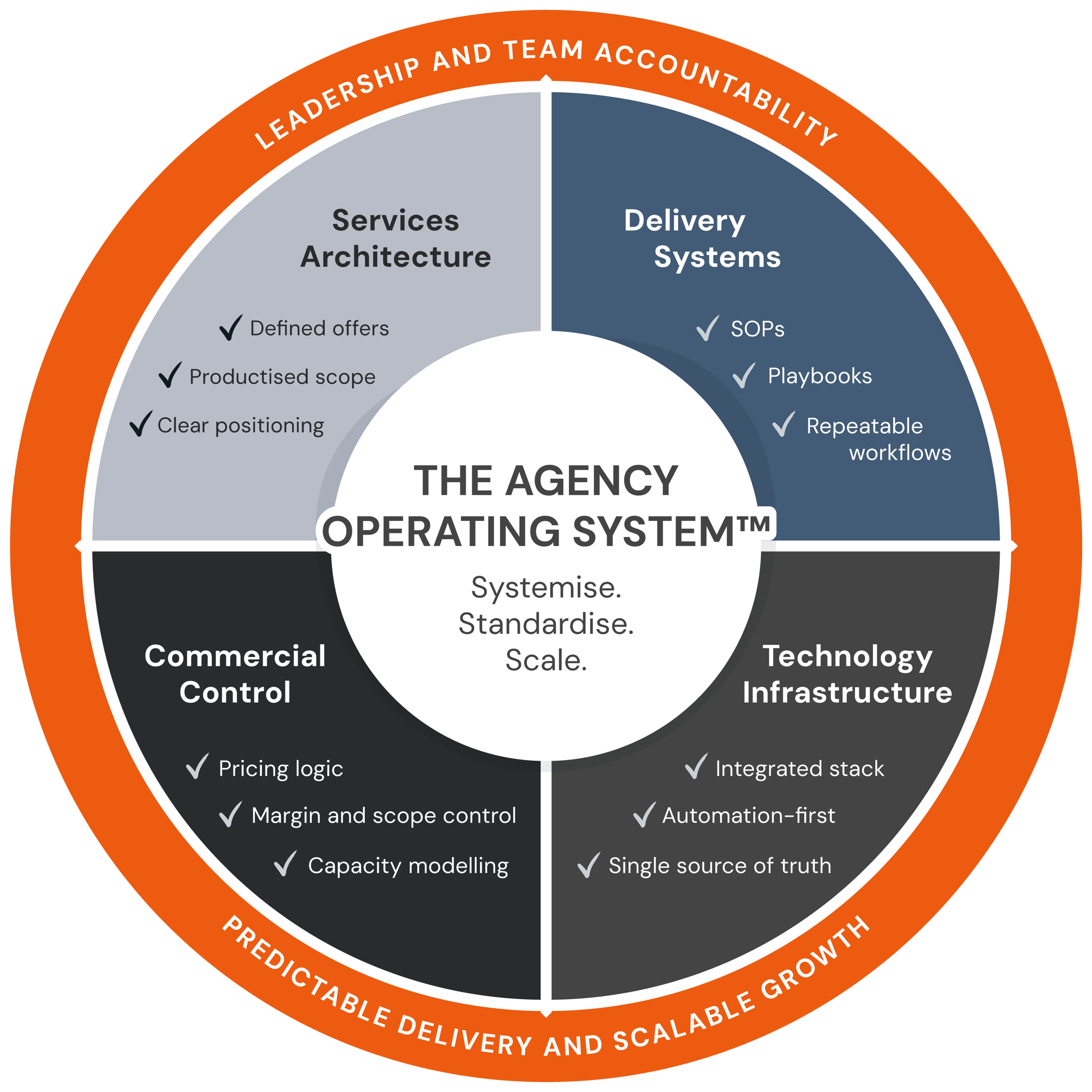
Most agencies try to scale before they have an operation worth scaling. The Agency Operating System™ fixes that.
It structures your agency across four core pillars, so delivery becomes predictable, margins hold, and growth doesn't depend on you doing everything.
Every service I offer sits within one of these pillars. Where you start depends on where the pressure is greatest.
Charleh Knighton - Managing Director, KUB
Ben Blance - SEO Strategist, Socially Grown
Colin Comerford - Tax Partner, Comerford Foley
There are systems and services available across each pillar, all sharing the common goal of removing chaos, reducing founder dependency, and building an agency that scales without you at the centre of everything. Keep scrolling to explore each pillar individually.
Most agency chaos starts here. Undefined offers, shifting scope, and positioning that tries to serve everyone means your team never knows exactly what they're delivering, and neither do your clients.
Your service lines documented, productised, and positioned clearly. No more custom-scoping every engagement from scratch.
Delivery boundaries that protect your margins and set accurate client expectations before work begins.
A market position that attracts the right clients, supports premium pricing, and makes sales faster and more predictable.
Inconsistent delivery is the most expensive problem in an agency. When work lives in people's heads rather than documented systems, quality depends on who's available, not on what you've built.
Every repeatable task documented so your team delivers consistently, regardless of who's working on it.
The strategic layer above the SOP, how decisions get made, escalated, and resolved without involving you.
Delivery structured as a system, not a series of improvised responses. Clients get a consistent experience. Your team gets clarity.
Agencies that undercharge, over-deliver, and never model capacity accurately don't have a growth problem. They have a commercial architecture problem. This pillar fixes the economics.
Pricing structures built on margin, value, and sustainability, not what feels comfortable to say on a call.
The systems that prevent scope creep from silently eroding profitability on every engagement.
A clear picture of what your team can actually deliver, so you stop overselling and start growing at a pace your operation can support.
Disconnected tools, duplicated data, and manual processes that should have been automated years ago. This pillar installs the infrastructure that makes everything else run without constant intervention.
Tools that talk to each other, configured around how your agency actually works, not how the default setup assumed you would.
Repetitive internal processes removed from your team's plate so they can focus on delivery, not administration.
One place where project status, client data, and performance metrics live. No more chasing updates across platforms.
The four pillars build the foundation. The outer rings are what they make possible.
With services architecture, delivery systems, commercial control, and technology infrastructure in place, your agency operates with leadership accountability at every level, and grows without the founder becoming the bottleneck.
Predictable delivery. Scalable profit. An agency that runs without you holding it together.

Build a scalable, profitable agency; one system, one process, one leadership shift at a time.
No lengthy onboarding. No open-ended commitment. A straightforward conversation that identifies where your agency is breaking down and what the right first step looks like.

We'll discuss where your agency stands, what's working, what's costing you margin, and where founder dependency sits.
Based on what we find, I'll recommend the right pillar to address first and the service that fits.
Work begins with a clear scope, defined outcomes, and every engagement designed to make your agency less dependent on you over time.
I believe you should be able to understand the cost of working with me before we ever speak.
Every service has published pricing, and if you want a faster answer, the instant pricing calculator gives you a clear number based on your specific situation. No gatekeeping. No pressure.
The Agency Operating System™ is a structured framework designed to help agencies move from operational chaos and founder dependency to predictable delivery, strong margins, and scalable growth.
Because it is designed as a structured operational framework. Each engagement fits within a larger architecture that strengthens your agency over time.
It addresses the structural issues that prevent agencies from scaling: inconsistent delivery, unclear positioning, poor pricing, and fragmented operations.
It is designed for agency founders and leadership teams who want to grow sustainably without being trapped in daily operational firefighting.
Not necessarily. Most agencies start with the pillar where pressure is greatest and build from there.
While it is designed primarily for marketing and digital agencies, many of the operational principles apply to other service-based businesses.
Most consulting focuses on isolated improvements. The Agency Operating System™ focuses on building a complete operational foundation.
In some cases it improves them; in others it replaces outdated processes with more scalable systems.
Implementation timelines vary depending on the pillar being addressed and the current state of the agency.
Success means predictable delivery, strong margins, and an agency that no longer depends on the founder to function.
The system is structured around four pillars: services architecture, delivery systems, commercial control, and technology infrastructure.
They represent the core structural areas that determine whether an agency can scale sustainably.
Yes, but not necessarily at once. Most agencies strengthen the weakest pillar first before addressing the others.
Many agencies begin with services architecture because unclear offers and scope issues often create operational chaos.
When one pillar is weak, the entire agency becomes harder to manage and scale.
Each pillar supports the others. Clear services make delivery easier, delivery systems protect margins, and technology supports both.
Not always. Often the goal is to organise and strengthen what already exists.
Yes. Most agencies improve one pillar at a time.
There is a logical progression, but the right starting point depends on where the agency is currently struggling.
A predictable operational foundation that supports sustainable growth.
The system includes three core services: Agency Systems Consultancy, Fractional Chief Operations Officer, and Fractional Chief Growth Officer.
It focuses on documenting and improving the systems, processes, and workflows your agency uses to deliver work.
This role provides operational leadership that helps agencies build structured delivery systems and reduce founder dependency.
It combines operational and growth leadership to help agencies scale while maintaining operational control.
The right service depends on your agency’s current bottleneck: systems, operations, or growth infrastructure.
Yes. As your agency evolves, the service supporting you may change.
Each service has clear structure and pricing but adapts to your agency’s needs.
No. They are designed to strengthen leadership, not replace it.
Yes. Some agencies use multiple services simultaneously when addressing multiple operational challenges.
Engagement length varies depending on the complexity of the operational changes being implemented.
Improved delivery consistency, stronger margins, clearer positioning, and reduced founder dependency.
By replacing informal decision-making with documented systems and leadership accountability.
Yes. Clear pricing, defined scope, and consistent delivery processes help protect margins.
Clients receive more predictable delivery and clearer expectations when services are structured properly.
Often it does, because operational bottlenecks are removed before growth increases pressure.
It documents workflows, decision-making processes, and responsibilities across the agency.
Yes. Clear systems and workflows reduce last-minute improvisation and reactive work.
Yes. When processes are documented, onboarding and delegation become much easier.
Yes. Leaders gain clearer visibility of performance and operational health.
An agency that operates predictably and scales without constant founder intervention.
If your agency struggles with inconsistent delivery, scope creep, unclear positioning, or founder dependency, the system can help.
It is typically most valuable for agencies that already have some clients and delivery processes in place.
Yes. Most engagements are delivered remotely and can support agencies across different locations.
Each service has transparent pricing published so you can understand the investment before speaking.
Engagements are structured around clear outcomes rather than open-ended commitments.
Not always. Technology improvements are addressed only when necessary.
Once the right entry point is identified, work typically begins shortly after the initial conversation.
We discuss your agency’s current challenges, operational structure, and growth goals.
Yes. The goal is to address the most pressing operational issue first.
Book a call to assess where your agency is experiencing the most pressure and identify the right starting point.
If you are ready to replace operational chaos with a system your agency can run and scale without you, let's talk about where you are and which pillar is the right place to start.