You built the agency. Now it runs you. As your Fractional COO, I install the the systems, accountability, and delivery framework that lets your agency perform consistently without your constant involvement.
Build the systems and team structure that keep delivery running without you in the middle of everything.
Documented workflows, clear accountability, and consistent quality, regardless of who is on the job.
Operational clarity reduces scope creep, improves capacity management, and gives you real visibility over profit.
Most agency founders aren't stuck because they lack ambition. They're stuck because the agency isn't structured for independence.

Without documented systems, problems escalate to the founder. You become the bottleneck, and the business stalls when you step back.
Unclear accountability and inconsistent delivery frustrate strong performers. Retention suffers when structure is absent.
Scope creep, poor capacity management, and reactive pricing eat into profit. Without operational control, growth makes the problem worse, not better.

As your Fractional COO, I work inside your agency to install the operational layer that removes you from the centre of delivery, and replaces founder dependency with documented, accountable structure.
Book a callI build the systems and team framework that keep delivery running predictably, without your constant involvement.
Documented SOPs, playbooks, and repeatable workflows mean your standard of work no longer depends on who is doing the job.
Pricing logic, capacity modelling, and scope management give you real visibility over profitability, and the tools to protect it.
Clear accountability structures and coaching for senior staff mean decisions get made without escalating to you.
Every system I install is designed to be owned by your team. My involvement reduces over time. That is the point.
Whether you need to fix delivery, regain margin control, or build the leadership layer your team needs, this is where the structural work happens.
Capacity and resource planning aligned to delivery capacity
Profitability frameworks that protect margins at project level
Forecasting and reporting that keeps you ahead of issues
Growth and organisational planning grounded in operational reality
Project management improvements that reduce reactive firefighting
SOPs, playbooks, and templates your team can actually follow
Workflows that control scope creep and protect profit
KPI dashboards and delivery performance reporting
Coaching for delivery leads, account managers, and senior staff
Clear roles, accountability structures, and progression frameworks
Regular leadership alignment sessions
Knowledge transfer designed to make your agency self-sufficient
A clear process to help you step into the CEO role your agency needs:

I'll map your current delivery structure, identify where fragility sits, and establish the priorities for standardisation.
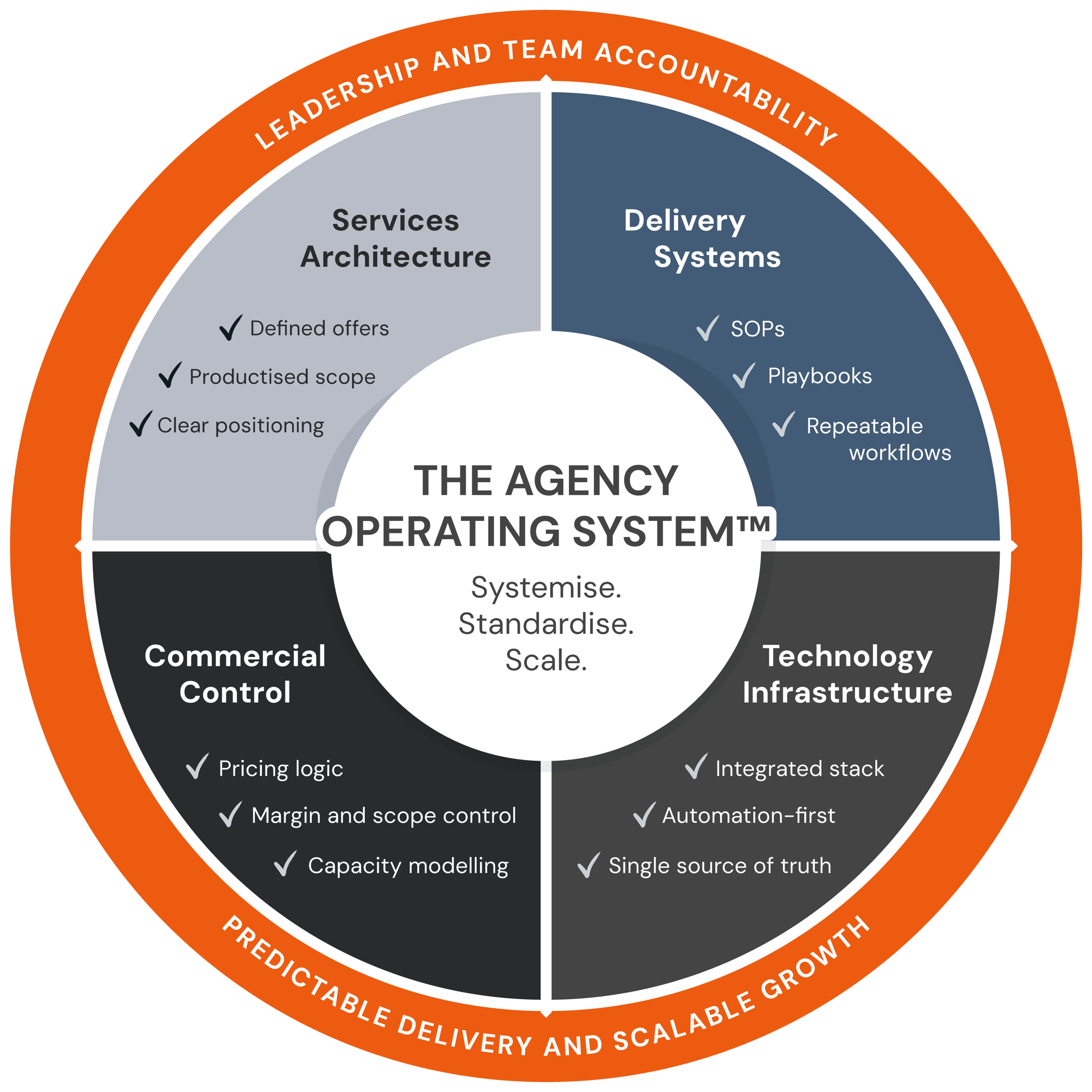
I build and install the operational layer: workflows, accountability structures, margin controls, and team frameworks, aligned to the Agency Operating System™.
Your leadership team takes ownership of the systems. My involvement reduces by design. The structure remains.
Packages are available based on the scope of operational work required. All engagements run on a minimum 6-month commitment, enough time to install structure that holds.
Having worked inside and alongside agencies for years, I have seen the same structural problems repeat. Delivery built on tribal knowledge. Accountability that lives in the founder's head. Growth that creates chaos rather than capacity.
The Agency Operating System™ is the framework I designed to fix it. Standardise is Stage 2, the layer that makes delivery consistent, leadership clear, and the business structurally ready to scale. Without it, growth is fragile by design.
Charleh Knighton - Managing Director, KUB
A Fractional COO installs the operational structure your agency needs to run consistently without you in the middle of everything. That includes systems, accountability, delivery frameworks, and the leadership rhythm that keeps the business moving without constant founder intervention.
An Operations Manager typically runs the system you already have. A Fractional COO builds, installs, and strengthens the operational layer underneath the agency so the whole business becomes less fragile and more scalable.
Systems & Pricing Consultancy focuses on diagnosing and installing the foundational architecture. A Fractional COO takes that further by embedding operational leadership, coaching the team, and making sure the structure is actually used and sustained.
It is operational leadership. I work inside the agency to help decisions get made, systems hold, and the founder step back from delivery without things breaking.
No. I strengthen the team you already have, clarify roles, install accountability, and help existing leaders operate with more confidence and consistency.
Founder-led agencies that have grown to the point where delivery is too dependent on the founder, margins are under pressure, and internal leadership needs strengthening.
No. It also suits agencies that are growing steadily but know the current operating model will not hold under more scale.
No. Delivery is central, but the role also covers leadership accountability, profitability visibility, scope control, and the operational decisions that shape growth.
Yes. That transition is one of the core reasons founders hire a Fractional COO. The work is designed to remove you from the centre of operations so you can lead the agency rather than hold it together.
An agency with clear operational structure, stronger leaders, protected margins, and a founder who is no longer the bottleneck.
Usually a combination of delivery workflows, SOPs, playbooks, KPI dashboards, accountability structures, and forecasting tools that make operations easier to manage and less reactive.
Yes. Predictable delivery is one of the main outcomes of the work. The goal is for quality and performance to depend on systems, not on who happens to be available.
Yes. Scope creep is usually a structural issue caused by weak scoping, poor handoffs, and unclear delivery boundaries. I help install the controls that stop it from quietly eroding margin.
Yes. Capacity and resource planning are central to operational clarity. Without them, agencies oversell, overload the team, and lose visibility of what delivery can actually support.
Yes. Project management improvements are often part of the engagement, especially where reactive firefighting has replaced consistent workflow.
Yes. The aim is practical documentation that supports real work, not a folder full of theory no one uses.
Yes. Operational forecasting and reporting help leadership stay ahead of issues instead of discovering problems after margin has already been lost.
Yes. A big part of the role is making sure decisions no longer escalate to the founder by default.
Yes. Operational control and margin protection are inseparable, so pricing logic, delivery cost, and scope boundaries are all part of the picture.
Yes. The goal is not isolated improvements. It is one coherent operational structure your team can run confidently.
You need to stay involved enough to support change, set direction, and help transfer authority properly. The goal is not to remove leadership, but to remove your role as the default operational escalation point.
By putting systems, accountability, and leadership structure in place so operational decisions can be made without constantly coming back to you.
Yes. Coaching delivery leads, account managers, and senior staff is a core part of the work because structure only holds when leaders are capable of owning it.
Yes. Many agencies suffer because accountability is vague. Clear ownership makes better decisions and smoother execution possible.
That is often exactly why this service is needed. I help strengthen the team beneath the founder so leadership becomes something the agency can rely on.
Yes. Accountability frameworks are part of the operational layer: who owns what, how performance is reviewed, and how issues are escalated.
Yes. If team structure is part of the bottleneck, I can help redesign roles, define gaps, and support recruitment decisions.
That often happens when systems are weak and leadership is unclear. Better structure usually improves clarity, morale, and retention.
Yes. In many ways, it is even more important there, because unclear accountability and fragmented delivery become more visible when the team is not in the same room.
Ideally, you move from being the person who catches everything to the person who leads the business with more distance, more clarity, and less operational drag.
Better delivery consistency, stronger team accountability, clearer margin visibility, less founder dependency, and an agency that is far easier to lead.
Some relief often comes quickly once priorities and escalation points are clarified. Deeper operational change usually compounds over a number of months as systems and leadership habits start to hold.
Yes. Better scope control, capacity visibility, and operational discipline usually improve margins in ways founders can see quite quickly.
Yes. That is one of the main reasons to bring a COO in. The role exists to replace reactive management with structured execution.
Usually, yes. More predictable delivery and clearer communication tend to improve client confidence and reduce avoidable churn.
It often does. Burnout in agencies is usually driven by poor structure, inconsistent workloads, and constant escalation. Better systems reduce that pressure.
Yes. Standardisation is what stops growth from turning into inconsistency.
Yes. The point of standardisation is to make sure the agency is strong enough to absorb more growth without the founder becoming the shock absorber.
Through visibility over delivery performance, team accountability, margin control, capacity, and the reduction of founder-dependent decision-making.
A business that continues to perform even when you are not personally holding delivery together.
Pricing depends on the scope of operational work, leadership depth required, and the level of involvement needed to standardise the agency properly.
Yes. All engagements run on a minimum six-month commitment because real operational change takes time to install, embed, and transfer.
Because this is not advisory coaching in isolation. It is operational structure being built, used, and transferred into the leadership team.
Typically operational assessment, leadership sessions, systems installation, workflow improvements, accountability structures, reporting, and coaching for key team members.
That depends on the package, but regular leadership interaction is built in so momentum and accountability stay strong.
Primarily remotely, though in-person sessions can be added where useful for leadership planning or deeper operational work.
Only where new tools, specialist support, or additional implementation needs are agreed in advance.
Yes. That is part of the design. As the team becomes more capable and the systems hold, my involvement should decrease.
That is common. The work may involve strengthening and standardising what already exists rather than rebuilding everything from scratch.
Book a scoping call. We will look at where the agency is operationally fragile, where founder dependency is highest, and what it would take to fix it properly.
Let's look at where your agency's operational structure is fragile, and what it would take to fix it. Book a scoping call to start the conversation.