Search for topics or resources
Enter your search below and hit enter or click the search icon.
You have systemised your operations and standardised your delivery. Now it is time to scale. As your Fractional Chief Growth Officer, I install the growth architecture that makes demand predictable, margins healthy, and your agency less dependent on you.

Stop splitting your focus across delivery, operations, and growth. Get the strategic leadership to work on your agency, not just in it.
Develop positioning, marketing, and sales architecture that generates consistent, qualified demand. month after month.
Aligned teams, clean data, and documented processes turn revenue from reactive to repeatable.
Without dedicated growth leadership, most agencies hit the same ceiling:

Delivery takes priority. Positioning stays vague. Inbound leads are an afterthought.
No one owns demand generation. Pipeline health depends on timing and luck.
Strategy, relationships, and growth decisions all route back to you, because there is no system to carry them.
Whether this is the next stage of our work together or your starting point, the role is the same: unified leadership across growth, marketing, and commercial strategy, so your agency scales intentionally rather than reactively.
Book a call
Step away from daily operations knowing delivery, processes, and team accountability are handled.
Build positioning, content, and campaigns that generate consistent, qualified demand, not just referrals.
Margin, capacity, and utilisation become clear and manageable instead of reactive.
Develop leaders who own their functions and grow with the agency.
Decisions built on clean data, not instinct, and a growth path that does not depend on you being in every room.
Strategic and operational leadership spanning positioning, marketing, and revenue, structured around what your agency actually needs at this stage.
Integrated growth strategy across positioning, marketing, and revenue
Differentiation and market trust architecture
Pricing and commercial decisions that protect margin
Aligned planning across delivery, sales, and marketing
Build the internal marketing function your agency has never had
Content systems and authority-building that generate inbound leads
Channel oversight: content, SEO, and paid
KPI dashboards that connect marketing directly to revenue
Delivery workflow optimisation and SOP development
Team structure, hiring, and progression frameworks
Capacity and utilisation modelling
Knowledge transfer that builds self-sufficiency over time
Move from reactive operator to strategic CEO with a simple, straightforward plan:

Together, we'll map your agency's current position: goals, constraints, team structure, and where growth is getting blocked. No assumptions.
.png?width=125&height=125&name=numbers-removebg-preview%20(1).png)
You receive a unified growth roadmap: positioning, marketing, commercial architecture, built around your specific priorities.
.png?width=125&height=125&name=numbers-removebg-preview%20(2).png)
I work alongside your team to implement systems, build leaders, and drive demand. You step into CEO mode. My involvement reduces as your agency becomes self-sufficient.
Flexible leadership packages covering growth strategy, marketing execution, and commercial management. All packages require a 6-month minimum commitment.
For agencies that need marketing & operational clarity, stronger processes, & part-time support across strategy, team, & delivery.
Most Popular
For agencies that want deeper CGO involvement: operational oversight, marketing direction, sales enablement, & team development.
For agencies that want fully integrated CGO partnership across growth strategy, operations, sales, delivery, team capability, & leadership.
Monthly fee
£8,100
£11,600
£13,600
Price break
When we work more closely together, there are greater efficiencies & reduced administrative overhead, which allows me to offer expanded services at better value. That's why larger commitments unlock price breaks, allowing you to benefit from more for your investment.Standard pricing
Level 1 price break
Get more services for your investment
Level 2 price break
Maximise what you get for your spend
Marketing audit & strategy creation
A full review of your current marketing performance, systems, channels, & team capabilities. I produce a clear, actionable strategy to align your marketing with business goals & remove the blockers slowing growth.Plan & management of marketing budget
I help you set a realistic, ROI-focused marketing budget & manage it across tools, campaigns, & contractors, ensuring every pound supports measurable growth.Identification & oversight of technology needs
I assess your current tech stack, identify gaps, & recommend the tools your agency needs for efficient delivery, reporting, collaboration, & scalability, ensuring you’re not overpaying for the wrong systems.Process improvement & SOP development
I map & document the processes your agency relies on, improving efficiency, reducing errors, & giving your team a clear, repeatable way of working.Done-for-you support days
Fractional support days are the flexible blocks of time I dedicate each month to your business, used for strategy, implementation, coaching, or collaboration with your team. These days are your access to senior-level marketing leadership without the full-time overhead, ensuring consistent progress & strategic alignment across every project.4 days per month
5 days per month
6 days per month
Leadership check-ins
Sessions focused on operations, performance, risks, & priorities. We align leadership on decisions, unblock challenges, & keep momentum high across the agency.Monthly
Bi-weekly
Weekly
Hiring, onboarding & team management
Support with hiring the right people, onboarding them effectively, & managing day-to-day priorities so your team performs consistently & confidently.Not available
Marketing team only
All departments where required
Career progression frameworks & training plans
I help you design the right org structure & support recruitment, from defining roles & responsibilities to assessing skills & helping you hire for gaps that slow delivery.Not available
Capacity & utilisation modelling
Clear modelling that shows who’s overworked, who’s underused, & where you need to hire or redistribute workload, helping you make decisions that protect both margins & team wellbeing.Not available
Channel oversight
High-level direction & quality control across your core channels (normally content, SEO & paid media) to ensure everything supports the strategy.Content, SEO, paid media
Not available
Sales enablement
Support for aligning sales & marketing, improving your pipeline quality, reviewing sales calls, refining messaging, & ensuring your strategy turns into closed revenue.Call handling & pipeline management
Not available
Available if needed
Available if needed
KPI dashboard setup & performance reporting
I build dashboards that track the metrics that actually matter. You’ll get regular updates & clear commentary on performance, progress, & where we need to focus next.Not available
Private Slack channel
Direct access for quick questions, operational decisions, & day-to-day guidance so your leadership team never gets stuck waiting for the next call.Not available
Priority support
Client delivery QA & account health tracking
I audit client delivery quality, identify bottlenecks, & monitor account health across projects, ensuring clients get consistent quality & your team delivers reliably.Not available
Not available
Strategic planning & change management
Support with planning agency-wide initiatives, operational changes, team restructuring, or process shifts, ensuring changes land smoothly & are adopted across the business.Not available
Not available
Available if needed
Company handbook & policy development
Support with planning agency-wide initiatives, operational changes, team restructuring, or process shifts, ensuring changes land smoothly & are adopted across the business.Not available
Not available
Available if needed
Support with company board and/or investor reporting
Preparation & strategic input for board packs, investor updates, & quarterly reports, ensuring your marketing performance is communicated clearly & credibly.Not available
Not available
Available if needed
For agencies that need marketing & operational clarity, stronger processes, & part-time support across strategy, team, & delivery.
Most Popular
For agencies that want deeper CGO involvement: operational oversight, marketing direction, sales enablement, & team development.
For agencies that want fully integrated CGO partnership across growth strategy, operations, sales, delivery, team capability, & leadership.
Monthly fee
£8,100
Price break
When we work more closely together, there are greater efficiencies & reduced administrative overhead, which allows me to offer expanded services at better value. That's why larger commitments unlock price breaks, allowing you to benefit from more for your investment.Standard pricing
Marketing audit & strategy creation
A full review of your current marketing performance, systems, channels, & team capabilities. I produce a clear, actionable strategy to align your marketing with business goals & remove the blockers slowing growth.Plan & management of marketing budget
I help you set a realistic, ROI-focused marketing budget & manage it across tools, campaigns, & contractors, ensuring every pound supports measurable growth.Identification & oversight of technology needs
I assess your current tech stack, identify gaps, & recommend the tools your agency needs for efficient delivery, reporting, collaboration, & scalability, ensuring you’re not overpaying for the wrong systems.Process improvement & SOP development
I map & document the processes your agency relies on, improving efficiency, reducing errors, & giving your team a clear, repeatable way of working.Done-for-you support days
Fractional support days are the flexible blocks of time I dedicate each month to your business, used for strategy, implementation, coaching, or collaboration with your team. These days are your access to senior-level marketing leadership without the full-time overhead, ensuring consistent progress & strategic alignment across every project.4 days per month
Leadership check-ins
Sessions focused on operations, performance, risks, & priorities. We align leadership on decisions, unblock challenges, & keep momentum high across the agency.Monthly
Hiring, onboarding & team management
Support with hiring the right people, onboarding them effectively, & managing day-to-day priorities so your team performs consistently & confidently.Not available
Career progression frameworks & training plans
I help you design the right org structure & support recruitment, from defining roles & responsibilities to assessing skills & helping you hire for gaps that slow delivery.Not available
Capacity & utilisation modelling
Clear modelling that shows who’s overworked, who’s underused, & where you need to hire or redistribute workload, helping you make decisions that protect both margins & team wellbeing.Not available
Channel oversight
High-level direction & quality control across your core channels (normally content, SEO & paid media) to ensure everything supports the strategy.Content, SEO, paid media
Not available
Sales enablement
Support for aligning sales & marketing, improving your pipeline quality, reviewing sales calls, refining messaging, & ensuring your strategy turns into closed revenue.Call handling & pipeline management
Not available
KPI dashboard setup & performance reporting
I build dashboards that track the metrics that actually matter. You’ll get regular updates & clear commentary on performance, progress, & where we need to focus next.Not available
Private Slack channel
Direct access for quick questions, operational decisions, & day-to-day guidance so your leadership team never gets stuck waiting for the next call.Not available
Client delivery QA & account health tracking
I audit client delivery quality, identify bottlenecks, & monitor account health across projects, ensuring clients get consistent quality & your team delivers reliably.Not available
Strategic planning & change management
Support with planning agency-wide initiatives, operational changes, team restructuring, or process shifts, ensuring changes land smoothly & are adopted across the business.Not available
Company handbook & policy development
Support with planning agency-wide initiatives, operational changes, team restructuring, or process shifts, ensuring changes land smoothly & are adopted across the business.Not available
Support with company board and/or investor reporting
Preparation & strategic input for board packs, investor updates, & quarterly reports, ensuring your marketing performance is communicated clearly & credibly.Not available
Monthly fee
£11,600
Price break
When we work more closely together, there are greater efficiencies & reduced administrative overhead, which allows me to offer expanded services at better value. That's why larger commitments unlock price breaks, allowing you to benefit from more for your investment.Level 1 price break
Get more services for your investment
Marketing audit & strategy creation
A full review of your current marketing performance, systems, channels, & team capabilities. I produce a clear, actionable strategy to align your marketing with business goals & remove the blockers slowing growth.Plan & management of marketing budget
I help you set a realistic, ROI-focused marketing budget & manage it across tools, campaigns, & contractors, ensuring every pound supports measurable growth.Identification & oversight of technology needs
I assess your current tech stack, identify gaps, & recommend the tools your agency needs for efficient delivery, reporting, collaboration, & scalability, ensuring you’re not overpaying for the wrong systems.Process improvement & SOP development
I map & document the processes your agency relies on, improving efficiency, reducing errors, & giving your team a clear, repeatable way of working.Done-for-you support days
Fractional support days are the flexible blocks of time I dedicate each month to your business, used for strategy, implementation, coaching, or collaboration with your team. These days are your access to senior-level marketing leadership without the full-time overhead, ensuring consistent progress & strategic alignment across every project.5 days per month
Leadership check-ins
Sessions focused on operations, performance, risks, & priorities. We align leadership on decisions, unblock challenges, & keep momentum high across the agency.Bi-weekly
Hiring, onboarding & team management
Support with hiring the right people, onboarding them effectively, & managing day-to-day priorities so your team performs consistently & confidently.Marketing team only
Career progression frameworks & training plans
I help you design the right org structure & support recruitment, from defining roles & responsibilities to assessing skills & helping you hire for gaps that slow delivery.Capacity & utilisation modelling
Clear modelling that shows who’s overworked, who’s underused, & where you need to hire or redistribute workload, helping you make decisions that protect both margins & team wellbeing.Channel oversight
High-level direction & quality control across your core channels (normally content, SEO & paid media) to ensure everything supports the strategy.Content, SEO, paid media
Sales enablement
Support for aligning sales & marketing, improving your pipeline quality, reviewing sales calls, refining messaging, & ensuring your strategy turns into closed revenue.Call handling & pipeline management
Available if needed
KPI dashboard setup & performance reporting
I build dashboards that track the metrics that actually matter. You’ll get regular updates & clear commentary on performance, progress, & where we need to focus next.Private Slack channel
Direct access for quick questions, operational decisions, & day-to-day guidance so your leadership team never gets stuck waiting for the next call.Client delivery QA & account health tracking
I audit client delivery quality, identify bottlenecks, & monitor account health across projects, ensuring clients get consistent quality & your team delivers reliably.Not available
Strategic planning & change management
Support with planning agency-wide initiatives, operational changes, team restructuring, or process shifts, ensuring changes land smoothly & are adopted across the business.Not available
Company handbook & policy development
Support with planning agency-wide initiatives, operational changes, team restructuring, or process shifts, ensuring changes land smoothly & are adopted across the business.Not available
Support with company board and/or investor reporting
Preparation & strategic input for board packs, investor updates, & quarterly reports, ensuring your marketing performance is communicated clearly & credibly.Not available
Monthly fee
£13,600
Price break
When we work more closely together, there are greater efficiencies & reduced administrative overhead, which allows me to offer expanded services at better value. That's why larger commitments unlock price breaks, allowing you to benefit from more for your investment.Level 2 price break
Maximise what you get for your spend
Marketing audit & strategy creation
A full review of your current marketing performance, systems, channels, & team capabilities. I produce a clear, actionable strategy to align your marketing with business goals & remove the blockers slowing growth.Plan & management of marketing budget
I help you set a realistic, ROI-focused marketing budget & manage it across tools, campaigns, & contractors, ensuring every pound supports measurable growth.Identification & oversight of technology needs
I assess your current tech stack, identify gaps, & recommend the tools your agency needs for efficient delivery, reporting, collaboration, & scalability, ensuring you’re not overpaying for the wrong systems.Process improvement & SOP development
I map & document the processes your agency relies on, improving efficiency, reducing errors, & giving your team a clear, repeatable way of working.Done-for-you support days
Fractional support days are the flexible blocks of time I dedicate each month to your business, used for strategy, implementation, coaching, or collaboration with your team. These days are your access to senior-level marketing leadership without the full-time overhead, ensuring consistent progress & strategic alignment across every project.6 days per month
Leadership check-ins
Sessions focused on operations, performance, risks, & priorities. We align leadership on decisions, unblock challenges, & keep momentum high across the agency.Weekly
Hiring, onboarding & team management
Support with hiring the right people, onboarding them effectively, & managing day-to-day priorities so your team performs consistently & confidently.All departments where required
Career progression frameworks & training plans
I help you design the right org structure & support recruitment, from defining roles & responsibilities to assessing skills & helping you hire for gaps that slow delivery.Capacity & utilisation modelling
Clear modelling that shows who’s overworked, who’s underused, & where you need to hire or redistribute workload, helping you make decisions that protect both margins & team wellbeing.Channel oversight
High-level direction & quality control across your core channels (normally content, SEO & paid media) to ensure everything supports the strategy.Content, SEO, paid media
Sales enablement
Support for aligning sales & marketing, improving your pipeline quality, reviewing sales calls, refining messaging, & ensuring your strategy turns into closed revenue.Call handling & pipeline management
Available if needed
KPI dashboard setup & performance reporting
I build dashboards that track the metrics that actually matter. You’ll get regular updates & clear commentary on performance, progress, & where we need to focus next.Private Slack channel
Direct access for quick questions, operational decisions, & day-to-day guidance so your leadership team never gets stuck waiting for the next call.Priority support
Client delivery QA & account health tracking
I audit client delivery quality, identify bottlenecks, & monitor account health across projects, ensuring clients get consistent quality & your team delivers reliably.Strategic planning & change management
Support with planning agency-wide initiatives, operational changes, team restructuring, or process shifts, ensuring changes land smoothly & are adopted across the business.Available if needed
Company handbook & policy development
Support with planning agency-wide initiatives, operational changes, team restructuring, or process shifts, ensuring changes land smoothly & are adopted across the business.Available if needed
Support with company board and/or investor reporting
Preparation & strategic input for board packs, investor updates, & quarterly reports, ensuring your marketing performance is communicated clearly & credibly.Available if needed
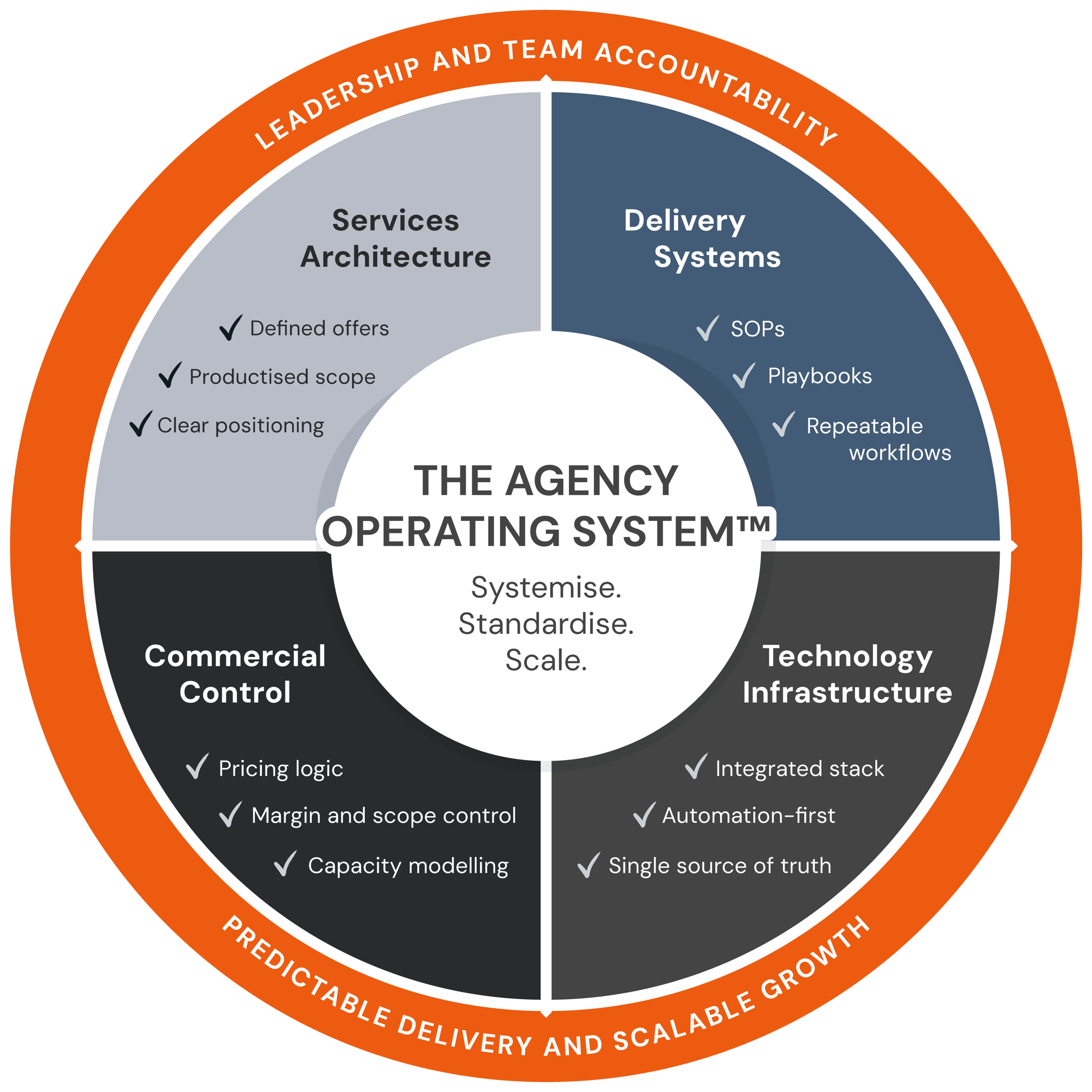
Having worked inside and alongside agencies for years, I have seen the same patterns repeat: Marketing deprioritised by delivery pressure. Growth built on referrals and relationships rather than systems. Founders still at the centre of everything, years after they intended to step back.
The Agency Operating System™ is the framework I designed to fix it. Each stage builds on the last. Without the operational foundation, growth creates chaos rather than capacity.
Whether we have worked through Stages 1 and 2 together or you are coming in at Stage 3, the goal is the same: an agency that grows without depending on you to drive it.
Charleh Knighton - Managing Director, KUB
A Fractional CGO installs the growth architecture your agency needs to scale predictably. That means aligning positioning, marketing, sales, commercial decisions, and leadership so growth no longer depends on you being at the centre of everything.
A Fractional COO standardises delivery and operations. A Fractional CGO builds on that foundation by creating the growth system that makes demand, revenue, and commercial performance more predictable.
A Fractional CMO focuses primarily on marketing leadership. A Fractional CGO goes further by connecting marketing to sales, pricing, capacity, delivery reality, and agency-wide growth decisions.
To help you move from reactive growth to structured scale. Instead of relying on referrals, founder relationships, or ad-hoc marketing, the agency develops a repeatable system that generates and supports growth.
It is a strategic leadership role with strong operational relevance. I help define direction, build the framework, and work with your team to make sure it actually gets implemented.
Agencies that already have more stable operations but now need growth leadership, stronger positioning, and a demand system that does not depend on founder hustle.
No. I strengthen what already exists, fill leadership gaps, and help your people operate with more clarity and accountability.
No. Marketing is one part of it, but the role is broader. It covers commercial strategy, positioning, pipeline health, team enablement, and the structural conditions that support profitable growth.
Yes. That is one of the main outcomes. With operational foundations in place and growth leadership installed, you can focus on leading the agency rather than carrying it.
A business that grows with more predictability, healthier margins, stronger internal leaders, and less dependence on you to drive demand and make every key decision.
Growth architecture is the structure underneath how your agency wins work and scales it. It includes positioning, marketing systems, pipeline design, commercial logic, and the internal alignment needed to support demand without chaos.
By helping build a real marketing function, clearer positioning, and a system for generating qualified demand consistently rather than waiting for introductions and timing to do the work.
Yes. Strong positioning is one of the foundations of predictable growth. If your agency sounds like everyone else, demand stays inconsistent and price pressure stays high.
Yes. That is often part of the role. Many agencies have never built an internal marketing engine because delivery has always taken priority.
Yes. Growth without commercial clarity creates volume but not health. Pricing, margin logic, and commercial choices are all part of scalable growth.
By aligning positioning, content, channels, and sales process into one system, then measuring what actually drives qualified opportunities.
Yes, at the leadership level. The goal is to make sure channels support the overall growth architecture rather than operating as disconnected tactics.
Yes. In most agencies, better positioning and stronger qualification improve growth more than simply increasing top-of-funnel activity.
Yes. Trust architecture is a key part of agency growth because stronger authority improves conversion, pricing power, and inbound demand quality.
Clear priorities, clean data, aligned teams, documented processes, and decisions made from visibility rather than instinct.
I work across leadership, helping align growth, delivery, sales, and commercial decisions so the agency is not pulling in different directions.
Yes. A core part of the role is developing leaders who can own their function and make strong decisions without everything escalating to the founder.
Yes. If growth is being blocked by unclear roles or weak leadership coverage, I help define the right structure and support hiring decisions.
By making sure they operate from the same growth framework, with shared visibility into demand, capacity, positioning, and commercial targets.
Yes. That is one of the main outcomes of the work. Clearer data, stronger accountability, and better role ownership reduce decision dependence on the founder.
That is common. The role often includes building the internal marketing function your agency has never properly had.
Primarily with leadership, but the work affects operational and commercial teams too because growth only works when the whole system is aligned.
Yes. The role is specifically designed to stop strategy, relationships, and growth decisions from always routing back through you.
That is often a leadership and structure problem, not a talent problem. The work helps unify direction, priorities, and ownership.
It removes the need to personally drive every growth conversation, fix every strategic gap, or act as the default link between departments.
Typically stronger positioning, more qualified demand, clearer growth decisions, better commercial control, and a leadership team that can carry more of the load without the founder.
Clarity often improves quickly. More substantial demand and commercial results usually build over the following months as the growth system takes shape.
Yes. The role is designed to support sustainable growth, which means commercial decisions, pricing, margin, and delivery capacity all stay in view.
Yes. That is one of the central goals. Growth should become a managed output of the system, not something driven by luck, timing, or founder energy.
Often, yes. Better positioning, cleaner qualification, and stronger buyer trust tend to reduce friction in the sales process.
Potentially, yes. Agencies with stronger leadership, cleaner commercial systems, and less founder dependency are usually more attractive and resilient businesses.
Yes. If you are carrying operations, growth, and commercial leadership at the same time, the business is structurally too dependent on you. This role is designed to change that.
Yes. Growth leadership only works properly when it is tied to operational reality, capacity visibility, and margin protection.
Through growth KPIs, lead quality, conversion performance, leadership effectiveness, commercial clarity, and the reduction of founder-dependent decisions.
An agency that can grow intentionally, with leadership, demand, and commercial structure strong enough to keep scaling without dragging you back into the centre.
Pricing depends on the level of growth leadership, execution oversight, and commercial involvement required, with flexible packages designed around the scope of support.
Yes. All packages require a six-month minimum commitment because meaningful growth structure takes time to build, embed, and transfer.
Because this is not a quick advisory engagement. It involves assessment, growth framework design, implementation, leadership development, and measurable progress over time.
Typically growth strategy, positioning work, commercial decision support, team leadership, marketing oversight, and the systems needed to make demand more predictable.
That depends on the package, but the engagement includes regular leadership interaction and ongoing involvement in key growth decisions.
Primarily remotely, with in-person sessions available where useful for planning, leadership work, or intensive strategy sessions.
Only where additional tooling, specialist support, or agreed implementation needs are added explicitly.
Yes. As the team becomes stronger and the growth architecture holds, my involvement should reduce. That is built into the model.
If operations are still fragile or delivery remains inconsistent, Stage 1 or Stage 2 may need attention first before growth can be scaled safely.
Book a scoping call. We will look at where growth is currently blocked, how dependent the agency still is on you, and what Stage 3 needs to look like for your business.
If your operations are in order and delivery is consistent, the next step is building the growth system to match. Let's talk about where you are and what Stage 3 looks like for your agency.
