
Are your competitors appearing in ChatGPT, Perplexity, or Gemini answers when buyers search for businesses like yours? And are you struggling to understand why, despite years of marketing investment, your business isn't part of those recommendations?
I work with founder-led B2B businesses on exactly this problem as a certified member of the AI Trust Signals Implementation Network, auditing why well-established companies are structurally invisible to AI tools. This article explains why it's happening, corrects the most common misconception about AI and search, and sets out a clear action plan to fix it.
It is written for B2B business owners and marketing leaders who want to understand AI visibility and decide what to do about it.
Key takeaways
- When AI tools like ChatGPT, Perplexity, or Gemini recommend competitors instead of you, your content is not structured in a way large language models can retrieve and cite.
- Google ranking does not guarantee AI recommendation: the two systems reward different signals entirely.
- AI tools select businesses based on answer clarity, topical authority, and third-party citation, not company size or budget.
- The process of fixing this is called Answer Engine Optimisation (AEO): restructuring content so AI systems can quote it confidently.
- Any business, regardless of size, can earn AI recommendations by addressing these structural gaps.
What does it mean when AI recommends your competitors instead of you?
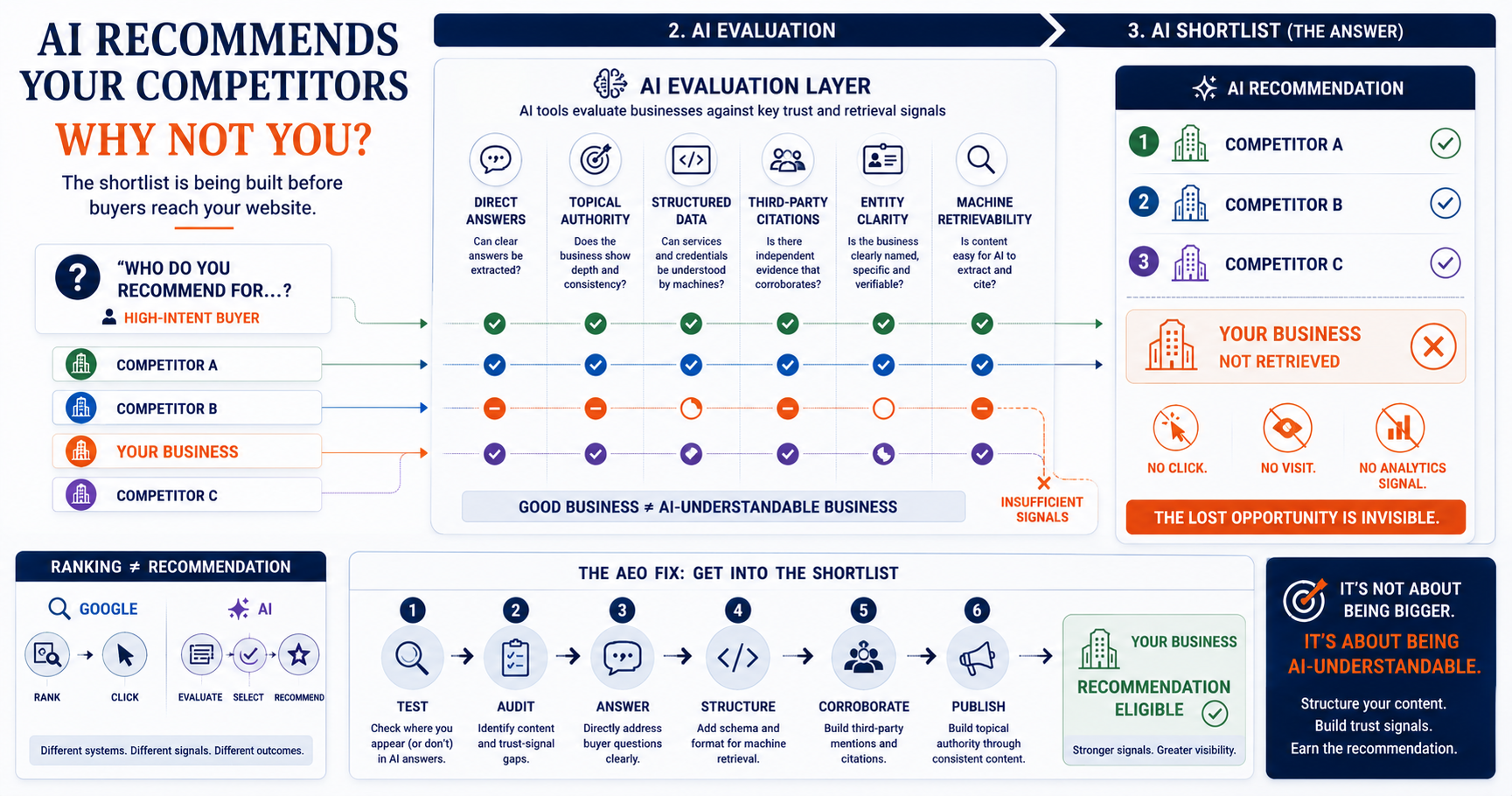
When an AI tool recommends your competitors instead of you, it means large language models like ChatGPT, Perplexity, or Gemini are including competitor names, services, and expertise in generated answers, while leaving your business out entirely.
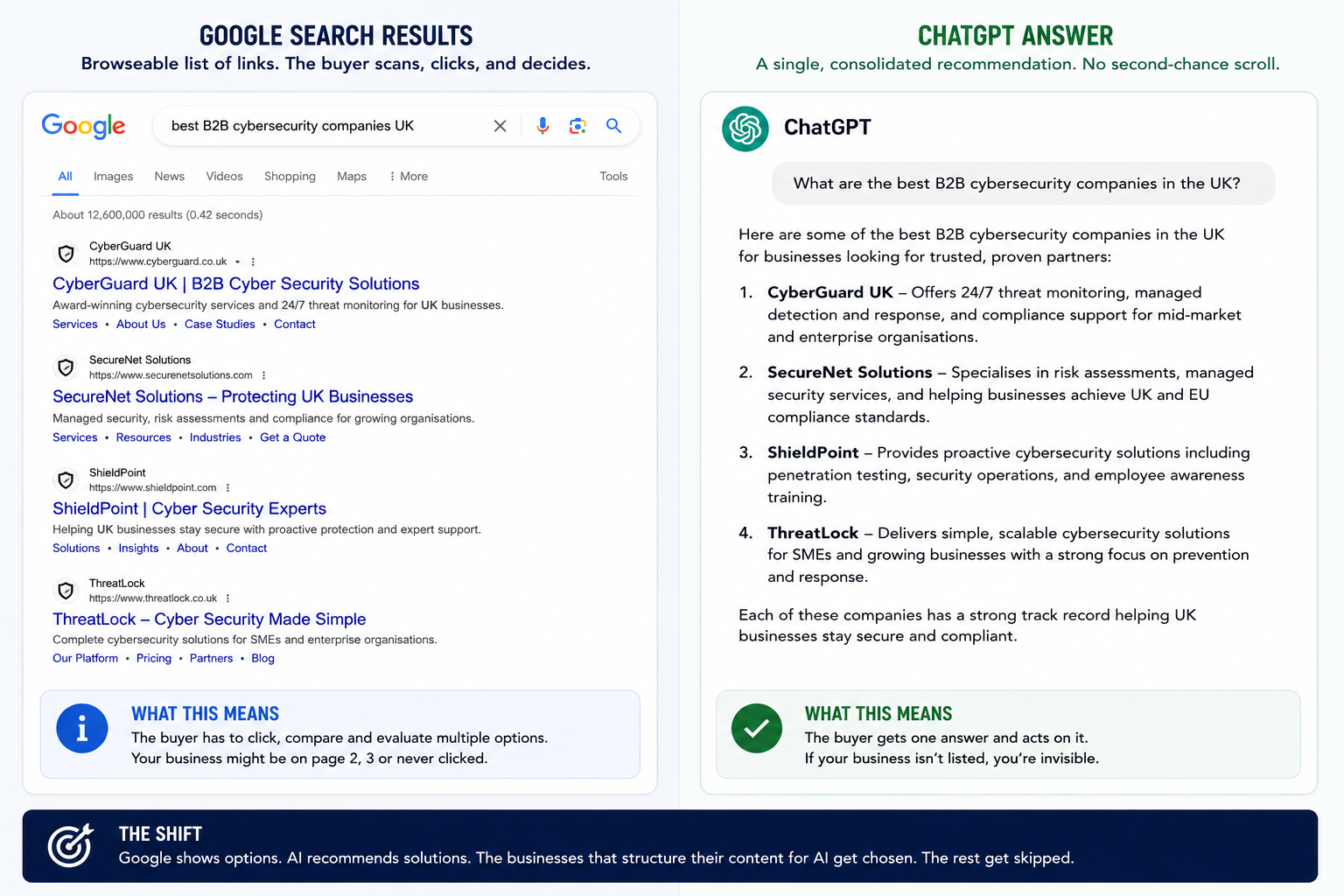
This is not the same as having a low Google ranking. An AI-generated answer is not a list of results a buyer can scroll through. It is a single, confident response. If your business isn't named in that response, you are absent from the buyer's consideration.
The buyer receives a curated shortlist, acts on it, and moves on. There is no second-chance scroll. There is no visibility of who was excluded.
Understanding the difference between "AI recommendation" and "AI ranking" is the foundation for fixing this problem.
Why AI search invisibility is now a business-critical problem
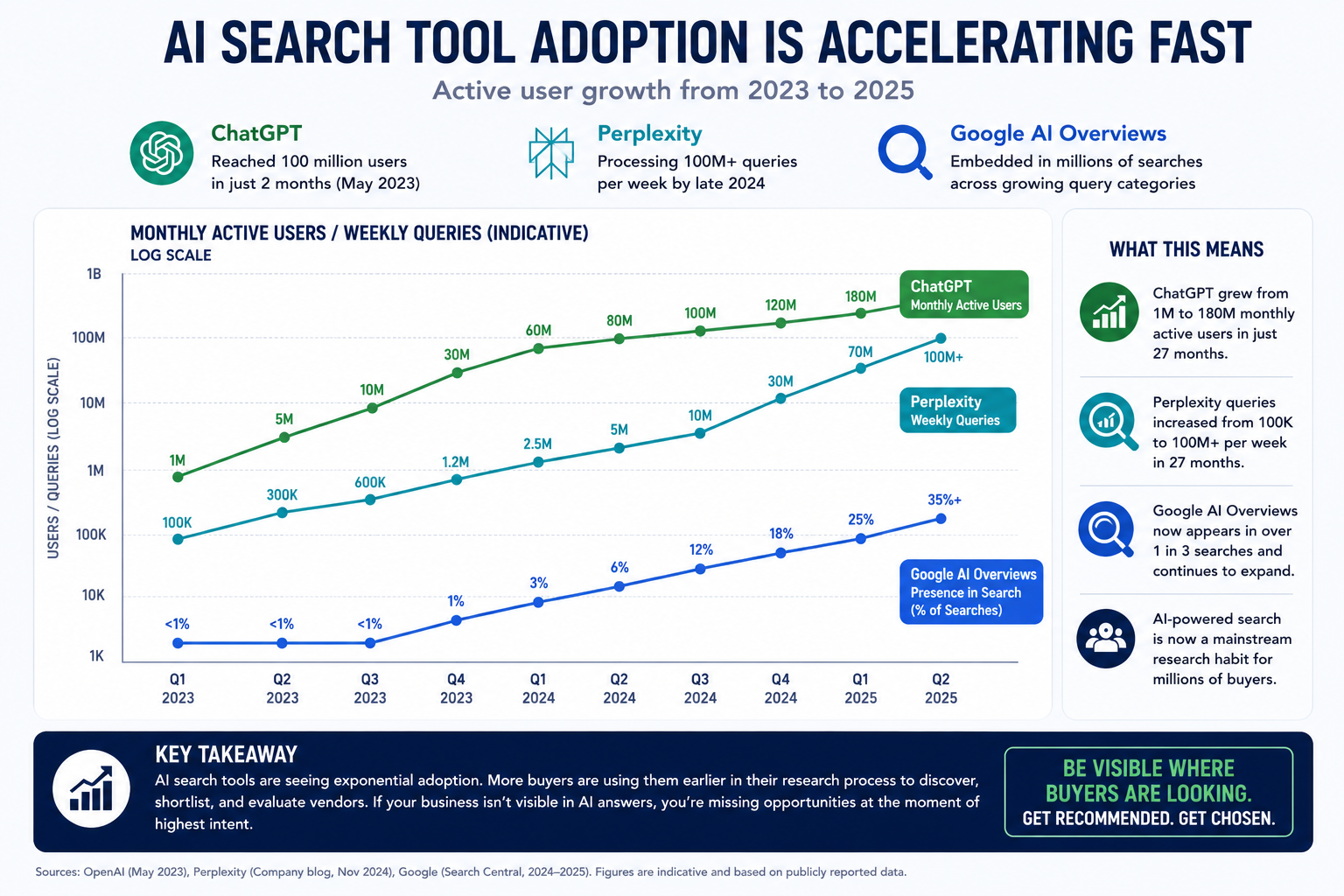
AI-driven search tools are now used by millions of buyers to shortlist vendors and get recommendations. If your business doesn't appear in those answers, you are invisible at the moment of highest buyer intent.
Unlike a low Google ranking, an AI answer that omits your business produces no second chance. The buyer receives a confident recommendation and acts on it.
Data and benchmarks
- ChatGPT reached 100 million users in two months, the fastest consumer application adoption on record, as reported by Reuters in 2023.
- Perplexity reported processing over 100 million queries per week by late 2024 (estimate based on publicly reported figures; treat as indicative)
- Google AI Overviews are embedded into standard UK search results across a growing range of commercial query types
The commercial damage is invisible in your analytics. Buyers who receive an AI recommendation featuring competitors simply don't visit your site, and that absence leaves no trace in your data.
The real reasons AI keeps recommending your competitors
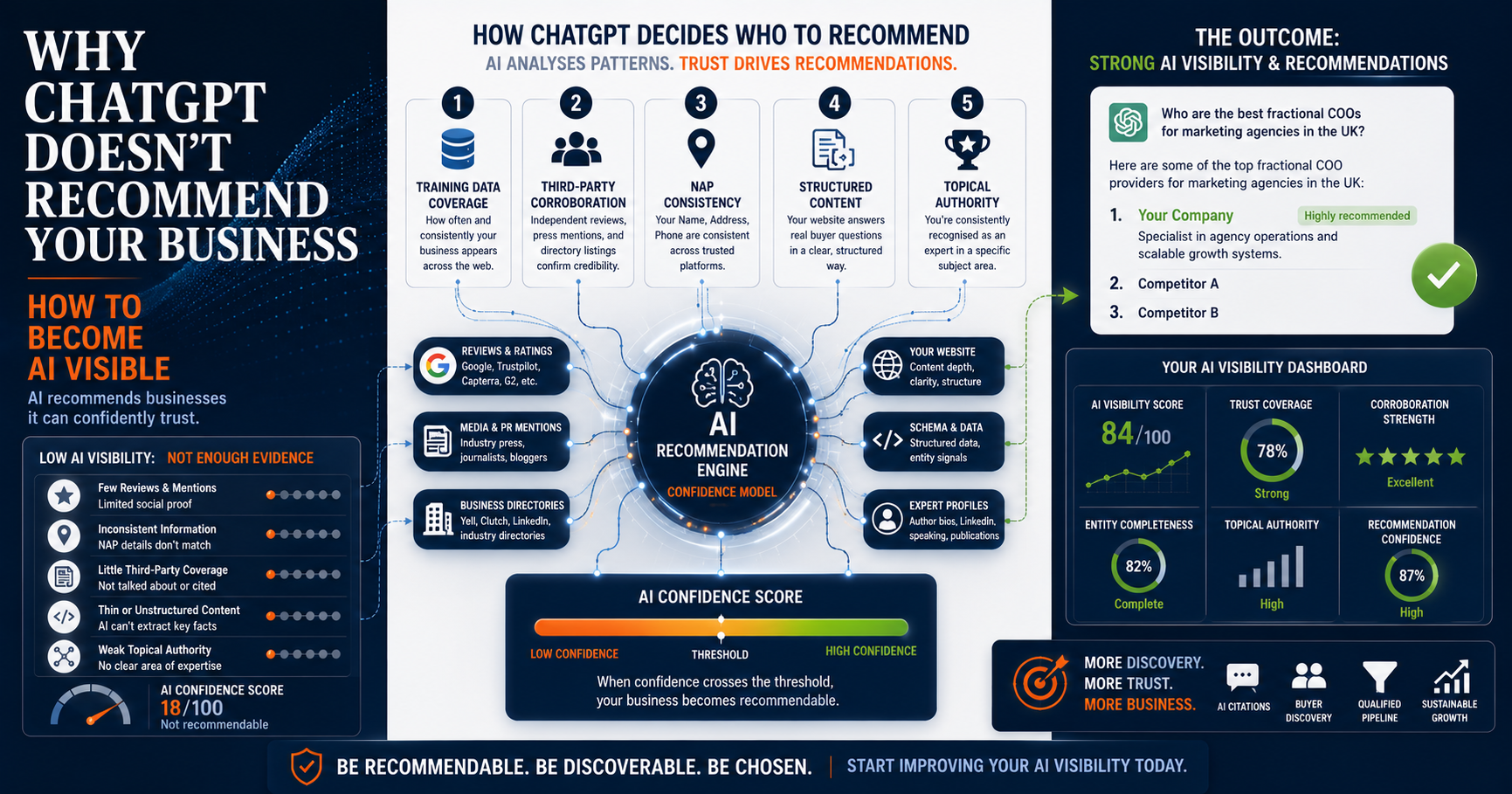
AI tools recommend competitors instead of you primarily because their content is structured, answer-ready, and cited by authoritative third-party sources, and yours is not.
This is rarely a budget issue. It is almost always a content structure issue.
The six most common root causes:
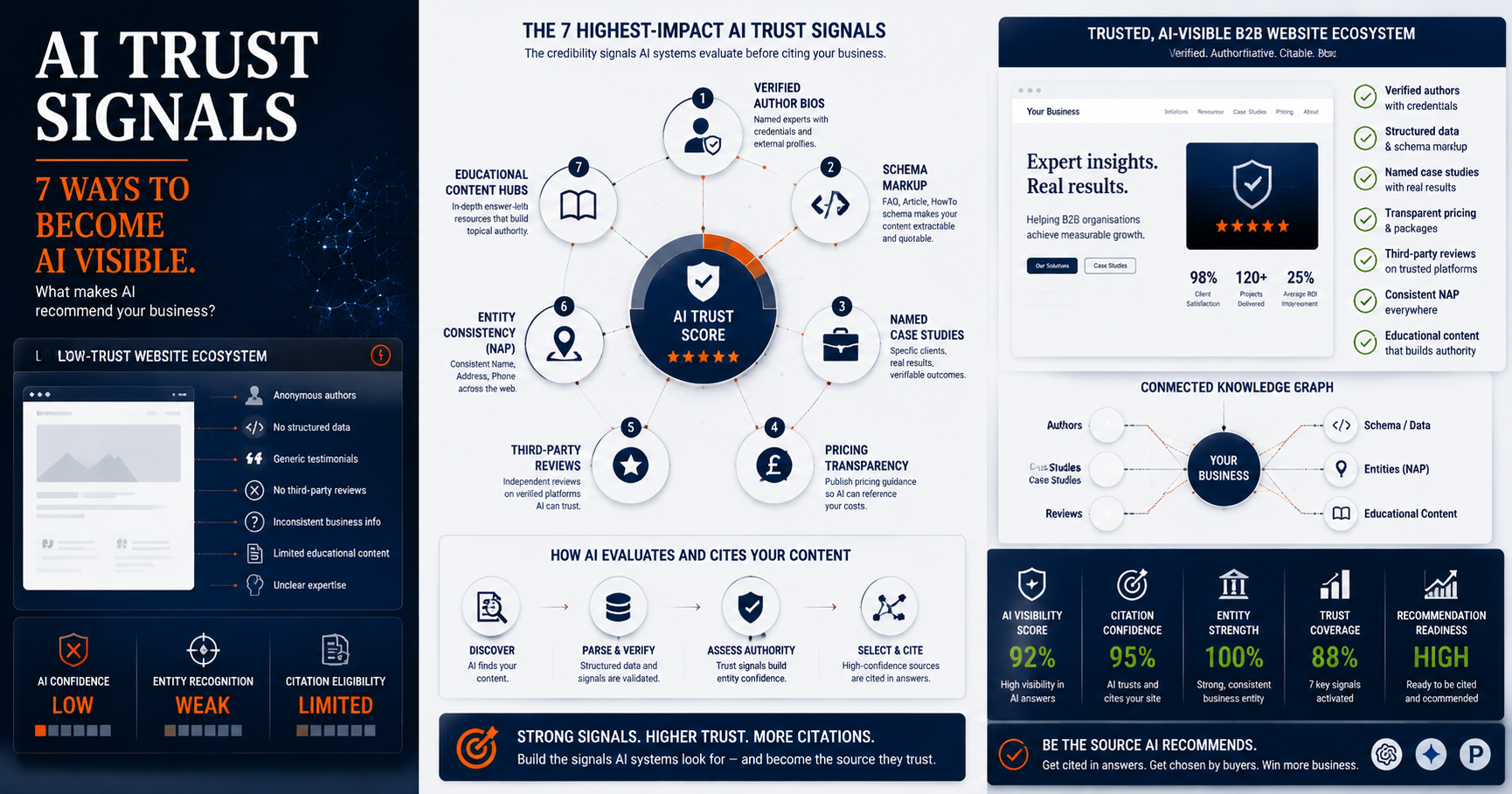
- No direct answers to buyer questions: AI models extract clear, standalone sentences. Vague positioning gets skipped.
- Weak topical authority: AI favours businesses that publish regularly and in depth on a subject, not those that do so occasionally.
- Missing schema markup: Structured data helps AI systems identify your services, pricing, and credentials with confidence.
- Thin third-party presence: If your business isn't cited or mentioned elsewhere online, it lacks corroboration in the model's assessment.
- Entity ambiguity: AI needs named, specific, verifiable information, not implied claims or generic descriptions of what you "do."
- Content not structured for machine retrieval: Long, embedded narratives give AI models nothing concrete to extract and cite.
The biggest misconception: Google ranking equals AI recommendation
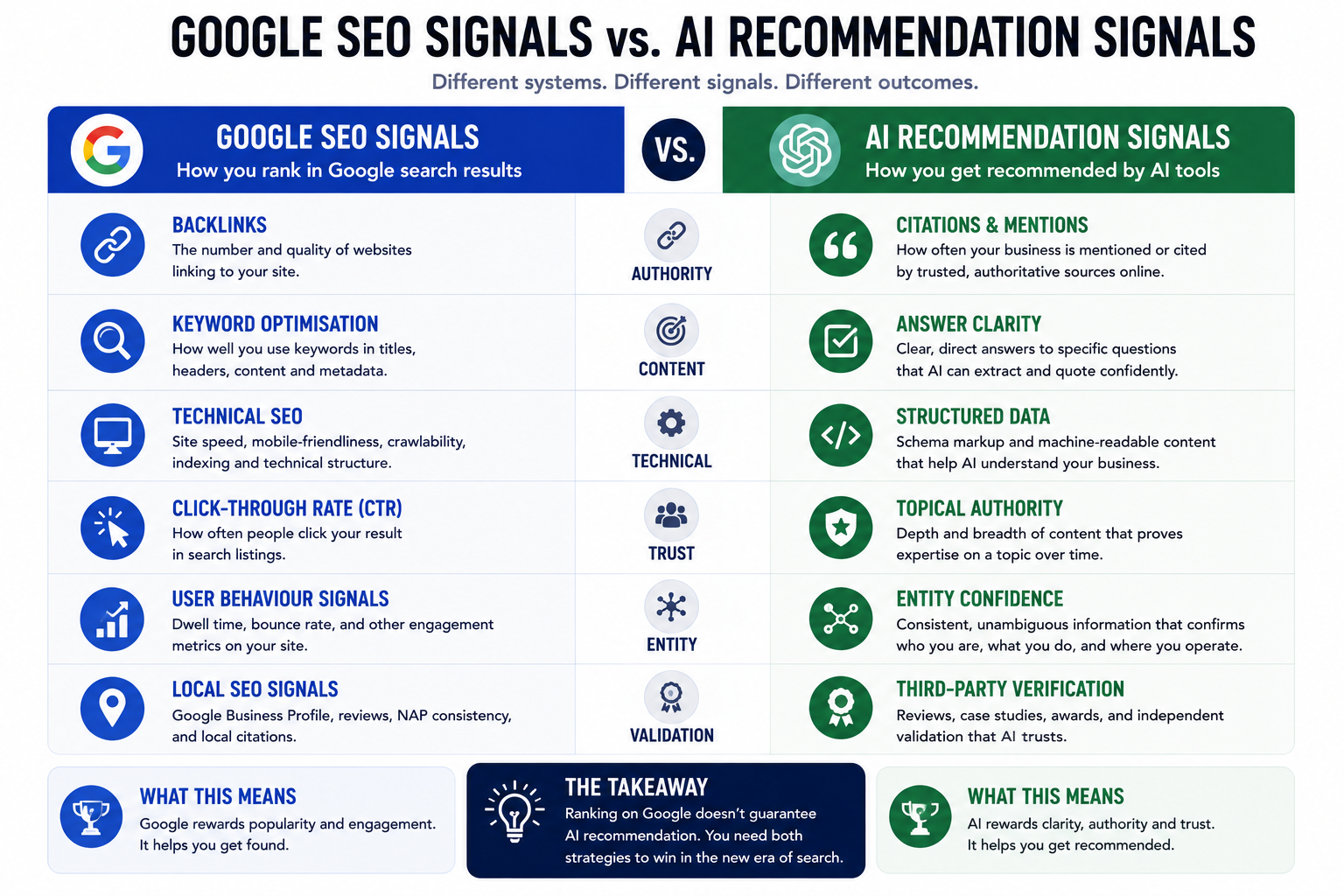
The most damaging assumption about AI search is that ranking well on Google guarantees AI recommendation. It does not, and treating them as the same thing is why many well-ranked businesses remain invisible to AI tools.
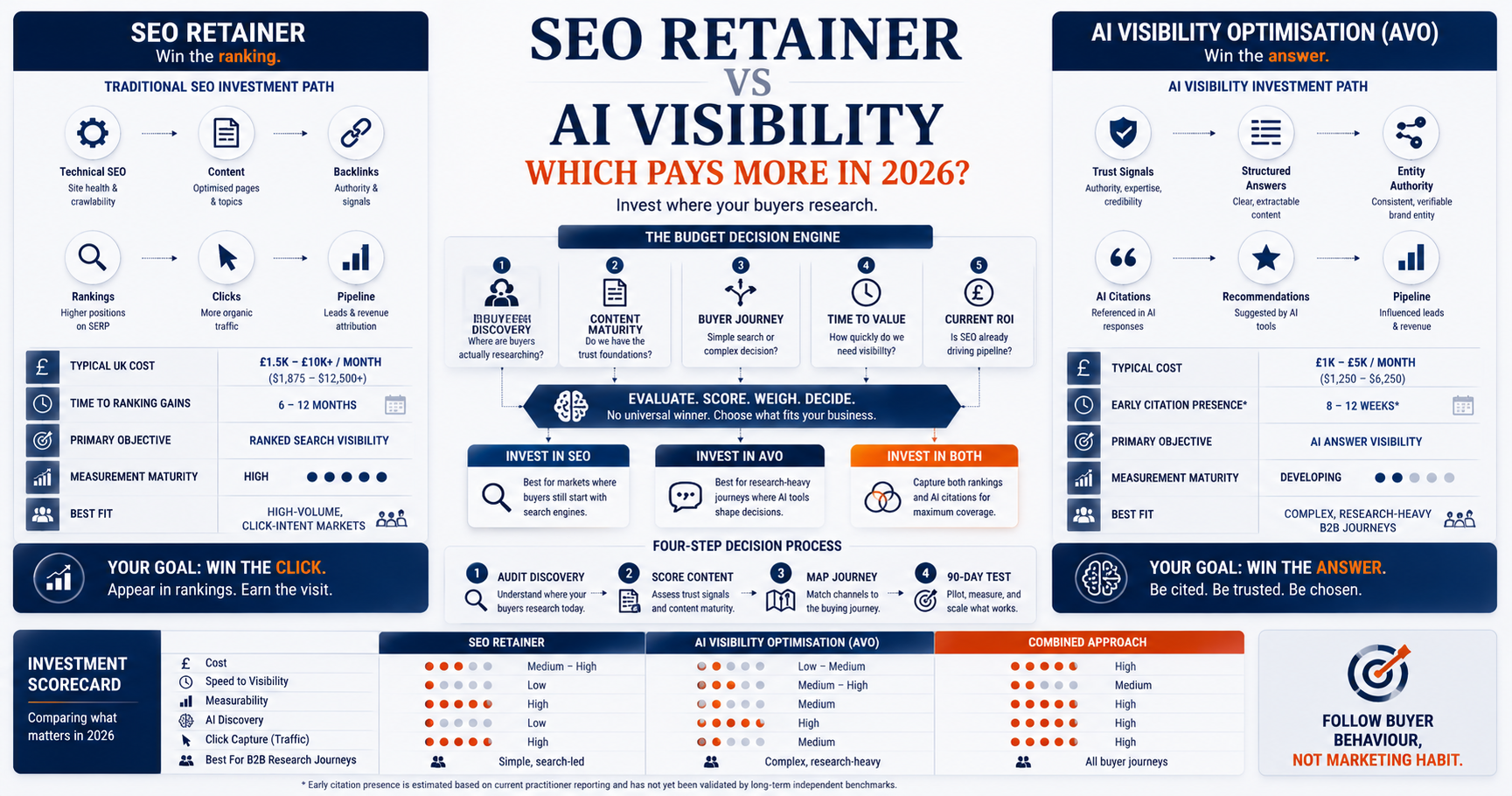
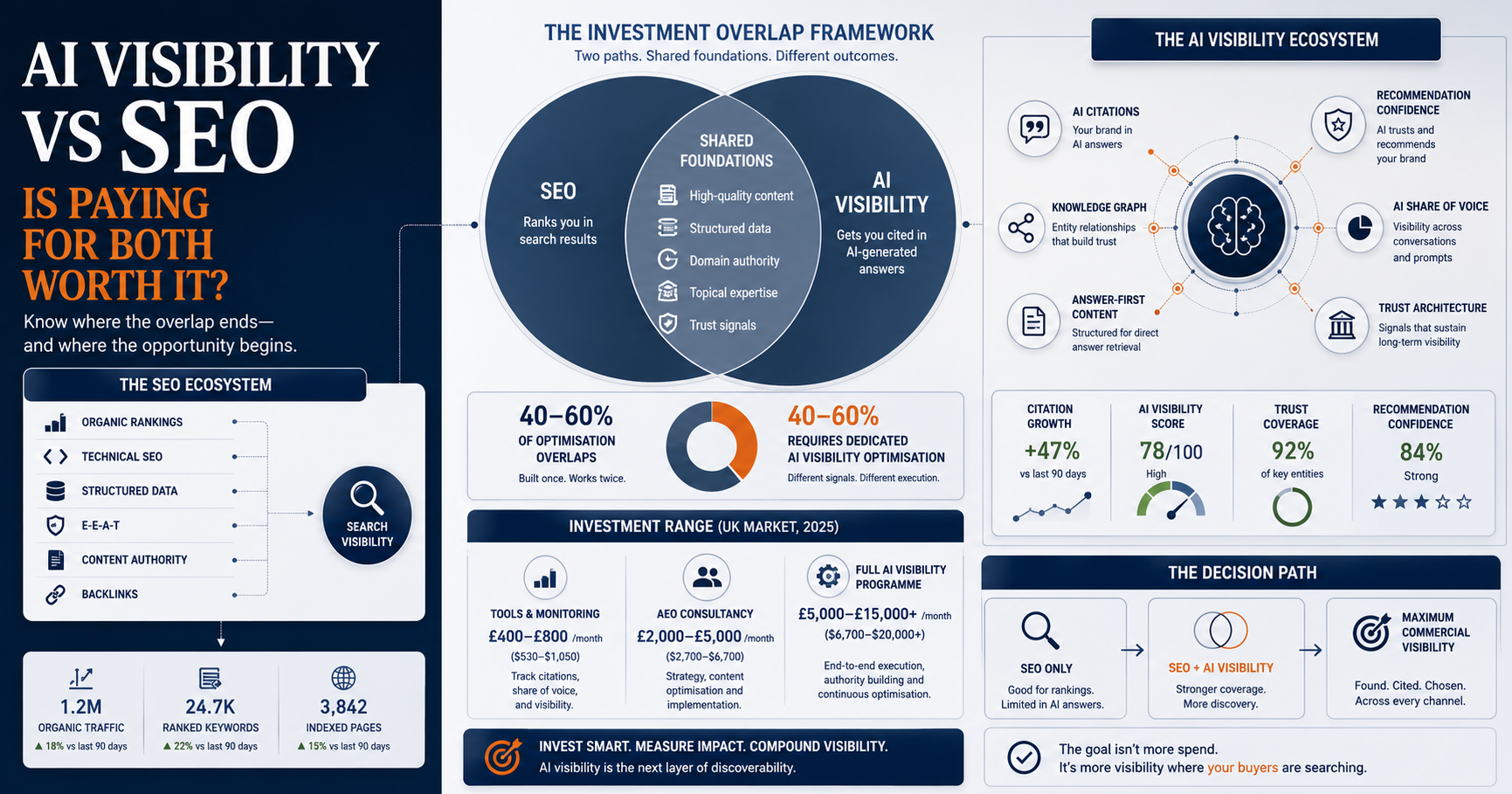
Google rankings are earned through backlinks, on-page SEO signals, and click-through behaviour. AI recommendations are earned through answer clarity, topical authority, and citation by trusted sources. The signals overlap, but they are not the same.
Two other common myths worth clearing up: AI does not only recommend large brands, content structure matters far more than company size. And social media following has no notable influence on AI recommendations; published, structured web content does.
What AI invisibility is costing your business
Being invisible to AI search tools costs real revenue, not just brand awareness. It costs you high-intent buyers who receive a confident AI answer featuring competitors and never look further.
A simple scenario to illustrate the exposure: If 500 buyers per month ask an AI tool to recommend businesses in your category, and competitors appear in 80% of those answers, that is 400 potential buyers each month who receive a shortlist that excludes you.
Because AI answers feel authoritative and complete, buyers rarely question who was left out. The cost adds up quietly, and never appears in standard analytics.
How to fix AI invisibility: A step-by-step action plan
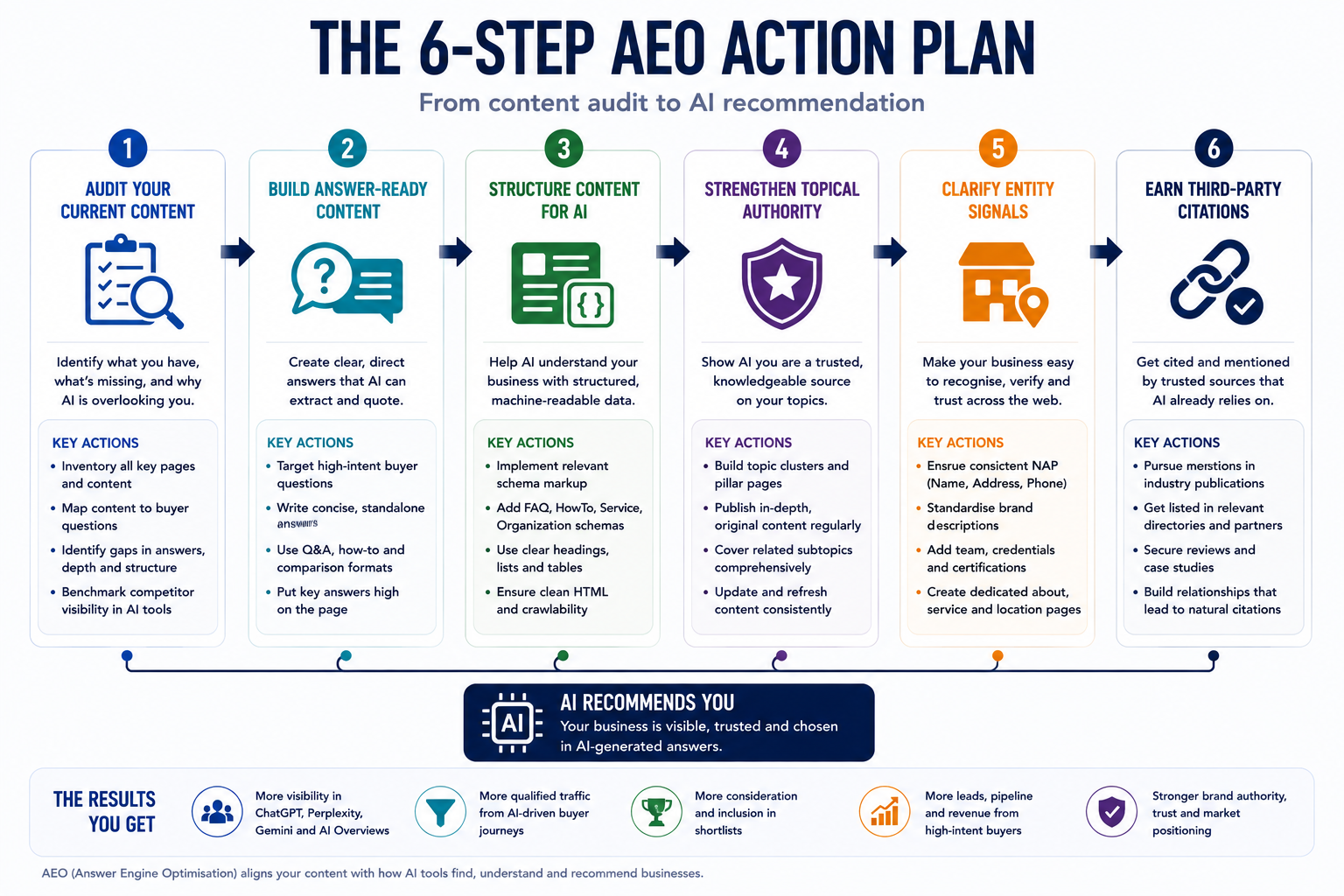
To fix AI invisibility, businesses need to audit their content for answer-readiness, restructure key pages to directly address buyer questions, build topical authority, and get their brand cited across trusted third-party sources.
This process is called Answer Engine Optimisation (AEO), distinct from traditional SEO, and increasingly important as AI-generated answers replace search results pages.
Six steps to get started
- Test your current position: Ask ChatGPT, Perplexity, and Gemini: "Who do you recommend for [your service type] in [your market]?" If competitors appear and you don't, you have a confirmed gap to address.
- Audit your content for answer-readiness: Can a sentence from your page stand alone as a confident AI answer without additional context? If not, restructure it. See: 90-Minute Marketing Triage™
- Map and answer buyer questions explicitly: Build pages around the specific questions buyers actually ask, not internal assumptions about what they want to know.
- Add schema markup: FAQ, HowTo, and service schema make your content machine-readable and significantly easier for AI models to retrieve.
- Build third-party presence: Get mentioned, cited, or featured on authoritative directories, publications, and partner sites.
- Publish regularly around your area of expertise: Depth and regularity signal topical authority to AI models. See: AI Visibility Optimisation; from £1,500 ($1,875) for a baseline audit
Note: Steps 2 and 6 link to services I built and run, so I have a commercial interest in mentioning them here. The steps themselves apply regardless of who carries them out.
How to check if a page is AI-ready
The clearest test: read the first 100 words of a key page and ask whether they answer a specific buyer question clearly and completely, without requiring context from anywhere else on the page.
If they don't, the page won't be retrieved. Bold your direct answers. Add FAQ sections. Use plain language. Structure before length.
Frequently asked questions about AI recommendations
These are the questions business owners most commonly ask when they first realise AI tools are recommending competitors instead of them.
How long does it take to appear in AI recommendations?
There is no guaranteed timeline. Structural improvements to well-trafficked pages can begin influencing AI outputs within weeks. Building topical authority through regular publishing typically takes 3–6 months.
Does business size affect AI recommendations?
No. AI recommendation is determined by content quality, structure, and authority signals, not company size or marketing budget. Small, well-structured businesses regularly appear in AI answers ahead of larger competitors.
Can I pay to appear in AI answers?
No. AI-generated recommendations are not paid placements. They are earned through structured content and third-party citation, which is why they carry more buyer trust than paid advertising.
How do I confirm whether AI is recommending my competitors right now?
Ask ChatGPT, Perplexity, and Gemini directly: "Who do you recommend for [your service] in [your market]?" If competitors appear and you don't, your AI visibility gap is confirmed. This takes under five minutes.
Conclusion
You've invested in your business, done good work, and built marketing around it. The fact that AI tools are recommending competitors instead of you is not a verdict on quality. It is a structural problem.
Right now, your content is not presenting your business in a way that AI systems can retrieve and cite with confidence. That gap is costing you buyers who never see your name.
The good news: AI recommendation is not controlled by large budgets or large brands. It is earned through clear, answer-ready, well-structured content, and an ongoing presence on authoritative sources. Both are within reach for any business willing to address them systematically.
How to take action now
- Ask ChatGPT and Perplexity who they recommend in your category; confirm the gap exists before spending anything
- Audit your top 5 pages: does each open with a direct, standalone answer to a real buyer question?
- Add FAQ sections and schema markup to your key service pages
- Book a 90-Minute Marketing Triage™ to identify your structural content gaps quickly
- Explore a full AI Visibility Optimisation audit, a complete assessment across 19 trust signals with a prioritised remediation roadmap
Related reading:
If you want a structured diagnosis of where your AI visibility is leaking and a clear plan to fix it, my AI Visibility Optimisation service is built for exactly this. It sits within the In-House Growth Engine™, a four-stage system for replacing marketing dependency with a growth system your business owns. As above, this is a service I built and operate.

About the author
Tom Wardman is a fractional marketing consultant and Growth Independence Architect™ who helps founder-led B2B businesses replace agency dependency with self-sufficient growth systems. He is one of the UK's first five certified coaches in the Endless Customers methodology and a certified AI Trust Signals Implementation Network partner. His work spans fractional CMO services, HubSpot implementation, and AI visibility, all structured around one outcome: growth systems businesses own and operate without ongoing reliance on external support.
Pricing disclaimer: All GBP–USD price conversions are rounded estimates and correct at the time of publishing, calculated at £1 = $1.25. Exchange rates fluctuate and figures should be treated as indicative only.
Topics: