



Key Takeaways
- A best-fit client is a business whose goals, resources, and readiness align closely with the provider's expertise, process, and service model.
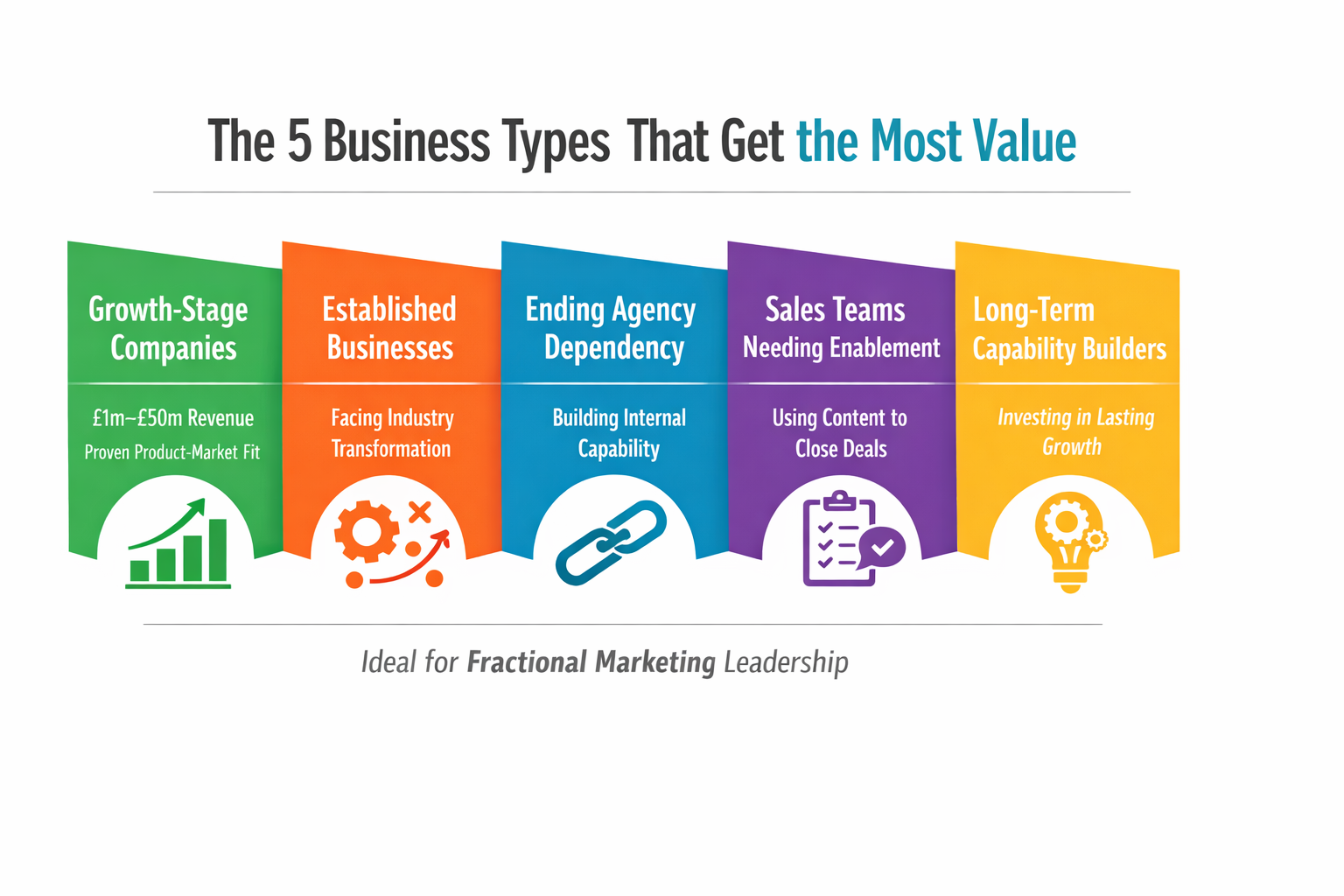
- Five business types consistently achieve exceptional results: growth-stage companies with proven revenue (£1m–£50m / $1.25m–$62.5m), established businesses undergoing transformation, companies ending agency dependency, businesses with sales teams needing enablement, and organisations ready to build in-house capability.
- Typical engagements range from £15,000 to £75,000 ($18,750–$93,750) depending on scope, with best-fit clients achieving 5-10x ROI within 12-18 months.
- Poor-fit indicators include pre-revenue stage, lack of decision-making authority, inability to dedicate internal resources, and expectation of overnight results.
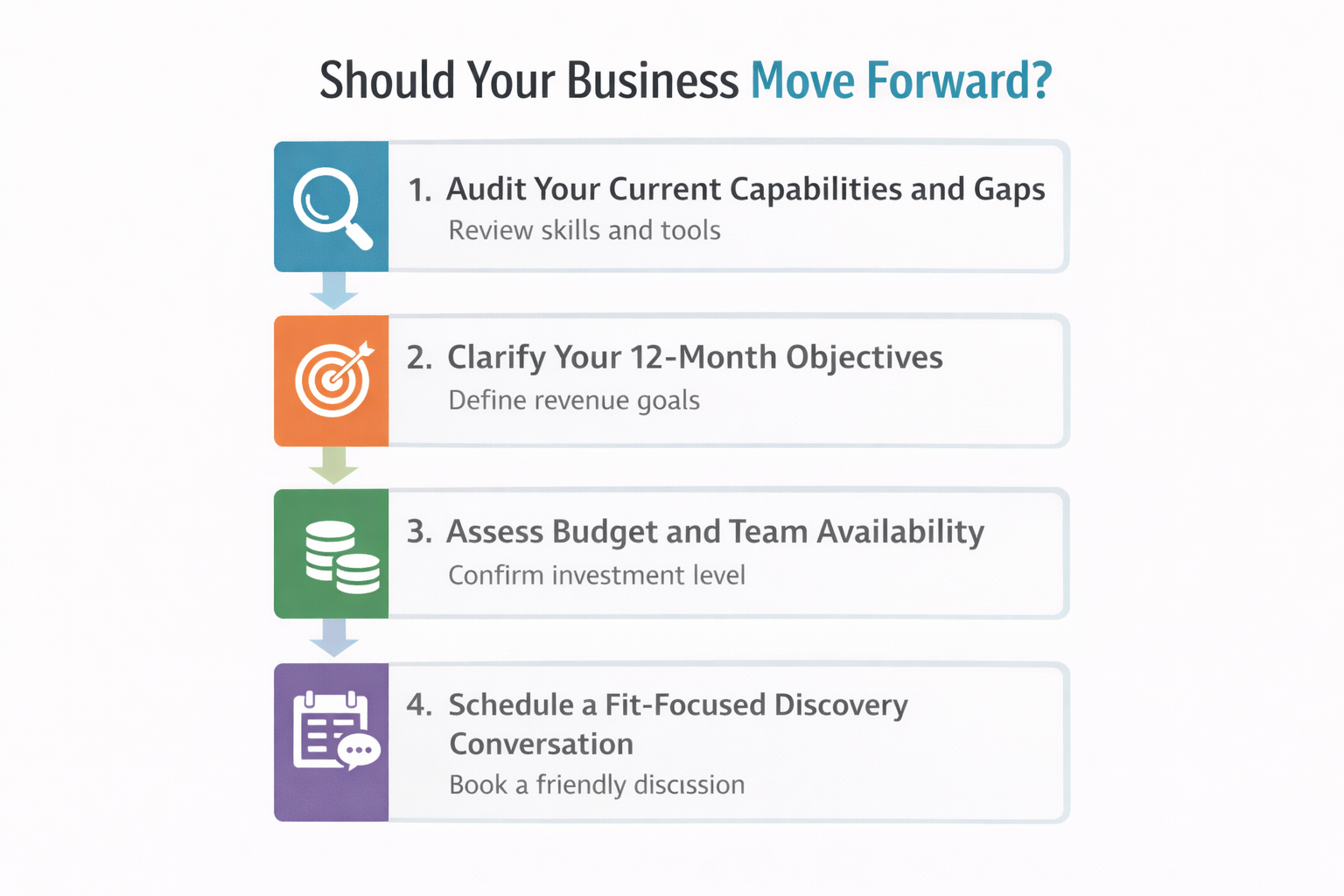
- A four-step evaluation process surfaces deal-breakers early: audit current capabilities, clarify 12-month objectives, assess budget and team availability, then schedule a discovery conversation.
Your sales team closes fewer deals than they should. Your marketing creates content that rarely connects to actual revenue. You've tried agencies, freelancers, and DIY approaches, but nothing builds the lasting capability your business needs.
I help businesses doing £1 million to £50 million ($1.25m–$62.5m) in annual revenue build in-house sales and marketing engines that create trust, shorten sales cycles, and generate endless customers. But not every business is ready for this approach, and forcing a mismatch wastes both time and money.
In this article, you'll learn:
- The 5 business types that achieve the highest ROI
- How to evaluate if your business is ready
- What investment and returns to expect
What makes a business a "best fit" client?
A best-fit client is a business whose goals, resources, and readiness align closely with the specific expertise, process, and service model a provider offers. When this alignment exists, both parties achieve better results, faster timelines, and higher satisfaction than in mismatched engagements.
Strong matches matter more than budget or industry. A £5 million ($6.25m) professional services firm with committed leadership and a team ready to learn will achieve better outcomes than a £20 million ($25m) manufacturer that lacks internal resources or expects instant transformation without process change.
The ideal engagement has three dimensions: strategic readiness (you know change is needed), resource availability (you can dedicate team time), and cultural compatibility (you're willing to build capability, not just rent expertise).
The 5 types of businesses that get the most value
Five distinct business profiles consistently achieve exceptional results: growth-stage companies with proven product-market fit, established businesses undergoing transformation, companies ending agency dependency, businesses with sales teams needing enablement, and organisations ready to invest in long-term capability building. Each profile has clear characteristics that predict engagement success.
Type 1: Growth-stage businesses with proven product-market fit (£1m–£50m Revenue)
You've proven your business works, but growth has stalled or become unpredictable. Your sales team struggles to close deals because prospects don't trust you yet. You need shorter sales cycles, better close rates, and more qualified opportunities.
Type 2: Established businesses undergoing market transformation
Your market has changed fundamentally and you need to adapt your positioning. Competitors use AI and modern marketing approaches whilst you're stuck with outdated tactics. You recognise that cold outreach gets ignored and generic content fails to connect, so you're ready to build genuine trust with customers.
Type 3: Companies ending agency dependency and building internal capability
You're tired of paying agencies that produce traffic bumps without qualified leads. Every time you stop paying, the results disappear and you're left with no internal capability. You want to own your growth engine, not rent it monthly.
Type 4: Businesses with sales teams needing content enablement
Your marketing creates content but your sales team ignores it or doesn't know how to use it. Marketing and sales operate in separate worlds, causing misalignment, wasted effort, and lost deals to competitors who've built credibility first.
Type 5: Organisations ready for long-term capability building
You understand that transformation takes 12-24 months, not weeks. You're willing to dedicate team resources, embrace honest feedback, and step out of your comfort zone to build something that lasts beyond any single consultant engagement.
How to evaluate if you're a good fit
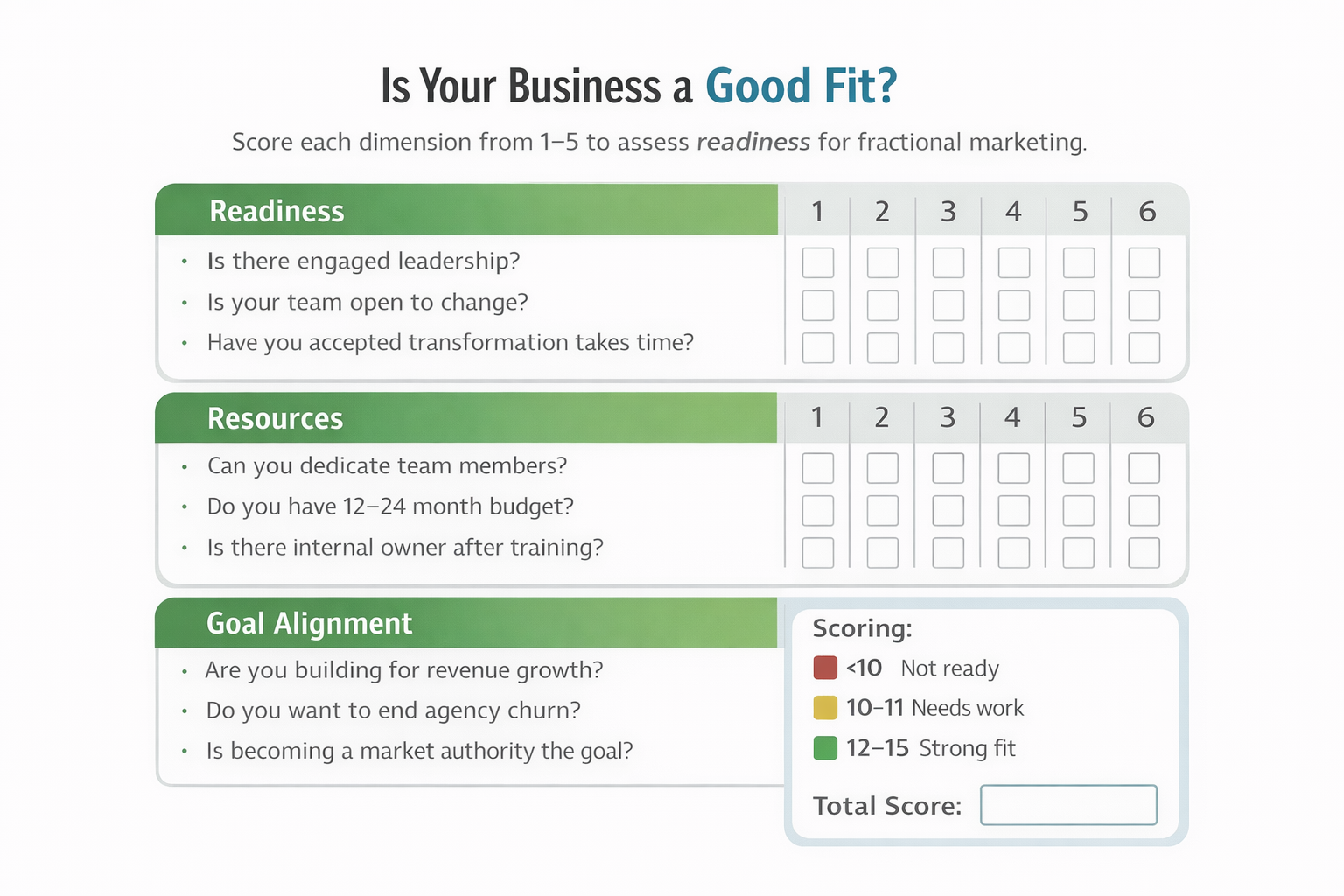
Use this 15-point scorecard to rate your fit before booking a discovery call. Businesses can evaluate fit by assessing three dimensions: current-state readiness, resource availability, and goal alignment. A simple scoring framework across these dimensions reveals whether an engagement is likely to deliver 10x ROI or become a frustrating mismatch.
Ask yourself these questions:
- Readiness: Do you have engaged senior leadership? Is your team willing to change how they work? Have you accepted that lasting transformation takes time?
- Resources: Can you dedicate team members to implementation? Do you have budget for 12-24 month engagements, not just quick fixes? Will someone internally own the systems after training?
- Goal alignment: Are you building for revenue growth, not just marketing activity? Do you want to become the trusted voice in your market? Are you looking to end agency dependency?
Score each dimension from 1-5. If you score below 10 total, you're likely not ready yet. Scores of 12-15 indicate a strong match.
What it costs to work together (And why fit matters for ROI)
Typical engagements range from £15,000 to £75,000 ($18,750–$93,750) depending on scope, duration, and complexity, with best-suited clients consistently achieving 5-10x return within 12-18 months. Poor matches often struggle to reach break-even because misaligned expectations, inadequate resources, or wrong-time implementation undermine even excellent strategy.
Investment increases when you need immediate lead flow, operate in highly competitive markets, or require extensive content creation and video production. Investment decreases when you have strong existing foundations, basic marketing skills, and flexible timelines.
Best-suited clients see ROI through shorter sales cycles (30-60% reduction), higher close rates (40-70% improvement), and predictable lead generation that supports sales targets. They also build permanent internal capability, eliminating ongoing agency costs of £3,000–£10,000 ($3,750–$12,500) monthly.
Recommended resource: My pricing page
Who this is not right for (yet)
Certain business conditions consistently predict disappointing outcomes, regardless of provider quality. Recognising these red flags early saves both time and money.
You're likely not ready if:
- You're pre-revenue or haven't achieved product-market fit yet
- You lack decision-making authority or budget ownership for the full programme
- You can't dedicate internal team resources to implementation and training
- You expect overnight results without changing current processes
- Your leadership isn't aligned on the need for transformation
- You're looking for someone to "do marketing for you" rather than build capability
- You want to keep outsourcing rather than developing in-house expertise
None of these are permanent disqualifiers. They simply mean you should address these gaps before engaging, ensuring you get maximum value when the time is right.
How this approach compares to alternatives
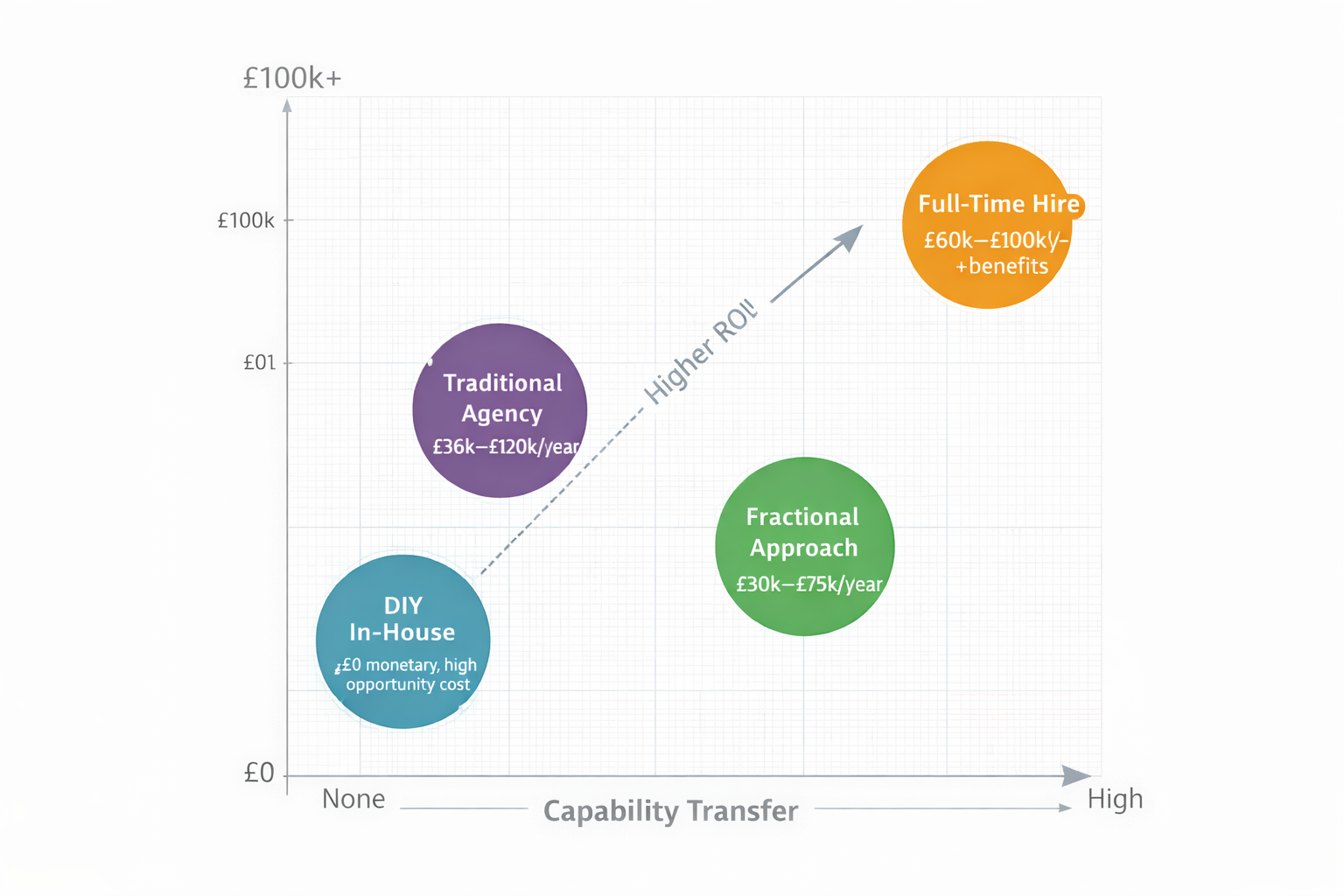
Businesses typically consider four alternatives: hiring a full-time marketing director, using a traditional inbound agency, choosing a lower-cost freelancer, or attempting the work in-house without guidance. Each alternative serves different business profiles better, making the comparison less about "best" and more about "best for your specific situation."
Understanding where each approach excels helps you make confident decisions based on your revenue size, team capabilities, and long-term goals.
| Criterion | Fractional approach | Full-time hire | Traditional agency | DIY in-house |
|---|---|---|---|---|
| Typical cost | £30k–£75k/year ($37.5k–$93.75k) | £60k–£100k/year ($75k–$125k) + benefits | £36k–£120k/year ($45k–$150k) retainer | £0 monetary, high opportunity cost |
| Speed to results | 60-90 days for quick wins | 90-180 days (recruitment + ramp) | 30-60 days for activity, often no revenue link | 6-12 months with frequent stalls |
| Capability transfer | High - training built in | Medium - depends on individual | None - stops when you stop paying | High if you succeed |
| Best for | £1m–£50m businesses building capability | £50m+ needing full-time leadership | Businesses needing execution only | Businesses with strong existing marketing skills |
This is why the fractional model offers the highest ROI for mid-sized teams building long-term capability.
The key difference: I build systems your team will own, not systems that rely on me. Traditional agencies create dependency. Full-time hires bring capability but cost significantly more. DIY attempts often fail without proven frameworks and external accountability.
External resource: HubSpot's guide to fractional marketing roles
Step-by-step: Evaluating if you should move forward
A four-step evaluation process helps businesses make confident hiring decisions. This sequence surfaces deal-breakers early whilst building conviction for good-fit matches.
Step 1: Audit your current-state capabilities and gaps (Week 1)
Review your existing marketing foundations, team skills, and sales enablement tools. Identify what's working, what's missing, and where sales and marketing aren't aligned. Be brutally honest about capability gaps.
Step 2: Clarify your 12-month business objectives (Week 1-2)
Define specific revenue targets, market positioning goals, and sales cycle improvements you need. Write down what success looks like in measurable terms: shorter sales cycles, higher close rates, more qualified opportunities.
Step 3: Assess your budget and team availability (Week 2)
Determine realistic investment levels (£15k–£75k / $18.75k–$93.75k range) and identify which team members can dedicate time to training and implementation. Confirm leadership buy-in and resource commitment.
Step 4: Schedule a fit-focused discovery conversation (Week 2-3)
Book a friendly chat to explore alignment, ask questions about the approach, and determine if working together makes sense for both sides. This isn't a sales call, it's a mutual evaluation.
Frequently asked questions about client fit
Businesses evaluating fit consistently ask similar questions about timing, prerequisites, engagement models, and success factors. The following answers address the five most common questions from discovery conversations.
What if we're between two of these business types?
Most businesses span multiple types. A growth-stage company often needs sales enablement whilst ending agency dependency. What matters is scoring well on the three dimensions: readiness, resources, and goal alignment, not matching one category perfectly.
Do we need to have everything figured out before we start?
No. You need clarity on your revenue goals and commitment to the process, but perfect planning isn't required. The first 30-60 days include strategy development and systems mapping that establishes clear priorities based on your specific situation.
How much of our team's time will this require?
Expect 5-10 hours weekly from your core team during active implementation phases. Leadership needs 2-3 hours monthly for alignment sessions. Done-for-you services require less team time initially; training programmes require more consistent engagement but build permanent capability.
What happens if we're not seeing results?
Quarterly reviews track specific metrics: sales cycle length, close rates, lead quality, and team capability development. If results aren't progressing as planned, we adjust the approach or acknowledge the engagement isn't working. I'm not here to take your money for disappointing outcomes.
Can you work with businesses outside these five types?
Sometimes, but the right match matters more than revenue size or industry. If you score well on readiness, resources, and goal alignment, we should have a conversation. If you're pre-revenue, lack internal resources, or want someone to "do marketing for you" indefinitely, we're likely not a match.
Conclusion: Alignment matters more than budget
You now know the five business types that achieve exceptional results: growth-stage companies with proven revenue, established businesses transforming their approach, organisations ending agency dependency, sales teams needing enablement, and businesses ready to invest in lasting capability.
The difference between good and great outcomes isn't budget or industry—it's alignment. When your goals, resources, and readiness match the engagement model, you build something permanent rather than renting temporary fixes.
How to take action now
- Score your business on the three dimensions: readiness, resources, and goal alignment
- Review the five business types and identify which profile fits you best
- Audit your current marketing and sales capabilities honestly
- Determine your 12-month revenue and positioning objectives
- Book a friendly discovery conversation to explore if working together makes sense
My services help businesses doing £1 million to £50 million ($1.25m–$62.5m) in annual revenue build sales and marketing engines they'll own forever. Whether you need hands-on execution, strategic guidance, or comprehensive team training, I work alongside your team to create trust-building systems that generate endless customers.

About the Author
I'm Tom Wardman, and I help business leaders build in-house sales and marketing capability that ends agency dependency. Over the past decade, I've worked with businesses across professional services, B2B, manufacturing, construction, and healthcare to build trust with customers, shorten sales cycles, and create predictable revenue growth.
My approach uses the Endless Customers System™, a proven framework that thousands of organisations globally have used to transform their marketing. I don't build systems that rely on me; I build systems your team can confidently own and run long after our engagement ends.
Pricing disclaimer: All GBP–USD price conversions are rounded estimates and correct at the time of publishing. Exchange rates fluctuate and figures should be treated as indicative only.
Topics: