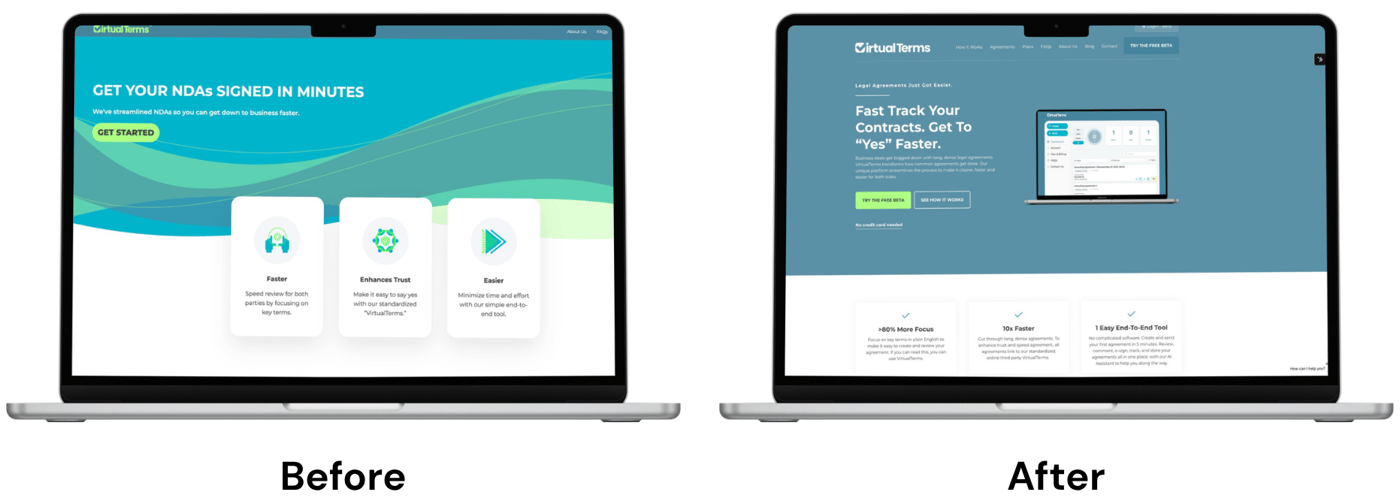
The product existed. The vision was clear. But there was no audience definition, no positioning, and no system driving growth. Everything was founder-led and ad hoc.
When VirtualTerms came to me, they didn’t have a marketing problem. They had no marketing function at all. The product existed. The vision was strong. But growth relied on:
A basic website
Mailchimp email marketing
Founder-led, ad hoc activity
There was no defined audience, positioning or strategy, and without those, everything else was guesswork.
For an early-stage SaaS product, this is where most fail. Without clarity:
Messaging doesn’t resonate
Content doesn’t convert
Paid and organic channels underperform
Product-market fit becomes harder to identify
The risk was building momentum in the wrong direction. As such, my role was to build the foundation from the ground up. They needed a complete marketing system, anchored in positioning, audience clarity, and a long-term growth strategy.

We started by answering the most important question: Who is this actually for?
Through ICP development and persona work, we identified core segments including:
Solo practitioners and consultants
Fractional executives
SMB decision-makers
The primary persona highlighted a critical insight:
Users weren’t just looking for contracts
They were trying to save time, reduce risk, and look professional without legal complexity
This reframed how the product should be communicated.
The product itself was strong. But the messaging wasn’t landing. From the strategy work:
Traditional agreements are time-consuming, complex, and expensive
VirtualTerms solves this with standardised, plain-English agreements completed in minutes
This enabled us to make a key positioning shift, from “legal tech tool” to “faster, simpler agreements that build trust and remove friction”
This became the foundation for all future marketing.
With positioning defined, we built a full GTM strategy covering:
Product roadmap and expansion (starting with NDAs, expanding into broader agreements)
Revenue and growth targets (scaling to $10M+ ARR over 5 years)
Channel strategy across content, website, sales, and paid media
KPI framework for acquisition, conversion, and retention
The strategy followed a clear principle: Build a trusted brand first. Then scale demand.
We implemented a content strategy rooted in real buyer questions. The focus:
Pain point education (legal inefficiencies, contract risks)
Solution comparisons (DIY vs software vs lawyers)
ROI-driven content (time saved, cost reduced)
Best practices for agreement management
This was content ultimately designed to:
Attract the right audience
Build trust
Support sales conversations
We then mapped the 90-day beta launch plan. Key initiatives included:
Product launch platforms (Product Hunt, BetaList, Startup directories)
Network-driven growth via fractional communities
PR strategy focused on industry inefficiency and innovation
Website messaging tailored to specific audiences
Initially, the focus was on fractional executives. But through product listing platforms and early feedback, a key insight emerged: The messaging resonated more strongly with lawyers and legal-adjacent users
This created a natural pivot opportunity, refining positioning based on real market response.
To support execution, we established:
A structured content cadence (3 articles per week)
HubSpot-based tracking and reporting
Lead scoring and CRM alignment
Email automation and nurture sequences
The goal was simple: Turn marketing into a system, not a series of one-off activities.
Arthur Swanson - Founder/CEO, VirtualTerms
No defined marketing function
Unclear audience and positioning
Founder-led, inconsistent activity
Limited visibility into what was working
Strong, differentiated positioning
Full go-to-market strategy and roadmap
Early-stage traction and validated messaging direction
Real-time visibility into deals, campaigns, and revenue
Most early-stage companies think they need more leads. VirtualTerms needed something more fundamental: Clarity.
Once the audience, positioning, and strategy were in place, everything else became easier. Content had direction, messaging resonated, and channels had purpose.
Defined and validated core target audiences
Clear positioning built around speed, simplicity, and trust
Full GTM strategy aligned to $10M+ growth trajectory
Content and channel strategy supporting long-term demand generation
Enabled scalable operations across sales, delivery, and finance

If your growth relies on founder activity and ad hoc effort, you do not have a marketing engine; you have a dependency. Book a call to discuss what a properly structured foundation would look like for your business.