



How do you know if a marketing consultant will actually help your business grow?
And why does your investment in consulting so often fail to move the revenue needle, leaving you with generic advice that looks good on paper but never quite translates to real results?
Too often, I meet teams who've spent six figures on consulting with no measurable impact.
You're about to learn what separates genuinely different consulting approaches from the typical playbook. After helping dozens of B2B firms shift from tactics to systems, I've learned what actually works. You'll see the specific frameworks, methodologies, and principles that drive real results, and how to spot the difference before you invest a penny.
This guide breaks down what makes a consulting approach effective, scalable, and tailored to real business results, who it works for, and how to evaluate whether an approach will deliver measurable outcomes for your business.
In this guide, you'll learn:
- What separates different vs. traditional consulting
- Why most consultants default to templates
- The 3 pillars of framework-driven consulting
- Who this approach is right for—and who it's not
- How to evaluate if a consultant's truly different
What defines a truly different approach to marketing consulting?
A truly different approach to marketing consulting is defined by measurable frameworks, transparent methodologies, and outcomes that directly tie to business revenue rather than vanity metrics.
Most consultants show you their process. The best ones show you how their process connects to your bottom line.
The difference sits in three areas:
- What problems they solve first (systems vs. tactics)
- How they measure success (revenue vs. engagement)
- Where they place accountability (outcomes vs. deliverables)
Traditional consulting focuses on what you should do. Different consulting shows you why it matters and how to measure whether it worked.
Every recommendation should connect directly to a business outcome you can track. If it doesn't, you're paying for activity rather than results.
Why most marketing consultants follow the same playbook
Most marketing consultants follow the same playbook because they rely on template-based strategies, industry trends, and surface-level audits that feel safe but rarely produce breakthrough results.
The typical approach looks like this:
- Audit your current marketing
- Spot the obvious gaps
- Recommend the latest trendy tactics
- Deliver a nice-looking strategy document
- Leave you to figure out implementation
This cookie-cutter approach stems from consultants prioritising scalability over customisation. They recycle the same playbook across vastly different industries and growth stages, ignoring the nuances that matter most.
The problem? Your business isn't identical to their last three clients. Your market position, customer journey, and growth stage all demand different approaches.
When consultants don't dig deep enough to understand your specific situation, they default to safe recommendations that might work for anyone—which means they rarely work brilliantly for you.
But there's a better way. When consulting is built on frameworks rather than templates, everything changes.
How a framework-driven marketing consulting methodology delivers measurable results
My framework-driven methodology combines diagnostic analysis, custom strategy architecture, and implementation roadmaps tailored to your specific market position and growth stage.
I don't start with channels or tactics. I start with questions:
- Who actually buys from you, and what do they need to trust you?
- Where does your customer journey break down?
- What does your unit economics (like customer lifetime value vs. acquisition cost) tell you about which channels can scale?
- Where does your market positioning create opportunities?
The Endless Customers System™ powers everything I do. It connects your technology, content, website, and sales activities into one system that turns trust into steady revenue growth.
Rather than working through a checklist, we build a custom strategy based on:
- Your customer reality: What they actually need to hear, not what we want to say
- Your competitive positioning: Where you can win, not where everyone else is fighting
- Your resource constraints: What you can actually execute, not theoretical best practices
This diagnostic approach identifies the highest-leverage opportunities specific to your business. Then we prioritise based on impact, effort, and your team's capability.
What clients can expect: Deliverables and outcomes
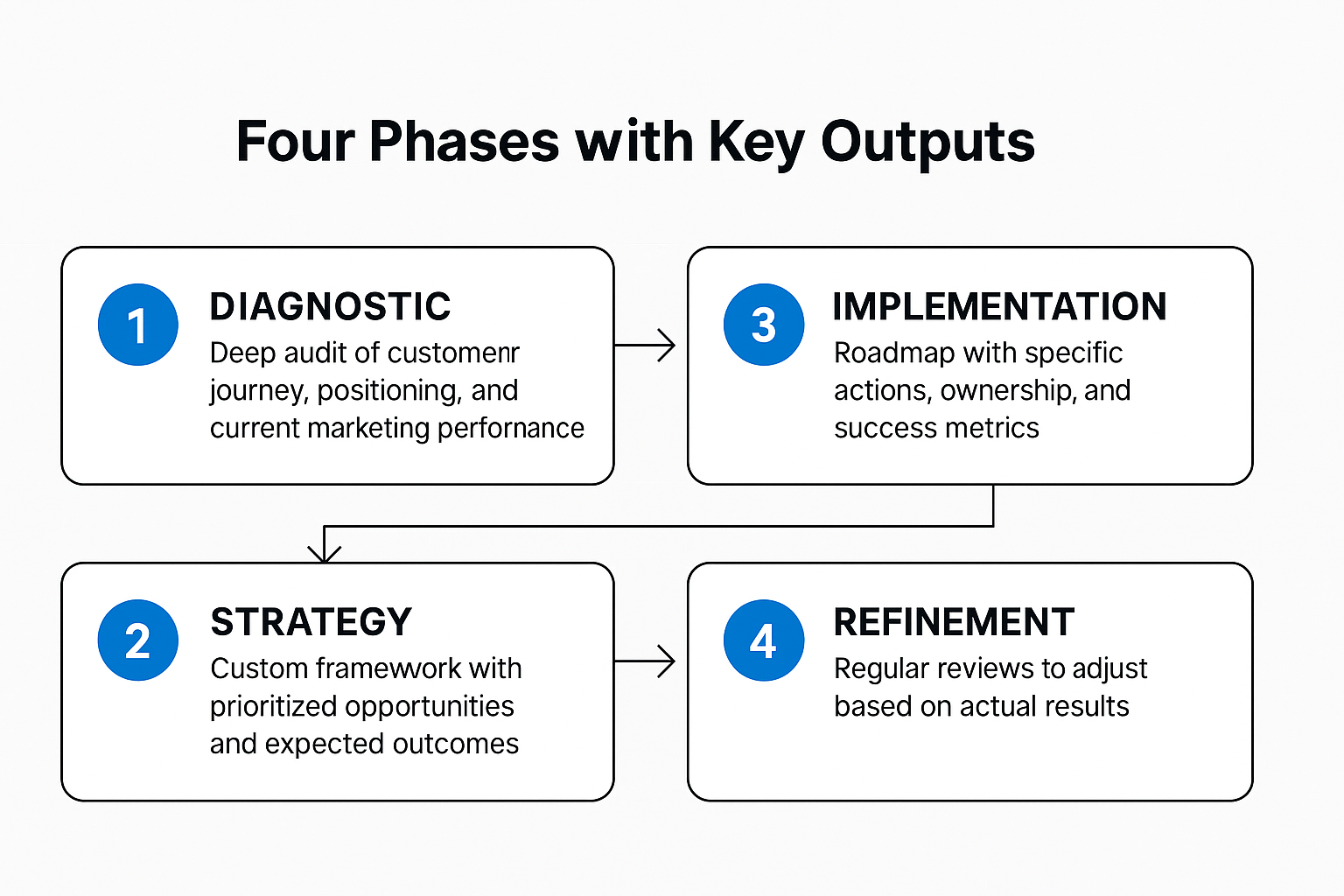
Clients receive a detailed strategy document, prioritised implementation roadmap, and ongoing access to refine tactics based on real-world performance data.
Here's what working together looks like:
| Phase | What You Get | Timeline |
|---|---|---|
| Diagnostic | Deep audit of customer journey, positioning, and current marketing performance | Weeks 1-2 |
| Strategy | Custom framework with prioritised opportunities and expected outcomes | Weeks 3-4 |
| Implementation | Action plan with clear owners, deadlines, and metrics for success | Week 5 |
| Refinement | Regular reviews to adjust based on actual results | Ongoing |
Beyond documents, you'll gain clarity on exactly which marketing initiatives to pursue, which to abandon, and how to measure success using revenue-focused metrics rather than engagement numbers.
You'll know:
- Which channel to prioritise (and which to stop wasting money on)
- What content to create that actually moves buyers forward
- How to align your sales and marketing teams around shared goals
- What metrics matter for your specific business model
No fluff. No vanity metrics. Just clear direction that leads to measurable, revenue-focused business outcomes.
The three pillars that separate my approach from traditional consulting
The three pillars that separate my approach are systems thinking over tactics, brutal honesty about what won't work, and accountability tied to business outcomes rather than campaign activity.
Pillar 1: Systems thinking over tactics
Most consultants recommend tactics. I design systems.
A tactic is "start a LinkedIn newsletter." A system is "create a content engine that qualifies leads before they reach sales." The first might get you followers. The second gets you customers.
Pillar 2: Brutal honesty
I'll tell you when your idea won't work. I'll challenge your assumptions. I'll push back when you're chasing shiny objects instead of fixing foundations.
You're not paying me to agree with you. You're paying me to help you grow. Sometimes that means having uncomfortable conversations about what needs to change.
Pillar 3: Outcome accountability
Traditional consultants measure success by deliverables completed. I measure success by business outcomes achieved.
Did leads increase? Did sales cycles shorten? Did customer acquisition costs drop?
These pillars mean that every recommendation is grounded in your specific business model, competitive reality, and resource constraints—not theoretical best practices pulled from a template.
But even the best methodology doesn't work for everyone. So who's the right fit for this kind of consulting?
Who this approach works best for (and who should look elsewhere)
This approach works best for mid-market companies and B2B businesses ready to move beyond experimental marketing toward strategic, scalable growth, particularly SaaS teams with £4M+ ($5M+) revenue, professional services firms, and industrial services companies.
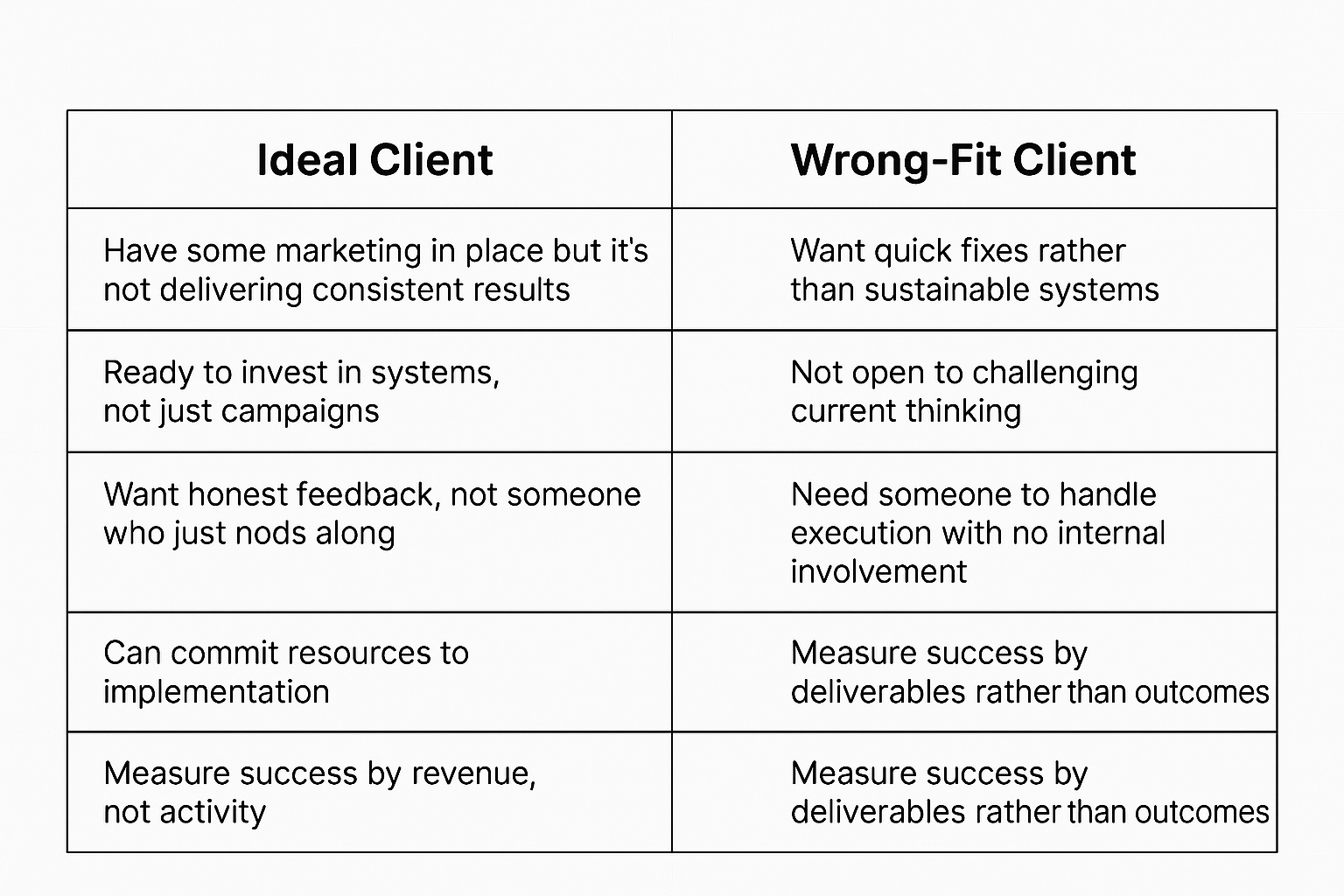
You're a good fit if:
- You have some marketing in place but it's not delivering consistent results
- You're ready to invest in systems, not just campaigns
- You want honest feedback, not someone who just nods along
- You can commit resources to implementation
- You measure success by revenue, not activity
If you're looking for someone to simply execute your existing plan or need a full-service agency to handle day-to-day tasks, a traditional marketing agency or fractional CMO may be a better fit.
This approach isn't right for you if:
- You want quick fixes rather than sustainable systems
- You're not open to challenging your current thinking
- You need someone to handle all execution with no internal involvement
- You measure success by deliverables rather than outcomes
How to evaluate if a consultant's approach is genuinely different
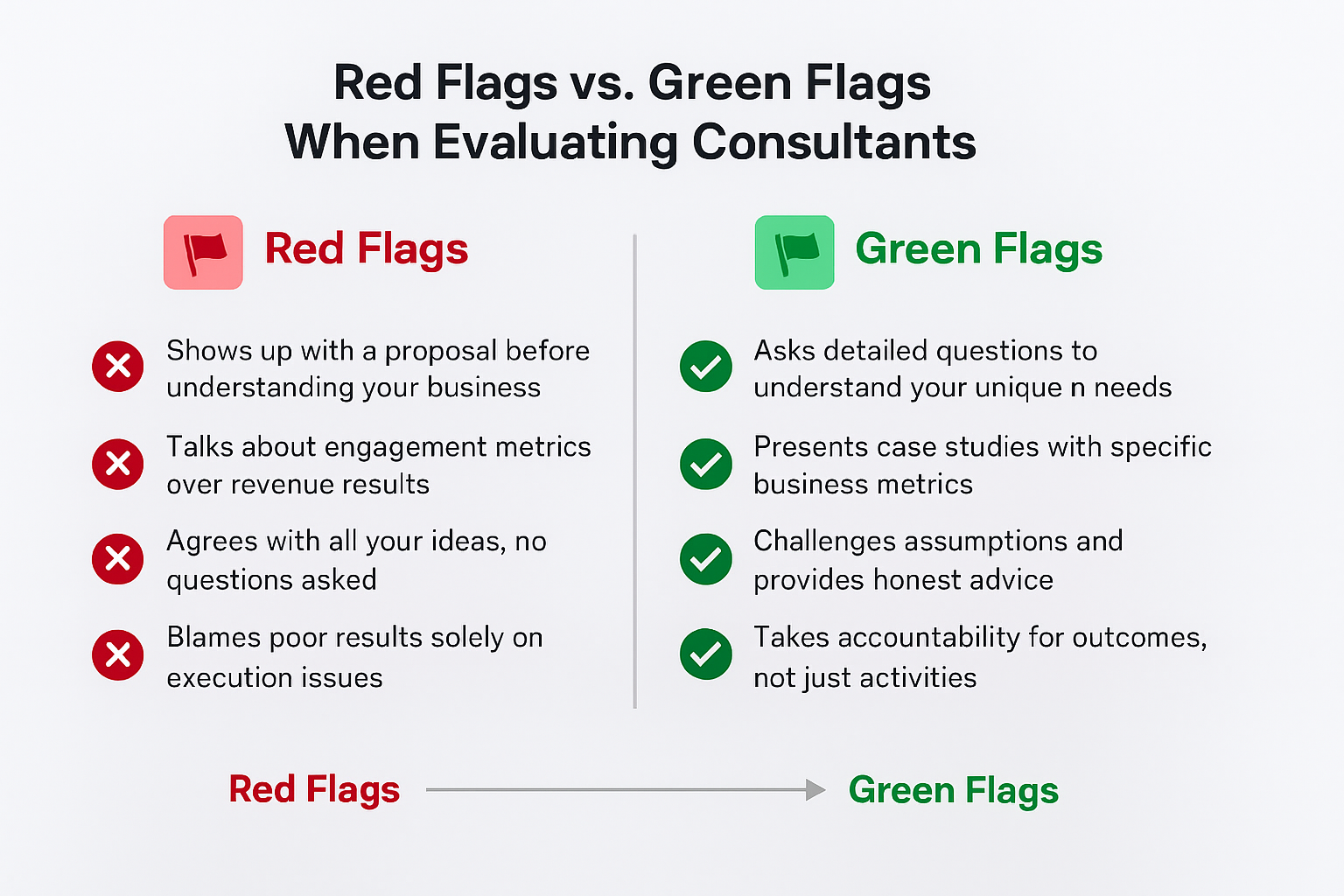
To evaluate if a consultant's approach is genuinely different, ask for their diagnostic process, request case studies with specific metrics, and assess whether they challenge your assumptions or simply agree with your ideas.
Ask these questions in your first conversation:
-
"What's your diagnostic process before making recommendations?": A good consultant audits before advising.
-
"Can you share case studies with specific business metrics?": Look for revenue impact, not engagement metrics.
-
"Tell me about a time you advised a client not to pursue something they wanted to do.": This reveals whether they'll challenge you or just take your money.
-
"How do you measure success?": If they talk about deliverables rather than outcomes, walk away.
-
"What happens if your recommendations don't work?": Different consultants take accountability. Traditional ones point to execution issues.
A truly differentiated consultant will spend more time asking questions and identifying problems than pitching solutions in the first conversation.
If someone shows up with a proposal before understanding your business, they're selling a product, not consulting.
And here's your final litmus test: If a consultant can't clearly explain their diagnostic approach in 60 seconds or less, should you trust them with your budget?
Conclusion
Most marketing consultants offer the same template-based advice dressed up in different packaging. You've now seen what genuinely different consulting looks like, and how to spot it.
Remember: different isn't just about being contrarian. It's about matching strategy to your specific business reality rather than recycling generic best practices.
The right consulting approach starts with understanding your customer journey, your market position, and your growth constraints. Then it builds custom frameworks that connect marketing activity directly to revenue outcomes.
As someone who's guided dozens of companies through this transformation, my job isn't just to advise, it's to create a roadmap that drives real business outcomes.
You don't need more templates: you need a roadmap that works for your business reality.
If you're ready to move beyond cookie-cutter strategies and build marketing systems that deliver measurable growth, the next step is simple.
If you're ready to discuss how this approach could work for your business, let's have a conversation about where you are now and where you want to be.

Topics: